The video cleverly rebrands token dilution as a strategic growth engine to transform supply-side fear into speculative optimism. It offers a sophisticated narrative that assumes developer incentives will automatically translate into enough utility to offset the inherent sell pressure.
Installieren Sie unsere Erweiterung an, um sofort in jedem Video zu suchen
Hedera: Why 8% supply = 700% GAINSHinzugefügt:
While the retail crowd stares in horror at billions of tokens hitting the market, they are missing the single most important wealth transfer in Hedera's history. A wave of panic is sweeping through the HBAR community as 4 billion tokens are scheduled for distribution this quarter.
>> [snorts] >> Now, for the uneducated trader, this just looks like a death sentence, a massive event designed to crush the price and dilute your holdings. But, the reality is that we are witnessing a calculated psychological trap designed to shake out weak hands before the next leg up. This data reveals that Hedera has already reached 86% terminal dilution. The upcoming release is a minor 8% shift in a supply that is already mostly circulating. And when you realize the heavy lifting of inflation is finished, the fear of this distribution evaporates. Understanding the difference between a dump and a strategic distribution is what separates the exit liquidity from the institutional winners. Most people think that this new supply is destined for the open market to be sold off by the founders, but they fail to account for the hard mathematical ceiling that governs this network. This isn't an infinite money printer. It is a closed system moving assets from a stagnant treasury into an active building ecosystem. Hedera's total supply is fixed at 50 billion HBAR, a hard cap that provides the fundamental scarcity required for a global trust layer while ensuring predictable network fees. Now, by looking at the current sentiment indicators, we can see exactly how the market is misinterpreting this expansion. The noise is loud, but the ledger is quiet. You see, retail traders are focused on the number of tokens, while institutions are focused on the number of developers that those tokens are about to fund. The extreme fear shown here historically marks the exact moment the institutional players realize that their core accumulation. The retail sells the rumor of the supply, while smart money buys the reality of the network expansion. Now, this disconnect is where your profit margin lives. You see, you've been told that more supply equals lower prices, but history tells a much more profitable story. And if you want to survive the coming months, then you need to stop reacting to the headlines and start reading the velocity of the network. To understand where we are going, we have to look at the math that turned the 2024 skeptics into millionaires. To understand where we are going, we have to look at the math that turned the 2024 skeptics into millionaires. History, it doesn't repeat, but it often rhymes. And in late 2024, the headlines were identical to what you see today. Massive supply influx imminent. Retail traders panicked, selling their bags at the bottom, convinced that liquidity would dilute HBAR into oblivion. What they failed to realize was that these assets weren't being dumped on an exchange.
They were being developed on, at least, as high-octane fuel for the network growth. This chart, it highlights the correlation between the 2024 liquidity injections and the subsequent 700% price discovery. [music] The initial dip was a bear trap. Once developer capital generated on-chain volume, the price exploded, proving that strategic distribution is a catalyst for massive growth, not a crash. So, when the foundation releases tokens to builders, they aren't seeking a quick exit. They are building the infrastructure that makes HBAR a necessity for global enterprise. And in 2024, those grants fueled the real-world asset bridges [music] that we rely on now. The protocol's efficiency allowed this capital to circulate faster than the market could sell, creating a massive supply shock that caught the bears off guard. The gossip about gossip protocol ensures that the network remains mathematically secure even as the ecosystem scales to handle the world's most critical data with asynchronous finality. You see, this model, it incentivizes building over speculation. And while other networks clog down growth, Hedera thrives because its architecture is designed for high-velocity transaction environments. Now, during the 2024 cycle, the number of developers hit a tipping point. Now, these builders didn't sell their grants. They used them for fees and network security, effectively locking that value back into the ecosystem. This visualization, it tracks the surge in active developer repositories alongside treasury disbursements. It proves that these tokens act as an investment in human capital. As the builder count rises, the fundamental work value grows, basically easily absorbing the impact of the new circulating supply. The 2024 cycle is not a warning. It is a blueprint for the current rally. The same mechanics are in play today, but with more institutional weight behind them than we saw 2 years ago. The supply, it is increasing to meet a massive demand that retail hasn't even noticed yet. With all of that said, it does raise a question. Do you believe institutional foundations are more likely to dump on the market or fund the very developers who drive your tokens value? Let me know your thoughts in the comments below. When tokens move from a stagnant treasury into the hands of a Fortune 500 builder, the network doesn't get diluted. It gets fueled. Now, this is the fundamental misunderstanding that keeps retail traders poor. A token sitting in a foundation wallet has zero economic impact. But, when that token, or that same token, is placed into a revenue-generating corporation or corporate application, it actually becomes an engine for burning native supply. Now, for those who want to master these technical analysis and risk management behind these institutional shifts, the cheeky school.com offers a complete curriculum on crypto safety and portfolio management with a 50% off discount code that's available in the description below. This layout illustrates how every transaction on the Hedera Token Service and Consensus Service converts a tiny fraction of HBAR into a permanent network fee. By moving tokens to developers who build high-volume applications, the foundation is effectively increasing the burn rate of the entire network, ensuring that as usage grows, the relative value of your remaining tokens increases. This is the institutional playbook. They aren't looking for, at least, at the sticker price of the coin. They are actually looking at the cash flow of the network.
Every grant given to a developer is a seed planted for future transaction volume. The goal isn't to increase the number of tokens in circulation just for the sake of it. It is to create a high-velocity environment where HBAR is constantly being used and recycled. The Hedera Council has committed over $100 in HBAR towards ecosystem grants, ensuring that the next generation of enterprise-grade applications has the resources to scale globally. One of the biggest drivers of this volume is the massive industrial adoption that we are seeing with real-world assets. The sheer number of transactions occurring right now is staggering, and it's all powered by the very supply that retail traders are currently fleeing. See, this isn't speculative trading. It is the plumbing of the new digital economy. This visualization of the atma.io workload shows a staggering 71 billion cumulative transactions processed on chain. The meaning here is rather clear. Real-world utility is the primary driver of demand.
This proves that even a massive injection of tokens is easily absorbed when the underlying network demand is driven by global supply chains and industrial data. The math of wealth is simple. Demand-driven by utility will always outpace supply driven by distribution. And when you look at the transaction fees generated by these billions of events, you realize that the foundation is essentially funding its own deflationary engine. The opportunity to front-run this developer app capital, it is closing rather fast. And the biggest players in the world are already positioning themselves. Even a world-class system has its breaking points, and ignoring these risks is how most retail traders lose everything. You see, we can't talk about the upside without also looking at the institutional war. You see, critics, they argue that Hedera is too centralized, pointing [music] to the governing council as a walled garden for the elite. There is also a glaring dependency on a single entity, atma.io, which accounts for the vast majority of the token or network traffic. Now, if one client leaves, the narrative of massive institutional and transactional volume could crumble. It's important to remember that all investing, it carries significant risk, and you are responsible for your own financial decisions, because I am not a financial advisor. Now, one way to manage this risk is through a redundancy strategy, using multiple KYC'd accounts like Binance, Coinbase, Bitget, Blofin, Kraken, and many others to ensure that you always have access to your liquidity. I'll put a list together of the exchanges I'm currently using in the pinned comment down below. This chart displays the concentration of network traffic. While billions of transactions are processed, [music] a single use case dominates the ledger.
Now, this reveals a vulnerability. The network currently lacks the broad-based retail diversity [music] found on other chains, making it reliant on a few key corporate partners. Now, this concentration is exactly why the skeptics doubt the network's long-term decentralization. If the governing council remains an exclusive [music] club of 39 giants, can it ever truly be the people's ledger? Well, the corporate council model is under constant fire from those who believe that crypto should be permissionless [music] from day one. A ledger controlled by a council of corporations is simply a database with extra steps. True decentralization requires a level of retail participation that Hedera has yet to prove. You see, this lack of retail participation is visible when you look at the raw user numbers. When the tech is superior in many ways, the adoption hasn't translated to the same retail frenzy seen on competitors. Now, this creates a liquidity gap that can lead to stagnant prices [music] even when the tech is performing flawlessly. This comparison shows the reality of the retail gap. While Solana boasts over 2 million daily active users, Hedera sits at a fraction of that, around 4,700.
The meaning here is vital. Hedera is an enterprise powerhouse that hasn't yet captured the retail imagination, leaving a massive opening for those who believe the flip is coming. If this retail gap doesn't close, the network risks becoming the back-end utility that never really sees the explosive valuation of its [music] peers. But, even in the face of these risks, the landscape shifted dramatically in early 2026. [music] The regulatory shadows have vanished, and the biggest players in the world are now legally cleared to buy exactly what you're afraid of holding. The regulatory shadows have vanished, and the biggest players in the world are now legally cleared to buy exactly what you're afraid of holding. Now, the March 17th, 2026 joint ruling by the SEC and CFTC changed the landscape forever. By officially classifying HBAR as a digital commodity, the authorities removed the single greatest barrier to institutional entry. While retail traders were paralyzed by supply fears, the canary HBAR ETF began a silent aggressive accumulation of the circulating tokens. And for real-time alerts on these massive ETF inflows and how they impact the market, you should join our free Discord through the link that's in the description. This visual represents the exchange outflows. It shows over 530 million HBAR being moved into the canary ETF custody. The meaning here is profound. The very liquidity injection that you fear is being vacuumed up by the institutional giants before it can even hit the open market. This is a massive supply sink that [music] creates a definitive floor for the price action.
Now, this legal certainty is the ultimate catalyst. For years, the threat of being labeled an unregistered security suppressed the valuation of the network. Well, that era, it is now dead, and the classifications provide the green light for pension funds and sovereign wealth funds and even global banks to treat HBAR with the same legitimacy as Bitcoin and physical gold.
2026 digital commodity taxonomy officially categorized HBAR as a utility-driven commodity, providing the definitive legal framework required for global banking integration and institutional asset management. So, we are witnessing a fundamental shift in ownership. In previous cycles, we saw legacy entities like Grayscale creating selling pressure, but the new regime of ETFs is focused on one thing, permanent accumulation. See, the ETF gap is closing, and it's doing so at an expense of the fearful retail seller. By comparing the 2024 Grayscale outflows to the current canary ETF inflows, we see a complete reversal in institutional behavior. Now, this indicates that the market has transitioned from a phase of uncertainty and liquidation to one of aggressive long-term accumulation under a hospitable legal framework. Now, the wall of money is no longer a theory. It is a mathematical reality visible on the ledger. The supply is being concentrated into the hands of the most powerful financial entities on the planet. The opportunity to front-run the developer capital is closing. The only question left is the if you are be the one providing the liquidity or the one that is owning it. Now, with all of that said, another question does pop up. With HBAR officially being classified as a commodity, which major bank do you think will be next to join the governing council? Let me know your thoughts in the comments below. The window to front-run the massive wave of developer capital is closing fast, and the choice that you make now determines your position for the rest of the decade. The we are witnessing a historic crossroads.
Right, the transition to the open-source Hedera Hashgraph initiative has effectively stripped away the perception of proprietary code that once held this network back from global adoption. See, by donating the core codebase to the Linux Foundation, Hedera has invited the world to build on its foundations.
[music] And while the noise of the Q2 distribution keeps the masses distracted, the actual production output of this network is accelerating at a pace that dwarfs its competitors. Now, this data reveals that with 152 core developers, Hedera is now the second most actively developed project globally, trailing only MetaMask. You see, this meaning is vital. The industry's best engineers are building on this technology, while retail traders are being encouraged to abandon it. Now, this engineering dominance is evident in the version 0.73.0 mainnet upgrade that went live on April 16th, 2026. You see, this update it integrated simple fees and threshold [music] signatures, making the network faster and more predictable for enterprise workloads. And we are moving towards a future where every industrial item is tracked immutably. The creation of a verifiable digital product passport via the consensus service proves this architecture can handle extreme, sustained enterprise workloads without fracturing under the pressure of global demand. Now, the technical foundation is finished, and the regulatory path is officially clear. The only thing missing is the market's realization of what has been built. Now, we are currently seeing HBAR trading at 9 cents, struggling against a resistance barrier at 10 cents, [music] while technical indicators suggest a coiled spring. Now, the relative strength index currently sits at a neutral 44, meaning the asset is neither overextended nor exhausted.
Combined with the 10-cent resistance target, this indicates a major price movement is likely as the newly distributed developer capital activates.
Now, utilizing this temporary price suppression to finalize your core portfolio accumulation is probably the only logical move before the next phase of enterprise volume arrives.
Now, do not be the one providing the liquidity at the top. Be the one who owned it through the accumulation phase.
Now, to see how this institutional pivot fits into the broader macroeconomic shift, make sure to click the video that's on the screen right now, which the algorithm has recommended specifically for you.
Ähnliche Videos

Are our DeFi tools becoming too easy to exploit?
saidotfun
228 views•2026-05-30

Solana Unchained ($UCHN) Explained: Solana’s Next Big Utility Project?
CryptoVlogOfficial
339 views•2026-05-30

⚠️ALGO Has a Very Bright Future! ✅ One #Crypto Everyone Should Own!
MetaShackle
184 views•2026-05-30

BingX EventX: Trade Sports, Crypto & Global Events With One Click
AidenCryptox
311 views•2026-05-31
XRP IS GOING TO VANISH! A SUPPLY SHOCK IS INEVITABLE! (THIS IS THE PROOF!)
NCash
2K views•2026-05-31

AI Predicts What XRP Looks Like If Ripple Gets A Fed Master Account
CryptoBlazon
422 views•2026-05-30

Max hit $120,000!!!!
ArajoRarities
168 views•2026-05-31
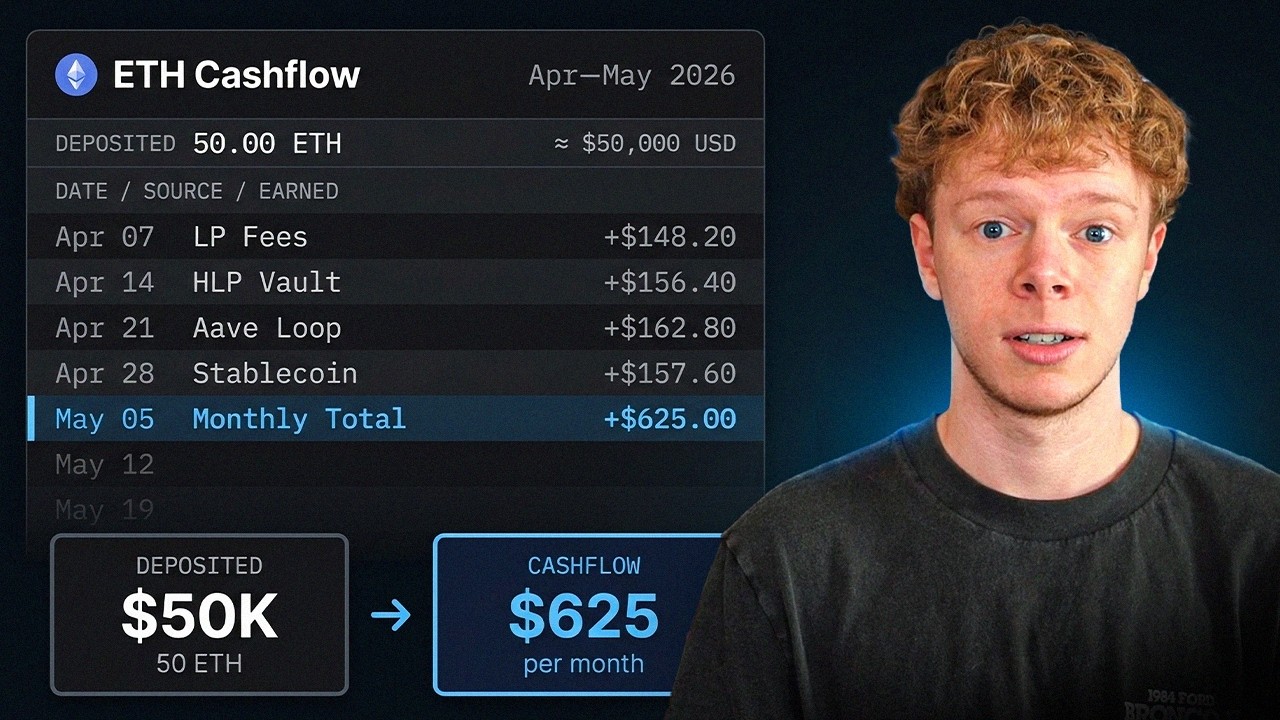
How I Turned $50,000 of ETH Into $625 / Month of Cashflow (DeFi Passive Income)
jakeacall
528 views•2026-05-29


