House spiders are beneficial household inhabitants that naturally control pest populations by consuming common indoor insects like mosquitoes, flies, and cockroaches; they are not dangerous to humans and have evolved to live alongside us, serving as silent guardians that maintain natural balance in our homes.
Install our extension to search inside any video instantly.
Never Kill The Spider In Your Room... Here's Why
Added:There's something in the corner of your room right now. Maybe above your window.
Maybe behind your bookshelf. Maybe resting silently near the ceiling where you stopped noticing it weeks ago. A small creature, motionless, patient, watching the world from a place it deliberately chose. And almost every single time you see it, your first instinct is exactly the same. Grab a tissue, a shoe, a broom, kill it. But what if that instinct is one of the biggest misunderstandings humans have ever had with the natural world? What if the spider in your room is not a pest at all? What if it's one of the oldest protectors your home has ever known?
Because science is beginning to reveal something deeply fascinating about the spiders living inside human homes. And once you understand what they are actually doing there, you may never look at them the same way again. For most people, spiders trigger something ancient. fear, discomfort, a feeling that something about them is wrong.
Their long legs, their silence, the way they remain perfectly still for hours, as if they're waiting for something. But here's the truth. Of the more than 45,000 known spider species on Earth, the overwhelming majority have absolutely no interest in humans. They do not hunt us. They do not chase us.
They are not hiding under your bed, waiting for you to fall asleep. In fact, most spiders are terrified of creatures as large as we are. The fear we feel toward them is often rooted more in instinct and imagination than reality.
And yet, despite our fear, spiders continue to quietly live alongside us.
Not by accident, but by choice. You see, spiders are extraordinarily sensitive creatures. They can detect vibrations in the air, changes in humidity, subtle temperature shifts, microscopic movements that human senses would never notice. To a spider, your home is not just a building. It is a living map of invisible activity. Every corner carries information. Every vibration tells a story. And when a spider chooses a specific location in your room, it is making a calculated decision. It has found something they're worth staying for. And that something should concern you far more than the spider itself.
Because spiders are not interested in humans. They are interested in what lies around humans. Mosquitoes, flies, gnats, fleas, cockroach, nymphs, clothes moths, tiny insects hidden inside dark corners and quiet spaces. The very creatures that contaminate food, damage fabric, spread disease, and bite you while you sleep. A single common house spider can consume hundreds of insects every year silently, efficiently, without chemicals, without noise, without asking for anything in return. The spider in your room is running a pest control operation inside your home. And most people spend their lives trying to destroy it. But this is where things become even more fascinating.
Researchers studying common household spiders discovered something unexpected.
Spiders remember not like humans remember conversations or birthdays, but in a way that is astonishingly precise.
They build mental maps of their environment. They learn the movement patterns of prey. They adjust the architecture of their webs based on previous success. A spider that has remained in the same corner for several weeks has already studied that space. It understands the airflow, the vibrations, the timing of insect movement near windows, lights, and hidden cracks. Its web is not random. It is engineered.
Every strand is placed for a reason.
Which means when you destroy a spider and remove its web, you are not simply removing an animal. You are erasing weeks of accumulated environmental knowledge. A living detection system that had quietly adapted itself to your home. And then there's something even stranger. Certain species of harmless house spiders have been observed hunting other spiders, including dangerous ones.
In parts of North America, seller spiders, often called daddy longlegs, have been documented attacking and killing brown recluse spiders. One of the few spider species that can pose genuine medical risks to humans. Think about that for a moment. The spider you fear may actually be protecting your home from spiders that are truly dangerous. Nature often works through balance, quiet, invisible balance. And most of the time, humans interrupt that balance without even realizing it. But humanity's relationship with spiders was not always based on fear. For thousands of years, many cultures saw spiders very differently. In ancient Egypt, spiders were connected to Ne, the goddess associated with weaving fate and destiny. In Native American traditions, Spiderwoman was considered a sacred figure, a creator, a teacher, a keeper of wisdom. In West African folklore, a Nazi the spider became the symbol of intelligence, storytelling, and hidden knowledge. And in parts of Japan, seeing a spider in the morning was considered a sign of good fortune. People would intentionally leave it unharmed. These beliefs were not simply random superstitions. They came from generations of observation. People noticed that homes with spiders often had fewer insects, fewer pests, fewer problems. Long before modern science existed, humans were already recognizing the quiet role spiders played inside human environments. And now science is finally beginning to explain why.
Consider mosquitoes alone. Mosquitoes are responsible for more human deaths every year than any other animal on Earth. Malaria, deni fever, zika virus, Westnile virus, millions of infections, hundreds of thousands of deaths. And yet, a simple spider web placed near the right corner of a room can intercept mosquitoes before they ever reach you.
The web you destroyed last week may have prevented multiple bites that same night. That is an exaggeration. That's biology. But perhaps the most surprising discovery about how spiders is this.
Many of them are no longer truly wild animals. For years, scientists assumed spiders simply wandered indoors to escape bad weather or cold temperatures.
But modern research suggests something more complicated. Somehow spiders have evolved specifically to live alongside humans. They are adapted to warm indoor temperatures. Artificial light cycles.
The specific insect populations created by human homes. In other words, your house is not just a shelter to them. It is their natural habitat. Over thousands of years, certain spider species gradually built their lives around ours, quietly evolving in the background of human civilization, living in our ceilings, our basement, our atticts, watching generations of humans come and go. And despite how often we kill them, they continue returning. There's another detail most people never notice. Spiders are extremely sensitive to environmental change. A sudden increase in spiders inside a specific area of your home can sometimes indicate a larger hidden issue. Moisture problems, insect infestations, cracks near windows, shifts in temperature or air flow. Pest researchers have noted that spiders often move toward areas where insect activity is increasing. Sometimes before humans notice anything unusual at all, the spider is not causing the problem.
The spider is responding to the problem.
It is following signals you cannot yet detect. In a strange way, spiders act almost like biological warning systems built into the ecosystem of your home.
And maybe that's why they unsettle us so much because spiders force us to confront something uncomfortable. The reality that our homes are not isolated from nature. No matter how modern our lives become, nature still exists inside our walls. tiny ecosystems, invisible movements, silent interactions happening every night while we sleep. The spider simply makes that hidden world visible.
And perhaps that's why so many people instinctively destroy them. Not because spiders are dangerous, but because they remind us that we are never fully separate from the natural world. So the next time you see a spider sitting quietly in the corner of your room, pause for a moment. Look at it carefully. That small creature has mapped your walls. It has learned the rhythms of your home. It is hunting things you cannot see. It has likely been protecting your space for weeks without you ever noticing. And it asks for almost nothing in return. No sound, no attention, no recognition, just a quiet corner to continue doing what it has done beside humans for thousands of years. Maybe the spider in your room is not an invader. Maybe it is one of the oldest allies your home has ever had.
And maybe the real mystery was never why spiders live with humans, but why humans became so afraid of the creatures quietly helping them all along. So next time you reach for a shoe, you may want to stop and think first. Because the spider in your corner might not be your enemy at all. It might be your silent guardian. If you've ever noticed a spider staying in the same place for weeks or appearing in strange moments or quietly watching from the corner of a room, tell me about it in the comments below.
Related Videos
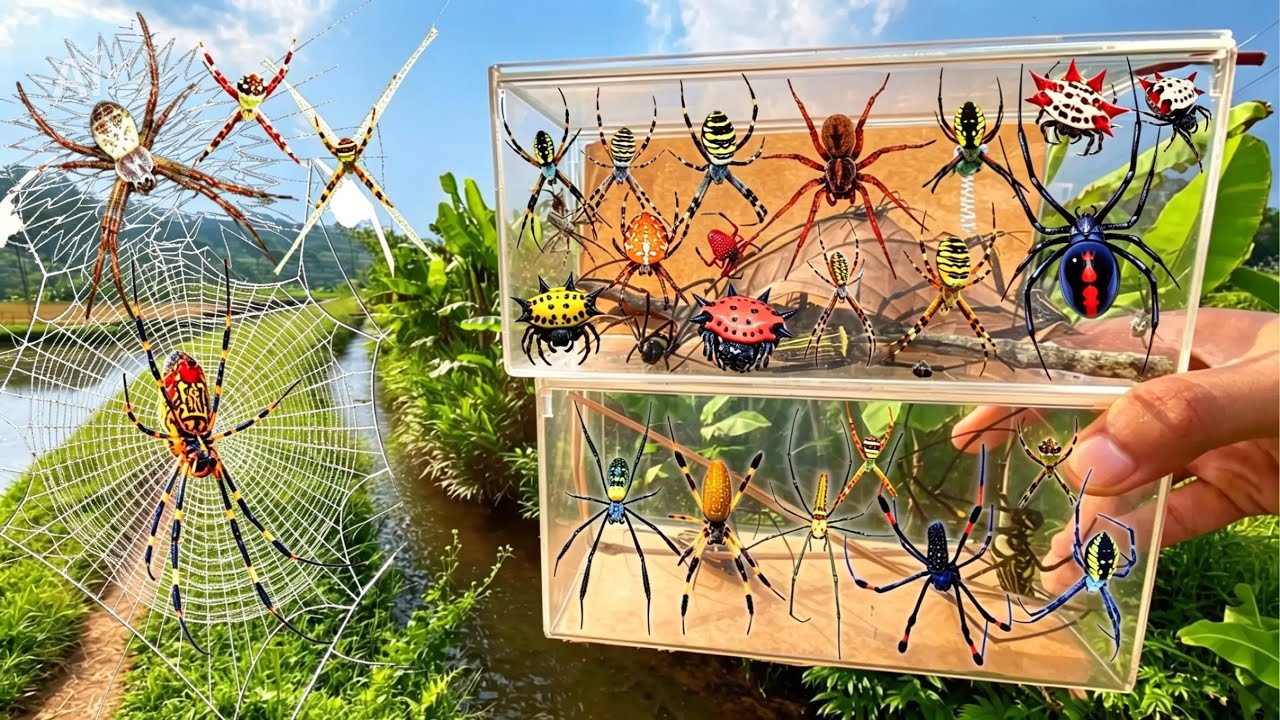
I Found 7 Golden Orb Spider In The River !! Spiny Spider, Weaver orb Spider
insect_geography
1K views•2026-06-16

Your nose is more than a breathing tube...
HealthInSeconds_1
2K views•2026-06-16

Why do marmots always look so dramatic
CodeFauna
3K views•2026-06-16

Your Axolotl Is a Salamander That Never Grew Up
dailywildreports
661 views•2026-06-17

King Vulture: The Colorful King of the Rainforest Skies!
NatureChirps-05
185 views•2026-06-18

The Biggest Lies In The Animal Kingdom!
InfiniteFactssofficial
1144K views•2026-06-15

Humpback Whale, Whale Shark, Great White Shark and Mako Shark Giant Ocean Adventure for Kids
EvieWildTales
5K views•2026-06-18

Thunder Mountain in Juneau, Alaska
Raven-Orix
1K views•2026-06-14



