To find the area of an unbounded region between a function and the x-axis, set up an improper integral from the starting point to infinity, then evaluate it by taking the limit as the upper bound approaches infinity. For the function 1/x * ln(x²), use u-substitution with u = ln(x²), which simplifies to u = 2ln(x), and the integral evaluates to 1/ln(3) as the limit approaches infinity.
Install our extension to search inside any video instantly.
AP Calc BC Multiple Choice: Improper Integral FAST ⚡️#exampreparation #maths #calculusbc #calculusAdded:
If R is unbounded region between the graph of 1/x natural log of x squared and the x-axis for x is greater than 3, what then the area of R is blank?
The key there is x is greater than 3. If you're trying to find the area of the function, let's just draw it. Let's let this be y. All you do is integrate from where you want to start to and I guess in this case infinity. What's going on there? How do you find the area? You take the integral from 3 to infinity of the top equation, which is this, minus the bottom equation, which is x-axis, so 0, which is 1/x natural log of x squared dx.
It's a improper integral. Remember the way we do that is we take the limit of that instead. We're going to take the limit as b goes to infinity from 3 to b of 1/x natural log of x squared dx. This looks like the u sub.
We'll let that be u.
Take derivative of sine, du dx equals 1/x.
Solve for dx. Multiply both sides by dx.
And then you want to get dx by itself, multiply both sides by that. You get x du equals dx. Now we're going to replace this with this.
I get integral of 3 to b, the limit as b goes to infinity.
Wait, don't the x's cancel out? Take the limit as b approaches infinity from 3 to b of Move that up, negative u du.
Notice I didn't change my limits because we're doing like the limit at infinity thing. I'm just going to integrate it, plug my u back in, and then go from there. The integral of this is add one to the power of our new power.
You get u to -1 over -1 from 3 to b.
Plug my u back in cuz I didn't change my limit to natural log. Ooh, natural log of x to the -1 over -1. Actually, make that nicer. Looks -1 over natural log of x. We'll leave u to the bottom, but the negative could go either way. It's fine top. Make it easier. I get this from 3 to b.
Don't forget the limit as b goes to infinity. So we're plugging in top bottom. This is going to be negative one natural log of B minus negative one over natural log of three.
So, don't forget it's this guy minus this guy plugging something into B.
Minus this guy plugging in three in.
And we're doing all this as the limit as B goes to infinity. If you substitute that in here, unlike last time, the natural log on the bottom, this just goes on to infinity. One over infinity, which just makes this zero.
And then this side, double negative makes it positive. I get one over natural log of three, which I believe is one of the choices. Yep. See.
Related Videos

A Brutal Radical Expression Made Easy! The Shortcut Changes Everything.
tamoshop
112 views•2026-06-02

V : jee main /advance class 11 mathematics : Binomial Theorem class-1 ( 29 may 2026 )
dcamclassesiitjeemainsadva9953
125 views•2026-05-29

Is This Pentomino Tileable?
3cycle
241 views•2026-05-30

This Sudoku Has Many Lines!!
CrackingTheCryptic
2K views•2026-05-29

Olympiad Mathematics | Indian Can You Solve This One?
PhilCoolMath
268 views•2026-06-02
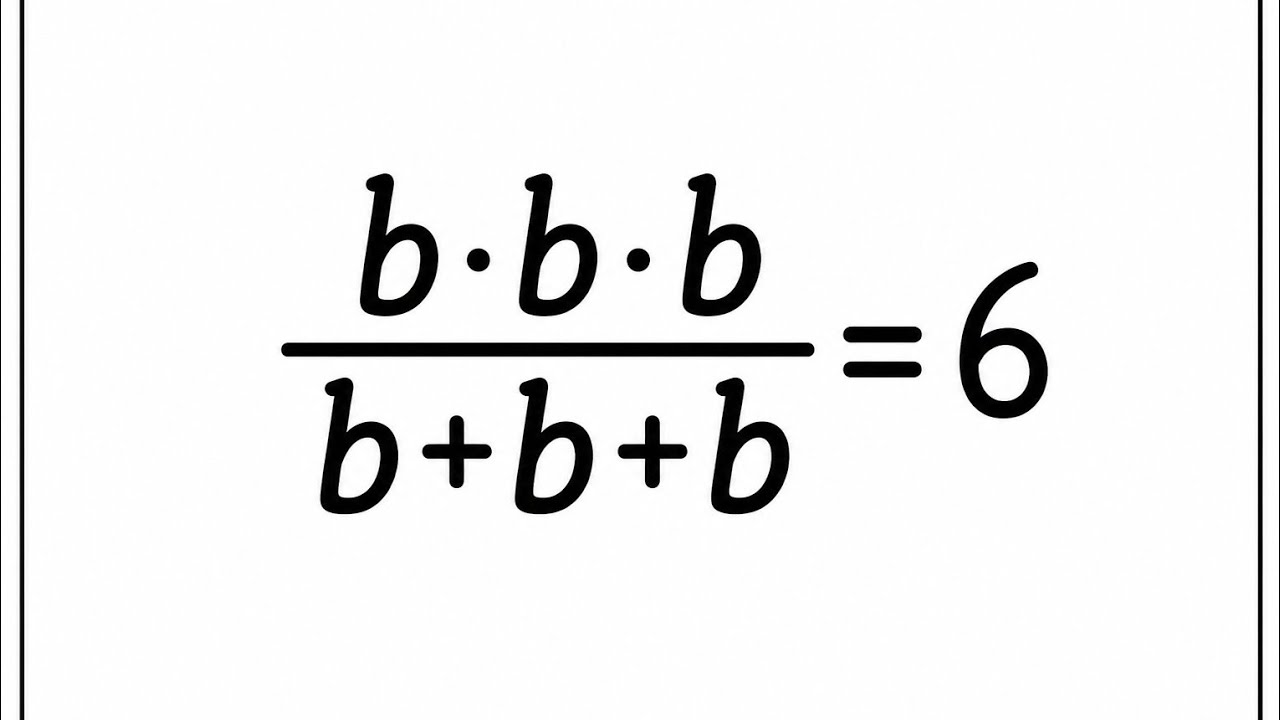
Olympiad Mathematics | Indian | Can You Solve This?
PhilCoolMath
669 views•2026-06-02

Can you get the Correct answer for this Math Quiz?
Fendora01
24K views•2026-05-29

NUMBERBLOCKS COUNT THE TOTAL SUM OF TEN NUMBERS | ADD SMALL TO BIGGEST NUMBER | hello george
hellogeorge2294
5K views•2026-05-28



