The space between galaxies is not truly empty but contains thin, ultra-diffuse plasma at temperatures of hundreds of thousands to over a million degrees, along with dark matter halos that provide the gravitational scaffolding for the cosmic web structure. This invisible matter, which constitutes about 85% of the universe's total mass, was discovered through the Bullet Cluster collision and gravitational lensing observations, revealing that the universe's true structure is a vast interconnected network of filaments and voids rather than isolated galaxies in an empty void.
Install our extension to search inside any video instantly.
The Space Between Galaxies Is Not Empty | Space Documentary 2026
Added:When you direct your gaze toward a clear moonless night sky, it triggers a deep sensory experience. Countless distant stellar fires pierce the dark overhead canopy, naturally drawing human attention toward their brilliant flickering signals. Uncountable numbers of thinkers across our history have stared upward, focusing their collective wonder on these radiant focal points.
Between every gleaming star lies a seemingly infinite expanse of black.
Intuition suggests this dark backdrop represents a state of utter nothingness.
Biology heavily influences this assumption as evolutionary survival historically depended on recognizing movement, shapes, and reflected light.
Survival instincts finely tune the human visual cortex to detect photons, hardwiring our neural pathways to equate illumination with physical presence.
Shadows and unlit regions naturally register in our minds as areas lacking substance. Consequently, observing the nocturnal heavens leads to a natural conclusion. The universe consists of isolated islands of matter floating within an endless empty ocean.
Direct observation easily reinforces this deeply held belief. Glancing into the quiet stretches between constellations provides no visual feedback. Photons travel freely across unimaginable distances without encountering any obstacles to scatter their path or diminish their energy.
Centuries of logical deduction rested upon this premise.
Philosophers and early naturalists universally agreed that if a specific region emitted no radiation, reflected no ambient glow, and cast no measurable silhouette, it must be devoid of material. Luminous objects held mass, generated heat, and commanded gravitational influence.
Everything else served merely as a blank stage, waiting for physical entities to eventually occupy it. Early civilizations meticulously documented the most prominent celestial beacons.
Ancient astronomers constructed elaborate mythological narratives around dense star clusters and tracked the predictable wandering paths of neighboring planets. Astrolabes and primitive armillery spheres provided mechanical models for predicting eclipses and celestial alignments.
Through all these ancient endeavors, mapping the heavens meant plotting the coordinates of glowing objects. Unlit regions remained unchallenged as the default state of nature. These vast stretches functioned simply as the necessary distance required to separate the burning spheres. Nobody bothered to catalog empty spaces because finding nothing in a vacuum seemed self-evident.
The scientific revolution transformed how humanity probed the cosmos.
Optic tubes fitted with precisely ground glass lenses granted early astronomers the unprecedented ability to magnify the distant heavens. Through these revolutionary instruments, blurred smudges of light resolved into dense clusters of stars. Thousands of faint new objects flooded into human awareness for the very first time. Every subsequent refinement in telescope design pushed our visual boundaries further outward. Yet, while the total senses of observable stars multiplied at an astonishing rate, the foundational paradigm remained intact. Discovering more glowing matter merely populated the cosmos with additional isolated light sources. Wide black gaps still separated every newly discovered cluster, entrenching the concept that emptiness dominated the vast majority of space.
The 20th century brought a golden age of astronomical engineering.
Large optical observatories constructed on high altitude mountain peaks began capturing ancient light that had journeyed for millions of years. In the thin cold atmosphere, scientists exposed sensitive photographic plates to the night sky. Through these painstaking efforts, researchers proved that many diffuse nebula were not merely local gas clouds residing within our neighborhood.
These distant spirals were independent galaxies. Swirling discs containing billions of suns drifted far beyond the farthest reaches of our Milky Way.
Charting this expanded cosmos became an ambitious scientific endeavor of the modern era. Astronomers launched observation campaigns intended to catalog every recognizable galactic structure within the observable universe. Researchers measured spectral red shifts, calculated standard candle distances, and plotted spatial coordinates with breathtaking precision. Vast encyclopedic cataloges compiled the positions, estimated masses, and chemical compositions of these distant cosmic islands.
Tracing the architecture of reality relied on following the breadcrumbs of starlight. Human intellect proved capable of measuring environments inaccessible to our physical bodies by relying on advanced mathematics and rigorous observation.
We reached out across millions of parexs to weigh remote suns and map their precise trajectories.
Exposing a single photographic plate often required hours of perfectly guided tracking to capture a sufficient number of photons. These tiny packets of electromagnetic energy traversed staggering voids, preserving a galaxy's physical state as it appeared eons in the past. When incoming light struck the chemical coating on the glass, it triggered a physical reaction, leaving a permanent record of a farway world. Laboratory technicians then analyzed these microscopic dark spots, translating physical smudges into concrete mathematical coordinates.
Massive ledgers soon filled with the location, luminosity, and spectral signature of hundreds of thousands of individual galaxies.
Assembling these expansive ledgers represented a major leap forward in human cognitive achievement. We successfully evolved from passive stargazers into active, precise ctographers of the cosmos. Our species mastered the ability to decipher alien chemical compositions by splitting their incoming light into detailed distinct wavelengths.
Analysis of the dark absorption bands hiding within these continuous spectra granted us the power to identify specific elements burning in atomic furnaces millions of light years away.
Every successful spectral measurement served to reinforce the prevailing cosmological model. Classical physics operated flawlessly when applied to these glowing bodies. Orbital velocities matched the predicted gravitational equations based entirely on the amount of visible mass present.
Decades of relentless observation ultimately culminated in a detailed comprehensive model of the universe.
Scientists successfully drafted an intricate cosmic atlas relying on how luminous structures distributed themselves across space.
This established framework rapidly gained acceptance as the definitive blueprint of reality known as the old map.
Within this theoretical architecture, physical matter clustered tightly into glowing hubs, creating spectacular pin wheels of gas and dust.
Expanding outward from these brilliant hubs lay immense silent territories lacking any physical substance. Radiant energy functioned as the primary proxy for physical mass.
An unquestioned correlation existed within the global scientific consensus.
A glowing region confirmed physical presence.
Conversely, areas lacking illumination were dismissed as vacant. Constructing this ambitious atlas required brilliant minds piecing together millions of scattered data points into one cohesive hole. Entire generations of astrophysicists dedicated their professional lives to refining galactic coordinates and improving distance measurements. Their collective output stands as a monumental triumph of human curiosity, perseverance, and analytical rigor.
We successfully deciphered the complex orbital mechanics of spiral galaxies [music] and accurately calculated the immense gravitational forces required to bind colossal stellar clusters together.
Despite these magnificent achievements, the foundational premise underlying all mathematical calculations relied heavily on a profound observational bias.
Researchers universally assumed their highly sensitive photographic plates and advanced optical sensors captured a complete inventory of all cosmic material.
Visual evidence dictated existential boundaries. If finely tuned instruments failed to detect a measurable electromagnetic signal coming from a specific coordinate, that region immediately received classification as a true vacuum. These boundaries shape the direction of astrophysics for nearly a century. Maps inherently dictate how civilizations perceive and interact with their surrounding territory. By deliberately charting only the luminous bodies, we inadvertently programmed ourselves to ignore the vast spaces stretching between them. Cosmic architecture appeared elegantly straightforward and logically sound. Enormous galaxies populated a massive three-dimensional grid separated by staggering, unbridgegable gulfs of pure emptiness.
Cosmologists calculated total universal mass by adding up the estimated weight of every glowing object recorded in the cataloges.
This straightforward arithmetic seemed mathematically unassalable and physically sound. Tallying up the stars essentially meant tallying up the entire universe. Humanity rightfully took pride in this beautifully organized blueprint.
Emerging from perceived celestial chaos, we forged a structured, scientifically rigorous comprehension of the natural world, we knew exactly where the galaxies lived, calculated how fast they moved away from one another, and understood what elemental forces fueled their brilliant cause.
We possessed a reliable, thoroughly tested inventory of the cosmos.
Everything fit perfectly within the established equations, and the universe made perfect intuitive sense to a species that evolved to rely almost exclusively on visible light. Beneath this elegant mathematical framework, however, lay a quietly expanding anomaly.
Placing trust in our optical senses had provided a comforting picture of reality. It delivered a comprehensible universe tailored to human perception.
Yet the cosmos operates under no obligation to conform to human sensory limitations.
Fundamental physical laws governing reality function independent of our biological capacity to perceive them. As our observational instruments grew more sensitive, subtle persistent discrepancies began to emerge right at the very boundaries of our pristine galactic maps.
The journey we're about to embark upon requires moving beyond the visible spectrum. Prepare to leave behind the familiar glow of the stars and step directly into the silent uncharted territories that make up the vast majority of our universe.
For countless generations, we gazed upward, entranced by the brilliant fires burning brightly in the dark.
Confident that we were seeing everything there was to see, we assumed the black ocean between stars was an absolute void. Physics eventually shattered this assumption not through the invention of larger optical lenses but through the rigorous discipline of theoretical mathematics applied directly to the dawn of time itself. Pushing our understanding past the limitations of biological eyesight required stepping backward to an era long before any stars ignited.
14 billion years ago, reality existed in a state of incomprehensible heat and density. Everything we now perceive, every atom shaping the current cosmos, occupied an unimaginably compressed volume, expanding violently outward, this primeval furnace cooled at an exact, measurable rate. Deep within that rapidly expanding plasma, fundamental particles collided with ferocious energy. Quarks bound together, forming the very first protons and neutrons.
Cosmologists refer to these familiar foundational building blocks as barriers. Understanding the behavior of these barriers during those initial minutes unlocked a profound secret regarding the total inventory of the cosmos.
As temperatures dropped systematically across the expanding volume, protons and neutrons began fusing together. They formed the nuclei of the earliest recognizable elements. Hydrogen emerged rapidly, soon followed by helium and faint traces of lithium. Researchers call this brief frantic period of atomic assembly primordial nucleioynthesis.
The process lasted merely a few minutes, yet it permanently stamped an elemental fingerprint across the universe.
Mathematical models detailing nuclear physics predict a specific outcome for this primordial forging process.
Generating the distribution of hydrogen and helium currently observed in the oldest, most undisturbed regions of space requires a precise quantity of starting materials.
Human intellect deciphered this ancient process with astonishing clarity.
Tracing the intricate pathways of subatomic collisions allowed scientists to calculate the specific density of ordinary matter present during those crucial first three minutes. One specific isotope provided the key to unlocking this monumental puzzle.
Dutarium consisting of one solitary proton bound securely to one neutron acts as a sensitive gauge for matter density.
Surviving the primordial furnace required perfectly balanced conditions.
Packing too many protons closely together would have caused every single dutyium nucleus to smash instantly into another, rapidly forging helium and leaving no trace behind. Spacing the protons too far apart would have prevented dutyium from ever forming.
Surveying ancient untouched gas clouds far across the cosmic horizon reveals a remarkably consistent survival rate for this fragile isotope.
By working backward from that surviving fraction, physicists pinpointed the exact amount of ordinary matter forged at the beginning of time. Deriving this number represents one of the triumphant achievements in the history of human thought. We essentially reverse engineered the mechanical origins of creation. The established laws of quantum mechanics and thermodynamics provided an unwavering theoretical mandate.
We knew how many barriers had to exist within the modern universe to satisfy the equations. Armed with this definitive master total, the global scientific community initiated a comprehensive audit of the physical world. Astronomers transitioned seamlessly from passive observers into rigorous cosmic accountants. They opened a massive ledger and began systematically tallying the cosmic assets.
Completing this colossal inventory required measuring the mass of every recognizable structure drifting through space. Researchers painstakingly calculated the luminous output of huge spiral and elliptical galaxies.
Converting brilliant starlight into estimated stellar mass. They cataloged immense sprawling clouds of glowing interstellar dust. Advanced orbital telescopes captured high energy X-rays radiating from superheated gas trapped securely within dense galactic clusters.
Radio telescopes scan the heavens for the faint steady emissions of cold atomic hydrogen drifting between star systems. Every photon and radio wave striking our detectors contributed another vital data point to the Grand Tally.
We meticulously accounted for glowing planetary nebula, roaring quazers, and smoldering stellar remnants. Decades of relentless observation ultimately produced a detailed account of the physical universe, documenting visible structures with breathtaking accuracy.
Comparing the strict theoretical mandate against this exhaustive observational census provoked an unprecedented rupture in our understanding of reality.
When cosmologists placed the predicted quantity of berons on one side of the ledger and the observed mass on the opposing page, the resulting discrepancy was staggering. The columns refused to balance. Tallying up every glowing star, every swirling nebula, and every pocket of radiating gas yielded a total that fell well short. Our prize cataloges captured barely half of the necessary material. A glaring deficit dominated the universal balance sheet. Consider a rigorous financial institution conducting a thorough audit of its vaults only to discover 50% of the expected currency is missing.
The foundational physics of the early universe demanded a specific deposit of matter. The astronomical ledgers recorded the cash on hand. Subtracting the highly visible material from the mandated total revealed an unaccounted absence so large it challenged the foundations of observational astronomy.
Trillions of tons of protons and neutrons vanished from the active record. Such a colossal shortfall could have easily shattered scientific confidence. Facing a discrepancy of this scale, lesser minds might have discarded the theoretical framework governing the early universe. Retreating back to the comforting certainty of visual evidence would have been easy. Instead, the astrophysics community demonstrated tenacity and intellectual courage.
They chose to trust the fundamental laws governing subatomic particles.
The rigorous mathematics describing primordial nucleioynthesis remained flawless, repeatedly verified by independent calculations and strict laboratory experiments. Therefore, the flaw did not reside within the theoretical origins of reality. The critical error lay within our methods of observation. Missing this immense volume of material forced a shift in astrophysical perspective. These unaccounted assets were not composed of exotic incomprehensible substances operating outside the bounds of known physics. The missing mass consisted of ordinary familiar barrians. We were searching desperately for the exact same protons and neutrons that construct human hands, fuel brilliant stellar cores, and form the rocky mantles of terrestrial worlds.
Half of the ordinary matter forged at the dawn of time existed somewhere within the present-day universe, silently defying our advanced attempts to locate it.
Confronting this discrepancy required acknowledging a severe limitation inherent to our technological evolution.
Searching purely for objects that emit, reflect, or absorb obvious electromagnetic radiation restricted our capacity to perceive reality accurately.
We had essentially mapped a vast complex topography by only recording the scattered bonfires burning across its surface. The magnificent cosmic atlas constructed over centuries of painstaking labor suddenly appeared woefully incomplete.
It represented merely a partial rendering of the physical world, detailing only the material eager to announce its [music] presence. Standing bravely at the edge of this realization, scientists understood that a vast portion of the universe remained deeply hidden right before their eyes.
Trillions of tons of ordinary matter drifted silently through reality without casting a single shadow or generating a measurable spark. Finding this missing material rapidly became an urgent, compelling mission.
Resolving the unbalanced ledger demanded entirely new techniques capable of detecting substance that generated no visible glow.
The scientific community enthusiastically prepared to search for an invisible quarry, armed solely with the unshakable conviction that the theoretical numbers told the truth.
Humanity willingly embarked upon a grand unprecedented detective story, striving to locate the remaining half of the ordinary universe.
Recognizing the severe deficit permanently elevated our relationship with the cosmos, we no longer accepted surface appearances as indisputable truth. Grasping the true physical scale of the world required us to look deeper, pushing boldly past the brilliant distractions scattered across the heavens.
The glaring mathematical discrepancy demanded a revolutionary approach to cosmic surveying. Deep within the seemingly silent spaces separating the luminous galaxies, an unimaginable wealth of ordinary substance waited patiently to be discovered. Realizing this fundamental truth anchored a bold new era of exploration. The numbers do not work. Resolving this glaring mathematical contradiction required astrophysicists to invert their standard observational methodology.
Rather than actively searching for glowing material, researchers realized they needed to look for what was blocking the light. If the unaccounted barrier stubbornly refused to shine, they must nonetheless interact physically with any radiant energy passing directly through them. Human ingenuity swiftly conceived a brilliant strategy relying on monumental cosmic backlights, illuminating the unimaginably vast.
Seemingly empty stretches separating distant galaxies demanded light sources possessing incomprehensible power. Deep within the earliest epix of the cosmos, super massive black holes actively consumed surrounding material, generating sheer friction so intense it routinely outshone entire galactic clusters. Astrophysicists recognize these brilliant ancient beacons as quazers, emitting photons across billions of light years. They provide a steady, continuous, bright spectrum of radiation aimed directly at our terrestrial detectors.
Consider the epic billion-year trek of a single photon departing one of these remote cosmic furnaces.
Surging relentlessly across the expanding cosmos, this tiny packet of electromagnetic energy embarks on an arduous, precarious journey toward our local neighborhood.
Traversing immense territories devoid of recognizable stellar structures, the traveling light must navigate silent spaces previously assumed vacant.
Should the missing ordinary matter drift within these exact regions, the incoming photon would inevitably encounter it.
Quantum mechanics strictly dictates how atoms and light interact. Electrons orbiting an atomic nucleus can only absorb specific, highly distinct wavelengths of radiant energy. When a passing photon perfectly matches the required energy state, the atom captures it instantly, pulling it out of the traveling beam. Consequently, as intense quazar radiation pierces through intervening clouds of invisible gas, specific colors get systematically plucked away.
Arriving eventually at our orbital observatories, the surviving light strikes sensitive spectroscopic instruments. Scientists systematically split this ancient beam into its constituent wavelengths, spreading it out into a highresolution spectrum.
Examining this broad band of light reveals tiny precise dark gaps where specific photons are simply missing. We are quite literally reading shadows.
Every single dark notch represents a concrete physical encounter occurring eons ago far out in the deep stretches of space.
The missing wavelengths function exactly as a detailed fossil record written in absorbed energy. Translating these delicate spectral fingerprints demands phenomenal analytical precision, showcasing the pinnacle of human cognitive capability.
Astrophysicists decode these subtle missing bands [music] to determine precise chemical compositions, physical temperatures, and spatial densities regarding the invisible gas clouds the light passed through.
As the universe constantly expands, it stretches traveling light, shifting absorption lines toward the red end of the spectrum. Gas clouds located closer to Earth shift less, while those resting further away shift significantly more.
Measuring these visual shifts allows scientists to calculate exact distances for every invisible cloud scattered along the photon's path. We essentially constructed a highly accurate three-dimensional map detailing invisible material simply by measuring colors hidden within its shadow.
Processing thousands of these distant quasa spectra yielded a revolutionary revelation regarding the missing ordinary matter. The unaccounted barrians were not clustered into tight freezing spheres, nor were they floating as simple uncharged atomic dust.
Instead, aggregated data pointed definitively toward a state of matter so extreme it defied everyday terrestrial intuition.
Our lost physical assets had transitioned into a diffuse, highly ionized plasma.
Researchers designated this vast hidden architecture the warm, hot intergalactic medium. Understanding the bizarre physical properties characterizing this elusive plasma requires redefining how we generally perceive heat and physical density.
Gas temperatures within this hidden network saw anywhere from hundreds of thousands to well over a million degrees. Such extreme thermal conditions usually suggest a blazing inferno capable of vaporizing solid matter instantly. Yet, if an astronaut could step outside a spacecraft directly into this highly charged environment, they would freeze almost immediately. Science explicitly separates evaluating temperature from actually transferring thermal energy.
Temperature simply measures pure kinetic speed regarding individual particles bouncing around within any given space.
Within this diffuse intergalactic plasma, surviving protons and electrons zip back and forth at genuinely astonishing velocities.
Their incredible speed registers mathematically as an extraordinarily high temperature. Transferring that kinetic energy, however, strictly requires physical collisions. Density utterly dictates whether those fast particles ever actually bump into anything else. Out in the deep unlit territories stretching between galactic clusters, scattered atoms remain so widely dispersed they practically never cross paths.
A single cubic meter encompassing this space might contain only a handful of solitary protons. An object placed squarely within this environment would experience almost zero atomic collisions, rendering any actual transfer of thermal energy impossible.
The plasma burns at a million degrees mathematically, yet remains physically incapable of warming a human hand.
This astonishing scarcity explains why missing matter eluded our finest instruments for nearly a century.
The thin plasma is vastly too hot to emit low energy radio waves characteristic of cold hydrogen clouds.
Simultaneously, it remains far too diffuse to generate powerful X-ray radiation, typically produced by dense cosmic structures. It sits quietly in a frustrating observational blind spot, existing perfectly in a state of extreme thermal and physical contradiction.
Atoms spread this far apart simply cannot collide frequently enough to release measurable photons. They harbor immense kinetic power yet remain entirely trapped in the dark. Generating such staggering temperatures across seemingly empty space requires a different mechanism than stellar fusion.
Tracing the evolutionary history defining this invisible gas reveals a profoundly dynamic universe. As gravity slowly pulled matter together over billions of years, vast quantities of ordinary gas fell continuously into wide shallow gravitational wells. accelerating steadily across immense distances, falling material gained tremendous speed. Eventually, these massive streams collided violently with one another, generating colossal cosmic shock waves stretching across millions of light years. These unyielding silent shock waves systematically heated the gas to million° temperatures, forcibly stripping electrons away from their native nuclei.
This brutal cosmic friction transformed previously cold, undetectable hydrogen into the ionized, invisible plasma we currently detect. The realization that our missing physical matter exists as an ultra diffuse, superheated fog fundamentally alters how we perceive unlit heavens. We previously assumed spaces between galaxies were pristine, silent vacuums.
Now we definitively know they contain turbulent hot plasma shaped by immense gravitational forces.
The protons and neutrons mandated by strict mathematical equations governing primordial nucleioynthesis never vanished. They simply stretched themselves out so thinly they became fundamentally transparent.
Finding them required our species to transcend our heavy reliance on glowing objects and learn to interpret the delicate language of missing light. We effectively tracked down trillions of tons of elusive matter not by seeing it directly, but by analyzing tiny silhouettes cast against background fires burning during the early universe.
Decoding these ancient quazer signals proves human intellect can successfully outmaneuver strict limitations imposed by human biology. Staring into the deep cosmos, our eyes demand bright focal points to anchor our understanding.
Our minds, however, possess a magnificent capacity to conceptualize the unseen. By trusting fundamental laws governing subatomic particles and electromagnetic radiation, we pierced a veil of absolute invisibility, we transformed, scattered, missing photons into a definitive inventory chronicling the natural world.
Once empty voids slowly began revealing their hidden substance, transforming from barren wastelands into regions filled with swirling superheated activity.
Mapping this newly discovered plasma required processing mountains of complex spectral data gathered from all across the celestial sphere. Whenever quazar light pierced the darkness, it revealed another distinct pocket harboring this diffuse material.
Slowly, methodically, a completely new pattern began emerging from endless [music] lists compiling spectral coordinates.
The warm, hot intergalactic medium did not drift aimlessly or distribute itself evenly across the void. It followed specific deliberate pathways directly through the deep dark. Tracing exact locations connecting these invisible gas clouds unveiled a structural geometry so vast and complex it dwarfed individual galaxies we had spent centuries cataloging.
We were finally looking past scattered stellar bonfires. And in doing so, we caught our very first glimpse of the true scaffolding governing reality.
Shifting our perspective from a flat celestial canopy to a fully realized three-dimensional volume required an unprecedented leap in astronomical surveying. Earlier catalogs inherently flattened the cosmos, plotting specific coordinates onto a static two-dimensional grid, much like ancient ctographers mapped the Earth.
depth remained an elusive metric.
Ascertaining exactly how far away a particular galactic spiral rested demanded entirely new technological approaches capable of measuring cosmic expansion directly.
Telescopes equipped with automated spectrographs began capturing thousands of galactic emissions simultaneously, meticulously calculating their physical recession speeds. Because expanding space stretches traveling light, objects located farther away recede faster and shift more dramatically toward the red end of the spectrum. Converting these spectral shifts into reliable distance measurements finally granted humanity the ability to perceive depth on a universal scale.
Constructing these sweeping models demanded incredible feats of engineering. Astronomers designed complex automated instruments capable of peering at hundreds of specific targets simultaneously.
Precisionmilled metal plates fitted with tiny optical fibers effectively rooted ancient starlight directly into massive spectrographs.
Every single night, dedicated researchers swapped out these intricate arrays, methodically capturing the recession velocities of entirely new cosmic sectors.
This relentless industrialized approach to mapping the heavens transformed astronomy from a patient solitary pursuit into a synchronized global endeavor. The resulting databases compiled endless arrays of precise spatial coordinates, altering our relationship with the deep sky.
Supercomputers processed millions of data points, effectively translating flat photographic images into a breathtakingly profound spatial environment.
Adding this crucial third axis instantly dissolved a deeply ingrained cosmological assumption. Scientists previously suspected that stars and gas clouds dispersed themselves randomly, much like scattered dust thrown across a dark floor.
Mathematical rendering shattered this chaotic premise. Reality organizes itself into a colossal interconnected framework spanning billions of light years. Galaxies do not simply drift aimlessly through a homogeneous expanse.
They align with absolute precision.
Forging an overarching architecture completely invisible to traditional observation. Astrophysicists universally adopted a singular, highly descriptive term to categorize this monumental structural discovery. They called it the cosmic web.
At the grandest intersections of this staggering geometry sit incredibly massive gravitational hubs. Thousands of mature galaxies swarm together in violent magnificent dances, forming colossal clusters that serve as the fundamental anchors defining the physical universe. Immense gravitational forces compress infalling material into these highly active focal points, forging the most densely packed regions known to science. Superheated gas roars between the clustered systems, glowing furiously in X-ray wavelengths, while immense physical pressures bind the entire localized region together.
These phenomenal nodes act as the central metropolises of reality, drawing in surrounding matter with an unyielding powerful gravitational grip. Branching outward from these brilliant anchors stretch impossibly long, delicate tendrils of physical substance. These stringy filaments act as the vital connective tissue linking the disperate clusters.
Spanning distances so incomprehensible they defy terrestrial comparison. To traverse a single cosmic thread aboard a vessel traveling at the speed of light would require hundreds of millions of years. Millions of individual galaxies populate these narrow bridges arranged meticulously along the tort gravitational lines. Tracing these sprawling three-dimensional labyrinths reveals a structural elegance that mirrors biological neural networks yet operates on a scale defying human imagination.
Luminous matter faithfully follows these distinct arterial pathways, leaving the surrounding spaces breathtakingly pristine. Bordering these radiant threads lie regions of awe inspiring emptiness. Enormous spherical gaps stretch across the computational models, defining the strict outer boundaries of the glowing filaments. These hauntingly silent territories completely dominate the total cosmic volume.
Measuring hundreds of millions of parexs across, they harbor almost no luminous material whatsoever. Plunging into one of these spherical depths means leaving the comforting proximity of neighboring star systems entirely behind. A photon born near the center of a cosmic void journeys through absolute uninterrupted silence for eons before ever brushing against the outer edges of a glowing galaxy. Should a technological civilization somehow evolve near the absolute center of such a region, their night skies would appear almost entirely black, they might never even realize other galaxies existed until they developed advanced observational technology capable of peering past their immediate lonely neighborhood.
True isolation exists within these immense depths, providing a stark, quiet contrast to the highly crowded metropolitan nodes. Integrating our newly discovered missing matter directly into this sprawling geometric blueprint delivered yet another profound revelation.
The millionderee ultra diffused plasma we painstakingly tracked using quazer absorption lines perfectly matches the sprawling architecture of the filaments rather than resting passively within the deep spaces. This highly ionized gas functions as an active continuously flowing medium. It courses slowly along the massive gravitational tendrils tracing the exact pathways established by the stellar strings.
We previously conceptualized this elusive substance as a static reservoir of lost matter.
Understanding its true spatial geometry transforms that passive image into a highly dynamic, beautifully active biological analog. The intergalactic medium acts exactly as a colossal circulatory system distributing raw atomic material across the cosmos.
Rivers of ionized particles stream steadily down the immense cosmic arteries, drawn inexraably toward the dense gravitational nodes located at the primary intersections. As these invisible currents flow inward toward the massive clusters, they provide a crucial steady supply of raw atomic fuel.
Maturing galaxies actively consume this infalling material, utilizing the fresh hydrogen to ignite brand new generations of blazing stellar cores.
This continuous cosmic metabolism ensures that the sprawling galactic metropolises do not simply burn out and fade into the dark over billions of years. Human intellect successfully mapped an active living network where invisible material continuously sustains the brilliant fires burning brightly across the visible universe.
Perceiving this active circulation permanently shatters any remaining terrestrial illusions regarding human stillness. Earthly observers often intuitively feel they are standing upon a stationary platform safely watching the distant heavens revolve around them.
Nightly stargazing heavily reinforces a comforting sense of profound spatial stability.
Reality proves infinitely more dynamic and or inspiring. Our own celestial neighborhood.
A modest collection of spirals and dwarf systems formerly known as the local group actively participates in this grand cosmic migration. Precise mathematical measurements detailing the cosmic microwave background reveal our exact velocity relative to the rest of the observable universe. We are currently hurtling through space at a staggering 600 km every single second.
To genuinely comprehend such a velocity requires discarding our native terrestrial framework.
A commercial airliner cruising across an ocean requires several hours to cover a tiny fraction of that distance. At our current cosmic speed, the Earth traverses the equivalent width of an entire continent in the precise time it takes a human being to blink. We are moving forward with astonishing momentum. Yet, the sheer unfathomable scale of the universe renders this incredible journey imperceptible to our biological senses.
The distant stars appear comfortably frozen in place, highly deceptive in their apparent stillness. Only by looking at the oldest light in the cosmos could our species finally detect our true relentless motion across the void. At this very moment, our entire solar system rides a massive unstoppable gravitational current.
Carrying the entirety of human history and every living terrestrial creature, our planet surges forward along a distinct local filament. We are being pulled steadily toward a phenomenal concentration of mass hiding out of sight far beyond the Milky Way's dusty horizon.
This ceaseless trajectory proves definitively that humanity does not simply sit back and watch the universe happen from afar.
We are intimately woven directly into the very fabric of the structural web.
Caught entirely within its sweeping majestic flow. Every single human being travels at unimaginable speeds, participating perfectly in the physical evolution of the cosmos. Grasping the mechanical nature of our continuous journey elevates our biological existence into something genuinely extraordinary.
We occupy a tiny, fragile, rocky sphere spinning rapidly around an average yellow sun. Yet our minds successfully decoded the architectural layout of reality itself. Mapping the immense nodes, delicate filaments and quiet voids proves that the cosmos adheres strictly to fundamental laws of physical organization.
Nothing happens entirely by accident.
Physical matter actively seeks out other matter, building impossibly large latises that stretch across the entirety of time and space.
Recognizing the delicate, stringy nature of this underlying structure immediately provokes a deeply concerning mathematical problem among astrophysicists.
Ordinary gas and glowing stars alone simply do not possess enough collective mass to forge such monumental architectural marvels. Spinning galaxies and sprawling filaments constructed purely from the protons and neutrons we successfully audited would instantly fly apart under the sheer force of cosmic expansion.
Something else must act as the invisible foundational scaffolding holding this colossal web securely together.
To truly understand the universe, humanity needed to confront an entity so elusive it fundamentally redefineses the very concept of physical reality.
Calculating the total gravitational output of every known star, wandering planetary body, and sprawling plasma cloud reveals a severe structural deficit. Relying strictly on the attractive forces generated by ordinary barionic matter leaves the magnificent cosmic web completely vulnerable.
Relentless cosmic expansion pulls incessantly at the delicate filaments connecting the massive galactic nodes.
Left entirely to the meager grip of protons and neutrons, these fragile bridges would possess zero structural integrity. Stretching forces would easily overpower the atomic cement, tearing the sprawling architecture apart long before the constituent galaxies ever had a chance to fully mature.
Yet, deep space observatories clearly show these ancient formations enduring beautifully across billions of years. An unyielding, deeply hidden architect must therefore provide the overwhelming majority of the required gravitational tension.
Discovering this invisible scaffold required shifting our perspective dramatically inward from the sprawling intergalactic highways. Unlocking the universe's ultimate structural secret meant rigorously examining the precise mechanical behavior of individual stellar pin wheels.
During the latter half of the 20th century, brilliant observational minds began scrutinizing the rotational dynamics governing nearby spiral galaxies. Vera Rubin boldly spearheaded this investigative endeavor.
Armed with newly upgraded spectrographs capable of unprecedented precision, she targeted the extremely faint outer edges of massive stellar discs. Her primary objective involved measuring exactly how fast these outlying regions spun around their brilliant, tightly packed cores.
Classical mechanics lays down extremely definitive rules regarding orbital motion. Planets residing close to a central star naturally experience intense gravitational pull, forcing them to travel at tremendous velocities simply to maintain their specific orbits, moving further outward across any solar system. That invisible grip weakens exponentially.
Consequently, distant planetary bodies must travel significantly slower to avoid flying off into the void.
Applying this rigorous time- tested logic directly to a spinning galaxy dictates a predictable behavioral pattern. Almost all visible mass aggregates tightly within the blazing chaotic galactic center. Therefore, stars residing on the extreme outer fringes ought to orbit at remarkably leisurely pace compared to the frantic high-speed crowding near the core.
Processing the incoming spectral data from these distant outer rims entirely shattered those established classical expectations.
By meticulously measuring the Doppler shift of ancient light emitted by peripheral stars, astronomers fully anticipated seeing the orbital velocities drop off in a smooth curve.
Instead, the mathematical results plotted a stubbornly flat, completely straight line. Stellar bodies drifting along the extreme edge of the galactic disc whipped around the center just as rapidly as those positioned securely near the bustling core.
Capturing light from highly ionized gas clouds situated at the very fringes of neighboring spirals. Reuben repeatedly confirmed this baffling phenomenon. The data refused to conform to classical Newtonian physics. Trusting these unexpected measurements required immense intellectual courage, forcing the scientific community to accept that our fundamental understanding of galactic mechanics remained vastly incomplete.
Racing along their massive orbital pathways at such phenomenal speeds should have doomed these celestial structures entirely.
Centrifugal force generated by these extreme velocities massively outweighs the inward gravitational pull produced by the luminous matter alone. Operating strictly under standard physical laws, these rapidly spinning galaxies possessed absolutely no right to hold their shape. They should have violently unraveled billions of years ago.
Moving at hundreds of km/s, the outer stars demanded a phenomenal anchor to maintain their circular trajectories.
Without a massively augmented gravitational tether, the spiraling discs would act exactly like a rapidly spinning grinding wheel, shedding loose sparks, violently slinging their peripheral suns directly into the deep intergalactic void, enduring intact across the eons.
These beautiful spiraling formations prove definitively that our visual inventory remained dramatically flawed.
Keeping these immense stellar engines from flying apart against such catastrophic rotational forces demanded a genuinely staggering amount of extra gravity. Calculating the precise mass required to secure the fastmoving outer stars yielded a ratio that permanently altered astrophysics. For every single ounce of glowing material captured by our telescopes, an invisible substance possessing five times greater mass had to actively surround it. The visible stars provided only a frail, inadequate thread of gravity, while the observed orbital speeds required a massive, unbreakable cable of physical weight. Recognizing this unseen presence, researchers adopted a stark, descriptive moniker. They labeled it dark matter. Utilizing this specific terminology does not imply any menacing nature or aggressive quality whatsoever.
It simply signifies a stubborn absolute refusal to interact with the electromagnetic spectrum.
This immense stabilizing scaffold operates completely outside the established boundaries of typical atomic physics. Protons, neutrons, and electrons routinely collide, generate thermal friction, and emit radiant photons.
Dark matter entirely bypasses these familiar mechanical rules. Radiant energy travels directly through these dense, massive concentrations, as if they do not physically exist at all. A cloud of this substance never reflects a single wandering photon, absorbs no heat, and casts no measurable shadow, firing a tremendously powerful laser beam straight into the thickest core of a dark matter. Concentration would yield no interference, as the light would pass completely unhindered.
Mapping the geometric shape of this elusive material reveals an architecture wildly different from the familiar celestial bodies we cataloged for centuries.
Ordinary berionic matter behaves in interactive ways when clouds of standard hydrogen gas collapse under gravity.
Individual atoms smash together frantically. These constant collisions generate immense friction, forcing the gas to bleed off thermal energy and slowly flatten into thin, highly organized spinning discs. Because dark matter cannot physically interact with itself, it experiences absolutely no friction.
Lacking the ability to shed kinetic energy through atomic collisions, it refuses to collapse into a flattened plane. Instead, it remains suspended in colossal puffy spheres.
Wrapping entirely around every single visible galaxy, these invisible spherical halos dwarf their luminous hosts. Where we see a bright flattened disc of spiraling stars, gravity detects an immense globe extending hundreds of thousands of lightyear further into the dark.
Visible galaxies represent nothing more than a fragile luminous skin draped thinly over an incredibly dense, unseen skeleton.
We spent centuries studying the glowing paint on the walls without ever realizing the massive structural beams holding the entire building together, the brilliant galactic hubs anchoring the cosmic web rest securely within the deepest gravitational pockets carved out exclusively by this massive transparent substance.
Comprehending a physical material that commands colossal gravitational influence while remaining completely intangible pushes human imagination toward its limits.
We naturally equate extreme mass with physical solidity. If an entity weighs enough to wrangle billions of blazing suns, terrestrial intuition suggests it should feel incredibly dense to the touch. Yet, the physics governing this elusive material operates on a profoundly alien frequency. It does not exist in some distant, inaccessible dimension. Massive concentrations of this invisible weight permeate our local cosmic neighborhood right now, sharing our precise physical space. Trillions of dark matter particles pass directly through your hands every single second, seamlessly streaming across your biological tissues without disturbing a single carbon atom.
They weave continuously through the solid iron bedrock of our planet without slowing down, creating no microscopic friction and leaving no trace of their passage.
Living directly within this phantom ocean fundamentally redefineses humanity's physical relationship with the cosmos.
We're intimately surrounded by a substance that effortlessly dictates the macroscopic stability of the entire universe, yet ignores the microscopic reality of our own bodies, a relentless, silent blizzard of mass sweeps through our terrestrial environment constantly.
governed solely by the unwavering laws of gravity.
This beautifully asymmetric relationship allows complex biological life to flourish undisturbed while providing the necessary galactic stability required to harbor planetary systems over billions of years.
Deducting the undeniable physical reality of a substance that completely bypasses human biological senses stands among our greatest cognitive triumphs.
We cannot touch it. Our eyes remain blind to it.
And our finest terrestrial laboratories struggle immensely to capture even a fleeting whisper of its existence.
Nevertheless, mathematical rigor and meticulous celestial observation confirm its dominance over the cosmos. Human intellect successfully mapped an invisible empire utilizing nothing more than the careful observation of gravitational effects. Tracing a flat line on a spectral graph granted our species the astonishing ability to perceive the true underlying architecture of nature.
We outsmarted the physical limitations of our own flesh to witness a fundamental truth governing the natural world. Establishing this staggering 5:1 ratio drastically rewrites our understanding of cosmic construction.
Barionic material comprising every planetary surface, glowing gas cloud, and living organism accounts for a mere fraction of what actually populates the universe.
We successfully tracked down the missing half of our ordinary matter, only to realize that ordinary matter itself constitutes a profound minority.
The overwhelming bulk of physical reality operates silently in the background, shaping the grand architecture of the heavens through unadulterated gravitational influence.
Recognizing this invisible authority forces us to re-evaluate exactly how the cosmic web originally formed.
Moving our gaze backward toward the genesis of the massive filaments requires examining how this phantom substance physically behaves when monumental cosmic structures violently collide. Witnessing such an unimaginable convergence pushes observational astronomy to its zenith. Deep within the Karina constellation lies a spectacular celestial battleground known widely among astrophysicists as the bullet cluster.
Billions of years ago, two colossal galactic aggregates drifted steadily toward one another, drawn inexurably together by mutual gravitational attraction, accelerating constantly across the void. These staggering accumulations containing stars, gas, and invisible mass eventually smashed together at velocities exceeding 10 million mph.
Capturing this titanic impact granted humanity an unprecedented laboratory to study extreme physics.
Events possessing this magnitude unfold over millions of years, rendering them essentially frozen from our brief temporal perspective. By combining data from advanced orbital X-ray observatories with deep field optical telescopes, scientists reconstructed the mechanical dynamics governing [music] this brutal cosmic collision. During this monumental smash, ordinary berionic material behaved exactly as classical physics dictates. Massive clouds containing highly ionized plasma, accounting for almost all normal matter within both clusters, slammed directly into one another, rushing into the shared center. Individual protons and electrons collided violently, experiencing immense physical friction.
These roaring gas fronts rapidly decelerated, becoming entangled in a superheated central tangle. Thermal energy spiked dramatically, causing the jammed plasma to glow fiercely across the X-ray spectrum.
Looking purely at this blazing hot gas, one might easily conclude that the entire collision had ground to a fiery halt right in the impact zone center, barionic material always obeys strict rules governing physical friction.
Slamming your hands together instantly converts kinetic motion into heat and sound, halting your palms upon contact.
Glowing plasma clouds experienced this exact same phenomenon on a scale spanning millions of light years. They piled up, shocked and stubbornly resisted further forward momentum.
Had the universe consisted solely of protons and neutrons, these clusters total mass would currently reside firmly within that central blazing wreckage.
Yet the true narrative defining this cosmic impact proved far more profound and alien.
While the ordinary gas stalled miserably in the center, unseen dark matter halos ignored the collision entirely, trillions upon trillions of solar masses composed of this phantom substance simply phased right through the opposing cluster, lacking any capacity to interact electromagnetically.
Dark matter particles experience absolutely zero friction. They cannot bump into one another. They cannot generate thermal shock waves and they cannot be slowed down by physical impact.
Slipping through the most violent event imaginable without registering a single microscopic disturbance, these massive invisible spheres continued their forward trajectories effortlessly.
They completely abandoned the tangle barionic gas behind them, emerging perfectly intact on the other side.
Realizing that invisible mass had separated from glowing gas required an observational technique bordering on the miraculous because this frictionless substance refuses to emit radiation.
Astrophysicists could not photograph it directly. Instead, human ingenuity turned towards space's fundamental geometry. According to general relativity, any object possessing extreme mass physically warps the spatial fabric surrounding it. Light traveling from distant background galaxies must traverse this distorted terrain, following curved optical paths created by the intervening weight.
Arriving at our terrestrial detectors, these ancient background signals appear visually stretched, smeared, and magnified.
Astronomers call this elegant optical phenomenon gravitational lensing.
Measuring these minuscule visual distortions across the bullet cluster region allowed researchers to map exactly where the true weight resided.
Feeding thousands of warped background images into sophisticated computational algorithms yielded a stunningly definitive contour map detailing the total gravitational layout.
The resulting mathematics permanently silenced any remaining doubts regarding an unseen cosmic framework's existence.
The plotted contours definitively proved that the cluster's overwhelming bulk did not align with the superheated X-ray emmitting gas stalled in the center.
Instead, two colossal invisible mountains of gravity sat far out on the flanks, precisely where dark matter halos would have traveled had they ignored the crash. Mapping this distinct separation stands as a monumental triumph showcasing analytical deduction.
We successfully prove that gravity can detach itself from luminous material during extreme collisions. This historic observation thoroughly validated a ghostly non-interacting substance dictating overarching universal mechanics. Dark matter ceased being merely a convenient mathematical placeholder designed to fix broken orbital equations. It materialized mathematically as a distinct tangible entity possessing its own unique physical properties.
Understanding its frictionless behavior fundamentally altered how we conceptualize the cosmic evolutionary timeline. Tracing cosmic history forces us back to the unimaginably hot epochs immediately following the universe's dawn. During those primordial stages, ordinary matter existed as a blazing chaotic soup containing elementary particles, constantly bombarded by intense radiation.
Photons ricocheted endlessly between free floating electrons, generating immense outward pressure.
Whenever barionic gas attempted to collapse inward under its own weight, this ferocious radiation pressure violently pushed it back out.
Consequently, ordinary matter remained frustratingly smooth and unable to clump together.
Building massive structures using glowing material alone was physically impossible during the universe's fiery infancy. Free from electromagnetic radiation's tyrannical grip, dark matter faced no such restrictions.
Because it cannot absorb or interact with photons, this invisible substance felt absolutely no outward pressure from blazing primordial light.
It simply ignored the blinding heat entirely.
Operating under gravity's sole influence, massive pockets containing this phantom material began collapsing inward, while surrounding universal spaces remained a perfectly smooth radiating fog. Slowly and deliberately, these immense unseen accumulations carved out deep gravitational basins.
They acted as tireless sculptors, forging an expansive, invisible topography millions of years before a single star ever ignited.
Operating strictly in the dark, this majestic architect laid down the fundamental foundation for everything we currently behold. This material's frictionless behavior allowed it to pull tightly together, establishing colossal wells of gravity distributed continuously across the expanding cosmos. Without these pre-existing structural anchors, chaotic berionic gas would have simply drifted outward forever, expanding into an endless featureless mist. Complex chemistry, stellar ignition, and planetary formation would have never possessed the necessary environment to occur.
We owe our very existence to the quiet unseen labor performed by a substance indifferent to our physical reality.
Eventually, expanding space cooled sufficiently to allow protons and electrons to bond, forming the very first neutral hydrogen atoms.
Suddenly, the blinding radiation fog cleared, streaming freely across the void without constantly smashing into charged particles.
Stripped of that relentless outward pressure, newly formed atomic gas finally surrendered to gravity.
Drifting slowly through the dark, this ordinary material naturally cascaded downward [music] into massive invisible valleys already prepared by the frictionless sculptor. Finding immense gravitational pockets waiting patiently in the dark, the hydrogen pulled together, compressed, and finally sparked the glorious era of stellar ignition.
Looking upward today, human visual perception captures only the final brilliant result terminating [music] this ancient cosmic ballet.
Majestic spiral arms, blazing galactic cores, and sprawling stellar filaments represent merely a surface reaction.
Luminous matter serves only to highlight the deepest trenches excavated long ago by the physical realm's true master.
Visible galaxies function perfectly as a fragile bioluminescent skin draped smoothly over an entirely dark body.
We spend our nights marveling at the glowing epidermis, oblivious to the colossal, invisible musculature dictating every single movement beneath the surface. Acknowledging this profound hierarchy places human intellect squarely at cosmic awareness's absolute pinnacle.
Despite evolving to navigate purely through optical cues on a small rocky world, our mind successfully peeled back the radiant surface to expose the invisible engine driving reality. We learned to track a phantom material that stubbornly refuses to announce itself.
Utilizing mathematics as our ultimate sensory organ, we mapped transparent mountains of gravity and watch them phase flawlessly through unimaginable cosmic collisions.
The universe hid its greatest structural secrets behind a veil of absolute invisibility.
Yet, humanity figured out exactly how to read the heavy footprints left behind.
Mastering the mechanics governing this elusive architect fully explains how the overarching celestial framework maintains its incredible stability.
Yet focusing entirely on immense gravitational anchors leaves one massive component missing from our universal inventory.
Gazing away from dense, heavily populated galactic nodes.
We must inevitably turn our attention back towards staggering, lonely territories spanning the distances between them. Comprehending reality's true character requires plunging headirst into immense, seemingly vacant spheres bordered by luminous filaments.
We initially assumed these colossal gaps contained absolutely nothing. Physics and relentless observational curiosity soon shattered that misconception, revealing that true emptiness is mathematically impossible.
Exploring these sweeping territories demands adjusting our senses once more, preparing to encounter a fundamentally different kind of unseen presence humming quietly in the dark.
Stepping away from the colossal gravitational anchors demands a conceptual leap into regions previously dismissed as utterly barren. Navigating toward the absolute center within a profound cosmic gap systematically strips away any familiar proximity to stellar neighbors. Deep within these expansive territories, hundreds of millions of parexs isolate any potential observer from the nearest glowing galaxy. Biological intuition immediately registers this domain as an impenetrable silent abyss.
However, radically scaling down our physical perspective entirely shatters that quiet illusion. Imagine compressing your physical form until you match the precise dimensions characterizing a solitary hydrogen atom drifting exactly in the middle of this vast intergalactic expanse. Operating from this microscopic vantage point, the concept of absolute blackness dissolves instantly.
Looking outward from such a minuscule perspective reveals an environment blazing with ancient omnidirectional radiance. An observer situated at the atomic scale finds themselves completely submerged within the cosmic microwave background. This pervasive hum represents the residual thermal signature generated during the universe's incredibly dense, fiery birth. Relentless cosmic expansion stretched those initial blinding flashes into long completely invisible microwave frequencies over billions of years rather than fading into nothingness.
This primordial energy bathes every single coordinate across the physical cosmos equally. Nowhere exists a totally cold untouched corner. The void reverberates continuously with this baseline frequency, establishing a fundamental ambient temperature hovering just fractions of a degree above absolute zero. Capturing this precise wavelength required humanity to launch sophisticated orbital observatories, carefully chilling their delicate sensors to extreme limits simply to avoid internal thermal noise, filtering out the loud local emissions originating from our own Milky Way. Scientists isolated this faint universal whisper.
Their magnificent engineering triumphs translated a supposedly desolate wasteland to a glowing ubiquitous testament to time's earliest moments.
Layered intricately over that foundational microwave humides a chaotic, ceaseless traffic of more recent stellar emissions. Every single photon successfully escaping a blazing galactic core and avoiding a physical obstacle eventually ends up traversing these deep spaces. Astrophysicists quantify this relentless ambient illumination as the extra galactic background light. Instead of perceiving distinct isolated beams, a microscopic observer would experience a continuous overlapping wash of electromagnetic waves arriving simultaneously from every conceivable direction. Billions of years of active cosmic history intersect perfectly at this exact location. The collective radiant output generated by countless extinct and currently thriving star systems forms a subtle unyielding crossfire of pure radiation.
Measuring this diffuse glow directly from Earth challenges our brightest minds as they must painstakingly subtract the brilliant glare generated by our solar systems own wandering dust just to glimpse the broader universe's faint ambient light.
Empty space operates flawlessly as a limitless multidirectional intersection for this ancient traveling energy, preserving a chaotic but perfect record detailing every star that has ever shined.
Photons hardly represent the exclusive travelers navigating this sweeping domain.
Subatomic ghost particles surge continuously through the dark at velocities almost completely indistinguishable from light speed.
Trillions upon trillions of neutrinos forged deeply within the crushing pressures dominating distant stellar furnaces and violent supernova detonations stream effortlessly across the gap. Possessing a physical mass so infinitesimally small it actively evades definitive terrestrial measurement.
These entities carine through reality without interacting with standard berionic material whatsoever. An atomic-sized monitor would witness a torrential invisible rain of neutral particles passing directly through their immediate vicinity every single microsecond.
Catching even a single one of these phantoms requires humanity to construct colossal detectors buried deep beneath miles of pristine Antarctic ice.
Utilizing the entire Earth as a massive protective filter carrying pristine unaltered data straight from the collapsing cores of dying suns. Neutrinos treat immense intergalactic gulf simply as an open entirely frictionless thoroughare.
Occasionally, this subtle subatomic drizzle violently erupts into extreme kinetic anomalies. Ultra high energy cosmic rays tear aggressively across the void, carrying genuinely staggering momentum. Unlike massless photons or ethereal neutrinos, these specific travelers are actual physical fragments.
Often bare protons or heavy atomic nuclei accelerated to incomprehensible velocities by the universe's most powerful engines.
Active galactic nuclei and colliding super massive black holes act as colossal natural particle accelerators forcefully ejecting solitary charge fragments deep into the intergalactic medium. A single microscopic proton racing through this environment can legitimately pack the exact kinetic energy matching a fiercely driven baseball.
Discovering this phenomenon sent shock waves through the physics community as human logic struggled to comprehend how a tiny microscopic speck could wield macroscopic power.
When dedicated atmospheric observatories detect these tiny projectiles striking our upper atmosphere, humanity intercepts travelers that spent entire eons crossing the deepest, quietest regions of reality without ever touching another physical object, guiding this relentless subatomic transit is a highly subtle overarching force field woven directly into the spatial fabric itself.
Faint intergalactic magnetic fields stretch extensively across the deepest voids far removed from the powerful swirling dynamos characterizing spinning galaxies. These delicate magnetic threads possess a strength millions of times weaker than the field naturally protecting our home planet. Yet their sheer scale grants them immense physical influence. They gracefully curve the trajectories of high energy cosmic rays, trapping charged particles in sweeping slow motion spirals spanning hundreds of millions of light years. Detecting these incredibly weak fields demands extraordinary analytical prowess.
Relying heavily on minute polarizations observed within distant radio bursts.
Unraveling the exact origins driving these ubiquitous fields remains one of modern astrophysics most thrilling active quests.
Current theoretical models suggest they might represent lingering stretch marks left behind by primordial cosmic inflation, proving definitively that even the emptiest coordinates retain a precise structural memory detailing the big bang. Synthesizing these diverse, highly active phenomena fundamentally redefineses how we define a vacuum. What earlier generations logically assumed to be a blank static container waiting passively to be filled is mathematically and physically teeming with ceaseless activity. The deepest depths of space function exactly as a highly active multidirectional highway. Energy and subatomic matter constantly exchange positions, intersecting precisely at every single mathematical point within the void.
Removing all glowing stars, unseen dark matter halos, and ultra diffuse plasma clouds does not leave behind a sterile baron nothingness.
Eliminating bulk mass merely reveals a dynamic buzzing arena defined entirely by relentless high-speed transit. A single cubic meter of supposed empty space continuously hosts a furious intersection of microwaves, ancient starlight, ghost particles, and high energy protons, all dancing perfectly along invisible magnetic lines.
Perceiving this intricate web of radiation and subatomic motion highlights the human mind's truly extraordinary capability.
We occupy a tiny visually dependent biological shell.
Yet, we possess the profound intellectual capacity to tune our advanced instruments [music] toward the universe's most subtle frequencies.
We can effectively hear the symphony of the void. By deciphering the invisible microwave wash, tracking the paths carved by lone high-speed protons, and measuring impossibly faint magnetic fields, we prove that human curiosity transcends mere visual observation, we actively decode unseen rules governing reality.
Demonstrating that our minds remain vast enough to conceptualize structures we can never physically touch.
Understanding that kinetic energy and radiation permeate every cubic cm across the cosmos eliminates the concept of true isolation. Space is never truly empty. It continuously hums with activity, communicating constantly through a complex subatomic language we deliberately taught ourselves to perfectly understand.
Realizing that space brim with this ceaseless activity requires humanity to fundamentally rewire thousands of years of deep-seated evolutionary conditioning.
Ancient terrestrial survival dictated that our earliest ancestors pay strict attention only to illuminated phenomena.
Recognizing a sunlit predator, identifying a bright terrestrial landmark, or following the daily cycle of the sun kept early homminids alive, firmly establishing a powerful neurological reliance on visible photons. Consequently, our highly adapted brains naturally learned to dismiss unlit areas as entirely vacant.
This strict biological wiring forged a powerful cognitive bias where human perception directly equated darkness with absolute absence.
Overcoming this instinctual limitation represents an intellectual triumph far surpassing any purely technological achievement. We deliberately chose to question the very sensory organs that historically guaranteed our survival. By daring to investigate the blackest patches of the night sky, we uncovered a paradigm shattering truth.
Visual emptiness is merely a biological illusion. Generations of brilliant thinkers originally constructed elaborate philosophical frameworks based entirely on that specific optical limitation. Classical physicists envisioned a completely sterile vacuum serving merely as a blank backdrop for glowing celestial bodies.
Moving past this deeply entrenched perspective demanded extraordinary cognitive flexibility.
Human intellect systematically dismantled the optical dictatorship governed by the retina by leveraging advanced mathematics, theoretical physics, and precision engineering. We crafted entirely new methodologies to observe the natural world. Telescopes sensitive to microwaves, orbital sensors capturing high energy particles, and immense underground neutrino traps effectively granted us a synthetic expansion of our native biological senses.
We broke free from the narrow band of visible light, proving definitively that our minds can comprehend forces and physical structures that our flesh could never naturally perceive. Applying these advanced observational tools to the deepest heavens fundamentally transformed our entire spatial paradigm.
Those supposedly barren gaps separating distant stellar clusters actually function as the vital connective tissue uniting reality.
Rather than isolating celestial bodies from one another, immense dark expanses inextricably link every single galaxy into one continuous grand physical structure.
Consider how sheer physical continuity characterizes this invisible architecture. Hot ultra diffuse plasma bridges the immense gulf, separating massive superclusters, ensuring that raw elemental material flows smoothly across billions of parexs.
Dark matter halos stretch incredibly far beyond their luminous hosts, physically overlapping with neighboring invisible spheres to maintain overarching cosmic stability.
Ubiquitous fields of background radiation and ancient magnetic lines weave continuously through every cubic inch of these territories, establishing an absolutely unbroken physical medium.
Suddenly, the universe ceases to appear as a fragmented collection of lonely islands.
It emerges clearly as a singular, completely integrated entity. No true separations exist anywhere within this magnificent celestial framework.
Every burning star, every orbiting rocky planet, and every conscious observer sits deeply embedded within this unbroken continuum.
Luminous galaxies simply represent the most visually obvious intersections where this underlying material naturally pulls together and ignites.
They function merely as bright knots tied along an infinitely wider, fundamentally invisible net. Recognizing this profound interconnectedness fundamentally elevates our understanding of physical reality.
We are not drifting blindly through a sterile indifferent vacuum. Instead, our home world actively participates in a dynamic, universally spanning exchange of matter and energy. The sheer physical volume composing the cosmos consists almost entirely of this active connective material.
Understanding this pervasive integration definitively changes how we define darkness itself. Black skies do not signify a missing physical presence or a terrifying boundary where reality simply stops. They represent the universe carrying on its intricate, beautiful operations in specific wavelengths we cannot biologically register. Unseen plasma glows fiercely in high energy X-rays while relic radiation bathes the cosmos in continuous microwave frequencies.
High-speed protons and ethereal neutrinos zip endlessly across the void, completely ignoring the highly restrictive visible spectrum. When we look up at the night sky and perceive blackness, we're merely witnessing our own optical limitations reflected back at us. The cosmos constantly blazes with activity. Our natural eyes are just not tuned to the correct channel. Grasping this magnificent reality should evoke profound awe rather than existential dread.
Realizing the universe is full completely banishes the ancient fear regarding the empty void. Surrounding our tiny blue planet lies a vibrant, incredibly active environment constantly humming with primordial energy and fundamental subatomic particles.
Humanity successfully decoded this hidden reality by trusting rigorous logic and collective scientific inquiry over highly deceptive sensory input. Our species prove definitively that physical size does not dictate cosmic importance.
While our biological bodies remain confined to a single planetary biosphere, our collective intellect has successfully mapped the deepest invisible currents shaping the entire cosmos.
We routinely reach across billion-year time spans, weigh unseen galactic empires, and precisely track the trajectories of invisible fundamental particles.
Such monumental cognitive leaps continuously reaffirm the astonishing power inherent within human curiosity, staring into an apparently empty abyss.
Astrophysicists [music] did not accept intellectual defeat.
They asked rigorous probing questions, built unimaginably complex analytical machines, and collaborated across multiple generations to piece together the ultimate physical truth. Tracking down the highly elusive intergalactic plasma, mapping the dense but frictionless dark matter, and actively listening to the subtle subatomic whispers echoing across the void stand as monumental testaments to our intellectual tenacity.
We successfully mapped an invisible universe using nothing more than the careful application of fundamental physics and an unyielding desire to understand our surrounding natural environment. This remarkable capability makes our species uniquely significant within the grand cosmic order. We function precisely as the biological mechanism through which the cosmos fundamentally understands itself.
Every newly discovered cosmic thread, every accurately mapped dark matter halo, and every captured primordial photon serves directly as a tribute to this relentless exploratory drive. We successfully peeled back the visible, brilliantly glowing layer of reality to reveal the breathtaking physical complexity humming quietly beneath. The natural world operates with an elegant, unbroken continuity that rightfully demands our utmost respect and endless fascination.
No empty spaces exist to permanently separate us from the farthest reaches of time and space.
We are physically touching the very fabric that connects the oldest quazers to the newest stellar nurseries.
Synthesizing decades of meticulous observation ultimately leads to one profound, undeniable conclusion regarding our place within the cosmos.
Human beings exist entirely as an integral component woven deeply into a thoroughly populated dynamic universe.
We spent centuries categorizing the bright flashing beacons scattered across the sky, unaware that the spaces between those lights held the true physical mass governing existence.
Bravely adjusting our perspective allowed mathematics and advanced instrumentation to illuminate the unseen. We effectively conquered the dark not by shining a louder light into it, but by learning how to read the subtle, silent language it naturally speaks.
This monumental shift in perception stands as a permanent victory for human cognition. We no longer gaze upward and see an endless empty space threatening to swallow our tiny, fragile world. We look up and recognize a highly structured, incredibly busy highway system carrying the fundamental ingredients required for continuous cosmic evolution.
The vast distances separating spiral galaxies no longer represent dead zones lacking physical purpose.
They actively cradle the massive gravitational scaffolding, transport the ultra hot atomic fuel, and constantly transmit the oldest thermal memories originating from the universe's fiery dawn. Every single inch of this sprawling architecture serves a distinct vital function in maintaining overarching universal stability.
Achieving this unprecedented level of cosmic awareness permanently binds our planetary history to the grander mechanics operating [music] across the deep void.
Atoms forging our biological structures trace their direct lineage back through the massive invisible networks we recently mapped. The precise gravitational forces steering our solar system around the Milky Way rely entirely on the transparent spheres stabilizing the entire galactic disc.
Furthermore, the subtle microwave wash generated during the universe's earliest moments continuously bathes our terrestrial atmosphere every single day.
We are deeply physically entangled with the unseen mechanisms orchestrating reality.
Recognizing this profound physical entanglement replaces feelings of isolation with a powerful sense of universal belonging. We belong seamlessly to this magnificent integrated structure, actively participating in a celestial dance governed by invisible rules we brilliantly taught ourselves to comprehend.
Armed with this profound realization, our relationship with the night sky changes forever.
Stargazing transforms from a simple appreciation of glowing pin pricks into a deeply profound recognition of an invisible active majesty. we finally comprehend the complete picture. The physical universe operates as a flawless, highly interconnected continuum, permanently bound together by invisible forces and unsung particles.
The darkness holds no terrifying secrets. It simply holds the rest of the universe. The space between galaxies is not nothing. Good night. And the next time you look up, remember the void is full.
Related Videos

James Webb Found Galaxies That Shouldn't Exist | A Discovery That Challenges the Big Bang
ScienceandTechnology-u7u
554 views•2026-06-15

Can a Star Become a Planet?
MindBlownFacts202-s1u
119 views•2026-06-14

NASA Is TERRIFIED After Unknown Force Disables Voyager 1 in Deep Space!
Eternityinspace
142 views•2026-06-14

What if Humans can walk on Titan?
mia_explores_space
829 views•2026-06-14

The Moon Covers Venus — Don’t Miss This Rare Sky Event!
Aaliyahthetravelerexplore
1K views•2026-06-17

Mars With Oceans Like Earth? This Is What Happens
Scenicmotionsomniverse
36K views•2026-06-15
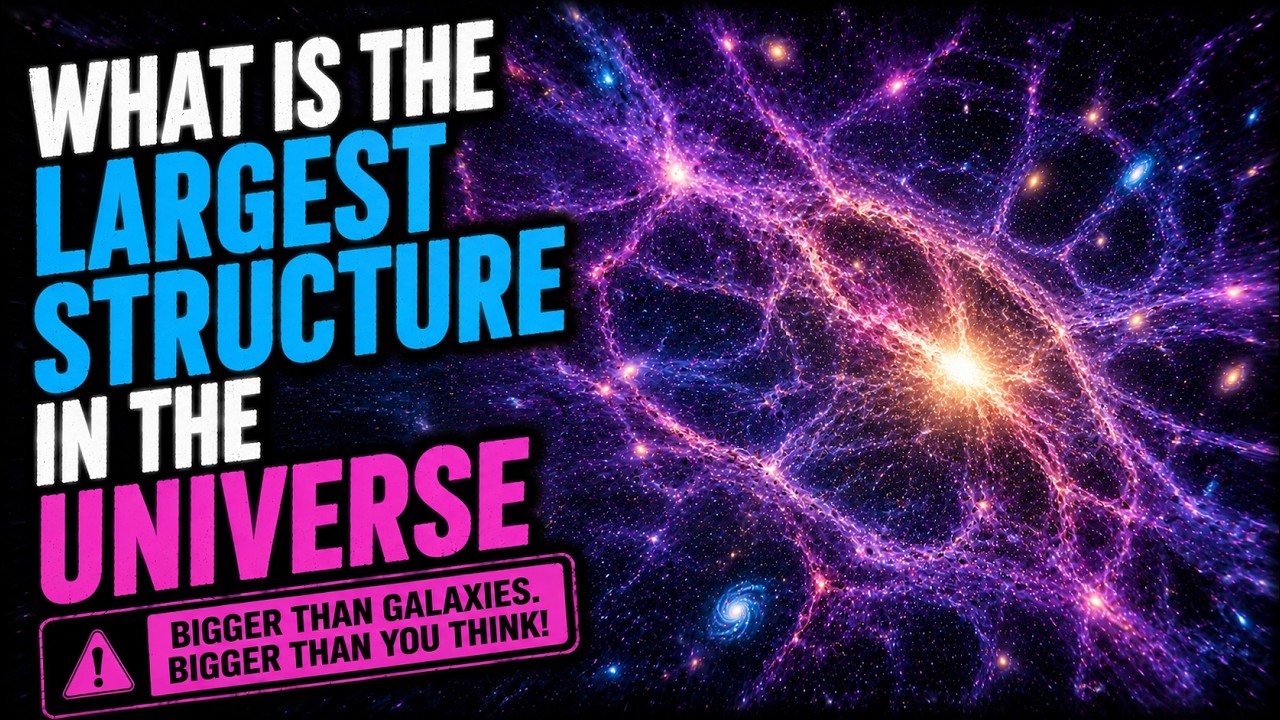
What is the Largest Structure in the Universe?
AstroniumLab
575 views•2026-06-17

What If We Found a Second Earth?
TheBrightMatter
247 views•2026-06-16



