For GCSE Maths Paper 2, students should focus on predicted topics as they become more accurate, use calculators for most calculations, revise all topics as if they will appear, warm up before the exam, work backwards through papers to tackle harder questions first, and practice final questions to maximize grade potential.
Install our extension to search inside any video instantly.
Watch This Video Before GCSE Maths Paper 2Added:
GCSE Maths Paper 2 is now here. One of the biggest, most important, and best GCSE subjects. In this video, I'm going to be giving you guys the best advice I have for the things you can be doing between now and the exams to maximize the results that you get. Now, please make sure to subscribe and leave a like.
So, I got the impression that Paper 1 went fairly well for most people. You know, it didn't seem to go amazing, but yeah, whatever it went for you, it's really important that for Papers 2 and 3, you improve and you work hard for these papers, okay? Those two papers are more important. And my Paper 1 in Maths, I actually also felt went badly. That's one of the exams that I thought went the worst out of all of my GCSEs, and I still managed to get a 9. I know you might be thinking and you might have counted up your grades or whatever, but you just never know what you got in that Paper 1 for sure until you actually get your results back. So, you cannot give up moving into this Paper 2 and Paper 3.
There's still time to learn topics, there's still time to improve your grade. And actually, the first point which links directly to this is that Papers 2 and 3, you can definitely do better on because the predictions get a lot more accurate. So, you may have seen predicted Paper 1s, and those are very hard to predict because they're just guessing random topics based on the last few years and all of that. However, as Papers 2 and 3 come about, the predictions get a lot more accurate.
This is because if something like trigonometry hasn't been tested in Paper 1, it's way more likely to be tested in Papers 2 and 3. Across the three Maths papers, most topics do come up each year in different formats. So, we know that if a topic hasn't come up in Paper 1 and 2, it's almost certain to come up in Paper 3. Now, I've linked in the description some really good like predicted topic sheets. I know First Class Maths Don does one, and I know loads of like resources do predicted papers. Now, for me, I was only doing past papers that were predicted at this point, especially because they get more and more accurate. And this advice applies for Paper 3 in Maths as well.
So, my advice is if you're doing past papers, just do predicted papers. Sure, they're not going to exactly predict it, but I was a little bit surprised by the time my Paper 3 came around how much practice I had in those topics that were more likely to come up, and this definitely benefited me. So, this could be the difference, you know, this could maybe gain you five marks if you focus your vision on the stuff that's going to come up. So, as always, you've got to prioritize and focus on your weak areas, but if you see that, you know, circle theorems is very likely to come up, which it is, by the way, then make sure that you have revised those circle theorems. So, that's my first piece of advice is the predictions are going to make this paper hopefully a little bit better for you. So, do pay attention to them, especially by the time paper three comes around. Now, this paper for all exam boards, as far as I'm aware, is a calculator paper. Now, I'm going to go against what advice some advice that you may have heard from your teachers, and in my view, you should be doing most calculations with your calculator. I would honestly be checking things like, I don't know, two times 11 or something like that with my calculator. That's probably a bit extreme, but I was caught once in an A-level maths lesson doing like two times three in my calculator.
That was probably too far. But the point is, use your calculator, right? It's there to be used. Don't be that one person who is like, "Oh, yeah, I'm only going to use it when I really need." Or they don't really use it, and they just make mistakes. So, yeah, use your calculator, it'll speed things up. But remember to write write out what you're putting into your calculator, right?
That is really important. Don't jump ahead and jump like jump steps and stuff. But that calculator is there to help you, so do use it. Now, as always, I want your mentality to be like for this exam and for revising topics is revise every single topic like it's going to be in that paper. I always find this just helped me like want to focus more, revise harder, and just overall like improve in it quicker. So, imagine when you're revising a topic that it's going to come up, because the truth is, it really could. With maths, unlike with English or history or something, most topics come up, okay? So, you really want to focus on those topics and make sure you're still learning topics. Now, I was tutoring someone the other day, and we went through about three topics, and we learned them that she didn't know before. So, there's a lot of time to or there's more time than you think to learn topics. And I've been saying this a lot this year, because I really believe it's true, and I know from my experience teaching that I've often seen students learn something the day before, they go into the exam, it comes up. And here's then, try and keep learning topics. Pick a couple topics that you're like, "Oh yeah, I'm not too sure how to expand a triple bracket if you do higher or whatever whatever the topic is." And try and learn it. Circle theorems is one of them. That was one of those topics that I just hated. And yeah, I did have to revise it because I hated it. And that's what I want you to do as well.
So, keep trying to learn topics. It's not that hard to learn a maths topic in my opinion. You just watch a YouTube video on it and then practice it and mark it and repeat. So, do that if you can, if you have time. If you're watching this like a minute before, then don't worry about it. Just try and do that for paper three as well. On the morning of a maths exam, I really like warming up. So, I would recommend doing something like a Corbettmaths 5-a-day, doing a couple questions before you get into that maths paper. This can make the difference if you are just a bit more like in that mathematical mind. I personally found like I did have to warm up to like optimize my exam performance versus something like English. Like it's a different subject. So, just make sure that you're in that maths like focus mode. And for me, doing a little warm up, doing a couple questions helped.
They don't have to be super hard questions. Just get yourself in that maths zone.
Along these lines then, something that I've been experimenting with recently is doing a paper kind of backwards. So, if you're aiming for a grade nine, then I would almost I'd definitely consider doing this. Now, I didn't do this when I did my GCSEs and I still managed to get a nine. But the other day, I was doing a paper I went through a paper with a student that I was working with and I think I got 95%. And for me, I liked starting at the end. Now, the reason I did this is because the end is the hardest questions. So, I'd start at the end and I'd probably get stuck, right?
Though most of them I just would get stuck right at the end, but I started thinking about them. Then as I work my way back, I got more and more fluent with maths. I was like more and more warmed up. And that meant I had a gap.
So, once I like finished it and I did the early ones, I went back to the end and I found that most of the time some thought something new like came to me and I had a fresh mindset ready to do that. If you do it from the start and you get to those end questions, when you get stuck, it can be a bit harder to like go away and come back to that because you've done every other question. But, something that is really powerful in an exam is going away, doing some maths, and then coming back to it.
And often, you'll find you have a fresh perspective on it. So, that's just something to think about. You don't have to radically change everything. You don't even have to do it backwards. But, you could at least look at some of these end questions to start thinking about them. Then, by the time you get to them, you will have thought about them a little bit, and you'll be a bit more fresh coming into that. So, that might be something that's worth trying. If you are aiming for a high grade, so grade nine or grade five in foundation, one thing that I'll definitely be doing is just looking through past papers, go to the final two questions, and just try and do them. The more you see of those hard hard questions, the better that you're going to get because those are going to be the questions that define a grade nine, right? Grade boundaries are pretty high. I think it's over 17 out out of 80. Like, it will vary year and year a bit, but they are getting higher.
And so, that means you can't really afford to drop all marks from those final two questions. So, that's going to be where the grade nine is basically made. If you are aiming for nine, the first half of the paper shouldn't be that bad at all. So, practice some of those harder questions because you will see the pattern. You'll see the type of topics that come up in those questions, and they are not too bad once you practice them, once you learn them. Same with if you're aiming for grade five in foundation, look at the harder questions. What are they like? What topics come up? And practice some of those. Now, as always, make sure that you're checking things like rounding it to a significant figure or rounding.
Like, those are often the just those final questions that could be really easy just to miss. So, whenever I did a question and I got an answer, I'd always just go back to the question. I'd see, is it asking me to do it in two decimal places or however it's rounding me? And then, I'd write that down as well.
Another piece of like exam technique that really helped me in A-level maths is that I read a question twice. So, I read a question, and then I like forced myself to like calm down, and then I just I'd like breathe, and then I just read it again. And I know that sounds kind of odd, but it really helped me just reframe it and really focus on that question. So, yeah, make sure you are answering that question. Try and break it down. One of the hardest skills in maths is just looking at a big dense piece of information and actually finding out what is important here, breaking it down. What is the question asking me? And then along these lines, every single bit of information they give you, or most of the time the information they give you is relevant.
So for example, if they give me the area of a triangle and they're asking me to find an angle, almost certainly I'm going to need to use the area to find the angle. So yeah, they do dress up with waffle and lots of other words, but if they're giving you facts and numbers, there's almost always a reason they're giving you that. If they're telling you a line is perpendicular, there's going to be a reason they are telling you that. So use that in your answers and in your thought processes and that might help you get to an answer. In short, that's the best advice I have for maths paper two. You've got this. Remember I thought my maths paper one went worse and I actually did manage to get a nine because I did well in papers two and three. So what you want to be doing is you want to be revising topics. Focus on those predicted topics, but don't neglect everything, right? But they are more likely to come up. I'd be doing predicted past papers, not just past papers at this point. You might as well focus on the topics that are more likely to come up. Then make sure you warm up on the day. Make sure that you're kind of fresh and ready for this exam. Don't give up and I would also recommend if you do get stuck on a question, you've got to move on. Come back to it when you're feeling fresh and very often you'll be able to find something else that might help you get the answer. So yeah, I hope you found that helpful.
Best of luck. I really hope all your exams are going well and make sure to subscribe and leave a like.
Related Videos

A Brutal Radical Expression Made Easy! The Shortcut Changes Everything.
tamoshop
112 views•2026-06-02

V : jee main /advance class 11 mathematics : Binomial Theorem class-1 ( 29 may 2026 )
dcamclassesiitjeemainsadva9953
125 views•2026-05-29

Is This Pentomino Tileable?
3cycle
241 views•2026-05-30

This Sudoku Has Many Lines!!
CrackingTheCryptic
2K views•2026-05-29

Olympiad Mathematics | Indian Can You Solve This One?
PhilCoolMath
268 views•2026-06-02
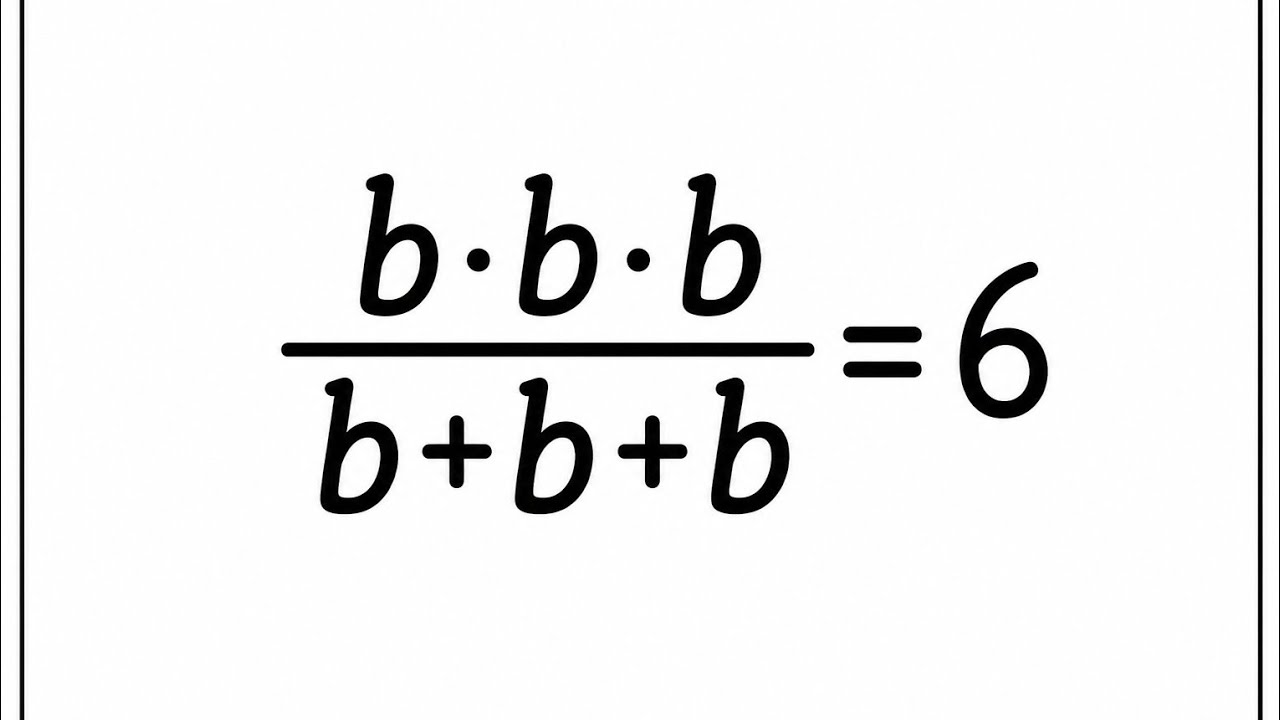
Olympiad Mathematics | Indian | Can You Solve This?
PhilCoolMath
669 views•2026-06-02

Can you get the Correct answer for this Math Quiz?
Fendora01
24K views•2026-05-29

NUMBERBLOCKS COUNT THE TOTAL SUM OF TEN NUMBERS | ADD SMALL TO BIGGEST NUMBER | hello george
hellogeorge2294
5K views•2026-05-28



