The 'invert and multiply' rule for dividing fractions works because it finds how many times the divisor fits into the dividend by first converting both fractions to a common unit (same denominator), then dividing the numerators; this process reveals that dividing by a fraction is equivalent to multiplying by its reciprocal.
Install our extension to search inside any video instantly.
The Reason We Cross-Multiply {#maths #fractions #matheducation}Added:
Why do we invert and multiply when dividing fractions? This one confuses a lot of people, even adults. To explore this, we first need to think about what division means. With this problem, we can think about it in two different ways. One, dividing 12 into four equal groups, or two, finding out how many times four >> [music] >> fits into 12.
This could mean sharing 12 cookies equally among four people, each person [music] gets three cookies, or figuring out the number of people who can each get four cookies [music] from a batch of 12, which is three people. Even though both scenarios result in the same answer, the process and the visual model looks different. This second interpretation, how many groups of a certain size can we make, is especially useful for understanding divisions of fractions. Let's try 3/4 divided by 2/3.
[music] Now, we want to see how many group sizes of 2/3 fit into 3/4. But wait, 3/4 and 2/3 are different sizes, and because of that, we can't compare them directly. To solve this problem easily, we'll need to find a common unit. After dividing it up evenly, now we ask, how many groups of 2/3, which is equal to 8/12, fit into 3/4, which is the same [music] as 9/12.
We can make one full group with eight same-size pieces, and we have nine pieces in total. Remember, the denominator tells you the number of equal-size pieces that make a whole, and the numerator tells you how many pieces you have. So, the answer is 9/8. [music] This shows why the invert and multiply rule works. We're essentially finding how many times the divisor, [music] 2/3, fits into the dividend, 3/4. Once you break everything into the same-size parts, >> [music] >> the pattern becomes clear. They created a shortcut for this process, which is why when we divide a fraction by another fraction, we [music] multiply by its reciprocal. This invert and multiply rule is not arbitrary. It's a shortcut that reflects a deeper, logical process.
When students understand the why behind fraction rules, they don't just memorize, they make sense of the math.
And when they make sense of it, they build stronger reasoning skills and become more confident problem solvers.
[music] To learn more about this work, check the link to the study in the description below.
Related Videos

A Brutal Radical Expression Made Easy! The Shortcut Changes Everything.
tamoshop
112 views•2026-06-02

V : jee main /advance class 11 mathematics : Binomial Theorem class-1 ( 29 may 2026 )
dcamclassesiitjeemainsadva9953
125 views•2026-05-29

Is This Pentomino Tileable?
3cycle
241 views•2026-05-30

This Sudoku Has Many Lines!!
CrackingTheCryptic
2K views•2026-05-29

Olympiad Mathematics | Indian Can You Solve This One?
PhilCoolMath
268 views•2026-06-02
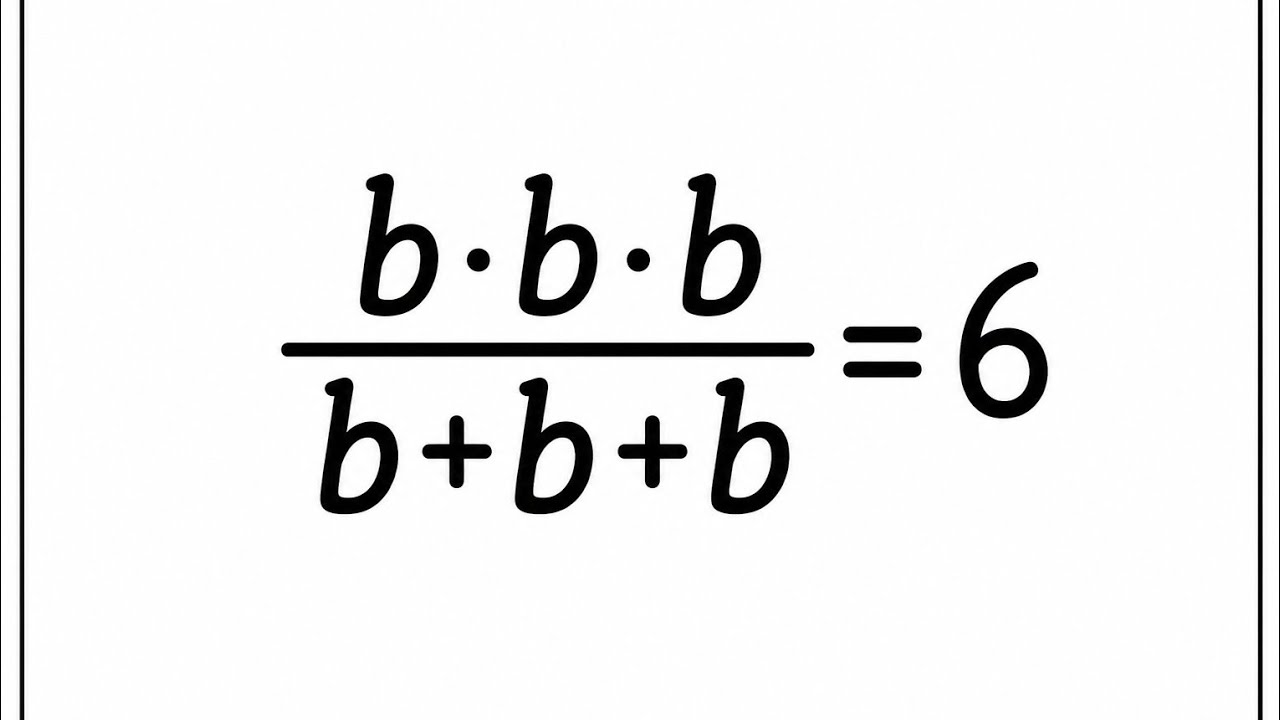
Olympiad Mathematics | Indian | Can You Solve This?
PhilCoolMath
669 views•2026-06-02

Can you get the Correct answer for this Math Quiz?
Fendora01
24K views•2026-05-29

NUMBERBLOCKS COUNT THE TOTAL SUM OF TEN NUMBERS | ADD SMALL TO BIGGEST NUMBER | hello george
hellogeorge2294
5K views•2026-05-28



