A 40-year helioseismology study by the Birmingham Solar-Oscillations Network (BiSON) reveals that the Sun's magnetic activity during solar cycles 22-25 is becoming increasingly confined to shallow layers near the surface, rather than spreading from deeper layers as scientists previously predicted, indicating that our understanding of the Sun's interior dynamics and space weather forecasting models may need revision.
Install our extension to search inside any video instantly.
SOMETHING inside the SUN is CHANGINGAdded:
So, what's your looking right now is the AR4455, the sunspot on the sun.
>> [clears throat] >> It is currently earth-facing as we speak.
And you can see the motion around that sunspot. Uh the blue and the red are the opposite polarities.
And it's quite active.
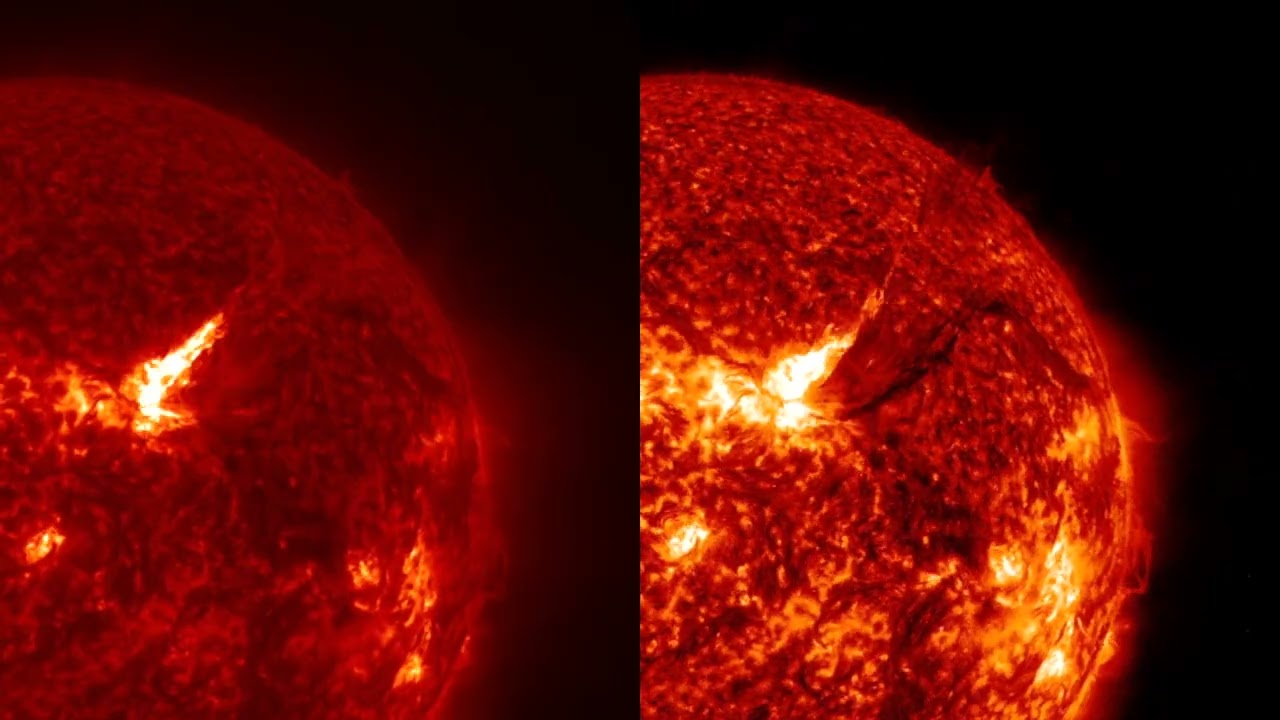
So, this sunspot is earth-facing as we speak. And if I zoom out right now on this live sun image, you see like sun is very active.
Our sun is behaving differently.
It's not behaving differently just from the outside, but it is behaving differently from the inside.
I wanted to show you what's going on with the live data. So, this is Ray. I go by Cosmic Ray on this channel. I use my backyard telescopes to connect with the universe. I'm a earth science and space science researcher. If you are into these videos, please give me that early like and subscribe. So, let's get into it. This one region produced [clears throat] 16 C-class flares and three M-class flares. It's a group of sunspots. It's an active region. That's how they named it. If you [clears throat] take a look at the sun right now, it has several of these active regions. And you see sun has several sunspots on the sun that you are seeing. And if the sun doesn't have any sunspots, then we are talking about we are moving into the solar minimum. Right now, we are in this active cycle, almost like 11-year cycle.
And we are almost at the end of it. And once we see almost like no sunspots anymore, we will get into the solar minimum. The conventional idea is whenever you take a look at the sun and as the sun getting free of the sunspots, this is like conventional wisdom for the last 400 years that once you see the sun without any sunspots, you are actually moving from solar maximum back to the 11-year cycle again into into the solar minimum.
That conventional wisdom is now changing. This is very interesting. You will see a comet coming here near the sun.
It's a brand new unidentified comet as of May 29th, few days ago. It just you're seeing the comet live. This is a comet that will be discovered soon.
There will be a name for this comet.
People just identified that 4 days ago. It came close to the sun. Uh we don't know the fate of this comet yet.
We will get more details. Uh chances are sometimes it does survive, sometimes these ungrateful may not survive. So, we'll get more details.
So, on the right side, we are seeing this huge coronal mass ejection coming in.
>> [clears throat] >> So, we are in the solar maximum period and you're seeing quite a lot of action coming from the sun. What I'm going to show you here and what we are going to talk about, probably you may not have heard or seen.
This is called BiSON Network.
Birmingham Solar Oscillations Network.
These are six telescopes that are all over the world. They are in California, Chile, Spain, South Africa, Australia.
And they listen to the sun everyday. They've been listening since 1976. Our sun oscillates like a bell and they are scanning the surface and listening to those oscillations from the sun surface.
They're doing this day and night. These telescopes are all over the world.
And they've been doing it for 40 years now.
There is a study that came in recently with that 40 years of study. And what we found is very interesting and I'm going to share that with you. So, you must have heard by this time that sun has solar cycles and are like 11 years.
So, during the solar minimum like almost like spotless, no sunspots.
And during the solar maximum, we will have lot of sunspots. Sun is very active. What we are experiencing now is that that is the solar maximum.
You we are probably about to be done with the solar maximum. There is another interesting thing about these solar cycles.
Every 11 years the magnetic poles, not the real poles, the magnetic poles shifts from one side to the other side.
And sun experiences that magnetic pole shift every 11 years.
And after 11 years again, it comes back. So, what it means is every 22 years, the poles are going to come to their original positions. During the solar maximum, sun is very active, more coronal mass ejections. So, we need to know the beginning and ending of solar cycle to learn more about the space weather.
The interesting part is whenever we are hearing from these telescopes on the ground, the six telescopes on the ground, our expectation is to hear these waves coming from the core as well as coming from the surface or from core to the surface as the sun is oscillating.
What we found is very interesting now.
So, what did we learn from this 40 years of study?
From the solar cycle 22 to the current solar cycle 25, our models, our space weather models, our helio seismology models predicted that when this heightened solar activity is going on, this magnetic activity is going to spread across the sun, from the deeper layers of the sun to the surface of the sun.
Instead, what we found is this magnetic activity now is squeezed into the upper layers, the shallow layers near the surface.
So, our models are predicting that this magnetic activity is coming from the deeper inside of the sun, and now we are looking at these solar activity, this heightened magnetic activity is now more and more squeezed in the surface layers of the sun. What does it mean to us is we need to make changes to our space weather models. What you are looking at is the coronal mass ejections that's happening last 1 month.
So, you can see the transit of the planet.
I believe it's Mercury in front of sun.
Look at all the coronal mass ejections that are going off from the sun. Sun is still active.
We are still in the solar maximum looking at this data.
It's still producing those flares.
524, I recorded this for 1 full month.
Yeah, a lot of ejections.
I believe I came up to today.
So yeah, I wanted to share that data with you.
So this study was released on May 29, 2026, like a couple of days ago.
And very interesting study. This is something that we still need to get into more details of what's the impact going to be.
So here is what we are looking at. The results from the cycles 22 through 25.
>> [clears throat] >> And we are this yellow or orange thing that you are looking at are the oscillations based on the sunspots prediction. That's what we are expecting like this way, right? And as you can see, now we are hearing more and more above that range.
That's what we are we are seeing.
Particularly the high frequency, which is means the in the surface layers, it's a lot more above the range than what we are anticipating. Our sunspots didn't tell us the full story. Our sunspots gave us a pretty normal distribution of our model. Whereas the solar activity is higher than the sunspots are predicting.
And now we are looking at the way the model used to look at the blue picture on the left versus the orange that you are seeing more skewed towards the surface activity. We need to see the impact in terms of our space weather models and our helio seismology models.
So that's pretty much is where we are.
This is the cutting-edge science at this moment. We need to take a look at our models to see what revisions that we need to make. So, this is Thank you everyone for watching. If you like this video, smash that like button. Click on subscribe if you haven't subscribed.
Give me the hype as well. Thank you everyone. I'll see you in the next video.
Related Videos

Spiral Galaxy NGC 3370 from Hubble | NASA APOD 2025-11-05 #Shorts
galaxygallery
938 views•2026-05-30

There May Be A Giant Hole In The Universe... And We Might Be Inside It | The Cosmic Ledger Entry 015
TheCosmicLedger
145 views•2026-05-31

Captured the Blue Moon (with a twist) 🌙✨ #space #bluemoon #telescope
realAstroExplorer
674 views•2026-06-01

The Map We Sent to the Stars in 1977 — Why Scientists Now Regret It
TheAncientRecord7
183 views•2026-06-03

Is this a copy of our galaxy? Discover Galaxy M81!
UniverseDocumentaries-cc4mb
995 views•2026-05-31

10 Planet Where a Black Hole Replaces the Sun
cosmicexplorer-EN
147 views•2026-06-02
Solar Flares and CMEs at Earth - More Likely | S0 News June.3.2026
SpaceWeatherNewsS0s
2K views•2026-06-03

Voyager 2 Just Sent Back Its Final Images After 12 BILLION Miles!
PHN413
463 views•2026-06-01



