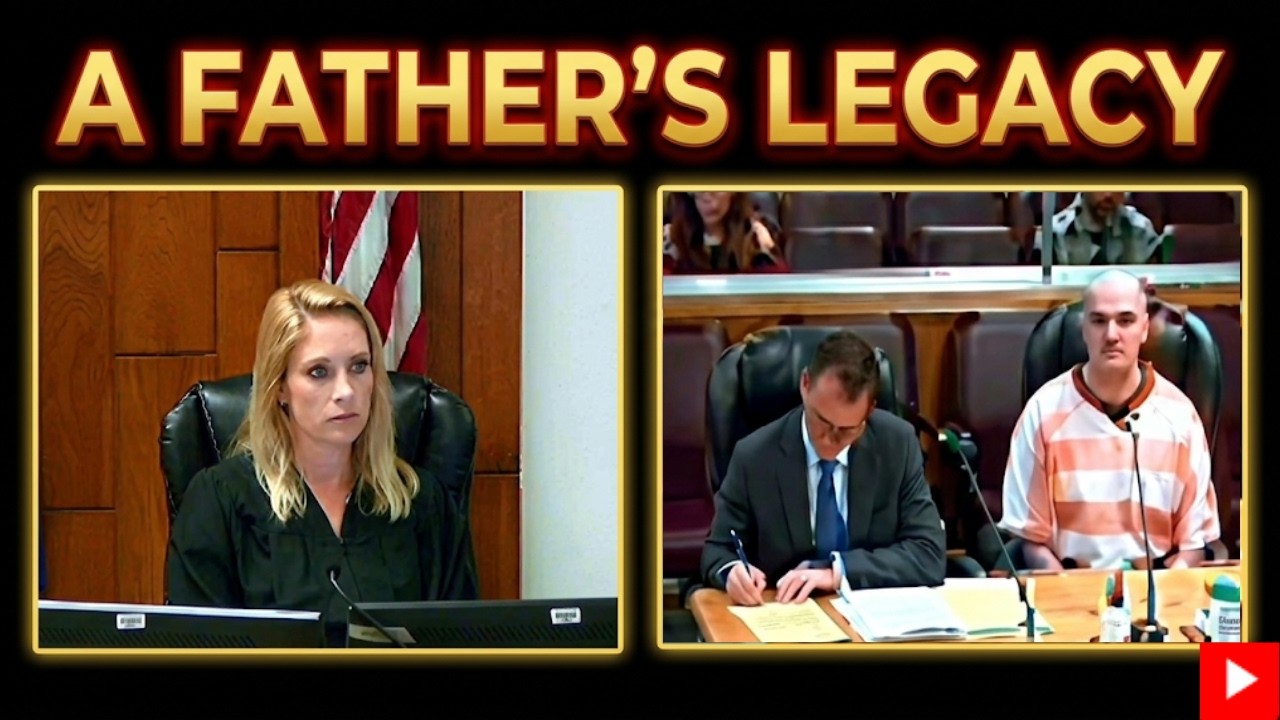
This video examines the 2024 shooting of Kentucky District Judge Kevin Mullins by former Sheriff Sean Mickey Stines, exploring how mental health assessments, surveillance evidence, and legal defenses interact in criminal cases. The case illustrates the tension between psychiatric evaluations suggesting psychosis and physical evidence (locked door, methodical shooting, phone calls) that suggests awareness and intent, demonstrating how courts must balance medical diagnoses against circumstantial evidence when determining criminal liability.
Install our extension to search inside any video instantly.
"He Did IT!": SHOCKING NEW UPDATE JUST CHANGED Everything About Sheriff Stines
Added:14:38 is I mean, I'm sorry, 14:48.
And that's you on the video?
>> Yes.
>> Okay. And that's the FaceTime call that Mickey made to you?
>> Yes.
>> And is that about the correct time that you were calling him FaceTime?
>> This is recording.
This is Guys, come on. We're not being Mickey, we're not being unfair to you.
>> Do you want to have a drink of water?
>> Yeah, I'm >> Four days after the shooting, a social worker sat across from Shawn Mickey Steins inside the Leslie County Detention Center and concluded that the former sheriff of Letcher County Kentucky was still in an active state of psychosis. He did not recognize that he was in a jail cell. He could not comprehend the charge against him, and he had no memory of firing nine rounds into the body of District Judge Kevin Mullins, a man he had called a friend for most of his adult life.
Judge Kevin Mullins served the people of Letcher County Kentucky for years from the bench of the District Court in Whitesburg. In the hills of Eastern Kentucky where communities are tight and everybody knows everybody. Mullins was a fixture. He wasn't some distant figure behind a robe. He was the kind of judge who had lunch with the local sheriff at a restaurant called Streetside. He kept his chambers open to law enforcement and attorneys alike. He had built his career in a courthouse where relationships ran deep and the lines between professional and personal were often blurred. Letcher County sits in the coal fields of Appalachia, a place where civic institutions carry enormous weight because there aren't many of them. A district judge in a county like that isn't just an arbiter of the law. He's a neighbor. He's the man you see at the gas station, at the high school football game, at the diner on a Saturday morning. Kevin Mullins was all of those things. He was also someone's colleague, someone's friend, and someone who on the afternoon of September 19th, 2024 sat behind his desk in his own chambers and never stood up again.
The surveillance footage from inside Judge Mullins' chambers that day tells a story in silence. There is no audio, only video, and every second of it has been scrutinized. At approximately 2:35 p.m., Mullins is seen in his chambers speaking with a small group of people. 4 minutes later at 2:39 p.m., Sean McKnight Stines enters the room. He is the sitting sheriff of Letcher County.
Within 60 seconds, Stines asks the four other people in the room to leave. They do. The door closes for nearly 10 minutes. The two men sit and talk. The conversation appears calm at first, at least from what the silent footage reveals. Then around 2:48 p.m., Stines makes a video call to someone on his own phone. A minute later, he attempts another call. It doesn't appear to connect. He then asks to use Mullins' phone, comparing a contact on his own device, and makes a call from the judge's phone. What was said on that call and to whom remains one of the most critical unanswered questions in this case.
>> I have a timestamp screenshot, Your Honor, of the video.
14:38 is I mean, I'm sorry, 14:48.
And that's you on the video?
>> Yes.
>> Okay. And that's the FaceTime call that Mickey made to you?
>> Yes.
>> And is that about the correct time that you recall him FaceTiming you?
>> What happens next is captured with terrible clarity. Stines stands from his chair, reaches for his service weapon, and moves to lock the door. He turns back toward the judge, according to the grand jury testimony of Kentucky State Police Detective Clayton Stamper, Stines fires two shots at Mullins. The judge goes down. Stines then reaches around the desk and fires a third shot. He begins to leave, but turns back, reaches under the desk, and fires six more rounds. Nine shots total. Seven of them were fired while the judge was already on the ground. Let that settle. When officers arrived, they found Judge Kevin Mullins on the floor of his chambers with multiple gunshot wounds. He was was dead at the scene.
Meanwhile, Steins had walked out of the courthouse, a deputy spotted him on the street moving away from the building with what the deputy described as a blank look on his face. The deputy called out to him. Steins didn't respond. He didn't acknowledge the deputy at all. Minutes later, two officers entered the courthouse and began preparing to clear the building for an active shooter. Steins walked right in behind them. He told them simply, "There's nobody else. It was me."
Body worn camera footage from the responding officers captures the next 2 hours in unsettling detail.
Steins is seated, handcuffed in a hallway of the courthouse.
An officer who has clearly known him for years approaches and asks if he's okay.
Steins nods, but immediately becomes fixated on one thing.
He does not want to leave the building.
When told he would be transported to a jail in another county for his own safety, Steins replied, "I'm alive and well. No weapons on me. If I leave this building, I won't draw another breath."
He repeated this fear multiple times. He asked to be placed in protective custody at the Letcher County Jail.
He insisted he had seen it done with officials who had committed crimes in the past. The officers reassured him no one would hurt him. But Steins was unshakable in his conviction that leaving meant death.
>> Do you want to talk at all, Mickey?
Earlier you said you Listen, Mickey, if you don't want to talk, that's fine. I I don't want to force you to, okay?
>> We didn't We're not going to force you if you don't want to talk.
>> That's your That's your right. You don't have to.
Read your rights to him as well.
>> And you know that. You're the sheriff. I mean, you know just as much as we do.
>> All right.
>> But it's up to you.
>> If I can see my daughter in person here before you leave.
>> You can say what you want at the jail.
>> At the jail?
>> Yeah.
>> At the jail, through a screen, on a phone, I want to see my daughter in person. And then after that, I'll tell you everything.
>> At that jail. When there's no cameras, video recording.
>> Where Where's your daughter at?
Huh? How do we Where's your daughter How do we track her down? Where's she at?
>> She's at LCC.
She's at LCC. I talked to her.
>> So Now, Mickey, I want to I want to just kind of for your daughter, let's talk about this for your daughter, okay?
If she finds out that her dad is being arrested for shooting the judge and she did She's in the hospital. I didn't know how old she was.
>> So, I didn't know. So, she's in the hospital. What is she, a senior? That's going to be hard.
>> She She will want to see me. She will want to Now, come on, guys. Be fair to me now.
>> I know I'm being fair. That's all I was just I was just wanting you to think about that. How >> I'm How is she going to >> In the same footage, something else emerges.
Steins could joke with the officers about restaurants and shared memories.
He could laugh, but the moment anyone asked about the shooting or his family, he went completely silent. He stopped reacting entirely, as though a switch had been flipped.
One officer told him directly, "I'll be honest, Mickey, you don't seem like you normally seem when I speak to you."
Steins' reply was flat. "Well, I'm in handcuffs." The officer pressed, "Not just that." And Steins said only, "I just want y'all to be fair to me."
>> This is recording.
His re- >> Guys, come on.
Mickey, we're not being unfair to you.
>> Do you want a drink of water?
>> Yeah, I do.
>> The investigation by Kentucky State Police moved quickly on the physical evidence, but slowly on the question that has haunted this case from the beginning. Why? Detective Stamper's testimony before the grand jury outlined the forensic picture.
The surveillance video, the ballistic evidence, the body, the weapon, but Stamper also testified about a line of inquiry that went nowhere.
Police investigated whether Judge Mullins had any inappropriate involvement with Steins' family members.
They probed Mullins' phone records.
Steins' family members told investigators they had no contact whatsoever with the judge, and police found no evidence to contradict that.
So, whatever Steins believed was happening, whatever drove him into that room with a loaded weapon, did not appear to be rooted in any verifiable contact between Mullins and his family.
What investigators did find was context.
In the months before the shooting, Steins had been named in a civil lawsuit filed by a woman named Sabrina Atkins.
The suit alleged that one of Steins' deputies, Ben Fields, had allowed Atkins to leave jail on GPS monitoring in exchange for sexual favors.
>> When I got there, he had been arrested also, and he was actually in rehab, and his parents didn't want me there, so they threw me out. And being and Deputy Ackles come up there to tell me that and escort me off the property. I was crying. My whole world just totally got torn apart. I didn't know what I was going to do money-wise, you know, anything. Steins' and strangers' houses.
And I was crying and I told Ben that, and he said, "Don't worry." He gave me a hug, and he said, "We'll figure out work something out."
>> At least some of these alleged encounters took place inside Judge Mullins' chambers. Fields ultimately pleaded guilty to felony charges of rape, misogyny, and tampering with a monitoring device in January 2024.
>> He called me. It was on a Saturday night. I never will forget it. And told me meet him at the courthouse at 8:00 at night. So, I was like, "Okay." We went to the Judge Mullins' chambers, and uh he told me to put my feet up on the desk, and he took my bracelet off, and I said, "What are you doing?"
And he said, "Go back to Pike County."
He said, "Uh before court, I'll meet you and you put your bracelet on, and then after court, I'll take it back off. And if you're in Letcher County, just make sure you wear something to cover up that they can't see your bracelet's not on."
>> He received a 7-year sentence with 6 and 1/2 years to be served on probation.
Judge Mullins himself was never accused of any crime in connection with the Atkins case while he was alive, But, the civil lawsuit dragged Steins into a public reckoning. Just 3 days before the shooting on September 16th, 2024, Steins sat for a deposition in that case.
Multiple people who knew Steins described a man coming apart in the days that followed. Local attorney Daniel Dotson, described as a friend of the victim, told investigators that he had warned Mullins before the shooting that Mickey was losing it and couldn't take this kind of pressure.
The local police chief reportedly told Dotson, "That son of a [ __ ] has lost his mind."
Steins' aunt, Sherry Steins, who testified at a recent bail hearing, described his behavior in the days before the shooting as psychotic. She said he was paranoid, believing people were surveilling his home. She said he had not grown up that way, and that the change was sudden and alarming.
The defense strategy rests almost entirely on the question of Steins' mental state. His attorneys, Jeremy and Carey Bartley, have entered a plea of not guilty and announced their intention to present an insanity defense.
They are also arguing extreme emotional disturbance, a legal doctrine in Kentucky that, if accepted, can reduce a murder charge to manslaughter.
The social worker's report from the Leslie County Detention Center, written 4 days after the killing, supports the picture the defense is trying to paint.
Steins was described as unaware of his surroundings, only aware of what jail staff told him.
He was suffering episodes of combativeness so severe that staff had to use pepper spray on him. His attorneys have filed a motion to unseal a full psychological evaluation conducted by state doctors, which remains under seal.
They have also moved to dismiss the indictment entirely. They argue that prosecutors failed to present the grand jury with medical records that the jurors themselves had requested. In Kentucky, as in most states, an insanity defense requires showing that the defendant, at the time of the act, could not appreciate the wrongfulness of his conduct or could not conform his behavior to the requirements of the law.
The locked door is the problem.
Former prosecutor turned defense attorney Tim Horn, who reviewed the surveillance footage, put it plainly. He noted that Steins got up, locked the door, kept the judge inside, and prevented anyone else from entering.
That sequence, captured in complete silence on video, suggests awareness, planning, and intent.
If Steins was truly in a psychotic break, severed from reality, how did he have the presence of mind to secure the room? If he was experiencing a complete mental fracture, why did he methodically fire nine rounds, pausing between volleys? And if he was so far gone that he couldn't recognize a jail cell 4 days later, what was he doing making phone calls from the judge's own phone just moments before pulling the trigger?
Sean Mickey Steins is 44 years old. He is being held without bond on a charge of first-degree murder of a public official. He resigned as sheriff 1 day before his first court appearance. He faces the possibility of the death penalty if convicted. His defense team has asked that bail be granted, calling his aunt and others to testify about his deterioration. They have argued that a change of venue would be pointless, >> [music] >> since national media coverage has saturated every potential jury pool in the state. The prosecution has the video. The defense has the diagnosis.
Somewhere between a locked door and a state of psychosis lies the truth of what happened inside those chambers on September 19th, 2024. Judge Kevin Mullens cannot tell us, and the man who killed him may not be able to, either.
That's it for today, folks. See you in the next video.
Related Videos

JAMIA BA LLB 2026 Offline Mock Interview | Final Interview Round Preparation
MLSLAWACADEMY
104 views•2026-06-16

6/15/26 Lively v. Wayfarer - Full Settlement Agreement is now public
littlegirlattorney
11K views•2026-06-15

HOA Demolished My Yacht for “Unauthorized Docking” — Too Bad I Own the Entire Marina!
Pro-RevengeStories
423 views•2026-06-15

JACKSON KIHARA'S SECRET DEAL: The Deal That Brought Out Jackson Kihara From Jail | LifeLens TV
LifeLens254
5K views•2026-06-14

Guelph's New Renoviction By-Law Explained.
CallCodyRE
807 views•2026-06-14

SCOTUS Rules 9-0 on Gun Rights for Marijuana Users
TheReloadSite
164 views•2026-06-18
A Family Tradition of Federal Time
LoneWolfUsul
603 views•2026-06-14

YouTuber Alexander Zabel Jr arrested again near Nancy Guthrie’s home amid investigation disruption
StarBuzzHD
136 views•2026-06-15



