Perverse sheaves are objects in algebraic geometry that generalize ordinary sheaves and are particularly useful for studying singular spaces. The hypercohomology of a perverse sheaf can be computed using the decomposition theorem, which states that the pushforward of a perverse sheaf decomposes into a direct sum of simple perverse sheaves. The computation involves stratifying the space, taking stalks at points in each stratum, and solving a system of equations based on the dimensions of the cohomology groups. This approach allows mathematicians to understand the structure of perverse sheaves by examining their restrictions to strata and their stalks, which are equivalent to representations of the fundamental group.
Install our extension to search inside any video instantly.
Perverse sheaves and chatting with Chat | Office Hours | May 10 2026Added:
Mathematicians, how we all doing today? How we all doing today? Oh, you know, I made my face smaller while recording a video, and I'm going to make it bigger again so you can see me and my big old face. Yay.
Doesn't that make you so happy?
Um, this is called an office hour, but you know, I might I might I might be very palish this office hour and and do some kind of work or not. I don't know.
Let's see. Good morning, Ka Cachuri.
And the thing is I'm tutoring in an hour or so or less than now.
Yeah. So I don't know what uh what what to talk about today gang. I was looking at a paper related to something. This is very related to some some fun ideas I was thinking about uh about um Caillou drip. Oh my god.
Uh hello thrones.
Um yeah interesting. So uh the group is called a k orbit group if g has k orbits under the action of its automorphism group. Hello green froggy.
And uh um yeah. So uh anyways so they prove here it's shown that if G is a K orbit group then K is bounded above by uh by some quantity. Good morning Z so far.
Uh and the three orbit groups which are not of prime power order are classified.
It is shown that A5 is the only insoluble four orbit group and a structure theorem is proved about soluble four orbit groups. So kind of a neat thing in my opinion.
Hard take. Most of higher mathematics is just definitions on top of definitions to be memorized.
Um, no.
Um, that's all very true. Why is OBS disconnecting?
Let me close a bunch of things. Maybe is my computer not uh having a hard time thinking so hard? proof uh versus the number of words that constitute uh a defute uh a definition.
Um yeah, I'm working on making things less like I don't know how I don't know why it's being like this.
Um hello Nerdy Quagsire. Nerdy Quagsar, when are any of those reading groups starting?
Um, there are a lot of definitions, but you don't think mathematicians memorize them. Well, it kind of I mean, yes and no. I mean, you better you better be able to bust out uh you better be able to bust out um You're right. It is Mother's Day. Uh and what is what's your point? call your mother. Uh or I guess spend time with your mother. You're you're probably are you in the same city as your mother? Um but uh yeah, what was I saying?
Yeah. Do I remember all the definition?
Do I remember all the definitions by heart from my undergrad? Probably not all, but I could probably reconstruct most of them with with reasonable accuracy, actually. Uh, and actually, I guess even in my own research, I don't think I could reproduce every definition with 100% accuracy.
But uh yeah, I'd say most mathematicians could reproduce most of the definitions that they need to know with uh 80% accuracy.
Let's say um pretty much all math education can feel like that through grad school. Yeah.
You've often thought we should redo how we teach stuff to be more whole grain than ultrarocessed.
I don't know exactly what you mean by that.
You've never done like memorization techniques for various definitions.
Yeah, I have. And I personally have no complaints about that.
Yeah, I live Wait, what? What? Wait, what?
Um, you feel like definitions are the main thing in math?
I mean, kind of kind of kind of.
However, you often think about a definition and why it is defined that way and end up understanding things better and the side effect of remembering the definition often. Yes, even math PhDs use Claude. What do you mean even? Math PhDs are the only ones who should be using Claude. Everyone else is ruining their lives.
Um, you like Japanese math education?
The chart screaming at me again. Zafarb. The chart series problems books were your training ground for early mathematics like calculus and everything was derived.
Derived categories looking for motivations behind definitions and theories are the best way of remembering them. Yeah, I mean that certainly helps. I mean even uh you know if you if you look at uh if you look at uh people who you know do memory competitions and stuff uh you know they I don't know do I need to close more things? I don't know.
I've killed everything. I shouldn't be being weird like this.
Um, uh, good morning, Will.
Uh, what are we looking at?
Yeah, producing definitions by heart is not the thing that matters. But I mean, yes. Yes.
But like to take an extreme, if you didn't memorize any definition and every single time when you're writing the document, you had to go look up a definition that it would take you a very long time to write something. It would also be very difficult for you to come up with a proof because how are you going to prove something about object X if you don't know the definition of of object X? Uh right. So um of course reproducing definitions by heart is not the thing that matters but it is necessary. It is necessary to have to to be able to recall 80% of 80% of all definitions relevant to you 80% of the time. Let's say uh and then you can look up the other stuff.
Yeah. Now, you don't need to spend time sitting around memorizing definitions for the most part um because you'll just end up remembering them through the process of of using them and applying them. But uh you know and I do think and I do think you know when I've had to when I studied really hard for I remember in analysis spending like 20 hours a week doing homework and writing out theorems and their proofs and definitions several times. I think that ended up being an efficient way to cram a bunch of information in my head uh very quickly and then it stayed there for a very long time.
Um, where are we here?
Um, understanding a definition and memorizing are two completely different things. Well, they're not unrelated.
They're very different things. I wouldn't say their dotproduct is zero, but you know the co the coine of the angle is small. Sure, it's a cosine of a small angle. Um, what universities have the best success predictive exams? That's a good question.
I don't know if there are any good ones.
Do universities have success predictive exams at all? Are there any? Uh, good morning, Will, if I didn't say good morning to you. I think I did already, but the thing that matters is theory building and problem solving.
Yeah, that's true.
Um, how do you get into Langland stuff from a more analytic background in modular forms? Oh, I mean, uh, yeah, that's that's, uh, that's a great way to get into it. So, so number one, I would recommend well, I recommend the book Automorphic Forms by by Anton Deepmar to basically everyone. Um, that's a great way and it starts off with modular forms and then it goes into and then it goes into uh modular forms. You might also like um you know there's automorphic forms and representations by Daniel Bump. Uh, like you might also, you know, starting off with Tate's thesis stuff. The thing is you'll want I mean either way you're going to want to learn some algebraic number theory. Uh, Emma Maths. Uh, you're going to want to learn some algebraic number theory no matter what.
But I guess there's some ways that are heavier than that. I mean um what you might like about Bump's book is I think there's a lot of uh analysis forward type things you know so like in the start of chapter 2 he's talking about um you know automorphic representations for like GL2 but you know uh section 2.1 is on is on mass forms and the spectral problem so you're talking about spectral theory of of oper operators of of lelassians and stuff. Um, that might be something to look at. Uh, now gets in Hans's book. Gets in Hans's book. I mean, I'll be honest, it's very at the beginning certainly it's very like anal it's very like algebraic geometry um focused.
But the point of the book um if you get into later sections which I'm not I'm personally not familiar with um you know some of the point of the later sections is is to talk about the so-called trace formula right um so you could go look at the section on trace formula and try try to work your way there now is this the best way if you want if you're if you want to go from modular forms to automorphic forms and staying in in a very analysis focused approach um is the best way. I don't know. I'm just trying to toss out some things here for you to take a look at that that that may be of uh interest to you. Um I think it's just you that can't hear anything. Safarb. Um, yeah, no one else is saying anything.
Hi, Shankar.
Um, so I hope that answers your question somewhat. Uh, Emma Maths.
Um, when am I doing a math podcast with Terry Towel?
I don't I don't see the point in doing that to be honest. Why would I? I mean, look, here's the thing. Terry, there's a million Terry Tow podcasts out there.
Seems every other day, bros giving a talk or going on some podcast or something like if I had the opportunity, if it somehow arose not if somehow we both happened to be at some conference together and I ran into him. Sure, maybe I'd ask him. But to be honest, I don't see I don't see the value in going out of my way to to ask Terry Tow to be on my pod. Like, why? Like, what am I going to ask him that that nobody else has asked him already? You know what I mean? Like, there's so many podcasts of Terry Tao talking about so many things. Um, it's just Yeah. I don't know. It's not uh it's not a it's not a huge it's not really a priority for me to be honest. Um it's terminology picked up from a posttock you know he pointed out that basically all math education is ultrarocessed um almost all abstractioning and preparation for results.
Uh, I still don't totally understand.
Jello Gallow L1 J1 Gallo.
A small percentage is whole grain math wherein you're going over results or theorems in the world.
Um, I think I get what you're saying.
Yeah, I mean maybe there could be an argument there could be an argument for, you know, working backwards, having a degree where you focus on reading papers and stuff and and getting used to the like diving into the deep end of the pool, let's say.
But I mean, the way that we learn most things is like, oh, you learn the the C major scale first and and and before you learn crazy Zen harmonic theory of the 19 Edo tuning system, you know, you learn like a pentatonic scale, you know, you learn a 145 chord progression before you, you know, study the chord changes in giant steps or something, you know.
Um, I mean, maybe I'm misunderstanding what you're saying, but like with all of the, you know, you learn about the atom is like, oh, you have a ball, you have one ball rotating another around another ball, you know, you learn this like super alterprocessed versions of stuff first. Uh, these oversimplified things, you know, I but maybe I'm misunderstanding what you're saying. I mean, I think I think it seems to be a good process. Maybe not the best for everyone. For some people, they really uh excel diving into the deep end, right? Allegedly, Schultz started at the proof of Formatless theorem and worked his way backwards until he hit matrices and then you know, and that worked for him very very well obviously.
Uh but not everyone's him.
Hello, Maddie.
All you can say is in your experience, you've never done definition memorization. Yeah. And fair. and probably most people don't. Um, but you know, for me, I I'm not most of the time, I mean, certainly now, I don't sit around memorizing definitions. I can't imagine myself ever doing that again.
But I'm also not complaining about the time in my undergrad when I had to. Um, could I confidently give the definition of coherent chief in non-nazerian case?
Um no maybe not coherent sheath. You know, you have an open cover such that the restriction an an open aphine cover such that the restriction to every aphine is you have um yeah maybe there's something weirder happening in the non-nazerian case you know but your sheath is something like locally locally finite presentable on your on your aon lines, right?
And like I said, there's, you know, there's 80% of the definition. So, so first off, I've never I've never needed to know the definition of coherent chief so far. Actually, I've never needed to know the definition of coherent chief so far. And so, like I said, 80% of the time you can recall 80% of 80% of the of of the 80% of the definitions you should know.
80% of the time you can recall 80% of that definition.
It seems like you have a pretty young audience. I've not seen a single comment in this chat with a full stop. Yeah, my nephew was dunking on me for he saw me texting someone and uh was like dunking on me cuz I put a period at the end of my sentences.
Um yeah, locally finitely presented uh and the colonel is of finite type.
Yeah. What's what's locally Naztherian?
Yeah, there's nothing special about there's nothing special in the non-Ntherian setting, right?
Like, am I crazy?
There's really nothing except you know you need the Nazerian assumption for uh uh right?
Yeah.
The root pointer is open neighborhood which exact sequence. Uh yeah coherent.
Okay. So yeah, uh it has to be finite type. Yeah, subjective morphism here.
Okay, so I was I guess I was uh it didn't have to be m and n here, but yeah, there we go. Like I said, uh I I missed some finite type stuff, but there's And look, I mean, what here is special about the netherness.
All right, you're back. Wait, did you leave? Why did you Oh, well.
Wow, a lot has happened in chat. Where am I? Here.
Uh, did I ever use flashcards for definitions and theorems? Yes. And I tell all of my students all the time to always do this and they never listen.
But I found flashcards extremely useful.
I' I'd carry flash cards around with me.
I'd put, you know, names of theorems on the front and then I'd put the statement and the proof on the back and definitions and I would keep them in like my jacket pocket or something. And then when I would, you know, when I'd be waiting for the bus or something, instead of being on my phone, I'd pull out the definitions and I'd go through them until I could produce everything in my head. At first it was impossible, right? It was like, "Oh, I can't think through the whole proof in my head." But then you just keep, oh, you review it, put it back through your pile, review it back through your pile, shuffle, and you got through. And eventually, uh, I did.
And, um, I found it to be a very helpful strategy, and I encourage lots of people to try that as well.
Um uh yeah, you mostly just remember the vibe of the definition and trust you can recreate the precise version from vibes.
Yeah.
Um yeah. Okay. Glad that helped. Uh Emma Maths. Um you've heard a few of them before but not checked them out. Yeah.
Yeah. start at those places and then you know uh feel free to branch out branch out from there you know uh there may be of course I'm I'm more of a algebraic flavored kind of guy so um I'm I'm confident that there are other texts out there uh that are more suited uh to your analytic tastes and and I'd encourage you to seek those out but at least these places will the books I mentioned will have some references that will be of interest to you. Uh had been quite busy nowadays with your research paper. So you couldn't join research uh recent stream though you could have joined yesterday office hours when we were when we were vibing and working shankar. That would have been a Why do I keep disconnecting from stream?
Annoying.
Uh, do you know how to calculate the hypercoology of a perverse sheath? Uh, I've never done it. I've never done it.
I mean, like I like I like I like I said. Uh wait, it's just Oh, this is just the ordinary. Wait, this is just the ordinary coalology, right?
The hyper cohomology are isomeorphic to the intersection coalology. Okay. Yeah. This is Wait, why is it called hyperco? What is hyper cohomology?
It's just the coomology, right?
I don't understand actually I don't understand but um I mean I I so so so fi the the maybe maybe we should uh maybe we should Maybe I should do some perverse chief computation videos. Actually, I mean, if if you go I think I've recommended this before. If you go look at my live streams from like a year ago, from like last June or something, I do a bunch of computations with with perverse sheets and demodules there. And and I mean here's here's the trick. So so so you have some stratification, right?
uh and you take the IC with respect to some local system on the stratum. So first off it the support it's only supported on the closure of the orbit that you came from.
the restriction of your perverse sheath back down to the original orbit will just be a shift um of this of this local system.
And um if the closure is smooth then uh for any stratum contained in the closure the restriction uh of if this is the trivial the the constant sheath uh the restriction to here will just be the constant sheath on D shifted by the dimension of C. So you can already from this alone you can get a lot of of mileage and in general what you do um I should do some worked examples of this maybe some actual videos but in general if it's not smooth you produce um a semi small resolution and then you know that the push forward um I know a lot of this not a lot of this will make sense to you entirely right now. I'm giving you the scaffolding and then maybe maybe just for you fi I will make some videos on on how to do this uh more properly but basically all of your uh this will be a direct sum of your simple perverse sheets I don't know let's label them with some index i to some multiplicity and then for each um for each so you you don't have to look at anything outside the closure and then for each strap atom inside the closure. You pick a point and then you take stocks. By the way, this is called the decomposition theorem. The fact that it's a direct sum. Then you take stocks. This side you're just going to get the coology of the inverse image of the fiber above X. And on this side you will get um just the sum of the stocks.
You'll get the sum of the stocks um of of each of these IC's.
And then basically the hope is the hope is that um you have so you have a bunch of unknown variables and the hope is that you have enough orbits here so that when you do this uh you pick or not orbit but stratum when you pick one x for each uh for each stratum. The hope is that you you I mean you basically just look at the dimensions of either side and the hope is that you get enough equations that you can uh solve this linear system of equations for these mi.
Um and that's that's that's basically it. And then okay sometimes you don't have enough and then you need to do some different strategies. But this is the big idea and maybe I should make a video for you going through some examples.
Chilled Vibes has been trying to learn group theory. Hell yeah.
Bro is a type of guy to read instructions line by line. Uh yep. What book is this? What book was I on? Uh uh this was Gats and Han. I think I was looking at uh Shaw. I don't know if you're still here, but that's what I was looking at at the time.
Um yeah.
What sort of prerex do you think you'd need for Demar on the algebraic side?
Your focus has generally been analysis in your studies, so you'd think you'd be fine with the analysis side. Um actually I think well um for much of Deepmar for much of Deepmar um for much of Deepmar let's say the first four chapters I don't think you need much maybe some representation theory but in fact he might even explain some of those definitions. Um, yeah, I think you'd be fine. At least for the first Emma Maths, I'm not sure if you're still here. Um, because I know I'm pretty far behind in chat. Um, but yeah, first four chapters, you should be good. Um, where am I here? Hello, Fimno.
Uh, wow, I am so far behind in chat.
Uh yeah, even chapter five, I mean the Adele's he talks a lot about analysis and forier theory on the Adels. Once you hit the Adele's and Tate's thesis, they're again I think I think actually it's very analytically flavored. So So I think you could understand it just fine.
But um you what what may be tripping you up at that point is you may lose an appreciation for why you're doing analysis on the Adele's possibly. So um especially when you get to last chapters the last sections in chapter six where where he talks about um stuff about like gow representations and l functions. I would say maybe once you get to that point, uh, you would maybe want to pause and go read a book, go read up on some basics of algebraic number theory, you know. Um, but I would I would say you could jump into DeepMar now and then, you know, uh, just learn other stuff as you go as you need it. Go pause to learn some other algebra as you need it. that that would be a not unviable um strategy.
Uh visual group theory. Nice.
How much would I recommend and not recommend uh Hungerford's Graduate Algebra? I've never looked at it, so I'm completely neutral.
Um completely neutral on it. I've never really taken a serious look at it.
Um, uh, that was not the book I was looking at though earlier. Cyber Potato. Hey, wait. Automorphisms. Yeah, wait a second. Where's the other I had? Uh, yeah, this was this is a paper I was looking at. Um, am I doing my first post talk? No. August 1st I begin.
Uh GAWA groups already. Nice, nice, nice, nice.
Is a herent chief just a coherent chief in the opposite category? One would uh one would imagine.
Uh yeah. Well, let's just let's just define it. Let's define that to be true.
Um uh well you shouldn't you shouldn't base my pronunciate you shouldn't base your pronunciation of netheran on my uh pronunciation.
Um yes netheran is exactly related to nether the mathematician.
She proved some theorems in physics, but she really I mean I mean she was a mathematician I would say and and some of her theorems uh some of her theorems uh ended up being very useful in physics. Um but but she really did uh a lot of incredible work across uh different fields.
Yeah. Understatement of the century here. Nerdy Quagsire.
Uh, flash cards are good for language learning, biology, medicine, and math.
Um, how to stop thinking everything is about you. I don't know. Uh, don't lean into it. Lean into your god complex.
That's what I say.
Um, you go through all the notes by rewriting everything that matters and it sticks in your head. Yeah, I've essentially used some part of that strategy. Hello, Fimnel. I said that already, but it's good to say hi more than once.
Not really a flash card guy. Use practice problems. Yeah, I mean practice problems ends up having the same uh ends up having the same result.
Uh, Ntherian schemes coherent if and only finitely generated.
Okay.
Bonus desor.
Uh, recently you learned of Arnold's approach to math. His philosophy is pertaining to the nature and goals of mathematics intrigued you. It's exactly the opposite of all you value in math.
Interesting. Uh Arnold's approach to math.
Whenever you see a subject or some matter, you always look with the perspective of what you can get out of it. How does this change you but not engaging the subject for itself?
I mean, that's a valid way to view the world. It's not the way that I view the world, but I would say that's also a valid way to look at things. Uh, not found. Okay. Well, but why is that then? Wait, why is that called hyper cohomology? Is coology when you have a complex of sheets? Why is it just why is it why do we call what's the what's the use of the prefix hyper then?
What's the use?
Uh, so you get two indices.
Wait, what?
How do you get two indices?
You got two indices. Why do Wait, why do you got two indices?
cuz you have the coomologies of each of the sheetses. I see.
Uh why are she being perverted? That's a good question. Because um yeah because that's why I see hyper coalology coalology via spectral sequence what do I mean when I say stratification that's a good question uh basically basically so usually we mean something like Uh it's a union of like um subsets that are locally closed.
Disjoint union of uh usually disjoint union of locally closed subsets that make up the whole thing. Um normally we want other there's other properties like sometimes we want the stratification to be good.
Um no uh oftent times the stratification may come for instance in my uh in my case from a group action uh into subsets that are locally closed and locally finite.
Um, right. Okay. Actually, it doesn't have to be disjoint in general. Oftent times in my case, we're we're looking at uh they happen to be disjoint unions.
So, fi you don't actually need a group action here though. It's more general than that.
Ah, okay.
Well, I've been calling you Zafarb this whole time, but I'll call you Zafar.
Um, chilled Vibes head is exploding.
Good. That's what I came here to do.
Explode heads.
You did wonder are caught seek cosec are inverses of trig functions.
Uh no.
This seems like a very uh I I'll I'll let you look that one up. Uh cosmic Do you understand? Oh, where are we here?
Uh, what are we here?
You understand how to compute cohomology of a perverse if you don't get how to go from coology to the coology of complexes of sheath.
uh from coology to the cohomology of complexes of cheese I mean it's just a the cohomology of a comp like of any complex of any complex right I mean is you have a complex and and you take the coomology right kernel di mod image DI minus one and if if this is a complex of sheav you can make the sheffy and you can get the cohomology sheath so if a is a perverse sheath yeah it's just it's just the the cohomology of of of that shified but but like I said uh I mean the way to do this in practice is you use the decomposition theorem and and you don't even need to cuz like most of the time I mean perverse sheath like it's like you don't know it's it's not like you have this information about what each of the sheets are with a completely like detailed description and like a a completely detailed description of what your differentials are of the complex.
Normally you don't have this. What you do is you is you take the decomposition theorem and you say and and you just want to know okay what what are like what am I what do the stocks look like?
If I can just understand for for each of my perverse sheets if I can just understand um I mean if I How should I say this? Okay. So, um understanding a perverse sheath just means looking at the for each of your stratum understanding the the structure of the stock of each of the coology sheets and what does that look like or the stock or even just the restriction down to D and by construction this will be a local system and the category of local systems is equivalent to the category of representations of your fundamental group. And so um you can generally label your local systems in terms of data here and then you just talk about well what are the the irreducible representations that correspond to each of these restrictions. I should really make a video for you fi and and go through and and do an example. Although I'll probably restrict to the equivariant case which cuts down your information even more and uh makes certain things easier. But actually I could start off with a non-equavariant case. What books for homological algebra?
Aluffy.
I for you for you nerdy quagsire I would start with uh I would start with a luffy. Uh, of course, Vible is like Vible. Vibel is the Bible for homological algebra. But, uh, for you, I would say start with a Luffy.
Uh, the chatters are too separated.
Maybe we should have a conference. The first K theory conference.
Cyber Potato. I mean, like I've said, me and others have have made suggestions about what to do and uh do feel sorry for you. I do hope that you can get some help, but like I said, this isn't the place to do it. Uh uh my chat is this this is not the place to do it, which is why I'm not really responding to the the messages. And uh yeah, I mean if if chat gets very gummed up with these messages and uh your setting is a little convoluted.
You were stuck on totalization.
I don't know what you mean by that. I don't know what you mean by that. Fine.
You need it badly for your research.
What do you need badly for your research?
Uh, send me an email. Send me an email and uh send me an email. My email is in the description. and let me know what exactly it is you need for your research.
Um like if you can send me a short document and being uh and being precise.
If you can send me a short document being very precise about what it is you need slashw want to know then maybe I can help you.
Uh uh how is GAWA theory different from group theory? Gawa theory is the application of group theory to the study of fields and polomials.
Uh, a kid who's going to be a freshman at university next year asked you what the point of GAWA groups is.
Wondered how me and chat would answer this. Um yeah the first thing that comes to my mind is the study of of polomials the first thing that comes to my mind is the study of polomials and how to factor them but um yeah I don't know I don't know if I let me meditate on that more I'd maybe explain it differently But um at least historically that was you know of course how they how they arose. Uh and it's still largely what it's about right. Um uh sir recalled he also thought gaw theory was useless. Really? What?
Really?
Sarah thought Gala theory was useless.
That is interesting.
I I would I would love to ask the Sarah because certainly the Sarah who thought that was also the s that was aware of the theorem about the insolvability of fifth degree polomials by by radicals.
Um, uh, where did I buy my flash cards?
Just anywhere that sells like paper products.
Go to the nearest dollar store or something, drugstore or something. Uh, yeah.
Um, perversies are called perverse.
Sometimes naming doesn't matter much.
Yeah.
Um what's the difference between point set topology and topology itself? Well, topology itself is broadened shall we say um above beyond the basic point set constructions. I mean point set topology just refers to I mean the sort of classical set theory based topology whereas now I mean topology includes algebraic geometry which you know you can think of in terms of like homotopy world or you can think about um local that generalize away the points and just consider you know algebbras of open sets.
Anyways, uh I don't think I'll get to you in the chat. I got to go. I have to I have to tutor.
Uh do I plan on learning my username eventually? Maybe. Only time will tell.
Stick stick around for this channel. Um, stick stick around uh in this channel to see if uh to see if it'll happen. Yeah, here I am still reading chat. Uh yeah, anyways, I gotta go. Thanks for joining me. Probably tomorrow we will get back to uh have a nice long pomodoro. That's my plan anyways.
Um, and until then, a Q I mean QD I mean Q E E.
Related Videos

A Brutal Radical Expression Made Easy! The Shortcut Changes Everything.
tamoshop
112 views•2026-06-02

V : jee main /advance class 11 mathematics : Binomial Theorem class-1 ( 29 may 2026 )
dcamclassesiitjeemainsadva9953
125 views•2026-05-29

Is This Pentomino Tileable?
3cycle
241 views•2026-05-30

This Sudoku Has Many Lines!!
CrackingTheCryptic
2K views•2026-05-29

Olympiad Mathematics | Indian Can You Solve This One?
PhilCoolMath
268 views•2026-06-02
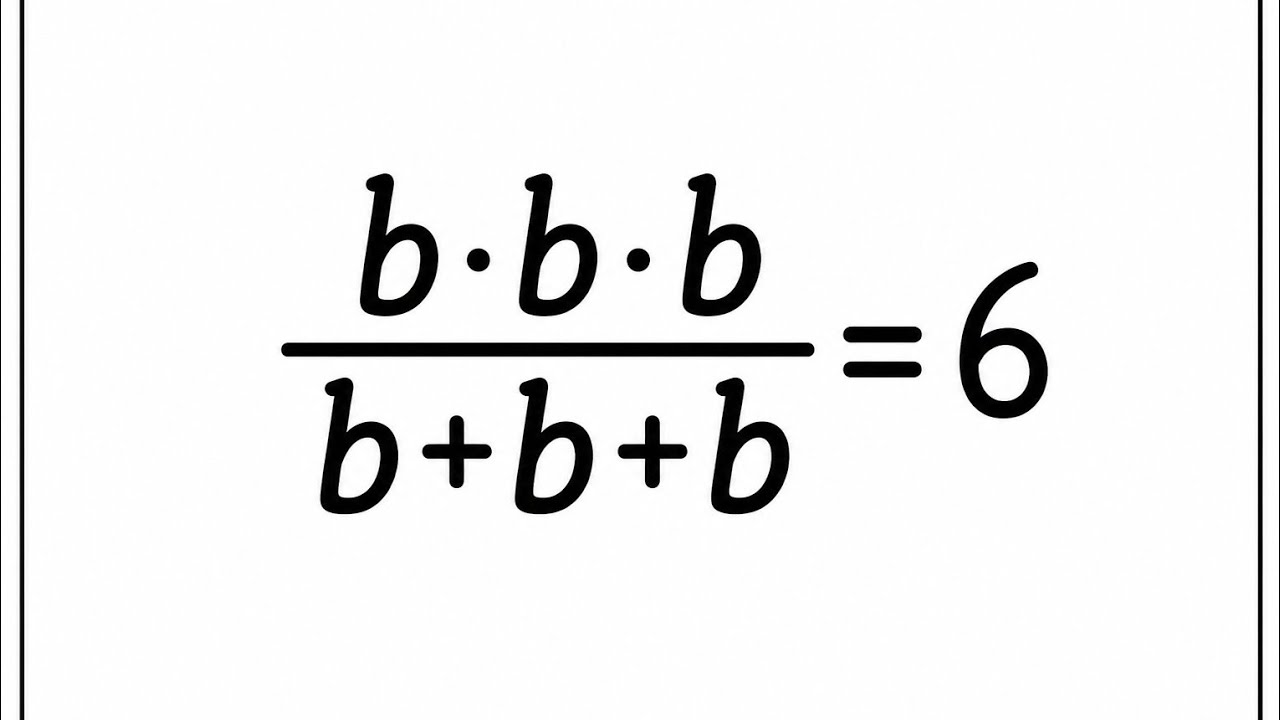
Olympiad Mathematics | Indian | Can You Solve This?
PhilCoolMath
669 views•2026-06-02

Can you get the Correct answer for this Math Quiz?
Fendora01
24K views•2026-05-29

NUMBERBLOCKS COUNT THE TOTAL SUM OF TEN NUMBERS | ADD SMALL TO BIGGEST NUMBER | hello george
hellogeorge2294
5K views•2026-05-28



