This video provides comprehensive GCSE maths revision covering both foundation and higher tier questions from Edexcel, AQA, OCR, and Eduqas exam boards. The tutor demonstrates key concepts including probability calculations, algebraic rearrangement, circle theorems, trigonometric values, and quadratic factorization. The session emphasizes understanding mathematical concepts rather than memorizing tricks, with the goal of helping students achieve top grades in their upcoming exams.
Install our extension to search inside any video instantly.
Maths GCSE Revision (Exam Thursday!)Added:
Excellent. Hi and welcome to um this live edition. Um and basically what I want to do is go through questions. Um you're more than welcome to uh leave comments about things you want me to go through um or anything like that.
Um, and we've already got our first message.
Okay. You should never ever rely on predicted papers um as accurate things um of things that are definitely going to come up. Uh it's all just based on statistics and probabilities. Uh the best predicted papers are always going to be uh paper two and paper three because we know what's come up on paper one. we know what's come up in the previous papers. Uh so always um make make sure you check them out. Um but you see the predicted papers as a revision tool and nothing more. Right? So what we're going to do is go to uh from grade one all the way up to grade nine. And we're just going to repeat that until um we are happy. Um and um along the way if you want to drop a message um then feel free to uh I think the thing is YouTube is not very good at um showing uh what people are saying on comments.
So I've got my phone here as well just so I can pick them up. They don't always show up which is really annoying. But I'm going to get going uh because I've waffled on too much. So, this first one is an OCR paper two. Now, you might be thinking, well, hang on, OCR paper two, that's not paper one. Uh, OCR do this weird thing where they have the non calculator as paper two. Um, so this is kind of paper one for everyone else, right? Uh, it says a fair spinner has six sides. They're labeled 1 2 4 5. And the diagram shows the probability scale.
All very interesting. Um and it is asking us to um uh which arrow shows the probability of scoring a two.
Okay. So how many twos are there? There are one two. There is one two and there's six all together.
Um and so let's have a look. So this will be halfway, right? This will be a half and this will be what? a sixth and then this will be 2 six and 3 six 4 six 56 okay so which arrow shows the property of scoring two there's one two and there six all together so that's going to be B uh scoring a number less than six well they're all less than six so it is going to be E because they are all less than six. And finally, scoring a one or a four. Let's have a look at one or four.
So, 1 2 3 four. Four of them are a one or a four. And so, four sixs or 2/3 is going to be D. So, our answer's going to be D. Fantastic. Grade one sust.
Let's move it on and let's see what we get for grade two. Oh my goodness.
Another probability question. Oh, let's do the top one. Why not? U. So, question 10. Uh, let's just make sure everything's set up. This isn't quite as smooth. Um, we're asked to find whether these are equations, expressions, formula, formula, inequality, or term.
Oh, that's interesting. You don't normally get that last one.
Um, this is what need to sort that out on the machine.
reprogram it. Okay. Uh, anytime you've got something without an equal sign, uh, it can't be an equation or a formula, if it doesn't have like a less than or greater than sign. Uh, it can't be an inequality.
Um, it can't be a term because there's actually two terms here. There's term here and a term here. So, it can't be an inequality. U, so it has to be an expression. So, this will be expression.
Uh, next one it's p<unk> r^2 = 30.
Uh, so this is quite a weird one because you'd think that this is a formula because that looks like a formula, but because it actually uh is equal to something um it's not a formula uh because you can work it out.
Anything you can solve is going to be an equation.
Sweet. Right, let's move on to grade three and trying to like get my Okay, there we go. Cool.
All right. Um, so we are halfway through one there. So, we're going to go down.
Um, circle the equation of the line. Oh, wow. This is quite a hard grade three one. Although, it's question 17, so it's maybe more grade four. Who knows? Um, and there's no such thing as grade.
There's no such thing as this question is X grade. This is all just sort of roughly.
Um, so we're going through the origin.
Um, and so there's no y intercept. So anything with a y intercept can go. That just takes one off. In fact, y= 6 will be a horizontal line. So that's not going to be the right one. So we've got two gradients here. We've got a gradient of three and a gradient of a third.
Um, if you put in the x value, it should equal the y value, right? So, x is 2.
So, y equ= 3 * 2. y would equal 6. So, that's the one there. If you put it into the other one, um, then it would not equal uh six because a third of two is not six. So, it's the third one along.
Right, grade three done. Let's move on to our grade four question.
Okay, which one do we fancy? 23 or 24.
Let's go for 24. Okay.
And let's just set this up. Just check everything's all hunky dory, which it is. Good.
Okay.
Um Sean pays £10 for 24 chocolate bars. He sells all 24 bars for 50p each. Work out Sean's percentage profit. So sells all 24 for 50p. So it's 24 times sort of half a pound, right?
So half of 24 is going to be12, right?
So you sold them for12. You bought them for10 and percentage profit is the change uh which is going to be10 to12 which is two over the original which is 10.
2 over 10 is 0.2 and as a percentage that would be 20%. So as percentage profit is 20%.
Cool. All right, let's move on.
And we got blank page here. And this is what happens with the automator for grade five is you've sort of got to go back a little bit. And what what do we fancy? I fancy doing the top one.
Okay, because I like rearranging. So, y = 3 W - 10. And we can put our lines in.
Make it a bit nicer.
And so when we are making W the subject of the formula, it means that we want to end with W equals. And so the first thing we want to get rid of is that minus 10 there. So we're going to add 10 both sides.
Nice and simple. Y + 10 = 3 W.
Next, we need to get rid of this time 3.
And to do that, we divide by 3.
And so we've got y + 10 over 3. And make sure it's all over three.
So our answer will be w = y + 10. All of that over three.
That's just um yeah, this is g a bit weird. I don't know why bit behind the scenes is not going as planned, but so they'll be. Okay, grade six.
This is where things get a bit interesting.
Okay, so uh where are we up to?
Right, Imran joins two tiles together.
Okay, so we're looking at exterior angles. The worst thing to do here is try and think of interior angles. It's going to take you ages. Best thing to do is think of exterior angles. Why?
because we've got a line here coming off both of these and it's a pentagon and hexagon. Okay. So, we got to find out this which I'm going to call X and we've got to find out this which I'm going to call Y.
So, X is the exterior angle of the hexagon. Yep, it's that way around. So to do that, to find out what it is, we get just get 360 and we divide it by six, which is nice.
It's just 60. So we know x is going to be 60°.
Y is going to be the same. It's going to be 360, but this time it's going to divide by five.
And um if we uh divided it by 10, that would be 36. divide by five, double that, 72.
Cool. And then finally, what we've got to do is just add the two together, right? So a is going to be um 60 + 72, which thankfully is 132 cuz that's what it asks us to find in the question. Few, we got it right. Iran thinks of another tile in the shape of a regular polygon that fits that will fit exactly into angle A. Is Iran correct?
This is a million dollar question, right? Is Iran correct?
Um, so, uh, sorry, I'm just doing things behind the scenes here.
So, we've done exterior angles and we know that um to find an exterior angle um they are going to add up to or they you do 360 divided by the amount of sides. But this this one here would be an in a would be an interior angle of this.
So, what we could do is work out what the exterior angle would would be.
And this is not the only way of doing this.
This is what I would do. And interior angle which is the 132. Uh if you take it away from 180, you get the exterior angle. Right? So we just do 180 take away 132 which is 48.
And then all we need to do then is uh 360 / 48. Now, um you probably could, um start dividing that by two. Let's see. This is This is where I get messy here. So, it's 24 and then that divided by two again and then divide by two again.
It's probably a quicker way of doing this. Divide by three. 15 over two and then that'll be 7.5.
Um so the answer would be uh no.
Um and something like um the number of sides cannot be 7.5 or something like that. Um sweet.
Right. Uh question in the chat is is this foundation. Um, what I'm doing is grade 1 to nine. So, grade 1 to 5 are all foundation questions and then grade six uh to nine are all higher. So, this one is the first of the higher ones I'm doing. Don't worry, I'm going to loop back to grade one uh after I've done some grade seven, eight, and nine questions, which I'm not necessarily uh looking forward to doing live, but cel.
So, we're asked to complete this table.
Uh, we've got like a reciprocal graph going on. Uh, 6 /us 3 is -2. 6 / -2 would be -3.
Oh, is that it? We just got to do one.
Okay. Draw the graph. Okay. So, we've got -6 - one.
Okay. This is this will show my graph making skills here. -3 - 2.
Is that right? - 2 - 3.
Uh -1 - 6 uh 6 uh 2 3 32 61. Is that all right? Now, reciprocal graphs. I'm just going to draw one quickly over here and then we'll try and do it. Uh they either look like this or if you're lucky like that. I say if you're lucky, it doesn't really matter.
So, it's going to be one of the one of the two. We've got the blue one. And so, ours and I'm rubbish at doing this on this tablet, but make sure Oh, that was awful. I'm not going to let that go. I go the other way. always turn the page so that it makes it easier for you. I can't do that with this tablet, but if I've got a piece of paper in front of me, I would turn it so that I've got a nice view of where I'm going. And what I'm looking for when I mark this is, have you missed any? Like there, I've missed it slightly. I might get away with that. Um, but if you've got like a cross here and you completely miss it, um, I'd probably mock knock a mark off for that. Needs to be one smooth line.
no feathering. So, none of this rubbish.
Uh you will instantly lose marks for that. It has to be one line. Um but I'm not looking for perfection. The one you see on screen now would give you um full marks.
Uh so this is um higher. Uh so it's grade seven. If you look on the left hand side, it says what what grade it is. Uh and if it's grade six to nine, it is higher. But I'm going to loop back around. So, this video live stream will go through higher and foundation. Um, I'll just go from grade one to nine, right? Uh, is that it? Yeah, that is it.
Sweet. That's not such a bad one. Okay, grade eight. Oh my goodness. What is going on with this question?
Okay. Um, right. What have we got? Uh okay just one sec get myself set up.
Okie dokie. So show the show that the value of 6 sin 30 + 2 cos 30 * 4 tan 30 is an integer. Wowee. Okay. Um so um in in responses to the chat um I'm going to go for grade one to nine and the questions will be randomly from Ed XL AQA OCR and educass. So they are all questions that can come up. If there's a question that I know won't come up on um on some of the exams I I'll just skip it. So Educas for instance do questionnaires which no one else does.
So I'm just going to skip that. So we're focusing on ones uh that will be appropriate for AQA foundation when I've done the grade 8 and grade nine question. So first thing to realize is that sin 30 is a half while so we got we've got cos 30 here.
So cos 30 uh is uh <unk>3 over two. And you might be thinking where am I getting these from? You just need to know these. tan 30 uh is uh 1 over<unk>3.
Uh you might know that as um was it roo<unk>3 over 3? Just rationalize the denominator. So, we've got 6 * a half + 2 * um <unk>3 / 2 uh * 4 * uh 1 / <unk>3.
Okay, so that will be 3 + 2 * 4 is 8 and <unk>3 * 1 is roo<unk>3. I'm just ting the fractions together. 2 * roo<unk>3 is 2<unk>3.
Got roo<unk>3 top and bottom. So that would just be a half. We got 3 + 8 * half, which is 4.
3 + 4 is hopefully seven if I've done it right. So our answer will be seven. It says show that it's an integer. Well, seven is definitely an integer. Just means a whole number. Sweet. Right, grade nine. And then we'll loop back to grade one. And this is again like the grade five before. I've got to sort of go back a bit.
Okay. Um, let's just set up um check we've got everything.
It's really weird.
Okay. Find the coordinates of the turning point of the curve with the equation there. Oh my goodness.
That's horrible. You must show you're working out.
Um, okay.
I don't really I I can't be bothered to do that one. I'm going to skip because a lot of people are saying foundation. So, I'm going to loop back again. That's That's a horrible question.
Uh, shall I do it though? It looks quite tempting to do.
What do you think? Is there anyone who wants me to do this or do you want me to go back to grade one and do some foundation ones?
I'm going to take your first answer cuz you would do complete the square, which is horrible to do with negatives.
Right, I'm going to loop back. We're going to go back to grade one.
Uh so grade one.
Okay. So here is a rectangle. Work out the area of the rectangle. This is Have we gone like ridiculous? Gone from sublime to ridiculous here. Um okay.
This is quite a nice one, isn't it? Are of rectangle is what? Four * 6, right?
Which is 24. Sweet. Okay. That's a very very simple way to start. I don't What is that? OCR 2024 November. That's a lovely question. Eh, right. Grade two.
These are all foundation. Oh my goodness.
Like that's a lot going on there. And that's just part A. I'm I'm going to I'm going to reroll reroll grade two.
Okay, here we go. Uh let's just set up behind the scenes.
Um okay so we are asked to work out an estimate for the value of 92* 1.63 and show you're working whenever you're asked to estimate you have to round to one significant figure um for everything. So 92 to one significant figure uh will be uh 90 and 1.63 63 to one significant figure will just be two. So it would be 180. So our answer would be 180 simples. E so just remember one significant figure.
Right. Uh the next one is a given that question and are we going to have No, we don't need to rearrange this. Sweet. So we've got 2.96 * 3.2 2 = 9.472.
And we've got two uh hang on the let's leave a little bit of a space. 29.6* 32.
So we know the answers will have the digits 9472.
And we've got to work out which digits, right? So what have we done to here? And what have we done to here? So what we've done to the 2.96 is we've times it by 10. What we've done to the 3.2 to get to 32 is again we've times it by 10. So our answer we're going to times by 100 cuz we've times it by 10 and times it by 10 again. So that would be 100, right?
So uh to times by 100 uh times by 10 would be 94.72 times by 100 will be uh 947.2.
So it' be 947.2.
two. That's quite a nice one. I quite like that one. Right, let's move on to grade three. These are all foundation ones.
Oh, this is a good question. I like algebra and and shape. Whenever the two come together, happy days. Diagram shows a rectangle or a second rectangle so far and we've been given what AB is and BC is and we've been given the perimeter and we're asked to find the value of X.
Okay. So whenever you have algebra and shape, there are two ways of um saying the same thing, right? And I'm going to put my lines in. Now there are two ways of saying the perimeter. We know that the perimeter is 40. So that's one of the ways that we can write it 40, right? The other way is by adding up each of the sides, right?
And a rectangle has the same uh lengths on both sides. So, if we start here and work our way around, that would be 12 + 2x + 3 + 12 + 2x + 3.
Now, if we collect the like terms, we've got 2x + 2x, that' be 4x.
Got 12 + 12 is 24 + 6 is 30. Hopefully, this is where I make silly mistakes because I'm rushing.
Going to take away 30 both sides.
That'll be the first thing we do.
So, we're left with 4x on the left hand side. Take away 30 from the 40. We're left with 10. Uh, this is not looking good. I never like it when I'm left with a decimal. So, we're going to divide by four both sides to get rid of that four before the x. And 10 divided by four, half it, it's five. Half it again is 2.5. Now, I'm never happy when I have a decimal, so I always double check it.
But looking at it and double checking in my head, it is 2.5. So, just when you got some time left in the exam, if you're ever left with a decimal, it doesn't mean it's wrong, which this one is correct. It just sort of reminds me to double check it a little bit and um check that that it's all hunky dory.
Right, next one.
got grade four.
Okay. So, large circle and small circle are shown. Radius of the large circle is 12 cm.
Okay.
So, we've got the radius there of 12 cm.
Uh the radius of the large circle is if it's 12 and it's a 4 to one. Okay. So it's 4 to 1.
So if that's 12, we're going to divide it by four and that would be three.
Okay? So that would be 3 cm, right?
Uh work out the shaded area. So uh area of circle is p<unk> r 2.
Um area of the big one is going to be therefore 144 pi cuz r 2 12^2 is 144 takeway uh is going to be 3^ 2 which is 9. So it' be 9 pi and that would be 14. So imagine that this is x right. So 144x take away 9x um would be 135 x but we're doing in terms of pi obviously so it's going to be in pi and that is our final answer I'm hoping.
Yeah, perfect. And that's four marks.
Cool. Let's move on to grade five.
If I press the right button.
Okie dokie. Oh, another make the subject. I like making things the subject. When you want to make something the subject, you do Q equals.
That is the objective. So, we're going to start with P= 6 Q + 7.
And we're going to draw our lines in.
So, first thing we want to get rid of is that seven. So, we're going to take away seven both sides and we have P - 7 = 6 Q. Next thing we need to do is get rid of this time 6. So, we're going to divide six both sides.
So, P min - 7. To divide six, all of that, you've got to put it over six and then we're just left with Q. Sweet. So, we just got Q= P - 7 / 6. Next, we're going to simplify some indices. And the rule is that um whenever you've got in fact I should write the answer here.
Let's just quickly write the answer.
There we go. Uh whenever you've got indices inside and outside of bracket you just times them together. So it be m to the^ of minus2 * -3.
Um whenever you've got two negatives multiplied together you get a positive.
2 * 3 is six.
Sweet. Right. I'm going to stick with the foundation unless someone says otherwise. Um, is educass an upgrade to functional uh skills? No, educass is just an exam board. It's like Ed XL, AQA or OCR. So, Educcast paper. The only difference is they only do two papers, but those two papers are very, very long. They're not an hour and a half. They're like 2 hours and a quarter or something. Can't really remember. Okay, I'm going to go back to grade one. Let me know if you want me to cover any higher stuff. Um, but I'm going to just keep going. Grade one to five because that is what I've been asked for so far.
Right. Uh, where are we going to start?
Work out. Oh god, I hate these division ones. Um, work out 280 divided by 7. Um, so go do what? Bus stop method. 7s into 280.
Uh, sevens into 28 go four hopefully.
Sevens into zero go zero. So it' be 40.
It's a nice way to start, isn't it? Nice grade one question, right? Let's go to grade two. And oh wow, this is quite a lengthy one. Which letter is the mode?
Mode means most common. Uh C comes up once, A comes up twice, and B comes up thrice or three times. So the B is the mode. One of the cards chosen random um mark with an arrow the probability has an A on it. Well, there are two A's.
So, it will be there. Let's just check.
1 2 3 4 5 6. 1 2 3 4 5 6. I think that's right. Uh we'll write down the property that the card chosen has a letter C on it. Um so that would be 1 over six.
There are six cards altogether. One has a C. Write down the ratio of the number of cards with the letter A to B. So there are two A's and three B's.
It's quite nice. Um so we are covering uh ED XL, AQA, OCR, and HCAS. So but I'm not going to cover anything that's not on all four exam boards. So we're doing questions that are on all four exam boards. Um, so if you're doing ED XL, this all the questions I'm covering could come up on the paper for the ED XL on Thursday. Right, let's move on to grade three.
Um, okay, I'm going to do the second one because I've answered that one earlier or similar one earlier. So 36 as a product of prime factors. Uh, everyone has a different way of doing this. It doesn't really matter which way you do, but you're splitting the number up by two numbers that multiply together to make it. Always pick two if you can. Um, and whenever you find a prime, you circle it because then you're finished.
Uh, what is it? 2 * 18 is 36. 18 is not a prime. So, we keep going. 2 * 9. Now, 9 you think may be a prime, but actually 3 * 3 is 9 and 3 are uh primes. The word product means that you have to put a times between them. So, it' be 2 * 2 * 3 * 3. And if you actually did 2 * 2 * 3 * 3, you would get 36. Sweet.
Grade four.
Oh, we did this one earlier. So, yeah, done this one. Let's do a roll. So, we go back to grade four. Let's roll it.
Okay, we haven't had this one. Uh, find the percentage of uh pupils who took more than 30 minutes.
Oh my goodness. Right. So this is 90 here and where is it? 150 there and 60 there.
Um and so as a percentage. So does it say how many in total there were? No, we have to actually work that out ourselves. That's really annoying. Um so 150 + 90 is 240 plus 60 would be 300.
So 300 alto together and there's 90 um who are more than 30. So it' be 90 over 300 times 100 right to make a percentage.
This must be easier ways of doing this.
I think I'm making this really difficult. Uh you might be thinking this is paper two um on the OCR OCR2 is their non calculator on paper two. So to make sure that this is all relevant for everyone's exam on Thursday who are doing paper one for ad XL aqa and edgecast um I'm just going to go through the all the noncal papers um so actually I'll tell you what it' be easier just times the 100. So that would cancel that and it' be 90 divided by 3, which is 20, right? So it' be 20%.
Actually, it's already got a percent sign there. Oops.
Okie dokie. On Tuesday, the number of pupils taking 10 to 30 minutes to travel to school was 25% less than on Monday.
Find the number of pupils taking 10 to 30 minutes to travel to school on Monday. So these all were on Tuesday, right? So we've got like a brand new situation here.
Uh oh no, on Tuesday the number of pupils was 25% less than Monday. Oh my god. Right. 10 to 30 was 150. So we can get rid of all that. And it's 150 was 25% less than Monday.
Right.
So, uh, so we've got Monday and we're going to take away 25%, take away a quarter and we get 150. So, what number do you take away a quarter and you get to 150?
Trying to think I I'm very happy to do this with a calculator. Um, I'm trying to figure out a way of explaining this um without a calculator.
So, we've got 100% and we've got 75%, right? So, 75% of it is 150. So, 25% of it would be a third of that, right? Which would be 50. So, therefore 100% of that would be four times that, which will be 200.
That's so much easier with a calculator to explain it. Anyway, right now we're going to move on to grade five. So, let's see what the dice roll gives us. Oh, tree diagrams. Sweet.
And they're decimals as well. Fantastic.
Uh, and we've got different probabilities on um Tuesday and they seem to be dependent on what you got on Monday. So, this is good. Notice that these two have to add up to one. So this and then this one has to add up to one. So it' be 0.7. This one and this one have to add up to one.
So it' be 0.9.
So complete the tree diagram. Done. The all the ones along the line way have to add up to one. Calculate the probability that Kathy cycles to work on both Monday and Tuesday.
Right. So, you're going to follow the tree across and we're going to cycle on Monday and we're going to cycle on Tuesday. And everything, all the probabilities we collect along the way, we multiply them together.
So, we're going to do 0.6 times 0.3.
Um, let me hang on. Let me just set this up. That's it. Okay. So to do that we can do um 6 * 3 which will equal 18. Um but this one um we're going to divide by 10 and we're going to divide by 10 for this one. Right? So our answer will be 100 of that. So we're going to divide 18 by 100. 0.18.
So our answer is 0.18.
Okay. Calculate the probability that Kathy does not cycle to work on either day. Don't quite understand how this is different, but maybe it's not.
So, does not cycle down this one, does not cycle down this one, and we go across that 0.4 and 0.1.
And so, we're going to do 0.4 time 0.1.
Now when you times by 0.1 that's just a tenth. So find a tenth of 0.4 get 0.04 would be our answer.
Um do you think the gray boundaries will be lower this year or higher? Uh I mean I'd never worry about the gray boundaries because the gray boundaries will be higher or lower depending on how well people did on the paper and how hard they think the paper is or how easy it is. Don't think about great boundaries.
Just think about like the questions that will come up and making sure you're maximizing your marks by getting the at least one mark uh in the the hardest most horrible questions. Try and get the first few marks at least. Right. Let's go back to grade one. Uh I've said this before, but if you've just joined, I'm only going to do the foundation because it's what people have been asking for.
Uh, but if you want me to do the higher, just let me know and I'll do some higher ones as well. Oh, this is a nice one.
Write four over five as a percentage.
So, first thing we're going to do is get the bottom to be 100. Right? So, I'm going to times them both by two and then times them both by 10. And then when we're left with um 100 at the bottom, percent just means per 100, right? cent is I don't know Latin for 100, right?
So, it's 80 per 100 or 80%.
Sweet. How nice is that? What a nice start. Grade two. Let me go downhill. Oh my goodness. What is going on with this?
I'm just going to go on to the next page.
This looks even worse. Which is this?
Educas. Okay. They rabbit on a bit with educass.
Okay. So, let's This is the one we've come up with. So, I'm going to stick with this, I suppose.
The health food shops. This is the one that most students just sort of zone out and sort of leave blank. But we can get some marks here. So, right, we're asked to find which bottle is better value for money. So, we've got 16 tablets at um 220 P and we've got 24 tablets at 350.
Right? How are we going to get those the same? Cuz like if one's got 24, so one's £3 pound50, you go, "Oh, well, that's not better value, but it's got more tablets." Right? Now, you could find out the price per tablet or the amount of tablets per penny. But notice 16 and 24 are both in the eight times table, right? So we can convert them into um we can have this one. So eight would be 110 p. And we can divide this one by three.
So we're having this. So divide by two and we're dividing this one by three and divide that by three. Can I do that divided by three? Probably not. Let's do a bus stop method to make absolutely sure.
Uh, so threes I don't know why I've crossed that out. That's really stupid. Threes into five go one carry the two. Oh, this is going horrible, isn't it? Because that would be what? Six.
This is not going well. Does this not like work nicely?
I feel fill this. Oh, this is paper one.
How's a paper one come up when I've specifically said not paper one? Uh, so this is a calculator one. So, we're going to reroll. That's really annoying.
See, I'm annoyed with my own program.
So, what were we up to? We were up to Were we up to grade three? I think we're up to grade three.
Uh, is this paper one again?
Right. Let's have a look and see.
Uh, ah, do you know what? I'm just going to I'm just going to keep r-rolling.
Oh, no. Paper one on edge cast is okay.
I think I'm losing it. Okay, we've got a recipes one. It's It's OC I was thinking of was paper too was that's really that's a horrible one. Right. Anyway, how many eggs does he need to make 60 cupcakes? So this time we've got 20 cupcakes here. So we're going to times everything by three for we're going to times the eggs by three to make 60. So it be 4 * 3 which will be 12.
And let me just set up something. Hang on.
All right. Cool.
Okay. Okay, how much butter to make five cupcakes? 20 divided by four is five.
So, we're going to divide the butter by four. When you divide something by four, you have it and then half it again. So, it' be 35 cuz half of 140 is 70, half of that is 35.
Sweet. We're doing well so far.
Uh Rashid has 210 g of cocoa powder and plenty of other ingredients. He says he can make at least 75 cupcakes.
Uh little bit of a tip. If it says is he correct, almost always uh they're not.
Sometimes they are, but almost always they're not. Um so 210 g of cocoa powder. So 60. So 60 is needed for 20. So 60 g makes 20 cupcakes.
Um so I don't know.
Try and think about what to do for this.
We could do one and divide it by 20.
There's so many different ways you can answer this question.
Um, so it'll be 3 g per cupcake.
And so 75 cupcakes.
Um, we'll need divide that by three.
Don't need to do bus stop. I will.
25. Why have I done bus stop for that?
That was too easy. So, um Oh, no. It' be 250, wouldn't it?
I'm being tense.
That makes literally no sense.
How have I divided by 20?
And then I times by 75.
So it should be that times 75.
Wow. Okay. So 3 * 75 21 22. Right. So 220.
There we go. got there eventually. Don't know where where I was going with that.
Um 225.
Wow. Uh so is he correct? Uh no is the answer. So let's just scroll down. So no, he needs 225 grams.
Right, let's move on.
Okay. Uh oh, we've got a nice uh standard form.
Oh my goodness. Wowee. Um now, if we're working this out in standard form, I could write this in standard form, right? So, decimal point goes there and count the jumps. Uh so, one, two, three, and decimal point goes one, two, three, four. So it be time 7 * 10 ^ 4 and then 2 * uh 7 is 14 10 ^ 3 * 10 ^ 4 add the powers together be 7. But this is not standard form annoyingly because it needs to be 1.4.
And sometimes you can get easily confused uh with which way we're going with this. So sometimes it's might be easier just to convert this back to a normal number. Right? So seven jumps. 1 2 3 4 5 6 7.
And to make it 1.4, we're going to do 1 2 3 4 5 6 7 8. Eight jumps.
So it be times 10 the^ of 8. So it' be 1.4* 10 the^ of 8.
heavily losing my voice at the moment.
This is not good.
Um, okay. Next, work out that.
Um, so what you can do with these is just split them up into two, right? Do that bit and do that bit separately.
Right? So 1.8 divided by 3? What's 18 / 3? It's going to be six. So what's 1.8 divided by 3? 0.6. Right?
times and then we are doing 10 ^ two take away because with indices when you divide you take the y minus one right so it be 10 2 take away minus one two minus make a plus so that'll be three but again we need to convert this to stand form so we're going to do one two three and then it would be one two. So it be 6 put this in the bottom bit. 6 * 10 to the power of 2. Um oh no it wants it as an ordinary number. So we just write 600. There we are. This is why you should check always check your um question before you commit to an answer. Okay, let's go to grade five.
And we've gone too far.
Uh, what do we fancy? Let's do some factorizing quadratics because I've already done standard form.
Um, so whenever you have a quadratic, that's an x squ term, an x term, and a number term. You're going to put a set of brackets down. On foundation, you all you need to do is put an x here and an x here. You need to find two numbers that add together to make the the number before the x and times together to make the number at the end. So they need to add together to make two and times together to make minus4.
Now to make a a minus when you uh multiply numbers together, one has to be a plus and one has to be a minus. Notice that when they add together, they're going to be a part plus. So this number here is going to be the bigger of the two, the larger of the two numbers. And we need two numbers that are factors of 24 that have a difference of two. So, there's not going to be like 24 and one because there's huge difference between them. Um, six and four is where I'm going to go. So, if I put a six here and a four here, 6 * -4 is -4. Sweet. And 6 + -4 is 2.
So, that works nicely. So, it's going to be x + 6 x - 4. Sweet.
Right. Um, I'm going to go back to grade one as I keep saying if you have been here for a while. Uh, if you are doing higher, let me know and I will do some uh, higher grade stuff. But I think most people have said that they're doing foundation. So, I'm going to stick to foundation for now.
Oh my goodness. Wow. Wordy wordy. Soci.
So, question three. 100 g packet of tea costs uh £416. 25 g packet of the same tea cost 1.5, which is better value for money. So, first thing you can do is just um uh make them both the same thing. And I always make it in pence.
I'm going to make them both out of I'm going to convert them both to 100.
Right, the top one's already 100. So, I'm going to times this one by four.
And we get 100 g is that times 4. So it' be 420 p.
Which is bigger 416 or 420?
Um obviously the 416 one is better. So the 100 g ram packet is the better value. and you can show it through um your working out. Um I don't know if you've got some time um you can make it a bit more clear, but I think if I was an examiner that would be enough for me.
Oh wow. Okay, so we got a nice uh distance time graph to try and get ourselves around.
Uh, what was Oliver's average speed between 1:00 and 3:00?
So, here and here.
So, average speed is the total distance over the total time. The distance I'm imagining is 20 miles. Yeah, 20 miles.
And the time is 2 hours.
So that's going to be 10 10 miles hour.
Sweet.
Give an explanation for the shape of the graph between 5 and 6:00.
So that is uh here and here.
So what's happening? Well, time is ticking. Well, time always ticks. That's what time does. Um but the thing that's not moving is the distance. Uh distance is staying at 40.
And so um like he's stationary um or he stopped or whatever. So he's not moving between which two times was Oliver cycling at his greatest speed. So greatest speed is highest gradient. And what I can do, this is this is the clever thing about this machine, right?
Is I can actually show you that this and this are pretty much the same gradient.
Okay, these ones are like horizontal, but this one here, this one around here has the steepest gradient, right? You got to sort of push this right the way up to get it level with that.
Okay. So, it is and you can do this with your ruler. Uh it is between uh let's just mark it on the diagram and I'll do it with pink. So, it's between this one and this one. So, it's 330 and 4.
So, 3:30 and 4.
Oliver started the final part of his cycle ride at six. He cycled 20 miles at a speed of 8 miles per hour. Draw the part. Um, okay. So, he's currently what's this? Yeah. Some of these journeys went for Are we going up or down? That's always the the question.
I think we're still going up, aren't we?
The distance. It's distance, not displacement.
Uh, so 20 miles an average speed of 8 miles hour. So 20 miles means we're going to go up to here.
We'll make it to that line. And if it's um 8 miles per hour to say, keep checking it. So it's 8 miles per hour, right? So, how many eights are there in 20?
Uh, what?
Oh my goodness. No, I was right. Um, so there are two whole ones and one half one.
Um, so it' be 2.5. So it's going to take two and a half hours. So it's going to end here.
And it's at a constant speed. So we just need to connect these together like that.
So it be at 830 it would hit that 60. That was horrible.
Don't know why it took me so long with that one. Grade two. Wow. Grade three.
Let's hope this is a nice one. And let's go for the top one. Find the expression in terms of n for the nth term. Okay. So few things you need to know for the nth term. First of all, what it's going up in, and it would help if I've got the right function.
Let's just delete that. Right. What is it going up in? And so, arithmetic or arithmetic.
Um, so it's going to go up in the same amount each time. So, that's going to be plus eight. That's going to be plus eight.
That's going to be plus eight. So if it's going up in eight then we straight away can say it's 8 n. So it's similar to the eight times table but it doesn't start at eight. The eight times table has to start at eight. To work out what the bit at the end is going to be is we go back and find the zero term. So we take away 8 from minus5. So - 5 takeway 8 is what? -3 is it? And so it would be 8 n -3 hopefully.
Right, let's move on. Let's do a grade four.
Okay. Oh, we've already done a speed one. So, I'm going to go back to grade three and I'm going go back to grade four. Oh my goodness. What is going on with this? What a lovely question. Thank you, OCR.
Four identical trapeziums are placed in a coordinate grid as shown. Write down the algebraic expression.
Uh hang on, let me just set up. There we go. Uh write down algebraic expressions for the coordinate of point P.
Okay.
Um so it's going to be A, isn't it?
Because we're given that this is a zero, right? So it's going to be A. That's that's the easy bit, right? Um now this point here is B.
Um so we know that B is this height here and we know that the width of a trapezium is A.
So um the height is equal. So this bit here is B. Oh my goodness. So this is B here.
This height here and this bit here is B.
This is trippy. This is quite an amazing question. Right. So the full height here just show you on it. The full height here we know is a and so the bit to P is the total A minus B. Oh my goodness, what a great question. So it's A minus B. Oh, the coordinates of point Q are 16 13. I'm I'm betting it's going to ask us to work out what A and B are, right?
Work out the values of A and B. Okay.
Wow. All right. So, let's work out all of the horizontal distances.
So, this is B here, right? Um what's uh this top bit? So this top bit is a minus b, isn't it?
No, I don't know how to work out this this section here.
That's bothering me because we know all the rest of them.
Let's see if we can work that out eventually. Uh so that's a distance here and then that's a there.
So is there a part of this that we can work out? Well, that's just going to be a minus b again, isn't it? Yeah, it is.
It's going to be a minus b.
This is a horrible question. I love it so much.
So, we've got uh adding up the uh horizontal ones. So, we're looking at the x. Okay. So, a minus b plus b plus a minus b plus b. Right? I'm going to do it up here just so we've got the diagram on the screen. Right. So, it's a min - b + b + a minus b + b. And we know it's 16, right? Because the x value is 16.
So, the minus b's, let's cancel them out. So, b and minus b, b and minus b.
So, we've got 2 a equals 16. So, a is half of that, right? Which is eight, I believe.
Okay. So, let's do the other way now.
So, looking vertically, um, we've got basically we can go we can cheat a little bit because we can do this a here and we can do this a minus b here, right? So, we've got a + a minus b equals 13.
And so we've got uh 2 a or 2 * 8 which is 16 because we know what a is minus b = 13. Add b both sides make it positive. Take away 13 both sides and you got what? B equals three.
Oh my goodness. What a great question.
Sort of hoping that comes up. Um I'm doing reset for edgecast. What uh what should barely any revision I done stressed out for big markers?
Yeah, I mean big markers are um annoying like this one. But I think when you come to this type of question, you think to yourself, okay, right, this is worth six marks. Was that worth the amount of time I put in it? No. Go off and get the easy marks. go off and get some nice nice marks to get. But when you're left at the end of the exam, don't close your booklet. Come back to this question and go, "Right, let's try and work our way through it and we can get somewhere.
Maybe we can get some sneaky marks here and there." Right, let's get to grade five.
Okay, so we got some quadratics and inequalities. And this is the last question of the paper, so we do expect this to be quite hard. And we've got uh two squares, and we'll work out the difference of it. And the trick with the difference of two squares is you have one bracket with a positive version and one bracket with the negative version.
And you just square root both the terms.
So it' be x cuz the square of x^2 is just x plus the square root of 100 which is 10 and x minus the square of 100 10. Okay.
So I mean you could rattle off a thousand of these now, right? This will be the worst you get in a foundation paper, right? So it be x + the<unk> of 144 which is 12 x -<unk> 144 which is -2 right and we can do x^2 - 4 and it's just memory right + 2 x - 2. You won't get any harder ones. If you're doing higher then they start mucking about with coefficients of x squares and all that stuff. If you're doing foundation that's the worst it gets.
We're going to solve this inequality.
And the first thing we do whenever we solve anything is put our lines down.
And so we got put our lines down. We normally put it on the equal sign, but it's an inequality. There's no equals.
Uh, now we've got x's on both sides. And the rule is if you got x on both sides, always get rid of the smaller amount of x, right? So we're going to get rid of this plus 2x subtracting 2x both sides.
Simple. So 7 x take away uh 2x is 5x and it get completely gets rid of that 2x and we're just left with one. Then we're going to take away the six.
So we got 5x is greater than -5 and then we're going to divide by five both sides and we've got x is greater than minus1.
Just be careful. If you ever times or divide by negative, you have to flip the sign with inequalities.
Uh yeah, and I agree. It wasn't worth the two marks. Yeah, it was quite a lot of work. Uh can you try to attempt more challenging questions after you finish the next question for higher paper?
Right. So, we keep going. I'm gonna keep going. Um we're g all the way to grade nine. So, from now on for just this section, we're gonna go all the way to grade nine and then we'll loop back to grade one. So, if you want to make a cup of tea, typical British cup of tea or something if you're doing the foundation paper, um, and we'll carry on going. So, grade six.
Okay. So, this is probably this could be on the foundation paper actually to be fair. So, maybe hold off making that cup of tea for a second because this could be this is from a higher paper. This is from AQA paper one 2024 November paper higher. And what we're going to do is we're going to just focus on this top bit. So it says a + 1 = 5. We're going to take away one both sides. I'm not going to do my lines cuz I'm not going to insult you. Easy.
And then we just add the bottom bits.
Right? So 2 + 3b uh equals 20. B our lines in.
And we're going to um take away two both sides.
3b = 18 and then divide by um uh divide by 3 and b = 6. Simples. Right. Let's move on. Grade seven.
Uh oh my goodness. We've already done quite a lot of um uh yeah, this should be all right.
Okay, so we've got uh this C is 2 ^ of 10 * 3 * 5 ^ of 6. Work out 18 C. 18 lots of C.
Okay. Um, so 18 C is just 18 times that monstrosity.
Okay. Um, but 18 we can do as product of primes. So 18 is what? 2 * 9 3, right?
So we're going to um put an extra two in that. So instead of 10 uh twos multiplied together, it's going to be 11. And we're going to put an extra two threes in it. So it be 3 ^ 3 * 5 ^ 6.
Wow, that's a horrible question. Okay.
Um, so our answer is 2 ^ 11 * 3 ^ 3 * 5 ^ 6.
Work out this monstrosity.
So we're cube rooting everything. Um, and actually the top bit is that's quite interesting. Um, I'm trying to think about how you would start this one.
I think you would look at doing um, whenever you cube root or square or anything the whole of a fraction, you're basically doing it to the top and bottom. But because this is divide by two, I think you can just get rid of that, right? Yeah. So it would be the cube root of 2 ^ 6 * 11 ^ 3 right.
Um now cube root is the same as the power of a third.
Um whether that's relevant maybe it is.
Um but actually yeah so if we put this in brackets 2 ^ 6 * 11 ^ 3 and put a third on the outside which is exactly the same thing as a cube root then the rule is um that you times each of the indices together. So we're going to do 2 ^ six but we're going to do six times the third. So a third of six is two and then we're going to do 3 * a third which is just one. So our answer will be um 2^ 2 oh it gives it as an inch. Okay.
So 2 squ is 4 * 11 which is 44. Oh my goodness. Yeah. I think if you're doing foundation you've just looked at a question. You're probably having a heart attack. Don't worry. This is grade seven. It's higher only and I can barely do it. Right. Oh circle theorems save the day. Always love a good circle theorem. show that y is um 35 degrees.
Okay, let's see what circle theorems we have. Well, we've got a cyclic quadrateral, which is a quadrilateral that is touching every single side of the circle. And opposite sides in a cycle quadrilateral um add up to 180.
So, we can work out what this one is.
Forgot to put my pen back. So we can work out this one is 180 take away 112.
Um so I'm going to do uh what's that going to be? That's going to be 68 degrees. So the full one is going to be 68°. And you'd write this down as DCB equals uh 180 take away. In fact, we just copy that and move that down. This is the beauty of computers is you can just cheat a little bit. don't have to rewrite anything and you need to give reasons right so cyclic quadrilateral please write the whole thing um then we can work out what this bit here is um so O CB equals 68 minus the 33 and I'm going to do this on a calculator only because I don't want to make a stupid mistake I do know how to do these in my head but Right? And in fact, we don't need to give a reason for that because that's obvious because you can see that. Now, the thing that might not be obvious is that we've got um a uh isoclesles triangle here, right? Because they're both radi. And the bottom two angles in isoclesles triangle are equal. So, y is equal to um OCB, which equals 35°.
And the reason is IOS blah blah blah lo triangle.
And um let me just set up. Hang on.
There we go. Okay. So our answer is y= 35. Sweet. But I think there's a part B.
Work out angle zed. Give reasons for your answers. Okay.
Um where are we going to get to zed from?
I'm trying to think. So, we've got 35 here. That's where we're up to so far.
And ah, we can work out this one here.
And it's angle at center is twice the angle of circumference, right? So, we can work out this one. If this is 35 and this is 35, then that's going to be 70.
So, B O C I'm going to do it up here actually so that you can see it. So B O C equ= 180 take away 70 uh which would be 110 uh angles in triangle add up to 180 and then zed equals 110 uh divided by 2 which equals 55 hopefully if I've done it right. Uh angle at center is twice angle at circumference. Wow. This is what my handwriting looks like at seven quart 7.
There you go. All right. Um cool. Let's do grade nine hopefully. Oh my goodness. Circle equations. Yay. That's always fun.
Who doesn't like circle equations?
Yeah.
Um, right.
So, uh, find an equation of the tangent to C at point P1 where P is greater than zero. Um, give your answer in the form y +<unk> of a x = b.
Right, let me just try and sort something out.
It's gone a bit weird.
Okay, just bear with me a sec.
Okie dokie.
Right. So, uh first thing to realize, uh is um that a circle equation is exactly that. It's a circle.
And we can see this bit here is actually r 2. So the width of it is going to be two. So it's going to be two in every direction. Okay. So this bit here for instance is going to be 2 0. That's the equation.
Find the equation of the tangent to C at the point P1. So C is a circle and we're looking at the point P1 where P is greater than zero.
So it's going to be one high. So it's going to be somewhere here.
Okay. So, it's going to be one high and this is going to be P. So, that's what we're looking for.
Um, and it's P is greater than zero. So, it's not this one over here, for instance.
Cool. So, we know exactly where it is.
Um, right. Okay. So, we're going to put one.
Uh, so the ycoordinate is one. So it's x^2 + 1^ 2 = 4.
x^2 = 4 takeway 1^ 2 which will be 3.
So x is square<unk> of 3. Right? This feels really easy. What am I missing here?
Okay, because we need to find what b is right.
So x is going uh yes the x coordinate is going to be that can't be the final bit.
Okay. So we need to find the okay because it's a tangent. Oh get confused confusing myself. Right. So we're looking for the tangent, right?
Okay. So the um gradient. So whenever we're looking for a tangent, it has to have the same gradient, right?
And we can look at the um can look at the um gradient of the um radius because we know that this point is if we muck up is p1.
Okay. So it's the change in y which is so the gradient is the change in y which is one over the change in um x. So the gradient is 1 over p for this bit.
And the um gradient of the perpendicular will be um you find the reciprocal of it and then you change the sign so it's positive so it will turn negative um so cuz it's this formula here right m1 * m2 = -1 right so gradient of tangent is going to be the reciprocal of 1 / p which is p and the negative version of that. So it's going to be minus p.
Oh my goodness, this is horrible. Okay.
Um and we know that P I mean the X value which we're calling P is <unk>3 and so the um gradient is going to be minus <unk>3 right but Uh, so we've got this part here is roo<unk>3 1 because we know what p is.
Oh my goodness, this is horrible.
Um, so, so we've got the line is going to be y = mx + c, but the m we know is the minus <unk>3 x + c and That's going to be uh so we're going to add that to both sides. But we need to find C. How would we find C? Oh, C is it's given to us, isn't it? C is four, isn't it?
Yeah. Okay. Wow. So C will equal four.
So it be Y + <unk>3X = 4, which is the form we're given it in. Oh my goodness. Wow. That took me way too long. I apologize for that.
Sometimes grade four, uh, sorry, grade nine stuff do that. Right, we are back to grade one. Wowee.
And I'm doing this all live. So, uh, there is no pre-recorded stuff at all.
Um, and we are back to Foundation. We're back to back to safe zone. Okay.
Uh, we've already done this question before. Um, so let's if I skip to question two.
Uh, okay. Complete the statement. 2 meters is well 1 meter is 100 cm so 2 meters will be 200 cm. Uh 8 kilogram kilogram is 1,000 g so it be 8,000.
This is nicer. I like this much better.
Uh use 8 km is 5 miles to convert this.
So 8 * 3 is 24.
So we times this by three and we get 15, right?
So it' be 15 miles.
Sweet. Let's move on to grade two.
And what we got?
Work out that. Okay. So with the fractions, we can find any number. Add any number at the top. Any number at the bottom. We can divide it by the same amount. So 6 and 12, we can divide them both by six.
So we've got 1 and two. Then we times the tops. 1 * 5 is 5. 7 * 2 is 14. And it saves us having to um simplify at the end. Sweet. Grade three.
Here is a rectangle. Yes, it is. Okay. I think this is part C of a question. So, let's move on to question 22. Now, ratios are always always going to be um uh coming up on the paper. So if you if you don't like ratios or you don't want to do ratios, get over it because you will have to do ratios uh on pretty much all the papers probably.
So it says x to y is 7 to 4 and x + y, oh my goodness, is 88.
Work out the value of x - y. God, this is horrible. So x to y is 7 to 4.
Oh my goodness me. Okay.
Um trying to figure out how you would start this. So you've got 88 and we know that there are um okay so this is just amounts. Okay. So there are how many parts are there all together?
So 7 + 4 there are what? 11 parts all together.
We know when you add up the x and the y you get 88, right? So we're going to do 88 and we're going to divide by the amount of parts. So each part we know is worth eight. Okay. So that's the value of one part.
Okay. Um so let's work out the value of x and y.
So x has seven parts. So 7 * 8 is 56.
and y has four parts. 4 * 8 is 32, right?
Uh, and then we're going to work out x minus y. So, we've got to work out x, we got to work out y, which we've done, and then we just got to subtract them. So, 56 take away 32 is 24. Oh, that's a horrible question. What was that? AQA.
Oh, wow. I like it though. Let's move on. Grade four. So, it's still in foundation and we've got nth terms.
Lovely.
Work out the difference between consecutive terms. Hang on, let me just set up behind the scenes. Where am I?
There we are.
Okay. So, um the the number before the n. So, say if it's say if you've got a sequence of 5 n + 3, right? The number before the n is what the term is going up in. It is the five times table, but everything's added three to it, right?
So the number before the n here is two.
So the difference between consecutive terms will just be two because it's 2 n.
So it's going up in two. I'm just going to delete that in case it gets in the way later.
Okay. Uh solve 2 n + 9 is less than 99.
So we're going to put our lines in and let's get started. So we are taking away nine both first of all from both sides. So we've got 2 n less than and then that would be 90 and then we're going to divide by two both sides.
So n is less than 45.
Cool. Uh write down the number of terms of this sequence that are less than 99.
Okay. The uh write down the number of terms that are less than 99.
Okay. Um, so we know, so we've because we've solved this, we know that the number has to be less than 45. This is a really weird question. So the, um, the term number can't be more than 45. Um, and so the number of terms will be 44 that are less than 99. That's a that's a really cool question. I like that.
That's HCAS. Good. Well done, HCAS.
Let's go on to grade five. Okay.
And yep, cool.
Which two statements are correct? And who is this? This is uh AQA. Okay, bring it on AQA.
Uh right.
So V is directly proportional to H.
Um so directly means like this. Um so it's when two terms are on the same level right um these aren't on the same level because uh the h is at the bottom and the v is at the top right v is inversely proportional to h that is correct that's inverse proportion when you've got the um one of the variables in the as a denominator of a fraction v is directly proportional to 1 / h. That is also correct. It's directly proportional. So you can rewrite it the as this k * 1 / h. So it's sort of similar to the top one. It's directly proportional to 1 / h. And it's not inversely proportional to 1 / h because that's the same as that. Right? That's a horrible question. Wow. Grade five.
Right. I'm going to ask for a vote.
Okay. I don't know. Can I do a vote? Uh probably do a vote. Let's do a vote. It says engage with your audience.
Uh okay. Have I engage I start a poll.
Okay. So I'm going to ask just foundation question mark.
Just foundation.
Should I So I've had that out. Just foundation questions, right? Should we do that? Okay. You can tell I'm so experienced with doing these polls, right?
I'm sort of hoping that there is Yeah.
Okay. I'm going to just do foundation for now. Actually, there's uh another question. Would you say foundation maths is more understanding the question than knowing the hard methods? Like most people could pass if they read the questions properly. Uh like it feels like that. Yes and no. Like um you still need to So you can get uh grade three by not really understanding much maths, just remembering things. I would say to get grade four or higher, you kind of need to know what's going on um and why methods work because some teachers just tr teach you tricks the whole time. Um and that's not helpful um for any grade higher than sort of a grade three.
Um, so yeah.
Right. I'm going to reset back to So I do one question because I see the poll is 50/50 so far. I'm guessing that's two votes. Could be four. Who knows? Um, so I'm going to maybe I'll do one higher question. Uh, and I'll make it a good one.
Uh, hopefully one I know. We've done circle theorems already. So let's see if there's Oh, here we are. This is a nice one. So this is higher only. It's grade um seven. This is just for the people doing high. But I'm only going to do this one question and we'll get back to foundation. Right. So whenever you've got to the power of a half, it's the square root. So square root of 36 is six. Simple. Anything to the power of 0 is one. That's on foundation as well, right? Anything to the power of zero is one. People write zero, they get it wrong. It's the easiest mark you can ever get. Right? Anything to the power of zero is one. Just try and remember that. Here we've got 27. I'm going to write it bigger because you can't really see it here. 27 to the^ of 2/3. Right?
There's a few things going on here. That means find the reciprocal.
Uh that means find the cube root and that means then square it. Right? Find the reciprocal. One over. Simple. Okay.
Uh find the cube root. Cube root of 27 is what? Three. 3 * 3 * 3 is 27. And then square it, which is nine. So the answer is 1 over 9. There we are. You got your higher question.
Okay. So just foundation's winning at the moment. So I'm going to do a few higher questions, but I'm going to whiz through the um grade one and three questions. There we are. So we go refresh and we go back to grade one.
Frequency trees. Oh, who doesn't like frequency trees?
Um, so there at cinema blah blah blah screen one, screen two. Three times as many uh let's just highlight that. Three times as many uh customers in screen two as screen one 68 uh paid child price.
Okay. So 68 p um paid child price.
So, um, we're going to take away the 15, right?
Because there's 15 here. And so, the other 68 or the rest of the 68 must be in the other one.
So, is it 53? I'm assuming. Let me just set up a second. I'm a bit all over the place in the behind the scenes. Um, all good. Right. Okay. Um, and twice as many customers in screen two.
So, it's going to be Oh, three times. There we go. Okay. I was going to say, so we're going to do 87* 3, which is what? 21 24 25 26. So 261 um then we're going to do 261 take away uh 53 what 28 uh 87 take away 15 72 and we can add 87 plus 261 like I've shown you how to do column I'm just going to do this in my head and hopefully get it right. Looks about right.
If it's not then I'm sure you'll let me know. Uh, oh, that's it. Sweet.
Frequency trees. Cool. Grade two. Uh, oh my god. Am I going to sit here and do this? Oh, go on. Why not?
Castle. Castle.
Castle.
Castle.
What did you do last night? I watched someone on YouTube crossing out castle and making tallies.
Watch me miscount. Yeah, I probably missed one. I don't think I have. So, that'll be 11.
Uh, farm.
Two, three, four, five, six, seven.
Museum. One, two, three, four, five, six.
Sweet. Right. Which one's the mode?
Write down the place that's the mode. M mode is most frequent. So it be castle.
Sweet.
Easy, easy, easy. Okay. So, grade three.
Uh, we've done inequalities, so I'm going to skip that. Um, okay. Direct and inverse proportion. Sweet. That's a good one. Direct proportion is a straight line. Uh so could be B, could be A or could be C. Second thing you need to know about direct proportion is it goes through the origin. So it has to go through the origin of these. C is the only one that goes through the origin.
So Y is directly proportional to X will be graph C. Inversely proportional is just anything that looks like that is inversely proportional because as one doubles the other halves. Okay. So if you imagine this point is I don't know 2 one right as this one doubles as the x doubles to two the y halves to one. Okay so it's going to be obviously graph d sweet. All right let's move on to grade four.
Okay. Oh my goodness. Got percentages.
Okay. Let me just make sure I'm ready behind the scenes.
Okay, so 70% of a number is 350. Okay, so I'm not even going to read the question. I'm just going to be like, okay, let's get started. So we can find out 10% by dividing it by seven, right? Uh 35 7 is five. So that' be 50. Find out 120%.
So let's do well 100% would be 500 and 20% is double 10, right? So that would be 100. So 120% will be those two added together which would be 600.
Sweet. How easy is that? Simple, isn't it? And so many of my students at school, foundation students would look at that and go, "No, I can't do it." But actually, it's pretty pretty straightforward once you've practiced and you understand percentages a little bit. You can get there. Okay? And you can at least pick up a mark there. You probably only need to work out the 10% bit for a mark. So, yeah, go for it.
Right. Grade five.
Uh, okie dokie.
Okay.
So, this is the last question on the paper on the foundation paper. So this is definitely foundation and we're told we're given the graph of y = x^2 - 2x - 3 and we're asked to work out the coordinates of the turning point.
Turning point is just the point the graph turns. Okay, it's that simple.
Stops going down and starts going up. So that would be what? minus uh no it won't be minus obviously it's going to be one and minus4 and uh find the roots uh the roots are basically where it crosses the um x-axis so they will be at minus one and three symbols right as promised I'm going to do one higher uh I don't know what the where's the poll that uh oh wow 80% is just foundation. So we've got one higher person. So we're going to do one higher question. Oh my goodness. What's what's going on with this question?
I think someone's trying out their motorbike outside.
Um I think this is quite a boring question.
Essentially the average is the median and interquartile range is the consistency. Okay, I'm I'm going to I'm going to reroll. That's a boring question.
Okay, this one's a good one because this is probably a quadratic, I'd imagine.
Although this is part C.
Uh, okay. Let's just do this one. I don't know whether you'd need to know the other ones, but anyway. So, uh, we're going to start off by working out the dis differences. So, that' be + 12. That would be plus, uh, 20, I'm hoping. And that will be plus uh what is that? 28 I think hopefully. Yeah. And then we work out the difference of the differences, right?
So difference of the differences is eight.
Then you get that eight and you have it and we get 4 n 2.
Okay. So that's the coefficient of the n 2. Now 4 n^ 2 would give us so n^2 first of all will give us um the sequence 1 4 9 16 25 right so 4n^ 2 would be four times that so it' be 4 16 um 9 * 4 36 is it hopefully and then 16 * 4 is 64 and then 25 * 4 is 100 Now, what do you notice about these the list here and the list here?
Well, all the 4 n squared ones are one higher than that, right? So, we don't actually need to go any further than that cuz it's going to be 4 n squ and then we're just going to take away one.
There we are. Two marks. Pathetic. It should be getting way more marks. Right.
We're going to start again and we're going to reset all the way back to grade one.
Oh, lovely. Got some negatives here. So, let's get going. Minus and a minus is a plus. 4 * 3 is 12. So, answer will be 12.
And I'm just going to set up behind the scenes. One sec.
Okay. Positive and minus is a minus. 6 * 5 is 30.
Now, we've got - 8^ 2ar. So, that's the same as - 8 * - 8. Two negatives make a plus. 8 * 8 is 64.
Is there another part of this question?
Yes, there is. 10 cubed. 10 cubed is 10 * 10 * 10. 10 * 10 is 100 * 10 is a th00and. Grade one done. Let's move on to grade two. Oh my goodness. Lovely composite bar chart. That's when you stack them above each other. Write down the number of men living in the village in the year 2000.
So men are the bottom ones. So we're looking for this height here.
And looking at this, uh, this one's 50.
So that would be 60.
And so our answer will be 60.
Oh, it's got a little place to put it.
Find the number of children living in the village in 2010.
So children is the bit at the top. Now this is where we've got to be a bit careful because we need to work out what the bottom bit is. So bottom bit will be 160 and the top bit will be 210.
So that is going to be 210 take away 160 will be 50.
For the people living in the village in 2020, find the ratio of the number of children to the total number of men and women.
Okay. So, we've got um where is it? 50 60 70 80 children and 200 men and women, right? Because that's 2002. Yeah.
So, the ratio would be uh I'm going to answer it up here just so we can see it.
80 to 200 that we can cancel down. So it be 8 to 20, 4 to 10, 2 to 5.
So you can cancel it down. Um, it doesn't actually say you have to. So we could leave it as 80 to 200.
Still get the marks. Sweet. Grade three.
Oh gosh, lots of words. But I do like the fact they're called A, B, and C. And I'm just going to call them A, B, and C.
Uh they're given cash tips when working in a cafe. They share the tips in the ratio of the hours they work each week.
One week Ahmed works 5 hours. So I'm going to do A to B to C. So A works 5 hours. B works 6 hours and C works 12 hours. Kath's share of the tips for this week is 18.
Okay. £18 work out armed share of the tips.
Oh, this is quite an interesting one because the numbers don't really work that nicely um in a way.
Um so, uh five.
So, I would do uh you So, we could go to six. And we can ignore B. B is not really anything to do with this. So we have it to go to six.
So it' be two and a half. Okay. So what I'm doing is I'm havinging it to go to six.
And the reason being is I know then I can times it by three to go to 18.
Right?
2 and a half * 3 is going to be um 7 and a half or um750.
Sweet. The following week, the tips total is 72. B works twice as many hours as A. C works three times as many hours as A.
Okay. Um so we're going to do A to B to C. Now, we got to put one of them as one because uh A um is being compared to each time. I'm going to put A as one.
And it says B works twice as many. So, it'll be a two. And C works three times as many. Okay. Next, we're going to add up and see how many parts there are all together. So, that'll be six parts all together. And there are 72 pounds in total. So, we're going to do the £72 divided by the six, which will be 12.
So, each part is worth12, and we're looking for Blake's share.
Blake has two parts, and we times that by the£12, which will give us £24.
Ratios can be a bit all over the place, but I think the more you practice with them, the better you'll get. Right. Grade four.
I think I've answered Yeah, I answered this question before. Uh, hardly anyone was here when I answered it because it was one of the first ones I did. So, I might do it again because it's quite a nice question.
Um, so it's quite complicated as well.
So, the ratio the um radius of the big circle and the radius of the small circle.
uh the radius of the large circle is 12 and it says the uh radius of the large circle is a ratio of 4:1 to the small circle. So we are first of all going to divide the 12 by 4 to get three right because if I times this by three I get 12 and I can times this by three and I get three. So it' be 12 cm and 3 cm.
Um the area of circle is p<unk> r^ squ and the um to work out the shaded area we're going to do big takeway small the big circle take away the small one right so the big one is going to be pi * 12^ 2 and we're going to take away I'm going to put them in brackets make it a bit simpler take away p<unk> * 3^ 12 squar is 144 and you can write this as 144 pi right and 3^ 2 is 9. So we can write that as 9 pi. Now you can sort of treat this as like e uh in algebra right we' write x pi sort of works the same way that you can um add and subtract them. So 144 pi take away 9 pi is 135 lots of pi. And it says give your answer in terms of pi.
That's our answer. 135 pi.
Right. Grade five. Um.
Oh my goodness. What is this?
So Neo and David are working out area of a sector of a circle. They must give the answer as a multiple of pi. N's answer is that David looks at N's answer and says your answer's wrong. Explain the error that Nia has made. Calculate the correct answer.
Um so 360 / 45 is 8. Uh that is correct and that's what you'd want to do. So we've got an eighth of a full circle because 90 would be a quarter, 45 would be an eighth. The area of the full circle is p<unk> * 24. Oh my goodness.
The circumerence is p<unk> * d. The area is p<unk> r 2.
So what she should have done is um step two, she used the wrong formula. should be uh p<unk> * 12^ 2, right? Unless Yeah.
Okay.
So, that would be 144 pi and then we're going to times that by an eth.
Um, to find an eighth, you have it, half it again, and have it again. So 144 half that is 72 half that is 36 and half that is 18. So that would be 18 pi hopefully.
Hang on one sec. Was it 28? Let's just check that one if I can. Don't think I can.
Um so I'm I'm pretty sure that's right.
Right. We've got one higher person here.
So we're going to do one higher question to keep them interested. Assuming they're still here. Hope they hope they are.
Okay. All right. This is famously I'm going to crash and burn. Algebra is not something that's that's uh nice to stream because if you go down the wrong path, it it can be quite brutal.
So, a cubed b over 7 + 5= c. here and we need to make a the subject which means we need a equals get our lines in. So there's some quite nice easy bits we can do first uh we can take away the five both sides right simples a blah blah blah uh equals c minus 5. Next, we can times that seven.
Free up the fraction. Get rid of the fraction.
And that would be 7 C - 35 cuz you got times everything by seven.
And then we can divide the B both sides.
So it be a cubed = 7 c - 35 over b. My b's and sixes look identical. I try my best.
Finally, we can cube root both sides.
This wasn't so bad. I don't mind this one. So a equ= the cube root of 7 cus 35 over b.
And we could have the top in brackets, but there we go. Nice easy higher one, right? As requested, we're going to loop back to uh grade one.
Okay. And let's let's do question one.
So, we've got to tick uh whether they are prime, odd, even, square, etc. So one is not prime, two is prime, eight is not, nine is not.
Uh two is uh not odd, nine is odd. Even is these two square is nine because it's 3 * 3.
Cube is eight because it's 2 * 2 * 2.
Sweet. There we go.
Grade two.
One sec.
Okay. So, uh plot uh plot the point 32.
So, 32 will be here. So, along the corridor up the stairs, write down the coordinates of the midpoint BC. So, the midpoint would be the bit in the middle, which is here. And so, that would be minus one.
Sweet.
Um on to grade three.
Uh, I've already done quite a few speed ones, so I'm going to reroll.
Do another grade three. I've done best value ones. All right. Uh, yeah, I'm trying to find one that I haven't done yet.
I'm going to reroll.
Okay. On the grid, draw a shape congruent to triangle A. Congruent means exactly the same. So, it's going to go three down and three across and one up. And then done. Sweet.
On the grid, enlarge shape B by a scale factor a third. So, it scale factor a third means that it's going to we're going to divide it by three. So, 1 2 3 4 5 six high three three.
Um when it's scale factor third, it will be two.
by one by one and then just join up.
Sweet. Grade four.
Uh I did those ones earlier. Try to find ones that we haven't done yet. I'm going to reroll key.
We did one very similar to that earlier.
Is this just all front elevations now?
Right. On the grid, draw the graph y = 1 - 4x.
And I'm just going to write that down here so that we've got it when I scroll down.
So the one means it will cross the um axis at one and the minus4 before the x means its gradient will be um uh for every one it goes across it will go down four. So we're going to go across one and down four. So one two three four and across one and down four. One two three four. Now you might be wondering why I've gone across across two. is because on this axis on this scale uh two is one right and uh I've got to be careful here.
It will be going down. Oh no, go all the way down.
Okay, so let's keep going a little bit so I can draw it. I'd normally put the ruler down. One, two, three, four, but I don't have a ruler. One, two, three, four. I just sort of do it with the tools I have.
and let's join them up.
It's annoying. I can't get it perfectly on the screen. So, it's missed a bit here. Make sure yours doesn't.
Should probably go right to the edge. We got that perfectly. We can move it a little bit. Jiggory pokery. Sweet. There we go. Done. Right. Grade five.
Uh, have we done this? Uh, Darcia says the statement in the box is an equation.
Ellis says the statement in the box is an identity. Which one of them is correct? Um, so, uh, Ellis is correct.
An identity means that it works for any value of x. It's it's really that simple. So you could put any value of x in there um and it would work.
Uh sorry one sec.
So um because would it would work for multiple values of x? Um, so when you've got an equation like 2x= 10, right? There's only one. There's only a finite amount of x values that will work for that. Just one. Okay? Only five work. But when you've got like x + x = 2x, like you could put anything as value of x there and it would work, right? Solve by factorizing.
Okay. put our brackets down and we're going to have always have x in for foundation paper.
And we need two numbers that times together to make -12 and add together to make four.
And so we need them to have a difference of four. Um so 6 and two they make a negative when they multiply.
So they have to be different signs. So it be 6 and 2. 6 + - 2 is 4. 6 * - 2 is um uh -2.
Now get each of these brackets equal to zero to solve. So x + 6 = 0.
Get our lines down.
- 6 both sides. x = -6.
Do the same with the other one.
Plus two both sides.
X= 2. And you'll notice they're just the opposite signs that are in the brackets.
Right? So x is - 6 and x is 2. All right. I'm going to do my last question.
So I am severely losing my voice.
Someone wanted grade nine. So let's go straight to grade nine. Why not?
As long as this is a good one. No, I'm not doing a proof of triangle.
Let's reroll.
Let's reroll.
Let's get a nice one.
Okay. Prove algebraically that the sum of any two consecutive terms in the sequence always adds always a is always a multiple of four. Oh my goodness. So sum mean add, consecutive means next to and multiple of four means that we're going to end up with some like 4n, right?
Um so we are can first of all put a value in and we could put one or two in but I'm going to put x in. So 2x 2 + 1 and the consecutive one. So the next one along would be uh two x + 1 squared + one.
Okay. Now, the reason I'm adding them is because it says that the sum of two consecutive terms. So, we're adding the two together.
Okay, if that makes sense. Maybe it does, maybe it doesn't. We're adding the two together and they need to add together to uh and it magically they will make a multiple of four.
Okay. So, first thing I'm going to do is expand the brackets I've made there. So 2x^2, we don't need the brackets around these. I've just sort of had those there um to show you them. And I'm going to expand this. So we've got uh x^2 + 2x + 1 + 1. Let's get rid of the other brackets that we've still got. So we got 2x^2 + 4x + 2 + 1. Uh 2x2 + 2x2 is 4 x^2.
Uh 1 + 2 + 1 is 4 and we've got that 4x there.
Now notice we've got three terms all with a four in the front of them. So we've got four brackets x^2 + x + 1.
And because we are tsing it by four um then it must be a multiple of four.
Um so you'd say like something like um it must be because it is uh the bracket is times by four. It must be a multiple of four. Right? I'm going to save it there. I'm just going to check the comments. Um uh what have we got? 2024 paper was a bit tricky. Depends what I don't really know what um year you're talking about.
Uh this one is higher. It's grade nine.
The one I've just done.
Um cool. Uh I'm gonna see whether I can do this tomorrow. So if you uh want to um join me uh the exam is on Thursday and what today is Tuesday. So tomorrow will be the night the day before the exam. Um so I will try my best to make it here. Um otherwise you can check out onmaths.com. We got loads and loads of um stuff there. Um, I'm doing uh higher and foundation, but I did a poll earlier to see what people um wanted me to cover. And I'll probably do the same again tomorrow. Um, and if more people are wanting to do foundation, then I will do some foundation ones. If there's people who want to do higher, I'll do some higher ones. But I'm going to quit now because my voice is about to disappear completely. So, thank you very much and hopefully I'll see you tomorrow. If not, good luck with your exams.
Related Videos

A Brutal Radical Expression Made Easy! The Shortcut Changes Everything.
tamoshop
112 views•2026-06-02

V : jee main /advance class 11 mathematics : Binomial Theorem class-1 ( 29 may 2026 )
dcamclassesiitjeemainsadva9953
125 views•2026-05-29

Is This Pentomino Tileable?
3cycle
241 views•2026-05-30

This Sudoku Has Many Lines!!
CrackingTheCryptic
2K views•2026-05-29

Olympiad Mathematics | Indian Can You Solve This One?
PhilCoolMath
268 views•2026-06-02
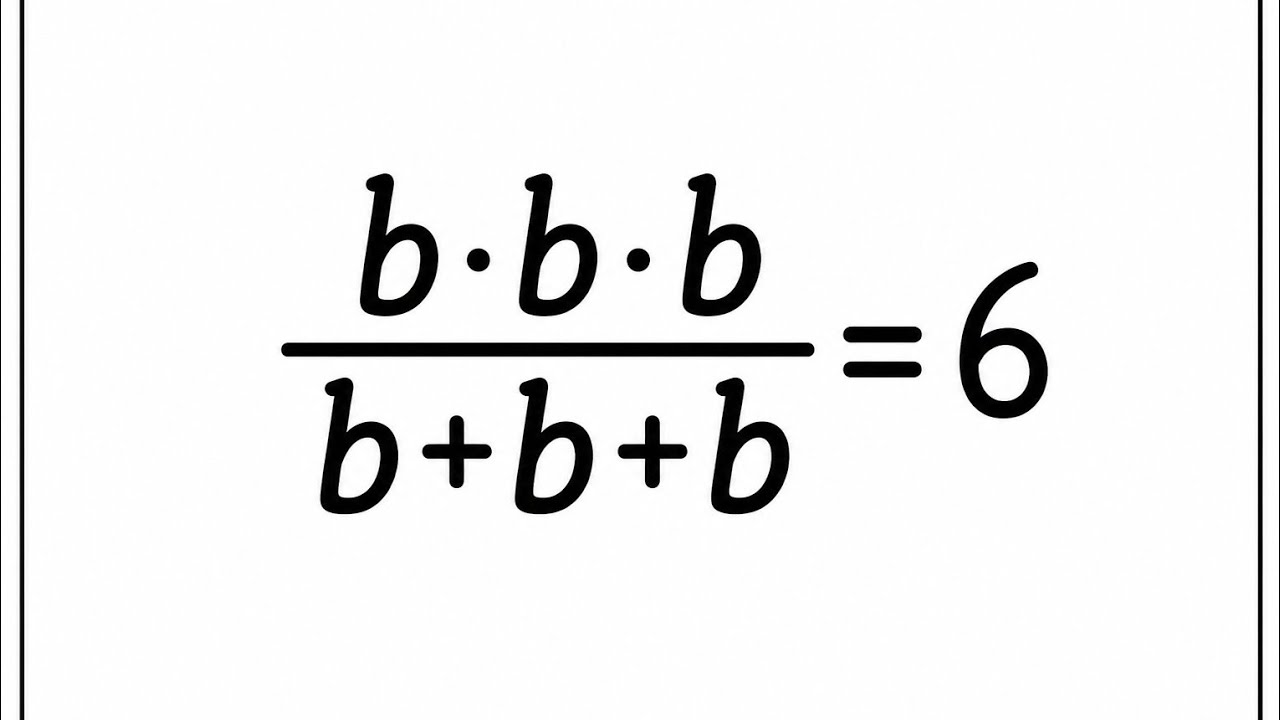
Olympiad Mathematics | Indian | Can You Solve This?
PhilCoolMath
669 views•2026-06-02

Can you get the Correct answer for this Math Quiz?
Fendora01
24K views•2026-05-29

NUMBERBLOCKS COUNT THE TOTAL SUM OF TEN NUMBERS | ADD SMALL TO BIGGEST NUMBER | hello george
hellogeorge2294
5K views•2026-05-28



