A compelling look at how a 1970s relic remains our most profound connection to the cosmos. It perfectly captures the poetic reality of a machine outliving its creators' wildest expectations.
Install our extension to search inside any video instantly.
We just got a signal from DEEP space!!! (Voyager 1: An Intro)Added:
A signal just reached Earth after traveling for almost an entire day from something we launched in the 1970s. And the craziest part is that it's still talking to us from interstellar space.
Today we're going to be talking about where that signal came from, Voyager 1.
Voyager 1 is the farthest human-made object ever built. It was launched on September 5th, 1977 by NASA during a rare planetary alignment that only happens about once every 176 years. This alignment meant something pretty incredible, right? With the right trajectory, a spacecraft could visit multiple outer planets using gravity assists, essentially stealing a little bit of momentum from each planet to slingshot Voyager 1 forward.
Voyager 1's primary mission was to explore the outer solar system, especially Jupiter and Saturn.
And it pretty much delivered. At Jupiter, it revealed active volcanoes on Io, the first ever seen outside of Earth. And at Saturn, it captured pretty detailed images of rings and discovered new moons and structures we didn't even know existed.
But here's the thing, Voyager wasn't just a science mission. It was also kind of a message in a bottle. Attached to it is the golden record, which is a gold-plated disc containing sounds, music, images, and greetings from Earth designed in the case that any intelligent life ever finds it.
After Saturn, Voyager 1's trajectory took it out of the plane of the solar system, giving us the first ever family portrait of our entire planetary system, including the famous pale blue dot image of Earth. And then it just kept going.
NASA essentially extended the mission, turning Voyager 1 into something much bigger, a probe to study the boundary between the solar system and interstellar space. In 2012, it officially crossed the heliopause, which is the edge where the sun's influence ends, >> [music] >> and became the first human-made object to do so and to enter interstellar space. Now, here's where things get really interesting. I mean, Voyager is so far away that its signals travel at the speed of light, and it still takes about 23 hours to reach Earth. That means every time we hear from Voyager, we're literally hearing from the past, from nearly a day ago.
But the signal itself is unbelievably weak, right? By the time it reaches Earth, it's something on the scale of 10 to the -16 W, which is less energy than a single snowflake hitting the ground.
So, how do we even detect such a small signal from Voyager 1 when there's hundreds of millions of thousands of watts coming from the sun and from cosmic rays and totally different things that aren't Voyager 1?
Don't forget to like and subscribe. It's [music] free, and you can change your mind at any point in time, and it really helps me out as well.
Related Videos

Spiral Galaxy NGC 3370 from Hubble | NASA APOD 2025-11-05 #Shorts
galaxygallery
938 views•2026-05-30

SOMETHING inside the SUN is CHANGING
RaysAstrophotography
1K views•2026-06-03

There May Be A Giant Hole In The Universe... And We Might Be Inside It | The Cosmic Ledger Entry 015
TheCosmicLedger
145 views•2026-05-31

Captured the Blue Moon (with a twist) 🌙✨ #space #bluemoon #telescope
realAstroExplorer
674 views•2026-06-01

The Map We Sent to the Stars in 1977 — Why Scientists Now Regret It
TheAncientRecord7
183 views•2026-06-03

Is this a copy of our galaxy? Discover Galaxy M81!
UniverseDocumentaries-cc4mb
995 views•2026-05-31

10 Planet Where a Black Hole Replaces the Sun
cosmicexplorer-EN
147 views•2026-06-02
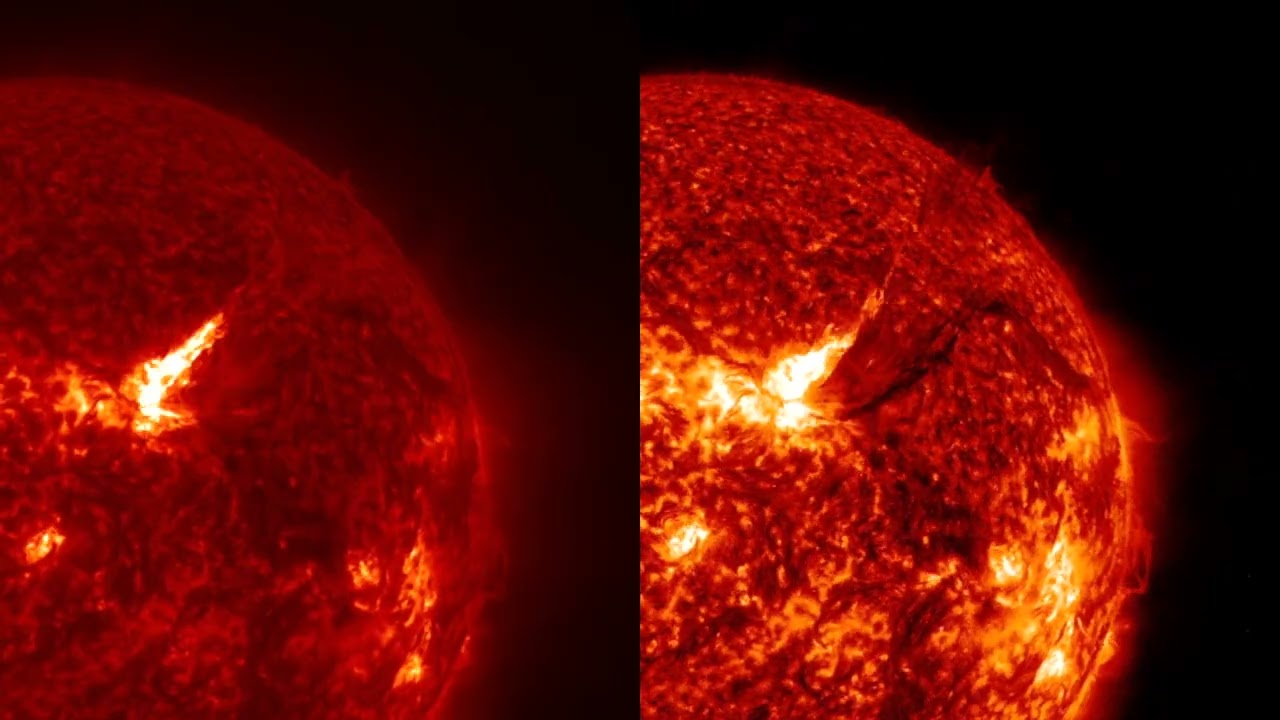
Solar Flares and CMEs at Earth - More Likely | S0 News June.3.2026
SpaceWeatherNewsS0s
2K views•2026-06-03



