This discovery masterfully leverages multi-mission data to transform a temporal anomaly into a profound insight into the Sun's magnetic confinement capabilities. It underscores how collaborative observation is finally catching up to the complex, long-duration dynamics of our local star.
Install our extension to search inside any video instantly.
RECORD! NASA Detected a Solar Burst That Defied ExpectationsAdded:
In August 2025, >> [music] >> NASA scientists detected a solar radio burst that lasted far longer than expected. Instead of fading after a few hours or days, the signal continued for 19 days, breaking the previous record.
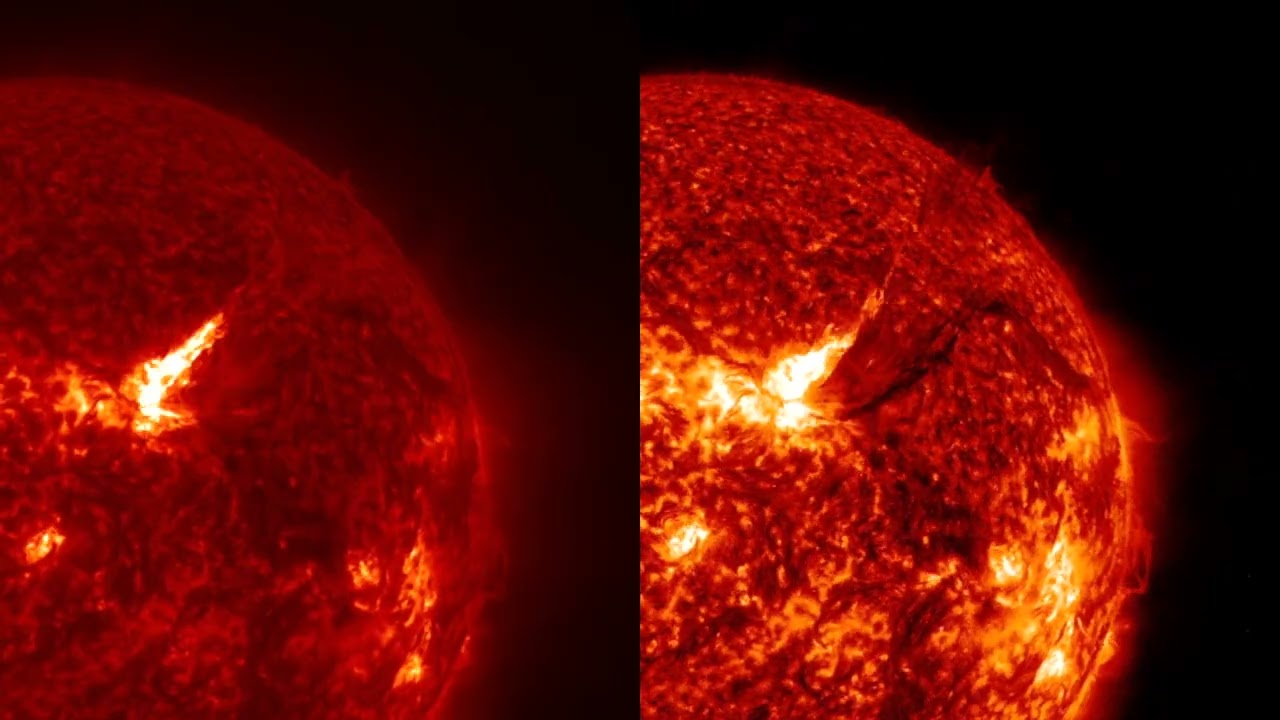
Using data from several spacecraft, researchers traced the burst to a large magnetic structure [music] in the sun's atmosphere called a helmet streamer.
The finding could help scientists [music] better understand long-lasting solar activity and improve space weather forecasting.
>> [music] >> In this video, we will look at what NASA detected, why it lasted so long, and what it means for future space weather predictions. Let's get started.
At first, it looked like just another murmur from the sun. Instruments picked up a type four solar radio burst, radio waves from swarms of energetic electrons trapped in the sun's magnetic fields.
Nothing the heliophysics community hadn't seen before.
Then, it refused to stop. Hours stretched into days. By the time the signal finally faded, it had been humming for 19 days straight, shattering the previous record of about 5 days and forcing scientists to ask what kind of magnetic prison could hold on to those electrons for so long.
Because no single spacecraft had a continuous view, the only way to track the event was to stitch together partial perspectives.
As the sun rotated, the source region moved into and out of sight of NASA's STEREO, Parker Solar Probe, >> [music] >> and Wind spacecraft, along with ESA/NASA's Solar Orbiter, each catching a few days slice of the same long-lived burst. When researchers lined those slices up, the pattern was clear. This wasn't a chain of unrelated flares. It was [music] one extended episode of trapped particles radiating steadily from the same patch of solar atmosphere. Using a new direction-finding technique on STEREO data, the team traced the radio emission back to a towering helmet streamer, a bright cusp-shaped magnetic structure in the corona often seen during total solar eclipses.
>> [music] >> In this case, the streamer seems to have acted like a gigantic magnetic bottle confining electrons fed by a series of coronal mass ejections and turning a routine solar outburst into a 19-day marathon.
That's what makes this event more than just a record. [music] It turns an odd, long-lasting signal into a laboratory for how the sun traps, recycles, and slowly releases energetic particles in its outer atmosphere.
The puzzle at the heart of this event is straightforward to ask and hard to answer. What kept this radio storm alive for 19 days when most type four bursts sputter out in hours or a couple of days? Type four bursts usually come from energetic electrons trapped in magnetic fields radiating as they spiral through plasma.
For that glow to last nearly 3 weeks, something had to keep those electrons confined, replenished, or re-energized far longer than normal.
The helmet streamer seems to be the key suspect. As a huge arching magnetic structure in the corona, it can behave like a bottle. Instead of letting electrons leak freely into space, it can trap them, [music] guiding their motion and letting them keep emitting radio waves as they bounce around inside. But a bottle with no refills runs dry. In the data, NASA scientists also saw three coronal mass ejections erupting from the same region. Each one capable of dumping fresh particles and shaking up the local magnetic field. The emerging picture is that the streamer provided the long-lived magnetic scaffolding while the CMEs fed or re-stirred the electron population. Turning a single outburst into a sustained stop and start marathon.
That shifts attention from the moment of explosion to the long magnetic aftercare.
A long-lasting type 4 burst might be less about one huge flare and more about how effectively the surrounding structures store and manage energetic particles. It also shows why radio data and multiple vantage points matter.
Without wide-angle multi-spacecraft listening posts, this would have looked like a handful of ordinary disconnected bursts instead of one extended revealing experiment in how the sun's magnetic traps actually work.
The biggest practical implication of this discovery is its connection to space weather forecasting.
The radio waves from this burst are harmless on their own. But the magnetic environments that produce these signals can also be linked to solar activity that sends energetic particles into space.
Those particles can affect satellites, spacecraft, >> [music] >> communication systems, navigation services, and astronauts beyond Earth's protective magnetic field.
This is why scientists care about events like this.
A long-duration radio burst may help identify solar regions where energetic particles are being trapped or repeatedly supplied.
>> [music] >> If researchers can connect these radio signals with the behavior of CMEs and helmet streamers, >> [music] >> they may gain better clues about which solar regions remain active after an eruption.
>> [music] >> For forecasting, that distinction matters.
A solar event does not always end when the first eruption fades. The surrounding magnetic structure may continue to evolve. And that continuing activity can be important for understanding future risks. This burst gives scientists a clear example of why the aftermath deserves attention. The next step is likely to involve deeper modeling. Researchers will try to understand how the helmet streamer held energetic electrons, how the three CMEs influenced the region, and whether the conditions that produced this event can be recognized in advance. A strong model would help scientists determine whether similar bursts are rare exceptions or part of a broader pattern. Older data may also become important. Scientists may search past solar observations for long duration type four bursts >> [music] >> that were missed or misunderstood. With improved analysis techniques, some events that once looked separate may turn out to be connected signals from the same rotating solar region.
>> [music] >> This discovery also reinforces the importance of observing the Sun from multiple locations.
Missions like STEREO, Parker Solar Probe, Wind, [music] and Solar Orbiter are not all measuring the same thing from the same place.
Their different positions allow scientists to build a more complete view of solar activity as it moves and evolves. That matters [music] as space activity increases.
Satellites are becoming more important to daily life, and future missions will send more spacecraft and astronauts beyond lower Earth orbit. Better space weather forecasting will require a better understanding of how solar particles are created, trapped, and released. For the general public, the key point is that this was not just a strange signal from the sun.
It was a rare look at how the sun's magnetic structures can keep energetic particles active for a surprisingly long time.
For scientists, it provides a new example that can be tested, modeled, and compared with future events.
NASA's 19-day solar radio burst revealed how long the sun can keep energetic particles active.
>> [music] >> Tracing it to a helmet streamer gave scientists a clearer view of the sun's magnetic behavior.
This discovery could help improve future space weather forecasting. [music] >> [music] [music]
Related Videos

Spiral Galaxy NGC 3370 from Hubble | NASA APOD 2025-11-05 #Shorts
galaxygallery
938 views•2026-05-30

SOMETHING inside the SUN is CHANGING
RaysAstrophotography
1K views•2026-06-03

Captured the Blue Moon (with a twist) 🌙✨ #space #bluemoon #telescope
realAstroExplorer
674 views•2026-06-01

There May Be A Giant Hole In The Universe... And We Might Be Inside It | The Cosmic Ledger Entry 015
TheCosmicLedger
145 views•2026-05-31

The Map We Sent to the Stars in 1977 — Why Scientists Now Regret It
TheAncientRecord7
183 views•2026-06-03

10 Planet Where a Black Hole Replaces the Sun
cosmicexplorer-EN
147 views•2026-06-02

Is this a copy of our galaxy? Discover Galaxy M81!
UniverseDocumentaries-cc4mb
995 views•2026-05-31
Solar Flares and CMEs at Earth - More Likely | S0 News June.3.2026
SpaceWeatherNewsS0s
2K views•2026-06-03



