The video provides a clear and insightful synthesis of recent data, effectively explaining Betelgeuse's erratic behavior through the lens of binary interaction. It is a well-crafted piece that respects scientific rigor while remaining accessible to a sophisticated audience.
Install our extension to search inside any video instantly.
BREAKING: Scientists Finally Discovered What’s Wrong With Betelgeuse!Added:
Roughly 650 light years away, a giant star in the night sky is behaving in ways that are terrifying astronomers.
Betelgeuse suddenly darkened so dramatically that scientists feared they might be witnessing [music] the beginning of a supernova explosion in real time.
But the deeper researchers investigated, the stranger the [music] mystery became.
A hidden 6-year cycle, violent plasma eruptions, and evidence of a possible [music] invisible companion star are now forcing astronomers to rethink everything [music] they believed about this cosmic giant.
And what they are discovering may reveal that Betelgeuse [music] is not simply dying. It may be unraveling in ways nobody expected.
For centuries, Betelgeuse has been one of the easiest [music] stars to recognize in Earth's sky.
Sitting on the shoulder of the constellation Orion, its reddish glow has fascinated astronomers for generations.
But in late 2019, something happened that immediately shocked the scientific world. The star began fading at an unbelievable [music] rate.
At first, astronomers thought their instruments were malfunctioning.
Betelgeuse was losing brightness so quickly that even ordinary skywatchers could notice the difference with their own eyes.
Within months, the star had dimmed by nearly 2/3.
For a giant star already approaching the end of its life, this was deeply alarming.
Scientists immediately started asking the question nobody [music] wanted to hear.
Was Betelgeuse about to explode?
That possibility mattered because Betelgeuse [music] is not an ordinary star. It is a red supergiant, one of the largest types of stars in the universe.
If placed at the center of our solar system, its outer atmosphere could stretch beyond the orbit of Mars.
Stars like this do not die quietly.
Eventually, their cores [music] collapse and trigger a supernova powerful enough to briefly outshine entire galaxies.
Naturally, [music] astronomers rushed to investigate.
Observatories around the world turned toward Betelgeuse, including the Hubble Space Telescope and the European Southern Observatory's Very Large Telescope.
Researchers wanted to know whether they were witnessing the final moments before one of the closest future supernovas ever observed from Earth.
But, the answer turned out to be even [music] stranger.
Scientists discovered that Betelgeuse had violently expelled a massive amount of superheated plasma from its surface.
This eruption was so enormous that researchers later described it as one of the biggest stellar outbursts ever directly observed.
The material blasted away from the star at incredible speeds before cooling in space and condensing [music] into a gigantic cloud of dust.
That dust cloud drifted directly between Betelgeuse and Earth, temporarily blocking much of the star's light.
In simple terms, the star had created its own cosmic smokescreen.
The discovery solved one mystery, but immediately created another.
Astronomers now understood how the dimming happened.
What they could not explain was why such an enormous eruption occurred at that exact moment.
And when scientists began searching older observations for clues, they discovered something [music] deeply unsettling hiding in Betelgeuse's history.
The star appeared to follow a mysterious rhythm nobody could fully explain.
Long before the great dimming captured global attention, astronomers already knew Betelgeuse behaved differently from most stars.
Its brightness naturally rises and falls over time [music] in a repeating pattern.
Scientists linked this behavior to gigantic [music] convection cells moving beneath the surface.
Imagine boiling water inside a pot, except [music] each bubble is larger than entire planets.
Hot gas rises upward, cooler material sinks back [music] down, and the star's brightness changes as different regions dominate its surface.
That regular cycle repeats roughly every [music] 400 days, and astronomers had studied it for decades.
But buried inside more than a century of observations was another pattern that made far less sense.
Researchers discovered a second brightness [music] cycle repeating approximately every 2,170 days, or just under 6 years.
This strange long-term rhythm refused [music] to fit existing models of stellar behavior.
For years, scientists debated possible [music] explanations, but none fully solved the puzzle.
Then, a new theory started gaining serious attention.
What if Betelgeuse is not alone?
Astronomers began proposing that a smaller hidden companion star might be orbiting Betelgeuse every 6 years.
Detecting such [music] an object would be extremely difficult because the red supergiant is overwhelmingly bright.
Trying [music] to see a faint nearby star next to Betelgeuse would be like trying to spot a flashlight beside a stadium floodlight.
But while the companion itself might remain invisible, its gravitational [music] effects could still reveal its presence.
Scientists realized the companion's orbit lined up surprisingly [music] well with the mysterious 6-year cycle.
As it moves [music] around Betelgeuse, its gravity could periodically disturb the giant star's outer atmosphere, creating waves and instabilities that slightly alter the star's brightness [music] over time.
Suddenly, the great dimming no longer looked like an isolated event.
Researchers started exploring whether the hidden companion may have helped trigger the massive plasma eruption itself.
If the smaller star passed through a particularly dense region of [music] Betelgeuse's outer atmosphere, its gravity could have destabilized one of the giant convection [music] cells near the surface.
That disturbance may have provided the final push needed to launch billions of tons of material into space.
And this is what makes the discovery so important.
Betelgeuse is the closest red supergiant to Earth, meaning [music] astronomers can study it in extraordinary detail compared to similar stars farther away.
If companion stars can influence giant stars this dramatically, scientists may need [music] to rethink how massive stars lose material before exploding as supernovas.
That affects much more than Betelgeuse itself.
It changes how astronomers model stellar evolution across the universe.
But as researchers continued analyzing the star, another mystery emerged that seemed even harder to explain.
Betelgeuse appeared to be spinning far faster than physics said it should.
The spin mystery surrounding Betelgeuse may be the most bizarre clue in the entire story because it directly challenges the normal behavior expected from giant stars. When stars expand into red supergiants, they are supposed to slow down dramatically. The physics works similarly to a spinning ice skater extending their arms outward. As the object becomes larger, its rotation speed decreases. [music] Since Betelgeuse is enormous enough to potentially stretch beyond Mars if placed inside our solar system, astronomers expected it to rotate very slowly.
>> [music] >> Instead, observations suggested something shocking. Scientists measured what appeared to be a rotation speed of nearly 5 km per second. For a star this massive, that number made almost no sense. Researchers immediately searched for explanations. One dramatic theory suggested Betelgeuse may have swallowed [music] another star sometime in the distant past. If a smaller companion spiraled inward and merged with the giant, its orbital momentum could have transferred enormous energy into Betelgeuse, spinning it up far beyond normal expectations. [music] It sounded like the perfect explanation for such a chaotic star. But newer research introduced [music] an even stranger possibility. What if Betelgeuse is not spinning that fast at all?
>> [music] >> Recent simulations suggest astronomers may actually be seeing an illusion created by the star's violent [music] surface turbulence. Betelgeuse is covered by gigantic convection cells carrying hot gas upward while cooler material crashes downward. [music] These motions create shifting Doppler patterns in the star's light that can mimic the appearance of rapid rotation. [music] In many computer simulations, the fake rotational signal looked almost identical to a genuinely fast spinning star. That changes the story completely.
If the rapid spin is merely an illusion, then Betelgeuse may not need the swallowed star explanation at all.
Instead, it could simply be one of the most turbulent [music] stellar environments ever observed directly. And when scientists combined this turbulence with the hidden companion theory, a fascinating picture started emerging.
The companion star could periodically disturb Betelgeuse's unstable atmosphere. Those disturbances might trigger giant plasma eruptions like the one responsible for the great dimming.
Meanwhile, enormous convection cells across the surface create the illusion of impossible rotation. Suddenly, multiple mysteries began [music] connecting together into one larger explanation. This is why Betelgeuse has become one of the most important [music] objects in modern astronomy. Scientists are not simply watching a dying star anymore. They are observing [music] stellar physics unfold in real time.
Every eruption, brightness fluctuation, and surface movement [music] provides clues about how massive stars behave during their final evolutionary stages. And perhaps the most fascinating part is that all these discoveries have actually made predicting Betelgeuse's future harder, not easier. Astronomers still know the star will eventually explode as a supernova. That fate is unavoidable. [music] But now scientists realize there are far more variables involved than they originally thought. The hidden companion could influence the star's evolution.
Internal turbulence could alter how mass is expelled into space. Surface instabilities may change over time in unpredictable ways.
In other words, Betelgeuse is teaching astronomers a humbling lesson. The universe is far more complicated than our first theories suggest.
Betelgeuse was once viewed [music] as a giant star slowly approaching an inevitable supernova explosion.
But recent [music] discoveries revealed something far stranger hiding beneath that familiar red glow.
Massive plasma eruptions, mysterious 6-year cycles, possible hidden companions, and turbulent [music] surface motions have transformed this star into one of astronomy's greatest cosmic mysteries.
Scientists are no longer simply waiting for Betelgeuse to explode. They are uncovering a giant stellar puzzle piece by piece.
And the next time you look up at Orion's shoulder, [music] remember this. You are not just looking at a dying star.
You may be watching one of the universe's most chaotic final acts unfold in real time. [music] So, what's the strangest part of the Betelgeuse mystery to you?
The great dimming?
The hidden 6-year cycle?
The impossible spin?
Or the idea of an invisible companion star? [music] Drop your thoughts in the comments. I'm genuinely curious.
If you enjoyed this video, don't forget to like, share, and subscribe for more updates on space exploration and scientific discoveries. Your support truly makes a difference and helps this channel grow. Thank you for watching and see you next time.
Related Videos

Spiral Galaxy NGC 3370 from Hubble | NASA APOD 2025-11-05 #Shorts
galaxygallery
938 views•2026-05-30

SOMETHING inside the SUN is CHANGING
RaysAstrophotography
1K views•2026-06-03

There May Be A Giant Hole In The Universe... And We Might Be Inside It | The Cosmic Ledger Entry 015
TheCosmicLedger
145 views•2026-05-31

Captured the Blue Moon (with a twist) 🌙✨ #space #bluemoon #telescope
realAstroExplorer
674 views•2026-06-01

The Map We Sent to the Stars in 1977 — Why Scientists Now Regret It
TheAncientRecord7
183 views•2026-06-03

Is this a copy of our galaxy? Discover Galaxy M81!
UniverseDocumentaries-cc4mb
995 views•2026-05-31

10 Planet Where a Black Hole Replaces the Sun
cosmicexplorer-EN
147 views•2026-06-02
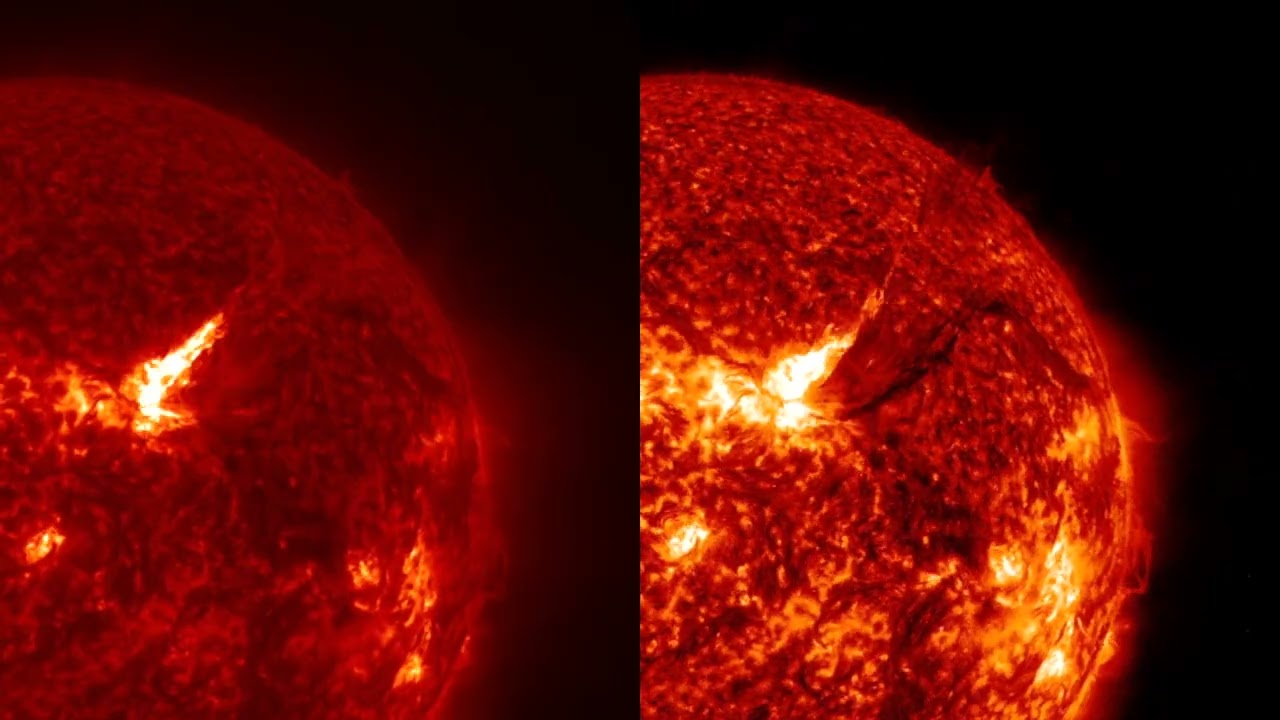
Solar Flares and CMEs at Earth - More Likely | S0 News June.3.2026
SpaceWeatherNewsS0s
2K views•2026-06-03



