The universe continues to mock our preference for clean lines, revealing a cosmic boundary far more nuanced than our textbooks dared to predict. Voyager 2’s data isn't "impossible"—it’s a humbling reminder that nature rarely follows a simple script.
Install our extension to search inside any video instantly.
Voyager 2 Has Made An “IMPOSSIBLE” Discovery After 46 Years In SpaceAdded:
Somewhere in the cold, black silence, far beyond the planets, a machine built in the 1970s is still whispering back to Earth. Its memory is smaller than a modern car key. Its transmitter is weaker than a refrigerator light bulb.
And yet, after 46 years in space, Voyager 2 is still [music] sending back data from a region no human technology was ever truly expected to survive [music] long enough to explore. That alone would be extraordinary. But what makes this story unsettling [music] is not just that Voyager 2 is still alive.
It is what it found out there.
Because when scientists expected to see the clear boundary between our solar system and interstellar space, Voyager 2 found something that did not behave the way the textbook [music] said it should. No dramatic magnetic flip. No clean cosmic doorway.
Just a discovery so strange that it forced researchers to confront a terrifying [music] possibility.
Maybe the edge of our solar system is far more complex than we ever imagined.
Voyager 2 exists because of one [music] of the rarest opportunities in modern astronomy.
In the late 1970s and early 1980s, Jupiter, Saturn, Uranus, and Neptune aligned in a way that only happens once every 176 [music] years.
That alignment meant a spacecraft could use the gravity [music] of one giant planet after another like invisible stepping stones, gaining speed with each encounter, and turning what should have been a 30-year journey to Neptune into something far shorter.
NASA realized the opportunity was too extraordinary to ignore, so it launched two nearly identical spacecraft, Voyager 1 and Voyager 2, just days apart in 1977. [music] They were designed for a mission expected to last only 4 years. Instead, they became the longest-running explorers in the history of spaceflight.
And what makes that achievement even more incredible is how primitive the spacecraft really are by modern standards. Each one carries [music] just 69 kilobytes of memory, not megabytes.
Kilobytes. The data is stored on eight-track tape recorders. Their signals are transmitted through a 23-watt radio [music] system so weak that hearing them from billions of miles away is like trying to catch the faintest squeak in the middle of a hurricane.
And yet, Voyager 2 kept going.
It flew past Jupiter, then Saturn, then became the first and only spacecraft [music] ever to visit Uranus in 1986, and Neptune in 1989.
It crossed the asteroid belt, survived the giant planets, and continued flying outward into a region humanity had never touched before.
That is what makes Voyager 2 feel almost mythic.
It is not just a spacecraft. It is a survivor from another technological age, still functioning in a place that was once pure theory.
Like an old ship built from wood and brass, somehow drifting into waters no one believed it could ever reach.
Voyager 2 kept traveling long after its designers had any reason to think it would.
And after more than four [music] decades in space, it arrived at the one place scientists most desperately wanted to understand, the border of the heliosphere, the invisible magnetic [music] bubble created by the sun.
That is where the impossible discovery began.
For years, scientists believed they had a rough idea of what the edge of [music] our solar system should look like.
The heliosphere, inflated by the solar wind, acts like a giant [music] magnetic cocoon surrounding the planets and shielding us from much of the radiation coming from deep space.
Somewhere far beyond Pluto, this protective bubble was expected to end at a boundary called the heliopause, where the outward pressure of the solar wind gives way to the interstellar medium.
Researchers thought that when Voyager crossed that line, the signs would be unmistakable. Galactic cosmic rays would surge, plasma density would jump, and most importantly, the dominant magnetic field direction should shift because the spacecraft would be leaving the sun's magnetic domain and entering a region shaped by the wider galaxy.
But that is not what happened.
Voyager 1 reached the heliopause first in August [music] 2012 and detected some of the expected signs, including the increase in plasma density. But it did not see the clean magnetic field change scientists had anticipated. That was puzzling enough.
Then Voyager 2 arrived at the interstellar shore in November 2018 and returned an even more unsettling confirmation.
It also crossed a region around 120 astronomical units from Earth.
It also saw the telltale [music] changes in cosmic rays and plasma conditions.
But once again, there was no dramatic [music] magnetic flip.
The boundary existed, and yet it did not behave like a simple dividing line.
That was the discovery that sent shockwaves through the scientific community.
Because it suggested the heliopause [music] is not some clean edge like stepping out of a house into open air.
It may be more [music] like walking through coastal fog, where land and sea blend into one another in ways that are hard to define.
The Voyagers were finding [music] small-scale turbulence, signs of interaction, and complex transitions near the border. But not the large-scale [music] magnetic separation theory had promised.
That meant one of two things.
Either the heliosphere [music] interacts with interstellar space in a far stranger way than the models predicted, or the Voyagers are showing [music] us that the very concept of a simple solar system boundary was wrong from the start.
The deeper scientists [music] looked, the stranger the picture became.
Theoretical models had predicted that the heliosphere should expand [music] and contract with the sun's 11-year activity cycle.
When the solar wind is stronger, the heliopause should be pushed farther outward. When it weakens, the boundary should retreat inward.
So by the time Voyager 2 reached that frontier, the conditions suggested the heliopause ought to have been farther away than where the spacecraft actually encountered it.
But once again, reality did not cooperate.
Voyager 2 crossed at roughly the same distance as Voyager 1 had years earlier, even though the solar conditions were different. The models did not line up.
And that is where the discovery became truly disturbing.
This was not just one odd reading from one old spacecraft. It was two independent probes arriving years apart, both finding a boundary more complicated and less obedient than theory allowed.
The data showed that the heliosphere's interaction with the interstellar medium produced noticeable turbulence on small scales, [music] but almost no large-scale field variation where researchers expected it most.
That means the giant magnetic bubble surrounding our solar system may not have a simple, stable shape at all.
It may twist, blend, ripple, and distort in ways that make our whole picture of the solar frontier too neat and too human.
Like trying to understand the shape [music] of a fishbowl from the perspective of a fish inside it, scientists are being forced to admit how little they truly know about the structures surrounding us.
From Earth, the heliosphere seemed like a manageable concept, a protective shell, a cosmic border, a clear transition between home and the wider galaxy.
But Voyager 2 revealed something more unsettling.
The border may not be a line. It may be a moving, tangled region where solar influence and interstellar forces braid together in ways we still cannot map properly.
In other words, after 46 years in [music] space, Voyager 2 may have discovered that the frontier between our solar system and everything beyond it is not just distant. It is fundamentally more mysterious than we were prepared for.
What makes all of this even more incredible is that Voyager 2 made this discovery while operating in conditions that should have shut it down long ago.
The spacecraft is powered by heat from radioactive [music] plutonium slowly decaying into electricity, and every year it loses more power.
NASA has been forced into an engineering form of triage, >> [music] >> shutting down heaters and nonessential systems one by one just to keep the mission alive.
Instruments that were expected to fail in extreme cold kept working anyway, even after temperatures [music] dropped far beyond tested limits.
It is one of the most astonishing examples of durability in the history of exploration. [music] At this point, Voyager 2 is not just collecting data. It is enduring, still sending whispers [music] across billions of miles with technology older than most people alive today.
Still teaching us about a region no one fully understood. And the longer it survives, >> [music] >> the more profound its role becomes.
This spacecraft was never intended to explore interstellar space. It was built to tour the outer planets and then go silent. Instead, it outlived its mission by decades and ended up finding one of the deepest mysteries in heliophysics.
That alone feels almost poetic. A machine from the [music] past revealing that the future of our understanding is still unfinished.
And beyond the science, there is something almost haunting [music] about Voyager 2's journey.
It is still traveling outward.
Long after its instruments fall silent, it will continue [music] into the dark for thousands, then millions of years.
It carries the golden record, a message from Earth meant for a universe that may never answer.
And somehow that makes the discovery even more powerful.
Because Voyager 2 did not just show us an unexpected boundary at the edge of the sun's [music] reach.
It reminded us that even the places we thought we understood as borders are still [music] full of uncertainty.
The solar system does not end with clarity. It dissolves into [music] mystery.
So in the end, Voyager 2 did not just survive longer than anyone expected. It reached the edge of the sun's influence and found something far more unsettling than a simple [music] border.
What scientists expected to be a clear transition between our solar system and interstellar space turned out to be messy, turbulent, and deeply confusing.
The cosmic rays changed. the plasma changed, but the magnetic field did not behave the way the models said it should.
And that means one of the most important boundaries around our entire solar system may be far more complex than we ever imagined.
>> [music] >> That is what makes this discovery feel so powerful.
Not because Voyager 2 found some giant object or dramatic explosion, but because it exposed [music] a deeper kind of mystery, the kind that forces science to admit that even after decades of theory, the frontier around us is still not fully [music] understood.
The heliopause was supposed to be a line.
Voyager 2 revealed something more like a living boundary, a shifting entangled region [music] where the sun's influence does not simply stop, but slowly gives way to the wider [music] galaxy in ways we still cannot explain.
And maybe that is the most incredible part of all.
A spacecraft built in the 1970s, [music] running on fading power and ancient technology, traveled billions of miles just to tell us that the map is incomplete. That the edge of home is stranger than we thought.
That even now, after 46 years in space, Voyager 2 is still teaching humanity how little we truly know.
If this changed the way you [music] see space, subscribe, turn on notifications, and stay with us. Because Voyager's final whispers may still carry discoveries [music] that rewrite what we know about the universe.
Related Videos

Spiral Galaxy NGC 3370 from Hubble | NASA APOD 2025-11-05 #Shorts
galaxygallery
938 views•2026-05-30

SOMETHING inside the SUN is CHANGING
RaysAstrophotography
1K views•2026-06-03

Captured the Blue Moon (with a twist) 🌙✨ #space #bluemoon #telescope
realAstroExplorer
674 views•2026-06-01

There May Be A Giant Hole In The Universe... And We Might Be Inside It | The Cosmic Ledger Entry 015
TheCosmicLedger
145 views•2026-05-31

The Map We Sent to the Stars in 1977 — Why Scientists Now Regret It
TheAncientRecord7
183 views•2026-06-03

10 Planet Where a Black Hole Replaces the Sun
cosmicexplorer-EN
147 views•2026-06-02

Is this a copy of our galaxy? Discover Galaxy M81!
UniverseDocumentaries-cc4mb
995 views•2026-05-31
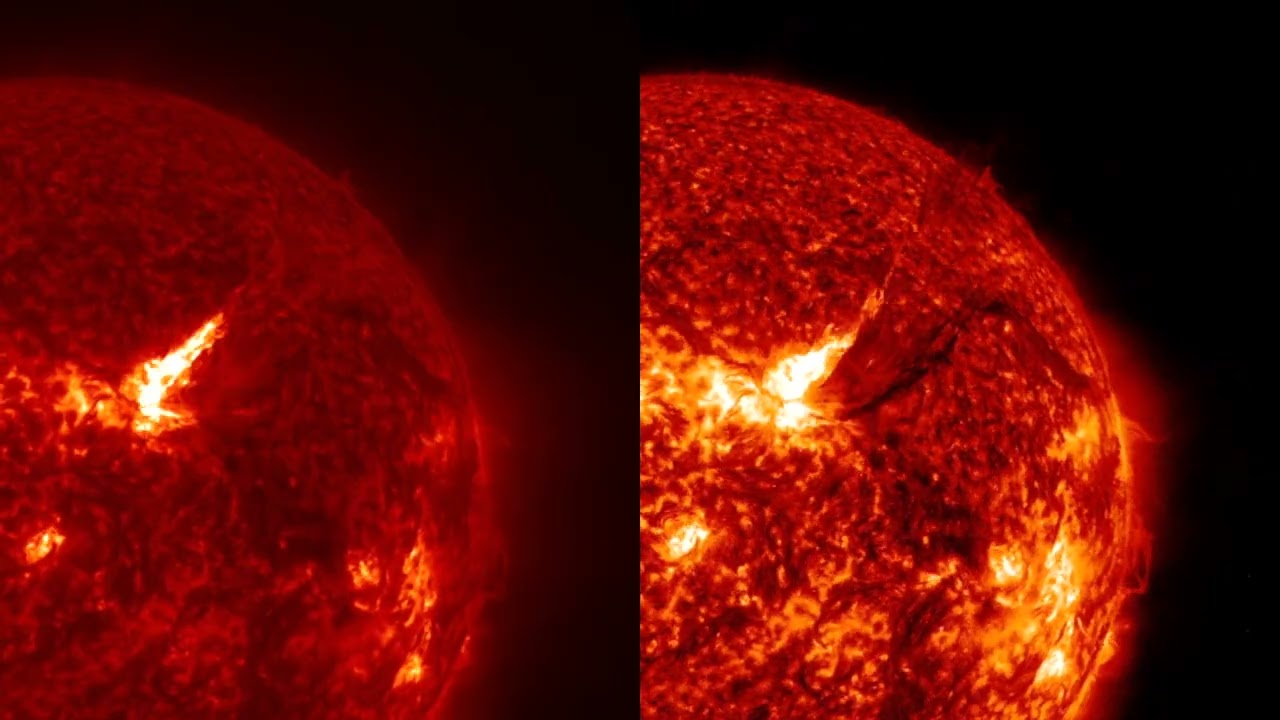
Solar Flares and CMEs at Earth - More Likely | S0 News June.3.2026
SpaceWeatherNewsS0s
2K views•2026-06-03



