The video provides a lucid synthesis of cosmic topology, grounding abstract theoretical paradoxes in the latest empirical data from the James Webb Telescope. It is a commendable piece of science communication that respects the viewer's intellect while maintaining clarity.
Install our extension to search inside any video instantly.
The Paradox of an Infinite Universe Explained | James Webb Telescope DiscoveryAdded:
Is the universe truly without end or does it possess a boundary? Some distant frontier where reality itself begins to fade.
And if such an edge exists, what, one might wonder, would greet you there?
For centuries, humanity has gazed into the night sky searching not only for stars, but for answers.
Today, modern cosmology offers a profound revelation. The universe was born roughly 14 billion years ago in an event we call the Big Bang and ever since it has been expanding quietly, relentlessly, stretching the very fabric of space itself.
Now, at first glance, this seems to invite a simple question. If something expands, surely it must have an edge, a limit, a place where it ends.
And yet, the universe resists such simplicity.
You see, there is a fundamental constraint woven into reality itself.
Nothing can travel faster than light.
Not matter, not energy, not even information. And so, there is a limit to what we can observe, a cosmic horizon beyond which we cannot see. Not because there is nothing there, but because it's light has not yet had time to reach us.
When we look out into the cosmos, what we truly behold is not the entire universe, but a vast sphere centered on our own tiny vantage point. This is known as the observable universe and due to the continuous expansion of space, the most distant galaxies we can detect are not merely 14 billion light-years away from us today, but closer to 45 billion light-years from us today.
Within this immense sphere lie hundreds of billions of galaxies, each containing countless stars, planets, and perhaps other forms of life.
It is a staggering expanse, yet still only a fraction of what exists.
In this sense, there is indeed an edge, but it is not a physical wall or boundary. It is something far more subtle, an edge in time itself, a limit defined not by space, but how far back into the past we can see.
Beyond it lies darkness, not empty, but simply unknowable.
And this is where the mystery deepens.
If the observable universe is only a portion of the whole, then how vast is the entirety?
Does space go on forever or does it in some grand and elegant way curve back upon itself?
There are, broadly speaking, two possibilities. The first is that the universe is finite, but without boundaries. At first, this may seem contradictory. How can something be limited in size, yet have no edge?
To understand this, we must turn to analogy.
Imagine the surface of an orange. To a tiny ant walking upon it, the surface appears endless. There is no edge to fall off. And yet, the surface is not infinite. If the ant travels far enough in a straight line, it will eventually return to where it began.
In a similar fashion, the universe itself may possess a shape, a higher dimensional curvature we call a hypersphere.
In such a cosmos, space wraps around itself. There is no outside, no boundary to cross, and no edge to encounter, only a seamless, continuous expanse.
This idea emerges from one of the most profound discoveries in physics, that gravity is not merely a force, but a manifestation of curved space-time.
Massive objects, stars, galaxies, clusters, bend the fabric of the universe and on the largest scales, this curvature could shape the entire cosmos.
If this is the case, then the universe, though finite, could be unimaginably vast, so large that from our limited perspective, it appears perfectly flat.
Observations suggest that if such curvature exists, the true universe must be at least a thousand times larger than what we can see and perhaps vastly more.
But there are even stranger possibilities. Some theories suggest a universe with a far more exotic geometry, something akin to a multi-dimensional torus or what one might loosely imagine as a cosmic donut.
In such a universe, traveling in a straight line could still bring you back to your starting point, but not in a simple, symmetrical way.
Distances might differ depending on direction. Light could traverse multiple paths, creating a hall of mirrors effect across the sky. A single distant star might appear in multiple locations and even at different stages of its life.
You might witness its birth in one direction and its distant demise in another.
Such a universe, while finite, could be surprisingly compact, perhaps only a few times larger than the observable cosmos.
Yet, even this remains speculative, for no such patterns have been conclusively observed.
And so, we arrive at the second great possibility.
What if the universe is not finite at all, but infinite?
An infinite universe stretches beyond all limits, no boundaries, no edges, only an endless expanse of galaxies, stars, and cosmic structures extending forever in every direction.
In fact, many of our current cosmological models are consistent with such a reality. They describe a universe that, on the largest scales, appears uniform and endless.
But infinity brings with it profound and often unsettling implications. For instance, if the universe is infinite, then even with a finite set of particles and physical laws, the number of possible arrangements of matter is also finite. However vast.
And in an infinite cosmos, those arrangements may inevitably repeat.
Somewhere, unimaginably far away, there could exist another world indistinguishable from our own. Another Earth. Another history.
Perhaps even another you watching this very moment unfold.
It is a notion both fascinating and deeply humbling.
For while the probability of such exact repetition is vanishingly small, in an infinite universe, even the rarest possibilities may occur again and again.
And yet, these distances are so vast that they defy comprehension.
To encounter such a duplicate, one might need to travel distances so immense they render the journey effectively impossible.
Far beyond the reach of any conceivable technology.
So, we are left with a curious paradox.
The universe may be finite, yet without edges, or infinite, yet filled with repetition.
It may curve in ways we cannot visualize or extend forever beyond our grasp.
Each possibility challenges not just the structure of the universe, but our place within it.
They remind us that what we see is only a fragment of a far greater whole.
That the cosmos is not merely large, but profoundly mysterious.
For all practical purposes, our universe, the observable universe, is finite. It has a horizon. A boundary in time.
Everything we have ever known or ever will know lies within it.
And yet, within this finite domain exists a richness beyond measure.
Galaxies without number. Worlds uncounted. Possibilities without end.
Whether the universe is infinite or not may remain unanswered for generations to come.
But perhaps, in the end, that question is less important than what we choose to do with what we can see.
Because even this small corner of the cosmos is more than vast enough to inspire wonder, to ignite curiosity, and to carry the dreams of countless generations into the stars. And in that sense, it is, for us, infinite enough.
Related Videos

Spiral Galaxy NGC 3370 from Hubble | NASA APOD 2025-11-05 #Shorts
galaxygallery
938 views•2026-05-30

SOMETHING inside the SUN is CHANGING
RaysAstrophotography
1K views•2026-06-03

Captured the Blue Moon (with a twist) 🌙✨ #space #bluemoon #telescope
realAstroExplorer
674 views•2026-06-01

There May Be A Giant Hole In The Universe... And We Might Be Inside It | The Cosmic Ledger Entry 015
TheCosmicLedger
145 views•2026-05-31

The Map We Sent to the Stars in 1977 — Why Scientists Now Regret It
TheAncientRecord7
183 views•2026-06-03

10 Planet Where a Black Hole Replaces the Sun
cosmicexplorer-EN
147 views•2026-06-02

Is this a copy of our galaxy? Discover Galaxy M81!
UniverseDocumentaries-cc4mb
995 views•2026-05-31
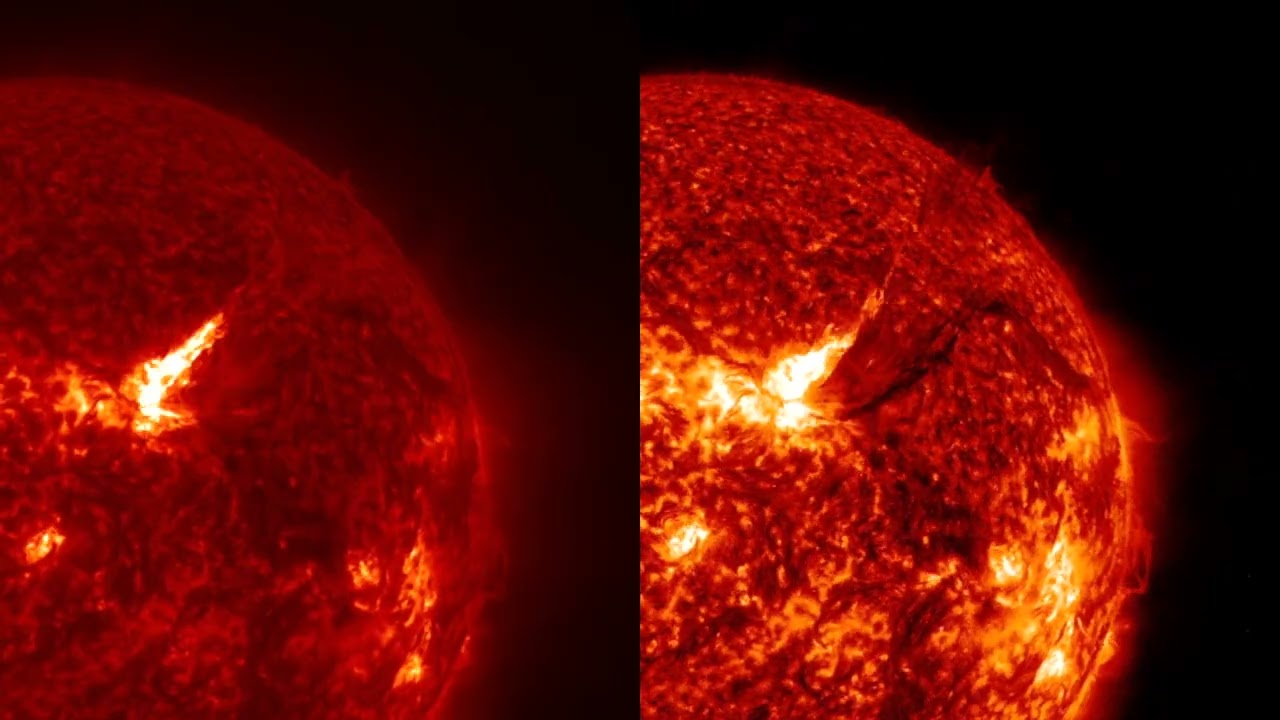
Solar Flares and CMEs at Earth - More Likely | S0 News June.3.2026
SpaceWeatherNewsS0s
2K views•2026-06-03



