This compilation effectively exploits cosmic dread to illustrate the fragility of our satellite-dependent world, though it prioritizes visceral impact over scientific nuance. It serves as a polished digital memento mori that reminds us our technological dominance is merely a grace period granted by a chaotic universe.
Install our extension to search inside any video instantly.
The Most Disturbing Events in Space (Pt. 2)Added:
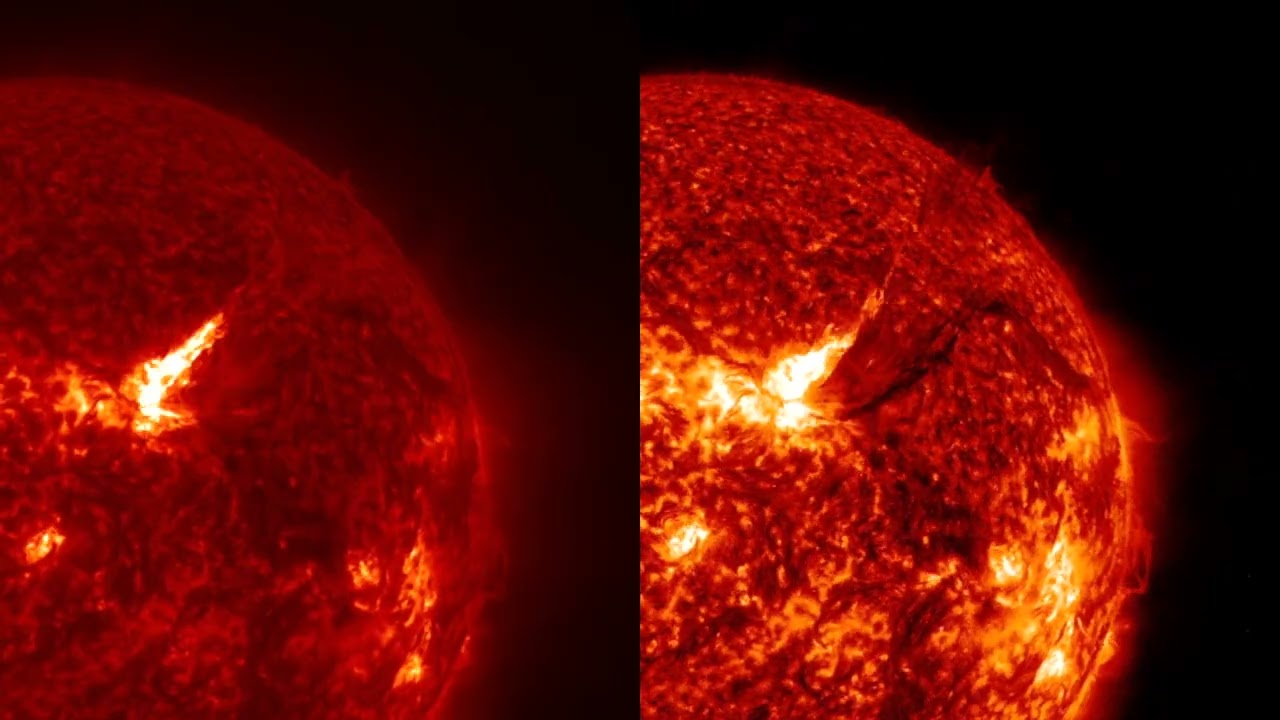
The 2012 near miss. In July 2012, something happened in space that most people on Earth never heard about. And the scary part is that we were just 9 days away from being in a completely different world today. The sun had an incredibly violent outburst. It was a massive cloud of charged particles shot out from its surface at incredible speed. We call this a coronal mass ejection. This particular one on July 23rd of that year was not a normal one.
Scientists later measured it and found it was one of the most powerful ever recorded, possibly stronger than anything we had seen in over 150 years.
Now, here is where things get uncomfortable. The cloud missed Earth, but only because our planet had moved past that exact spot in its orbit about 9 days earlier. These 9 days are the only reason life as we know it continued without interruption. What would have happened if it had hit? Scientists who studied the event estimated it could have fried satellites, collapsed power grids across entire continents, and knocked out GPS and internet systems worldwide. The recovery time would have likely been years, if not longer. Cosmos 954.
On January 24th, 1978, people in northwestern Canada heard a low rumble moving across the sky. Some saw a streak of light and a few reported feeling uneasy without knowing why. They had no idea what was passing over them. But we do now, and it's much scarier than what they could have imagined. Cosmos 954 had been launched by the Soviet Union in September of 1977. It needed a lot of power, and the solution was a small nuclear reactor on board, fueled by enriched uranium. For a while, everything worked as planned. But then the Soviets lost control of it. By the time it became clear the satellite was going to fall, there was no way to stop it. It re-entered the atmosphere and started breaking down, scattering debris across a massive stretch of Canadian wilderness, covering an area of roughly 124,000 square kilm. That is an area larger than many countries. A joint American and Canadian operation called Operation Morning Light was launched to find and recover the wreckage. They eventually found around 12 large pieces of debris. Some of those pieces were so radioactive that being near them for too long would have been dangerous to a person's health. But there's something pretty disturbing. The recovered pieces represented only about 1% of the total satellite. The other 99% was either burned up in the atmosphere, sunk to the bottom of lakes, or was simply never found somewhere out there in the wilderness. The Soviet Union paid Canada a settlement afterward. The mutated space fungi. In the late 1990s, the Russian Mir space station developed a problem that felt straight out of a sci-fi horror movie. Mir had been orbiting Earth since 1986, and over the years, it had become home to something unexpected. Cosminauts and researchers eventually found fungal growth behind wall panels, on equipment, on rubber seals, on cables, and even on the windows. The station, which was built from metal and glass and synthetic materials, was being slowly eaten from the inside. The incredible part was what the space environment had done to these organisms. Fungi on Earth are already remarkably tough. In space, exposed to high radiation, microgravity, and conditions nothing like what they evolved in. These organisms didn't die.
They adapted. Studies found that some of the strains collected from MIR had changed in ways that made them more resilient, harder to kill, and in some cases, more aggressive toward the materials they were growing on. There were strains that showed resistance to the cleaning methods used to remove them. For the cosminauts living inside the station, this raised real health concerns, while for scientists thinking about long duration space missions in the future, it raised a different one.
If microorganisms can change this quickly in space, what else might change given enough time and enough distance from Earth? The Veila incident. On September 22nd, 1979, an American satellite called Veila picked up something unusual over a remote stretch of ocean between South Africa and Antarctica. It was a double flash of light, extremely brief, extremely bright. And the reason that specific pattern mattered so much is that it had only ever been seen in one context before. It was the signature of a nuclear explosion. Matter of fact, Veila satellites were built for exactly this purpose. During the Cold War, the United States needed a way to monitor whether other countries were secretly testing nuclear weapons. So, these satellites were sent up specifically to watch for that kind of flash. By 1979, they had detected 41 confirmed nuclear tests.
This was allegedly number 42, except nobody ever officially confirmed it. The location was one of the most isolated stretches of ocean on the planet, which would have made it a reasonable place to test something without being seen. A government panel was put together and eventually concluded the signal was probably caused by something hitting the satellite combined with reflected sunlight. However, other agencies ran their own analyses and reached the opposite conclusion. Underwater listening systems detected acoustic signals from that region around the same time, consistent with an explosion.
Reports later emerged that sheep in parts of Australia showed unusual thyroid irregularities in the weeks that followed, which can be associated with radiation exposure. The 1972 Great Daylight Fireball. Most things that fall toward Earth from space burn up completely before they ever get close to the ground. But on August 10th, 1972, something very different happened.
Witnesses across the western United States and Canada suddenly noticed a bright object moving fast across the daytime sky. It left a long glowing trail behind it and was visible for nearly 100 seconds. What they were seeing was a large space rock, later estimated to be somewhere between 3 and 14 m across. Here is the scary part, though. It was what scientists call an earth grazer. The rock came within about 58 km of the surface, which in space terms is incredibly close, and then it skipped back out into space, never touching the surface. The atmosphere slowed it just enough, and its angle was just right, and it simply left.
Scientists calculated that if it had come in at a slightly steeper angle, it would have made contact. An impact of that size would have released energy comparable to a nuclear explosion, and the area below its path was not empty.
People were there, towns were there, and on that particular afternoon, nobody had any warning at all. The supernova of 1054. On the morning of July 4th, 1054, people in different parts of the world looked up and saw something really weird. Two suns. For anyone alive at that moment, with no scientific framework to explain it, it was even weirder. Chinese astronomers and Arab scholars recorded it carefully. In the American Southwest, indigenous communities appear to have marked the event in rock carvings that still exist today, showing a crescent moon next to a radiating point of light, which matches the exact position of the object on that morning. European records, interestingly, are almost entirely silent on it. And historians are still not entirely sure why. What these people were actually seeing was something pretty unique. A massive star roughly 6,500 light-years away had reached the end of its life and collapsed, triggering an explosion so powerful that the light from it crossed that enormous distance and still arrived here bright enough to cast shadows at night. It stayed visible to the naked eye in darkness for nearly 2 years. During the day, for about 3 weeks, it competed with the sun. What was left behind after the explosion is still visible today through telescopes. It is a vast tangled cloud of expanding gas and dust called the Crab Nebula. and at its center spins a dense collapsed object rotating about 30 times every single second. The Apollo eyeball flashes. Imagine closing your eyes in a dark room and suddenly seeing flashes of light that are coming out of nowhere. Not from a screen, not from a lamp, not from anything around you. Now imagine that happening while you are floating in space with no explanation for what you are seeing. That is exactly what Apollo astronauts started reporting. Early mission crews mentioned it quickly, but by the time of Apollo 14 and 15, it was clear this was happening consistently. Astronauts described seeing streaks, spots, and brief flashes, sometimes like a distant star blinking, sometimes like a quick line cutting across their vision. It happened with their eyes open and with their eyes closed. NASA took it seriously enough to design a specific experiment for later missions to study it. What they found was both fascinating and unsettling. The flashes were being caused by cosmic rays, high energy particles that travel through space at incredible speeds. On Earth, we are largely protected from these particles by our magnetic field and atmosphere. But in deep space, that protection disappears almost entirely.
These particles were passing straight through the walls of the spacecraft, straight through the astronaut's skulls and directly through their eyes and brains. When a particle cuts through the retina, the eye registers it as light, even though no light is actually there.
The brain gets a signal it does not know how to interpret and so it shows you a flash. Every time they saw a flash, it was a literal piece of deep space shrapnel passing through their brains.
Phobos 2's disappearance. In 1988, the Soviet Union launched two spacecraft toward Mars. The first one was lost a few months after launch due to a simple command error sent from the ground. It was embarrassing but explainable. What happened to the second one was harder to explain, and in the decades since, it has never been fully resolved. Phobos 2 reached Mars in January 1989 and spent several weeks in orbit sending back data and images as planned. Everything was working and scientists on the ground were close to the finish line. Then on March 27th, 1989, contact stopped. The last telemetry received showed the spacecraft had begun rotating unexpectedly and after that nothing.
Soviet engineers worked to reestablish communication but could not. The official explanation settled on a malfunction in the onboard computer system which caused the spacecraft to lose its orientation and break contact.
However, there's an extra element that caused theories online to go wild. Among the final images transmitted before contact was lost, there was one that showed what appeared to be a large elongated shadow falling across the surface of Mars. Researchers who worked on the mission made public statements at the time describing the image as anomalous and unexpected. Later analysis suggested the shape could have been Phobos itself casting a shadow or possibly an artifact produced during image processing. Both of those explanations are plausible, but neither has been universally accepted by the public. The spacecraft is still out there somewhere. The awakening of V404 Signney. For 26 years, the black hole V44 Signney was quiet. Astronomers knew it was about 7,800 light-years away, slowly orbiting a companion star. It had caused a significant outburst back in 1989 and then it had settled down and for more than two decades there was nothing particularly alarming about it.
Then in June 2015 it suddenly woke up when NASA's Swift satellite detected a sudden surge of X-rays coming from its direction on June 15th 2015.
Observatories around the world began pointing their instruments at it within hours. What followed over the next few weeks was one of the most dramatic black hole outbursts ever recorded. The black hole had begun pulling material from its companion star and consuming it at a violent chaotic rate. It flared repeatedly, sometimes multiple times within a single hour, and the brightness of those flares was extraordinary, briefly overwhelming some of the instruments trying to measure it. It became one of the brightest objects in the X-ray sky, which for something nearly 8,000 lighty years away, is a remarkable thing to say. However, what genuinely surprised researchers was the behavior of the jets. Black holes in this kind of feeding state often shoot out narrow beams of material at close to the speed of light. V404 Signney was doing this, but its jets were not pointing in a fixed direction. They were swinging around, changing orientation within minutes to hours, wobbling in a way that had not been clearly observed before. Later analysis suggested this was caused by the black hole spin physically warping the space around it.
It was a direct observation of a black hole bending the structure of spaceime in real time. The 1178 lunar apocalypse.
On the evening of June 18th, 1178, five monks in Canterbury, England, were looking up at a crescent moon. What they reported seeing next was so strange that people argued about it for centuries.
And when scientists finally took it seriously, the explanation they came up with was somehow even stranger than the original story. The monks described the upper tip of the moon suddenly splitting apart. They said fire burst out of it along with what they described as hot coals and sparks. The moon itself appeared to writhe almost like it was in pain. Their account was written down by a chronicler and it sat in historical records for hundreds of years. Then in 1976, a geologist went back to that description and looked through a different lens. He matched the timing and location the monks described with a specific crater on the moon called Jordano Bruno. It sits near the edge of the moon, exactly where the monks were looking, and compared to other craters, it looked remarkably fresh with long, bright streaks spreading out from it like cracks and glass. Hartung proposed that those five men had watched a meteor slam into the moon in real time. If he was right, it would be the only witnessed lunar impact in recorded human history. However, other scientists pushed back. A collision powerful enough to carve that crater would have thrown an enormous amount of debris into space and a large portion of it would have rained down on Earth for years afterward. We have no historical records of any unusual meteor activity during that period. And also, newer analyses indicate Jordano Bruno may be millions of years old, not medieval. So either the monks saw something else entirely or the crater is much older than it looks or we are missing a piece of the story.
GRB060 6114. On June 14th 2006, a NASA satellite called Swift detected a gammaray burst. Gammaray bursts are the most powerful explosions known to exist in the universe. Flashes of energy so extreme that in a matter of seconds they can release more energy than the sun will produce across its entire 10 billionyear life. They are rare and by 2006 scientists believed they understood them reasonably well. There were two types. Short ones lasting under 2 seconds and long ones lasting more than 2 seconds caused by the collapse and explosion of massive stars. GRB060 6114 lasted about 102 seconds which placed it firmly in the long category.
Except it then did something that long gammaray bursts are not supposed to do.
It didn't produce a supernova explosion.
When researchers pointed telescopes at its location in the weeks that followed, expecting to find the glowing remnants of a stellar explosion, there was nothing. The burst had come from a galaxy about 1.6 billion lighty years away, and whatever had caused it left no trace that matched anything in the existing framework. Proposals emerged, including the possibility of a star collapsing directly into a black hole without a visible explosion, but none were confirmed. The ISS sabotage. There are many ways things can go wrong in space. However, what happened to the ISS in 2018 was not expected at all. In late August, crew members on the International Space Station noticed the air pressure on board was dropping slowly, a small leak. They traced it to the Russian Soyuse MS09 capsule, which was docked to the station at the time.
What they found was shocking, a 2 mm hole. They patched it temporarily with sealant while investigators tried to figure out what had caused it. The first assumption was that a micromedorite had punched through, which does happen. But when engineers looked more closely at the hole, that explanation did not hold up. The edges were too clean and too smooth. The kind of edges left by a drill, not by an impact. There were also signs around the hole consistent with more than one attempt. As if whoever made it had needed a few tries to get through. The Russian space agency Roscosmos conducted an investigation, but did not publicly release a definitive explanation proving sabotage.
So, the hole was either made on purpose or it was a manufacturing error. The Kesler syndrome. This one is something that has been building quietly for decades. And the reason scientists find it so concerning is that by the time most people become aware of it, it may already be too late to stop. In 1978, a NASA scientist named Donald Kesler described a scenario that has since taken his name. The idea is straightforward. As more and more objects are placed in orbit around Earth, the chances of collisions between them increase. When two objects collide at orbital speeds, they do not simply bounce off each other. They shatter into thousands of pieces. Each of those pieces then becomes its own projectile capable of destroying other satellites and creating thousands more fragments which then do the same thing. A chain reaction self- sustaining with no off switch. The problem is already visible.
There are currently hundreds of thousands of pieces of debris circling Earth, ranging from old rocket parts down to fragments smaller than a fingernail. All traveling at roughly 28,000 kmh. At that speed, even a small fleck of paint can punch through a spacecraft wall. Two specific events added to this problem. In 2007, China destroyed one of its own satellites with a missile during a weapons test. That single event created thousands of new debris pieces that are still up there today. Then in 2009, two satellites collided accidentally over Siberia and added thousands more. The International Space Station performs evasive maneuvers multiple times per year to avoid debris.
What Kesler described was a point of no return, a density threshold where the cascade becomes unstoppable and certain orbital paths around Earth become permanently unusable, potentially for centuries. Every satellite that enables GPS, weather forecasting, and global communications sits in those same paths.
If you want to discuss this video or suggest an idea for the next one, join my Discord.
Related Videos

Spiral Galaxy NGC 3370 from Hubble | NASA APOD 2025-11-05 #Shorts
galaxygallery
938 views•2026-05-30

SOMETHING inside the SUN is CHANGING
RaysAstrophotography
1K views•2026-06-03

There May Be A Giant Hole In The Universe... And We Might Be Inside It | The Cosmic Ledger Entry 015
TheCosmicLedger
145 views•2026-05-31

Captured the Blue Moon (with a twist) 🌙✨ #space #bluemoon #telescope
realAstroExplorer
674 views•2026-06-01

The Map We Sent to the Stars in 1977 — Why Scientists Now Regret It
TheAncientRecord7
183 views•2026-06-03

Is this a copy of our galaxy? Discover Galaxy M81!
UniverseDocumentaries-cc4mb
995 views•2026-05-31

10 Planet Where a Black Hole Replaces the Sun
cosmicexplorer-EN
147 views•2026-06-02
Solar Flares and CMEs at Earth - More Likely | S0 News June.3.2026
SpaceWeatherNewsS0s
2K views•2026-06-03



