The video successfully transforms complex plasma physics into a compelling narrative about our solar system's fragile place in the cosmos. It serves as a humbling reminder that the Voyager missions continue to redefine our understanding of where "home" ends and the true unknown begins.
Install our extension to search inside any video instantly.
NASA Found an Invisible Edge Around Our Solar SystemAdded:
What NASA found at the edge of the solar system sounds impossible. Not a wall, not a planet, not the end of space, but an invisible boundary where the Sun finally begins to lose its grip.
For billions of miles, our Sun does more than shine.
It constantly releases a stream of charged particles called the solar wind.
That solar [music] wind pushes outward, past Earth, past Mars, past Jupiter, >> [music] >> past Neptune, wrapping the planets inside a gigantic invisible bubble called the heliosphere.
And far beyond the planets, [music] that bubble meets something colder, older, and darker.
Interstellar space.
This boundary is called the heliopause.
It is not the edge of the universe. It is not even [music] the absolute edge of everything orbiting the Sun.
But it is one of the most important borders humanity has ever discovered because it marks where the solar wind is finally pushed back by the particles and magnetic fields between [music] the stars.
In simple words, this is where the Sun's protective bubble starts [music] to fade.
And NASA did not just guess it was there.
Voyager 1 actually crossed this boundary in 2012 at about 11 billion miles from the Sun.
Voyager 2 crossed [music] it in 2018.
These spacecraft were launched in 1977, and after traveling for decades, they became the only human-made machines to directly enter interstellar space.
But here is the strange part.
When NASA's IBEX mission mapped [music] particles coming from the edge of the heliosphere, it found something scientists did not expect. A bright, narrow ribbon across the sky. [music] A ribbon at the edge of the sun's invisible bubble.
Scientists are [music] still studying exactly how it forms, but it appears to be connected to the way solar particles interact with the magnetic field [music] of interstellar space.
So, when people say space is empty, >> [music] >> remember this.
Our solar system is not just sitting naked in the galaxy.
It is wrapped inside a vast invisible shield created by the sun itself.
That shield does not block everything.
Cosmic rays can still reach [music] us, and Earth has its own magnetic field and atmosphere helping protect life here.
But, the sun's heliosphere is part of the reason our neighborhood in space is not [music] completely exposed to the galaxy around it.
Voyager is out there now, >> [music] >> beyond that boundary.
Listening to a region no human has ever touched.
Follow for more science that makes you see the world differently.
Related Videos

Spiral Galaxy NGC 3370 from Hubble | NASA APOD 2025-11-05 #Shorts
galaxygallery
938 views•2026-05-30

SOMETHING inside the SUN is CHANGING
RaysAstrophotography
1K views•2026-06-03

There May Be A Giant Hole In The Universe... And We Might Be Inside It | The Cosmic Ledger Entry 015
TheCosmicLedger
145 views•2026-05-31

Captured the Blue Moon (with a twist) 🌙✨ #space #bluemoon #telescope
realAstroExplorer
674 views•2026-06-01

The Map We Sent to the Stars in 1977 — Why Scientists Now Regret It
TheAncientRecord7
183 views•2026-06-03

Is this a copy of our galaxy? Discover Galaxy M81!
UniverseDocumentaries-cc4mb
995 views•2026-05-31

10 Planet Where a Black Hole Replaces the Sun
cosmicexplorer-EN
147 views•2026-06-02
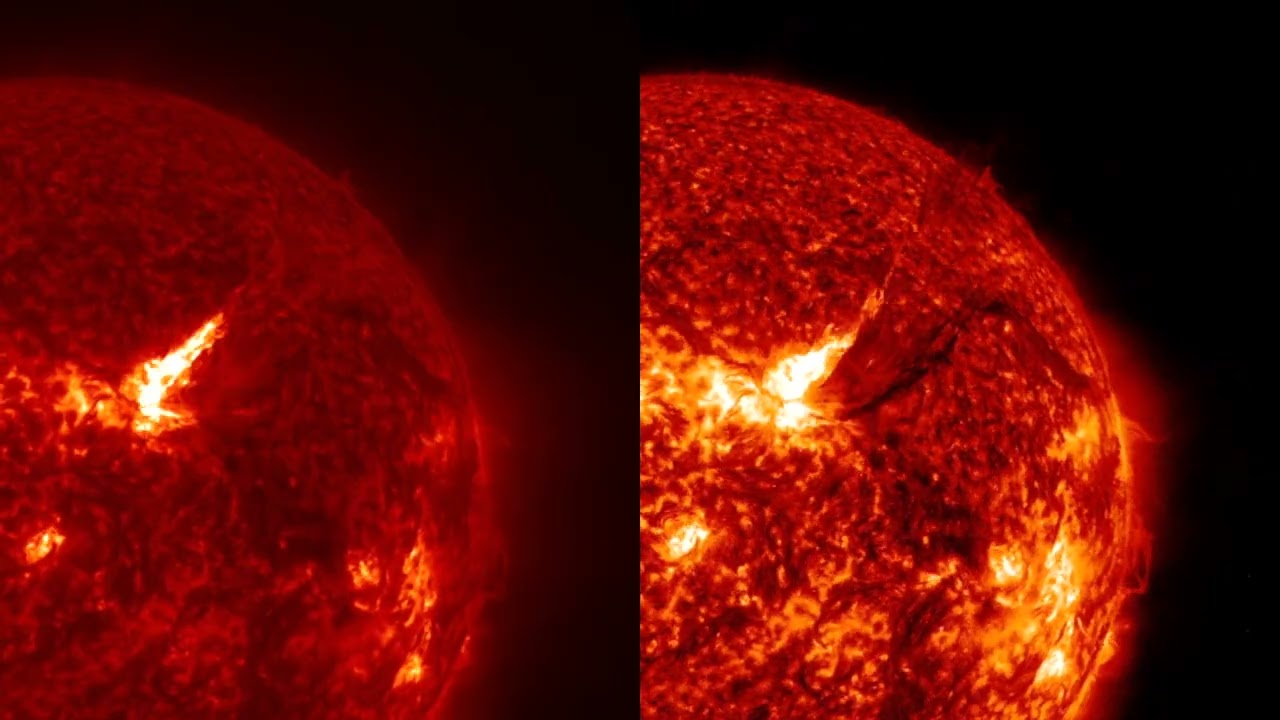
Solar Flares and CMEs at Earth - More Likely | S0 News June.3.2026
SpaceWeatherNewsS0s
2K views•2026-06-03



