This visualization masterfully shatters our intuitive but incorrect perception of a crowded solar system by grounding astronomical data in tangible human scales. It is a humbling reminder that the universe is defined far more by its vast emptiness than by the matter within it.
Installez notre extension pour rechercher instantanément dans n'importe quelle vidéo
The Solar System Is Much Bigger Than You ThinkAjouté :
A passenger Boeing can fly from New York to Los Angeles in about 5 to 6 hours, but to reach Mars, it would take at least 7 years. And to the next planet, Jupiter, 75 years, minimum. When it comes to measuring things in space, our usual sense of scale fails us. Let's try to grasp just how enormous the sizes and distances in space really are. For this, we need a different scale. Using the latest scientific data, the animation studio Reuniverse visualizes the true scale of the solar system, sizes, and distances in the solar system.
Let's shrink the Earth down to the size of a tennis ball, just 6.7 cm in diameter. For perspective, a tennis ball is about as many times smaller than the Earth as a water molecule is smaller than the ball. Now, let's see what the planets of the solar system would look like and what the distances between them would be.
Let's start with the sun. It is now a sphere with a diameter of 7.3 m, about as tall as a twostory house, a massive ball that barely fits in a yard. And yet, we've shrunk it by 190 million times, and it's still enormous.
The closest planet to the sun is Mercury. To reach it from the sun, you'd have to walk 305 m. That's about 3 football fields in a row. It's tiny next to the 7 m sun, but it's nowhere near it, even though it's the closest planet.
At our scale, it's slightly smaller than a pingpong ball, just 2.5 cm. The next planet is Venus. From Mercury, you'd have to walk another 265 m to get there.
That's almost the length of six Statues of Liberty laid on their sides without the pedestals. Venus is nearly Earth's twin in size, 6.4 cm in diameter. The difference is only 3 mm.
Another 218 m, roughly the length of a large container ship. And here's our Earth, the tennis ball we started with. The distance from the sun to Earth at this scale is 788 m. You'd need about a 10-minute walk to get here. And we're only at the third planet.
At the same scale, the moon is 2 m away from Earth, about the height of a standard door. You can't quite reach it with your hand, but it's close. In size, it's like a large grape, 1.8 cm.
Up next is Mars. The distance from the moon to it is about 410 m, almost the height of one of New York's most famous skyscrapers, the Empire State Building.
It's about the size of a large plum, 3.6 cm in diameter. Reddish, noticeable, and yet tiny compared to what comes next. So far, all the planets have fit within just over a kilometer from the sun.
Mercury, Venus, Earth, Mars. It's like one dense city block. But the next stop, Jupiter, is much farther away. You'd have to walk nearly 3 kilometers from Mars to reach it. That's no longer a couple of minutes. It's almost half an hour's walk. Roughly like lining up 3.5 Burj Khalifas on their sides. And when it finally appears, it'll be a large beach ball, 74 cm. But it's still not the edge of the solar system. For the next stop, we'd need to walk even farther, another 3.5 km. That's almost 40 to 45 minutes on foot, roughly the length of a large airport runway, and only at the end of that journey does Saturn appear. It's slightly smaller than Jupiter, approximately 60 cm, like a large fitness ball. But it has character. After all, it has rings. At this scale, they stretch to nearly 1 and a half meters in diameter, a perfectly even disc around the planet and incredibly thin. Their thickness at this scale would be less than a micron, about 100 times thinner than a human hair.
To reach the next planet, Uranus, you'd have to walk twice as long, about an hour and a half at a steady pace. The distance is already 7.6 6 km here. More than anywhere, you can feel the solar system thinning out. The farther you move from the sun, the greater the distances between worlds become. Uranus itself is noticeably smaller than the previous giants, about 27 cm, the size of a basketball. After Jupiter and Saturn, its size no longer intimidates.
But it surprises in another way. It's the only planet in the solar system that rotates on its side with its axis tilted almost horizontally. And beyond this point, the distances keep growing.
The last planet, Neptune, is another 8.6 km from Uranus. This is almost the edge of the planetary system. And here, the strange structure of its outer reaches becomes especially clear. The journey grows longer while the planets themselves barely increase in size. On our scale, this journey will take nearly 2 hours on foot without stopping.
Neptune itself is almost the same size as Uranus, about 26 cm, the very same basketball size. But the distance between them is 7 times greater than the entire journey from the sun to Mars. So even at this scale, 190 million times smaller, the full journey from the sun to the last planet, Neptune is about 24 km. But the strangest thing about this journey isn't how long it is, but how it's structured. The first kilometer is the busiest. Here, the planets follow one after another, and the distances are barely noticeable, and then everything changes dramatically. The planets thin out, leaving more and more empty space between them. And it becomes increasingly clear in the solar system, it's not so much the sizes of the objects that astonish, but the distances between them. But this is only the beginning. Yes, the distances are impressive, even at this minuscule scale. But when it comes to comparing volume, the difference becomes even more striking. First though, let's clarify something. Otherwise, the numbers that follow may seem unbelievable.
A cube with a side of 1 cm has a volume of 1 cm. But a cube grows in three directions. Width, height, and depth.
So, a side of 2 cm has a volume of 8. A side of three 27. A side of 4 64. a side of five, 125, and so on. With each step, the volume increases more dramatically.
This applies to everything that has volume. Take a sphere for example. What looks from the outside like just a slightly larger ball inside can turn out to be a bottomless abyss. Just start putting things into it.
Now, let's see this with the planets of the solar system.
The moon looks impressive in the night sky and it doesn't get lost next to the earth either. It is only 3.7 times smaller than Earth in diameter. But this is where volume starts to feel strange.
In diameter, the gap does not look dramatic until you start thinking in three dimensions. Then the difference suddenly grows. One moon drops into Earth, then a second, then a tenth, and there is still plenty of room because each moon occupies only a small fraction of Earth's vast sphere. In fact, nearly 50 moons could fit inside Earth.
Now, let's switch roles. Earth is no longer the container.
Now, we'll try to fit it inside another planet. For clarity, let's take a large planet significantly larger than Earth.
For example, Saturn.
Saturn is approximately 9.5 times larger in diameter than Earth. This difference looks significant yet still easy to grasp, like comparing a passenger car to a mining dump truck. Impressive, but not shocking. But what happens with volume is far less obvious and truly staggering.
If you start filling Saturn with Earth's one by one, you could fit as many as 760 inside. Watch it long enough and the comparison stops being about geometry.
Each Earth is not just a blue sphere. It is our whole world with its oceans, mountains, clouds, cities, and people.
And Saturn keeps swallowing one Earth after another while seeming almost empty inside.
But Saturn isn't the largest planet in the solar system.
Jupiter is slightly larger, only about 1.2 times wider than Saturn. If you place them side by side, the difference isn't that noticeable. In diameter, Jupiter is 11 times larger than Earth, not far ahead of Saturn.
And once again, this number is deceptive. At first, the difference between the planets seems small, but then it turns out that in terms of volume, it's nearly double. This is why comparing Saturn and Jupiter is especially deceptive. The eye barely notices the difference. One giant beside another, both seeming almost equal. But volume builds its advantage quietly. A little more width, a little more height, a little more depth. In the end, that small extra space turns into hundreds of additional Earths. Because Jupiter could hold about 1,300 Earths inside, almost twice as many as Saturn. But even enormous Jupiter is just a warm-up before the finale.
Because the solar system still has its largest object, the sun itself.
It's 109 times larger in diameter than Earth. After Saturn and Jupiter, that number no longer seems intimidating.
But we already understand how volume works. And here it has a surprise for us. The sun could contain 1.3 million earths, a million planets the size of our world, a million earths with oceans, a million atmospheres, a million civilizations.
If you were to throw one whole earth into the sun every second, it would take 2 weeks to fill it completely. And all of that is just one ordinary star. Not the largest, not even the brightest, just the star we happen to appear beside. The sizes of celestial bodies and the distances between them are among the most astonishing features of our universe. It's hard to say which is more impressive. After all, despite the enormous size of celestial bodies, they are actually quite sparse. Even in the relatively busy solar system, space is for the most part empty.
Vidéos Similaires

Spiral Galaxy NGC 3370 from Hubble | NASA APOD 2025-11-05 #Shorts
galaxygallery
938 views•2026-05-30

SOMETHING inside the SUN is CHANGING
RaysAstrophotography
1K views•2026-06-03

There May Be A Giant Hole In The Universe... And We Might Be Inside It | The Cosmic Ledger Entry 015
TheCosmicLedger
145 views•2026-05-31

Captured the Blue Moon (with a twist) 🌙✨ #space #bluemoon #telescope
realAstroExplorer
674 views•2026-06-01

The Map We Sent to the Stars in 1977 — Why Scientists Now Regret It
TheAncientRecord7
183 views•2026-06-03

Is this a copy of our galaxy? Discover Galaxy M81!
UniverseDocumentaries-cc4mb
995 views•2026-05-31

10 Planet Where a Black Hole Replaces the Sun
cosmicexplorer-EN
147 views•2026-06-02
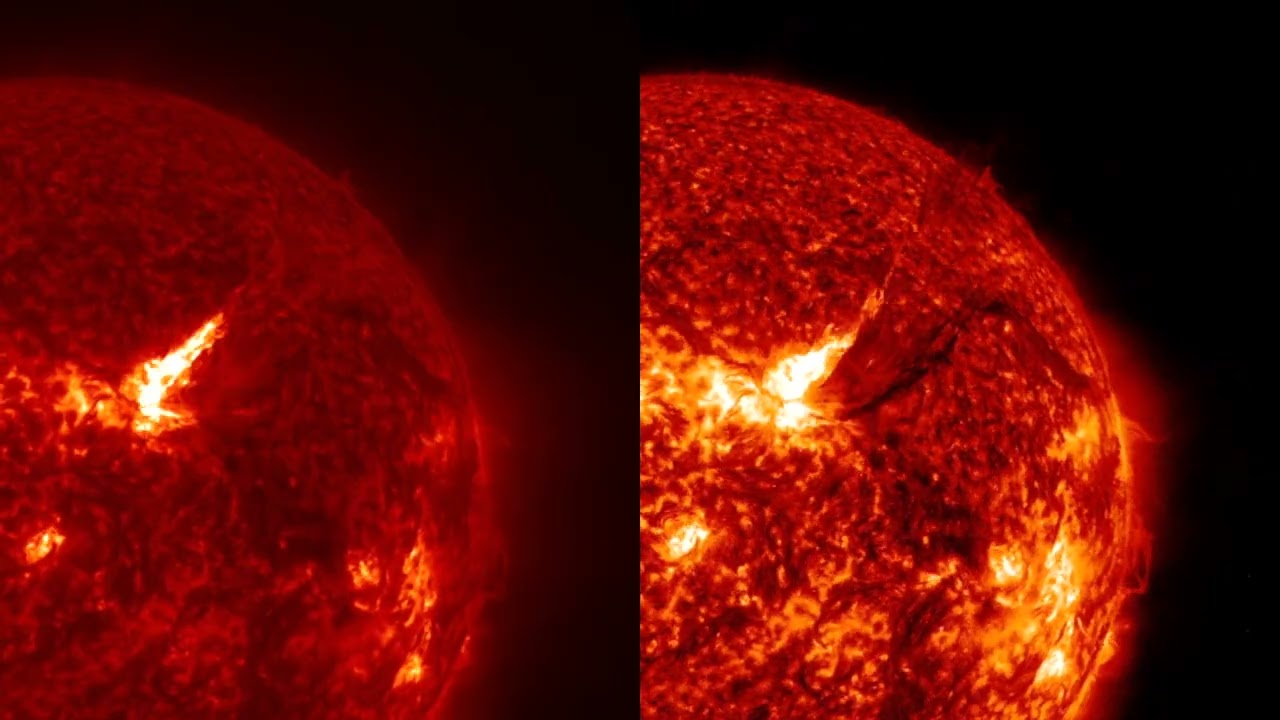
Solar Flares and CMEs at Earth - More Likely | S0 News June.3.2026
SpaceWeatherNewsS0s
2K views•2026-06-03



