Stars meet different fates based on their mass: massive stars explode as supernovae, creating heavy elements like gold and uranium while their cores collapse into neutron stars (1.4-3 solar masses, 20 km diameter, where a teaspoon weighs over 10 million tons) or black holes (over 3 solar masses, with gravity so intense that even light cannot escape); our Sun will become a red giant in 5 billion years, then shed its outer layers to form a white dwarf roughly Earth-sized that cools for trillions of years.
Install our extension to search inside any video instantly.
What Happens If Stars Die?Added:
Stars much larger than our sun meet a violent end, exploding as supernovae that can temporarily outshine an entire galaxy [music] of 100 billion stars.
These cosmic events forge heavy elements like gold and uranium, which scatter across trillions of kilometers of space.
The core that remains, if its [music] mass is between 1.4 and three solar masses, collapses into an incredibly dense neutron star, only about 20 km in diameter. A single teaspoon of neutron star material would weigh over 10 million tons on Earth. If the stellar remnant's mass exceeds three solar masses, >> [music] >> it collapses further, forming a black hole, an object with gravity so intense that nothing, not even light traveling at 299 million 792,458 m per second, can escape its event horizon. Our sun, however, will simply swell into a red giant in about 5 [music] billion years. Its surface expanding to engulf Earth's orbit. It will then shed its outer layers, [music] revealing a white dwarf, a superdense remnant roughly the size of Earth, cooling for trillions of years. [music]
Related Videos

Spiral Galaxy NGC 3370 from Hubble | NASA APOD 2025-11-05 #Shorts
galaxygallery
938 views•2026-05-30

SOMETHING inside the SUN is CHANGING
RaysAstrophotography
1K views•2026-06-03

There May Be A Giant Hole In The Universe... And We Might Be Inside It | The Cosmic Ledger Entry 015
TheCosmicLedger
145 views•2026-05-31

Captured the Blue Moon (with a twist) 🌙✨ #space #bluemoon #telescope
realAstroExplorer
674 views•2026-06-01

The Map We Sent to the Stars in 1977 — Why Scientists Now Regret It
TheAncientRecord7
183 views•2026-06-03

Is this a copy of our galaxy? Discover Galaxy M81!
UniverseDocumentaries-cc4mb
995 views•2026-05-31

10 Planet Where a Black Hole Replaces the Sun
cosmicexplorer-EN
147 views•2026-06-02
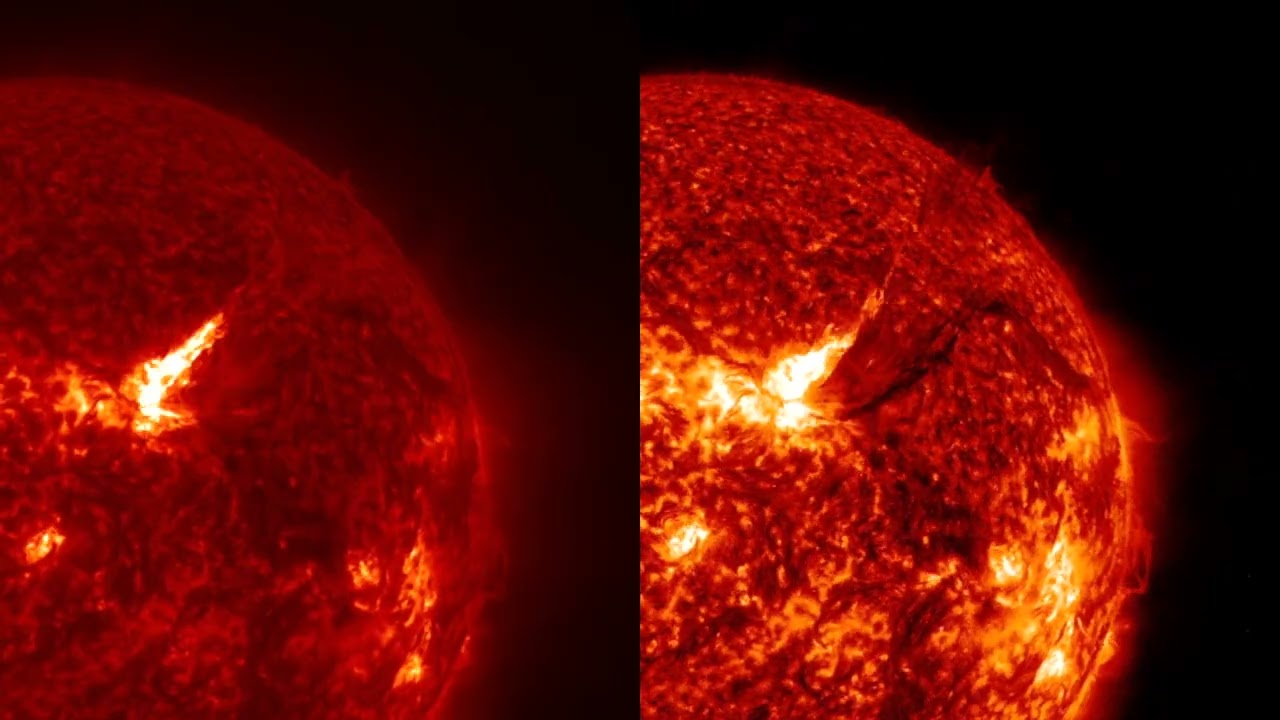
Solar Flares and CMEs at Earth - More Likely | S0 News June.3.2026
SpaceWeatherNewsS0s
2K views•2026-06-03



