Cain provides a lucid breakdown of how transient atmospheres challenge our understanding of small, icy bodies in the outer solar system. It is a refreshing example of science communication that prioritizes observational evidence over sensationalism.
Install our extension to search inside any video instantly.
The Green Bank Telescope Took This Image of OrionAdded:
A Kyper belt object with an atmosphere.
The moon that became Saturn's rings.
Tracking the art of its mission from Earth. And in Space Bites Plus, 3,000 new brown dwarfs discovered. All this and more in this week's Space Bites.
Astronomers know that for an object to hold on to an atmosphere, it has to have a minimum amount of gravity. It doesn't have to be a lot. In fact, an object like the moon could hold on to an atmosphere if it had enough of the material around it. But astronomers think they found an atmosphere around a Kyper belt object, something very small.
The object is called 2002 XV93 and it's beyond the orbit of Neptune and like Pluto, it is trapped in this orbital resonance with Neptune and so it never will crash into the planet. And astronomers were using a technique called an occultation where they were watching as the object passed directly in front of a star. And this is how they're able to find moons, rings, and in this case an atmosphere around this Kyper belt object. They watched as it passed through in front of the star and noticed that the star was dimming as if there was gas beside this Kyper belt object and then gas again as the star was reappearing on the other side. And astronomers did fallen observations with James Webb to try and see if they could detect the presence of the atmosphere and they couldn't. And so having an object this small, it could only hold on to an atmosphere for about 1,000 years.
And so how does it have one? One possibility is that it has some form of active cryovalkcanism on it. That there are ice volcanoes that are constantly spewing out material and replenishing the atmosphere. The other possibility is it was recently under some crash with another comet. And so we're seeing just the debris floating around this object.
They're going to have to wait for another occultation to see if the atmosphere is still there. And so this is totally unexpected. They're hoping for rings, maybe moons, but they found an atmosphere. We've got a story about this from Alan Bole. Astronomers have been arguing for a long time, where did Saturn's rings come from? One possibility is that the rings are very old, that they formed with Saturn early on in the solar system, or the rings are very new, that some source is either replenishing them or something broke up and became the rings. The scientific consensus is starting to lean towards Saturn's rings are young. Something happened relatively recent. And by relatively recent, I mean like say within the last 100 million years or so.
So now researchers have modeled the kind of object kind of moon that could have broken up around Saturn. They've dubbed it Chrysalis and estimated that it was about 1,500 kilometers across. And when it started out in a highly elliptical orbit, it was about 200 Saturn radi away from the planet. And then over time it got closer and closer and closer until eventually it got within about 1 and a half Saturn radi. And that started to bring within the ro limit of the planet. This is the point where the tidal interactions, the tidal forces from the planet are pulling on the near side stronger than the far side and it actually shears it apart and then it gets broken again and broken again and turns into this ring system around Saturn. And so the dinosaurs could have watched about 100 million years ago when this moon was being torn apart and turned into these rings. Got a story about this from Lawrence Tuggnetti. During the recent Aremis 2 mission, there were plenty of eyes on the mission and one really interesting one was the Green Bank Observatory in West Virginia. This giant radio telescope was watching several key points along the mission and it did these big long observations of the spacecraft as it was moving out to its farthest point away from the Earth as it was going around the moon. And the purpose of these observations was to test their tracking to see if they could determine the motion of the Aremis 2 mission independently from what NASA was doing. You know, we always get this comment from people who are skeptical of space flight who say, well, you know, why wasn't anybody watching the Aremis 2 mission as it was flying? Why weren't there telescopes pointed at the space?
Well, there were. And so the Greenbank Observatory was able to measure the motion of Artemis 2 and was able to measure its velocity to within 0.2 mm per second of NASA's official calculations. And one sort of really interesting thing like like the picture doesn't look great. Like I'm not going to lie, but one of the astronomers who helped take this image looked at and said, you know, there are four people in this single pixel. And it's crazy that we're looking out from Earth out into space seeing the spacecraft and there are people in this little dot in the sky more than 300,000 kilometers away from the Earth. That's what humanity can do.
Got a story about this from Mark Thompson. Little red dots are one of the big mysteries that were discovered, uncovered, revealed by James Webb. And these are these strange mysterious objects seen within the first couple of billion years after the big bang. They are very compact and they are sort of pushed into the infrared and probably some hot object putting out a lot of radiation, but it's then covered and enshrouded in dust. The go-to explanation for this is that it's some kind of actively feeding super massive black hole. We see these active galaxies around the modern era and we've seen them back in back in in history. But one of the telltale signs that goes along with the radiation is that you see X-ray radiation because you've got all this gas and dust flowing into this super massive black hole. It compresses, it builds a secretion disc around it, and that glows hot. Almost like the interior of a star as you're expecting to see those X-rays. And the big mystery is that we see these little red dots, which appear to be, they should be the region around a super mass, a black hole, and yet we don't see the X-ray radiation.
And this is forced astronomers to kind of go back to the drawing board and say, well, what could they be? I've done interviews where maybe they're the building blocks of globular star clusters and like there's a bunch of ideas and yet they all start to disappear at around the two billion year mark. And so what are they turning into?
What modern structure are we seeing in the universe today? Well, astronomers have found an example of a little red dot that is giving off X-ray radiation.
They were able to do fallen observations with the Chandra X-ray Observatory and they did detect the presence of the X-rays. And so one idea is that we are seeing this transition phase. You start out, you have this shroud of gas and dust. You have this super massive black hole at the heart of it's actively feeding and it's building up this these sort of powerful stellar winds almost like the solar wind coming from the sun that's starting to blow away all of this material around it that was obscuring the X-ray radiation. And then it reaches this point where now it's in clear space again and we can detect the X-ray radiation. And then these go on to become the hearts of the large galaxies we see around us today. And like this is the process. And like I love it like this is what James Web was meant to do to look back to the beginning of the universe, try to understand how the building blocks came together to form the modern universe that we see today.
We've got a story about this from Carolyn Collins Peterson. Every week we do a vote on our channel where you tell us what you thought was the best space news story of the week. And the winner last week was the 12,000 new Artemis images released by NASA. So, thank you everyone who voted. Now, we're going to put a vote on the channel this week into the post tab. So, go ahead, pick the story that you like the best. Of course, the best chance to see these votes, subscribe to the channel, click on the notifications bell, go into the post tab, vote for a whole bunch of stuff that you like, and then from this point on, the algorithm will smile on you. We only know of one way to get a black hole and this is to have a massive star die.
A star with over 20 times the mass of the sun has to run out of fuel, detonate as a supernova and you end up with a black hole at the heart of it. Then that black hole can go on feeding. It can merge with other black holes and eventually theoretically you can get those super massive black holes that we see at the centers of galaxies. Now there's another possibility that you can have a direct collapsed black hole. you can just have a large cloud of gas and in the right conditions it can just start turning into a giant black hole.
But whatever the case needs to be a lot of material coming together to form a black hole. But one theory that hasn't been ruled out yet is that there could be primordial black holes. So these would be black holes that formed at the beginning of the universe where you had regions of higher and lower density shortly after the big bang. and that you would get black holes of all masses, black holes with the mass of a couple of atoms, black holes with a million times the mass of the sun, black holes with a billion times the mass. It really just depends on what kinds of density gradients you had in the early universe.
Now, according to Stephen Hawking, black holes evaporate and he did the math for how long your regular mass black holes should last. About, you know, 10 the^ of 70 years, which is a lot. maybe up to 10 to the^ of 100 for the most super massive black holes. The lower mass black holes should evaporate more quickly. And if there were black holes very small, maybe the mass of an asteroid, then they should have already evaporated. But how long does it take for one of these lower mass black holes to evaporate? So a team of researchers went and looked at the calculations from Stephven Hawkings and evaluated according to quantum theory. And what they found is that a black hole will go through three phases of its evaporation.
It'll start at the beginning with the sort of standard hawking phase. And Hawking did the calculations for how long this will last. Then it moves into a second transition phase and then into an entanglement phase. And the entanglement phase sets the maximum time limit for how long. The problem is to understand to calculate how long the entanglement phase lasts, we need a theory of quantum gravity which is a thing that scientists astronomers are still working on. And so they still can't calculate that maximum lifetime for how long these things will last only the minimum which is the same as Hawking predicted. But one really interesting sort of side feature of the calculations that they did is that the black holes will behave like a white hole near the end of their life. And so you would have this material that is a black hole, but it's starting to push away material from around it instead of being this mass that is able to accumulate new mass. And so that gives you a vector for how you could search for these black holes that are in the process of evaporating and sort of near the end of their life is you're going to see different behavior.
Essentially things acting like white holes out there in the cosmos. And that could be an additional line of evidence that primordial black holes exist, that they evaporate according to Stephen Hawking, and that they could behave like white holes at the end of their lives.
But a story about this from Brian Corbeline. He is a PhD astrophysicist and so he explains it much better than I do. If you've taken any astronomy, you have probably run into the Herzrung Russell diagram, an HR diagram. This is a plot that compares the temperature of stars against their luminosity. And that for main sequence stars, they sort of fall in this very consistent pathway from the beginning of their lives to the end of their lives. And depending on the mass, you get a different luminosity and it all sort of connects together. And then there are other branches where you can have red giant stars and dwarf stars and so on. But you can have this sort of one graph to explain them all. But these are just main sequence stars. What if you wanted to widen your concept and think about every physical object in the entire universe? So everything from asteroids all the way up to super massive black holes. Can you graph them all? And so researchers did exactly that. And they came up with a new graph that they call the cohesive object sequence. It's a plot of 2,000 objects where you compare their density against their mass. And all of the objects fit into this graph and you get some really interesting patterns at the low end where you've got very porous objects, different kinds of stars, and all the way up to this hard limit of black holes. So by creating this graph, you can then predict different kinds of objects that might be out there depending on their density and their mass. We've got a story about this from Andy Thomas Wick. Astronomers have been scanning the sky for signals from extraterrestrial intelligence for a long time. One giant telescope that has been participating in this search is the Green Bank Observatory. Talked about it earlier on this episode. This is the one in in West Virginia. And astronomers have been scanning for a decade with the Greenbank Observatory and have gathered information on more than 70,000 stars and planetary systems. And their detection pipeline is automated. So, they're able to essentially discount 99.5% of the objects that appear in this survey. Their detection pipeline is so efficient, they're able to catch between 94 and 99% of any genuine narrowand signals that range across this full range of frequencies. And they flagged 100 million candidate signals for further study. And then they processed them through a bunch of automated filters. They got rid of stuff that was they obviously knew what they were and they were left with about 0.5% of all of these objects. And then they checked them manually to see if they didn't have a way to explain them. And after checking 100 million signals, none of them survived this level of inquiry. And so they weren't able to detect a message from an extraterrestrial civilization after 10 years of data. 100 million signals, 70,000 targets. But now, like obviously if we had heard that the Green Bay Observatory had detected the presence of an alien civilization, that would have been very big news. But this allows them to put an upper bound on how many civilizations there are that are out there. That this search is so comprehensive. If there are aliens out there and they were transmitting, then they would have stood a good chance of detecting them. And so they were able to set an upper bound of less than one in 16,000 stars within 20,000 lighty years of the Earth holds a transmitter powerful enough to be detected by that search. And over time, as they continue to scan more and more locations, they will be able to keep setting that upper bound higher and higher and higher, which means that there's like a larger and larger volume of the space around us that doesn't contain any alien civilizations. Got a story about this from Mark Thompson. I hope you're enjoying this episode of Space Bites. Of course, you did probably have to see an ad at the beginning of this episode, which sucks. We hate ads. I wish I could turn them off. We can't. But there is a place you can watch all of our episodes without having to watch any ads. And that's over on Patreon. Now, I got a complaint in the last episode where I mentioned that and very cynical people say, "Why are you sending us over to Patreon? You're just trying to get our money." No, it's available for free on Patreon. You don't even have to log in.
You can just go into a completely incognito anonymous browser and you can watch this exact same episode without any ads. Why do we do this? Because we don't like ads and we want you to be able to watch these episode without ads.
If a school teacher wants to be able to display an episode of Space Bites or anything that we do, we want them to be able to do that without having to see any ads. And we the only place that we can put these is over on Patreon. So that is the solution that we do. So if you want to be able to watch these episodes, I'm going to put a link down in the show notes. You can watch it over on Patreon. Of course, this is just a fraction of all the stories that we're covering on Universe Today. And this is another big week. So many stories, like 35 to 40 stories this week. So, I'm working on my weekly email newsletter, which is taking me a long time, mostly because I'm traveling, but also because it's a very big episode, but I will have a write up of every single story that we're covering on Universe Today. And so if you just want like a big overview of everything we're talking about, everything that's interesting in space news, definitely check that out. You can go to universe.com/newsletter to sign up. There's no ads. I write every word. It's completely free. I want to talk about some ways that you can follow some of the team on other projects out there on the internet. But first, I'd like to thank our patrons.
Thanks to Abe Kingson, Andre Pretty, Brian Bod, Keredan, Chuck Hawkins, Commander Ba, Darkfinger, David Gilton, and David Mats. And for all the reading and math for toddlers, Eric Lindstöm, Evan Dpro, James Clark, Jeremy Matter, Jim Burke, Jordan Young, Josh Schultz, Marcel, Michael Barcel, Nordspace, OnePl.org. Please follow my nephew at Vick6994, Ring Kaidu, Richard Williams, Sean Sergeant, Steven Fam, Team49, Teles Canada, Vlad Chiplin, Wolf Gang Clots, and Zelda Galactic Defender who support us at the master of the universe level and all our patrons. All your support means universe to us. So you hear me say the names of the people on the team every week. Names like Matt Williams, Brian Cobberline, Paul Sutter. They are writers for Universe Today, but these people also have other outlets that they are able to get their work published.
And so I, you know, if you're interested, you want to learn a little bit more behind the scenes about these various people, I wanted to just kind of point you towards some interesting resources you can find them. So first, Dr. Paul Sutter, also known as the Ask a Spaceband podcast. He does these really cool series about different concepts in space astronomy every month on Universe Today, but he has the Ask a Spaceband podcast. He has shown up on various television shows. So, I'll put a link to Dr. Paul Sutter, Dr. Brian Cobberline, who is also a PhD astrophysicist. He has his own Patreon. You can go and follow his blogging that he does. Alan Bole is a legendary science journalist. In fact, he was one of my mentors, one of the first people that I reached out to when I wanted to become a space journalist and he runs his own blog called Cosmic Log is a regular contributor to GeekWire and writes for us, Universe Today. And then Matt Williams, who writes a ton of stuff for Universe Today, has his own podcast. and he's recently been posting the audio of all of his podcasts onto his YouTube channel and so you can go and check that out. Some cases he's interviewing people, other times he's just doing a solo episode where he's talking about concepts that are interesting to him. So definitely check that out. Carolyn Collins Peterson is again a legendary science writer and also has written many of the planetarium shows that you have ever seen. Mark Thompson is a regular contributor for BBC and various science television shows in the UK. And I'm sure there's other projects that the people are working on that I haven't been aware of. So uh we'll try and put links to as many things as we can down in the show notes, but uh and when the team are working on other side projects that are important, I will try to let you know as you just get a better sense of who all these people are and what they're working on.
All right. Uh goodbye from Tokyo. We'll see you next week.
Related Videos

Spiral Galaxy NGC 3370 from Hubble | NASA APOD 2025-11-05 #Shorts
galaxygallery
938 views•2026-05-30

SOMETHING inside the SUN is CHANGING
RaysAstrophotography
1K views•2026-06-03

There May Be A Giant Hole In The Universe... And We Might Be Inside It | The Cosmic Ledger Entry 015
TheCosmicLedger
145 views•2026-05-31

Captured the Blue Moon (with a twist) 🌙✨ #space #bluemoon #telescope
realAstroExplorer
674 views•2026-06-01

The Map We Sent to the Stars in 1977 — Why Scientists Now Regret It
TheAncientRecord7
183 views•2026-06-03

Is this a copy of our galaxy? Discover Galaxy M81!
UniverseDocumentaries-cc4mb
995 views•2026-05-31

10 Planet Where a Black Hole Replaces the Sun
cosmicexplorer-EN
147 views•2026-06-02
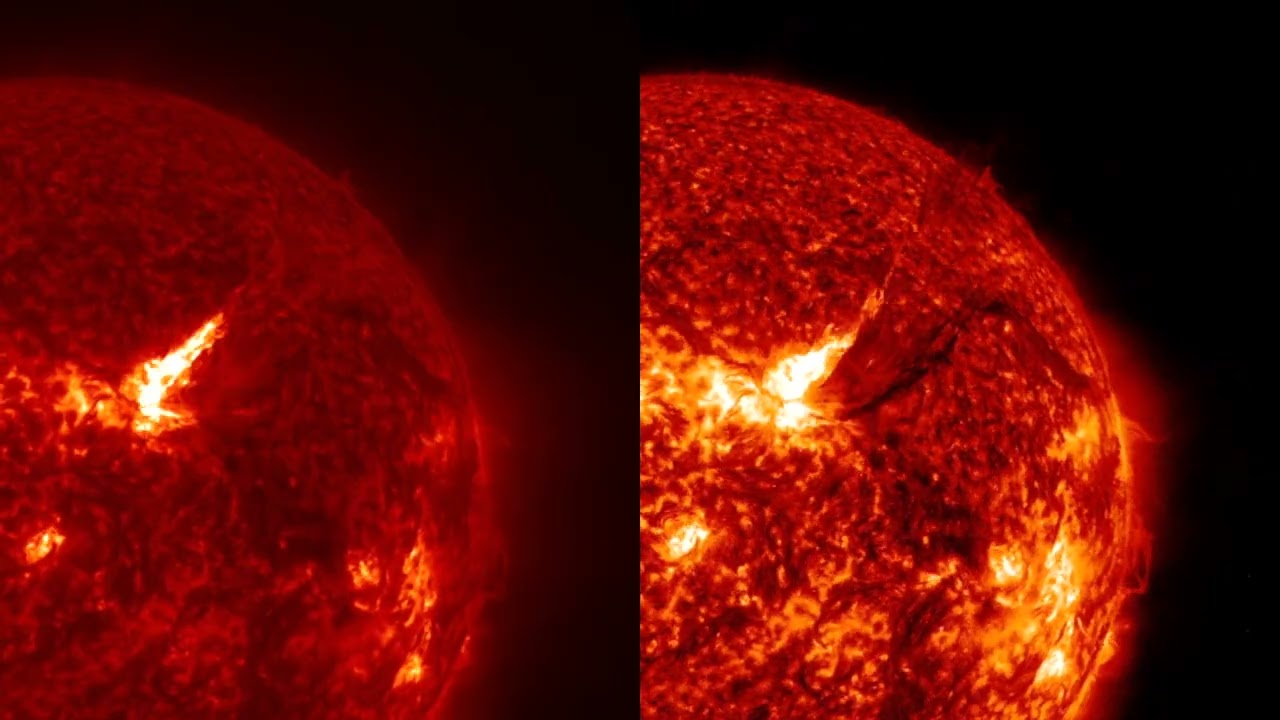
Solar Flares and CMEs at Earth - More Likely | S0 News June.3.2026
SpaceWeatherNewsS0s
2K views•2026-06-03



