Godier avoids the usual planet-status clichés by focusing on the fascinating physics of Pluto’s orbital resonance with Neptune. It is a clear and thoughtful look at how gravity, rather than just size, defines a world’s place in the solar system.
Install our extension to search inside any video instantly.
The Strange Deep Mysteries of PlutoAdded:
One of the odd mysteries, which are ongoing and multiplying, about the outer solar system is just what is out there. As the search for Planet 9 shows, there is still room for another large planet out there waiting to be discovered, and even some ideas of a separate Mars sized planet creating the so-called Kuiper cliff, an apparent strange cut off that may be due to a planet. And then there are the undiscovered Kuiper Belt objects themselves that could flood in now that the Vera Rubin Observatory is online and doing surveys which are uniquely suited to search for such objects. But the idea of further planets than Neptune is much older than current efforts to find one.
In the 1840’s, the discoverer of Neptune, Urbain le Verrier, did that by looking at perturbations outside of Newtonian mechanics with the orbit of Uranus.
This led him to finding Neptune, but by the end of the 19th century there were suggestions that Neptune alone was not causing all of the observed disturbances to Uranus’s orbit. In 1906, Percival Lowell, of Martian canal fame, was also looking for a ninth planet.
The strange thing here is that by using calculations by Elizabeth Williams, he searched for that missing planet while amid ending up ultimately wrong about the canals on Mars.
He never found that large new planet he was looking for, but strangely on the night of March 19th, and again on April 7th, 1915, he captured two faint images of Pluto.
He didn’t recognize it, and only after its official discovery was this found.
And that wasn’t the only time someone captured an image of Pluto without noticing it was some kind of a planet. Indeed, to date, there are 14 known observations of Pluto having been caught, but not recognized, including one from Yerkes Observatory in 1909.
Here’s something weird. Lowell founded the Lowell Observatory and after his death, his widow ended up in a court case that froze the search for Planet X at that observatory.
It resumed in 1929 under the direction of astronomer Vesto Slipher, and he put the project to a then 23 year old astronomer named Clyde Tombaugh, who got the job because he happened to be really good at making eyepiece astronomical sketches. He had a keen eye.
It paid off. Tombaugh was given the task of imaging the night sky in pairs of photographic plates, taken at different times, and then to use a device known as a blink comparator to flip the two images back and forth so Tombaugh could look for any kind of movement. This technique in a modern form is still used; always look for movement initially when trying to discover asteroids and so on, all these objects must necessarily move in their orbits. After about a year, Tombaugh spotted Pluto through its movement. After confirmation, Pluto was declared a discovered planet.
Of course it later got downgraded to a minor planet, but for many decades it was in fact the ninth planet no matter where your opinion is on the demotion. As an aside, there are some odd facts here. Pluto has not actually completed an orbit around the sun since its discovery, its year is just under 248 earth years, meaning that we won't see its full orbit until 2178.
Another is that Pluto has the distinction of being the only object in the solar system outside earth to have been visited, in some roundabout way, by its discoverer. Some of Tombaugh’s ashes were included on the New Horizon’s mission, so Clyde’s remains got the best view of another world a former human has ever been present for. Sadly, he was in no position to see it, but it did happen and Clyde’s ashes will likely be the first human remains to leave the solar system as New Horizons is set to head off into interstellar space. But, being cremated ashes, it’s not likely that aliens will find Clyde’s DNA and resurrect him in the future. At least hopefully not, the last thing we need is the Borg collective to find him, resurrect him, and send millions of cyborg Tombaughs to conquer earth.
But what was not expected, even given Pluto’s demotion, was that Pluto would end up being a very mysterious and interesting world, more than could have been imagined. There were things predicted about Pluto being weird before we sent a probe, such as predictions that it would have a tenuous atmosphere during the period it would be closer to the sun, but that atmosphere would freeze out when further away. That appears to be true, but it turns out that Pluto, when we visited it, revealed far more mysteries about it than it answered.
One other mystery was known before New Horizons. So Pluto has a very odd orbit for our solar system. It would be chaotic and Pluto may not be where it is, except it’s in a unique 3:2 resonance with Neptune, even though it crosses the orbit of Neptune during part of its orbit.
This is likely an artifact of planetary migration early in the solar system’s history, but what it ultimately means is that Pluto can’t ever hit Neptune. This is a weird one.
If you go by the contentious standards laid out that demoted Pluto in the first place, it actually should in principle demote Neptune as well, because one of the criteria is for a planet to be able to clear its neighborhood, but Neptune hasn’t ever gotten rid of Pluto.
This is even weirder because of the early solar system migration models, some of which show Neptune sweeping up Pluto into that resonance. Neptune seems to have not wanted to be a planet, deferring to its friend Pluto, and defying current human definitions of what a planet is. But there have also been suggestions that Pluto is so close to the line of stability, it may not be there in the far future of the solar system and then we can finally call Neptune a proper planet. But then you get into the odd reality that at times during its orbit, Pluto is actually closer to the sun than Neptune. Very unsavory and questionable the outer solar system.
But these odd orbits, which also includes odd inclinations, actually is a characteristic in general of Kuiper belt objects, so that’s a point against Pluto being a planet. It looks like a minor ice planet. That does not however mean it is uninteresting, far from it, but there are other questions regarding that, more on that in a bit. It may not be a minor planet either. And that brings us to Pluto’s sometimes atmosphere I mentioned before.
So observations from Earth hinted that the atmosphere of Pluto was indeed getting thicker as it neared the sun. This of course was expected from what we know. Somewhat uniquely, Pluto actually gets about 40 percent closer to the sun than when it’s at its farthest point, that’s significant, and changes the temperatures of its surface a lot. This means that as it gets closer, some of the nitrogen on its surface goes from a solid to a gas and some even escapes to space, before what’s left freezes back onto the surface as it draws away from the sun.
The question is, how much does it change over long periods of time given it loses nitrogen, what did it once look like? What effects did that have on Pluto’s rather strange surface? All open questions still. And by strange surface, I mean it, leading to another mystery.
New Horizons found Pluto to have totally unexpected terrain. It was expected to be rather boring like many of the icy moons of the solar system, a few of which might even be captured Kuiper Belt Objects themselves. But some of those moons have proven to be highly variable in what they are doing, Triton for example at Neptune was found to have outgassing cryovolcanoes by Voyager II, which was somewhat of a pleasant surprise for something that was once expected to be inactive and frozen solid. So too with Pluto.
Pluto has what looks like something akin to Sand Dunes and Snow Drifts. It’s technically not either one, but they are mysterious nonetheless. So to create something like dunes and drifts, you need a thick moving atmosphere, wind. Pluto never has enough for that seemingly.
But it can have very subtle gentle winds when the atmosphere is active and one idea is that methane sublimes when close to the sun and then freezes back out during a period where the subtle winds are still active and they redeposit it in dune and drift form, but in ice. But that’s only a hypothesis, no one really knows for sure the dynamics of this.
Now to why Pluto might not be a minor or a major planet. So Pluto is obviously round, which is another of the criteria for a planet, but not the only one. It also orbits the sun, another of the criteria. And it’s cleared most of its debris, other than Neptune. That goes both ways. But the main reason why it hasn’t totally cleared its orbit is because its orbit is so odd.
But then comes the New Horizon’s discoveries, and the reality is that the composition of Pluto actually more closely matches a comet than any other planet or moon in the solar system that we have data on. So is it actually a very large comet? That there isn’t a good definition for.
This brings up a brand new mystery that came up again just days ago in the news. So about 25 years ago a Kuiper Belt object was discovered doing something close to sharing Pluto’s orbit. These are called Plutinos and share that same resonance. The object is named 2002 XV 93, just when you think astronomical designations couldn’t get more cumbersome, they found a way to do it. It’s tiny, estimated to be about 500 kilometers. I don’t understand why we would call small objects doing that Plutinos, not Kuiper Belt objects in their own right, yet not give Pluto the term Plunot or something instead of minor planet. It shows the lack of uniformity of definitions in astronomy.
Here’s the oddity with 2002 XV93, it was measured to have an atmosphere in 2024 when it occulted a star. Instead of disappearing and reappearing as the object passed in front of the star, producing a knife edge effect, instead it was distorted which can only happen when an atmosphere is present. Now this is not much of an atmosphere, it's very, very thin, far further than Pluto's current atmosphere. There would be no wind you could feel, but that atmosphere is there.
What caused that atmosphere to form is a total mystery, and also if it too freezes out like Pluto. But it does beg a question, if the rules on having atmospheres for small objects in the outer solar system are so variable, then what defines a comet and how are Kuiper Belt Objects like Pluto not comets? Untackled territory without more data indeed.
And finally another great mystery is whether Pluto has a subsurface ocean or not, and an even bigger question of whether it could support some kind of life. Pluto does have sufficient radioactive decay going on in its core to heat up ices enough for rock to at least have separated out of them and then fell deeper into the interior. In short, it seems to be differentiated between a core and an ice mantle that may hold liquid.
There was some work done about a decade ago that simulated the suspected impact that created the Sputnik Planitia feature on Pluto and found that it’s probably due to water upwelling after the impact meaning that there is a subsurface ocean at least 100 kilometers deep buried under the ice.
More evidence from 2020 suggested that at least at the time just after its formation, it might have had a habitable ocean, and that may still be there in some form. There are other features on Pluto that more recently have been associated with cryovolcanic domes that are suggestive of a lot of heat in the interior of Pluto, more than had been suspected previously.
But the existence of that possible ocean is still contested, and almost nothing can be said at this time about the possibility that Pluto might have subsurface life. Only more missions out to that distant little world will shed light on that and the other mysteries.
Thanks for listening! I am futurist and science fiction author John Michael Godier currently musing that if Pluto can maintain a subsurface ocean just from radioactive decay, then it stands to reason that some of the other Kuiper Belt objects could as well. It’s an interesting thought, because that kind of body can exist in most star systems in the universe and even as rogue planets in deep space, really opening up the possibilities for oceanic life out there. The problem is, it also would basically be impossible to detect without heading to other star systems and starting drilling. The universe never makes anything easy and be sure to check out my books at your favorite online book retailer and subscribe to my channels for regular, in-depth explorations into the interesting, weird and unknown aspects of this amazing universe in which we live.
Related Videos

Spiral Galaxy NGC 3370 from Hubble | NASA APOD 2025-11-05 #Shorts
galaxygallery
938 views•2026-05-30

SOMETHING inside the SUN is CHANGING
RaysAstrophotography
1K views•2026-06-03

There May Be A Giant Hole In The Universe... And We Might Be Inside It | The Cosmic Ledger Entry 015
TheCosmicLedger
145 views•2026-05-31

Captured the Blue Moon (with a twist) 🌙✨ #space #bluemoon #telescope
realAstroExplorer
674 views•2026-06-01

The Map We Sent to the Stars in 1977 — Why Scientists Now Regret It
TheAncientRecord7
183 views•2026-06-03

Is this a copy of our galaxy? Discover Galaxy M81!
UniverseDocumentaries-cc4mb
995 views•2026-05-31

10 Planet Where a Black Hole Replaces the Sun
cosmicexplorer-EN
147 views•2026-06-02
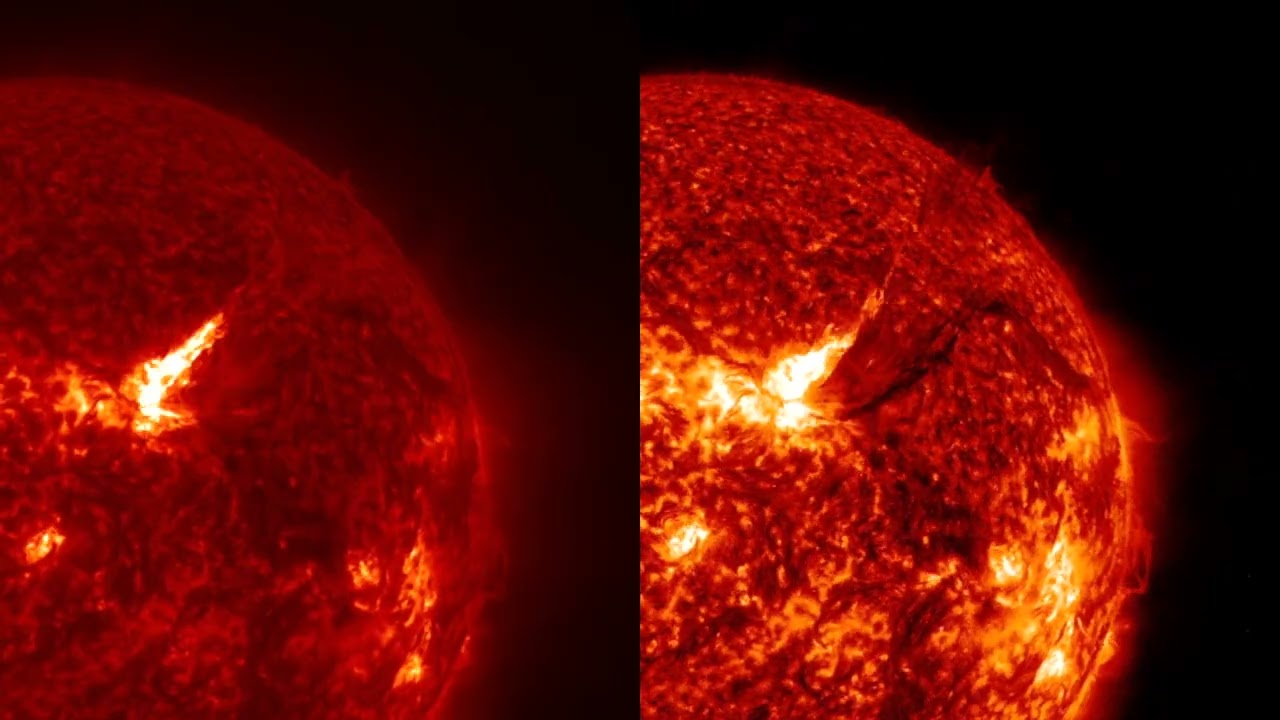
Solar Flares and CMEs at Earth - More Likely | S0 News June.3.2026
SpaceWeatherNewsS0s
2K views•2026-06-03



