The James Webb Space Telescope has detected supermassive black holes (approximately 100 million solar masses) just 300 million years after the Big Bang, which challenges existing cosmological models because forming such massive black holes requires an enormous amount of time for stars to be born, die, and collapse into black holes that then merge together.
Install our extension to search inside any video instantly.
Supermassive Black Holes Appeared WAY Too Early in the Universe 😳🕳️Added:
But one of the most pressing things, one of the reasons why I wanted to bring you in cuz you are very knowledgeable in all things space, is the James Webb's telescope and all the different stuff that they've been finding, particularly about these galaxies that were formed very shortly after not shortly, you know, not within our our lifetime shortly, but >> Right. cosmologically shortly after the Big Bang that it seems like we have to figure out why these things are forming. Is the universe older? There's all these different kind of speculation. Maybe the Big Bang is not 13 point whatever billion years old, but maybe 22, 24.
Like what What is your take on all this?
Yeah, the the James Webb Space Space Telescope is such an incredible instrument. The data has just blown us away. You know, when you build this thing and you look at it and unfolding in space, you think there's so many ways it could go wrong that we all were just like, you know, this thing was 215 moving parts or something I had to unfold.
>> In space. Yeah. The fact it just all worked was just remarkable. And then when we got those first images, they just kind of blew us away as well cuz we had sort of these engineering expectations of what it would do, but the data was just even better than that.
So, when it, you know, of course the first thing you want to do is point it to the most distant part of the universe and see what's out there in those darkest patches. And so when it did that, yeah, it started finding a couple of things. It started finding quasars, which is kind of the the center of these very active galaxies. These are supermassive black holes that have little crap falling in and they're spewing out all this energy.
They're kind of feeding supermassive black holes. And so we started detecting those way earlier than we thought the universe should be able to build them.
Because to make a supermassive black hole, I mean, these things are like a 100 million solar masses. Imagine that, 100 million suns have have not only been born, but died, gone through their entire life cycle, died, collapsed into a black hole, and then those black holes have presumably somehow merged together into this super behemoth of this 100 million solar mass thing. So, we're finding those just, you know, 300 million years after the Big Bang. And that that was like, hold on. That that doesn't make any sense. Like, how how can this be? And similarly with the uh with the galaxies, we were seeing these images. These galaxies, and you can date roughly how old they should be based off the red shift. So, the you know, the universe is expanding. So, therefore, if something is very far away from us in the universe is expanding, it's like it's stretched more and more and more as it journeys over space.
Related Videos

Spiral Galaxy NGC 3370 from Hubble | NASA APOD 2025-11-05 #Shorts
galaxygallery
938 views•2026-05-30

SOMETHING inside the SUN is CHANGING
RaysAstrophotography
1K views•2026-06-03

There May Be A Giant Hole In The Universe... And We Might Be Inside It | The Cosmic Ledger Entry 015
TheCosmicLedger
145 views•2026-05-31

Captured the Blue Moon (with a twist) 🌙✨ #space #bluemoon #telescope
realAstroExplorer
674 views•2026-06-01

The Map We Sent to the Stars in 1977 — Why Scientists Now Regret It
TheAncientRecord7
183 views•2026-06-03

Is this a copy of our galaxy? Discover Galaxy M81!
UniverseDocumentaries-cc4mb
995 views•2026-05-31

10 Planet Where a Black Hole Replaces the Sun
cosmicexplorer-EN
147 views•2026-06-02
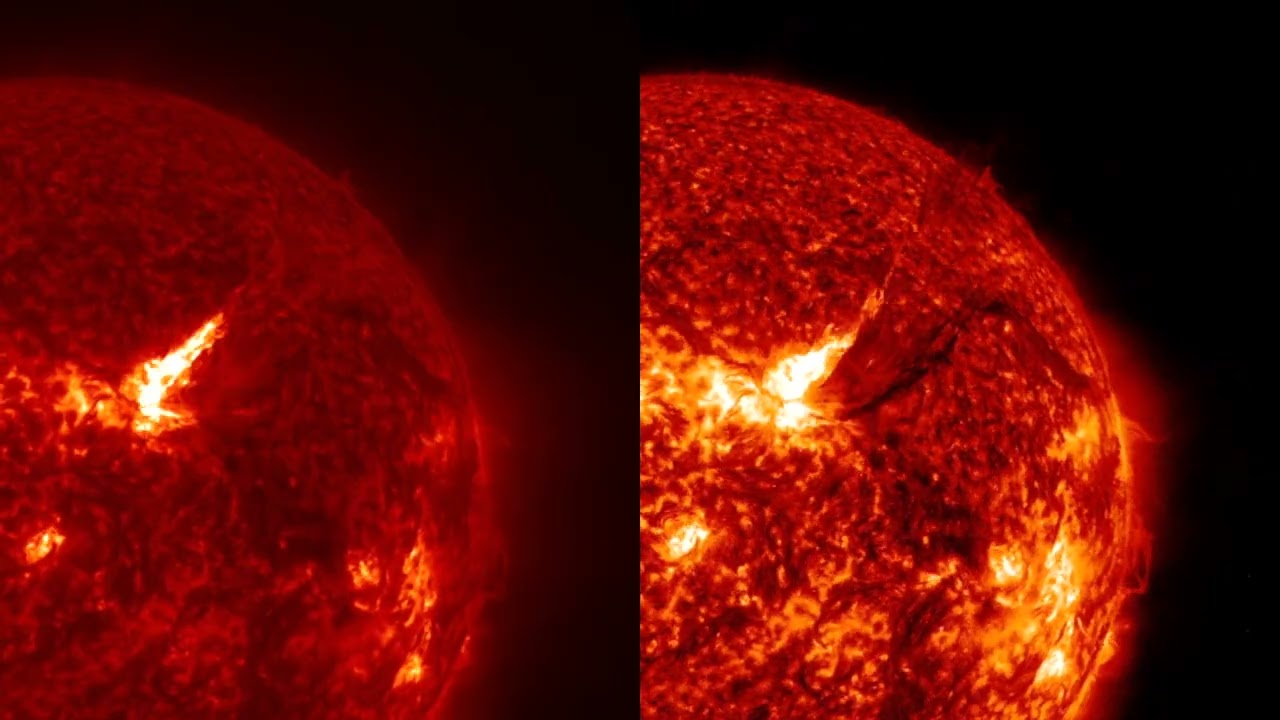
Solar Flares and CMEs at Earth - More Likely | S0 News June.3.2026
SpaceWeatherNewsS0s
2K views•2026-06-03



