This video brilliantly deconstructs the myth of cosmic emptiness, revealing that the universe's "nothingness" is actually its most critical laboratory. It challenges us to realize that the vast gaps we once ignored are where the most fundamental physics is truly happening.
Install our extension to search inside any video instantly.
Scientists Got a Signal From Where Nothing Should ExistAdded:
Something fired a signal from empty space. Perfect.
Clockwork.
Every 44 minutes without missing once.
80% of the universe by volume is a void.
A near total nothing. And for decades, science assumed those voids were silent.
They were wrong. Tonight, we travel through the biggest hole in the observable universe.
Track a pulsing object that breaks every rule about how dead stars behave. Follow the brightest radio flash ever recorded across 130 million lighty years and watch a 7-hour explosion that should have lasted seconds. If you enjoy this journey, hit subscribe and leave a like.
We are just getting started. Brace yourself. We begin.
80% of the universe by volume is nothing.
Or at least that is what it looks like from the outside.
Stretch your mind wide enough to picture the entire observable universe.
Everything we can possibly see from Earth. Now picture that space filled with a three-dimensional web. A cosmic lattice made of filaments and sheets of galaxies. Billions of them all connected at bright glowing nodes. That web is real and it is confirmed by decades of telescope surveys. Now picture the spaces inside the web. The hollow interiors between all those bright filaments. Those hollow regions are called cosmic voids and they are enormous. Together they account for roughly 80% of all the space in the observable universe. Most voids are big.
Some are hundreds of millions of light years across. One lightyear alone is about 6 trillion miles. Hold that number. Now multiply 6 trillion miles by hundreds of millions. The Buddha's void makes most other voids look small. It sits centered about 700 million lighty years away from Earth in the direction of a constellation called Bhutes. It spans roughly 330 million lightyear from edge to edge. To cross it at the speed of light, traveling at 186,000 m/s, the fastest speed anything in the universe can move, you would need 330 million years. The universe itself has only existed for 13.8 billion years. The crossing time for this single void is nearly 2% of the entire age of everything. Astronomers discovered it in 1981.
A scientist named Robert Kersner was running a survey of galaxy positions across a wide section of sky, measuring their red shifts, which is the way galaxies stretch the light they emit when they are moving away from us. Red shift tells you roughly how far away a galaxy is. Kushner and his team expected to find galaxies spread somewhat evenly across their survey zone. Instead, they found a gap, an enormous one. A region where galaxy after galaxy was simply absent. In a space that size, you would expect to find roughly 2,000 galaxies based on standard cosmic distribution.
Kushner found 60. 60. A gap so dramatic that his team spent years double-checking the data before publishing. The booty's void is sometimes called the great nothing. And the name fits 60 galaxies where 2,000 should exist. The density of matter inside it is so low that even dark matter, the invisible stuff that makes up most of the mass in the universe, is nearly absent in its deepest interior.
The void is not just short on stars and gas. It is short on everything. Now, pause on this for a moment. Every galaxy you have ever heard of, the Milky Way, Andromeda, every photograph from the Hubble Space Telescope, every cluster of galaxies used in a science textbook, all of it represents that 20%. The bright filaments, the nodes and sheets of the cosmic web, the crowded parts, the booty's void represents the opposite. It is the universe's baseline, its default, and by volume, it wins. If our own Milky Way sat at the very center of the Buddhist void right now, astronomers standing on Earth would have pointed their best telescopes at the sky for all of recorded human history and seen zero other galaxies. Recorded history goes back roughly 5,000 years. zero other galaxies for 5,000 years because the nearest ones would sit on the far edge of the void, too distant to see with any instrument humanity built before the mid 20th century. We only know other galaxies exist because we are lucky enough to be in a crowded neighborhood.
The Buddha's void is the universe showing you what most of itself actually looks like. And it gets stranger from here. Robert Kersner did not set out to find the biggest known void in the universe. In 1981, he was doing something more routine. He and his team were mapping galaxies across a slice of the sky, measuring their distances using red shift, building a kind of three-dimensional census of what exists out there. It was careful, systematic work, the kind of project that usually produces data, not headlines. Then the data came back wrong. A region of sky they expected to be populated with galaxies was essentially empty. The team rechecked their instruments. They checked the math. They repeated measurements. Each time the same answer, a vast expanse of space with almost nothing in it. Kushner reportedly called it the biggest thing in the universe.
He was close to right. The void they discovered was so large and so unexpected that the scientific community spent years processing what it meant.
Standard cosmological models at the time predicted that matter should be spread somewhat evenly across space on the larger scales.
A void 330 million lightyear wide challenged those models directly.
Something had swept an enormous region nearly clean of galaxies and the question of how that happened is still being worked on today. One leading answer involves dark energy. This is the force or property of space responsible for the accelerating expansion of the universe. Inside cosmic voids where matter density is extremely low, dark energy does something interesting.
Gravity from matter usually fights against dark energy's push. Inside a void, gravity barely exists. So, dark energy takes over completely. It pushes the void wider. It accelerates the expansion happening inside it at a rate far greater than anywhere else. Voids grow. They push outward against the cosmic web surrounding them. The filaments and sheets of galaxies around them get compressed as the void expands.
This is an active ongoing process happening right now across the entire observable universe. The Buddha's void is not a static scar in space. It is a growing expanding structure. Confirmed.
This realization changed how scientists thought about voids. Before they were treated as dead zones background, the nothing between the somethings. After Kersner, researchers began to see them as laboratories. the best natural laboratories in existence for studying dark energy because dark energy's effects are amplified inside voids in ways impossible to measure anywhere else. Alice Pazani, an astrophysicist at Princeton University, has spent years studying cosmic voids. She put it directly. Now is the right moment to use voids for cosmology. The timing matters because new space telescopes are finally delivering data precise enough to measure what dark energy is actually doing inside these regions. And the boot's void is the most extreme example available. There is a human side to this too. Kushner's discovery in 1981 came before anyone had the tools to fully understand what he found. He found the hole. The explanation for why it exists and what it tells us about the universe required decades of physics, mathematics, and telescope technology that did not yet exist. Science often works this way. Someone stumbles into something vast and strange. The discovery sits there. The understanding comes later, slowly, built by dozens of researchers across generations. The Buddha's void sat there for over 40 years before its deepest implications became clear. And here is something that lands harder when you sit with it. If the void is growing, pushing outward, then the universe's largest known empty region is getting larger right now, larger every second. The great nothing is not finished yet. What happens to the galaxies on its edge is a story for later. For now, something even closer demands attention. Something much closer. In fact, something that involves our own galaxy. Here's a detail most people never learn in school. The Milky Way, our galaxy, the one containing our sun, our solar system, and every human who has ever lived does not sit in the crowded, well-filled part of the cosmic web. It sits inside a void. Scientists call it the KBC void, also known as the local hole. It is smaller than the Buddhist void, much smaller, confirmed.
But it is still enormous by any human scale. The local hole stretches roughly 1 billion lightyear across. 1 billion lightyear at 6 trillion m lightyear. The Milky Way sits somewhere inside this underdense region, not surrounded by the dense filaments of the cosmic web, but floating in a region where galaxy density is lower than the universal average. For most of astronomical history, this was not a known fact. It is hard to measure the density of your own surroundings when your surroundings are so large. Mapping the local hole required decades of galaxy surveys across enormous volumes of space. And only recently did the picture become clear enough to confirm. The existence of the local hole matters for reasons that reach far beyond geography.
Right now, one of the most heated debates in all of science involves a number called the Hubble constant. This is the number that describes how fast the universe is expanding. The problem is that two different methods of measuring this number keep producing two different answers. One method looks at light from the early universe, from the cosmic microwave background, the faint glow left over from shortly after the big bang. The other method looks at specific types of nearby stars and galaxies to calculate how fast they're moving away from us. The two answers disagree, and the disagreement is significant.
Scientists have checked both methods repeatedly. Both appear to be correct within their own logic. The two numbers simply do not match. This is called the Hubble tension and it is a live unresolved crisis in cosmology. Some researchers think it points to entirely new physics, forces or particles or processes that current models do not include.
One proposed explanation involves the local hole. If the Milky Way sits inside a void where matter density is lower than average, then galaxies near us would be moving away slightly faster than they otherwise would because dark energy is more dominant in low density regions. This would make our local measurements of the expansion rate look higher than they really are, which is exactly the pattern seen in the disagreement.
The local hole might be distorting our ruler. This is still a theory.
Scientists are actively debating whether the local hole is large enough or empty enough to fully explain the Hubble tension on its own. The answer is not settled, but the possibility that our own address in the universe is skewing one of the most important measurements in cosmology is the kind of thing that keeps physicists awake. Here is the larger takeaway. The Buddhist void is 330 million lightyear wide and grows larger every second. The local hole stretches roughly 1 billion lightyear and may be bending our measurements of the entire universe's expansion. And both of these enormous nearly empty structures are places where physics gets strange in ways that the standard models were not built to handle. The void is not background noise. The void is where some of the most important science is happening. And then in 2023, something inside the Milky Way started sending a signal that nobody could explain.
15,000 light years from Earth, inside our own galaxy, something is beating like a clock. Every 44.2 minutes without variation, without delay, it fires a pulse of radio waves that lasts exactly 2 minutes. Then silence. Then exactly 44.2 2 minutes later, it fires again.
Then silence over and over. The object was first detected by the Australian Square Kome Array Pathfinder Telescope, a powerful radio telescope array located in the desert of Western Australia.
Astronomers began tracking the signal in late 2023.
The pulses were extraordinarily bright in radio waves. Among fewer than 30 cosmic objects ever detected across the entire observable universe, this one ranks as one of the brightest radio sources ever recorded.
Confirmed. The object is called ASCAP J1832-0911.
We will call it J1832 for short. At first glance, J1832 resembles a known type of object called a pulsar. Pulsars are the collapsed remains of massive stars that exploded as supernova. What is left after such an explosion is an incredibly dense ball of neutrons spinning rapidly with a powerful beam of radiation sweeping outward like a lighthouse beam. Every time that beam sweeps past Earth, we detect a pulse. Most pulsers spin extremely fast. Some complete hundreds of full rotations per second.
The fastest known pulsar spins more than 700 times per second. J1832 pulses once every 44 minutes. That is thousands of times slower than a typical pulsar. If J1832 were a spinning neutron star like an ordinary pulsar, it would have to be spinning so slowly that the physics of how pulsars generate their radio beams should not work at all. Standard pulsar theory says that below a certain spin rate, the pulsar simply stops emitting.
It crosses what physicists call the death line. J1832 sits so far past the death line that it should be completely silent. And yet, it is one of the loudest radio objects ever recorded. This alone made it a genuine scientific mystery. A class of objects called long period transients had been identified just a year earlier in 2022 by researchers using another Australian telescope.
These were objects emitting radio pulses at intervals ranging from several minutes to several hours, far longer than any known pulsar. J1832 fit into this new category, though its extreme brightness set it apart from the handful of others known. But J1832 had one more surprise coming and it arrived by accident. While J1832 was pulsing away in radio waves, a completely different telescope was watching a different target nearby.
NASA's Chandra X-ray Observatory, one of the most sensitive X-ray telescopes ever built, happened to be pointing at a nearby supernova remnant in the same region of sky. At the exact moment J1832 fired one of its radio pulses, Chandra caught something. X-rays coming from the same location. At the same time, no long period transient had ever been caught emitting X-rays before. Chandra confirmed it was real. The radio pulse and the X-ray pulse were rising and falling together, connected, synchronized.
something was generating both types of radiation simultaneously with mechanical precision every 44 minutes. That finding changed everything because explaining radio pulses from a slow spinning dead star is already difficult. Explaining synchronized radio and X-ray pulses from the same object at the same time every 44 minutes requires new physics or new models that do not yet exist. The leading theories are already fighting each other and neither is winning.
Scientists studying J1832 quickly narrowed the options down to two leading explanations.
Both are extraordinary.
Neither fully works. The first possibility J1832 is a magnetar. A magnetar is the rarest and most violent type of dead star known to science. When a massive star explodes as a supernova, it leaves behind a neutron star. A ball of densely packed neutrons roughly 12 m across, but containing more mass than our sun. Most neutron stars spin fast and carry moderate magnetic fields. A magnetar carries a magnetic field roughly 1 trillion times stronger than Earth's.
The magnetic energy stored in a magnetar is so enormous that its own crust periodically cracks under the strain, releasing bursts of x-rays and gamma rays powerful enough to affect Earth's atmosphere from tens of thousands of light years away. If J1832 is a magnetar, it has been spinning down for an extremely long time. Its 44minut period implies it is at least 500,000 years old based on how fast neutron stars lose rotational energy. the problem. A magnetar the old should have burned through most of its magnetic energy. It should be dim, fading, quiet.
J1832 is among the brightest radio sources in the observable universe. For this theory to work, J1832 would need a crystal magnetic field of at least 10 trillion gor. To put that in scale, Earth's entire magnetic field measures about half a gor. 10 trillion gor is a number that strains current models of how magnetars form and evolve. Confirmed data theory still under debate. The second possibility J1832 is a white dwarf in a binary system. A white dwarf is the leftover core of a smaller star roughly the size of Earth but with the mass of our sun.
By itself, a white dwarf is dense and slowly cooling. Place it next to a companion star in a tight orbit and the situation gets more interesting. As the two stars orbit each other, the white dwarf's magnetic field sweeps through the companion stars outflow of gas and particles.
That sweeping generates radio emission with a period matching the orbital cycle. This hypothesis gained strength in 2025 and early 2026 when two other long period transients were confirmed to be exactly this. White dwarf stars orbiting smaller companion stars with orbital periods producing pulses at intervals of many minutes. Those confirmations made the white dwarf binary model far more credible across the whole category. But neither of those confirmed white dwarf systems produced x-rays.
J1832 does. The X-ray output from J1832 is extreme and generating it from a white dwarf system requires additional mechanisms that current models struggle to provide.
Lead researcher Dr. Zitang Wang at Curtain University stated directly that this discovery could require entirely new models of stellar evolution or new physical processes. That is a scientist's careful way of saying the current toolbox might be missing a tool.
Both theories have real evidence supporting them. Both have serious problems that the evidence also creates.
The answer may be a third option that nobody has fully proposed yet.
Meanwhile, something even stranger happened.
J1832 went silent. Across a 6-month observation window in 2024, the signal dropped. Both the radio pulses and the X-rays fell by several orders of magnitude nearly to zero. The most precisely timed, most consistently bright long period transient ever found simply switched off. Scientists do not know what turned it off. They do not know if it will come back. They do not know whether this silence is temporary or permanent. A clock that ran perfectly for months just stopped and nobody touched it before 2022. Long period transients did not exist as a category.
There was no entry in any major astronomy catalog, no textbook chapter, no dedicated search program. The objects now grouped under this name were so unlike anything astronomers were looking for that the surveys designed to find known objects simply passed over them.
The signals were real. The telescopes were running. Nobody recognized what they were seeing. That changed in 2022 when researchers at the International Center for Radio Astronomy Research in Australia were processing data from the Merchesen Widefield Array, a radio telescope spread across the Western Australian desert. They found a signal pulsing every 18.2 minutes. slow, extremely slow by pulsar standards, extremely bright, polarized in a way that pointed to strong magnetic fields.
They published it. The object was real, confirmed, and fit into no existing category. Astronomers began calling these objects long period transients, a label describing what they observe, signals that repeat, but slowly. By 2025, roughly 10 to 12 had been confirmed worldwide.
A small number, but the rate of discovery was accelerating as telescopes improved and search programs were redesigned to look for slower signals instead of assuming all pulses spin fast.
The most scientifically haunting individual case before J1832 was an object called GPMJ1839-10.
Its signal repeats every 21 minutes, bright enough to detect across thousands of light years, polarized, consistent.
When astronomers went back through decades of archived radio telescope recordings looking for earlier traces of the signal, they found something that stopped them cold.
GP MJ1839-10 had been pulsing since at least 1988, 35 years before anyone recognized it for what it was. This object was broadcasting its 21-minute signal into space. The recordings were sitting in storage. The signal was in there. Nobody had looked at those particular files with eyes tuned for something this slow and this strange. This was not a new object. It had been active for decades, quietly repeating its pattern into instruments that were not designed to notice it. The universe had been sending this message since before the internet existed, before most people listening to this were born, and humanity received it without understanding a word.
A 2026 study published in Nature Astronomy confirmed what GPMJ1839-10 is. A white dwarf star orbiting a smaller companion star with a 9-hour orbital period. As they circle each other, the white dwarf's magnetic field drags through the companion's outflow of particles, generating the 21minute radio pulses that match a sub period of their orbital dance. confirmed this confirmation mattered enormously. It gave the white dwarf binary hypothesis real solid support. At least some long period transients are this two dead or dying stars in a tight embrace, producing signals that look like clockwork because orbital mechanics actually are clockwork. But the category kept growing stranger. A new long period transient found in January 2025 data pulses every 35.79 minutes and emits light that is 100% polarized.
Meaning every wave in its signal is aligned in exactly the same direction.
That level of polarization is extraordinary and implies an extremely organized, extremely powerful magnetic field. After an 8-day active window, it's switched off completely. And then there is the one that is spinning up.
That case breaks a rule so fundamental that it applies to almost every known pulsar and it demands its own chapter.
Every known pulsar is slowing down. This is a law of physics with almost no exceptions. A spinning neutron star carries its rotation from the explosion that created it. Over time, it bleeds that rotation away into radio waves, X-rays, and magnetic field activity. It slows. It dims. Eventually, it crosses the death line where it can no longer emit detectable pulses and goes quiet.
The process takes millions of years, but the direction is always the same.
Slower, dimmer, done. A long period transient discovered using Canada's Chime telescope and reported in July 2025 is spinning faster over time. The object is designated Chime J1 1634 + 44.
Its spin-up is confirmed, measured, real. A cosmic object in the category defined by extremely slow rotation is against the expectations of essentially all pulsar physics accelerating. Almost every known pulsar spins down because it radiates energy outward. That energy has to come from somewhere. And the somewhere is rotational momentum. For a pulser to spin up, something must be adding rotational energy to it. Adding pouring in, feeding it spin. The most plausible mechanism is accretion. If a companion star exists in a close orbit, material from that companion can fall toward the more compact object. As it falls, it spirals inward, carrying angular momentum with it. That angular momentum transfers to the spinning object, speeding it up. This process is already known to create a class of objects called millisecond pulsars.
Ordinary pulsars that were spun back up to extraordinary speeds by centuries of material falling onto them from a companion. Recycled pulsars, some call them. Chime J 163 4 + 44 may be a long period transient getting recycled in real time. If that is confirmed, it means the long period transient category includes objects at wildly different stages of their lives. Some are ancient magnetars slowly fading past the death line. Some are white dwarf binaries with orbital mechanics driving their pulses.
Some may be neutron stars being spun back up by a companion. One has been pulsing for 35 years undetected.
One fires synchronized radio waves and X-rays. One switched off after 8 days.
One is accelerating. These objects may share a name, long period transient, and a general feature. Slow periodic radio pulses, but their origins could be as different as a car engine and a waterfall both generate energy. The mechanism is entirely different.
Scientists working on this category put it plainly in a 2026 review paper. The diversity within long period transients suggests these objects may not all share the same origin at all. The label might be a bin containing genuinely different types of physics grouped together only because our current instruments see them the same way from 15,000 lighty years away. The Kim telescope that found this spinning up transient is the same telescope that a few years earlier began cataloging a completely different class of signals coming from far beyond the Milky Way. Signals from millions and billions of light years away. Signals so brief they were almost missed entirely and so powerful they rewrote an entire chapter of cosmology.
Those signals are called fast radio bursts. And one of them detected in March 2025 was the brightest ever recorded in all of human history. On March 16th, 2025, the Chime telescope in British Columbia caught something extraordinary.
A pulse of radio energy arrived at Earth. It lasted milliseconds, a fraction of a second, shorter than the blink of an eye. In that fraction of a second, the source of that pulse released more energy than our sun produces in an entire year. The pulse came from outside the Milky Way, way outside. Scientists named it Frb 20250316A, but quickly gave it a nickname radio brightest flash of all time. The nickname is not poetic exaggeration. By the measurements taken, it was the brightest fast radio burst ever detected since the first one was found in 2007.
Among all the radio signals ever recorded from outside our galaxy, this one stood above the rest. Fast radio bursts are one of the most extreme phenomena in the universe. They are millisecond flashes of radio energy originating from outside the Milky Way, often from billions of light years away.
They arrive as a single pop of signal, powerful beyond comparison, and then they are gone. Most are never seen again from the same location. The first fast radio burst was discovered in 2007, buried in old recorded data from a radio telescope in Australia. A researcher named Duncan Lurmer was reviewing archived observations when he found a signal so brief and so powerful that it stood out against everything else in the recording. Scientists spent years confirming it was real and not interference. It was. That burst became known as the Laura burst, and it opened a field of astronomy that has cataloged roughly 1,000 fast radio bursts since then. Radio brightest flash of all time was different from the moment it arrived. Chime detected it with its main array in British Columbia, but Chime had also recently deployed outrigger telescopes. Smaller receivers spread from British Columbia all the way to West Virginia. Together, these outriggers gave astronomers something previously impossible. The ability to triangulate the precise origin point of a fast radio burst using radio waves alone. They narrowed the source to a region just 45 lighty years wide.
45 lightyears is smaller than the average star cluster. The precision was unprecedented. That region sits in the outskirts of a galaxy called NGC4141, roughly 130 million lightyear from Earth. Astronomers then pointed the James Webb Space Telescope directly at that 45 lightyear patch. Web detected a faint infrared signal at the exact location. That infrared detection was a clue. The leading hypothesis for what creates fast radio bursts is that they come from magnetars, the same type of extreme magnetic dead star, considered as a possible explanation for J1832.
Magnetars can produce violent eruptions powerful enough to generate radio bursts detectable across hundreds of millions of light years. The combination of Web's infrared detection and the burst's extreme brightness strengthened the hypothesis, though confirmation of the specific source requires future observations. One flash, milliseconds long, 130 million light years away, bright enough to stand alone among all the radio events ever recorded. And fast radio bursts as a group had already done something even more remarkable than being bright. They had solved a mystery that had embarrassed astronomers for decades. Where had all the matter in the universe gone? For decades, scientists knew something was wrong. Add up all the matter you can see in the universe.
Galaxies, stars, gas clouds, dust, everything visible through every telescope ever built. Then add the matter calculated to exist based on how galaxies move and how the cosmic web formed. The second number is far larger than the first. Roughly half of all the ordinary matter the universe was supposed to contain was simply gone from the ledgers. Theorists knew it had to exist. The math of the big bang and the formation of the cosmic web demanded it.
But no telescope had ever measured it directly. Astronomers had a name for it.
The missing barrians problem. Barriians are the protons and neutrons that make up the matter we interact with every day. The missing matter was not dark matter. Dark matter is a separate mystery. This was ordinary matter, the same stuff as stars and planets and people, just vanished from the observable inventory. Fast radio bursts found it. The key is a property of radio waves traveling through space. When radio pulses pass through any region containing charged particles, the signal gets dispersed. Lower frequency components of the pulse slow down slightly compared to higher frequency components. The signal arrives smeared across a tiny range of time instead of arriving all at once. The more material the signal passes through, the more smeared it gets. Astronomers can measure that smear and read it like a ruler measuring the total amount of matter between the source and Earth. A landmark study published in 2025 using 60 fast radio bursts with known distances did exactly this. The team measured the dispersion of each burst and mapped what all that matter added up to. The answer was definitive. 76% of all ordinary matter in the universe lives in the intergalactic medium. The thin wispy gas filling the space between galaxies.
15% sits in cold gas halos surrounding individual galaxies. Only 9% lives in stars, planets, and everything else we can actually see through telescopes.
Confirmed. The missing matter was in the voids in the seemingly empty stretches between galaxies. Too diffuse to detect with ordinary telescopes. Too spread out to see directly, but thick enough in total to account for 3/4 of everything ordinary in the universe.
The intergalactic medium contains fewer than 10 particles per cubic meter across most of its volume. For comparison, the air you breathe contains around 25 million trillion particles per cubic meter. The best vacuum chambers ever built in laboratories on Earth are denser than the universe's natural background. And yet that near total emptiness added up across billions of light years contains most of the matter in the universe. The void was never as empty as it looked. The great nothing was full of something all along, just spread so thin that only the most powerful flashes in the universe could reveal it. The lead author of the 2025 study put it plainly. Thanks to fast radio bursts, scientists had finally closed the barrier budget. But fast radio bursts had one more secret to give up. And this one revealed something about where they actually come from. For years, astronomers assumed most fast radio bursts came from isolated stars.
Lone magnetars spinning in space, occasionally erupting with radio energy powerful enough to cross billions of light years. That assumption made sense.
The strongest evidence pointed to magnetars. The brief violent nature of the bursts matched what a magnetar eruption would produce. The single burst nature of most fast radio bursts fit a lone star firing off energy randomly.
Then the world's largest radio telescope proved the assumption wrong. China's 500 meter aperture spherical telescope carved into a natural bowl in a hillside in Gujo province is the largest filled aperture radio telescope ever built. Its collecting area is so vast that it has no equal anywhere on Earth for sensitivity to faint radio signals.
Starting in the mid 2020s, it began a long monitoring campaign on a repeating fast radio burst source located approximately 2 1/2 billion light years from Earth. The telescope watched this source for nearly 20 months. During that time, the team tracked not just whether the source fired, but the precise character of each signal, including a property called polarization, which describes the orientation of the radio waves as they travel through space. Then the polarization changed, suddenly dramatically. This kind of sudden change in polarization is called a rotation measure flare. It happens when material with a magnetic field passes between the source and the observer, rotating the signal's polarization as it travels through. The specific pattern of the change revealed what had happened. A companion star orbiting the fast radio burst source had ejected a coronal mass ejection. A burst of magnetized plasma from its surface directly toward the fast radio burst source. The plasma cloud had briefly surrounded the source, twisting the polarization of its outgoing pulses, a coronal mass ejection from a companion star. Our own sun does this regularly. The corona, the sun's outer atmosphere, occasionally releases enormous clouds of charged particles. We detect them at Earth as solar storms.
The companion star orbiting this fast radio burst source did the same thing and the effect was visible from 2 1/2 billion lightyears away. This was the first decisive evidence that at least some fast radio burst sources are binary systems. Two stars in orbit around each other with the companion actively influencing the burst sources environment. Published in the journal Science in January 2026, the finding overturned the assumption that all fast radio burst sources are isolated. The binary confirmation also connects fast radio bursts back to the long period transient story. Both categories now include confirmed binary systems. Both produce periodic radio signals linked to stellar companions. The connection between these two families of extreme objects is becoming clearer, though the full picture remains unresolved. And while both of these discoveries came from objects inside or near galaxies, something happened in the summer of 2025 that had nothing to do with radio waves, an explosion appeared in the sky. Gamma rays for 7 hours. 7 hours. Gammaray bursts are the most powerful explosions in the universe. When a massive star collapses or two neutron stars collide, the energy released in the form of gamma rays in the first few seconds surpasses the total energy output of a billion suns. The burst fires in a narrow jet.
And if that jet happens to point toward Earth, our telescopes catch a flash of gamma rays that briefly outshines everything else in the gammaray sky.
Most gammaray bursts last between a fraction of a second and a few minutes.
The longest ones previously recorded stretched to around 4 hours, which was already considered extreme and required unusual explanations. On July 2nd, 2025, NASA's Fairmy Gammaray Space Telescope detected a burst. The team logged it and began the standard follow-up observations.
Gammarray bursts fade quickly and the afterglow at other wavelengths, X-rays, visible light, radio waves provides crucial information about what happened.
The burst kept going. An hour in, still going. 2 hours, 3 hours, 5. The team tracking it grew. More telescopes were pointed at the location. Every record in the catalog was being surpassed in real time. By the time GRB250702B, the designation given to this burst, finally faded, it had lasted approximately 25,000 seconds, nearly 7 hours. The previous record sat at around 15,000 seconds, itself considered extraordinary. Confirmed. 7 hours of continuous gammaray emission from a single event represents a problem for every known model of what causes gammaray bursts.
A collapsing star produces its burst in the first seconds of collapse.
A neutron star merger releases its energy in a rapid intense flash. Neither mechanism sustains gammaray emission for 7 hours. Three separate explosive pulses were detected within a single day, spaced out as if something kept re-triggering the event. A single catastrophic collapse uh does not pulse.
Something was firing again and again.
Teams using NASA's Hubble Space Telescope, the European Southern Observatory's Very Large Telescope, and groundbased instruments worked to localize the source. The burst's afterglow appeared strongest in infrared light rather than visible light, a sign that the source sat behind an enormous wall of cosmic dust. A relativistic jet, a narrow beam of matter and energy moving at no less than 99% of the speed of light was punching through that dust cloud, producing the signal that telescopes could catch. The host galaxy was identified. Massive, distant, cloaked in dust so thick that most of the burst's light never reached visible light telescopes at all. Something in that galaxy fired three rounds of gammaray energy across a single day, producing a burst longer than any in the record books, driven by a jet moving at a speed that makes crossing the Atlantic Ocean look like a leisurely stroll. And the explanation, when scientists began to piece it together, pointed towards something that had never been directly caught in the act before. The most widely supported explanation for GRB250702b involves an intermediate mass black hole. Black holes come in ranges. Stella mass black holes form when massive stars collapse. They typically weigh between 5 and 100 times the mass of the sun. Super massive black holes sit at the centers of galaxies and weigh millions or billions of solar masses. Between these two extremes lies a gap. Intermediate mass black holes, objects weighing between 100 and 100,000 solar masses.
They are predicted by theory. They are difficult to confirm observationally.
Only a handful of strong candidates exist. A paper published in monthly notices of the Royal Astronomical Society in 2026 proposed the following scenario for GRB250702b.
A star wandered too close to an intermediate mass black hole. Gravity stretched the star, distorted it, and began pulling it apart. This process is called a tidal disruption event.
Normally the star falls apart and its material forms an accretion disc around the black hole feeding it steadily. A single jet fires. The burst lasts as long as the material keeps flowing, but the star in this scenario did not fall apart cleanly on the first pass.
Instead, the proposal suggests the star made multiple close approaches. Each pass brought it near enough to be partially disrupted, sending a burst of material toward the black hole and triggering a new pulse of gammaray emission. Then the star, still partially intact, swung away on its orbit. Then it came back. Each orbit, another disruption, another pulse, another. The three explosive events across a single day correspond to three close passages of a star that took multiple approaches before being consumed completely. If confirmed, this would mark the first direct observation of a relativistic jet produced by an intermediate mass black hole eating a star. The first time humanity watched that specific class of black hole do what theory predicted it could do. The word if carries real weight here. This explanation is a theory actively contested. Other models are on the table. One proposes a black hole spiraling into a stars interior from within, generating a longived jet as it destroys the star from the inside out. Another involves a collapse scenario outside current theoretical frameworks entirely. No single explanation has been confirmed by peer review as of the time this video covers.
The debate is live. What is confirmed?
The duration record is real. The three separate pulses are real. The relativistic jet is real. The dust obscured host galaxy is real. The physics required to explain all four of those facts simultaneously remains a genuinely open problem. Intermediate mass black holes were already mysterious before this. Their existence was inferred from theory and from a small number of ambiguous detections.
GRB250702b might be the clearest window ever opened into what one of these objects actually does when it eats. The answer to what powers it is still being argued in journals and at conferences. And while astronomers were arguing about what exploded 7 hours in a distant galaxy, a completely different team was quietly puzzling over three signals that have been coming from the center of our own galaxy for decades.
Right at the heart of the Milky Way, something strange has been glowing for a very long time. Three separate signals come from the galactic center. Three different types of energy, three different detection methods. Each one was discovered independently. Each one has been studied for years. Each one has resisted a clean, satisfying explanation. The first and most famous is a gamma ray signal at a very specific energy level. 511,000 electron volts.
Scientists call this the 511 kilo electron volt emission line. It shows up as a bright concentrated glow of gamma rays coming from the central region of the Milky Way detected by instruments aboard the European Space Ay's Integral satellite which tracked it for over two decades.
Something in the galactic center is generating enormous numbers of posetrons, the antimatter twin of the electron. When a posetron meets an electron, both particles annihilate each other, releasing gamma rays at exactly this energy. The signal is confirmed and real, but its source is not. Supernova, pulsars, and even dark matter have all been proposed. None fits all the data perfectly. Confirmed signal, unknown source. The second signal is a high energy glow at around 2 million electron volts called the 2 mega electron volt gammaray continuum. It is a broader less sharp signal than the 511 kilo electron volt line also coming from the galactic center region and also without a clear identified source. The third signal is unusual ionization. Gas clouds in the central molecular zone. The dense region of gas surrounding the galactic core are being ionized at a rate far higher than any known astrophysical process in that region can produce.
Something is stripping electrons from atoms in that gas with enough energy to match the ionization of a very powerful source. No known standard process accounts for it. In 2026, an international research team published a paper proposing that all three signals share a single origin. Excited dark matter. Here is how their model works.
Dark matter particles, whatever they are, occasionally collide with each other. In the model, these collisions briefly boost the dark matter particles into a higher energy state, an excited state. Similar to how electrons and atoms can be excited to higher energy levels by absorbing light. When the excited dark matter particle returns to its ground state, it releases posetrons.
Those posetrons annihilate with electrons nearby, producing the 511 kilo electron volt signal. The same process also generates the higher energy continuum glow and dumps energy into the surrounding gas producing the excess ionization.
One mechanism three confirmed signals theory. The model is mathematically coherent.
Researchers say it is testable with future low energy gammaray telescopes currently in planning stages. Direct detection of dark matter particles would confirm or refute it definitively. No dark matter particle has ever been directly detected. The excited dark matter model sits as a compelling theory backed by circumstantial evidence from three separate independent observations.
If it turns out to be correct, the center of our own galaxy has been showing us dark matter annihilation for decades. And we have been cataloging the evidence without recognizing what we were looking at. Three signals, one possible answer. And the instrument needed to confirm it has not been built yet. Something else near the galactic center is also starting to demand attention. much smaller, much more precise, and if confirmed, it could allow scientists to test Einstein's general relativity at the most extreme gravitational conditions available in the observable universe. At the very center of the Milky Way sits a super massive black hole called Sagittarius Aar. It weighs roughly 4 million times more than our sun. Everything within a few light years of it orbits under conditions of extreme gravity. Time runs slower there. Space itself curves dramatically. Stars near it follow orbits so tight and so fast that they complete a full trip around the black hole in just a few years. Astronomers have tracked those stars for decades to measure the black hole's mass and to confirm that Einstein's general relativity correctly predicts their behavior under extreme gravity. In February 2026, a team using data from the breakthrough listen Galactic Center survey reported detecting something near Sagittarius A star that had never been seen before in that location. A possible pulsar.
The signal completes a full rotation every 8.19 milliseconds. That is an extremely fast spin, placing it in the category called millisecond pulsars.
neutron stars that have been spun up to high speeds by material falling onto them from a companion star over long periods of time. A millisecond pulsar is the recycled pulsar mentioned in an earlier chapter. The end result of a slow process of material transfer, spinning a dead star back up to hundreds of rotations per second. Finding a millisecond pulsar is significant on its own. Finding a candidate millisecond pulsar within the extreme gravitational field surrounding the Milky Way's central black hole would be one of the most valuable scientific tools ever discovered. Here is why pulsars are extraordinarily precise timekeepers.
Their rotations are so regular that astronomers can predict when each pulse will arrive down to a fraction of a nancond.
This precision makes them natural instruments for measuring the effects of gravity on time. Einstein's general relativity predicts that a clock in a stronger gravitational field ticks more slowly than a clock in a weaker field.
Put a pulsar near a super massive black hole and every pulse it fires should carry a measurable imprint of how extreme gravity is warping time around it. Astronomers have wanted a pulsar near Sagittarius A star for decades precisely because such an object would deliver the most stringent test of general relativity ever conducted. The gravitational conditions near a 4 million solar mass black hole go far beyond anything achievable in a laboratory, far beyond what ordinary pulsar timing experiments can test. The February 2026 candidate has not been confirmed yet. Further radio observations are needed to rule out other exotic radio sources at the galactic center and to establish a stable timing solution across many rotations.
The galactic center is a noisy environment full of hot gas, magnetic fields, and other radio objects that can produce confusing signals. If confirmed, it would be the first pulsar ever detected near Sagittarius A star, and it would hand physicists a natural instrument for probing gravity at the edge of a black hole. Something no telescope, no particle accelerator, and no spacecraft has ever been able to do.
The candidate exists. The confirmation is pending. The potential reward is enormous. But here is the part that puts this whole story in a different light.
Every object in this video, the long period transients, the fast radio bursts, the 7-hour gammaray burst, the three galactic center signals, and now this possible pulsar, all of them were detected recently.
Most of them in the last 3 years. Some of them are decades old in terms of their signal, but only just recognized.
The universe has been talking for a very long time. The word empty no longer means what it used to. Before radio telescopes, before fast radio bursts, before long period transients, scientists divided the universe into two zones. Matter zones, where galaxies and stars and gas clouds live, and empty zones, the voids between them. The assumption was clear. The empty zones are background filler, the stage on which the real action happens. Every discovery in this video has been tearing that assumption apart. The intergalactic medium, the gas filling the space between all the galaxies in the observable universe is so thin it contains fewer than 10 particles per cubic meter. In a cubic mile of this material, you would find fewer particles than the best vacuum chambers built by human engineers. By every intuitive measure, this medium qualifies as nothing. And yet, it holds 76% of all the ordinary matter in the universe. Confirmed. That is the substance of galaxies, stars, planets, and every living thing. 3/4 of it all floating in what looks like nothing.
spread so thin across such enormous distances that it is invisible to most instruments. Only the brief violent flash of a fast radio burst traveling billions of light years and smearing slightly as it passes through all that thin gas can reveal the total quantity of material sitting in this apparent void. Meanwhile, the voids themselves are active structures. The Buddha's void is expanding. It presses outward against the cosmic web surrounding it. Dark energy, the force behind the accelerating expansion of the universe, is strongest inside voids where gravity from matter is too weak to push back.
The void grows. The filaments of the cosmic web compress slightly where the void pushes against them. The void is not passive. It is doing something. It is reshaping the large scale structure of the universe from the inside. 1 billion lightyears at a time. And at the quantum level, even the most perfectly evacuated region of space is not truly empty. Quantum mechanics requires that even a vacuum contains energy called vacuum energy or 0 point energy. Space itself vibrates at a baseline. Pairs of particles briefly appear and disappear constantly everywhere, including in regions with no galaxies, no stars, no gas clouds, and no dark matter. The universe's minimum state of existence is still not zero. Cosmic voids also contain occasional dwarf galaxies, small and faint, too dim for most surveys to detect at those distances. Thin threads of dark matter trace through them, invisible and diffuse. The deepest core of the Buddha's void has a matter density more than 100 times lower than the universal average. And even there, the universal average of roughly one hydrogen atom per cubic meter still applies as a starting point. The emerging picture is uncomfortable for anyone who wants a clean boundary between full and empty. The cosmic web and the voids between it are not opposites. They are two parts of the same structure, connected, active, and mutually shaping each other. Objects within the Milky Way like GPMJ1839-10 were silent in the historical record simply because no survey was looking for signals that slow. The sky is not quiet because nothing is there. The sky was quiet because our instruments were listening for the wrong things. The universe has been broadcasting across every frequency for billions of years.
The signals were always present. The silence was ours. And now, one more question forces itself into this picture. In early 2026, social media was flooded with a claim that a signal had been detected from inside the boots void itself. A mathematical pattern, prime numbers, a possible message. How do you tell the difference between a real discovery and a story someone invented? In February 2026, posts began spreading across social media claiming that the world's largest radio telescope had detected a signal coming from inside the Buddhist void.
The specific claim, on February 11th, a prime number pattern was embedded in radio pulses arriving from the great nothing. The posts spread fast. They generated enormous engagement. Comment sections filled with people asking whether this was alien contact, a hidden mega structure, or some unknown object drifting through the void. None of it was verified.
No peer-reviewed paper exists for this detection. No press release was issued by the National Astronomical Observatories of China. the institution that operates the 500 meter aperture spherical telescope.
No credible science outlet, not nature, not science, not any major astronomy news source with editorial standards, reported it as a confirmed observation.
The claim came from social media posts spread by accounts with no documented connection to telescope operations and was never corroborated by a second independent source. The classification for this claim is unknown. most likely fabricated or heavily distorted from an unrelated piece of data, possibly a misrepresentation of something mundane that someone reframed for engagement.
The Buddha's void is a real structure confirmed and studied for over 40 years.
The specific signal claim, as described in those posts, has no scientific foundation. This matters beyond one false story. The space science community is currently in an extraordinary period of genuine discovery. Long period transients, fast radio bursts, record-breaking gammaray bursts, the barrier budget closure, galactic center dark matter signals. All of these are real, confirmed, and published in peer-reviewed journals with full data sets available for independent review.
The scientists behind them spent years building instruments, designing observations, and checking their results before publishing. Fabricated stories compete directly with real ones for attention. When a viral post claims a prime number signal from the Great Nothing Days before a legitimate paper on long period transients publishes, the fake story sometimes reaches more people than the real one. This is a documented problem and researchers studying fast radio bursts and long period transients have said publicly that public confusion between real and fake signals creates real damage to scientific communication.
The tools for distinguishing real from fake are straightforward. A confirmed discovery comes from a named institution, appears in a peer-reviewed journal, can be checked by other telescopes, and includes data that independent researchers can examine. A fabricated one appears first on social media, cites no paper, names, no journal, and cannot be corroborated. The emotion it creates, wonder, fear, excitement, does not make it real. The real discoveries in this video are extraordinary enough. A dead star firing synchronized radio and X-ray pulses every 44 minutes from 15,000 lighty years away. A 7-hour gammaray explosion, possibly driven by a star being eaten in stages by a black hole. Three signals from the galactic center, possibly tracing dark matter annihilation.
The brightest radio flash in recorded history pinpointed to a 45 lightyear patch of a distant galaxy. None of those required invention. They required instruments, patience, and peer review.
The universe provides astonishing things without any help from fabricated stories. And some of the most astonishing things about it are still being argued over by scientists in real time. The Buddhist void itself is an excellent example. What it actually holds, how dark energy uses it, how nutrino physics might be tested inside it, and what it means for the large scale structure of the universe is a frontier of genuine ongoing research.
That research is about to get a major upgrade. The Uklid Space Telescope was launched by the European Space Agency in July 2023. Its mission is to map the large scale structure of the universe across more than 1/3 of the entire sky, tracking billions of galaxies across 10 billion light years of cosmic history.
Among its primary targets, cosmic voids. The reason is precise.
Inside a cosmic void, dark energy behaves differently than it does in the filaments and nodes of the cosmic web.
Gravity from matter suppresses dark energy's push everywhere that galaxies cluster together. Inside a void, where matter density is a fraction of the universal average, dark energy acts almost undisturbed.
By measuring how voids of different sizes grow over cosmic time and comparing that growth to predictions from different models of dark energy, Uklid can test which version of dark energy is actually operating in our universe. But the ambition goes further.
Nutrinos are the lightest particles with known mass. They travel through almost everything, interacting so weakly with ordinary matter that billions pass through your body every second without a trace. Despite their tiny mass, the total mass of all the nutrinos in the universe adds up to something significant on cosmological scales.
Measuring the combined mass of all nutrino types is one of the outstanding problems in particle physics. Cosmic voids offer a way to do it.
Nutrinos stream freely through voids, barely deflected by the thin matter inside them. By comparing the structure of voids in detail with the predictions of models that assume different total nutrino masses, Uklid can constrain what that mass must be. The technique works because nutrino mass affects how structure forms and how voids grow in ways that differ measurably depending on the mass assumed. Princeton astrophysicist Alice Pasani, who has spent years developing the theoretical groundwork for this measurement, described the current moment as the right time to use voids for cosmology.
The data now becoming available from Uklid, was not achievable with any previous instrument. The boot's void, the most extreme void in the observable universe at 330 million lightyear wide, is one of the most studied single voids in this program. Measuring how dark energy and nutrinos behave inside it compared to smaller voids and to the cosmic web surrounding it gives researchers leverage that no other structure provides. At the same time, radio telescopes on Earth are beginning redesigned survey programs aimed specifically at finding more long period transients.
The signals were always there. The survey strategies were designed to find fast pulsars, slow them down, extend the search window, and new objects appear.
Several candidate long period transients found in recent years were sitting unrecognized in data recorded years earlier. GPMJ1839-10 was pulsing since 1988.
The archive held 35 years of its signal before anyone read it correctly. ASCUBJ J1832-911 was detected in 2023 data but confirmed and published in 2025.
The gap between signal and understanding is shrinking as search algorithms improve. Every improvement in sensitivity, every new outrigger antenna, every redesigned survey strategy shifts the boundary of what is detectable. The universe does not change. The instruments change and as they change the sky that looked quiet begins to speak. The chapter of cosmic discovery that began with Kersner's accidental void in 1981 and accelerated with the first fast radio burst in 2007 and the first long period transient in 2022 is nowhere near finished. The signals are coming from everywhere. From inside the Milky Way, from the intergalactic medium. From dustcovered galaxies on the far side of observable space. From the galactic center where dark matter might be announcing itself through three simultaneous signals and possibly from regions of the universe that the best current instruments still cannot fully read. The silence was never real. GPMJ1839-10 did not start existing in 2023.
It started existing long before that.
Long before the telescope that found it was built, long before the researchers who identified it were born. When astronomers went back through decades of archived radio telescope recordings and searched for its signal, they found it sitting there in data from 1988.
quiet, patient, repeating its 21-minute pulse into instruments that recorded it faithfully and filed it away without understanding what it was. 35 years of signal, unread.
This is one of the most clarifying facts in modern astronomy. The universe was not hiding this object. The object was broadcasting continuously. The data was captured and stored. The silence was entirely on the human side. a gap between what instruments can record and what researchers know to look for.
Archives are not passive storage. They are time machines with limited instruction manuals. Right now, pabytes of radio telescope data sit on servers around the world recorded by instruments that were designed to find fast pulsars, compact galaxies, and known types of transient events. The search algorithms that process that data were built to find signals repeating many times per second. A signal repeating once every 21 minutes or once every 35 minutes or once every 44 minutes would pass through those algorithms essentially invisible.
The data is there. The signal is in it.
The software simply was not told what to look for. This is already being corrected. Teams at multiple institutions have begun running new search algorithms across old data.
Specifically designed to find signals repeating at intervals of minutes to hours.
Early results suggest additional long period transient candidates hiding in recordings that go back years. Each one confirmed would push the known history of these objects further back in time.
The same pattern holds for fast radio bursts. The first one was found in 2007, but it was discovered in archival data recorded in 2001. The detection predated the understanding by 6 years. Duncan Laura was not looking for a fast radio burst when he found the Laura burst. He was reviewing old recordings for a different purpose and recognized something extraordinary in data that had been sitting unused.
The implication is significant. Every survey program running today is producing records that future astronomers will mine for signals that current researchers do not know to find.
The archive being built right now across every radio telescope array on Earth contains objects that no existing category describes.
Some of those objects are almost certainly broadcasting signals that our current algorithms classify as noise. In one sense, the universe has already told us about them. We have the recording. We have not yet learned to read it. And the improvement is not coming slowly. New search methods, wider frequency ranges, faster computing, and deliberate redesign of survey strategies toward longer time windows are all accelerating. The window between recording and understanding is closing.
The signals that were always there are one by one beginning to be heard and some of them are coming from directions that were not just quiet but actively hostile to detection.
GRB250702 BE's host galaxy was hiding. Astronomers who tried to find it in visible light, the light human eyes detect and that most optical telescopes are built to capture, saw almost nothing. The source sat behind an enormous wall of cosmic dust, dense enough to absorb and scatter most of the visible wavelength light trying to escape from it. The galaxy existed. Its light was emitted. The dust swallowed it before it could reach Earth's telescopes. Cosmic dust is not like household dust. It is made of tiny particles, carbon grains, silicut minerals, ice coated grains ranging from a few nanometers to a few micrometers in size. It forms in the outflows of dying stars, in the cooling gas around red giants, and in the dense molecular clouds where new stars are born.
Individual grains are microscopic, but gathered across a galaxy's entire volume, the total dust content can be enormous.
Some galaxies are so dustri that they are nearly invisible at visible wavelengths, even to the most powerful optical telescopes.
GRB250702 bees relativistic jet punch through this wall. A jet moving at 99% of the speed of light, carrying energy equivalent to the sun's entire output across enormous time scales does not stop for dust. The gamma rays came through. The infrared light came through because infrared wavelengths are long enough to pass around dust grains that would block shorter wavelength visible light. The X-ray afterglow came through. Multiple observatories tracked the fading afterlow across these wavelengths.
NASA's Hubble Space Telescope observed in infrared and near ultraviolet. The European Southern Observatory's Very Large Telescope in Chile contributed optical and near infrared measurements.
Groundbased instruments added radio detections of the fading jet. Together, they built a picture of something hidden behind a dust screen, detectable only through the wavelengths energetic enough or long enough to punch through. This has a broader implication for gammaray burst astronomy. Most gammaray burst cataloges are assembled from bursts that produce bright optical afterglows.
Optical follow-up is the standard tool for determining how far away a burst is and what its host galaxy looks like. But if a significant fraction of gammaray bursts occur in dust obscured galaxies, then the cataloges built from optically bright afterglows are systematically missing a population.
GRB250702b may represent a class of events that are happening regularly but going largely undetected because the optical signal never gets through. How common this is remains an open question.
Infrared and radio surveys are now being developed to search for exactly this kind of dust hidden afterglow.
Specifically, because events like this one suggest the optically visible sample is incomplete.
The dust wall does not just block light.
It blocks the scientific record.
What else is hiding behind it? How many gammaray bursts have fired without making it into any catalog? is something researchers are actively trying to measure. The answer will almost certainly expand the known rate of extreme cosmic explosions. And the explosions themselves raise a question that goes beyond gamma rays and dust.
When something that powerful fires a jet moving at 99% the speed of light, what does that jet do to everything it passes through? A relativistic jet is one of the most violent structures in the universe. Picture a fire hose. Now replace the water with plasma heated to billions of degrees. Make the hose invisible about as wide as a solar system and aim it across hundreds of millions of light years. Now accelerate everything in that stream to within 1% of the maximum speed anything can move.
That is approximately what a relativistic jet looks like in physical terms. The jet from GRB250702b moved at no less than 99% of the speed of light. This is not a figure chosen for drama. It is the lower bound on what the observations require. The actual speed may have been higher. At these velocities, the physics of motion behave nothing like everyday experience. Time dilation becomes extreme. The jet carries energy so concentrated that it can drill through enormous clouds of gas and dust that would stop any ordinary beam of light. When a relativistic jet fires from a collapsing star or a disrupted one, it does not disappear quietly into space. It interacts with everything in its path. First, it plows through the immediate environment around its source. The gas and dust surrounding the star or black hole gets compressed, heated, and swept outward.
This interaction produces the X-ray and optical afterglow that astronomers detect in the days and weeks following a gamma ray burst. The jet's energy is deposited into the surrounding material, and that material radiates as it heats up. Second, the jet carries magnetic fields. These fields are threaded through the plasma, organized by the extreme conditions near the jet's origin. As the jet expands and decelerates, the magnetic fields influence how particles radiate, producing the polarized afterglow light that carries information about the field geometry back to Earth's telescopes.
Third, if the jet is powerful enough and longived enough, it can influence the host galaxy itself. Long lived jets from super massive black holes are already known to suppress star formation across entire galaxy regions by heating surrounding gas and preventing it from collapsing into new stars. Whether a jet from a gammaray burst event like GRB250702b has measurable effects on its host galaxy depends on the total energy deposited which remains under active calculation. The jet from GRB250702B lasted 7 hours. For comparison, most gammaray burst jets last seconds to minutes. A 7-hour jet deposits orders of magnitude more total energy into its environment than a standard burst.
Exactly what that energy budget does to the host galaxy is one of the open questions that follow-up observations are trying to answer. There is also a question about the jet itself. The leading hypothesis involves a jet produced by an intermediate mass black hole disrupting a star across multiple passes. Jets from this class of black hole have been theorized for years but never observed directly. If GRB250702B confirms the intermediate mass black hole scenario, it would provide the first direct measurement of how much energy such an object can channel into a jet. Giving theorists a real data point to replace decades of estimates. The jet burned for 7 hours. Where all that energy went is a question that will be answered by telescopes still being pointed at the fading afterglow location. Meanwhile, something even more invisible than a jet is reshaping our understanding of the universe's structure.
And it involves particles so small and so reluctant to interact with anything that billions of them pass through your body every second.
Nutrinos are the least sociable particles in the universe. Every second, roughly 100 billion of them pass through each square cime of your body. They come from the sun, from cosmic rays hitting the atmosphere, from supernova in distant galaxies, from the big bang itself. They arrive constantly.
They pass through you completely. They pass through Earth completely.
A nutrino can travel through a lightyear of solid lead and have roughly a 50/50 chance of interacting with anything.
They carry mass, very little, but real mass. Confirmed by experiments in the late 1990s and early 2000s that showed nutrinos change time as they travel. A behavior only possible if they have mass. But the exact value of that mass has never been directly measured. The sum of the masses of the three known neutrino types is one of the outstanding unsolved numbers in physics. Current experiments constrain it to be extremely small, but the precise value matters enormously for cosmology. Here is why nutrinos were produced in enormous quantities shortly after the big bang.
Because they carry mass and exist in such vast numbers, their total contribution to the universe's mass energy budget is cosmologically significant. How much mass they carry determines how strongly they resisted gravity in the early universe, which in turn determined how structure formed, how galaxies clustered, and how cosmic voids grew. A heavier nutrino would have smoothed out cosmic structure in the early universe more aggressively, producing a different pattern of galaxy clustering and void sizes than a lighter nutrino would. The large scale structure we see today carries the imprint of a neutrino mass in its statistics. Cosmic voids are the best place to read that imprint. Inside a void, neutrinos stream through nearly undisturbed by gravity.
Outside the void, in the dense filaments of the cosmic web, gravity pulls nutrinos slightly inward along with ordinary matter, though much less so than for heavier particles.
By precisely comparing the size, distribution, and growth rate of voids across cosmic history and matching the measured pattern against models that assume different nutrino masses, the Uklid satellite can extract the nutrino mass sum to a precision unachievable by any other current method. The boot's void at 330 million lightyears across is the extreme reference point in this analysis. Its size, depth, and the density of structures around its boundary all encode information about how nutrinos shape the cosmos. Measuring it with Uklid's precision and comparing it to theoretical predictions for different nutrino masses turns the great nothing into a physics instrument. The researchers pioneering this method, including Alice Pazani's group at Princeton, describe it as a new way of using emptiness as a detector. The void itself does not emit or absorb anything.
It simply exists, shaped by the physics of the early universe. And the shape records the physics that created it. A particle so light it passes through the Earth without slowing down left its fingerprint on a structure 330 million lightyear wide. That fingerprint is being read right now. But while Uklid maps the void and nutrino physics plays out across cosmological scales, something much more immediate is also shifting. The instruments doing the detecting are changing faster than at any point in history. Every major discovery in this video came from an instrument that either did not exist a decade ago or gained a critical new capability in recent years. The Australian Square Kilm Array Pathfinder Telescope, which found J1832, came online in 2012, but expanded its survey speed and sensitivity through hardware upgrades that made the 2023 detection possible. The Merchesen Widefield Array, which found the first long period transient in 2022, is the same telescope that found GPMJ1839-10's historical signal after researchers went back to its archives with new search methods. The Chime telescope in Canada, which detected the brightest fast radio burst ever recorded and found the spinning up transient, was completed in 2017 and deployed outrigger antennas that enabled precise fast radio burst localization only in the years after that. China's 500 meter aperture spherical telescope which provided the first binary evidence for fast radio burst sources completed construction in 2016 and has been accumulating sensitivity data since then with its most significant fast radio burst results coming in 2025 and 2026.
NASA's Fermy Gammaray Space Telescope, which caught the 7-hour gammaray burst, launched in 2008.
Its detection in 2025 came not from a new instrument, but from a rare event landing in a wellstudied instrument's field of view at the right moment. The pattern is clear. New instruments enable new detections.
Upgraded instruments enable finer analysis of what existing instruments catch. Search algorithms designed for new signal types unlock discoveries hiding in data already recorded. The square kilometer array itself, the full-scale version of which is now being constructed across South Africa and Australia, will dwarf every current radio telescope in collecting area and sensitivity. When it reaches full operation, it will be capable of detecting signals that current instruments miss entirely. Not because the signals are absent, but because current instruments are not sensitive enough to catch them. The square kilometer array will survey the sky for long period transients, fast radio bursts, and entirely unknown signal types at a rate and depth that makes current discovery rates look modest.
Researchers working on long period transients have stated openly that the current known population of roughly 10 to 12 objects is almost certainly a severe undercount. The square kilometer array is expected to find hundreds.
The same telescopes improving radio detection are also cross-linking with X-ray, infrared, and visible light facilities.
The accidental detection of J1832's X-rays by NASA's Chandra Observatory succeeded because a human being happened to have scheduled Chandra to observe a nearby target at the right time. Future coordinated surveys will search for X-ray counterparts to radio transients systematically rather than accidentally.
Each new capability shifts the boundary between the undetectable and the known.
The great nothing shrinks a little. The archive speaks a little more clearly.
The universe's signal to noise ratio from humanity's side keeps improving.
What the next generation of instruments will find in the first years of full operation is genuinely unknown. The history of every previous generation of radio telescopes suggests the answer is things nobody predicted. The signals are there. The ears are getting better. And as the ears improve, the questions they are trying to answer keep getting bigger. Even if you removed every galaxy, every star, every gas cloud, every nutrino, and every dark matter particle from a region of space, it would still contain something. This is one of the most unsettling confirmed results in all of physics. Quantum mechanics, the theory that describes how particles and energy behave at the smallest scales, requires that even a perfect vacuum contains energy. This is not a philosophical position or a theoretical placeholder. It is a measured confirmed physical fact. The energy of empty space called vacuum energy or 0 energy produces measurable effects on atoms and on the behavior of light. Two metal plates placed extremely close together in a vacuum attract each other slightly because of this energy.
The effect is called the casmir effect and it has been confirmed in laboratory experiments. The vacuum energy is real.
Space itself at its most basic level is not zero. It vibrates. Pairs of particles briefly appear from this energy, exist for an immeasurably short time and annihilate back into energy again. This happens everywhere constantly, even in the deepest core of the Buddha's void. Cosmologists believe vacuum energy is the same thing as dark energy, the force driving the universe's accelerating expansion. The mathematical connection between the two is the leading hypothesis.
Though a serious problem exists when physicists calculate the expected size of vacuum energy from quantum mechanics and compare it to the measured strength of dark energy. The two numbers disagree by an enormous amount. The calculated value is roughly 120 orders of magnitude larger than what is actually observed.
This is called the cosmological constant problem and it is considered one of the most severe unsolved problems in all of theoretical physics. Something is cancelelling almost all of the vacuum energy's effect on the large scale universe, leaving only the tiny residual that shows up as dark energy. Nobody knows what is doing the cancelling. This matters directly to the void story. Dark energy is most visible inside cosmic voids precisely because there is so little matter to suppress it. The booty's void is the largest known region where dark energy operates nearly unimpeded.
Measurements of how fast it is expanding, how its walls are accelerating outward, and how its interior structure departs from the standard model all probe dark energy in ways impossible anywhere else. The void is not just an absence. It is an active dark energy dominated region where the tension between vacuum energy and structure formation plays out without interference.
Every measurement of void growth is a data point on one of the deepest unsolved problems in science. The great nothing is not empty. It holds the baseline energy of the universe and is shaped by a force that physicists cannot fully calculate. That force, whatever it ultimately is, drives the largest structures in the observable universe.
And it connects directly to a question that science has only recently realized.
It was not asking correctly. The cosmic web was not designed. Nobody arranged the filaments and voids. It grew from the earliest moments after the Big Bang out of tiny quantum fluctuations in density, regions slightly denser and regions slightly less dense than the average.
Gravity pulled on those dense regions, gathering more matter. Over hundreds of millions of years, the slightly denser patches grew into filaments, sheets, and nodes of galaxies. The slightly less dense patches became voids, emptied out as matter flowed toward the surrounding filaments. The process is called gravitational collapse on cosmological scales. And it is entirely self-organizing. No blueprint, no external force arranging the pieces.
Gravity, dark energy, ordinary matter, dark matter, and the initial quantum fluctuations from inflation all interacted and the cosmic web is what came out. This has a powerful implication. The pattern of voids and filaments in the observable universe today is a direct record of the physics operating in the first fractions of a second after the big bang. The size distribution of voids, the thickness of filaments, the density of galaxy clusters at the nodes of the web. All of these carry encoded information about conditions that existed before any star, any galaxy, or any atom had formed.
Reading that information is what surveys like Uklid are designed to do. By mapping billions of galaxies and the voids between them across 10 billion light years of cosmic history, Uklid builds a three-dimensional picture of how the cosmic web evolved over time.
Each epic of that evolution constrains the physics that drove it. Dark energy's strength, neutrino mass, the density of dark matter, and the character of the initial quantum fluctuations that seeded everything. The booty's void fits into this as an extreme data point. A void 330 million lightyear wide in a universe where most voids are far smaller is a statistical outlier. Understanding why it grew so large, whether it formed from an unusually underdense initial region or grew faster than average because of local conditions, helps constrain the models of how structure formation proceeded. In 2026, researchers working with Uklid's early data release reported finding more large voids than standard models predicted. The result is preliminary and requires further analysis before any conclusion can be drawn. But if it holds, it would suggest that the standard model of cosmic structure formation is missing something. Some physical process or parameter that the data is trying to point toward. The universe built itself according to rules. Those rules are written in the pattern of what is full and what is empty. The reading is ongoing. And while the large scale structure of the universe reveals itself slowly through surveys and statistical analysis, a completely separate line of evidence is closing in on the smallest and most elusive part of the picture.
Dark matter makes up roughly 27% of the universe's total mass energy content.
Ordinary matter, the stuff of stars, planets, gas, and everything detectable through telescopes, accounts for only about 5%.
Dark energy fills the remaining 68%.
Dark matter does not emit light. It does not absorb light. It does not interact with electromagnetic radiation of any kind. It reveals itself only through gravity. Galaxies rotate at speeds that require far more mass than their visible stars and gas can provide. Galaxy clusters bend light from objects behind them more strongly than their visible mass predicts.
The cosmic web structure could not have formed from ordinary matter alone in the time available since the big bang. Dark matter is the gravitational backbone of everything. But nobody has ever detected a dark matter particle directly. Dozens of underground experiments built in the deepest mines and tunnels on Earth, shielded from cosmic rays and vibration, have searched for dark matter particles colliding with ordinary atoms. None have produced a confirmed detection.
Particle accelerators have searched for dark matter particles produced in high energy collisions.
No confirmed signal. The galactic center signals discussed in chapter 13 represent a different approach. Three unexplained emissions from the center of the Milky Way interpreted through the excited dark matter model would be indirect detections. dark matter annihilating with itself, producing posetrons, producing gamma rays at a specific energy. The logic is sound. The model fits the three signals simultaneously. The confirmation requires future instruments that do not yet exist. Meanwhile, cosmic voids offer yet another indirect probe. Dark matter is less concentrated inside voids than outside them. But the distribution of what little dark matter exists in voids follows patterns that depend on dark matter's properties.
Specifically, if dark matter consists of particles with small but nonzero warmth, meaning they were moving fast enough in the early universe to smooth out small scale structure. The distribution of matter inside voids looks different than if dark matter is cold and slow.
Void statistics can constrain whether dark matter is warm or cold independent of any direct detection. The combination of void structure measurements from Uklid, galactic center signals from gammaray telescopes and underground direct detection experiments running simultaneously means dark matter research is approaching the problem from three entirely different directions at once. One of these directions will produce a confirmed result first.
Which one and when is genuinely unknown.
The theoretical particle physics community has been predicting imminent direct detection for over two decades and been wrong each time. What has changed in the last 3 years is the galactic center evidence. Three confirmed unexplained signals fitting one coherent theoretical model is a qualitatively different situation than zero confirmed unexplained signals. The excited dark matter paper does not claim detection. It claims consistency and demands a test. The test is coming. The instruments needed to conduct it are in planning stages. Dark matter is the largest unknown in the universe's mass energy budget. Something that massive, that fundamental, that pervasive leaves marks. The marks are starting to accumulate in one place at once. The center of the Milky Way is not somewhere you would want to visit. Within the innermost few hundred lightyears surrounding Sagittarius A star, conditions are extreme by any measure.
The density of stars is far higher than in the sun's neighborhood. Magnetic fields are orders of magnitude stronger.
Gas clouds move at speeds that would be remarkable anywhere else in the galaxy.
The radiation environment from X-rays, gamma rays, and fast particles is intense enough to affect the chemistry of surrounding gas clouds. Sagittarius A star sits at the very center. 4 million solar masses compressed into a region smaller than our solar system. Stars orbited at speeds of thousands of miles/s.
The closest known stellar orbit takes only a few years to complete at a distance roughly 160 times the distance from Earth to the sun. This extreme environment is precisely why the candidate millisecond pulsar report in February 2026 is so scientifically valuable. A pulsar in this region would experience the full force of the black holes gravitational field in every rotation.
Each pulse it sends out carries the imprint of the space-time geometry surrounding a 4 million solar mass object.
General relativity makes specific testable predictions about how gravity warps time near a mass that large. A pulser times itself with nancond precision. The combination delivers a measurement of space-time curvature with extraordinary accuracy. Existing tests of general relativity near compact objects have used pulsars in binary systems with neutron stars or white dwarfs.
Those systems probe strong gravity well, but the gravitational fields involved are modest compared to what exists near a super massive black hole. A pulsar orbiting Sagittarius A star at close range would probe gravity at a level that no existing experiment approaches.
The galactic center is also where the three dark matter signals cluster. The 511 kilo electronv gammaray glow peaks there. The two mega electron volt continuum comes from there. The excess ionization is centered on the central molecular zone surrounding it. If excited dark matter is real, the galactic center is where it is most active because dark matter density is highest there, making particle particle collisions most frequent. The galactic center is also incredibly difficult to observe. Gas and dust between Earth and the center absorb visible light almost completely. Observations require infrared, radio, X-ray, or gammaray wavelengths to penetrate the interstellar medium. Even at those wavelengths, the density of overlapping sources in the same region of sky makes individual detections harder to confirm.
The candidate millisecond pulsar may turn out to be something else. The region is full of exotic radio sources.
Confirming a pulsar requires detecting a stable repeating timing signal across many months of observation, and the galactic center environment introduces enough noise that confirmation takes time. But if the signal holds, the Milky Way's central black hole will have a natural clock orbiting next to it. And that clock will measure spaceime in ways that no human-built instrument ever could. The strangest address in our galaxy might be about to hand physics its sharpest tool. Every object discussed in this video sits within a specific window. A window defined by what current instruments can detect, at what sensitivity, in what time frames.
Long period transients are detectable because modern radio telescopes can survey large patches of sky quickly enough to catch signals repeating over minutes. But the sensitivity threshold matters. An object like GPMJ1839-10 detected from a few thousand lighty years away would be completely invisible at 10 times the distance with the same telescope.
How many long period transients exist beyond that horizon, pulsing away in the Milky Ways outer regions or in nearby galaxies is entirely unknown. Fast radio bursts are detectable because their extreme brightness lets them cross billions of light years. Even so, most detected fast radio bursts are single events. A repeating source observed for 20 months by the 500 m aperture spherical telescope provides rich information. A single burst from a source that repeats only once every decade gives almost nothing to work with. The most useful fast radio burst sources for physics are the repeating ones. How many repeating sources exist?
Bursting at rates too slow for current monitoring programs to catch more than once is another open question. Gamma ray bursts in dust obscured galaxies like the host of GRB250702b are systematically underrepresented in current cataloges. The rate correction for this population is still being worked out. The true rate of extreme long duration gamma ray bursts could be significantly higher than current statistics suggest. Dark matter signals from the galactic center require instruments sensitive to low energy gamma rays in a specific range. The integral satellite that tracked the 511 kilo electronv signal for two decades has been retired. The next instrument specifically designed to probe that energy range is still in the planning phase. There is a gap in coverage.
Confirmed signals sitting without a follow-up instrument in orbit to study them further. The neutrino mass measurement using cosmic voids depends on Uklid delivering its full data set over the mission's planned lifetime.
Early data releases are promising, but the precision needed for a neutrino mass constraint comes from the complete survey years away. Each of these gaps represent signals that exist. In some cases, signals already partially detected, waiting for the instrument that can complete the picture. The universe is not being stingy. The signals are real and they are arriving.
The limiting factor is entirely on the detection side. sensitivity, survey design, instrument coverage, and time. Every discovery in this video came when an instrument finally matched a signal that was already there. The next wave of discoveries will come the same way. The universe has a signal budget far larger than anything we have measured. We have captured the edge of it. The gap between detecting a signal and understanding it can last decades.
The 511 kilo electronvolt gamma ray emission from the galactic center was first detected in the 1970s.
More than 50 years later, the best current explanation is a theory requiring confirmation from instruments not yet built. The signal is confirmed.
The source is unknown. GPMJ1839-10 began broadcasting in 1988.
The recording sat in an archive for 35 years. Understanding came only in 2023 and full classification as a white dwarf binary took until early 2026.
The Buddha's void was discovered in 1981 and named the great nothing. For decades, it was treated as a scientific curiosity, a dramatic data point with limited practical use. The realization that it serves as a precision laboratory for dark energy and neutrino physics came much later as the theoretical tools to use it were developed by researchers like Alice Pasani who spent years building the mathematical framework that makes void cosmology possible. Fast radio bursts were first detected in 2007. The missing barian problem they solved was identified decades earlier in the 1990s when large-scale surveys first measured the gap between the expected and observed barionic matter content of the universe.
17 years passed between the identification of the problem and the tool that resolved it.
Science moves at the speed of instrumentation multiplied by the rate of theoretical development filtered through peer review and reproducibility.
This is not a complaint. It is a description of how knowledge actually accumulates. A signal sitting unrecognized in an archive is not a failure. It is a future discovery already made waiting for the framework to interpret it. ASCAP J1832-0911 was detected in 2023.
Its discovery paper appeared in Nature in 2025.
The debate over what it is continues in 2026.
The answer may require a new generation of instruments to confirm. That answer, when it arrives, will have been built on the combined work of the researchers who designed ASCAP, the researchers who analyzed the data.
the researchers who scheduled Chandra to look at a nearby supernova remnant at exactly the right moment and the theorists who developed the magnetar and white dwarf binary frameworks that give scientists something to test the data against. Understanding is a collective time delayed process. The discoveries in this video did not appear from nowhere.
They appeared because instruments were built over decades. Archives were maintained. Theoretical frameworks were developed and researchers were finally asking the right questions with the right tools. The next generation of researchers will look back at the signals we are detecting today, the ones we do not yet fully understand and find the explanation sitting in data we have already recorded. They will read what we could not. One of the most quietly astonishing facts in this entire video is a timing fact. The light and radio waves from ASCAP J183 2-0 911 left that object 15,000 years ago.
15,000 light years is the distance. The pulses arriving at the Australian Square Kilm Array Pathfinder Telescope in 2023 departed their source before recorded human history began. before agriculture, before writing, before any known civilization left a permanent mark on the earth. Whatever J1832 is doing right now, at this moment, is unknown. The information will take 15,000 years to arrive. The pulse we receive today is ancient news. Fast radio bursts carry this effect to extremes. The brightest fast radio burst ever recorded, nicknamed radio brightest flash of all time, traveled 130 million light years to reach Earth. It departed when the Cretaceous period had not yet begun on Earth. When it left its source, the asteroid that would eventually end the dinosaurs had not yet struck. The pole spent 130 million years crossing the intergalactic medium before a telescope in British Columbia caught it in March 2025.
GRB250702b came from even further. Its host galaxy sits at a distance that means the gammaray burst we detected on July 2nd, 2025 happened at a time when the Earth was still forming its first stable continental crust billions of years in the past. The universe we observe is always a time delayed picture. The further something is, the older the image. Looking across billions of light years is looking across billions of years of history.
Every telescope observation is simultaneously a measurement of distance and a measurement of time. This is why cosmic voids contain information about the early universe. The booty's void structure was shaped by conditions in the first billion years of cosmic history. The pattern of filaments and voids we observe today carries encoded data about what the universe was like when it was a fraction of its current age. Reading that pattern is reading the past. The galactic center signals come from around 26,000 lighty years away.
The 511 kilo electron volt gamma rays detected by the integral satellite departed before any known human civilization left a written record. The candidate millisecond pulsars signal, if confirmed, departed from near the Milky Way's central black hole 26,000 years ago. Every signal in this video is a message from the past. The universe sends these messages continuously. The messages carry information about conditions that no longer exist in the same form. By the time they arrive, the source has moved on, evolved, possibly cease to exist entirely. The signals reach us. We read them as best we can.
And somewhere right now, a signal is being emitted that will reach Earth in 15,000 years or 130 million years.
Whatever is generating that signal today, whatever strange object is pulsing in a void or erupting in a distant galaxy, humanity will not receive its message until long after everything we know has changed entirely.
The universe is patient. When Robert Kushner found the Buddha's void in 1981, the known inventory of extreme cosmic phenomena was far shorter than today.
Pulsars had been discovered in 1967.
Quazers were identified in the 1960s.
Gammaray bursts were detected in the late 1960s by military satellites monitoring nuclear testban treaties, though their cosmic origin was not confirmed until the 1990s.
Fast radio bursts did not exist as a category until 2007. Long period transients did not exist until 2022.
The rate at which entirely new categories of cosmic objects are being added to the inventory is accelerating.
Each new category came from an instrument sensitive enough to catch something the earlier instruments missed. Combined with a researcher willing to take a strange signal seriously rather than dismissing it as noise.
The first fast radio burst sat in archive data for 6 years before Duncan Lurmer found it. The first long period transient was only recognized after researchers redesigned their search algorithms to look for slow signals.
ASCAP J18 32-0 911's X-ray connection was caught by coincidence when a different telescope happened to be pointing at a nearby target. Serendipity and preparation are not opposites in astronomy. They are partners.
The prepared researcher with the right instrument at the right moment is the mechanism by which serendipity becomes a discovery. The square kilometer array when complete will conduct surveys with a sensitivity roughly 50 times greater than any current radio telescope and at survey speeds that dwarf existing programs.
Researchers working on long period transients estimate the known population of roughly 10 to 12 objects will expand to hundreds or thousands once the full array begins operating. Fast radio burst detection rates will increase by orders of magnitude. The sky will become effectively a much louder and more populated place, not because anything changed in the universe, but because the instrument finally matches the signal.
Simultaneously, new space-based X-ray and gammaray telescopes in development will open coverage in energy ranges currently under observed. The low energy gammaray range where the excited dark matter signals from the galactic center sit is poorly covered by current instruments. Missions designed to target this range are in various stages of proposal and development. The Uklid satellite will deliver its first major data release covering void statistics within the next few years, potentially confirming or challenging the preliminary hints of more large voids than models predict. The candidate millisecond pulsar near Sagittarius A star will either confirm or dissolve as more data arrives from radio telescopes monitoring the galactic center. Every open thread in this video has a timeline. None of the timelines are closed. Science in this field is running fast. The inventory of the universe's extreme phenomena is still being written. Every civilization that looked up at the night sky for the first time looked at a sky full of signals they could not read. Ancient observers saw the Milky Way as a band of light. They had no way to know it was 300,000 lighty years wide, contained 400 billion stars, and sat inside a void a billion lighty years across. They had no way to know that the darkness between the stars held gas thin enough to be invisible, but collectively massive enough to account for most of the ordinary matter in the universe.
They had no instrument to catch a signal that pulses every 44 minutes from 15,000 lighty years away. They had no framework to recognize a millisecond flash of radio energy as a probe of the universe's missing matter. The sky looks simpler than it was, calmer, more complete. Every instrument built since Galileo's first telescope has revealed that the sky is more complex, more populated, and more strange than the previous instruments suggested. Every increase in sensitivity has found objects that the previous generation of telescopes could not see. Every new wavelength open to observation has revealed phenomena invisible at every other wavelength. The pattern holds without exception.
Every time science built a better ear or a sharper eye, the universe turned out to be doing more things than expected.
This pattern is not a coincidence. It is a statement about the universe's actual complexity relative to any snapshot humanity takes of it. The universe operates across an enormous range of energies, time scales, and physical processes. Human instruments cover subsets of that range. The subsets keep expanding. Each expansion finds new things in the gaps. The voids are the most extreme version of this. For most of astronomical history, the 80% of the universe's volume occupied by voids was written off as background as the stage, not the story. Then dark energy turned out to dominate voids. Then fast radio bursts revealed that voids hold most of the ordinary matter. Then void statistics turned out to be precision probes of neutrino mass and dark energy strength. The background turned out to be where most of the universe's physics is operating. The void teaches a specific lesson. Absence is not the same as emptiness. What looks like nothing is often something operating at scales or sensitivities that current instruments cannot resolve. The correct response to apparent emptiness is to point a better instrument at it, not to stop looking.
Every signal in this video came from somewhere that a previous generation of astronomers would have written off. The great nothing produced signals. The empty intergalactic medium held 3/4 of all matter. A dead star in a region of sky that looked unremarkable fired synchronized radio and X-ray pulses for months before going dark. The lesson repeats. Every confirmed discovery in this video implies a larger population of similar objects still undetected.
12 confirmed long-p period transients implies hundreds or thousands at sensitivities. The square kilometer array will reach. 1,000 cataloged fast radio bursts with detection rates limited by telescope time and survey coverage implies a far larger population of sources, most quiet. some repeating on time scales too long for any current monitoring campaign to catch.
One 7-hour gammaray burst in a dust obscured host galaxy nearly invisible to optical telescopes implies more events of similar duration hiding behind similar dust screens uncataloged because the instruments designed to study gammaray bursts are tuned for the optical afterglows that most bursts produce. Three unexplained galactic center signals fitting one coherent dark matter model implies if the model is correct that dark matter annihilation products are detectable in principle across many regions of elevated dark matter density including other nearby galaxies. The large melanic cloud and Andromeda galaxy are prime candidates for a follow-up search. The candidate millisecond pulsar near Sagittarius A star if confirmed would be the first of a population that theorists have predicted for decades. General relativity requires that highly compact objects near super massive black holes follow specific orbital evolutions.
Multiple pulsars near Sagittarius A star timed with precision would provide a three-dimensional map of space-time geometry around the black hole. The search for more will follow a confirmation of the first. The Buddhist void's interior has been surveyed primarily in the optical range. 60 known galaxies exist in a region expected to hold 2,000.
How many exist there at infrared wavelengths, too faint and too small to appear in current surveys is unmeasured. Dwarf galaxies and voids are expected by theoretical models, but systematically missed by surveys designed to find brighter objects.
The true count of galaxies inside the Great Nothing is almost certainly higher than 60. Each confirmed object is the first data point on a distribution. Each distribution is broader than the first data point suggests.
The shape of those distributions, how many objects exist at each brightness, each period, each distance tells researchers what physical process produces the population and how common it is across the universe. The inventory of confirmed objects is small. The inventory of existing objects is almost certainly enormous by comparison. The difference between those two numbers is the frontier. Every telescope improvement brings the frontier closer.
Somewhere in a server rack, in a telescope archive building in Western Australia or British Columbia or Guau Province, a recording exists that contains a signal nobody has identified yet. It arrived at the antenna as radio waves, was digitized, compressed, and filed under a time stamp. The processing pipeline that analyzed it was looking for known signal types. It passed through the filters looking for fast pulsers. It passed through the filters looking for known gamma ray burst afterglows. It was classified as background or noise or a data artifact and set aside. Inside that recording, an object 15,000 lighty years away is pulsing at an interval no existing search algorithm was designed to catch.
or a fast radio burst from 3 billion lighty years away arrived with a dispersion signature pointing to a new population of intergalactic matter or a gammaray precursor to an extreme event is sitting in a data set that nobody has cross referenced against the right wavelength. The discovery is already made. The understanding has not yet arrived. This is the actual state of astronomy in 2026.
The signals are arriving faster than the frameworks needed to interpret them. The archive is growing faster than the algorithms searching it. The universe is generating information at a rate that vastly exceeds any institution's capacity to fully process in real time.
Every signal discussed in this video followed this path. Recorded, mclassified or ignored, revisited with better tools or better questions.
understood, at least partially, published, debated, refined. The path from signal to understanding is not a straight line. It is a process running in parallel across dozens of research groups, telescope programs, theoretical frameworks, and review processes, all moving at different speeds toward the same target. The boot is void has been known since 1981 and is still revealing new physics. ASCUB J183 2-0911 was detected in 2023 and remains unclassified as of 2026.
The 511 kilo electronv signal from the galactic center has been measured for 50 years without a confirmed source.
GPMJ1839-10 was broadcasting for 35 years before anyone recognized it. The universe does not wait for understanding. It sends the signal whether or not a framework exists to read it. What has changed in the last 3 years is the rate of recognition. New instruments, new algorithms, redesigned search strategies, and coordinated multi-wavelength follow-up have compressed the gap between signal and understanding in ways that were not possible a decade ago. The sky is getting louder from the human side. More signals are being caught. More are being understood faster. More are pointing toward physics that standard models were not built to handle. Every void, every dead star pulsing past its theoretical limit, every 7-hour explosion, every millisecond flash from a billion light years away, every signal emerging from where nothing was supposed to exist. Is the universe insisting on being more complex than any current model of it?
The signal is here. The understanding is catching up.
Related Videos

Spiral Galaxy NGC 3370 from Hubble | NASA APOD 2025-11-05 #Shorts
galaxygallery
938 views•2026-05-30

SOMETHING inside the SUN is CHANGING
RaysAstrophotography
1K views•2026-06-03

There May Be A Giant Hole In The Universe... And We Might Be Inside It | The Cosmic Ledger Entry 015
TheCosmicLedger
145 views•2026-05-31

Captured the Blue Moon (with a twist) 🌙✨ #space #bluemoon #telescope
realAstroExplorer
674 views•2026-06-01

The Map We Sent to the Stars in 1977 — Why Scientists Now Regret It
TheAncientRecord7
183 views•2026-06-03

Is this a copy of our galaxy? Discover Galaxy M81!
UniverseDocumentaries-cc4mb
995 views•2026-05-31

10 Planet Where a Black Hole Replaces the Sun
cosmicexplorer-EN
147 views•2026-06-02
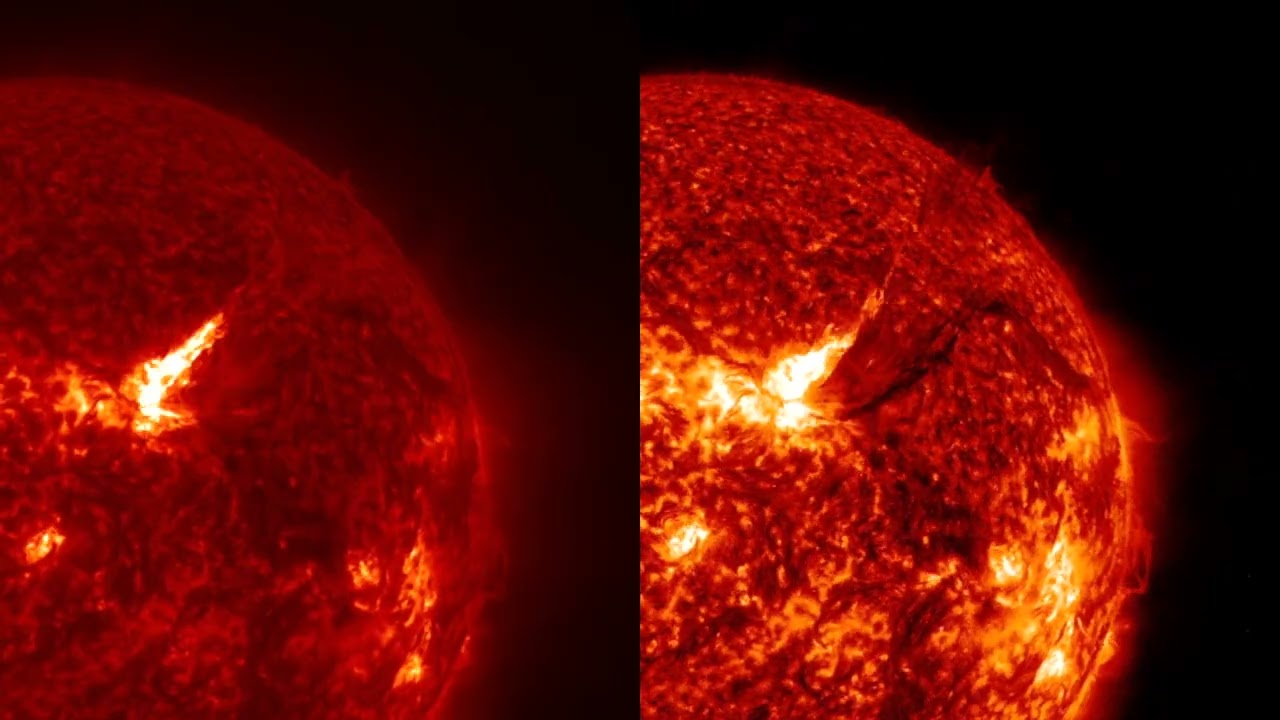
Solar Flares and CMEs at Earth - More Likely | S0 News June.3.2026
SpaceWeatherNewsS0s
2K views•2026-06-03



