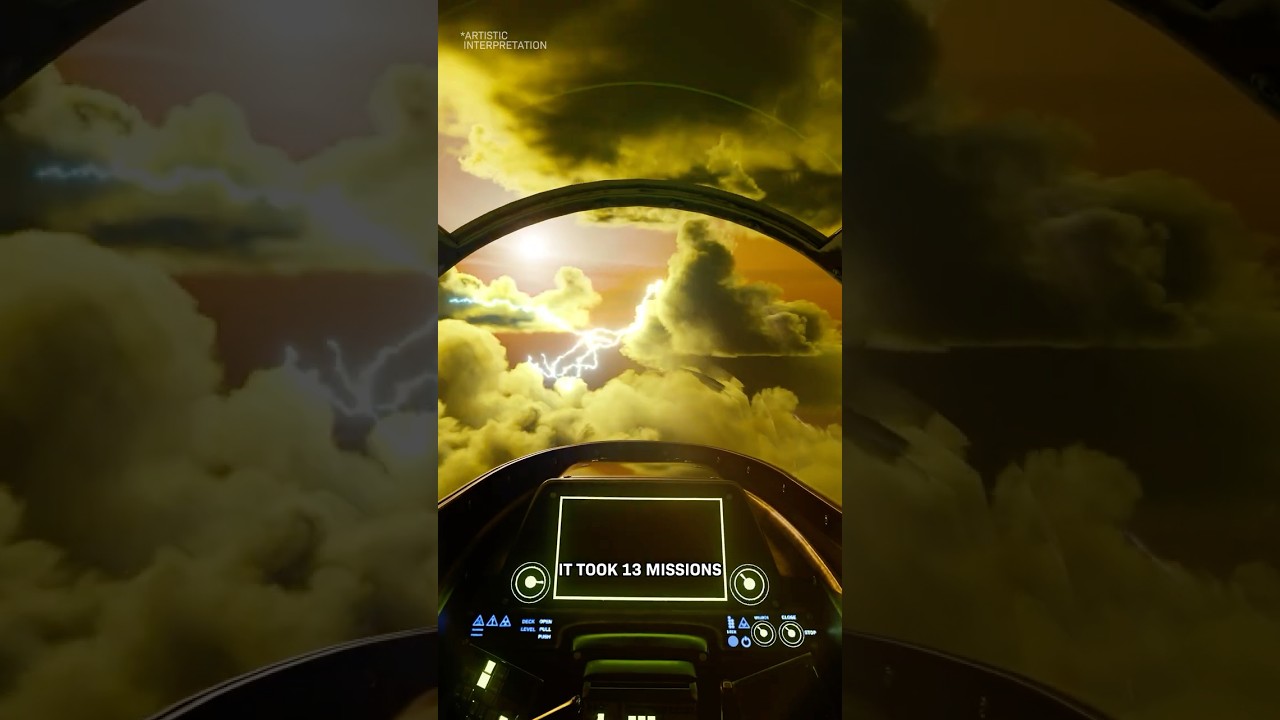
Voyager 1, launched in 1977 and now 47 years into its mission, has revealed that interstellar space is not empty but contains structured, dynamic phenomena including plasma oscillations and a sharp heliopause boundary, challenging humanity's previous assumptions about the void between stars.
Install our extension to search inside any video instantly.
Voyager 1 Has Made An UNIMAGINABLE Encounter After 47 Years in Space!
Added:At this exact moment, far beyond the warmth of the sun, where sunlight is no longer a comforting glow, but a fading and indifferent spark stretched into interstellar darkness, an old machine is still trying not to die.
Voyager 1 is out there, drifting through space at a distance so extreme that no human being will ever physically reach it within any foreseeable future.
It is powered by a shrinking reserve of plutonium, communicating with Earth using a transmitter weaker than a household light bulb, and operating on computing hardware less powerful than the simplest modern devices.
By all normal expectations, it should have gone silent long ago, reduced to inert metal drifting through an empty void.
But it has not.
It continues to respond.
It continues to transmit.
And most unsettling of all, it continues to report a universe that refuses to behave like the simple emptiness it was once assumed to be.
Instead, the space beyond the solar system appears structured, dynamic, and subtly active in ways humanity is only beginning to recognize.
In 1990, NASA made a decision that now feels strangely prophetic.
Voyager 1's cameras were permanently shut down, not because they had failed, but because there was no longer enough energy to justify visual imaging.
The spacecraft was too far from meaningful targets, and every remaining watt had to be conserved for survival and communication.
But before the system was powered down, Voyager was given one final instruction.
Turn around and take one last look at Earth.
The maneuver was delicate and risky, as the spacecraft was already aging after more than a decade in space, its systems exposed to radiation, cold, and mechanical fatigue.
Even a A error could have ended the mission instantly.
Yet Voyager succeeded.
The image it returned became one of the most iconic in human history, the pale blue dot, Earth reduced to a faint speck suspended in a beam of scattered sunlight, almost lost in the vastness of space.
But behind the emotional weight of that image lies a technical reality often overlooked. The raw data was imperfect.
It contained streaks, noise, distortions, and optical artifacts produced by extreme distance and weak signal strength.
For years, these imperfections were treated as expected limitations of deep space imaging.
Later, however, as image processing techniques improved and the original data was revisited, subtle questions emerged about whether all those irregularities were purely instrumental or whether they also hinted at the increasingly complex environment Voyager was beginning to enter even then.
To understand why Voyager's later measurements feel so compelling, it is important to understand what kind of object it actually is.
This is not a modern autonomous probe equipped with artificial intelligence, adaptive systems, or high-speed processing.
It is a relic of another technological era.
Its memory is measured in kilobytes.
Its logic is rigid, its response is predefined, and its tolerance for error extremely limited.
Every command sent from Earth takes more than 22 hours to arrive and another 22 hours for a response to return, turning any interaction into a multi-day exchange across billions of kilometers.
A single conversation spans nearly two days, each instruction traveling through deep space like a faint whisper stretched across a cosmic distance.
And yet, despite radiation damage, system degradation, and the absence of any possibility of repair, Voyager continues to function at the edge of interstellar space.
Every packet of data it sends is not just information. It is persistence encoded as signal, endurance translated into telemetry, and survival expressed through diminishing electrical pulses.
As Voyager moved farther from the Sun, its instruments began reporting subtle irregularities.
Some were expected, such as increasing noise, gradual sensor degradation, and memory errors caused by long-term radiation exposure.
But embedded within these predictable failures were patterns that resisted simple explanation.
Small deviations in plasma readings, slight inconsistencies in expected particle densities, and faint structures within what should have been random background noise began to appear with a persistence that made them difficult to dismiss.
At first, each anomaly was attributed to conventional causes, instrument drift, calibration errors, or solar influence miscalculations.
Yet over time, the repetition of these irregularities across multiple data sets created a sense that something more structured might be present in the surrounding environment.
The most significant shift came when Voyager crossed the heliopause, the boundary where the Sun's influence gives way to interstellar space.
Scientists had expected a gradual transition, a slow fading of solar wind into the broader galactic medium.
Instead, Voyager encountered a sharp discontinuity.
Particle densities changed abruptly, magnetic field orientations shifted suddenly, and cosmic ray intensity increased in a step-like manner.
It was not a smooth gradient, but a clear transition, as if the spacecraft had crossed a boundary between two distinct physical regimes rather than drifting through a continuous medium.
Beyond this boundary, Voyager detected a persistent and unexpected phenomenon.
Low-frequency plasma oscillations permeating interstellar space.
These were not random fluctuations or chaotic turbulence.
They exhibited structure, repetition, and a subtle coherence that suggested large-scale organization within a medium previously assumed to be mostly uniform and inert.
Scientists cautiously described it as a background hum, though the term understates its implications.
If interstellar space carries organized oscillations across vast distances, then it may not be empty in the traditional sense.
Instead, it behaves more like a medium with intrinsic properties, dynamic interactions, and possibly long-range coupling effects that are not yet fully understood.
As Voyager continues its outward drift, these anomalies do not escalate dramatically, but they persist consistently.
Tiny deviations accumulate over time, slight inconsistencies repeat across independent measurements, and the background signal maintains structure instead of dissolving into randomness.
Individually, none of these effects violate known physics, but collectively they create a gradual erosion of certainty about what empty space actually means.
The broader implications extend into modern astrophysics, where large-scale observations of the universe already suggest that matter is not distributed randomly.
Cosmic structures form filaments, galaxies align in vast networks, and subtle anomalies in background radiation continue to generate debate.
While most of these observations remain within statistical expectations, some patterns resist easy reconciliation.
Voyager, in this context, becomes more than a spacecraft. It becomes an in situ probe moving through a region of space that was previously accessible only through remote observation.
And direct measurement often complicates theoretical models rather than simplifying them.
The deeper implication is not that Voyager has discovered discrete objects or hidden structures floating in space, but that the assumption of complete emptiness may itself be incomplete.
Interstellar space may possess gradients, flows, oscillations, and organizational features that exist at levels too subtle to detect without a local probe.
As Voyager continues its slow departure from the solar system, its own existence becomes part of the story it is measuring.
Its power supply continues to weaken year by year, forcing mission engineers to shut down instruments one by one to conserve energy.
Its future is finite, and its eventual silence is inevitable.
Yet paradoxically, as it approaches the end of its operational life, the significance of its data grows rather than diminishes.
A fading machine built in the 1970s is providing some of the clearest direct measurements humanity has ever received from interstellar space, revealing a medium that may be more structured and dynamic than previously assumed.
It is not announcing a dramatic discovery in the form of objects or artifacts, but something quieter and more profound, that the environment between stars may itself be active in ways we are only beginning to measure and interpret.
One day, Voyager 1 will transmit its final signal.
After more than 22 hours of silence on its end, that last faint transmission will arrive at Earth, marking the end of contact with a machine that has traveled farther than anything made by human hands.
After that moment, it will continue drifting silently, carrying the golden record as a message intended for unknown civilizations, while also carrying something unintended, evidence that the space it travels through may not be empty at all.
It will become a silent artifact moving through a structured cosmos, a reminder that even in the absence of sound, light, or interaction, the universe may still contain patterns waiting to be understood.
Related Videos

Avi Loeb: We May Be Close to the Biggest Discovery in Human History
ProfessorAviLoeb
10K views•2026-06-21

Why Do We Only See One Side of the Moon?
SpaceTheory9
1K views•2026-06-18

The Biggest Lie in Telescope Marketing
Astrolavista
179 views•2026-06-21
James Webb Telescope Found a NEW EARTH But It's Inhabited!
PHN413
858 views•2026-06-20

The Most Disturbing Events in Space (Pt. 3)
ThePaintExplainer
251 views•2026-06-21

10 Space Threats That Scientists Are Monitoring Right Now
SpaceMate-SM
146 views•2026-06-22

Can SpaceX Put a Million People on Mars? | with Dr. Scott Solomon
EventHorizonShow
731 views•2026-06-18

Massive Solar Storm Alert! The Sun's Explosive Power Revealed
SciVelocity
182 views•2026-06-18