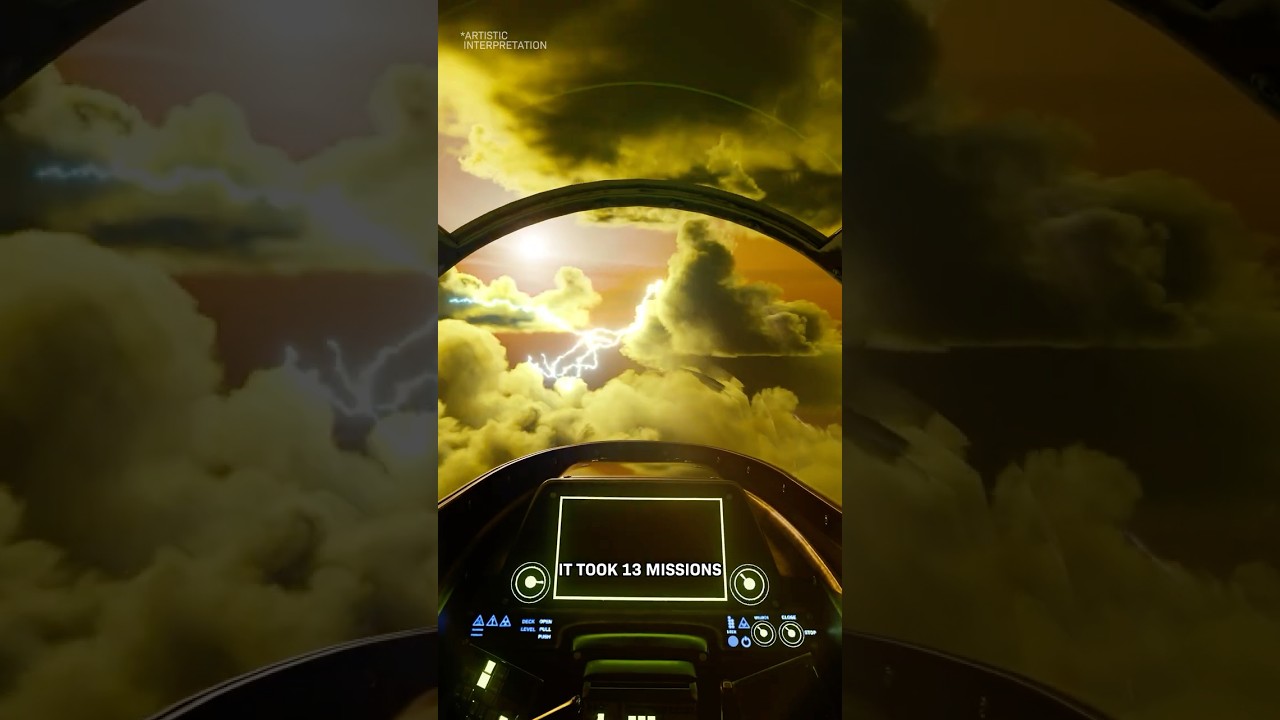
The video effectively uses cosmic anomalies to highlight the limits of human knowledge, turning complex physics into a humbling lesson on universal unpredictability. It’s a sharp reminder that what we call "disturbing" is often just the universe operating beyond our current scientific maps.
Install our extension to search inside any video instantly.
The Most Disturbing Events in Space (Pt. 3)
Added:The Bonilla observation.
This one is likely the most insane space event I've ever talked about. On the morning of August 12th, 1883, a Mexican astronomer named Jose Bonilla sat down at his telescope at the Zacatecas Observatory to study [music] the Sun.
What he saw stopped him completely.
Hundreds of objects close together were crossing in front of the Sun. In just 2 hours of clear sky, he counted 283 of them. He kept watching, and over the course of the next day and a half, he took many photographs of the objects.
Each one appeared fuzzy, surrounded by a kind of mist, and many had what looked like dark tails trailing behind them. He had no explanation, so he sent word to the nearest observatories in Mexico City and Puebla, but their response made things even stranger. [music] The phenomenon was completely invisible to them, even though they were only a few hundred kilometers away. That detail is what makes this event so unsettling.
The fact that only Bonilla could see it suggests the objects were very close to Earth, close enough that the angle of view shifted the moment you moved just a short [music] distance. Later calculations estimated the objects passed between roughly 334 and 5,009 miles above Earth's surface, which is incredibly close in space terms. When Bonilla finally published his findings in 1886, the editor of the journal dismissed the whole thing as birds or insects flying past the lens. However, in 2011, researchers looked at the data again and reached a much scarier conclusion. They believed Bonilla had been watching fragments of a comet that had recently broken apart. Their calculations suggested a total of around 3,275 objects passed by Earth over those 2 days, [music] and the chunks weren't small, either. They ranged in size from 164 feet to 3,280 feet across. [music] If even one of them had hit, the impact would have made a nuclear bomb look like a firecracker.
The smallest fragments in the stream would have been 1,000 times more powerful than the atomic bomb dropped on Hiroshima. If all of them had hit, it would have been roughly equivalent to a full-scale global thermonuclear war packed into just a 48-hour window, causing an incredibly violent mass extinction. All of this was about to happen while nobody on Earth even knew about it. Some scientists now [music] think Banilla wasn't looking at meteors, but rather something like a swarm of locusts, though we still don't have confirmation either way. The VASCO project. The night sky is supposed to be stable since stars take millions or billions of years to die. And when they do, they usually go out in an explosion bright enough to be detected across the universe. However, there's a problem.
Researchers participating in the VASCO project compared a star catalog from the 1950s listing around 600 million objects with a much more recent sky survey that can detect stars five times fainter than the older one. They found roughly 150,000 objects in the old catalog that had no match in the new one. Most of those turned out to have normal explanations such as camera errors, brief flashes, moving objects, etc. But after careful inspection of tens of thousands of candidates, a disturbing discrepancy was found. There were still 100 points of light that appeared only in the older survey and nowhere else since. They had simply vanished with no normal explanation. No afterglow, no remnant, no detectable debris. There were many theories that tried to explain this phenomenon, and among them there was a really wild one. Keep in mind that VASCO is also a SETI project, acronym for search for extraterrestrial intelligence. The wild theory suggested that these stars [music] had been completely enclosed or their energy harvested by an advanced civilization using technologies like Dyson spheres.
Oh my god particle. On the night of October 15th, 1991, a detector in the Utah desert picked up something that physicists did not think was physically possible. A single particle smaller than an atom was streaking through the atmosphere carrying an almost unimaginable amount of energy. The particle [music] possessed 320 exa-electron volts of energy, millions of times more than particles achieve at the most powerful particle accelerator ever built by humans. It was traveling incredibly close to the speed of light itself. Here is why it was so alarming.
There is a known physical limit called [music] the GZK limit which describes how much energy a cosmic ray particle can hold before the background radiation of the universe strips that energy away during travel. Anything above that limit should not be able to cross large distances of space intact. The Oh My God particle had more energy than was theoretically possible for a cosmic ray traveling to Earth from another galaxy.
Simply put, the particle shouldn't have existed. So, where did it come from?
Nothing in our own galaxy is powerful enough to produce it. Researchers looked in the direction it seemed to arrive from and found no obvious source. No black [music] hole, no exploding star, nothing that could explain it. Then, a second particle of nearly the same energy was detected in 2021, arriving from a completely different direction in the sky. In both cases, no following observations have revealed the origin of these particles or how they managed to travel to Earth.
The Space Roar.
In 2006, NASA sent a balloon high above Earth's atmosphere carrying an instrument called ARCADE. The goal was to look for faint heat signals from the very first stars that existed. Instead of those faint signals, they heard a roar from the distant reaches of the universe. The signal was six times louder than expected. Scientists have tried several explanations, but the space roar does not fit any existing models and as of today, its origin remains unexplained.
The GD-1 Invisible Bullet.
In our galaxy, there are long trails of stars called stellar streams. Think of them as slow rivers of stars that form when a cluster of stars gradually gets pulled apart by gravity over billions of years. GD-1 is one of the longest and thinnest of these streams in the Milky Way and for a while it seemed perfectly normal. Then astronomers took a closer look and found something wrong. There was a gap as if something had punched straight [music] through it and just beside that gap, a clump of stars had been pushed off to the side like debris scattered from a collision. Scientists ran simulations and found that these features could be the result of the stream encountering an incredibly dense, massive object. They started looking for what could have caused it, checking the orbits of all known satellites in the galaxy, but none had crossed paths with GD-1 recently. They also considered whether giant clouds of gas could be responsible, but found they were not dense enough. Nothing known fit the size and force needed to produce that kind of damage. We don't have a 100% confirmed [music] definitive explanation, but the leading theory is that something made almost entirely of dark matter passed through the stream like a bullet.
The 2009 Jupiter Blindside.
In the summer of 2009, an amateur astronomer was looking through his telescope in his backyard when he noticed something wrong with Jupiter.
There was a strange dark spot near the bottom of the giant gas planet that was not there just a few days before. This dark mark was huge. In fact, it was roughly the size of the Pacific Ocean.
Scientists quickly pointed telescopes into space to see what was happening, and they realized that Jupiter had just been hit by an incredibly massive rock, either an asteroid or a comet, crashing into it at an incredible speed. an amount of energy equivalent to between 300,000 and 4.7 million Hiroshima nuclear bombs detonating all at once.
What makes this event truly disturbing is that nobody saw the rock coming. With all our advanced technology and scientists watching the sky, this massive object slipped completely under the radar until after it had already smashed into Jupiter. You can imagine what would have happened if this rock had hit Earth instead. Luckily, Jupiter is much larger and has much stronger gravity than Earth, allowing it to pull in dangerous space rocks. While this [music] helps protect us most of the time, all it takes is one rogue object to slip past.
The Hidden Quasar.
For decades, sky surveys cataloged a bright, intense light source in our night sky as an ordinary, albeit bright, star. However, in 2024, scientists realized they had made a massive mistake. That speck of light is not a nearby star at all. It is a quasar located 12 billion light-years away. A quasar is the extremely bright center [music] of a distant galaxy powered by a supermassive black hole. What makes this specific quasar so disturbing is its sheer scale. It is the brightest and most violently energetic object ever discovered in the entire universe, shining about 500 trillion times brighter than our sun. The black hole at its center is also the fastest growing one we have ever seen. It is so unimaginably huge that its gravitational pull is ripping apart and swallowing the equivalent of one entire sun every single day. All that material forms a giant swirling disc of superheated matter called an accretion disc before it falls into the black hole forever.
This disc alone is seven light-years across, which means it is thousands of times larger than our entire solar system. This monster is so incredibly bright that our computers initially rejected it. The automated systems designed to look for quasars ignored it because it was mathematically too bright to exist according to our models.
Imagining these distances is often hard, but to help you conceptualize it, just think that we can see the light from an object that is sitting physically halfway to the edge of our observable universe.
Abell 2261 black hole One of the most well-established sort of rules in modern astrophysics is that basically every large galaxy in the universe has a supermassive black hole sitting at its center. The bigger the galaxy, the bigger the black hole at its core. However, there's a problem. The galaxy at the center of Abell 2261 is up to 10 times the size of the Milky Way, and it has the largest galactic core ever observed. Based on its size alone, it should contain one of the biggest black holes ever recorded. The problem is that it's simply not there. NASA pointed both the Chandra X-ray Observatory and the Hubble Space Telescope at it. Nothing. [music] No sign of a black hole anywhere near the center of that galaxy. Then there is the other strange detail. The core of the galaxy is not even centered inside the galaxy itself. This sometimes happens after two galaxies merge, and that's exactly what makes the leading theory so unsettling. During a merger of two galaxies, the central black holes from each could combine into one enormous black hole. This violent event generates huge gravitational waves, and if those waves were stronger in one direction, the new black hole could have been sent flying away from the center of the galaxy in the opposite direction.
[music] In other words, one of the most massive objects that could exist may have been physically kicked out of its own galaxy, and right now, nobody knows where it is.
The Cow Explosion.
On June 16th, 2018, we detected a sudden flash of brilliant blue light coming from a galaxy about 200 million light-years away. Within days, it had become one of the brightest things in that part of the sky. Astronomers scrambled every major telescope they could toward [music] it because what they were seeing did not match anything in their records. The explosion was 10 to 100 times brighter than ordinary supernovas, and while a typical supernova takes weeks to reach maximum brightness, this one took 3 days or less. That alone was deeply strange, [music] but there was more. Scientists observed that rather than fading quickly the way most short explosive events do, it kept pumping out X-ray and radio emissions for weeks, suggesting something at its center was actively powering it long after the initial blast. Then, there was yet another weird discovery. Researchers looked at the shape of it, and analysis revealed the Cow was the most asymmetrical explosion ever seen by astronomers, bursting outward in a flattened pancake-like shape rather than in a sphere as nearly all known explosions do. There are no 100% confirmations, just theories such as the leading one that involves either a newborn black hole or neutron star.
The Zombie Star.
In 2014, scientists spotted what looked like a normal supernova. Usually, a supernova flares up brightly for about 100 days and then slowly fades away into the dark. However, this specific one did something impossible. Instead of fading, it got brighter, then dimmed, then got brighter again. It repeated this cycle at least five times over almost 2 years.
Scientists were completely baffled by this behavior. It was acting as if it refused to die. The mystery grew even deeper when astronomers looked at old photographs of that exact same spot in space. They found out that this very same star had actually exploded 60 years earlier and somehow survived. According to everything we know about space, a star can only die and explode once. The sheer force of a supernova is supposed to completely destroy [music] it.
Scientists still do not fully understand how this is possible, and the best guess is that the star was so incredibly huge that its core [music] got dangerously hot. This heat would have caused extreme internal explosions that blew off its outer layers without completely destroying the entire star. But even that is just a theory.
If you want to discuss this video or suggest an idea for the next one, join my Discord. Link in the description.
Related Videos
Avi Loeb: We May Be Close to the Biggest Discovery in Human History
ProfessorAviLoeb
10K views•2026-06-21

Why Do We Only See One Side of the Moon?
SpaceTheory9
1K views•2026-06-18

The Biggest Lie in Telescope Marketing
Astrolavista
179 views•2026-06-21
James Webb Telescope Found a NEW EARTH But It's Inhabited!
PHN413
858 views•2026-06-20

10 Space Threats That Scientists Are Monitoring Right Now
SpaceMate-SM
146 views•2026-06-22

Can SpaceX Put a Million People on Mars? | with Dr. Scott Solomon
EventHorizonShow
731 views•2026-06-18

Massive Solar Storm Alert! The Sun's Explosive Power Revealed
SciVelocity
182 views•2026-06-18
Voyager 1 Has Made An UNIMAGINABLE Encounter After 47 Years in Space!
TUMMYYUMMY04
208 views•2026-06-18