This stream masterfully leverages the parasocial dynamic to transform technical education into a shared ritual of self-improvement. It proves that even fundamental syntax becomes more engaging when framed as a collective journey toward digital literacy.
Install our extension to search inside any video instantly.
️ [?] - Learning Python (Streamed 07/20/2026)
Added:That was tough.
That was really hard.
You cannot pass.
I am a servant of the secret fire wielder of the flame manure.
One day I knew I had to come back here.
I had to come back and get on the merry round and eat cotton candy.
a little bit better.
Well, I don't feel too good, but I feel awful, in fact.
But after many days, a whole week even of not practicing Python and not doing stream.
I'm just going to force myself to do a little bit.
I'm having a hard time. I'm in a lot of pain.
No, I shouldn't complain.
But it's true. I shouldn't complain about it, but it's true.
I was thinking this morning about something I read about how mindset is so important to survival and I believe that to be true.
But even though I believe it's true, do I really embody that? I don't think so.
I think a lot of times I leave my mindset alone. I don't interrogate it. I just accept whatever it is. And my mindset tends to be pretty negative. I tend to focus on all the bad things.
I forget about what's good or at least neutral.
I focus on um how I failed out of grad school and I couldn't afford to go back and finish my degree.
I focus on, you know, how I lost my job and how I had extreme difficulty in the job market.
I think about how I spend my time, waste my time on silly games and silly things that aren't important.
I think about how I'm behind, how I'm not good at anything.
I think about what people say to me. I think about what people say to me all the time. I don't want to think about it anymore, but I think about it all the time.
I want to I want to prove that Someone as bad as me can persist.
But I'm having a hard time. Yeah.
Yeah.
I don't even really remember where I left off.
I know we I'm pretty sure we did these.
I don't think I got as far as 12. I think I did that. Yeah, I think we did function.
Let's look. Let's look.
Yeah, we definitely did this one. Oh, yeah. And then 11 was the one that had the different ones. I did scope. I did geometry.
Did I finish lowerase?
I don't remember this first step is to write a function lower car character seems familiar that can return the result of converting a single character to lower case. Oh yes. And then we used we used um the character in ordinal like this. Whatever. But the opposite.
There was something like 675 and then what was the highest one? Oh, then we did that whole map. Yeah, I remember this now. Yeah.
When did we do the map though?
Was that on the next I'm sure it's I just don't remember when.
What's tips? I feel like I stopped here.
I confused.
Maybe I'm confused.
print options. Oh, I did read this before loops and other increments. Yeah, I did read this.
I had a I I had a mental breakdown over this exercise to print type print type type print. But I think I understand it a tiny bit better now.
print outputs whatever the object in parentheses is as um a string representation.
But it has But it returns none.
Oh, my tummy hurts.
And then I also got it confused because I did some of this in the ripple and then some of it in a Python script.
But the ripple doesn't behave the same way as a Python script because the ripple shows the output of some things that wouldn't actually be shown in um in a script. So I think that was confusing me too.
A blank line.
Meow. Meow. Meow.
blank line print of a print of a blank line is nothing. The type print of a print of a blank Um, let me think. This prints a blank line.
This prints nothing.
The type of a print of a print is none.
And the type of a type of print of print is type.
And then to print that type, the type of a print So this this prints blank line this prints none.
A type of a print of a print is none type but nothing prints. A type of a type is class type but nothing prints.
But then we print that class type and we ask what's the type of a print of a type. The type of a print is a non type that doesn't print anything and then you print the type of a print which is none type anyway.
So this is 12 13.
I don't remember this. Wait.
Oh, it was all the way back here. We did this.
I guess I have to go back and rewatch the VODs, but I think I might have deleted some of them, so I don't remember if it's in there.
If you want to get good at something, you you got to practice a lot. You got to practice every day. You got to practice a lot.
And just because other people and just because AI is better than you and will always be better than you, it doesn't mean you can't learn to to be better at something. And just cuz you're stupid doesn't mean you can't try to learn anyway. Cuz you know, you got to pass the time one way or another.
Nope. Every eventually we're all going to die and we're all going to be dead.
I'm not going to be here anymore.
You got to pass the time before then someway. You don't don't want to spend all your time going to anime girls.
Got spend some of it doing the fun things.
A list is a sequence of variables.
No, it's not. This is a sequence of several variables grouped together under a single name.
Instead of writing a program with many variables x0, x1, x2, you can define a single variable x and access its members x of one. No, x of zero, x at index one, x at index two, etc. Most in Fortunately, you can put other expressions and variables inside the square brackets like I and I + 1. This allows us to deal with arbitrarily large data sets using just a single small piece of code. One way to create a list is by enclosing several values separated with commas between square brackets. My list the first value in the list 1999 4.5.
This creates a list called my list of length three. Each element of the list gets a number called its index. The initial element has index zero. The next element has index one and so forth.
The individual variables comprising the list have the names list name, index number. So in this example, my list with the bracket zero is a variable whose value is the string, the first value in the list and print my list two would print 4.5. You could change the values of the items in the list and print out entire list. So updating and printing a list numbers 01 2 number zero zilt print numbers. So then we should get zilt one two it's printed. Okay.
As you can see number zero is treated as if it were itself a variable. Oh, this is actually pretty cool though.
Honestly, I never thought of it that way.
I never thought of this this way.
It has a value and can be changed. Next, try to predict the final state of the visualized example below. Then compare it with actually running the code. So my list 1 10 100 a thousand for i in range 0 to two.
So 0 1 - i is equal to 2 * - i + i.
So for - 0 2 * - 0 which is 1 is 2 + i which is zero is 2. So that gets updated to two.
And then for one my list one is 10. 2 * my list one which is 10 is 20.
+ 1 is 21. So, we should get 2 21 100 1,000, but it's not printed or anything cuz I don't see that in this list. But that's what's going to be in my list.
Yeah.
What is the output of the following code fragment stuff 2 25 802 stuff at index zero is two.
Stuff at index two is 80.
stuff at index three is 12.
But we reassigned this 80 to 12. So we get 22 25 12.
But Python calls a list would be called an array in most of the programming languages. Python also has something different and more advanced called arrays. Yeah, that's what I was confused about because they started this chapter talking about arrays, but I never learned arrays yet.
Efficient arrays of numeric values.
This module defines an object type which can compactly represent an array of basic values, characters, integers, floatingoint numbers. Arrays are mutable sequence types and behave very much like lists except that the type of object stored in them is constrained.
The type is specified at object creation time by using a type code which is a single character.
The following type codes are defined.
B signed character int.
Capital B unsigned character int U w character T unic code character W pi U CS for unic code character. Why are so many these integers? Sign short unsigned short signed int unsigned int unsign long sign long unsigned long long float double.
What the f? What the f? What the f? What the f? What the f?
It can be uh unic code 16 bits or 32 bits depending on the platform.
Arrayu now uses W character T as C type instead of depreciation depreciated PI unic code. Okay, whatever.
It's appreciated since version 3.3 will be removed in version 3.16. Please migrate to W type code added in version 3.13. Okay. Well, well, well.
See also the C types instruct modules.
Okay, I'm getting too lost in the sauce, but whatever. A common error. If you try to ask Python for an index that doesn't exist, it gives you an error.
Out of range error. My list 1 2 4 8 print my list four at index four, but there's only three. 0 1 2 3 trace back most recent call last in line two of the code you submitted print my list index 4 index error list index out of range in the above example because my list has length four and the first index is zero the maximum possible index is three asking for an index of four five or anything larger gives this kind of error.
Common useful operations.
The length of a list len list. To determine the number of items in a list, call the length function on that list.
Look at how range is used in the following example.
My list 312 pizza 34 print. My list has length length my list one two three four five for i in range zero to the length of my list five print item at index i colon my list i.
So item at zero three item at one 12 item at two pizza item at three three item at 44 for yep.
It is common to use len to write code that can work on list of any length like in the example above and in the next exercise. Monkey in the middle. write a function middle L which takes the list L as its argument and returns let's try let's go ahead middle L taking L and it's going to return item in the middle in order that the middle is well defined mind you should assume that L has odd length.
For example, calling middle 80 1121 should return 100 since it is positioned exactly in the middle of the list.
So how do we find so how do we find the middle number of a list of odd numbers?
Well, we can use math. That's how. So we take the length of the list and then we need to do let's see it could let's see Um, the vision would give us a float.
modulo would give us a remainder.
Integer division would give us a rounded number, but that doesn't really help, does it?
Maybe maybe that is what I want. Do I want integer division?
Um 11 / 2 5.5 11 modulo 2 would be 1 11 floor division 2 would that be Give me six.
Gives me five.
Oh, is this is floor division?
How many times does this number go into this other number? Ignoring ignoring remainders, but it's the middle point of 11.
Let me check.
of 11 items starting with zero.
One, two, three, four.
Two, three, four, six, seven, eight, nine, 10.
One, two, three. One, two, three, four, five.
But index five. Okay. May I reduce flirt division.
Um, let's see. F L is 80121.
equals 800.
Oops.
12.
Length of L should be five.
Five.
integer division two should be two and then L at should be 100.
Yay.
Are lists like strings? At this point, you might have noticed that the operations on lists are a lot like strings. Both of them can be passed to the length function to get their lengths and both of them use x index to extract individual items. Lists and strings are indeed related. They are both sequence types in Python. The one major difference is that individual characters in strings cannot be changed. Yeah, strings are immutable but lists are mutable.
Error caused by trying to assign a value to a character in a string. Word is slack. Print word word at position index one which is slack, L.
And then try to change the L to an N and have it be snack. And we get trace back most recent call last in line three of the code you submitted. Word index one equals n type error string object does not support item assignment and it gave this output slack out.
For this reason lists are called immutable type and strings are immutable. You will see a little bit more information about this in lesson 17, concatenation and creation from the lesson about string type.
You may remember that it is possible to use and to merge concatenate two strings together. You could do the same thing with lists.
List A three go 7.1. List B four high one. List C is list A plus list B. Print the length of list C and we should get 1 2 3 4 5 [snorts] 6 is six. And then print list C. We should get three go 7.14 high one.
Similarly, you can use the multiplication symbol to extend the list by repetition. This is useful for creating a new list of a desired length.
My phone number 967 + 1 * 4.
Put my phone number 967 one one one new empty list 0 * 20 is a list of lot of zeros to solve the next exercise. Use one of the operators we just introduced in a for loop. Write a function called natural numbers which takes a positive integer n as input and returns a list.
one to blah blah blah consisting of the first n natural numbers.
We want an integer n and a list consisting of firsts.
like natural numbers.
It's natural. I don't know what a natural number is.
In mathematics, the natural numbers are the numbers 0, 1, 2, 3, and so on, possibly excluding zero. This is what the [ __ ] is this difference? the integer.
The terms positive integers, non- [clears throat] negative integers, whole numbers, and counting numbers are also used.
[ __ ] The set of natural numbers is commonly denoted by a bold n or a blackboard bolt end.
Natural numbers are used for counting.
Okay, fine.
They want us to start from zero or should we assume they don't want us to start from zero?
Either 012. Actually, they tell us they told us they want us to start at one.
So, We want to return a list. We're going to call it list.
Um for I range. Make an empty list first.
What it be range zero? No, one starting at one.
two + one.
Um, list at I Let's start at zero because this is for the index.
It's still n + one or is it just n 0 to n?
Let's see if it's two. If a number is two, the first two natural numbers are one, two, which is index zero, one, which is the same thing as range 02.
Okay.
List is going to be equal to I press one, right?
So for the number five we're in range 0 to 5 list 0 will be equal to 0 + 1 will be 1 or list index one will be equal to two.
This index four will be equal to five.
That should work.
List assignment index out of range.
[clears throat] Okay.
We don't want to We want to change this.
Uh, I just add it. That work?
Doesn't work either.
How do you pen to list, man? Oh, man. Oh, man. I forgot. Every week I forget how to do this list.
And I don't think that's how I was supposed to do this. For some reason, I don't feel like this is how I was supposed to do this. For some reason, they said something about concatenation.
Use one of the operators we introduced in the for loop.
Um, was I supposed to use len?
No.
See, but these these examples already had a list.
My brain hurts.
This one already had a list. This one had a list called my list.
This one had a list called L.
This had a list A, B, C, whatever.
This had a list. I don't get it. He was one of the operators we introduced and a four loop.
Meow. Meow. Meow. Meow.
Maybe we have to use it like this.
Is this? Let me think.
This equals 0 + 1, which is one. Oh, this works.
It works. It works. It works.
It has a wrong length of unexpected damage. [ __ ] Oh [ __ ] Local. We still need an empty list.
We do that.
We can do that. We could do that instead. That works.
Hey, that [laughter] works.
Hey, [laughter] we could just do that.
Whatever.
Whatever.
Negative indices. To get the last item of a list, use this name index minus one. More generally, L minus K returns the K item from the end of the list.
Python handles this internally by translating it into L of the index length L minus K. This shortcut notation works for strings too. Palindrome. A palendrome is a word which is spelled the same forward as backwards. For example, the world word race car is a palendrome. The first and last letter are the same R. The second and second to last letters are the same A. Write a function is palendrome S.
This takes a string S as input and returns true.
If pal return true else return false.
But how do we tell if it's a pallet germ? If if sat Check. How do we check? How do we check?
Hum.
hum.
Oh, my brain hurts.
My brain hurts. My brain hurts. My brain hurts. Starting at one.
L at index K is translated as L at index length of L minus K.
K item on the end of the Let's test this if it's true. Let's say we have a list of five and we want list at minus2 L at the index 5 - 2 is the same thing as L at index 3.
0 1 2 3. That makes sense.
Okay.
Maybe we don't need a for S.
Maybe we do need one for I in range zero to length.
The value at S index I is the same at the Lu of S.
This makes sense.
We need zero and we need one.
Okay, my brain hurts.
This is not the same thing.
If I is zero, we want the other one to be well, it doesn't have to be a length.
It could just be just another thing.
We want the other one to be one.
And if I want to be two, how do we get that?
We get two.
That's not negative. That's just minus We get zero. We get one.
Get one2.
23.
This is not right though.
This car is true.
Fool proof. Helen has a wrong valley.
True. Expect false.
One here.
One, two, three.
Four. One, two, three, four.
I think I'm confused because um it only this the way I wrote it, it only checks the first character, I'm pretty sure.
Yeah. Anyway, I stop here. I stop here for today. I do more tomorrow. I think about it. Goodbye.
Related Videos

6:13
Computer Science
TOP 15 Data compression Interview Questions and Answers 2019 Part-2 | Data compression | Wisdom jobs
wisdomjobs
281 views•2019-06-28

27:51
Computer Science
CTS 158: 802.11w Management Frame Protection
ClearToSend
4K views•2019-02-04
23:21
Computer Science
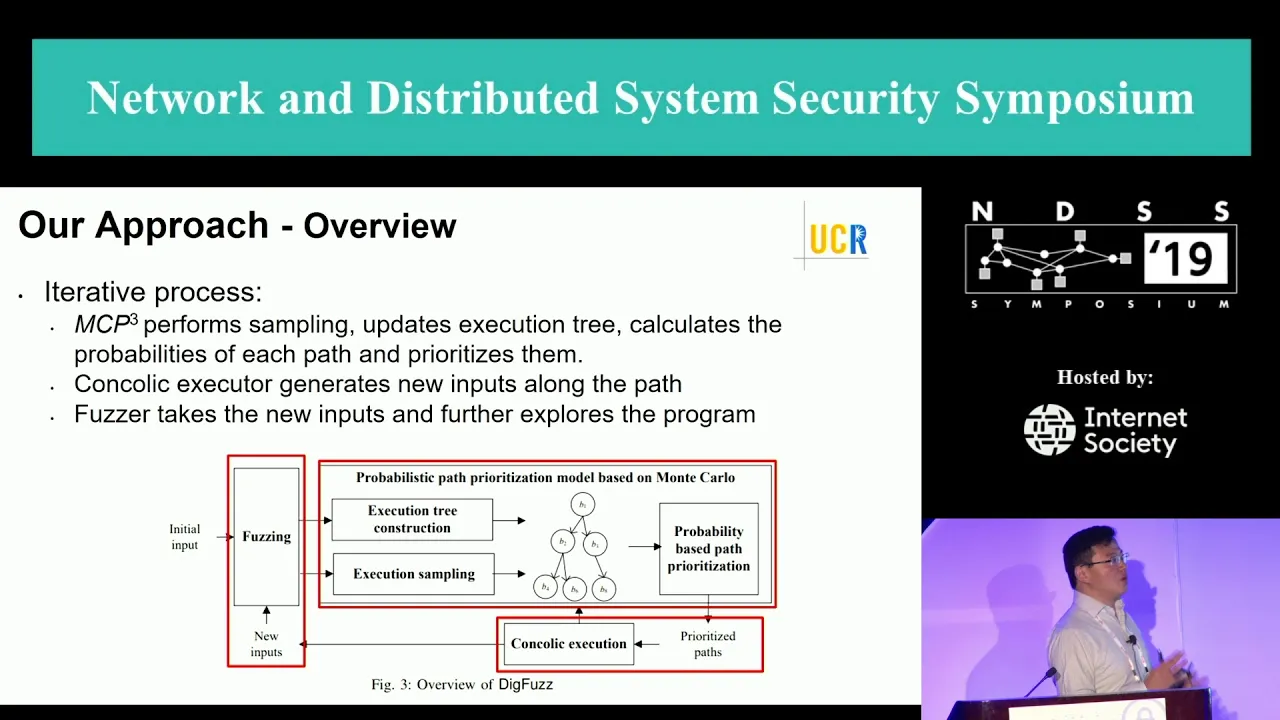
NDSS 2019 Send Hardest Problems My Way: Probabilistic Path Prioritization for Hybrid Fuzzing
NDSSSymposium
496 views•2019-04-02

12:48
Computer Science
How realistic is Cities: Skylines?
CityBeautiful
159K views•2019-02-14
46:39
Computer Science
GUIs & TUIs: Choosing a User Interface for Your Python Project | Real Python Podcast
realpython
2K views•2025-04-04

25:15
Computer Science
The OSI Model - Explained by Example
hnasr
225K views•2019-05-12
1:10:47
Computer Science
Cloud Computing - Introduction
elithecomputerguy
98K views•2019-10-07

2:24
Computer Science
From Traveler's Dilemma to Dynamic Routing | Demystifying Networking
IITBombayJuly
5K views•2019-08-04
Trending

5:07
Philosophy
One Must Imagine Sisyphus Happy
vlogbrothers
61K views•2026-07-21

25:15
Business
Future of Taylor Farms
maighstirtarot5385
11K views•2026-07-21

12:30
Business
The Downfall of OnePlus!
techwiser
65K views•2026-07-21

23:12
Engineering
My Friend Locked Up The Engine On His K-Swapped Bug...
boostedboiz
128K views•2026-07-21