Observation and engagement are essential therapeutic interventions in mental health inpatient care, with observation determining the frequency of monitoring based on patient risk levels (typically ranging from level 1 at 30-60 minute intervals to level 4 continuous observation with multiple staff members), while engagement involves therapeutic interactions tailored to individual patient needs to support assessment, care, and recovery. These practices have evolved from primarily surveillance-focused approaches to more patient-centered, therapeutic interventions that balance safety with dignity, privacy, and therapeutic relationship building. The implementation of these practices is influenced by national guidance such as NICE guidelines, the Mental Health Code of Practice, and the Enhanced Therapeutic Observation and Care (ETOC) program, while challenges include staffing pressures, workforce shortages, and the need for robust handover processes during patient transfers.
The Lampard Inquiry Live - Day 55 22/07/26 AM
Added:Mr. Griffin.
Good morning, chair. Today the inquiry will hear from Jill Archerald, uh, an expert witness, and she will deal with observation and engagement and the use of vision-based monitoring.
Uh there may be aspects of today's evidence that are difficult to listen to. For some people, it may not be possible to sit through the full session and we'll be hearing from Miss Archbold both in the morning and the afternoon.
Anyone in the inquiry room should feel free to leave at any time.
May I take the opportunity to remind those engaging with the inquiry that emotional support is available for all who require it. Uh present today as on every day are representatives of Hestia and they are able to provide emotional support. They are currently in this room and can be identified by their orange colored scarves.
There's a private room downstairs where anyone who needs emotional support can talk to Hestia.
Uh if you prefer, you can speak to a member of the inquiry team. We're identifiable by our purple landards and we can put you in touch with Hestia.
Uh for those following the hearing online, information about emotional support that's available can be found on the inquiries website at lampardinquiry.org.uk.
The support tab is near the top right hand corner. Chair, we want everyone engaging with this inquiry in whatever way to feel safe and supported. And chair, with your permission, uh, I'll now ask for Miss Archable to be sworn.
Do I stand? All right. Um, I, Jill Archerald, do solemnly, sincerely, and truly declare and affirm that the evidence I shall give shall be the truth, the whole truth, and nothing but the truth.
Would you provide your full name, please?
>> Um, yes. Uh, Jill Veronica Archerald.
>> Miss Archerald, have you provided the inquiry with an expert report uh called report for the Lampard inquiry observation and engagement and the use of vision-based monitoring?
>> Yes.
>> Do you have it in front of you?
>> I do. Is it dated the 1st of July 2026?
>> It is.
>> And in total, is it 104 pages long?
>> It is.
>> Are there a couple of corrections that you'd like to bring to the chair's attention?
>> There is.
>> Uh, can we start with page 92, please, and paragraph 256?
Should that paragraph simply be deleted because it repeats most of the paragraph above it?
>> Yeah, it should.
>> Could we go to page 101, please? And the last paragraph there.
Can we see at the end of the first sentence the word note?
Yes.
>> Should that actually be not not?
>> Yes, that's correct.
>> Thank you.
>> And then can we look at your appendix at page 102?
>> Yes.
>> Do we see the penultimate paragraph there starting with number three? Date September 2021 to November 2023.
>> Should that simply be deleted as it repeats the paragraph above it?
>> Yes, that's correct.
And finally in the same appendix at the top of the next page where we see five date can we see there a reference to July 2026 and should that in fact be July 2016?
>> Yes that's correct.
>> Thank you.
If we look at the bottom of page 101, uh, does the report include your confirmation that you've made clear where facts and matters referred to are or are not within your own knowledge and that where they are within your own knowledge, you confirm them to be true.
And finally, that the opinions you've expressed represent your true and complete professional opinions on the matters to which they refer.
Is that correct?
>> That's correct.
>> And do you again confirm that today?
>> I do.
>> Uh you say at paragraph 1.11, so that's at page five, that in preparing this report, I have sought to provide objective, balanced, and impartial evidence to assist the inquiry on the matters within my area of expertise.
Again, is that correct?
>> That's correct.
>> Have you signed the report?
>> I have. and subject to the corrections that you've just notified. Is it true and accurate to the best of your knowledge and belief?
>> It is, >> Miss Archbold. The report stands as part of your evidence. The chair, the inquiry, and others have read it with care, and that means I don't intend today to ask you about every aspect of it.
What I'd like to do now, please, is to ask you a little bit about your own background and experience. Is that okay?
>> Yes.
>> Um, you provided a summary at section one of the report. So, that's from page three and we've seen the appendix and there's more information there as well, isn't there?
Are you a registered mental health nurse or RMN?
>> I am.
>> When did you qualify as an RMN?
>> 2006.
>> Can you help us with this? What is an RMN? Um, an RMN is uh the terminology for a registered mental health nurse.
>> And what does that entail?
>> Um, a mental health nurse specializes in um supporting people with mental illness which involves assessing, treating, um, enabling recovery um, and it's a highly skilled role that helps develop therapeutic relationship and providing holistic care.
>> Thank you. And does the registered element of it demonstrate that the nurse has completed an approved program of education in mental health nursing and is registered with the nursing and midriffrey council?
>> Yeah, the registration allows you to practice as a mental health nurse >> since 20 November 2023.
Have you been employed as a consultant nurse and responsible clinician stroke approved clinician on a male acute ward in Cumbria within the Cumbria Northumberland Tine and Weir NHS Foundation Trust or CNTW.
>> Uh yes, I've been a consultant nurse since 2019 and became a responsible clinician in 2023. But since November 2023, I've been a consultant nurse with responsive clinician duties on a male acute ward in Cumbria.
>> And just staying with the uh male acute ward, what are what would your role be there, please?
>> Um I am the responsible clinician um for 10 patients. Uh it's an 18 bedded ward.
Um and I'm consultant nurse for the 18 patients. So I am responsible for the care and treatment of the patients assigned to my care. Um and that is also um I have statutory obligations due to the mental health act for those patients.
>> If you pause there, I'm going to uh break that down and come back and ask you about individual parts of it.
>> First of all, you uh how long have you been a consultant nurse? Did you say from 2019? Yeah. 2019.
>> And what is a consultant nurse?
>> Um, a consultant nurse is um a high level nurse. The the role came about about 26 years ago and it was developed to encourage nurses um highly experienced nurses to remain in clinical practice and not just go into operational roles. So it was encouraged to keep um skilled and experienced nurses in face-to-face practice. Um the role um incorporates four elements such as clinical practice, research and development, leadership and education and training. Some consultant nurses have a balance of more clinical work than research and some are more researchers than clinical but ultimately we work within the four pillars of those nursing.
So you we've also heard that you are a responsible clinician approved clinician and you you've touched on that already but I just want to come back to that please.
>> What is that sometimes abbreviated to RCA?
>> It is.
>> Can we just use that if we need to? What what does an RCA do? Um an AC is approved by the secretary of state to act in accordance with the with the mental health act. The RC is the role uh by your employer to act in such a manner. So the AC is the training the approval to do it and the RC is the role in which you're in. So the approved clinician as you said approved by the secretary of state uh and is that to make certain decisions as you say under the mental health?
>> Yeah within the mental health act. Yeah.
>> Can we deal with certain other qualifications please?
>> Yeah.
>> Did you obtain a diploma in mental health nursing in 2006 and are the following amongst the qualif qualifications you received subsequent to that? So a BSc in practice development in nursing in 2014.
>> Yeah, that's correct.
>> Um and postgraduate certificates in clinical leadership in 2020.
>> Yes.
>> And mental health law in 2022.
>> Yes.
>> Uh what did you study or cover uh for the mental health law post-graduate certificate? Um uh I completed the post-graduate in mental health law in preparation for becoming an an approved clinician. So the course covered the human rights act, mental capacity act and the mental health act.
>> So uh human rights principles and the human rights act 1998 specifically were amongst the areas that you studied.
>> It was yes.
What further experience do you have of the application of human rights concepts in the context of mental health and mental health impatients?
>> It's incorporated into my daily practice. Um maintaining the rights of individuals. Um it's working in accordance with the law. Um majority of my patients are detained under the mental health act. Um but that doesn't mean that we don't take into consideration that their rights. Um and so it's it's a very um it's a responsible role that takes great consideration that you're always doing the right thing at the right time.
>> What experience do you have in relation to mental health tribunals specifically?
>> Um quite frequent. It's uh part of my weekly work. Um, and patients that are in my care have the right to appeal the decision to be detained under the mental health act and in preparation for that have to write reports and attend tribunals um, usually on a weekly basis.
>> Thank you. Uh, do you also have a level seven qualification in non-medical prescribing?
>> I do. Yes, I'm a non-medical prescriber.
>> What What's the non-med non-medical element? Um, I'm just not a doctor, medical doctor.
>> So to to to lay people, you you're able to prescribe. It's just that you're not a doctor.
>> Yes.
>> Thank you.
>> Could we look at uh briefly at some of the previous roles that you have performed. I'm going to ask that uh part of your report is put up please. I'm going to give the reference of your report once. It's INQY025967, but I I'll just refer to it as the report. Would you put up please page 102 um and expand from employment history to the bottom of the page?
Thank you.
Just uh starting with the top of the list there. This is the role I think that you have told us about from November 2023 uh to current within your the trust that we've just discussed um and the RCA consultant nurse role and I think you've already explained it's an adult acute 18 bed inatient ward. Yes, >> that's correct. And can we see there underneath it the role that you performed before uh from September 21 to November 23 in the same trust as a consultant nurse. So that was crisis resolution home treatment team. And then if we drop down to number four between 2019 and 21 in the same trust as consultant nurse.
Would you go over to the top of the next page please?
And we can see that was on a a mix 22 bed adult acute inpatient psychiat psychiatric intensive care ward. And then we see work as a service manager between 2016 and 2019 work as ward manager, team lead, clinical lead and staff nurse before that. Those are all at the Cumbria Partnership NHS Foundation Trust. What is the relationship, if any, between that trust and the trust that you currently work for?
In um October 2019 um the North Cumbria uh mental health and learn disability services merged with um Newcastle Tine and Wea mental health and learn disability services and South Cumbria merged with Lanasher Care uh trust.
>> So it's a development into that to the current trust.
>> Um Cumbrian Partnership Trust was not solely a mental health and learn disability trust. It also incorporated uh district nursing, community hospitals. So it allowed uh Cumbria to be part of a bigger mental health and learning disability focused trust.
>> Thank you very much. Uh would you take that down please? Uh now amongst the other facets to your career that are set out in the report, have you on two occasions acted as an expert advisor to the Health Services Safety Investigations Body or HSIP?
>> I have. Yes.
>> And did that include in 2024 uh working on the investigation examining the use of enhanced observation levels for patients who self harm on in inpatient wards?
>> I did. Yes.
And since 2014, have you been a lead peer reviewer for the Royal College of Psychiatrists Accreditation for Inpatient Mental Health Services or Ames program?
>> I have been. Yes.
>> You're here today to provide expert evidence to the inquiry on observation and engagement practices.
uh the use of visionbased technology such as CCTV and bodywn cameras and vision-based patient monitoring systems. Now we have been using the acronym VB PMS which is a bit of a mouthful but we do understand what that means thanks to the evidence we've heard recently.
Is this all in the context of mental health in patient care?
>> It is.
First, can I ask you how you're familiar with the use of CCTV and bodywn cameras?
And for those following, this is uh paragraph 1.9 at page four.
Um, yeah. So, in my previous role as service manager, uh, CCTV was beginning to be implemented into the wards that I I worked. Um so CCTV was implemented first if I recall and then followed by body warn cameras. Um but round about that time I wasn't um I I wasn't directly involved in the governance uh of the implementation.
So I was part of the early talks about introducing it onto acute wards.
>> And uh how are you familiar with VBPMS?
And this is paragraph 1.10.
Um I be from a professional I had a professional interest and and I was aware of the technology um from my time on a a Piku which is the psychiatric intensive care ward. So I was that was round about 201920 that I was aware of the technology but I didn't actively uh well I didn't work on a ward till 2023 when it was implemented. Um it had just been implemented around about the time that I started working on the ward and that was when my first experience of working with the technology.
>> So are you familiar with the system in practice?
>> I am yes. Thank you.
Uh you provide a summary of your instructions at section two of your report.
Can we deal briefly with them now? Uh please before we move on to address your first topic. You say this at paragraph 2.2 and that's page six that this report will discuss observation and engagement practices and the use of VBPMS and VBT.
VBT vision-based technology within mental health inpatient settings. It will benchmark practice against relevant national standards, legislation and guidance and will identify what good practice looks like during the relevant period. It will also consider the challenges faced in mental health inpatient care in England during the relevant period as well as current practice. And does the report indeed cover those matters?
>> Yes.
>> And you've provided, as I've said, a detailed summary of your instructions in section two, and I don't intend to take you through that now. Has the inquiry provided you with a large amount of evidence and information to review for the purposes of providing your report?
>> It has.
Does that include witness statements, exhibits and transcripts of evidence from sources such as LEO or Oxy Health um and Essex Partnership University NHS Foundation Trust or Epert.
>> It has just deal with what we should call uh Oxy Health. We understand that the company Oxy Health has rebranded and is currently known as LEO but we have during the course of this inquiry been referring to Oxy Health as the name of the company. What I suggest just for the sake of simplicity is that we continue to do so if we need to refer to the company uh today >> and we have been referring to the technology as Oxy Vision. Could we continue to do that again for the sake of simplicity today so that we all know what we're talking about?
>> Yes.
>> Yeah. Yeah.
>> Have you also been provided with the statement and material provided by the organization stop oxivision?
>> I have. And have you been provided with case summaries and further material, including witness statements from bereaveved family members concerning the 14 tragic deaths that you've considered for the purposes of the report?
>> I have.
So you refer in the report to 14 deceased individuals and you do so in the context specifically of your instructions. So that's observations, engagement, technology and do you take aspects of their experience uh to then discuss points that you're able to make uh falling within your instructions?
>> I have. Yes.
>> And in within the report, do you refer to the following uh people? Adam Steel, Bethany Lily, Diana Hammond, Edw Inilu, Elise Sebastian, Gareth Clark, Jason Standing, Johnson Omote, Yimbo, Kelly Campbell, Madison Naylor, Michael Nolan, Morgan Rose Hart, Sophie Alderman and Steven Neville. Do you refer to all of them in your report?
>> I do.
>> What information did you consider in relation to those deaths, please? Um I considered the case summaries supplied by the inquiry the uh family statements and the investigation um from EOT and the coroners information.
>> So one of the questions I have is just for absolute clarity is this. Did you read the family statements prepared by the bereaveved families or have you relied solely on the case summaries? I read the family statements.
>> Could we move then to our first topic?
Um, this is observations and engagement and it's section three of your report.
Can I start by asking you what observations are in this context, please?
>> Yes. Observations is um a formal uh approach to how often somebody should be observed. So there's lots of observations in a patient's daily life on a ward, but this is a more formal approach and identified level of what's required based on risk and need >> and is is it an intervent intervention of varying intensity?
>> The observation is an observation that that that's the observation level will determine the frequency of when somebody should be observed. Um and then it's the engagement that details the more intervention.
>> Thank you. Uh that then does bring us on to the question of what engagement is.
>> Engagement is the prescribed need of engagement to help that patient. Um there's an identified risk that um sorry that a patient is identified as a risk that requires increased observation levels. So the engagement is what interventions are going to be done on the frequency of those observations.
Um >> so you say at paragraph 3.2 uh page 12 that engagement refers to the therapeutic interaction that supports assessment and care. Would that be correct?
>> That is correct.
>> Thank you.
>> Why are observations and engagement considered together?
Because the observation just tells us where somebody was at what time. The engagement tells us how somebody is, which then informs treatment and recovery.
>> So they're both essential elements.
>> They're both essential. Yeah.
>> Is it the case that an engagement very much depends on the nature of risk and the presentation?
say just to suggest that turning up and talking to somebody or observing that they are >> breathing fit and well is too simple.
You have to moderate engagement to the circumstances of the patient.
>> Yes. So example, if somebody's not eating or drinking, the engagement is to support with the eating and drinking. um if somebody's um highly distressed the engagement is to offer comfort and support. So it should be tailored specifically to the each patient. Thank you.
>> Uh you say this uh towards at paragraph 18.1 this is page 62 of your report.
Observation and engagement practice exists for an important purpose.
To preserve life, reduce harm, provide reassurance, and support therapeutic recovery during periods of significant distress and vulnerability.
When delivered well, observations can save lives. And is that something that you've seen in your own practice and experience? Yes. Yeah.
>> Uh could you put up Eput 020729 at page four please and expand the top of the page to include 1.1.
So this is from the 2023 therapeutic engagement and supportive observation policy of EPUT and as you know EPOT has been a focus of the inquiries work.
I just want to ask you about a couple of things here please.
First of all, can we see at 1.1 the first sentence or two? Therapeutic engagement and supportive observation is an intervention by which staff engage with a patient to develop a therapeutic relationship, offer therapeutic intervention and to reduce risk to the patient and others on the ward.
So the reference there is to therapeutic engagement. How is that different from simple engagement?
>> It should have purpose and meaning and it should be meaningful to the patient.
There's also reference there to supportive observation.
H how is that different from simple observation?
>> Supportive observation again should be meaningful to that patient and be it should be viewed by the patient as supportive, helpful. Do you agree in general terms with the description here of the therapeutic engagement and supportive observation? Uh do do you agree with what is set there as an intention?
>> Yes.
Can we just see the next sentence says that it's imperative that this policy has patients and their loved ones experiences at the heart of it. That that would follow I think from what you've just been saying. Yes.
>> Yes.
>> And just dropping down a little bit uh just over halfway. Therapeutic engagement and supportive observation should be used to support care and treatment and not purely to avoid risk.
It is an opportunity to build therapeutic relationships and maximize the opportunity for therapeutic support.
It should be goal directed and seen as an integral part of the inpatient care plan. And then at the bottom, individualized care plans mindful of patient and carer preferences are central to providing considerate care at a time of increased need and vulnerability and in order to promote dignity. Just breaking that down, it suggests that the engagement and observation should be used to support care and treatment and not purely to avoid risk. What's your view about that?
Yes sir, I would agree with this statement.
>> Has the approach to observations changed over the time being considered by this inquiry from the beginning of 2000 to the end of 2023 and indeed beyond up to present time.
>> Um yes in clinical practice it it has it evolved quite a bit. Um I think it it was initially um more about the observation, keeping an eye on somebody, checking where they are, but as we've learned more um such about trauma informed care and managing risk and um and what what is helpful to a patient, it's become much more of an engagement tool. So just to point out every patient on a ward should be engaged regardless there should be an engagement plan but for some patients they do need um a more prescribed more frequent engagement plan because their need at that time um requires that. So over the 23 24 years we've become much more um patient centered and more mindful of the impact that those observations have and that's why they are they should be time limited because they also come with you know it can be intrusive in somebody's in in somebody's care. So that's why it should be really focused. It should be time framed. It should be reviewed and it should be meaningful.
>> And so just to to pick up on what you said towards the start of the period that we're considering the approach would have been quite different potentially with much more of a focus on the observation side and as I've understood your evidence as we go on through the period of time the engagement element becomes more important.
>> Yeah. There used to be uh a general feeling amongst nurses that intermittent um level two observations didn't save lives because it gave an opportunity a window of opportunity. But what as we've learned more and evolved in our practice, we do recognize that actually it does it can save lives and and it it's it you learn from that p that patient being able to maintain their own safety for those 15 minutes is really telling that might that that that's a big deal for somebody who struggles to maintain their safety. So if they're able to maintain safety for 15 minutes, you build on it to then they can maintain the safety for 30 minutes and then you build and build. There's a saying every take every step, take every day. We say take every 15 minute, you know. So it it we've we've now realized the level two can be really helpful.
>> We'll come on to level two in just a moment.
>> Yeah.
>> Could you take that down please?
You refer in the report, this is paragraph 3.3 at page 12, to work by Len Bowers and others into suicide and self harm in inpatient psychiatric units, a national survey of observation policies from 2000. So that's right at the start of the period that we're interested in in this inquiry. I'd like to look at part of that. Please, could you put up online source one at page seven, please?
And could you expand the paragraph on the left hand column above conclusions?
Perfect.
So this is what that says. Lastly, it should not be forgotten that good relationships with and knowledge of patients are the foundations of patient safety.
The establishment of such relationships is the heart of psychiatric nursing acute inpatient work for which psychiatric nurses are specifically trained.
Such relationships promote a strong therapeutic alliance to which the patient can become committed and facilitate the sharing of suicidal thoughts and impulses linked to a competent systematic research-based risk assessment. They enable the proper identification of those patients who require CO. Now I think that's a reference to constant observation in the first place.
What is constant observation?
>> Um that is where you've got um somebody with you at all times.
>> Uh does it equate to what we'll talk about in a moment levels three and four?
>> It does.
Did so does this bring up right at the start of the period we're looking at a point that you've already made more than once um the importance of good relationships and uh therapeutic care.
>> It does. Yeah.
>> So this is referring to constant observation but would what I was wondering was whether the same points here would apply to lower levels of observation too.
>> Yes, it would. Could you take that down please?
What I want to do just is even at this very early stage is just to ask you something that I may ask you again as we go along. uh and it's a point that is made at different stages in your report and it it's this is is one of your observations that there can sometimes be a gap between on the one hand policy and expectations for example we've just been looking at an eer policy and on the other what is actually happening on the ward is that right >> that's right Yeah, >> for example, you say this at paragraph 18.11, that's page 64. For people who are following, the ability to consistently deliver observations to the desired standard is increasingly challenged by growing clinical demand, staffing pressures, workforce shortages, high patient acuity, and reliance on temporary staff. unfamiliar with the ward environment or patient group and we'll come back and I'll ask you about aspects of that. Mhm.
>> What I'd like to do now though, please, is to move on to legislation, national policies, standards, and guidance. And this is section four of your report.
And what I want to do is to stay with the Len Bowers paper from 2000 that we were just looking at. Could you put up online source one, please, at page one uh and expand just under the title, please?
So do we see here there's little empirical literature on observation as a psychiatric nursing procedure to prevent patients from harming themselves or others. National guidelines for this practice do not exist with a consequence that local policies might be variable in content and quality. Now that makes a point that you make in your report at paragraph 4.1 where you say that prior to 2000 there was little guidance for observations practices in mental health inpatient settings.
What happened locally instead?
There was policies uh back in 2000s trust the trusts had policies and um it was implemented onto the ward but you might see variations on different wards even within the same trust. So it'd be very much led by the ward manager and what the practice would be. So you might see wards who have more uh high observation levels compared to others.
It would also vary on some wards um because we're talking back in 2000, the environments probably weren't as safe as what they are now as well. So depending on the environment, that might also inform if somebody's on higher observations. And back in 2000, we had um an open door. Um I I didn't work on a a locked door till um about 2014.
It was traditionally acute wards were open doors. So the practice was completely different but it was very much before then you were very much led by your senior senior leaders on the the actual practice.
>> So you've talked about the possibility of a variation even between wards in the same trust. Would there also be variations between different trusts and providers?
>> Yeah.
>> Thank you. Could you take that down please?
Um in the report you chart the relevant legislation uh policies national policies standards and guidance as they came into existence.
You do that in some detail. I'm not going to ask you about everything in that section of your report. But I will ask you about uh aspects of it please.
So do the relevant u legislation policies etc. include the 2005 National Institute for Health and Clinical Excellence or NICE guidance on restrictive practices, observations, deescalation and management of violence in mental health settings.
So you address this just for those following at paragraph 4.2.
You also explain that that 2005 guidance was updated in 2015.
You refer to this as a ma the major influence in driving policy and practice and remains relevant to this day. Could you just explain what you meant by that please?
>> Um I I think the nice guidance was the closest thing uh that we had to guide us in our practice. We we had work there was research there was papers written but this was um we we hold nice to the pinnacle of our guidance for care and treatment of patients. So when it was developed in 2005 um that was our starting point really for for guiding us and then later updated in 2015 but it was influenced by recognizing observations and engagement as a restrictive practice and seeing it more in that concept which I don't think we've considered it before.
>> We'll pick up on that that point of observations being considered as restrictive uh later on.
was another of the important developments the mental health code of practice from 2015.
The the code of practice 2015 also um highlighted about restrictive practices um in line with the mental health act but we took it for all patients on all wards. So again, it just made us more informed and more aware of how we practice and the impact it has.
>> Uh does the code of practice provide statutory guidance to registered medical practitioners, approved clinicians and others on how they should carry out functions under the mental health act in practice?
>> It does.
>> You say this at paragraph 4.4 Four, through the principles of least restrictive measures, maintaining dignity and respect, being person centered, carer involvement, and being traumainformed and necessary.
Uh, that's how it influenced inatient observations. Is that correct?
>> It is.
>> Can we look at a part of it, please?
Would you put up online source two, please? This is the code of practice uh dealing with enhanced observation which we'll come on to.
So would you put up yes online source two at page 287.
So do we see here thank you for that. Do we see here provider policies should cover the use of enhanced observation and include and we see some bullet points including the last one there how observation can be carried out in a way that respects the individual's privacy as far as practicable and minimizes any distress. In particular, provider policies should outline how an individual's dignity can be maximized without compromising safety when individuals are in a state of undress, such as when using the toilet, bathing, showering, dressing, etc. And can we see in the next paragraph, staff should balance the potentially distressing effect on the individual of increased levels of observation, particularly if these are proposed for many hours or days against the identified risk of self-injury or behavioral disturbance. Levels of observation and risk should be regularly reviewed and a record made of decisions agreed in relation to increasing or decreasing the observation.
uh first of all dealing with the points about respecting privacy, minimizing distress and maintaining dignity. Why is that important in the context of an inpatient setting?
>> All those aspects could be uh re-triggering a trauma and delay somebody's recovery. Um and so it is a a balance and we we do have techniques and skills that we can balance um maintaining um privacy and dignity but also maintaining the patients welfare and safety at the same time. But it's crucially important that those factors are taken into consideration. And also we we do know just from my own practice that when patient on patients are on high uh observation levels, they tend to neglect personal care because of of um the privacy and dignity element. So we and that is not the that's not what we're aiming to achieve. So it's getting a fine balance.
Um but it's really um we work with patients at the worst time of their lives. So we we certainly don't want to cause any more harm.
>> Thank you. Would you take that down please? You refer also to the culture of care program from 2024 with a culture of care standards produced by NHS England.
>> Yes. There was in partnership with uh over um I believe that the Royal College of Psychiatry there was um it was um a very collaborative approach and it was identifying not just standards but the culture on impatient wards and um it was very much person centered family carer le.
uh you address a paragraph 4.9 which is page 15 uh uh more about the standards themselves but could you give us uh the key points arising from them for the purposes of uh your uh the areas that we've asked you to cover >> the cultures of care program um was a really good program in letting us see it from the other side letting us see it from family and patient experiences and getting us um reinforcing. We knew it but it didn't always translate into practice. So it helped the cultures of care program offered um coaching for impatient wards to improve their practices and improve the way they interact with patients and families and also looking at the environment to make it more therapeutic and caring because the environments themselves you you've got lots of standards to achieve but they don't always in they don't always um think so I think if you think of fire regulation So, you've got to have heavy doors. You've got to um and in infection control, everything's got to be clinical. You can't have soft furnishings, but then you've got equally the the voice of the patients and the the carers and even the staff that the environment is not therapeutic. So, you're balancing a lot of expectations on a ward and the the culture of care sort of help bring together those those conflicting demands that we we might have. That environment must be safe but equally it must be therapeutic at the same time.
>> And you say in the report that it also highlights the importance of understanding the reasons behind a patient's distress and behavior.
>> Yeah.
>> And the importance of involving patients and families in care planning. Is that right?
>> Yes.
Does the guidance also recognize that ward culture, staffing pressures, leadership, training, and workforce well-being all influence the quality and effectiveness of observation and engagement practice?
>> It did. Yeah. Then the last of the um developments that I want to ask you about is uh another NHS England document I think uh ETO uh from 2024.
Uh can you explain what ETO stands for and what it is please?
>> It's enhanced uh therapeutic observation and care.
>> What does enhanced mean here? Is that levels two and above? Yes, that's my understanding.
>> And what was the importance or significance of ETO? Would you cover for those following from paragraph 4.10 onwards?
>> I think the the importance of it was it was the first major dedicated um guidance or program on observations and engagement practice. Although it had been touched on from restrictive practices, this was the first time that observations and engagement was defined in it in its own meaning. Um it gave um clear um expected guidance and support to what individual trust trust should uh work on and how it can how it can achieve better outcomes.
>> Thank you very much. Uh, chair, I'm about to move on to a new area. May I suggest, we've been going for just a little under an hour. May I suggest that we break now until 10 11?
>> 10 11.
>> Thank you.
Uh, Chair, just may I uh pick up on something I said by way of introduction this morning and indeed we say every morning. Uh we understand that the evidence that's being given at these hearings can be very difficult to listen to and of course people should feel free to leave the hearing room uh if they feel they need to. We will just ask that they uh do not come back in until there is a pause uh so as not to disturb others including the witness. So just wanted to reiterate that point. Uh I said Miss Archbour that I was going to move on to a new topic. Uh and this is section five of your report on divi defined levels of observation and engagement.
And uh we've already started to talk about different levels and enhanced levels. But can we now deal with that topic itself?
Is it right that there's no single nationallymandated system defining the different levels of observation?
>> Um yes that's my understanding.
>> So is this another scenario where the approach is on a local level?
>> Yes.
So typically defined within local trust policies for example >> it is um but um to my knowledge most trusts follow a similar principle but um like the definition of what level four is might vary.
>> So I'm going to ask you about that in a moment. I'm going to ask you first just to take us through the different levels and then we'll look in terms of level four at eut's policy.
You say in the report that although termin terminology and exact frameworks may vary between trusts, they have the same clear principles as per NICE 2015 and ETO 2024 guidance. Does that pick up on what you've just been saying?
>> Yes.
>> And you set out the different levels of observations and engagement in some detail in the report. What I want to do please is to look at the nice guidelines but in fact I'm going to take them as they're set out in the ETO report just for the sake of simplicity. I'm going to ask now that online source three is put up. This is the ETO guidance at page seven. And can you expand from the top of the page to the bottom of the bullet points?
So I'm just going to read this uh please. We can see uh four levels of observation that should be used in inpatient psychiatric wards including general adult wards, older adult wards, psychiatric intensive care units and forensic wards.
So I suppose the first question that arises from that is are there particular types of ward or service where different approaches to observation are appropriate?
Um my understanding is that the observation levels remain the same on each of the ward the the it's just some might wards might use them more frequently than others.
>> So the the general approach in terms of the levels that we're about to go through should be of wide application.
>> Yes.
>> Thank you. Can we start then in the first bullet point? Low-level intermittent observation. The baseline level of observation in a specified psychiatric setting. The frequency of observation is once every 30 to 60 minutes. Is that correct?
>> That is correct. Yeah.
>> So that's in layman's terms is that the entry level uh of observation and the the only level that's not an enhanced level. Yeah, that's a minimum level that most if not all patients will be placed on.
>> Do we then see high level intermittent observation usually used if a service user is at risk of becoming violent or aggressive but does not represent an immediate risk. The frequency of observation is once every 15 to 30 minutes. Again, is that what some people refer to as level one as level two?
>> It is. Yeah. Then do we move on to continuous observation? Now, we've already seen reference to this. Usually used when a service user presents an immediate threat and needs to be kept within eyesight or at arms length of a designated one-to-one staff member with immediate access to other members of staff if needed. Is that what is sometimes referred to as level three?
>> It is. And then level four, multi-professional.
Sorry, I've said level four. I'll come back to ask you whether that's correct.
The fourth bullet point, multi-professional continuous observation, usually used when a service user is at the highest risk of harming themselves or others and needs to be kept within eyesight of two or three staff members and at arms length of at least one staff member. Now, does that equate to what is sometimes referred to as level four?
>> In my practice, that is level four.
>> Thank you.
>> Yeah.
>> Can we deal then first with level one to the extent that we haven't covered it already? You say this at paragraph 5.3.
The purpose is primarily to maintain awareness of each patient's location and general presentation including for environmental safety purposes. Is that correct?
>> That is yes.
>> Now you've mentioned level two uh before the break and now we can come back to look at it uh again. You say in the report that this approach is intended to reduce predictability and thereby minimize opportunities for self harm, suicide attempts, absconding or other adverse incidents. Would you expand on that please? Um yeah so I would say in about the last uh maybe eight years so previously practice would be um 10 minutes 15 minutes or 30 minute intervals and you would do it specifically on the 10 minutes 15 minutes or 30 minutes.
>> What so is the same time every hour?
>> Every time. Yeah. Um and then um some evidence and some uh review of practice was been undertaken and it was felt that the observations were becoming predictable in nature and that if a patient was intending to cause themsel harm or cause other harm or abscond they had a a window of opportunity that they could act on. Um so we moved away from specific 10 15 20 or 30 minute uh checks to number of checks within the hour. So such as you'll be checked on four times the hour and those four times could technically be checked on within the first 30 minutes. So there might be 30 minutes of not being checked on. Um I I can see the advantage and disadvantage of both and I believe there's place for both regular checks and ones where the sporadic in the hour. So some patients will need that frequency of every 10 minutes whether it's for eating and drinking or falls or uh physical health where people where their risk profile um might be uh predictable timings might put place them at greater risk then I could see that being more used in practice.
>> Just asking you about that last point.
So in the later approach, more recent approach, is there a deliberate unpredictability to the times at which an observation will be made?
>> Sorry, could you just read? Yes.
>> So you were talking about predictability or unpredictability. Is is the approach more recently to deliberately be unpredictable? So a patient won't know.
>> Yes.
>> It won't be 10 past the hour that someone will be turning up. They could turn up anytime to conduct an observation. What's the purpose of that?
Um it it's it's to c I suppose it's to observe the patient in the most natural uh state um and also reduce the opportunity for them to come to some harm or be um or cause harm. So I it's it's sporadic in nature and that's meant to I suppose it's the risk management of of it the element of it. You mention in the report uh that there's limited evidence that intermittent level two observation alone prevent serious self harm or suicide uh but that used as part of a wider therapeutic risk management plan uh that there may be more effect. Is that correct?
>> Yes. Those observations and engagement as a standalone uh are only useful in the context of other treatment available. Uh sticking with that point, I'd like to look at uh an ENISH publication with you, please. Does Enish stand for the National Confidential Inquiry into suicide and homicide by people with mental illness?
>> It does.
>> Enish. Did they produce a report on inpatient suicide under observation in 2015?
>> They did. Could you put up online source four please at page three and expand the left hand column from key findings.
So this says, I'm not going to read all of it, but there are there were an average of 18 suicides by inatients under observation per year in the UK over a seven-year study period.
91% of deaths under observation occurred under level two intermittent observation.
Is that a surprising statistic?
>> No, it's it's not surprising. um you've got to take into consideration as well the amount of PE patients who would have been on level two who didn't go on to complete suicide. So um that no that does not surprise me.
>> Uh dropping down we could see deaths under observation tended to occur when policies or procedures including times between observations were not followed.
For example, when staff are distracted by other events on the ward at busy periods, for example, 7 to 9:00 a.m. when there are staff shortages when ward design impedes observation.
Would you agree with that?
>> I would agree.
>> And then it says half of deaths occurred when observation was carried out by less experienced staff or staff who were likely to be unfamiliar with the patient. for example, health care assistance or agency staff. Now, we'll come on a little bit in in a little while to talk about temporary staff.
Would you go please to the top of the next column? Thank you. Just the the first three bullet points that we see there, please.
Can we see uh in fact the second bullet point there, patients have mixed views about observation, some describing the process as intrusive and some as protective. Does that pick up on a point that you've made about a balance that needs to be struck on the one hand about keeping people safe but on the other in not in understanding that this is a restrictive intervention and uh the privacy and other rights of the patient need to be considered as well?
>> It does.
>> And do we see staff often do not see the purpose of observing the patient or how it links to the overall plan of risk management? They view the decision to start or stop observation as influenced by staffing levels and resources. Is that something that you've been aware of?
>> Um, sorry, could you uh repeat the question?
>> Yes. So, that last bullet point that we can see on the page, I was just asking whether that's something that you were al that you had also been aware of staff often not seeing the purpose of observing the patient.
>> Yes. And I think that um that is a concern and I think it's because they don't understand why that patient or understand the care plan or read the care plan or familiar with the patient's care. But the second part of the statement um in my experience observations are not reduced based on staffing levels.
>> Thank you.
or shouldn't be reduced based on staffing levels.
Have you seen evidence to indicate that level two observations are overused? And do you consider that this may have an impact on patient safety and outcomes?
If you do >> um my experience is some patients are unnecessarily placed on level two observations particularly at the point of admission. Um it generally tends to be that if it's the first patient's first admission to hospital the the nurse in charge might just put in an extra intervention just for to get to know the patient. Um and also just from supervising nurses throughout my career there there's a practice some nurses might be more inclined to implement level two observations and some might not. So it does vary but yes I have seen observation levels used unnecessarily.
>> Thank you. Would you take that down please? Moving on to level three. You refer to the purpose of this level as being to allow the staff member to provide an immediate intervention should risk behaviors arise. And we've seen uh what was said in the ETO document. But could you expand on on that point please?
This is paragraph 5.10 at page 18 for people who are following.
So you say the purpose of level three to allow the staff member to provide an immediate intervention should risk behaviors arise.
>> Yeah. Um so this is where you need to be with a patient at all times because the the they've got the highest level of need and the risks associated with that need can be life-threatening. So it's absolutely paramount that you remain with them. Can I ask you about the the beginning of the period that we're interested in and the approach to this level of observation back then? You address it in your report at 5.11 where you talk about it not being uncommon to observe staff sitting outside bedroom doors or maintaining continuing continuous visual supervision with limited therapeutic interaction. Is that correct?
>> That's correct. You actually describe it as custodial in nature. Could you just explain what you meant by that?
>> Um, it was very common in the early 2000s that you would just watch a patient. You would just follow them from room to room. You would just and it give uh naively some level assurance to the uh treating team that that patient can't harm themselves because they're under constant watch. it it it it wasn't therapeutic for the patient. Some cases there'd be times when it possibly was, but the the practice would be um you would be sat at the bedroom door, the patient would be in the bedroom and um more often than not, the the person doing the observations would be distracted by reading something or um engaging with other staff members. So it it it wasn't um I would I wouldn't say it was practiced based on evidence.
>> Thank you.
>> Time.
Do we see over the period we're interested in and indeed up until recent times the same trend uh to a more therapeutic approach even at level three?
>> Yeah, we we yeah it's it's around the same time that we started to become more aware of the engagement element of it and the purpose. um and the meaning behind it.
>> You suggest in the report that level three observations can have a negative impact on the patient. This is paragraph 5.12 particularly where privacy and dignity are affected.
Uh how would one try to address that?
>> Um it can be part of a patient's care plan that they could uh go in the toilet by themselves even though they're on level three observations within eyesight. It might be identifying that they feel more comfortable going to the toilet with certain members of staff if it's felt that you would need to be in the room. We also have um gadgets or technology where you they can put headsets on to to make noise whilst they're in the toilet to to maintain their dignity. We can play music um or we can stand on the other side of the door. And this is what should form part of the care plan that in the event that somebody needs to use the toilet or on a morning you would if it was a male um patient you would prioritize that they have a male member of staff with them whilst they're getting dressed. So you this is what the care plan should be.
Some male patients will prefer female staff that should be identified in the care plan and >> okay we'll come on possibly to touch on that. Earlier in your evidence, you made reference to you having techniques to balance uh the need to undertake quite demanding observations and the and the distress that that might cause to a patient. And you suggested that you could finetune the way you did things. Is that what you are referring?
Is that an example of yes what you're referring to? Yeah.
>> Um another example would even be if um a patient is not eating because they're intensely paranoid that the food has been poisoned. That intervention would be that that nurse eats the same food as that patient to demonstrate that it's safe to to eat. So it' be certain parts of the day that a member of staff will be assigned to have breakfast with them, have lunch, and that's it's so specific to that patient that um it's that individualized care planning and understanding that patient and they're the skills that you would apply.
>> But c can I just ask you this and it's back to the recurrent theme. What is what you're describing what one would want to see rather than what one will actually see necessarily see on any ward at any given time?
>> That's what you should see.
>> That's what you should see. Yes. Thank you.
>> Can we come on to level four please?
The highest level of observation and engagement which you describe as involving two members of staff allocated to a patient continuously. this level typically implemented in response to the highest levels of assessed risk. So the nice guidelines that we saw up on our screen said that uh two or three staff members and at arms length of at least one staff member. So can it involve more than two uh members?
>> Um it could I've not experienced more than two.
You say in the report there's been increasing recognition of the significant staffing governance and therapeutic challenges associated with prolonged 2:1 observation. It was recognized that this level of observation is the most intrusive, restrictive and is likely to be traumatic for the patient.
What was so what kind of governance around this would you need? What kind of review within a ward would this level of observation require? it would tend to have more senior oversight. Um, so the associate director of nursing or the director of nursing would have oversight. There would be independent panel reviews um on a a weekly basis or more frequent if identified. and there will be um a 24-hour review on um measuring how where where we're at in trying to reduce those observations and make it less restrictive. So, it has much more it it's it's a big deal. It's a big deal to do that. So, it has um it get gets everybody's attention and that you have to look at alternative strategies possibly a change of environment which could be a change of ward maybe. um you have to look at all eventualities and when it's level two it's it's mainly um for an example if a patient is frequently trying to leave the ward and it requires a nurse to place hands on to try and prevent them that's where two might be uh more safe or if somebody somebody is actively trying to harm the cells in the most serious of ways again it might require hands-on from the nurse and that's where um And also it's rare but um a member of the nursing team might be at risk from the other patient either through allegations or assault.
So the two persons necessary but they're they're rare. So in terms of oversight uh and governance it should be at all levels of that I understand it but becomes increasingly important the higher the level of observation >> it it it's um it has more of an we do get even on um level three where it's within eyesight there's a independent review but when it's level two that is really restrictive practice so that's when you might start start to see um the hopes model being implemented and That's when an independent panel will come and review.
>> So you talking about level two or level four?
>> Um level four.
>> Level four. Thank you.
>> So uh I'd said that I I wanted to look at the EUT uh policy on level four with you. And uh I'm just going to tell you what it says.
This is therapeutic engagement and supportive observation policy of 2023.
uh and it says this level four continuous within arms length. This means a nominated staff member will be allocated to observe the patient in close proximity within arms length uh for patients who pose the highest level of risk or harm towards themselves or others.
more than one nurse may be required to implement this level of observation safely, but it could be just one a nominated staff member in relation to level four. You've referred to two uh and I think the policy that we looked at before says you know up to three even. Can I just ask you this in relation to the EU policy a single person in relation to level four can that be safe?
within arms length. Yes. It depending on what the patient is on the the requiring the level for for. So it could be um digesting uh placing stuff in the mouth. One one member of staff might be able to safely manage that. If it isn't safely managed then you might need to but um and also somebody at risk of falls maybe or member of staff and that's why you're in arms. So yeah, you you're close by.
>> But so you mentioned the fact that we still have a scenario where the approach to levels of observation is on a local basis rather than a national basis.
Would this be an example of a local policy doing something slightly different from for example your your trust?
>> Yeah, I think the principle is the same that the categorizing it is sometimes different. Do you know of other trusts that would allow a single staff member to be um appointed to a level four observation?
>> My level four of understanding is two people um but within arms length yes we p I practice with one person within arms length.
>> Thank you. Your report also covers policies and procedures with regard to specific scenarios including seclusion and long-term segregation or LTS.
uh during periods of seclusion or LTS are patients generally maintained on high levels of of obser of observation.
Yes.
>> Why is that?
>> Uh level three. Why is that?
>> Yes. Why is that please?
>> Um it's because they're considered the most um in serious need and at risk.
>> Thank you very much. I want to move now to physical health. Uh this is section six. uh in the so this is physical health monitoring in the context of patients admitted to mental health wards and you say this at paragraph 6.1 people with severe mental illness experience significantly poorer physical health outcomes than the general population and are at greater risk of premature mortality with a report that people with severe mental illness die on average 15 to 20 years earlier than the general population. Is that correct?
>> Yes.
>> You add that observation practice must include active assessment of physical well-being, not simply confirmation of presence or location.
I want to ask you about news two please.
What is the national early warning score news?
Are you this is paragraph 6.2 two for people following >> it is a tool um that is used within the health service that um you monitor all six um which I've stated in 6.2 to such as blood pressure, oxygen, saturation, temperature. Um, and then you input the scores uh well the findings and it gives an overall score and then it gives guidance of when you would escalate it or monitor it um and depending on frequency.
>> So there's six you've mentioned uh three of them are the other other three respiration rate, pulse rate and level of consciousness or new confusion.
>> Yes. Are are any one or more of those more important than the others?
>> I don't think so. But uh them alone um you can have patients who might score really low on the news, but the presentation just doesn't look right. So for the professional eye, you would maybe repeat um the news. So yes, the news is there as a guide, but it shouldn't take away your professional judgment.
>> So it's part of the picture, but not the complete picture.
>> Yeah.
>> Thank you. you address in uh section 17 of your report nighttime uh and sleep.
Is there any part of the day when it's more important that these news two or some of those measurements should be taken? For example, is it necessary to take them all at night?
>> No.
>> We've heard already of the benefits of sleep for patients with mental ill health. Is there a generally agreed approach to nighttime observations and the nature or quality of uh the checks that need to be made?
you you try and do I think that's where we would accept that engagement reduces depending on if the patient is awake or asleep or trying to get to sleep um and where it becomes observations and we're just checking on the welfare making sure that they're safe um and the well but you try to do it in the least destru um sorry in fact struggling to find my word um disruptive way >> how do you strike the right balance between allowing a patient undisturbed sleep with all the benefit that that brings with it and keeping a patient appropriately monitored and safe.
>> It's it's really challenging. Uh the room should be designed that you should have a clear view from the the window at the door of the bedroom. Um for patients where they're all to mine I I work with single bedrooms with on suites. So there might be some bedrooms that offer better observations and I think if those patients are a higher risk I would be moving that patient's bedroom into a more visible compared to a patient who is considered a lower risk. So you have to be dynamic and you have to come you maybe have the conversation with a patient because you do get patients who say I haven't slept all night but the records will document slept since 10:00. Um, so you would might say to a patient, if if you hear us coming or you check you hearing us through the visor, raise your hand so we know you're awake. Um, and that might give us an in um incentive then to go into the room and seeing what's causing that patient to remain awake. But it's really it is challenging and also you've you've got the noise of other patients that might be noisy on the ward that may also disrupt sleep and the doors are heavy so you can't get in and out the doors. Um it's it's really challenging and I don't think it's one that we've managed to tackle.
>> Thank you. Uh you address dynamic and fluctuating observations in section eight of the report.
Uh what is a dynamic observation? it in that it fluctuates within the day. It's it's recognizing that some risk might be somebody might be more at risk at meal times, less of a risk at other times of the day. And so that should influence when how the observations are applied.
>> Let's just just be clear, that's a fluctuating observation, isn't it?
>> Oh, sorry. What's a dynamic observation?
>> Dynamic 8.1 for those >> Yeah. It it's just responding to when um something happens. It it's being prepared that something might not go to plan at any given time and you have to be prepared to increase observation levels at any given time and you must have the resources to be able to do that.
>> You say in the report, dynamic observation plans enable care to be tailored to the individual's needs, promote least restrictive practice, and support recovery while maintaining safety. Is that right?
>> Yeah.
I want to ask you about Elise Sebastian.
She was on the Long View Ward at the St. Orin Center and tragically died on the 19th of April, April 2021 at the age of 16.
You note that, and this is paragraph 8.3, when Eliz was alone or experiencing periods of isolation, she was required to be placed on level three observations, but she could be managed on level two observations when participating in activities or group settings. Now, is that an example of a fluctuating uh observation plan?
>> It is. Yeah. The inquiry heard evidence from Elise's mother last week, Victoria Sebastian. I'd like to look now at part of the statement that she provided to the inquiry. Is this one of the statements that you've considered?
>> I have. Yes.
>> Could you put up HJA019 679 at page 23 and expand paragraph 94 and the top? Yeah. Thank you very much.
Thank you. So, this is what this says.
Despite being on level three observations during isolation periods, which all staff were informed about during the shift handover, Elise was allowed to enter her bedroom alone.
To date, none of the staff members present on the day Elise died has admitted to letting her through the door.
You say in the report that the failure to provide Elise with a level three observations when she returned to her room resulted in her being able to cause herself harm resulting in her death. Now you make observations about Elise's case from paragraph 8.5 in the report.
uh starting with asking why Elise was not placed on level three observations when she returned to her room and suggesting it's difficult to determine.
But uh you then set out several factors which may have contributed to the failure. Would you just take us through those please?
>> Yeah. Um when somebody is on fluctuating observations, it's absolutely paramount that everybody knows that patient's risks because there's um the fluctuating observations helps patients have some independence and some um relief from being on constant observation. So it's it's done with the right intention but that having said that there must be systems in place for when uh the situation changes such as a lease going back to her bedroom. Um the when she was on level two observations. So when I've said it's it's not there's not one single cause misidentifying where she was when she was on level two as an observation is a root c one of the triggers of it. and then the person letting her in her room is also a trigger. Um, it's everybody's responsibility to make sure she's safe on that ward. And if there was a s it, if I remember from the case, the was you weren't able to move around the ward without staff enabling you to let you in. Um, so it sounded like the environment was able to monitor the movement of patients. So how she was able to go from a communal area to her own bedroom um and even let let in without anybody thinking she need the observations need to be increased is a concern. So just to be clear, this was a scenario where what should have happened under the fluctuating observation plan is that when she went from one area to her bedroom where she would be alone, the uh there should have been an increase in the level of observation. Is that correct?
>> Yes, correct.
>> But that didn't happen. There was no observation once she was in her room.
and and that must have been really confusing for her if she was aware of a care plan and what should have happened um to be left alone in her bedroom.
>> You say this >> confusion.
>> Uh paragraph 8.7. The fact that the observation requirements were not implemented when Elise returned to her bedroom indicate deficiencies in communication during the shift, inadequate handover of risk information, competing clinical demands, staffing pressures, or a lack of familiarity with Elise's care requirements.
Whilst it's not possible to identify a single causitive factor from the evidence that you've seen, the information suggests that a combination of individual team and organizational factors contributed to the failure to provide the observation arrangements intended to keep Elise safe. Now, is there anything you'd like to add to that?
>> No.
Can you take that down, please? Could we address observations levels when transferred to another ward or hospital?
Uh, and this is section 10 of your report.
What might the effect be on a patient's risk profile if they're moved from a mental health inpatient unit to an acute ward or hospital?
>> Completely different environment that isn't designed to meet their needs. Um so you have to take into consideration when a patient does get transferred from a mental health ward to an acute medical ward. um what is that patient's individual risk and what would the impact of being in a different environment be for some it might have minimal impact for them others it might be quite significant >> you say that it might significantly alter the patient's risk profile is that right >> yes you've got to reassess because it's a different environment >> and you say that acute general hospital environments are not typically designed or risk assessed in the same way that mental health inpatient wards are Yeah.
>> Could we look at something that develops that point, please? Would you put up the HIB investigation report? This is online source six, patients at risk of self harm, continuous observation at page 19.
Now, is this is this one of the reports that you were involved in?
>> Yes.
>> Uh we see there two paragraphs. I just want to look at um aspects of those. We see in the first acute hospital environments, particularly intensive care and high dependency units, create additional risks for patients at risk of self harm. The staff from both the acute hospital and MHS, which we understand is mental health hospital, told the investigation that risks arose from, for example, medical equipment, the ability to open windows, potential liature points, and the availability of cutlery.
Now did is that something that would all be familiar with you is risks when you move to a different environment?
>> Yes.
>> Do we then see towards the bottom of the second paragraph in a new environment the risks were likely to be different potentially leading to different unpredictable behaviors? Would you agree with that?
>> Yes.
>> Thank you. Could you take that down?
So would that mean that for someone moving from a mental health inpatient environment to an acute environment that then there may need to be a reconsideration of their observation level?
>> Yes.
>> Can we look um at the case of Bethany Lily please?
Bethy's brothers, Alexander and Paul Gil, have provided a statement to the inquiry. Could you put up BH A010167 at page 56 and expand paragraph 1411?
And we see 1411. Could that be expanded, please?
Thank you. Just want to read this, please. We've been asked to comment on the level of observations in place when Beth was transferred from the Peter Bruff unit to the Thor Ward in Baseldon Hospital on the 15th of January, the day before her death. In essence, Beth was transferred without any handover, consultant to consultant discussion, or any member of staff accompanying her.
So, the receiving staff had no clinical history of Beth when she was transferred.
The lack of proper handover meant that Beth went from being on level three one-to-one observations being in line of sight at all times at Peter Bruff ward to level two observations, four observations per hour, then purely on the basis there had been no adverse incidents in 24 hours. She was further downgraded to level one observations on the 16th of January without any further risk assessment carried out by a consultant psychiatrist. Given the near misses and consistent attempts at self harm in the weeks leading up to the 16th of January with the last instance of self harm being on the 14th of January to have this done without input from a psychiatrist and preferably input from a team of people involved in her care.
This was clearly inappropriate.
So, was Bethany a mental health impatient transferred to an adult acute ward?
Uh, my memory from the case was that Bethany was a mental health impatient and was transferred to accident and emergency for treatment. And while she was at accident and emergency, she was reallocated a different bed on a different mental health ward. So she when she when she was medically fit she returned to a different ward is what I if I can recall >> but what we see here was on her arrival her observation level was actually reduced and then reduced again. Would it be common when someone is transferred to a new environment for observation levels to actually be reduced?
>> It would be surprising. The only time that you might see that is if a patient is transferred to your care who is more you're more familiar with that patient than the previous ward. Um so if you uh a patient might be transferred back to you because you know that patient particularly well you've worked with them you know them you might feel after reviewing the patient that um you might be able to take more of a dynamic risk um positive risk take. However, um you would he be heavily influenced on the previous decision to be put on high high observation levels. Um and you you'll be more inclined to wait for a period of time to make your own judgment rather than just basing your judgment on past experience of the patient because there might be new changes. You might know the patient of old but you you won't be familiar with recent events. So is it just taking an example of someone on level three observations moved to a different environment?
Would the normal approach be to to keep them on at least that level uh whilst of some form of risk assessment in the new environment is taken? that would make more sense and and good practice would be to review a period of time and allow for more follow-up conversations with the previous team.
>> And is that for the reasons that we were just talking about that the new environment may have new types of risk that didn't exist in the old environment?
>> So many factors that can influence a decision that the time sometimes you need time to be able to explore all those factors. You say uh in the report that this case highlights the importance of robust handover arrangements. This is paragraph 10.5.
Uh comprehensive risk assessment during ward transfers and ensuring that any changes to observation levels are based on clinical need rather than assumptions, environmental factors or changes in care setting alone.
Is there in your experience a standard or optimum practice for how long a patient should be maintained on an observation level before they are reviewed, especially when transferring from another ward?
>> There's no specific length of time, but it has to be enough time so you get a longitudinal assessment uh but not too long where it's having um it's unnecessary. So there's a balance of being satisfied with your new assessment where combined with trying to be the least restrictive at the same time.
Thank you. Could you take that down, please?
Uh in section 11 of your report, you address legal framework and capacity to consent.
Uh for consent to be valid, must it be both voluntary and informed?
And must the person consenting have the capacity to make the decision?
>> They should.
>> What does voluntary mean in this context?
>> Uh voluntary is that they agree to be there, the volunteer to be there.
They're agreeing to their uh care and treatment.
>> Is there a further element to it that they shouldn't be influenced by pressure from medical staff for example or friends or family or indeed anyone?
>> Yeah. No, they shouldn't be coerced into it. What does informed mean in this context, please?
>> Informed. In >> sorry, informed. So, you've said consent must be voluntary and informed. We've dealt with voluntary. I just wanted to ask you about informed and what that means in this context.
>> They must understand what they're agreeing to and they must be given all relevant information uh for them to make an informed choice. When you say all relevant information, would that include both benefits and risks?
>> Yes.
What are the options where a voluntary patient refuses observations?
you deal with this at paragraph 11.1 for those following. That's page 32.
>> Um if if the uh presenting need and risk from a professional point of view indicates that a a patient needs enhanced observation levels, you would have that conversation with them. You would give them um the reasons why you think it was necessary. if they didn't agree um just for that element of their care um but the route say they agree to remain as an informal patient on the ward. that they're that agreeing to the over other over other over other over other over other over other over other over other over other over other over other over other over other over other over other over other over other over other over other over other over other aspects of the care plan but they're not agreeing to the observations then you would respect their views and you would try and work with them in an alternative but maybe with the agreement that if things don't go to plan that we could increase or um it it's it's they would have to agree we I we couldn't overrule it unless we we um use the mental capacity act which is then assuming that the lack of the capacity or we would have to use the mental health um act if we think it's absolutely necessary to prevent them but really they would be the last resorts.
So if I've understood you correctly, the general approach would be you need consent just even just for observations and you would work with the patient on that. But there may be scenarios, particularly serious ones potentially where you'd have to consider your statutory powers in the case of a voluntary patient who refused observations. Is that is that in summary what you were saying?
>> Yes.
Can we deal with capacity?
I think you just touched on it because we've just talked about the mental capacity act, but what is capacity as a concept in this context? It's the ability to understand, weigh up information, retain information and and um communicate a decision on any element of anything. But we we start from a standing point that we assume everybody's got capacity first. Um >> so uh this is the mental capacity act section one is it must a person be assumed to have capacity unless proven otherwise?
>> Yes.
>> And are there further important principles that are set out in the mental capacity act that must influence the approach in relation to patients? Do they include a person is not to be treated as unable to make a decision unless all practicable steps to help him to they always use him in these acts but we take that to mean a patient.
>> Yeah.
>> A person is not to be treated as unable to make a decision unless all practicable steps to help him to do so have been taken without success.
>> Yes, you must. If a patient is struggling to communicate verbally, that doesn't mean that they can't communicate. So, you would look at alternative ways that they might be able to communicate their wishes. And it's important to point out that people can have capacity but still be detained under the mental health act. There's an assumption that everybody detained lacks capacity. And that's not my experience at all. It's another of the principles that the mental capacity act sets out that a person is not to be treated as unable to make a decision just because uh they make an unwise decision.
>> That is true. Yeah.
>> And uh does it also stipulate that a decision made under this act for on behalf of a person who lacks capacity must be made or done in his best interests.
>> Yes. Now, we've heard actually quite a bit yesterday and during the course of the evidence about best interests decisions. So, is that what this is referring to? A requirement that at the heart of any decision is the best interest of the patient.
>> Yes. If a patient lacks capacity, >> if a if a patient lacks capacity.
>> Yeah. And uh finally in terms of the principles I want to ask you about before a decision are made does the mental capacity act also say this that before a decision is made regard must be had to whether the purpose can be as effectively achieved in a way that is less restrictive of the person's rights and freedom of action. And again we have heard over the course of the evidence reference to the least restrictive approach. Yeah.
>> So, do these requirements apply in the context of observation and engagement as in other areas?
>> Yes. Yes.
>> Thank you.
Moving then to section 12 of your report, please. Initiating care planning and reviewing observation levels.
You say at 12.1 at page 34 that initial observation levels should be determined at the point of admission.
>> They should >> but may fluctuate throughout the duration of the admission and I think we've already talked a little bit about that.
Can we deal with um what happens at the point of admission first please?
>> What what what should happen then? What are what is the thought process or the requirement uh uh when someone enters the ward in terms of observation and engagement?
>> Um the admitting nurse so the nurse that tends to be the shift lead on a ward will receive notification of a new admission coming in. There should be a verbal handover and um we should be able to access the most up-to-date risk assessment electronically. Um and what happens is a patient comes onto the ward predominantly it's out of hours but if it's in hours it might be the wider MDT um we'll meet with the patient individually we don't meet as a big group we ask that everybody meets with them individually we already get a handover of what the risks are going to be before somebody comes in um it might be that be looking there often conversations might be we think this patient's going to need level free within eyesight based on the information that we've got. Um we're prepared for that. The patient comes in um and actually poss the way they're interacting with us. We think oh maybe we can do least restrictive and maybe go level two intermittent to begin with. Um and and that's ultimately how it's determined. But it can change at any point escalate up however on reduction.
What we advise is that it always goes back to the MDT.
>> So, uh, in dealing with the the time that a person enters the ward, the initial decision is based to a large extent on information that's being provided by the people >> and lots of information available. So there has been times when you get information and it would imply that the patient might be able to be placed on level one observations when the patient attends that does what the patient presents as and what's been handed over do not match.
>> So you would you wouldn't take as a given the information that you're provided with that's your starting point.
>> Yeah. And the admitting team tend to be the crisis team or come from a mental health act assessment. They aren't experts in observation levels. It's not with it's not a area of their practice.
So they often will they can make a recommendation some do have impatient experience but ultimately the decision lies with the impatient team.
>> Uh you say at paragraph 12.6 Six of the report that the level of observation and its rationale must be clearly documented in the clinical records and should include current mental state risk assessment purpose goal and agreed interventions time scale of review physical health concerns patient family and carer perspectives.
Now I just wanted to be clear about that. Is that what you're considering as soon as someone comes onto the ward or is that part of the consideration once they've been on the ward for a while?
>> That's as soon as they come on to the ward. Those uh what we're aiming to um get a better understanding of. We've received the handover. We've got the information available, but we then review the risk.
>> So there's somebody that has done the risk assessment prior to coming in. We it's it's paramount wherever possible that we speak to families and carers because it might be that that family member has had to be with that patient 247 for days because of the level of risk. So we would replicate that that would inform that maybe that patient needs level three observation. So or if they come from a supported like um community support placement we we need to speak to their support workers. So there's always information that gets missed in a verbal and written handover.
So we need to do our own digging of information really to be informed.
So you you explain in the report and is this is something we've heard elsewhere that during the earliest part of the period we're looking at. So I think you say around 2000 to 2010 uh clinical records tended to be paperbased uh and not always immediately available.
And then over time you see more electronic records. Is that correct?
>> Yeah.
>> You've spoken about a handover and what that might entail, but would those involved include for example the mental health act assessment team, the crisis team or the community mental health team?
You also mentioned a verbal handover.
What's the significance or importance of that please?
>> Um that is crucial. you need to speak to the practitioner who's been familiar with the case before. Um, and it's an opportunity to ask questions or clarify information that's written. Uh, because sometimes it can be misinformation. So, you would want to know um when was the last time the patient took some medication? Have they have they got medication on them? Um, it does yeah, that verbal handover which still often takes place via the telephone. Um for a patient been admitted who has been detained under the mental health act, it's you still want a practitioner, mental health practitioner from the crisis team or the community mental health team wherever possible. But equally, you then receive a handover from the approved mental health um practitioner, the AMP, uh which is often a social worker um who's delivering the section papers. So you would check those section papers and you would check that the information you've received and the clinical records that you've got. So it's lots of uh factchecking.
>> You you describe in the report uh the increased requirement over the period we're looking at and beyond for relevant information to be inputed into the record.
and you suggest that that can at times be quite ownorous on any uh on a busy impatient ward.
>> Can I ask you this to what extent in reality on the ground would a receiving team in an inatient unit necessarily have the time to work through the electronic records before deciding on a level of observation?
It's very limited. Um they would prioritize um because often admission follows a discharge with NHS bed pressures.
There's bacon beds don't sit for very long. So that nurse might be processing a discharge and then get information that an admission is coming in. So they've got multiple demands, but they crucially prioritize um speaking to the community practitioner to get a hand over and re briefly reviewing the records. If it's within hours, for example, in my practice and my colleagues, we would notify and then we would also look if there's limited information and we have not received a verbal handover, which is sometimes the case. the patient can turn up with ambulance crews new admission very li limited information you would air on the side of caution and police them on level three until you're able to gather information thank you very much chair may I suggest that we pause now and then we take a break for 10 minutes which will take us to 25 and that we come back and do a little bit more before we break for lunch >> yes >> thank you very Miss Archbold, just picking up on a point uh arising from what we were discussing before the break.
You've you've spoken about the process when a patient is admitted to the ward.
What I wanted to ask you about arising from that was how is the information that the admitting nurse receives then disseminated to others on the ward for example HCAs who will actually be performing the observations.
>> Um you should bring together a huddle.
So you would ask everybody available uh who is available to come into the office. You would give a handover of the uh the name of the patient um why they're coming in and what um or if they're all well we should be notified before they're coming in why they're coming in and the observations that are looking likely based on the information.
Um the shift planner would already identify an admitting nurse and a healthcare assistant. Um, so the healthcare assistant's job is to when the patient comes onto the ward to show them the bedroom, to check the belongings. Um, so they'll already be assigned for about the first hour to do all those administrative duties and you would let the uh on call doctor know if it was out of hours.
>> So that's the process that should happen in terms of dissemination of information across the ward or to at least to the relevant people who will be conducting the observations.
>> Yes.
I want to ask you about care planning.
This uh is raised in your report from page 42 at paragraph 1230 for those who are following.
What I want to do is look at this part of the report please. Could you put up the report paragraph 42? So page 42 at paragraph 1230.
So do we see here having a collaborated care plan in place can assist with measuring the effectiveness in effectiveness of the engagement.
It can help avoid overly subjective decision making as to when observation levels should be reduced. The plan should clearly outline and then do you list a number of things that it should outline rationale.
Sorry you nodded there. I'm just going to ask you when you nod to say yes so the transcript can pick it up.
>> Rationale, identified risks and positive factors, >> purpose, goals, agreed engagement, strategies, interventions, and any specific approaches required to support the patient safely and therapeutically.
how staff should respond to distress, escalation or changes in presentation and agreed review time scales and criteria for reducing or increasing the observation level. In fact, you say as we can see at the next paragraph, it's important that the patient not only is safe but feels safe, the observation can keep someone safe, the engagement can help someone feel safe. Is that correct?
That's correct.
>> When should a care plan be formulated and put in place?
>> Um at the point of admission. Um so the first hour the nurse should sit with the patient and based on the risk assessment and the needs assessment. uh determine the level of observation levels and then agree or uh or um a collaborative approach with the service user on what would be the purpose and what's the goal and that's when you should formulate the care plan.
>> So is that what makes a what we have been referring to as a care plan? Is that what makes it collaborative is that you're working with the patient or engaging with >> you're agreeing with it. Yeah, it it everybody gets confused what a care plan is, but if we say somebody's plan of care, everybody's like, "All right, that's the plan." But when we say care plan, we seem to think, "Oh, it it's it's a bit more confusing, but it's actually a plan of care for a patient.
The care plan is a physical document that the patient has a copy of, families can have a copy of that details the plan of care."
So you you've talked about a collaborative care plan and we have traced in other contexts a development over the time we're looking at. So from 2000 up to end of 23 and indeed uh beyond that uh whereby there was a narrower approach generally in relation to observations to one in which we see a more therapeutic and collaborative approach in in principle in any event.
Now, for how long have collaborative care plans been the norm? Are they the norm?
>> They should be the norm. Um, and care plans in general. Um, so observation levels should form be an aspect of their overall care plan altogether. There should be one care plan and the interventions might be that they're on enhanced observation levels. Um, and that's where it shouldn't be lots of different care plans for different things. It should be one. Um, and specifically identifying what that person's observation level should be.
Over time, we are encouraging and supporting more collaborative approach and that there should be evidence that it has been collaborative by using the patients language, getting the views of people who know them best. And when you're auditing a care plan, you should be looking for those that like the language used, can you does it feel like the patient was involved in this care plan? Can you see the patient's voice in this care plan? Um that's what we mean by collaborative. It might you might not always agree on certain elements of the care plan and that should be evidenced in the care plan as well. So when you a patient might say I'm agreeing for these observation levels for 24 hours only. Um so you would put the intervention would be the agreed time scale is 24 hours because patient A is not agreeing beyond that. So so that's where you can see that it's a collaborative approach.
>> How long has the collaborative approach been part of the process? So for example, if we go back to the early years that we're interested in from 2000 onwards, to to what extent would care planning involve this collaborative element? I would say more recently in about 10 year the last 10 years and we seeing a more active um there'll be services and there'll be practitioners who have always worked in a collaborative way but I think we it's it's it's more of a it's always been the expected standard but I don't think it's been given as much creed as it has been in the recent 10 years. Can I come back then to a question I've asked you previously?
So this is the expected standard.
>> Yes.
>> But does that expected standard differ sometimes to what in reality actually happens on a ward?
>> Yes.
>> Are there any general reasons for that?
just not enough time, too too many demands, too much expectations placed on the nurses to do the job. Nurses will ultimately focus on spending time with a patient and maybe paperwork second, but when things don't go to plan, it's the paperwork that is checked. Um, so that really affects a nurse in the workplace and that's what tends to leave people leaving the impatient environment because sometimes it can feel like an impossible task to meet the patients needs but equally meet the trust expectations.
>> Thank you very much. Would you take that down please?
I'd like to move on to training. This is at section 13 of your report from page 43.
Should staff assigned observations have specific training?
>> They should.
Could you confirm whether prior to the introduction of ETOK, so that's the enhanced therapeutic observation and care program we were talking about from 2024, there was any nationally mandated training package for observation and engagement?
>> Not to my knowledge.
>> Did that change with ETO?
>> Um, yes. My understanding that some organizations had a training pack package prior to ETO but ETO made it um mandatory expectation that there would be one.
>> You describe in the report how training requirements were determined prior to ETO. So for example at paragraph 13.1 where you say they were largely determined by individual trusts and uh providers. Correct?
>> Yes. What did that mean in terms of the consistency of training across the country?
>> The quality of the training varied. Um the the the trust individual trusts might have different priorities based on findings from investigations. So there might be more focus on um the paperwork of of uh observations where some might focus on the interactions with patients.
It really varied depending on each individual organizational need.
>> What might training look like uh prior to 2024? You address this at 13.2.
For example, you say it was common for staff to be inducted locally to the ward. Could you just explain uh what that what what that process might be?
>> Yes. So um if a new member of staff started working on a ward um it wouldn't be uncommon that they would be given the observation and engagement policy asked to read it sign a declaration that they'd write read the policy then they would be classed as super numery so not assigned any tasks for a period of time whilst they um shadowed another more experienced member of staff. um and they would be guided through the process of what you do with observations and then at certain point they would be considered competent to do them independently.
>> Uh so other than reading the policy the training would really be on the job.
>> It would be yes.
>> Uh coming back to ETO I'd like to look at one of the components of that program. So from 2024, could you put up online source three at page seven and expand the section? That's it. Thank you very much. So do you see here training competencies and support? Why is this policy important? Enhanced observations are a clinical intervention. Clearly defined training competency requirements and staff well-being support ensure staff are equipped to deliver therapeutic person- centered care. Standardizing these expectations across the organization promotes consistency and quality in ETO delivery, ensuring all patients receive uh appropriate care. So does that capture in essence why training is important in the context of an impatient ward?
>> It does. Yes.
>> You take that down please.
You say in the report this is paragraph 13.4 Four, the ETOP guidance recommends trust should develop a local training program incorporating e-learning, face-to-face ti teaching, simulation, reflective learning, competency assessment, and supervised clinical practice. What is the significance in your view of the face-to-face teaching part of that?
I think the face toface and the simulation is crucial in um ensuring that staff who are asked to do um a task or an activity or an intervention know what they're doing. Um it's such a big part of impatient care observations and engagement. It's it's the major intervention that we do but previously it's been given very little attention.
um and it's can be really difficult to to do um good observations and engagement. Um, so I just think that face-to-face teaching could offer people who aren't familiar with the process that guidance, those opportunity for question and answers to practice to to really prepare them as much as possible for stepping foot on an acute impatient well any uh mental health ward and give them the best you know the best skills that we can we can give them. So we heard uh from you that prior to ETO a lot of the training is just on the job. When you say face-to-face training, do you have a particular type of scenario in mind?
>> Yeah. So there's some training. So there's e-learning um which it's you go on and you're trusting the people who are doing the e-learning that they do it. They take notice and they're not just guessing the questions and you get so many attempts. So you're not really measuring somebody's active engagement in the process. It can it can be informative but I think it's limited and I think with certain um training it has to be face to face. I think it then shows how um it's a it's a a really important intervention and I think it should be treated as such. When you say facetoface training, might that just be following someone around a ward or do you envisage some other form of face to face training?
>> No, more formal training, so a training day. Um it it's where it's just designated and I also when you when you just train with another person, you miss the opportunity from other people's learning. So a group can contribute to the discussions. uh people might have more ex experiences of working in other services and and I just think it enriches somebody's learning.
>> Would you um would you want to see those who are already on wards doing observations as a result of um having had just on the job training? Would you want to see them now being trained? I would like to see everybody on the impatient wards being retrained.
>> Thank you.
>> For any level, even for for doctors. Um and I I just think it would be a a valuable lesson for all of us.
>> Do you consider there is a need for a more comprehensive set of national training standards for staff conducting observations?
I think it should be mandated that it is face face to face or in house in classroom learning. Um we do um prevention management and violence and aggression training. Um as part and and that would be mirrored across all mental health and learning disability trust that's in that's in the classroom. I would like to see that expanded to observations and engagement.
We do immediate life support training in the classroom with simulation. Again, I would like to see that applied to observation and engagement.
>> Thank you.
>> So, we've we've started to talk about temporary staff. I just want to pick up on that now and ask you about an aspect of the case of Sophie Alderman.
She was the daughter of Tammy Smith.
Uh Sophie was an impatient at Willow Ward at Roford Hospital and she died on the 19th of August 2022 at the age of 27.
Can you put up uh part of Tammy Smith's statement B I N D01 0161 at page 62.
And would you expand expand from staffing to the bottom of the page?
Thank you. So, do we see here?
I know that Eput's evidence to Sophie's inquest was that the ward was fully staffed on the day of Sophie's death, but I believe they attempted to obscure rather than address the problem.
Firstly, the supposed full staffing was only possible by recourse to a majority complement of bank and agency staff and the ward manager acting down and effectively working in two roles simultaneously.
Relying on bank and agency staff means that there are fewer people on a ward who know patients well and who patients in turn know well.
Who was Sophie going to be able to build a strong and trusting relationship with?
So Tammy there refers to a majority of bank and agency staff here and the effects on Sophie.
Can we move over the page please and highlight that? Thank you very much. Uh so we see here secondly and perhaps more importantly even if the staffing levels were technically up to standard EPU were hold up to a standard EPIT were holding themselves to that standard was obviously too low.
Staff member after staff member gave evidence at Sophie's inquest that they did not have time to engage therapeutically with patients. And can we see at the bottom how can it be considered by eert that there was enough staff on willow ward in all of those uh circumstances. You cover this from paragraph 14.17 at page 49 of the report and you tell us that Sophie was at level one at the time of her death. Correct.
>> Um sorry which page >> 14.17 at page 49.
Yeah.
>> And I just asked you uh whether as far as you're aware Sophie was at level one observations at the time of her death.
>> Yes.
>> Now you cover this in the same paragraph. How many members of staff were on duty on the ward and and the makeup of those staff?
>> Uh there was 10 members of staff on duty. Three were regular or permanent members of staff to the ward >> and seven that means seven temporary staff.
>> That's correct.
>> And you also cover the observation levels of the other patients. Uh could you just deal with that please?
>> Yes. So there was three patients required uh required level three or level four. One of whom required 2 to1 observations. This would have required a minimum of four staff members to maintain those observations.
Um, and then the investigation al also identified that five patients were subject to level two observations, but I have not been provided with the information of of how many staff were allocated to those level two observations. And then I'm assuming somebody was allocated to level one observations as well. You refer in the report to the conflicting demands staff can face within inpatient ward environments, particularly where multiple patients require high levels of support, observation, or immediate response? That's paragraph 14.24.
Does Sophie's case potentially demonstrate that uh issue?
>> Yes. I'm always cautious because I don't always think it's about staffing numbers. I think it's about the competency of the staff that you have and the skill mix. Yes, there's an essential number that you need, but if those 10 staff worked on that ward and knew those w patients well, the care shouldn't have been impacted. Um the challenge is when you've got multiple patients on high observation levels, they do become tend to become the focus and the patients who aren't on enhanced observation levels can if not not always but may be of secondly or not not in the um not as given as much attention as what they should have. Just dealing with the point about the prevalence of temporary staffing as you say this in the report 15.1 temporary staffing may impact continuity of therapeutic relationships and patient experience. That's that's potentially picking up a point that we saw in the statement particularly within mental health inpatient settings where familiarity, consistency, and relational security are important components of care. Can you just explain why u familiarity, consistency and that type of thing are important in this kind of environment?
The key to mental health nursing is that inter interpersonal relationships that a bit patients report they they are always keen to know who's going to be on shift, who's going to be their allocated worker because they have a sense of security knowing who's caring for them that day. Um, when it's unfamiliar staff and and the staff don't know them, they don't know the staff, that can increase somebody's anxiety and less likely for them to to seek out help or make us aware that they're distressed.
They might see the regular members of staff busy doing something. You often hear patients going, "There's not enough staff on the ward. Everybody's working really hard." So they don't want to interrupt people because they think, "Oh, that person's need looks greater than mine." And that's not what we want to hear. We want to be available to them at all times. So if they don't know the staff, they're less likely to approach them in times of distress. You say also in the report that high use of temporary staff may introduce additional safety risks where staff are unfamiliar uh with local procedures, ward environments, electronic systems, and patient needs.
Is that right?
>> That's right. Sometimes temporary staff um don't have access to electronic records or if they did have access, they haven't worked a shift. So the the time has lapsed so they're logged out. They might not be familiar with where and to find things on the electronic records.
Um, and they might not be familiar with local ward procedures of if somebody wants to get something out of a cupboard, is it fine to get it out of the cupboard? Um, and so it just puts extra pressure on the regular staff because they feel as though they're multitasking.
Um, and it it also feels like you're having to take care of the the unfamiliar staff to make sure they know where to go, what to do, and that adds extra pressure to an already pressured environment.
>> Thank you. Would you take that down, please?
Can we now consider some more questions about staffing? This is covered in section 15 of the report. Has there been guidance over the period from 2000 to the end of 2023 about how NHS trusts and service providers respond to the need for additional staffing? So this is from paragraph 15.2 of the reports on for those who are following.
>> Um yeah so there has been evolving guidance. Um it looks at um making sure that you've got the right staff, right skills, right place. And it also recognized particularly the NHS England's mental health staffing framework that staffing in mental health wards is very different from a an acute medical. Often safe staffing levels always were based on um medical hospitals and it didn't take into consideration mental health needs. I think what I'd like to do is actually look at part of that mental health staffing framework. Is that a national is that an NHS England uh document from 2015?
>> It is. Yes.
>> Mental health staffing framework, a practical guide to staffing inpatient mental health services. Correct.
>> That's correct.
>> Uh put up online source seven, please.
And uh page one expand the text at the bottom there please.
So do we see new framework for senior mental health professionals designed to ensure that the right to ensure the right people with the right skills are recruited into the right inpatient mental health settings.
This is not intended to be rigid or prescriptive but aims to provide support in seeking organizational assurance. How to complete a workforce analysis and how you can make it work in your own environment.
>> So this isn't mandatory. It's a a framework intending to provide support.
Yes.
>> Yes.
>> Could you go over the page please and expand uh guide objectives in the right on the right there.
Just looking at this to guide objectives to equip leaders within mental health with the skills, knowledge and competencies to plan and deliver safe staffing.
Assure all stakeholders that the skill mix and staffing numbers are appropriate for safe, compassionate care.
As assure stakeholders that staffing numbers and skill mix are balanced with professional judgment and any other relevant factors and to provide a means of assessing mental health services against agreed best practice. To what extent has this guidance or guidance of this sort been helpful or led to improvements in your view?
Um in my view the the guidance has gave a a more structure to an escalation process about staffing. What the challenge has been since 2015 the uh recruitment into impatient has no dived at the same time as this come out. So recruitment has become increasingly difficult. So there is an over reliance on um bank and um agency. I think we're moving more away from agency but we're still highly using flexible workforce which aren't you know people who might have a contract but um they're not specifically to work on one ward they move around the the old wards but the guidance was helpful um and it did give an escalation process and it gave a senior overview of the staffing pressures on acute impatient wards when I was in an operational role I would most of my job was staffing, addressing staffing needs, addressing staffing concerns. It it really did it does dominate inatient services.
>> You uh mentioned uh a moment ago the difference between staffing in in the mental health context and otherwise.
>> Yes.
>> And you you made the point that they're quite different. And I just want to look at something now that um covers that point with you. Could you go to page four uh and expand the text there?
Differences between mental health and other care settings.
It's vital to recognize and take into consideration these important differences between mental health and other areas of care. And do we see there are a number of bullet points setting out differences. So for example, mental health services require a higher proportion of interventions.
Intervention interventions are often reactive and unplanned.
Higher proportion of service users are ambulatory rather than bed-based.
Length of stay in hospital tends to be longer for mental health service users.
Higher percentage of service users are detained rather than there by choice.
around half service users require a higher degree of security. Would you agree that those are points which mark an important difference between the mental health context and the non-mental health context?
>> Yes, I would agree.
And do we see at the end of the text all of these factors demonstrate the need for a purpose-designed framework for effective mental health staffing?
>> Yes.
>> So is there anything there that we see on the screen with which you would disagree?
>> No, I agree with it all.
>> Is there anything there that's of particular significance in your view?
>> No.
>> Would you take that down, please?
You've provided uh at section 18 of the report your reflections on observations and engagement and you say this at 18.12 which is page 65.
Ultimately, observations are most effective when they remain human, relational, and patient centered rather than becoming purely procedural or surveillancebased.
Would you just expand on that, please?
observations can uh and do save lives, but they it really does boil down to the quality of them and the relationship that you have with the patient. that patient is going to interact with lots of professionals in a day when they're enhanced observations and and and it actually doesn't matter that there might be not some staff that they don't like or get on particularly well because you are not going to engage it's it's it's not normal to have therapy for 18 hours a day. So as long as it is meaningful and there's certain elements in the day where they get to be with a professional that that they do that work with then it it really can change lives and also it really enhances the quality of our work and it keeps mental health nurses doing what they do because they go into mental health nursing to be with people. Um, and so it it it can be a really important and meaningful intervention.
Um, I think it's become but when it's become procedural or surveillance, that's when we've completely lost the meaning of it.
>> Thank you very much for that.
We'll come back uh this afternoon and we'll move to a different area of the report where you discuss uh vision-based patient monitoring systems. So that's where we will turn to next. May I chair ask that we have a 45minut lunch today which would mean starting again at 1:45.
>> Can I just ask one? Yes, of course. I wanted to ask about staff undertaking observations.
Uh and we've heard about people suggesting that um the quality of the observations, the engagement uh can be compromised by staff fatigue, staff burnout and start long day rotors.
Do you have a view on that?
>> Yes. Um, so it it seems across the board that they've gone to long day working.
Um, and that that can be exhausting working 14 hours a day and sometimes they're working backto back shifts. Um, and if you've got multiple patients on observations, that's where the fatigue may set in. But ultimately I think if you are good at your job and care about what you do, you make it work. You engage that patient. Um and it can be a really meaningful intervention. Um a mean um so sorry I've lost the original question.
It was whether you thought um observations and engagement can be compromised by staffing uh arrangements beyond just numbers but rotors and time spent doing observations.
>> Yes, I think it has a major influence on the quality of the observations.
>> Thank you.
>> Thank you chair.
Related Videos

Inside Ronaldo’s Team Meeting
RonoSphereCR7
1K views•2026-04-17

You Are Not So Smart: Chapter 4 Hindsight Bias, What is it?
TheBey8nD8
230 views•2019-09-15
Sigmund Freud's Mind - Master Your Inner World (Your Unconcious Mind)
Ngaslife
1K views•2025-01-25

What affects your mood?
RandyPaterson
602 views•2019-05-16

Can you outsmart this logical fallacy? - Alex Gendler
TEDEd
2164K views•2019-11-25

Understanding the Relationship between Fear of Falling and Mobility in Older Adults
fallpreventioncommunityofp3788
823 views•2019-04-08
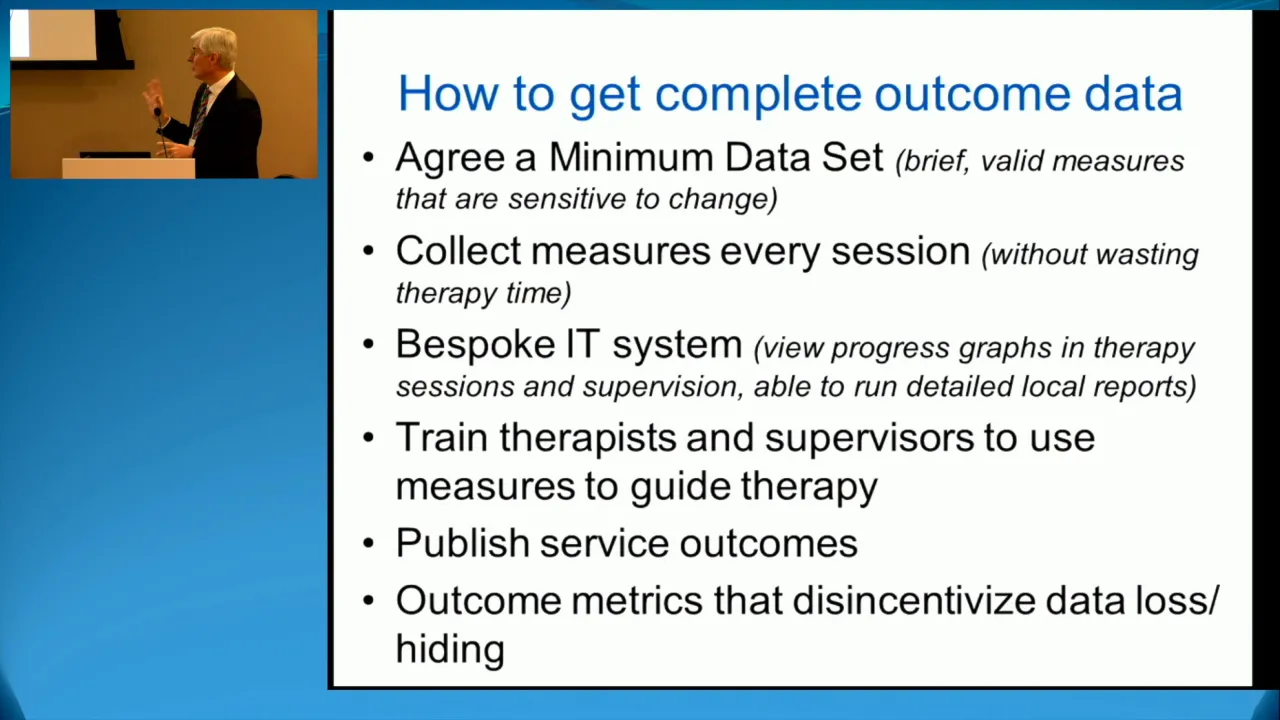
Measurement-based Care in Psychotherapy Workshop - Future of Psychotherapy Conference 2019
UofTPsych
243 views•2019-04-25

Dr. Carol Tavris — Mistakes Were Made (But Not by Me)
skepticmagazine
14K views•2019-05-02
Trending

2.4 BILLION Records Got Leaked...
DeepHumor
15K views•2026-07-22

Playstation NO DISC/NO BUY Fight Is Over...
DavidJaffeGames
4K views•2026-07-23

Should I buy a Sawmill?
essentialcraftsman
29K views•2026-07-22

Americans Confused in Australia for 17 Minutes Straight
IWrocker
17K views•2026-07-23