This story illustrates how mathematical talent can exist regardless of background, and how systemic bias can prevent brilliant minds from receiving recognition. The fictional narrative of Elijah Brooks, a 17-year-old who solved the Hartwell conjecture (posed in 1986), demonstrates that mathematical truth is objective and independent of personal characteristics. The story reveals that the original conjecture was actually proposed by three graduate students in 1986, including a Black researcher (James Brooks) who was pushed off the project and never received credit, highlighting how institutional bias can suppress legitimate contributions. The narrative emphasizes that talent doesn't ask for permission to exist, and that recognition often depends on who is present to witness it.
Black Boy Solved What PhDs Couldn't for Decades — Unaware He'd Just Made HistoryAdded:
A 17-year-old black boy stood at the center of a Boston auditorium, the only dark face in a sea of white blazers and cold, narrowed eyes. He had just written the final line of a proof, a problem that had defeated the world's brightest minds for four decades. Instead of applause, the silence felt almost violent. An elderly professor rose to his feet, lips curling into something between amusement and contempt. boy, who gave you permission to stand up there?
Elijah did not yet know his answer would rewrite history and unearth a secret buried for 40 years.
3 weeks before that auditorium, before the silence and the curling lip of a man who would soon lose everything, Elijah Brooks was sitting at a kitchen table on the south side of Chicago, working differential equations onto the back of an electric bill. The clock above the stove read 5 minutes 5 in the morning.
The light in the kitchen was a tired yellow. The bulb older than the boy himself. And the apartment around him made small familiar sounds. The radiator clicking the upstairs neighbors footsteps. A distant siren that nobody on the block bothered to notice anymore.
Elijah didn't notice either. Most of the world's noise had a way of falling away when numbers were on a page in front of him. His mother appeared in the doorway in her hospital scrubs, hair tied back eyes carrying the thin tiredness of someone who had not really slept in years. Denise Brookke set a chipped bowl of grits in front of her son and gave the same sigh she always gave when she found him still awake. You didn't go to bed again. Math wouldn't let me, mama.
She didn't answer that. She rarely did.
She only put a hand on the back of his head for a moment, the way she had since he was a baby, and went to pack the lunch she would eat between her two shifts at St. Agnes. Eight hours on the surgical floor, an hour for the bus six more on the night ward at the county clinic. She had been doing this for almost 10 years. His little sister Maya wandered in 5 minutes later in a two big t-shirt, climbed onto the chair next to him, and watched him write. She was eight, missing a front tooth, and convinced that her brother could do anything with a pencil. She tapped one of his equations with a sticky finger.
What does that one mean? It means the way something changes when you change something else. Like when mama is tired and we have to be quiet. He looked at her surprised and then he laughed. Yeah, exactly like that. Maya seemed pleased to have understood calculus before breakfast. The notebook beside him was older than he was. The leather cover had cracked along the spine, and the pages had yellowed in a way that made the ink look gentler than it was. His mother had given it to him on the morning of his 10th birthday, sliding it across the same kitchen table without ceremony, telling him only that it had belonged to his father, and that the line on the inside cover was meant for him to carry.
The rest of the pages had been blank. He had filled them year after year with his own work, never knowing that somewhere else in the world there were notebooks his father had filled, too. James Brooks had begun his life as a graduate student in mathematics at Berkeley in the early 1980s. By the time Elijah was born, he was an engineer working long hours at a small firm in Hyde Park, drafting electrical layouts for buildings he would never set foot in. The story of how the first man became the second was not a story Elijah had ever been told.
He only knew that his father had loved numbers in the same private way that he loved them, and that his father had been passed over for promotions three different times in 5 years, and that the fourth time had not come because his father's heart had stopped at a drafting table at the age of 39. Elijah had been seven. The boy remembered very little of his father, but he remembered the numbers. He remembered sitting on his father's lap and watching him fill page after page with figures. The patient way his hand had moved, the way he hummed when an answer came clean. And he remembered the last thing his father had ever said to him in the quiet of an ordinary afternoon, with nothing dramatic about it at all. Numbers don't see color, son. Only people do. For a long time Elijah had not understood what that meant. He understood it now. He did not have a tutor. He did not have a computer of his own. What he had was a public library card, a notebook that had outlived the man who started it, and a teacher at Lincoln High, who had once very quietly told him that he was the most gifted student she had seen in 28 years of teaching. He had pretended not to believe her. He had believed her completely. By 6:00, the sky over the rooftops had turned the color of weak tea. Denise stood at the door in her coat keys in hand and looked at her son the way mothers look at children they are afraid for. You eat that, she said, nodding at the grits. And don't walk Maya to school in those shoes. The souls coming off the left one. Yes, mama. She lingered another second. Then she was gone, and the apartment held its breath the way it always did after she left.
Elijah looked back down at his notebook.
On the inside of the front cover in handwriting that had never been his, someone had written a single line long ago in careful blue ink. He had read it a thousand times. Numbers don't see color. Only people do. He picked up his pencil and kept working.
Lincoln High School sat on a corner where the bus routts over overlapped a low brick building with a chainlink fence and a basketball court whose hoops had long since lost their nets. It was not the kind of school anyone wrote articles about. The kids who went there mostly stayed in the neighborhood after graduation and the teachers who lasted more than 3 years were the ones who had stopped expecting miracles. Elellanar Hayes had been there for 26 of those years. She was a tall, thin woman in her late 50s with gray hair that had once been a striking copper and reading glasses. She pushed up the bridge of her nose so often that the gesture had become a kind of punctuation. She had grown up in Boston, gone to MIT in the early 1980s, started a doctorate, and walked away from it 3 years in. The reason she gave when people asked was that her mother had gotten sick. The reason she gave herself in the small honesty of late evenings was more complicated. Mathematics had not been kind to women like her in those years, and she had grown tired of being told in a thousand small ways that her presence in a room was a tolerated favor. She had not stopped loving the work. She had only stopped expecting the work to love her back. Then three years ago, a freshman named Elijah Brooks had handed in a homework assignment that took her a full evening to grade because she had to sit down with her old textbooks to confirm that what he had done was in fact correct. He had skipped four steps and arrived somewhere her own dissertation committee would have argued about for an afternoon. She had asked him the next morning where he learned to do that. He had shrugged and said, "I don't know. It just looked like the way." She had been waiting ever since for the right door to open. The door came in the form of an envelope on a Tuesday in early March. Heavy paper embossed seal the words international mathematics conference Boston across the top. She read it twice in the teacher's lounge before she let herself believe it. The conference had announced its annual open challenge. a problem unsolved set down before the public and any qualified presenter regardless of credentials could submit and be heard.
The problem that year was the Hartwell conjecture posed in 1986, 40 years old.
No one had cracked it. Elellanar Hayes folded the letter in half, walked down the hall to her last period classroom, waited until the bell had emptied the room of every student except one, and slid the envelope across the desk to him. You have two weeks, she said. I can't promise you'll win. I can only promise you'll walk into that room.
Elijah read the letter. He read it again. His face did not change in any of the ways she had expected. He simply nodded once like a man receiving a very heavy package he had been told all his life would arrive.
"Why this one?" he asked. "Why the Heartwell?"
She did not have an answer he would have understood. She only said, "Because I think it's been waiting for someone."
That night, Denise Brookke sat at the kitchen table with the letter in her hands and did not speak for a long time.
When she finally did, her voice was tighter than her son had ever heard it.
Boston is 2,000 miles of trouble for a boy who looks like you, Elijah. I know, mama. You think they're going to clap for you up there? I'm not going for the clapping. Then what are you going for?
He looked at his hands at the calluses along the side of his middle finger from a decade of pencils. To not disappear.
She did not cry where he could see her, but he heard her later through the thin wall of the bathroom, and he lay in his bed and did not move for a long time. In the morning, she did not mention any of it. She only set a small box on the table next to his bowl. Inside was his father's watch, the steel band tarnished, the second hand still keeping its quiet, stubborn time. "Wear it," she said, "so you remember who you are." He put it on his wrist and it was the first thing in his life that had ever felt like armor.
The Sheran Boston rose out of Back Bay in glass and pale stone, all chandelier light and quiet money, the kind of building that made a young man think twice before leaning against any of its furniture. Elijah arrived on a Thursday afternoon with a duffel bag his father's leather satchel held together by a strap that had been restitched twice and a navy button-d down his mother had ironed flat the night before he left. He stood in the lobby for almost a full minute before he understood that he had stopped breathing. The hall was full of men and a small number of women in suits that fit them the way good suits fit people who own several. They held drinks they were not drinking and laughed at jokes that had been told a hundred times in rooms exactly like this one. Princeton was a word that floated past him twice.
Cambridge three times. A man in a tweed jacket clapped another man on the shoulder and used the phrase fields short list the way other people might say the weather. A waiter in a white jacket touched Elijah's elbow with practiced courtesy. The service entrance is around the back, son. Through that door and to your left. Elijah looked at him for a long second. I'm a guest. The waiter's face did several things at once. None of them quite became an apology. He nodded and slipped away into the crowd as if the boy had never spoken. Elijah crossed the lobby toward the registration table, and the carpet was very thick under his shoes, and his ears were ringing in a way they hadn't rung since the time in fourth grade when a kid had hit him in the side of the head with a textbook for getting an answer right. The woman at the registration desk smiled the smile that people in customer service learned to wear as a uniform. She asked his name, he told her, she typed. She frowned very slightly and typed again. You're sure you're registered for this event, sweetheart? This is the professional conference. The high school program is at the Marriott two blocks over. I'm sure. She typed a third time, her smile thinned. And you have a sponsor, a faculty sponsor, I mean. My teacher signed the form. Your teacher? Yes, ma'am. A small group had gathered behind him, and one voice in particular cut across the lobby with the easy confidence of a young man who had never in his life been asked to prove he belonged anywhere. The voice belonged to a tall blonde fellow in a cashmere sweater no older than 22, with the kind of jaw that television liked. "Is there a problem up there? Some of us have actual presentations to prepare?" The woman at the desk straightened. "No problem, Mr. Whitfield. Just a small confusion. The young man met Elijah's eyes and smiled. The smile had no warmth in it whatsoever.
First conference kid. Yes, sir. Don't let it eat you alive. He moved on. The small group around him moved with him the way schools of fish move. And Elijah caught the words charity case and who let him in before they were swallowed by the lobby's tasteful murmur. A man on the far side of the room had been watching the exchange. He was in his late60s, white-haired, sharpshouldered, wearing a charcoal suit that had clearly been made for him and only him. There was something about the way he held his glass perfectly still, perfectly level that made Elijah understand before anyone said a word that he was looking at the most important person in the room. The man's eyes lingered on him a fraction of a second longer than was comfortable. Then moved on, and the moment was over so quickly that no one would ever have been able to call it anything. The blonde young man would turn out to be Bradley Whitfield, 22, a senior at Yale. The white-haired man would turn out to be his great uncle.
Professor Richard Whitfield, 67, chair of the mathematics department at MIT chairman of the panel for that year's Open Challenge. a man whose name had been on the cover of a textbook in nearly every undergraduate program in the country for three decades running.
The only person in the lobby who walked over to Elijah, looked him in the eye, and put out her hand was a woman in her late 30s with a steel gray blazer and an expression that was somehow both tired and kind. She introduced herself as Dr. Sarah Wittmann of Stanford panelist. She asked him where he had come in from. She did not ask him whether he was sure he belonged.
Chicago, he said. Long flight, bus, ma'am. Something flickered behind her eyes. It was not pity. It was something steadier and harder to name.
Get some rest tonight, Mr. Brooks. They go in alphabetical order tomorrow until the last slot and the last slot is drawn.
Yes, ma'am. She held his gaze a beat longer. And when you go up there, don't apologize for being there. Not once. She was gone before he could answer.
The next morning, the auditorium filled by half 8. 12 names had been printed on the program in a serif font, 11 of them belonging to graduate students and post-doal researchers from the kinds of universities people listed on resumes without elaboration. The 12th name was Elijah's. The drawing of the final order was a brief ceremony at the front of the room. A junior staff member held up a small wooden bowl and each presenter stepped forward to draw a folded slip.
The first 11 slots were assigned by alphabetical order. The 12th slot, the closing presentation of the day, was the only one chosen by Lot, a tradition borrowed from older European conferences and kept mostly because it gave the proceedings a small theatrical pulse.
Elijah was the last to draw. The slip in his fingers said 12. A laugh went up from somewhere near the front row. It was not loud. It did not need to be loud. It simply existed in the room and refused to leave. Bradley Whitfield, who had drawn slot four, said something quiet to the young man next to him, and they both grinned. Elijah folded the slip and put it in his pocket, and he walked back to his seat without looking at any of them. That night, he sat on the edge of a narrow bed in a hotel two blocks south of the Sherin, the kind of place where the carpet had a smell and the heater rattled, and he held a phone to his ear and listened to his sister breathe on the other end of the line.
"Are you going to win?" Maya asked. He looked at himself in the mirror across the room. a boy in a borrowed shirt with his father's watch on his wrist and his father's notebook on the bedspread. He did not look like a winner. He did not in any obvious way look like anything at all. I'm going to do my best, Maya. Mama said, "Don't let them be mean to you."
Mama always says that. Mama said it twice this time. He smiled in spite of himself. He closed his eyes for a long second, and when he opened them again, he was looking at the open page of the notebook, the one with the inscription on the inside cover, the careful blue ink that had outlived the man who wrote it. Numbers don't see color. Only people do. He told Maya he loved her. He told her to put their mother on the phone, and he listened to his mother breathe a different kind of breath, the breath of a woman who had not slept and would not sleep. and he told her the things sons tell mothers when there is nothing else left to say. He did not sleep either. He sat by the window with the notebook open on his knees and he went through the proof one more time the way a man checks the locks on a house before a storm. At some point, the sky outside began to gray. He only noticed that the radiator had gone quiet and that his father's watch was still ticking and that he was no longer afraid of anything in the world except being made small. He stood up. He put on the navy shirt his mother had ironed. Tomorrow he would walk back into that auditorium. He would not apologize for being there, not once.
The auditorium at the Sheran Boston was the kind of room that had been built to make people feel small. The ceilings were three stories high, the walls panled in dark wood, and the seats rose in long curved rows that gave the front of the room the feel of an operating theater. By 9:00, the seats were full.
Reporters from two trade publications had set up cameras along the back wall.
A woman from the New York Times sat in the third row with a notebook on her knee, and she looked like everyone else, mildly bored. The first 11 presentations took the better part of the morning and the early afternoon, and by 2, it was clear to everyone in the room that the Heartwell conjecture had once again refused to give up its secret. Two of the candidates had broken down mid-presentation.
Three had run out of time. The rest had offered partial results, clever in places, but none of them had touched the core of the problem. Bradley Whitfield, who had presented in the fourth slot, had given a long and ornate argument involving a clever symmetry trick, and his greatuncle had clapped for him with a warmth that the panel had not extended to anyone else that day. Dr. Sarah Wittmann had sat through the applause, with her hand resting flat on her notepad, and her face had not moved.
When the announcer finally read Elijah's name, a small ripple of sound moved through the room. It was not a laugh exactly. It was the sound of a hundred people shifting in their chairs at the same moment. A hundred coats settling a hundred small adjustments of attention.
The boy walked down the aisle in his navy shirt, his father's notebook tucked under one arm, his father's watch ticking quietly on his wrist. He climbed the three steps to the stage. He picked up a piece of chalk. The board behind him was dark green and fresh the way conference boards always were on the first day, and the chalk made the small dry sound it made when it touched a surface that had not yet been written on. He wrote the first line of his proof. The room went very still. It was not the stillness of admiration. It was the stillness of people watching something they did not understand, and trying to decide whether the thing they did not understand was their fault or his. He wrote a second line, a third. He did not speak. He had been told once by Ellaner Hayes that mathematicians were like dogs, and that they would always look at the hand before they looked at the face, and that if you wanted them to listen, you put the work on the board first, and the words on top of it after.
By the time he turned around to begin his explanation, he had filled a full third of the board, and the equations on it were unlike anything anyone in the room had seen all day. Professor Richard Whitfield rose to his feet at the panel table. "Boy," he said. The word landed in the room like a chair pushed back hard. "This is not a high school classroom. You are using your notation incorrectly."
The auditorium looked as one body at Elijah. He took a breath. He set the chalk down on the rail. When he answered, his voice was steady in a way that surprised even him. Sir, with respect, the notation I'm using was introduced by Alexander Grothandeek in 1962 in the fourth volume of the seminary deeal.
It is not incorrect. It is simply uncommon.
There was no movement in the room for several seconds. Dr. Sarah Wittmann at the panel table wrote a single word on her notepad. From the third row, the woman from the New York Times stopped looking bored and started looking at the boy on the stage as if she had only just now noticed he was there. Whitfield did not sit down. He smiled the way a man smiles when he has been hit somewhere unexpected and does not want anyone to see that he felt it. That is a graduate level reference, son. Where did you read it? at the Harold Washington Library.
Sir, the reference room. They have most of the SGAA volumes on the third floor.
Most of them? Yes, sir. Volume 3 is missing. Someone's had it on hold for about a year. A small sound moved through the back of the room. It might have been a laugh suppressed.
Whitfield's jaw tightened by a fraction of a degree. Continue your presentation.
Elijah picked up the chalk again. He worked for the next 14 minutes without interruption, although Whitfield interrupted him three more times, each interruption phrased as a question, and each question pitched in a tone that suggested the boy ought to be embarrassed to be asked it. Each time Elijah answered. He answered without heat. He answered without sarcasm. He answered the way Elellanar Hayes had taught him to answer the kind of adult who did not want to be wrong in front of other adults by giving them so much information so politely that they ran out of room to refuse it. The chalk moved. The board filled. A topological transformation that no one in the room had ever seen applied to a number theoretic problem began to take a shape that even to the people who could not yet follow it looked structurally beautiful. Dr. Wittmann had stopped taking notes. She was simply watching him now, her chin resting on her knuckles. The boy reached the seventh step of his proof. He stopped. He turned around. He looked not at the panel, but passed them at the projector screen above the panel table, the screen that had been displaying Whitfield's slides from the opening lecture of the conference. The slides had been left up between sessions as a kind of background decor. Elijah's eyes moved across the third equation on the screen. His face changed. He set the chalk down again.
Professor Whitfield, he said quietly.
I think there's a problem with line three of your opening lecture.
The room did not breathe.
Professor Richard Whitfield was a man who had been receiving the careful applause of conference halls for 35 years. He had stood at podiums in Cambridge and Princeton and Berlin. He had been introduced on more than one occasion as the most influential applied mathematician of his generation. He was not a man who was contradicted. He was certainly not a man who was contradicted by a 17-year-old boy from a high school no one in the room had heard of. He produced from somewhere deep in his training the smile a man uses when he has decided to be amused. Are you saying I'm wrong, son? No, sir. Elijah said, "I'm saying that if you're right, then the Heartwell conjecture cannot be solved, but I'm about to solve it. So, one of us has to be wrong, and I would very much prefer it to be me." The sentence sat in the air for a long moment, and then Dr. Sarah Wittmann did something that no one had expected her to do. She stood up. Let him finish. It was not loud. She was not a loud person, but she was a member of the panel, and her voice carried the particular weight of a woman who had spent her entire career learning when to use it. The other panelists looked at one another and then at Whitfield and then at the boy, and none of them said anything.
Whitfield's smile thickened by a hair.
"By all means," he said. "Let the young man explain." Elijah turned back to the projector screen. He spoke slowly because what he was about to say required slowness, and because he understood with an instinct that had been forged on the playground of a school that had not always been safe for him, that the room was about to either listen to him or destroy him, and that there was no third option. He pointed to the third line of Whitfield's slide. In your opening lecture, sir, you used the Hopman lema in its standard form. That's been the standard approach for 40 years.
Almost everyone in this room has used it that way at some point. But the way you applied it here is on a domain that includes a boundary condition the lema was never proven for. It works in most cases. It does not work at the edge case that the Hartwell conjecture lives on.
He turned and wrote a short expression on the chalkboard beside his own work.
He underlined a single term in it right here. This is the term that breaks. If you use the lema the way line three uses it, this term goes to zero. If you use a slightly stronger form of the lema, which has existed since the early 2000s, it doesn't go to zero. It goes to something very small, but it stays. And the entire conjecture lives or dies on whether that term stays. He stepped back from the board. For the last 40 years, sir, every serious attempt at the heartwell has used your form of the lema because it's the form in your textbook, and your textbook is the textbook. So, every serious attempt has assumed that term was zero, and every serious attempt has hit the same wall. He looked at Whitfield. It isn't zero, sir. The room had gone past silence into something rarer. It had gone into the kind of attention that mathematicians enter once or twice in a career the kind in which several hundred people simultaneously realize that they are watching something that will be in a textbook before they retire. Whitfield did not answer immediately. His hand resting on the panel table had drawn into a slow fist.
The smile was still on his face, but it had gone somewhere else, a smile worn now by reflex rather than choice. He glanced just once at the slide behind him, and the glance had something in it that Dr. Wittmann caught, and did not forget a flicker that was not surprise.
It was recognition.
Elijah did not see that flicker. He had already turned back to his own work. He picked up the chalk. He took the lema in its stronger form, the one he had referenced, and he plugged it back into his proof, and the proof, which had already been beautiful, became something else. The transformation he had introduced earlier suddenly had a place to go. Two of the steps that had looked even to the panel like leaps of faith now had ground beneath them. The whole structure clicked into place the way a key clicks into the right lock and the click was almost audible. He filled the rest of the board and started on the side panel. He was no longer being interrupted. In the third row, the woman from the New York Times had stopped writing. She was leaning forward with her notebook forgotten on her knee. The young black reporter at the back of the auditorium, the only other dark face in the room, had quietly raised his phone and was filming. He was not from any of the major outlets. He worked for a small independent paper in Roxberry and had come to the conference because it was free press credentials and a free lunch.
He was streaming the whole thing to a small audience on his paper social account. By the end of the week, that stream would have been shared more times than anything he had ever written. Dr. Wittmann had not sat back down. Elijah finished the side panel and stepped back from the board. 40 minutes had passed.
The proof was not yet complete. He had reached the last and hardest section, the part where if he had been wrong about anything earlier, the wrongness would now begin to show itself. It did not show itself. Professor Richard Whitfield pushed his chair back from the panel table. He was not finished with the boy.
Where did you say you went to school again, son?
The question came across the room as Elijah was about to begin the final segment of his proof, and the boy stopped with his hand halfway to the chalk rail. The board behind him was already a forest of careful lines. Half of the panel was leaning forward. The other half was looking at Whitfield with an expression that was difficult to read. Lincoln High School, sir, in Chicago.
Lincoln High School? I haven't heard of it. No, sir. There's no reason you would have. And who supervised this work? My teacher, Miss Ellaner Hayes. Ah, the word was small and deliberate. And does Miss Hayes have a doctorate? No, sir. A master's? She has a master's from MIT, sir. She did three years of doctoral work there. She left in 1986.
A very small silence opened up in the room. Whitfield had started his career at MIT in the early 1980s. He would have known her. He had not expected the boy to know that he would have known her. He recovered with a smoothness that other people might have admired. I see. So, a high school teacher with an unfinished doctorate and what internet research has somehow guided you to a complete proof of a 40-year-old open problem. Forgive me if the picture is a little hard to bring into focus. Sir, with respect, my teacher didn't guide me to the proof.
She gave me the conference letter. The proof is mine.
Of course, it is. The two words sat in the room with a great deal of weight.
Bradley Whitfield in the front row laughed. It was not a private laugh. It was the kind of laugh that asks the rest of the room to laugh with it. And in a few corners of the auditorium, the request was honored. Not loudly, just enough. Elijah felt his hand begin to shake. He felt it the way people feel the first tremor of an earthquake somewhere beneath the floor, somewhere they cannot do anything about. The notebook tucked into his other arm slipped half an inch and he caught it.
But in catching it, he lost his grip entirely, and the notebook fell open onto the stage at his feet. It fell open to the inside of the front cover. The careful blue ink on the inside cover faced the auditorium like a face.
Numbers don't see color. Only people do.
He bent down. He picked it up. He stayed crouched for a second longer than he needed to because his eyes had started to do something he did not want the auditorium to see, and he needed the second to make them stop. In the back of the room, the young reporter from Roxberry did not lower his phone. In Chicago, in a kitchen 600 m away, Denise Brooks sat at the table in her scrubs and watched the stream on her daughter's small cracked phone screen. Elellanar Hayes had sent her the link 2 hours earlier. Maya was pressed against her side. Maya had started to cry without making any sound, the way children cry when they have learned very young that crying out loud is not always safe.
Denise's hands were folded flat on the table. She did not say anything. She did not move. Elijah stood up. He looked at his father's watch on his wrist. He looked at the auditorium. He looked at Richard Whitfield. When he spoke, his voice did not shake, although he could feel that the rest of him was trying to.
Sir, I don't have a tutor. I don't have a computer of my own. Everything I've learned, I learned from books that the Chicago Public Library let me borrow for free. And this proof, I wrote it on the back of my mother's electric bill because we don't keep loose paper in the house. We use what we have. He let that stand in the air for a moment. If you'd like to verify the work, I'll redo it from the beginning right now on this board without looking at my notes. He held the notebook out away from himself toward the panel table. You can hold this if you want. The auditorium had passed through silence and into the next thing after silence, which is a kind of low electric humming in the bones of everyone present. Dr. Sarah Wittmann did stand up this time, walked the length of the panel table, climbed the three steps to the stage, and took the notebook from Elijah's hand. She did not open it. She turned and held it up so the panel could see its closed cover. The notebook is in the panel's possession, she said evenly.
The student will continue from the beginning if the chair insists.
Whitfield did not look at her. He looked at Elijah. The look was no longer the look of an annoyed man. It had gone somewhere worse into a place where annoyance becomes something colder, something that lives below it. For one of the only times in his career, Richard Whitfield was being seen, and he knew it. That won't be necessary. The words came out a fraction too quickly.
Continue, Mr. Brooks. It was the first time he had used Elijah's name. Elijah turned back to the board. His hand was no longer shaking. The tremor had stopped at some point during Wittman's walk across the stage and had not returned. He picked up the chalk. He did not redo the proof from the beginning.
He did not need to. He simply continued from the line he had stopped at, and the next 20 minutes of his life were the cleanest 20 minutes of work he would ever do. When he set the chalk down for the last time before the final segment, the green of the board was almost entirely gone. The proof covered the front board and the sideboard and was beginning to spill into the corner. Half the panel had come down off the panel platform and was standing along the front row looking up at the work the way climbers look up at a wall they have just understood is climbable. Only Witfield had stayed in his chair. He was not finished either.
There were 15 minutes left in Elijah's allotted time. He had one section remaining, the final convergence argument, the part that closed the proof and made the Hartwell conjecture stop being a conjecture and start being a theorem. He had walked through that section in his head perhaps 400 times in the last two weeks. He could have written it in his sleep. Whitfield raised his hand. Before the young man closes, he said his voice louder now than it had been all afternoon pitched to carry to the back of the auditorium.
I would like, with the chair's permission, to offer Mr. Brooks a small additional question.
Dr. Sarah Wittmann, who had not yet returned to her seat at the panel table, turned slowly toward him. That isn't in the format, Richard. Call it a bonus, a small extension, a test of depth rather than mere preparation. It isn't in the format. It is at the chair's discretion.
The chair technically was Whitfield himself. He had built that into the rules of the open challenge 20 years earlier when the rules had been reddrafted under his oversight. The other panelists looked at one another.
None of them spoke. Dr. Wittman's jaw set in a way that made her face look older by 10 years. Whitfield rose. He walked to the sideboard, picked up a piece of chalk, and wrote a single equation in the upper right corner. He wrote it slowly, the way a man dictates an address he wants the other party to copy down correctly. Then he stepped back. This is a small variant of the Hartwell, he said, addressing the room more than the boy. A private generalization I have been considering for some years. It has not been published. It is not in the literature.
Mr. Brooks has, by his own claim, mastered the original. Surely a young man of his evident gifts will have no difficulty extending his methods to this related case. He smiled. You have 10 minutes, son. Dr. Wittman's voice cracked across the room. That problem is not part of the official challenge. The candidate is under no obligation to unless of course Whitfield went on talking through her without any particular rush. The boy is afraid. The auditorium did the crulest thing an auditorium can do. It waited. Elijah looked at the equation on the sideboard.
He looked at it for 15 seconds, then 30, and the silence in the room got heavier with every passing second. The variant Whitfield had written was not a small variant. It was a deeper version of the same problem set on a different kind of space, and the proof techniques Elijah had used on the original would not extend to it directly. Not in 10 minutes. Probably not in 10 weeks. He would need to rebuild three of his lemmas from scratch. He would need a piece of machinery he had read about, but had never had the time to fully construct. He understood what Witfield had just done. The room understood it, too. The trap had been set in plain sight, and the rule that had allowed the trap to be set was a rule Whitfield himself had written. In Chicago, Denise Brooks closed her eyes. Elijah closed his, too. He thought of his mother at the kitchen table at 5:00 in the morning with the chipped bowl and the tired yellow light. He thought of Maya tapping a sticky finger on his calculus and asking what the symbols meant. He thought of his father, what he could remember of him, which was less than he wished, and of the patient way that hand had moved across pages in a small apartment that had smelled of coffee and graph paper. Numbers don't see color, son. Only people do. He opened his eyes.
He walked to the sideboard. He picked up a piece of chalk. Sir, he said, and his voice was different now, not louder, but lower, the way a man's voice goes when he has stopped being afraid of the thing in front of him. I can't solve this problem in 10 minutes. I don't think anyone can. I'm not sure anyone ever will in the form you've written it.
Whitfield's smile became a very small, very still thing.
Then I'm afraid, but I can prove that it can't be solved, not the way it's currently posed, and that sir is also a kind of answer. He turned to the board.
He began to write. The 8 minutes that followed would later be replayed and slowed down and analyzed by graduate students for the better part of a generation. He did not solve Whitfield's variant. He did something stranger. He proved that the variant as written contained an internal inconsistency that it could not have a solution within the framework Whitfield had specified because the conditions of the problem and the structure of the space it was posed on were in a deep technical sense in conflict with one another. The proof was not a refusal. It was a precise demonstration that the question had been malformed. It was in the language of the field an impossibility result and impossibility results were the kind of thing senior mathematicians spent careers searching for. He stepped back from the board with 2 minutes still on the clock. Dr. Sarah Wittmann, who had not sat down again at any point in the last hour, took three slow steps forward and stopped at the foot of the stage.
She was looking at the sideboard. Her face had changed in a way that no one in the auditorium had ever seen it change.
She looked very slowly at Richard Whitfield. So did everyone else.
Whitfield was very still. He had recognized the impossibility result before the boy was halfway through it.
He had recognized it because he had suspected the same thing himself privately for almost 20 years and had never written it down because to write it down would have meant questioning the foundation of his own most celebrated work. The thing he had been most afraid of in his entire professional life had just been spoken out loud in front of his colleagues in front of the press by a 17-year-old boy whose name until that morning he had not bothered to learn. He did not move. The clock at the back of the auditorium ticked once, then again.
Elijah turned back to the front board.
The original proof was still waiting for its final section. He picked up the chalk. He went back to work.
Elijah went back to the front board, and the front board waited for him the way unfinished work always waits. patient and indifferent, holding the place where a man's life is about to either come apart or come together. The auditorium did not make a single sound. He did not rush. He had been told once in a free Saturday workshop at the public library by a retired engineer who had volunteered there for a decade that the worst thing a young man could do under pressure was hurry. and that the second worst thing was to apologize for not hurrying. So he did not hurry. He picked up where he had left off at the beginning of the final convergence argument and he wrote the next line in the same careful hand he had been writing in all afternoon. The convergence argument was the heart of the proof. It was the part that took every piece of machinery he had built over the previous 40 minutes and forced them line by line to agree with one another. Each step was small. None of them looked impressive on its own. What was impressive was the way they fit. He moved one expression to the right side of an equation. He absorbed a constant into a function. He invoked the stronger form of the lema he had introduced earlier, the one that did not let the critical term collapse to zero, and the lema earned its keep. The boundary case, the one that had defeated 40 years of attempts, met the inequality he had been steering it toward. It held. He wrote the closing line. He underlined it once lightly, the way Eleanor Hayes had taught him to underline a result. Never twice, never with flourish, only enough to say, "This is where I stopped." He set the chalk down on the rail. He turned around for 11 seconds. Nothing happened. 11 seconds is a very long time in a room of 600 people. Dr. Sarah Wittmann stood up from where she had been standing at the foot of the stage.
She did not say anything. She simply began to clap. Her hands met each other slowly, deliberately, the way a person claps when they want every clap to be heard separately. And after the third clap, a man in the second row stood up and joined her. And after the fifth, a woman three rows behind him, stood up.
And then the auditorium came up out of its seats the way a tide comes in, not all at once, in a wave that built from the front of the room and rolled toward the back. And within 20 seconds, every person in the auditorium was standing.
Every person except one. Richard Whitfield remained in his chair at the panel table. His hands rested flat in front of him. He was looking at the front board, and his face had gone the color of old paper. From the side of the panel table, an old man rose to his feet. He was perhaps the oldest person in the room, 81 years old, with white hair so thin it looked like frost on his scalp. and the rise itself took him a long careful moment, both hands braced on the table. His name was Professor Henry Goldman. He had been a young instructor at Berkeley in 1986.
He had known the small group of mathematicians who had originally posed the Hartwell conjecture. He had buried two of them. He walked to the foot of the stage and he climbed the three steps with the help of the railing and he did not look anywhere except at the front board. He stood in front of it for a long while. His finger lifted almost on its own and traced a line across the air a few inches from the chalk the way a man traces a line he has been waiting to see written for most of his adult life.
When he turned around, his eyes were wet. He looked at Elijah and for several seconds he did not seem able to find his voice. When he did, it was not loud. The room was so quiet he did not need it to be. "Son," he said, "I have been waiting 40 years for this. I did not think I was going to live long enough to see it." He turned slowly toward the panel table.
"Richard," he said, "you should be on your feet." Whitfield rose. He rose the way a man rises to receive a verdict. He did not clap. The room registered that he did not clap. The applause kept going. It went on for a long time.
The reception afterward was held in a long carpeted room on the second floor of the Sherin with white tablecloths and trays of small triangular sandwiches that nobody touched. People who had not introduced themselves to Elijah all morning now stood in a small respectful ark around him. The woman from the New York Times had her recorder out. The young reporter from Roxberry, whose phone had captured the entire afternoon in unbroken footage, was being approached by editors from three larger outlets. A man from a publisher Elijah had only ever seen on the spines of textbooks had pressed a card into his hand and asked him to call. Elijah held the card without quite seeing it. Dr. Sarah Wittmann cut through the small crowd with the ease of a woman accustomed to cutting through small crowds, touched his elbow once, and asked if he could come with her for a few minutes. He nodded. He followed her out of the reception room down the long carpeted hallway around a corner and into a smaller, quieter al cove with a single window that looked out over the gray afternoon light of Boilston Street.
She had a folder in her hand. The folder was thin and old, and the corners had gone soft with age. "Mr. Brooks," she said, "before you leave this conference, there's something you need to know. I considered not telling you. I decided I owed you the truth more than I owed anyone the silence. She handed him the folder. He opened it. The pages inside were photocopies faded, the kind of photocopies people made in the late 1980s when the toner was always running out. The top page was a typed paper untitled in its draft form with three names on the by line. The first name on the by line was R. Whitfield. The second was a name he did not recognize. The third name on the by line was J. Brooks.
He stopped breathing for a second. I went into the archives this morning, she said quietly. After your opening section, I had a hunch. The hunch turned out to be right. She let him read for a moment before she went on. There is no mathematician named Hartwell. There never was. The name was a pseudonym used by three young researchers in 1986 when they submitted the original conjecture to the annals. They were all graduate students. They wanted the work to stand on its own merits. Two of them were white. One of them was not. He kept reading. The young black researcher on that paper was the one who proposed the original line of attack. The same line of attack you used today. I've spent the last 6 hours comparing his marginal notes in the archive copy with the sketch you wrote on the board. They are the same hand of thinking, Mr. Brooks.
They are not similar. They are the same.
He turned a page. There was a handwritten note at the bottom of the next sheet. He recognized the handwriting before he could read the words. He had seen that handwriting on the inside of the front cover of his notebook every day for 10 years. His name was James Brooks, she said. The folder shook in his hands. He was pushed off the project in the spring of 1987.
The official reason given was that his contributions were not of doctoral quality. The push back was led by the senior member of the group, by the man who would later become the chair of mathematics at MIT. She did not say the name. She did not have to. After they pushed him off the paper, he never went back to academia. He took an engineering job to support your mother and the child she was already carrying. He kept working on the problem at night alone for 13 years. There are notebooks of his in this archive that no one has ever read. He never published. He never had access again to the kind of resources the work needed. He died before he could finish. Elijah closed the folder. He did not say anything for a long time. He was looking out the window, but he was not seeing Boilston Street. He was seeing the small apartment he had not lived in since he was seven, and a man at a drafting table humming when an answer came clean and a hand patient on a page.
My mother gave me his notebook when I was 10, he said finally.
She told me one line on the inside cover was meant for me. She told me the rest of the pages were mine to fill. I never knew there were others. There are others, Dr. Whitman said. I'm holding photo copies of three of them. I'd like with your permission to see them returned to your family. The line on the inside cover. Yes, he started this. He started it. You finished it. He knew somewhere that someone would. He just didn't know it would be his son. Elijah did not cry. Not yet. He held the folder against his chest the way he had held the notebook all day. He looked again at the by line at the top of the first page at the small typewritten letters at the three names that should have stood together for 40 years and had not. He understood then what he had done that afternoon. He had not solved a stranger's problem. He had finished his father's Logan airport at 6:00 in the evening had the gentle exhaustion of a place that had seen too many people that day.
Reporters were waiting at the gate more than Elijah had expected, and he answered the few questions he was willing to answer with the careful brevity of a young man who had not yet decided who he was going to be in front of cameras. He held the leather satchel against his side. He did not let go of it. He boarded the flight to Chicago and as he turned into his row, he found that the woman in the aisle seat next to his was Dr. Sarah Wittmann. She lifted her bag from the empty middle seat to make room. She had it turned out been booked on the same plane for 2 days. The world, she said with a small, dry smile, had a sense of humor. They did not speak much during takeoff. Somewhere over western Massachusetts, with the cabin lights low and the drink cart still two rows away, she turned in her seat. Stanford wants you, she said. I can tell you that already. MIT will want you, although it will be uncomfortable for everyone for a while. Princeton will call by Monday morning. So will Harvard. So will half a dozen places you haven't heard of yet.
You're going to have decisions to make that most adults never get to make. I want you to take your time. He looked at his hands. They had chalk dust still on them between the knuckles where he had not been able to wash it all out. Dr. Wittman, he said, "Can I ask you something honest? Please. What I want most right now isn't a school. It's enough money for my mama to stop working one of her two shifts. She's been doing both since I was seven." She did not answer right away. Whichever school you choose, she said finally, will offer you a stipend, a real one, the kind that takes a shift off your mother's calendar permanently. Don't take less than that from any of them. If they offer you less, you call me," he nodded. He looked out the window. The land below had become the dark, patient pattern of an America. At evening, the small clusters of light, the long roads between them, all the houses where people were finishing dinner and not thinking about him at all. He did not feel like a person who had made history. He felt like a boy on an airplane with chalk on his hands, going home to his mother and his sister. The plane began its descent into O'Hare just before 9. His mother was waiting for him at the curb in the old Chevrolet that had not been new when she had bought it 10 years earlier. Maya was in the back seat in her pajamas, asleep against the window, a small fogged circle of breath on the glass.
Denise Brooks got out of the car when she saw him. She did not say anything.
She walked around the front of the car and she put her arms around her son and she held him for a long time and she did not let go even when the airport traffic officer waved at her to move along. In the car on the way home, she reached into the glove compartment and took out an envelope. It was old. It had been sealed for 10 years.
Your father wrote this before he died," she said quietly. "I never could bring myself to give it to you. I always thought I would know when. Tonight, I think I know." She put the envelope in his hand. She did not start the car for another minute.
6 months later, a young man stood at the front of an auditorium at Stanford University in a navy shirt that fit him better than the last one had, with chalk dust on his hands again and his father's watch on his wrist. He was not a student there yet. He was a guest speaker. The room in front of him held perhaps 400 undergraduates of every color. And at the back of the room sat his mother in a new coat and his sister with both feet swinging from a chair too tall for her and Ellaner Hayes who had flown out from Chicago and who was crying quietly into a tissue she would deny crying into later. Richard Whitfield was no longer the chair of mathematics at MIT. The investigation had taken 3 months. The findings had been quiet but definitive.
The textbook would be revised. The by line of the original paper would be corrected postumously to include the name of James Brooks. The boy at the front of the room had not prepared a long speech. He looked at the page in front of him and then he folded it and then he set it aside. My father told me when I was a little boy that numbers don't see color. Only people do. He looked up. I want to add one thing to what he said. Talent doesn't either. It doesn't ask anyone for permission to exist. It just exists. And if the world hasn't seen you yet, that isn't because you aren't shining. He smiled. It's because they haven't opened their eyes.
You know, the thing that stays with me the most about Elijah's story isn't the proof. It isn't the standing ovation or the fall of Richard Witfield or even the moment Dr. Wittmann walked across that stage and took the notebook out of his hands. It's the smaller picture underneath all of it. A mother working two shifts. A father who did the work and never got to sign his name to it. A boy writing on the back of an electric bill at 5 in the morning because that was the paper he had. And it makes me wonder how many James Brookses are still out there. How many people in your own life are doing brilliant work in a kitchen somewhere on a lunch break on the back of something nobody ever throws away and waiting for the world to notice? So, I'd love to hear from you.
Was there ever a moment in your life when someone underestimated you and you proved them wrong? Or maybe a moment when you didn't get the chance to prove them wrong and it still stings. Tell me about it down in the comments. I read them. I really do. And the stories you share end up shaping the stories I tell next. If this one moved you even a little, hit that like button so it can find someone else who needs to hear it tonight. Subscribe if you haven't yet because there are more stories like Elijah's coming and I don't want you to miss the next one. And before you go, remember what his father said. Numbers don't see color. Talent doesn't ask permission. And neither my friend should you. I'll see you in the next story.
Take care of yourself out
Related Videos

Escaping the Fog
LogicLemurGaming
760 views•2026-06-03

Olympiad Mathematics | Indian | Can You Solve This One?
PhilCoolMath
650 views•2026-06-03

A Brutal Radical Expression Made Easy! The Shortcut Changes Everything.
tamoshop
112 views•2026-06-02

V : jee main /advance class 11 mathematics : Binomial Theorem class-1 ( 29 may 2026 )
dcamclassesiitjeemainsadva9953
125 views•2026-05-29

Is This Pentomino Tileable?
3cycle
241 views•2026-05-30

This Sudoku Has Many Lines!!
CrackingTheCryptic
2K views•2026-05-29

Olympiad Mathematics | Indian Can You Solve This One?
PhilCoolMath
268 views•2026-06-02
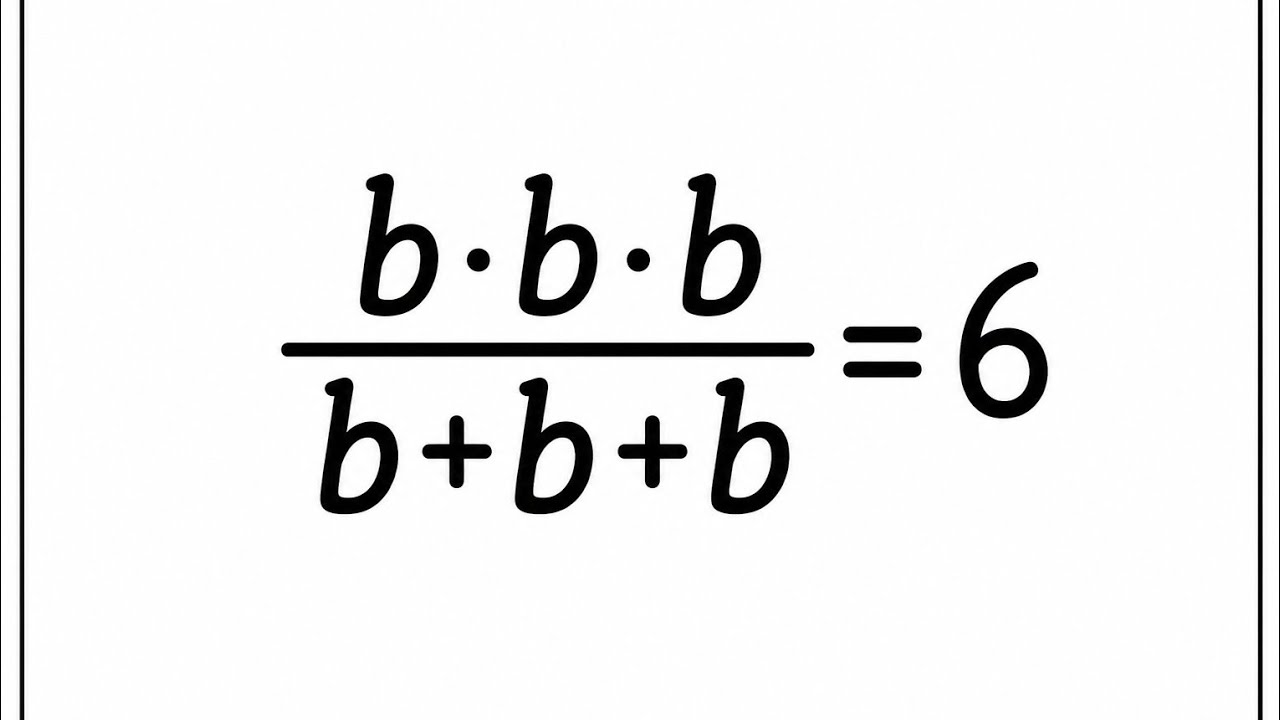
Olympiad Mathematics | Indian | Can You Solve This?
PhilCoolMath
669 views•2026-06-02



