Decentralizing perception to the feet is a pragmatic shift that overcomes the inherent blind spots of traditional vision-based systems. This localized awareness provides the necessary robustness for complex terrain where global mapping often fails under real-world perturbations.
Install our extension to search inside any video instantly.
Learning Locomotion on Discrete Terrain via Minimal Proximity Sensing
Added:In this work, we modified the feet of a commercially available animal D robot to house an STM Time of Flight proximity sensor. The sensor is placed inside the rubber ball foot, with a machined aperture providing an unobstructed field of view. Dedicated signal-processing electronics are integrated within the foot assembly.
This sensor divides its field of view into a 4-by-4 grid, providing 16 sensing zones. By scanning the terrain beneath the foot prior to contact, the sensor provides local geometric awareness independent of global line-of-sight constraints.
Leveraging foot-centric proximity sensor feedback, we propose a minimal approach for learning robust locomotion policies over discrete terrain.
We simulate the large FoV of the beams by ray casting at a higher resolution to approximate the sensor reading in each grid cell.
The resulting policy demonstrates reliable traversal across multiple terrain types with a balance of stability and agility.
As benchmarks for comparison, we investigated whether imminent contact information could be effectively recovered from conventional, base-centric sensors as an alternative to the foot-centric proximity pipeline.
We discovered that base-centric sensing models achieve reasonable performance in absence of injected degradations. However, once perturbations were introduced, the performance of base-centric sensing deteriorated markedly faster than that of foot-centric sensing.
We finally validate the proposed sensing framework through extensive real-world experiments. Here we present five representative stepping-stone scenarios, each beginning with an initial gap.
These experiments showcased reliable traversal of discontinuous terrain.
Thank you for watching.
Related Videos
1:08:04
Robotics
Setting up a curved screen with Immersive Calibration Pro 4 and multiple cameras (P3D v4)
FlyerOneZero
23K views•2019-07-21

1:01:27
Robotics
Robot Learning with Sparsity and Scarcity
allenai
379 views•2025-10-14

1:01:42
Robotics
Jorge Mendez-Mendez: Unlocking Lifelong Robot Learning With Modularity (2023-10-05)
umassmlfl
237 views•2024-01-06

2:16
Robotics
Northwestern’s MS in Robotics: Student Robotics Projects, 2023
NorthwesternEngineering
1K views•2024-05-31

11:14
Robotics
"Perfect" Turns: Turning by the Gyro - FIRST LEGO League (FLL) SPIKE Prime + EV3 RePlay Programming
ZacharyTrautwein
94K views•2020-10-02
1:01
Robotics
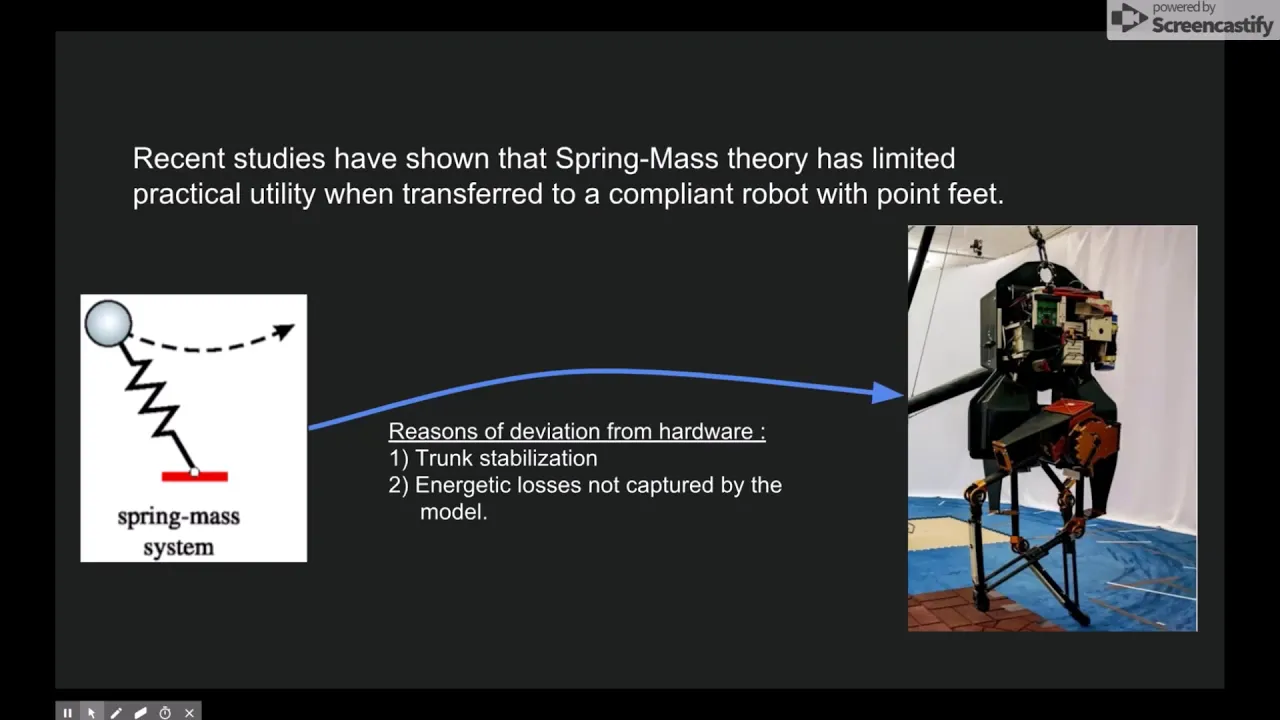
Gorkem Secer: TSLIP-based Deadbeat Running Control of Bipedal Robot ATRIAS
DynamicWalking-wv6qm
298 views•2018-06-22
4:10
Robotics
Self-Driving Cars Need Lessons On Human Drivers | Maddie About Science
skunkbear
26K views•2018-08-21

3:12
Robotics
Milrem Robotics’ THeMIS UGVs used in a live-fire manned-unmanned teaming exercise
MilremRobotics
99K views•2021-05-20
Trending
32:49
Engineering
we're almost finished the house (ep.125)
JennaPhipps
347K views•2026-07-22

21:29
Astronomy
We Finally Know Where Saturn’s Rings Came From
astrumspace
79K views•2026-07-22

12:13
Business
BIG BET: Cathie Wood goes ALL IN on Elon Musk
FoxBusiness
89K views•2026-07-22

13:55
History
MIC DROP: Smithsonian Director Called Out For Woke Propaganda
TheAmalaEkpunobi
37K views•2026-07-23