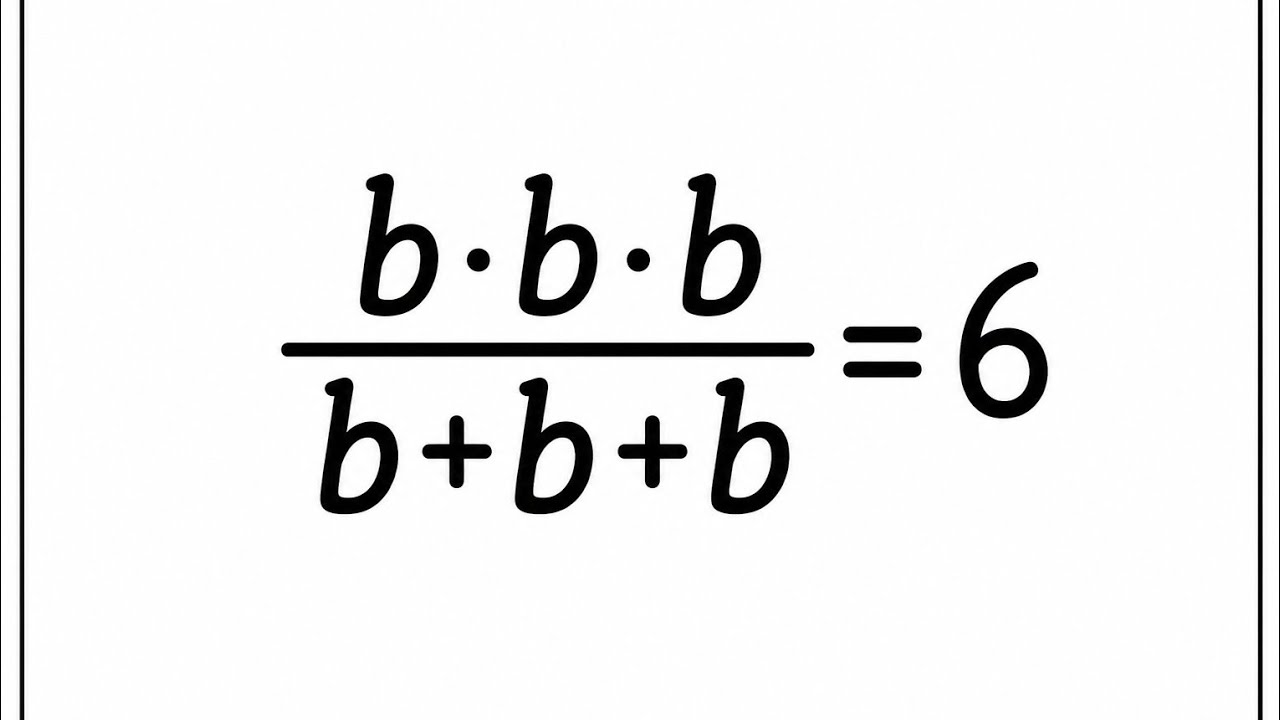
This video demonstrates how to solve the cubic equation k³ = 3k by factoring it into k(k² - 3) = 0, revealing three solutions: k = 0, k = √3, and k = -√3. The key insight is that cubic equations can have up to three roots, and students should not assume only one solution exists. The video also shows how to verify solutions by substitution and explains the geometric interpretation of the equation as the intersection of a cubic function and a linear function.
Install our extension to search inside any video instantly.
Germany | Can you solve this olympiad exam question?Added:
Hello, my friend. Happy to see you here.
Today, we have quick, tricky, and relaxing algebra question. We have k * k * k equal to k + k + k. And we need to solve this question for k. So, if you have your solution, your answer, you can also write it in the comments below, and then we will check your answer. So, it will be really interesting.
So, a lot of students might be thinking, "Okay, maybe k equal to zero is a solution, is a root to this question."
So, just look at it. So, for example, we we're thinking that right now we're we're thinking that k equal to zero is a root to our equation because a lot of students might be thinking that this is the the best the the fastest way to solve this question because zero * zero * zero equal to zero plus zero and plus zero, which is absolutely correct. And a lot of students might be thinking that this is only one root.
But in terms of algebra, we need to simplify it, we need to factor something, we need to write something on the left side, on the right side, we need to mix everything to find maybe we have another root. So, that's why just just we say, "Okay, we have k equal to zero is like our our first root." But we need to solve it for >> [clears throat] >> for another root, sorry. So, right now let's multiply k * k * k equal to k cubed. Okay, everyone knows about that.
So, k cubed right here equal to k + k + k equal to 3k. And right now, let's look at this question from a different angle because everyone knows about fundamental theorem of algebra. k cubed, it means three roots in total. We don't know how many real number roots, how many complex but right here, we can find maybe not like maybe a k second or k third. So, that's why we just write this 3k on the left side. So, k cubed minus 3k and equal to >> [clears throat] >> and equal to zero.
Right now, the best way to solve it is to factor our k. Let's do it. So, k and in parentheses, we have k squared minus three. k squared minus three equal to equal to zero. And right now now, one really interesting and very tricky moment because a product of two expressions equal to zero when the first expression equal to zero. So, k first is equal to zero.
And the second expression equal to zero.
So, k squared minus three is equal to is equal to zero. And right now, we can easily see, "Okay, we we had it before.
We solved it. We have our k first equal to zero. So, everything is great. Our root is absolutely correct. But right now, we have another another thing. We have k squared minus three equal to zero. So, let let's solve this equation.
Let's find let's solve for another root.
So, k squared minus three is equal to zero. So, there are a lot of ways how can we solve this question? Maybe the best one is to express this and express that and as a difference of squares. So, let's do it. So, we have k squared minus instead of three, let's write square root of three let's write square equal to zero. So, right now, we considered it as a difference of squares. This is for example our a and this our our b. And a squared minus b squared equal to a minus b a plus b a minus b a plus b a plus b. And right now, let's let's simplify it, let's factor it. We have k minus square root of three minus square root of three and times k plus square root of three plus square root of three equal to zero. So, a product of two parentheses equal to zero when the first parenthesis equal to zero. So, k minus square root of three is equal to zero. Right here, in this case, we we're talking about k second and k third plus square root of three equal to zero. And from here, we have k second equal to square root of three.
This is our k second. This our second real number root. I want to underline that this is our real number root.
And k third equal to minus square root of three. So, this is our third third root. So, right now, we can easily say that this our full solution to this question because right here in the beginning, we had k cubed. So, it mean that we have three roots in total and we we already found it. So, we have k first equal to zero k second equal to square root of three and k third equal to minus square root of three. And in the end, let's check these roots real quick. So, first of all, I want to rewrite our our question right here. So, we have k * k * k equal [clears throat] to k + k and plus plus k. So, right now, let's check for example for k equal to zero.
So, we already checked it. So, k equal to zero, everything is great. Zero * zero * zero equal to zero plus zero and plus zero. Everything is great. Right now, let's check real quick our this root. So, we have k k first right here.
We have k second equal to square root of three.
So, we have square root of three * square root of three * square root of three equal to square root of three plus square root of three and plus square root of three. Okay, so right now, let's let's learn, let's remember a great algebra tricks. So, square root of three * square root of three equal to three.
So, as a result, on the left side, we have three and this one we leave it without any changes. So, three is square root of square root of three.
What about this one? How can we add it?
So, for example, my quick trick right here. So, for example, square root of three is our a. The next thing, we have the same a and the same a right here.
So, when we add a plus a plus a we have we have 3a. And in our case, a is three square root of is square root of three.
So, we have three square root of three.
So, we have equal to three square root of three. So, everything is great. Our second root is also great. Right now, the third one.
So, k third equal to minus square root of three because sometimes happen that maybe a root is not good, okay? And we need to reject it. So, let's check it. So, we have minus square root of three times minus square root of three times minus square root of three equal to minus square root of three plus minus square root of three and plus minus square root of three. Okay, few thoughts about this question. First of all, right here, we have an have an odd power of expression. So, it's not like minus times minus. We have minus times minus plus and plus times minus equal to minus. So, I'm talking about simple word because you know, I don't want to get too much like complicated right here.
So, we have an odd power. So, it mean that a negative sign negative right here, square root of three times square root of three equal to three. So, we have negative three square root of three. What about right here? So, we have as I said before, this is our a, this is our a, and this is also our a.
So, we have three a three a. Okay, and as a result, we have minus three square root of three. So, we have a completely correct correct answer. So, right now, let's write our answer. And in the end, I want to show you like this question from a different from a different perspective. So, just look at it. So, this like a special case because a lot of students maybe like 90% of students, they like algebraic expressions. But maybe 10 or 20% of students, they like to check a solution by geometrical expression. So, we have k cubed equal to 3k. Okay, and if you see this type of expressions, I really hope you understand that we can we can express these graphs right here on this plot.
So, I I want to do this like very small a small thing right here. So, k cubed, everyone knows that this is our this line. I want to do this approximately. I want to do that approximately. And secondly, 3k, this our linear function. So, basically this graph can easily intersect with our x k cubed in a three points. Right here, we have minus square root of three.
Right here, we have zero. And right here, we have square root of three.
Okay, so basically, you can see this from this angle. So, it's not only one root, but but three root. And in the end, my maybe the quick tip which which can easily help you on on your exam. For example, if you have this my my last hint right here. So, k cubed equal to equal to 3k. So, right now, let's talk about for example, k squared for example, equal to equal to three. So, everyone knows about for example, this expression. k squared equal to three.
This is like a quadratic equation but without a second coefficient. But k squared equal to three. And right now, I ask yourself, "What about roots? How many roots do we get from here?" Of course, we can get two roots. Moreover, I can write it like equal to 3k plus two. This is a quadratic equation, something like that. And as a result, we can get from here, we can get two roots.
Okay, discriminant, you know, a basic basic thing. But what about k cubed equal to 3k? So, according to a fundamental theorem of algebra, when we have k cubed, we are talking about three three roots in total. And exactly in this case, we don't know how many real number roots, how many how many complex roots right here. We don't know exactly about about this thing. But this is extremely helpful because a lot of students maybe sit on an exam and they maybe saying, "Okay, k equal to zero, this is only one root." But if you have if you have three, so it's not that easy, okay?
Because we are talking about three roots three roots in total. Okay, so few thoughts about this question. This question is easy. I'm not going to talk anymore because this question is really easy. You can solve this question in a few minutes without any problems.
But I want to say you this really important thing like geometrical perspective, this algebraic perspective according to according to a fundamental theorem of algebra this quick check because sometimes happen that we our left side is not equal to right side.
You know, a few few thoughts about it.
But the main thing is this is this solution. So, I really hope you you understand it. I really hope you know what I mean right now because maybe a lot of two teachers, a lot of students here, and that's why I want to mention I want to underline really important moment. For example, for students, they might be saying k equal to zero is only one solution, but as you can see with this solution, with this factoring, we find our two roots, which is also which is also really good. So, I want to thank everyone for watching. Thank you for being here. I really hope you understand it. This is not that hard. This question is not that hard, so I really hope everyone understand what I mean right now, and thank you for watching. See you in the next videos. Also, I want to say um I'm glad to see you here, and I'm really happy that we have this type of community, a lot of teachers, a lot of students here, so it's also really appreciated if you leave your comment, leave your respond, and we discuss different thing. Also, write your write your question what you want to see on my YouTube channel. It's also really great and really kind of you if you write your your questions, your Olympiad question. It's also really great. So, thank you everyone for watching. And take care of yourself.
Have a great day. See you in the next videos.
Related Videos

Escaping the Fog
LogicLemurGaming
760 views•2026-06-03

Olympiad Mathematics | Indian | Can You Solve This One?
PhilCoolMath
650 views•2026-06-03

A Brutal Radical Expression Made Easy! The Shortcut Changes Everything.
tamoshop
112 views•2026-06-02

V : jee main /advance class 11 mathematics : Binomial Theorem class-1 ( 29 may 2026 )
dcamclassesiitjeemainsadva9953
125 views•2026-05-29

Is This Pentomino Tileable?
3cycle
241 views•2026-05-30

This Sudoku Has Many Lines!!
CrackingTheCryptic
2K views•2026-05-29

Olympiad Mathematics | Indian Can You Solve This One?
PhilCoolMath
268 views•2026-06-02
Olympiad Mathematics | Indian | Can You Solve This?
PhilCoolMath
669 views•2026-06-02



