The sensationalist framing hides a profound reality: our current theories of planetary formation are proving to be fundamentally incomplete. These discoveries don't break physics, but they do expose the limitations of our scientific imagination.
Install our extension to search inside any video instantly.
James Webb Detects a Nightmare Planet That BREAKS THE PHYSICSAdded:
From planets [music] with glass rain and oceans of lava to worlds with three suns and giant [music] diamonds, our universe is full of surprises.
Sometimes we find [music] celestial bodies that shouldn't even exist at all.
But despite all logical reasoning, they live and thrive.
In 2023, we discovered another impossible planet, TOI5295b.
Once [music] again, our universe turns out to be much more complicated than we thought. And this isn't the only strange planet that we've [music] discovered in recent years.
So, let's take a look at a couple of these impossible planets.
TOI5205b is the first one on the list. This is an unusually large planet orbiting a small star.
It's located about 280 lighty years from Earth. It's quadrillions of miles, but on a cosmic scale, it's pretty close.
This planet was [music] discovered just recently in 2023. So, why is it so special? Because it doesn't follow the rules of planetary formation like other planets in its neighborhood. TOI5205b is a bit of a rebel because it orbits a tiny red dwarf star that's only four times larger than Jupiter.
What's so weird about it, you ask? Well, you see, a red dwarf is basically like the runt of the litter in the world of stars. This type of star is rather cold, about two times colder than the sun.
They have a reddish tint, hence the name. And yep, stars work quite strangely. The closer they are to red, the colder they are. And the [music] closer to blue, the hotter they are.
Hey, I don't make the rules.
Anyway, because of all this, they aren't very bright. So, without a good telescope, you won't see them in the sky.
But they aren't just some space losers.
They're the most common stars in the universe. They also live much longer than our sun. And thanks to this, they usually have a bunch of different planets orbiting them, including those similar to our Earth.
So, if one day we decide to find a new home, it may well be near some red dwarf.
But here's the catch with TOI5205b.
It's a gas giant. Gas giants, like, for example, Jupiter or Saturn, are the behemoths of the universe. These planets are mainly made up of gases like hydrogen and helium. They don't have a solid surface like Earth or Mars, so you can't exactly land on them without getting crushed by the immense pressure.
And they're not called giants for nothing. They're absolutely massive. In fact, if you took all the other planets in our solar system and squished them together, they still wouldn't be as big as Jupiter. In other words, they're the gassy wrestlers of the planetary family.
So, how is it possible that such a huge planet orbits such a small, weak star?
Red dwarfs are usually considered too small to host gas giants. Moreover, it's physically impossible. Or at least so we thought. But TOI5205b had other plans and decided to form near a red dwarf anyway.
It's like a small P orbiting around a lemon, which doesn't sound that bad until you remember that Jupiter next to our sun is like a pee next to a basketball.
Only really big stars are able to keep such big planets nearby. This had astronomers scratching their heads as it went against everything they thought they knew about planet formation. And while we try to figure out how TOI5205b managed to break the rules, the planet itself seems pretty content to blaze its path through the cosmos.
And it isn't the only one. In recent years, scientists have discovered a bunch of such forbidden [music] planets.
So, let's check out the other ones. For example, TOI3757b, a giant planet with a density of a marshmallow. Imagine a giant planet that's so soft and fluffy it's like a marshmallow floating in space. That's right. TOI 3757b is a gas giant that's been dubbed the marshmallow planet because of its incredibly low density. Of course, it's not edible and cute like real marshmallows, but it would still be fun to touch it. This planet was discovered in 2022.
It's located in the constellation of the charioteer, 591 lighty years from us.
Just like the previous one, it's also orbiting around a red dwarf star. And get this, TOI 3757b only takes around 3 days to complete one orbit. Imagine having a birthday every 3 days.
It's also incredibly close [music] to its star, just some 3.5 million miles away. For comparison, [music] the distance between the sun and the planet closest to it, Mercury, is about 36 million miles. So, TOI 3757b is like right on top of its star. Let's hope this marshmallow planet doesn't get too toasted.
Now, let's talk about how this planet was discovered. It was spotted by the transiting exoplanet survey satellite or TESS, [music] a space detective on the hunt for new planets. The transit detection method is when scientists use the stars light to find their planet. When the planet passes through the star, it blocks a tiny portion of the stars light, making it look a little dimmer for a while.
Scientists can detect this [music] dip in brightness using special instruments.
If the dip happens regularly, they can tell that there's a planet orbiting the star.
The size of the dip in brightness tells scientists how big the planet is and how close it is to the star. If the dip is really small, that means the [music] planet is probably pretty small, too.
And if the dip happens more frequently, that means the planet is probably closer to the star. And this is how we discovered our marshmallow planet and many other ones.
Overall, TOI 3757b is a fascinating planet that's captured our imaginations with [music] its unique properties.
Now, let's move on to the next mysterious celestial body.
TYC8998-760-1B [music] on the border of a planet and a star.
That was a mouthful. Let me introduce you to a planet whose name I won't repeat. Well, this baby is also a gas [music] giant, but not just any gas giant. In fact, it's so big it could make Jupiter feel like a tiny pebble in comparison. I mean, it's 14 times the mass of Jupiter and three times as big around. Isn't that impressive? It orbits [music] a very young sunlike star 300 lighty years away. This star is only 17 million years old. And yes, it's considered a baby among the stars. For comparison, our own sun is about 4.5 billion years old.
But the star itself isn't that interesting. [music] The planet, on the other hand, is a bit of a weirdo. You see, planets just can't be that big.
With its enormous [music] mass, it should be a star. It's kind of like the Caspian Sea, which is considered the largest [music] lake in the world. Just as the Caspian Sea isn't really a sea or a lake, this planet is the [music] middle child of the universe. Not quite a star, but not exactly a planet either.
Some scientists think that it might be a failed star, which is like saying a cake that didn't rise properly.
And let's talk about its temperature.
You know how you feel like a baked potato when it's 90° F outside? Well, this planet laughs at us. Its estimated surface temperature is a whopping 2,600° F. That's hotter than a jalapeno popper straight out of the fryer.
This time, the planet was discovered by the imaging detection method. You see, capturing pictures of exoplanets is no easy feat. The star [music] is always way brighter and ruins the pick. It's like trying to take a selfie with your crush while your annoying little sibling is jumping up and down in front of you.
But scientists have a solution. They use some specialized optics and clever observation methods like coronography.
They basically block out the light of a star so that we can see the planet more clearly. Magic, right?
And that's how they discovered this not a star planet, too. And now it's giving scientists a lot to think about. It makes us question what we know about the formation of planets. Let's hope we'll find out more about it in the future.
It's amazing to think about the weird and wacky things that exist in our universe. And these [music] planets definitely fit the bill. Who knows what else is out there waiting to be discovered. Maybe someday we'll find a planet that's even more impossible than the ones we just discussed. Until then, keep your eyes on the skies and your mind open to the infinite possibilities of our [music] universe.
As scientists continue to explore the vast expanse of the universe, they've made some incredible discoveries that have left him with more questions than answers. From a scorching super Earth to a football-shaped world, [music] the exoplanet discoveries of 2022 are truly out of this world. So hold on tight. The future of exoplanet discoveries is looking brighter than ever. Number one, new type of exoplanets.
Red dwarfs make up over 70% of all stars in space. So in September of 2022, scientists decided to take a closer look at the small worlds orbiting them. What they found was amazing. New type of exoplanets that were made of half rock and half water, either in liquid or ice form. The researchers suggested that these planets likely [music] arose from icy material and were born far away from their stars past the ice line where surface temperatures are freezing. But they later migrated closer in [music] to where the astronomers detected them.
This discovery could have huge implications [music] in the search for life in the cosmos. Though these planets are loaded with water, they might not be covered in oceans. Who knows, [music] maybe one of them will be the next Earth 2.0.
Number two, Jupiteriz world. Imagine a planet so massive and mysterious, it's like a hidden Jupiter in our galaxy.
Well, [music] we just discovered one of those orbiting a star just 379 light years away. [music] Just we've named it the TOI 2180b and it's got everyone talking. Why? Well, for starters, [music] this planet takes a whopping 261 days to orbit its star, which is much longer than most distant gas giants we've come across so far. But that's not all. The temperature on this world is surprisingly [music] mild, averaging at a balmy 170° F. For comparison, the temperature on Jupiter and Saturn is around -280°.
It's like a bridge between the giant exoplanets we found and our Jupiter. But the question remains, how did this planet get to be so different?
Scientists are still trying to figure that out. Let's hope that we get some answers soon. Number three, the Hulk planet. This world is a place where the surface is covered in molten magma and the year lasts just half a day. Welcome to TOI 1075b, an [music] exoplanet that's been dubbed the planet Hulk by scientists. Located 200 lighty years away, this super Earth is one of the most massive ever discovered. Its proximity to its parents star causes its surface to reach scorching temperatures of 1922°.
It's so hot that any form of water would evaporate instantly, and the air would be filled with [music] vaporized rock.
But it's not just the heat that's impressive. It's also its size. TOI 1075b is nearly 10 times the mass of Earth, making it one of the most massive super Earths ever discovered. But the mystery doesn't stop there. The planet's orbit takes just 14 1/2 hours, making it one of the shortest orbital periods ever recorded for a planet of its size. What an exciting addition to our catalog.
Number four, three doomed planets.
[music] Astronomers made a shocking discovery of three planets that are circling in a dangerous [music] dance next to the slowly fading stars. Just a decade ago, scientists never even imagined such planets could exist. These gas giant planets, [music] similar in size to Jupiter, orbit way too close to their slowly fading stars. They're basically walking on [music] the edge. Take one of them for example, dubbed TOI 2337b.
Its [music] orbit will likely send it hurtling straight into the fiery arms of its host star in less than a million years. Well, I won't be around then.
[music] As these stars enter their final days, they're pulling in nearby planets like a black hole, altering [music] their orbits and potentially causing catastrophic collisions. And as these planets get closer to their stars, their atmospheres heat up and [music] swell, leading to some mind-boggling differences in density. But despite the doom and gloom, studying these worlds could give us valuable insights into the evolution of our own solar system.
Number five, planet with a barerium's atmosphere. These are two hot blazing planets, each with an atmosphere made of the heaviest element ever found in an exoplanet, barerium. These planets known as WASP 76b and WASP 121b are ultra hot gas giants called super Jupiters [music] that orbit incredibly close to their stars. These planets are basically like giant balls of fire with one side facing the star cooking at temperatures hot enough to vaporize iron and other metals. But as the hot iron vapor is blown into the planet's cooler night side, it turns into liquid and falls as iron rain. And these planets held a special surprise for us. Barerium is a heavy metal about 2 and 1/2 times as heavy as iron. And yet, scientists were able to detect [music] it in the upper layers of these planets atmospheres.
This is truly a mystery [music] and a puzzle we're still trying to solve.
Imagine landing on a planet like this [music] and looking at this rain of iron and the heavy barium in its skies. That would be awesomely horrifying. Number six, the football planet. Get ready to have your mind blown, [music] space enthusiasts, because we've just discovered the ultimate football-shaped planet, and it's [music] unlike anything we've ever seen before. Meet WASP 103b, the ultra hot exoplanet [music] that's more than a thousand lighty years away from Earth. This gas giant is so close to its parent star that its shape is being stretched by [music] the intense gravitational forces. But this isn't just a fun shape shifter. It's also a valuable scientific discovery. By studying the planet's passes across its star, we were able to measure its deformationation for the first time ever. It's like taking a snapshot of a planet in motion, and it's giving us insights into the extreme conditions that these planets can endure. This is truly a great discovery. Number seven, a zodiacal light. Are you ready for a cosmic ghost story? Scientists and high school students in China have uncovered a spooky phenomenon on three distant exoplanets. It's called zodiacal light, a glow that's similar to the one seen here on Earth during sunset. But this isn't just some eerie [music] light show. It could hold clues about the makeup of these potentially habitable worlds. Imagine watching the sunset from a dark spot on Earth. And instead of darkness, a triangle of light appears.
That's zodiacal light. It's caused by sunlight [music] reflecting off dust particles that fill the solar system, the remains of asteroids and comets. A team of researchers [music] analyzed 47 potential habitable exoplanets named Kepler 69C, [music] Kepler 1229b, and Kepler 395C.
All super Earths had signs of this life.
[music] This discovery is more than just a spooky phenomenon. It could reveal information about [music] the presence of asteroids and comets in these exoplanet systems, which could be difficult to detect otherwise. So, that's pretty neat. Number eight, a planet with silicate clouds. Introducing VHS [music] 1259B.
Not a home video recording system, but a strange and exotic world shrouded in mystery and wonder. A place where the clouds are made of sand and the sky is forever red. This isn't the stuff of science fiction, but a real life discovery made by the brilliant minds at NASA. This is a brown dwarf exoplanet that's making waves in the astronomical community. It's way too massive for a planet, nearly 20 times the size of Jupiter. But it's not quite a star. It's something in between, a cosmic enigma that defies definition. But what's really crazy about BHS 1256b is its atmosphere. Scientists have discovered that [music] the strange world is cloaked in thick clouds of silicate grains, similar to sand. It's the first time this kind of cloud has ever been detected on an exoplanet. And it's [music] a discovery that's sure to change the way we think about the universe and the possibilities of life beyond our world. And there you [music] have it, folks. The year 2022 was filled with incredible discoveries and groundbreaking findings in the world of exoplanets. But this [music] is just the beginning. As scientists and researchers continue to explore the vast expanse of space, we can only imagine what other [music] wonders await us. So, let's keep looking. Who knows what secrets the stars hold for us next?
So, planets with two suns, like Tatooine from Star Wars, used to sound like pure fantasy. For decades, scientists believe these systems were too unstable [music] to exist. Two stars tugging at a planet should fling it into space or drop it into one of the suns. Except it turns out that nature didn't get the memo.
Astronomers have found a planet calmly [music] orbiting two stars like it's no big deal. This planet lives closer to [music] its two parent stars than any other directly imaged planet in a binary star [music] system astronomers have ever seen. Now, direct imaging means they saw the [music] planet's light, not just its shadow. The whole system sits about 446 lighty years away. So [music] the light we see from it today left before humans ever built modern cities.
This space monster is [music] roughly 6 times the mass of Jupiter. And even more surprising, the planet is only about 13 million years old. It sounds ancient until you zoom out a little. Earth is about [music] 4.6 billion years old, which makes this planet basically a newborn in cosmic [music] terms. The two sons of this monster orbit each other incredibly fast and complete a full loop in just 18 [music] Earth days. That means their gravity constantly shifts, yanking space around them like a [music] cosmic washing machine. Even so, the planet stays locked in its path. So, it takes it 300 Earth years to finish a single orbit. So, nobody fully understands how this planet formed in the first place. When two stars orbit each other this closely, their gravity usually tears apart planet forming material before anything big can take shape. Scientists have only found a few dozen planets like this so far, and that's nowhere near enough to piece together the full story. To solve the mystery, they need more data. [music] Now, another cool find that still needs more research is a planet so stretched by gravity that it looks like a lemon, not a sphere. This planet is nothing like the calm [music] blue and green worlds we see in space movies. It orbits a pulsar, which is basically a stars [music] corpse. When a massive star expires, it collapses into an ultra dense object that spins [music] insanely fast and blasts radiation like a cosmic lighthouse. Being near one of those means game over for [music] anything solid. And yet, this planet hangs on barely. The gravity stretches it, pulling harder on the side facing the [music] pulsar than the far side, like cosmic taffy. And here's where it gets extra unsettling. When scientists analyze this planet's atmosphere, they didn't find water or oxygen. They [music] found helium and pure carbon. No clouds, no oceans, no chance [music] of life. According to everything we know about planet formation, this world [music] shouldn't exist at all. So, it might not be a planet in the normal sense. It could be the exposed core of a star that got shredded, leaving behind something stuck between planet and stellar corpse. That's a pretty [music] scary trend. The line between planets and stars keeps getting blurry. And speaking of scary, make this guy. This system lives around two red [music] dwarf stars. These two stars orbit each other at a distance similar to how far Jupiter sits from the sun. Scientists found two Earth-sized planets and a third possible one squeezed [music] right up next to the stars. One planet completes a full year in just over 2 days. Another takes about 3 and 1/2 days. The candidate planet orbits even faster. To put that in perspective, these planets sit less than 2 million miles from [music] their star. The moon sits about a/4 million miles from Earth.
So, yeah, these worlds [music] are close. When they combined data from space and groundbased telescopes, astronomers realized they were staring at something totally [music] new.
Planets that transit or pass in front of both stars. Most planets in double star [music] systems orbit only one star. And this setup shouldn't last long according to the rules of physics. But these planets exist anyway, calmly breaking the rules. [music] So, this guy proves that planet formation works in ways we still don't fully understand, and space clearly enjoys [music] messing with our expectations.
Now, let's crank up the horror a notch.
Astronomers made the first ever [music] 3D map of a planet outside our solar system. And not just any planet, [music] this one is so hot, it literally tears water molecules apart. As the planet moved [music] behind its star, the James Web watched tiny changes in the stars light at different colors or wavelengths. Some colors get absorbed by [music] water vapor, others don't. By stacking all that info together, scientists figured out temperatures at different heights and locations in the planet's atmosphere. And that's how they learned [music] that parts of its atmosphere heat up to nearly 5,000° F, hotter than molten lava. This super hot planet sits about 400 light-years away and weighs around 10 times as much as Jupiter. It races around its star in [music] just 23 hours. One year there is basically a day and [music] because it's so close, the temperatures get so high.
Winds try to move heat around, but they totally fail. WASP 18b's atmosphere barely has any water and instead [music] overflows with carbon monoxide.
Astronomers once believed water should be common in giant planet atmospheres.
This world proves water is optional, not guaranteed.
Now, magma worlds are another perfect proof of that. There's a huge group of planets called sub neptunes. Planets bigger than Earth but smaller than Neptune. For a while, some scientists [music] hope these worlds were hyish planets covered in deep oceans of water or ice wrapped in thick atmospheres. One famous [music] example was K218. Its atmosphere showed methane and carbon dioxide, but almost no ammonia. But as it turned out, lava dissolves ammonia, [music] too. So, the missing ammonia doesn't prove water at all. It could just mean the planet has a global ocean of magma instead. The researchers model [music] how these planets heat up, cool down, and evolve over time. They asked a simple [music] question. Do these planets ever cool enough to stop being lava worlds? And the answer was almost never. When they tested thousands of known sub Neptunes, they say almost all of them are likely lava worlds, not [music] water worlds. In simple terms, these planets don't breathe water vapor.
[music] They breathe rock vapor. Their atmospheres come from magma boiling, not oceans evaporating. And that changes everything. Many worlds we once labeled may be habitable turn into hellscapes the moment you run the numbers honestly.
And that means space isn't hiding earth clones but mass- prodducing furnaces and other sorts of monsters. Take this bad boy for instance. It sits only about 64 [music] light-years away which is uncomfortably close in cosmic terms and it's the nearest hot Jupiter to Earth.
From afar it looks stunning.
>> [music] >> A smooth deep blue marble floating peacefully in space. But that color hides something absolutely brutal. On this planet, it rains glass sideways.
Winds scream across the atmosphere at around 5,400 mph, fast enough to shred anything instantly. The blue color comes from tiny particles of silicate, the stuff glass is made of, floating in the air. The planet's surface temperature [music] hits about 2400° F, hot enough to melt rock. That heat turns those silicates into microscopic shards of glass that whip around the planet like a worldwide sand blaster. Standing there wouldn't hurt. You wouldn't exist long enough to ever feel it. And then there's the darkest planet ever found. It reflects less than 1% of the light that hits it. It's darker than [music] coal, darker than black paint. light just disappears into it. Not all planets even bother [music] with stars at all.
Astronomers have found rogue planets, worlds kicked out of their solar systems. [music] These lonely planets drift through space in total darkness, frozen and untethered with no sunrise ever [music] again. Now, all of this shows us that our universe isn't designed for life. Life survives despite the universe, not because of it. Earth isn't typical. It's lucky. We're only at the beginning of this discovery [music] era. Every year, new telescopes sharpen the picture. And every year, the picture gets stranger. The more clearly we see the universe, the less it resembles our imagination. And that's the most unsettling [music] truth of all.
Let's see. There's Mercury, Venus, Earth, Mars, [music] Fyatin, Jupiter. Wait, hold on. What fatin am I talking about? Well, let's see. It was the beginning of the 19th century and the asteroid belt hadn't been discovered yet. In the year 1801, one man named Jeppi Piazi spotted the largest asteroid in the solar system, series. At that time, people believed that there was a planet orbiting between Mars and Jupiter, and Siri seemed to fit the bill.
But the next year, another astronomer, Hinrich Olers, found one more space body following a similar orbit. It was an asteroid which was later called Palace.
This discovery helped Olers to figure out that these two space objects could be fragments of a planet. The discovery of two more asteroids, Vesta and Juno, seemed to confirm this theory.
It was believed that the planet which was named Fatin in the 20th century appeared in the early days of the solar system and was later destroyed and its debris formed the asteroid belt. Ber's idea was called the disruption theory.
To astronomers at that time, it seemed obvious that the planet once collided [music] with a large space object which led to its demise.
The most likely candidate was Nemesis, a hypothetical red or brown dwarf orbiting our sun. Another theory claimed that Fyetin could have gone through an internal cataclysm, which could have broken the planet into pieces. There was one more idea. Fyetin could have come too close to Jupiter and got torn apart by the gas giant's immense gravity.
These days though, astronomers don't believe in the disruption theory anymore. A new idea has replaced it.
It's known as the accretion theory. It claims that the asteroid belt is all that is left of the protolanetary disc.
Supposedly, this disc had been originally orbiting the sun even before the planets formed. Unfortunately, because of Jupiter's gravitational forces, it never managed to coalesce into a planet. But what is this asteroid belt we keep talking about? This region is located between the orbits of Jupiter and Mars. Tons of asteroids and even minor planets are found there. Some of them can sometimes migrate or even get thrown out of the asteroid belt to the outer solar system. The four largest asteroids in that area are series, Vesta, Palace, and Hyia. They make up half the mass of the entire belt. As for the rest of the mass, countless smaller bodies make up for it.
In loads of sci-fi movies about space, the main character gets into an asteroid belt and has to try hard to get away from countless rocks threatening to smash their spacecraft. Well, it has nothing to do with the real thing. Even though there are thousands of asteroids in this region, they're so widely spaced that the chance of collision is next to nothing. Hey, but it's a movie, right?
Anyway, when the asteroid belt was forming, some objects started to come together and form what we know as protolanets.
But the gravitational pull that was caused by the formation of Jupiter made such collisions too rough. And instead of forming large space bodies like planets, asteroids shuttered.
Astronomers think that as a result of such collisions, more than 99.99% of the original mass of the asteroid belt was lost in the first 100 million years of the history of the solar system.
Only the largest asteroids have enough gravity to get a spherical shape. Small ones are just often piles of rubble loosely held together by gravity. And the tiniest objects in the asteroid belt resemble dust. So small they are and all these objects giant and tiny orbit the sun. There are several types of asteroids depending on their composition and albido which is the proportion of light or radiation reflected by a surface. The main types are carbon asteroids which have a very dark surface, silicon ones, you can also call them stone asteroids and metal ones.
The first two types account for around 75% and 17% of asteroids that we know about.
For the first time, the asteroid belt was crossed by a spacecraft in 1972. It was the Pioneer 10 space probe. The spaceship managed to refute the theory that the belt was filled with dust that could easily damage all gadgets on board. It didn't happen. And since that time, eight more probes have traveled through the asteroid belt.
And now I'm going to tell you some cool facts about the solar system [music] itself. Try to count how many of these facts you've known before and write your answer down in [music] the comments below.
The solar system is a staggering 4.5 billion years old. Scientists came to this conclusion after studying meteorites, the oldest material they managed to find.
But our solar system isn't the only one in the Milky Way galaxy. The galaxy we live in houses about 100 billion star systems. And if it's just our galaxy alone, [music] what can we say about the whole universe?
Now, our sun is also insanely massive.
Here's the proof. 99.86% of all the mass of the solar system is the mass of the sun, in particular, hydrogen and helium, [music] that it's made of. The remaining 0.14% is mostly the mass of the solar systems eight planets.
Oh, by the way, contrary to popular misconception, outer space isn't a perfect vacuum. It contains not only stars and planets, but also clouds of interstellar dust, space plasma, and cosmic rays. Those are atom fragments dashing from the outskirts [music] of the solar system.
Now, one phenomenon astronauts should worry about while exploring space is cold welding.
If two pieces of the [music] same kind of metal touch in space, they bond and get permanently stuck together, kind of like [music] galaxy glue. It doesn't happen on Earth since water and air keep pieces separate.
You can see solar eclipses. Even though the moon is 400 [music] times smaller than the sun, it's also 400 times closer to Earth. So, it's perfectly capable of obscuring the star. But in 600 million years, the moon won't be able to block the sun completely because of the satellites changing orbit.
Behind the orbit of Neptune, there is the mysterious Kyper belt filled with massy icy objects. The most curious thing about this space formation though is that the scientists failed to explain the pattern of its movement. The only explanation they have is that Neptune might be hiding a ginormous planet.
[music] This hypothetical planet has already got the name planet 9 and all we have to do is wait until its existence is confirmed [music] or not. The ocean on Jupiter is larger than any body of water on other planets of the solar system. [music] But it's not the ocean you think about. The one on Jupiter isn't made of water. This memesmerizing thing consists of [music] metallic hydrogen and its depth is around 25,000 mi, which is actually almost the same as the circumference of Earth.
Now, people got to know about beautiful [music] Saturn's rings in the 1600s. But now we know that Saturn isn't the only ringed planet. All the giant gas planets, Uranus, Neptune, and Jupiter, have rings of their own, but they're thin and almost impossible [music] to see. As for Mars, Venus, and Earth, they're made of rocky material and have no rings.
At the same time, Saturn's moon Ria might have a ring system consisting of three narrow bands. If astronomers manage to confirm it, it'll be the first time for people to discover rings around a moon.
Oh, and Mars might get a set of rings of its own in the next 70 million years.
The red planet's largest moon, called Phobos, is orbiting closer and closer to the planet. One day, it's likely to get broken apart by the gravitational pole of the red planet and turn into a ring that can last for millions of years.
And another cool fact about Mars, you've probably heard of methane gas, a byproduct of such natural processes as volcanic activity and cow emissions.
Anyways, this gas is not only a part of the Martian atmosphere, but also the thing that confuses astronomers to no end. The thing is that the volume of methane on Mars keeps wavering, and scientists just can't figure out where it might be coming from. Can there be life on Mars? Can [music] there be cows on Mars?
This planet? Yeah, the one right here shouldn't [music] exist, but it does. A newly discovered planet rotates around a star [music] that's much smaller and dimmer than our sun. The planet, however, is enormous. Such a tiny [music] star couldn't create it. So, it's like finding an ostrich egg in a chicken coop.
A team at Penn State built [music] a special tool called the Habitable Zone Planet Finder. It's an instrument that's supposed to find planets [music] around dim, cool stars. It's connected to a big telescope in Texas. The tool [music] looks at the light from these stars, which is mostly in the near infrared beyond what our eyes can see. This gadget can spot changes in a stars speed caused by a planet. If a star movement slightly changes, that means there must be a gravitational pole nearby. Years ago, this technique helped [music] find the first known exoplanet around a star like our sun. Today, we've improved this [music] method to make more precise measurements. Our main goal is to find Earthlike planets. [music] They should be rocky and located in habitable zones, areas around stars where liquid water could exist. The Doppler technique isn't that great at finding Earthlike worlds yet, [music] but works well for cool, dim stars. And that's how we discovered the impossible LHS 3154b.
Planets usually form in discs made of gas and dust in space. Picture a flat spinning cloud of tiny particles. These particles come together and stick to each other, creating a flat rotating disc. Over time, these tiny bits combine to form a solid core. This is the starting point for a planet. Once the core is there, it attracts more dust and even gas like hydrogen and helium. But making a planet this way isn't easy.
They need a lot of stuff, mass and materials. This process is called [music] core accretion. Stars are a huge help in that process. Usually big stars have more gravity, so they can gather more stuff to form planets. But the star we [music] discovered recently isn't very big. It's 9 times smaller than our sun. A star this small shouldn't have a big enough disc to make a heavy planet.
[music] To do that, its disc should have been at least 10 times bigger. But this heavy planet LHS 3154b exists.
Now this [music] mysterious planet is 13 times heavier than our Earth. It's similar in size to Neptune. It's about 50 lighty years away from us in the Hercules constellation [music] which in space terms is very close. The planet is also super close to its star completing one year in almost 4 days.
This discovery is making scientists rethink their ideas about how [music] planets and stars come into existence.
There are new theories coming around.
For example, a theory called gravitational instability. It says that instead of the pieces coming together bit by bit, the material in the disc collapses all at once directly creating a planet. But even with this theory, it's hard to explain how such a heavy planet could form without a really massive disc. It'll take us some time to figure out the truth.
This isn't the first planet that makes us doubt our theories. Recently, scientists found another planet called Hala. This planet is orbiting a star called Bakedu. And just like the previous one, it shouldn't really exist.
It's way too close to its star. Stars change a lot during their lives.
Normally, when a star becomes big and prepares to leave this world, it's called the red giant stage. A star like that tends to destroy or push away any nearby planets, creating a huge mess.
Hala rotates around a red giant, and it should have been swallowed or destroyed by the expanding [music] star a long time ago. But it's still hanging there.
Even though Beu [music] has already started burning helium and shrunk to a smaller size than expected, Hala isn't bothered in the slightest. Scientists called Hala the forbidden planet. Ooh.
This discovery challenges what we thought about how planets survive near aging stars. It raises two theories. One suggests [music] that Bakedu was once two stars, a white dwarf and a red giant. Hala orbited them both and they merged before the [music] red giant fully expanded. This allowed Hala to survive because the extra helium from the white dwarf [music] prevented the red giant from growing too much. The second theory says that hollow formed from the debris created when the two stars merged. In this scenario, Hollow would be a very young planet orbiting an elderly star. Astronomers plan to continue studying Holla and look for more planets like that.
Another oddball besides me is called LT9779b.
This one scares us too because it's too shiny. The planet reflects 80% of the light from its star. Regular mirrors reflect from 85 to almost 100% of light, which means that this mysterious planet should look like a rough [music] mirror with aluminum or silver-like reflections. This is another Neptuneized planet. It's located [music] 268 light-years from us and was discovered by NASA's TES spacecraft. It completes a full rotation around its star in just 19 [music] hours. It's so close to its star that it's scorching hot, reaching temperatures [music] over 3,600° F. Normally, planets this close lose their atmosphere and turn into bare rocks. But this one [music] breaks the rules again.
Now, this time, we know the secret of its survival. It's because of the planet's shiny metallic clouds, which are made of glass and titanium salt.
These clouds rain titanium onto its hot surface. They also reflect a lot of the light, preventing the planet from getting too hot [music] and losing its atmosphere. It's like having a mirror shield. This planet's size [music] also surprised scientists. It's way bigger than Earth. Other planets this close to their stars are either much bigger gas giants [music] or small rocky planets.
This planet is a smaller gas giant, and scientists didn't [music] expect it to exist so close to its star. This is the shiniest planet ever found, even shinier than Venus. But despite [music] its cool appearance, it's probably not a friendly place for life because of its extreme temperatures and strange metallic rain.
And our final rule breaker is a [music] planet called Wasp 107b.
Scientists discovered it using the James Webb Space Telescope. It's located around 208 light years from us in the Virgo [music] constellation. It's also fast and completes an orbit around its star in just 6 days. This is a super Neptune exoplanet. It's similar to Jupiter [music] in some ways, including the same size and scorching hot temperatures. But the main difference is that it's much lighter, weaker, [music] and less dense. This is the least dense planet we've discovered so far. After researching [music] some more, we also found that it has a tail. The helium on the planet extends beyond [music] the transit egress. The planet is slowly losing its atmosphere due to extreme [music] ultraviolet radiation from the star. This creates a comet-like tail, so it looks like a fluffy comet.
But that was just the beginning. The planet's low density or fluffiness allowed astronomers to study its atmosphere in detail. They found some surprising things like water vapor and clouds made of fine silicut particles which are like really fine grain sand.
The planet's host star doesn't emit a lot of high energy light. But since W wasp 107b is so loose, the light can penetrate deep into its atmosphere. This creates sulfur dioxide that smell when you light a match. In other words, it's a fluffy planet that rains sand and smells like matches. The researchers think the sand clouds in the atmosphere form in a similar way to clouds on Earth. They just have droplets of sand instead of water. These sand droplets condense, fall, turn into silicut vapor in hot layers within the planet, and then rise again to form clouds once more. And once again, this planet couldn't have formed in its current spot. Astronomers [music] say that it likely moved closer to its star from a birth orbit because it was attracted by some heavier neighbor. It also follows a retrograde orbit, meaning it orbits in the opposite direction to its stars rotation. All these discoveries are changing how we understand planets and their atmospheres, giving us new insights into the mysteries of our own solar system.
We've discovered Kepler 22b, a small exoplanet in the Signis constellation.
Seems like nothing important, right? But it's actually a big deal. This is the first planet located in the habitable zone that was found by the Kepler telescope.
In other words, there may be water on this planet, [music] and if there's water, there may be life. Kepler 22b can become our new potential home. So, let's take a closer look at it.
Actually, discovering new planets is not easy at all. Not all of them can be seen through our super cool telescopes, even the almighty Hubble. Sometimes the stars are so small and dim that it's really hard to find them on a map.
The same thing happened with Kepler 22.
In such cases, scientists have to use a special method. First, they take a bunch of photos of the star in different periods of time. Then they look at them [music] and think, hm, are there any dark dots on this star somewhere? And if they find one, that might be a planet.
These photos actually help us to discover [music] some very important stuff like first of all this planet exists. Secondly, here is its size, radius, and proximity to the star. And finally, will we be able to live there?
Now, we know that Kepler 22b is very similar to our planet and could potentially become a second Earth. It's also very close to us, only 635 lighty years away. Yeah, it's about three quadrillion miles, but this is one of the closest options.
Kepler 22, the star of Kepler 22b, is a yellow dwarf. It's very, very similar to our sun. The same size, the same radius.
Even the age is almost the same, 4 billion years. The difference is only in luminosity. It's about 20% dimmer than the sun. So, no matter how [music] much you strain your eyes, you won't see this star in the night sky.
The planet Kepler 22b is about 2.4 times larger than our Earth. And that's pretty good. More radius [music] means more potential water and space to live.
Although going from one city to another would take a while. It's scary to even imagine a 3-day long plane flight.
We don't know the [music] exact mass of this planet, but scientists think it's bigger than Earth's. Actually, the mass of Kepler 22b [music] can be up to 36 times greater than that of our planet.
What does it mean? Vigorous [music] gravity. If the planet is 36 times heavier than Earth, then gravity there will be about six times stronger. Can you barely lift 20 lb of potatoes? Try 120.
Not to mention that you yourself can become much heavier on that planet.
You'll have to get incredibly pumped up just to walk there. You have to literally [music] turn yourself into a bodybuilder just to get to work.
The worst thing is [music] that with such gravity, it'd be incredibly difficult for plants to survive there.
They'd need at least a little freedom to rise up from the ground. and animals.
Our dogs and cats would have to turn into little balls of muscle [music] to survive there.
But if this planet has its own animals or other inhabitants, we can roughly imagine what they may look like. They probably have a lot of legs to make moving easier. They aren't really [music] tall, but they're very massive and extremely strong. H muscular giant [music] spiders could be worse. I guess the good news is that this is all unconfirmed information. If we're very lucky and gravity there turns out to be just a bit stronger than Earth's, then of course it'll be much easier to live there.
The next thing we know about Kepler [music] 22b is that it's about 15% closer to its star than we are to the sun. If Kepler 22b existed in our solar system, [music] it would be located somewhere between Earth and Venus.
Does that mean we're all going [music] to burn? No, silly. As I mentioned before, the star Kepler 22 is pretty cold, just some 10,000° F. And that's why we [music] can assume that the temperatures on Kepler 22b will be about the same as we have on Earth. If the planet orbits its star the same way Earth orbits the sun, which [music] we don't actually know, Kepler 22b can rotate around its star on its side, like for example, Uranus.
What? Didn't you know Uranus is actually lying on its side? Also, look at [music] its rings. Yes, Uranus also has rings like Saturn, but they're vertical. The universe is truly a mysterious place.
So, if Kepler 22b is really something like that, then the weather on the planet will be, to put it mildly, not very good. Incredibly cold winters will be regularly followed by hot summers.
[music] And just like with tidily locked planets, we'd be able to live more or less comfortably [music] only on the narrow piece of land between these two crazy sides. Let's hope that this is not the case and the planet rotates [music] normally.
But it's not all that bad. Studies show that there may be an ocean on Kepler 22b. You already know that water means life. But in this [music] case, it's also a big plus because a planet covered by an ocean always has more stable temperatures. The water absorbs [music] some of the heat and distributes it evenly across the planet. The hot parts cool down and the icy [music] ones warm up.
By the way, that's exactly what happened to Earth billions of years ago. [music] When our planet started getting its first little puddles, our beloved moon helped these puddles to spread all over the planet. Thanks to this, [music] a burning horror that used to be our Earth turned into a cute little ball full of life.
So, if Kepler 22b has water but [music] no atmosphere, scientists think that the average temperature there could be around 12° F. But if there's also an Earthlike atmosphere, then the temperature can reach 72° F, [music] that would be nice.
And finally, 1 year there is equal to 290 Earth days, about 9 months. [music] The planet has no natural satellites, so unfortunately, we'd have to say goodbye to a beautiful [music] view of the moon.
On the bright side, we'd probably be able to see the sun as a distant little [music] star. We could admire it in the night sky, remembering our home while not hiding from [music] giant spiders.
And this is all that we know at the moment. Unfortunately, [music] it's quite difficult to explore such planets.
So, there's a lot of very important data that we don't know. For example, what kind of planet is this anyway?
Yep, we're missing the most [music] important information about Kepler 22b.
We don't know if it's a rocky planet or not. And if not, then all the previously mentioned [music] information means nothing.
It may turn out to be a gas planet or a planet covered with gas but with a solid core like Neptune or a water world covered with a giant ocean.
In this case, it better be a water planet. Then at least we could build some kind of underwater city there. We could filter the water and eat fish until we evolve into an amphibious species. Does it even count as evolution if we go back to our roots?
Scientists, however, think that Kepler 22b may turn out to be a Neptune-like [music] planet. Some astronomers have even assigned the planet to a category of many Neptunes. Yes, this is a real planetary category, but this hasn't been proven yet.
But even if fortunately for us, Kepler 22b turns out to be a rocky planet, we still don't know what the atmosphere is like there. [music] Does it exist at all? What if it turns out to be something like the atmosphere of Venus, which is more toxic than your ex? Then we'd have to dig deep underground to somehow survive on this planet. [music] And then we'd have to come up with a heat source because it's pretty cold underground. Yeah, let's hope this won't be the case.
There are many possibilities with Kepler 22b. So far, we don't have a clear answer, but let's hope that scientists will find it before we load the first people into shuttles and send them to conquer Kepler 22b. [music] That would be awkward if it turns out to be a gas planet or something like that.
Related Videos

Spiral Galaxy NGC 3370 from Hubble | NASA APOD 2025-11-05 #Shorts
galaxygallery
938 views•2026-05-30

SOMETHING inside the SUN is CHANGING
RaysAstrophotography
1K views•2026-06-03

There May Be A Giant Hole In The Universe... And We Might Be Inside It | The Cosmic Ledger Entry 015
TheCosmicLedger
145 views•2026-05-31

Captured the Blue Moon (with a twist) 🌙✨ #space #bluemoon #telescope
realAstroExplorer
674 views•2026-06-01

The Map We Sent to the Stars in 1977 — Why Scientists Now Regret It
TheAncientRecord7
183 views•2026-06-03

Is this a copy of our galaxy? Discover Galaxy M81!
UniverseDocumentaries-cc4mb
995 views•2026-05-31

10 Planet Where a Black Hole Replaces the Sun
cosmicexplorer-EN
147 views•2026-06-02
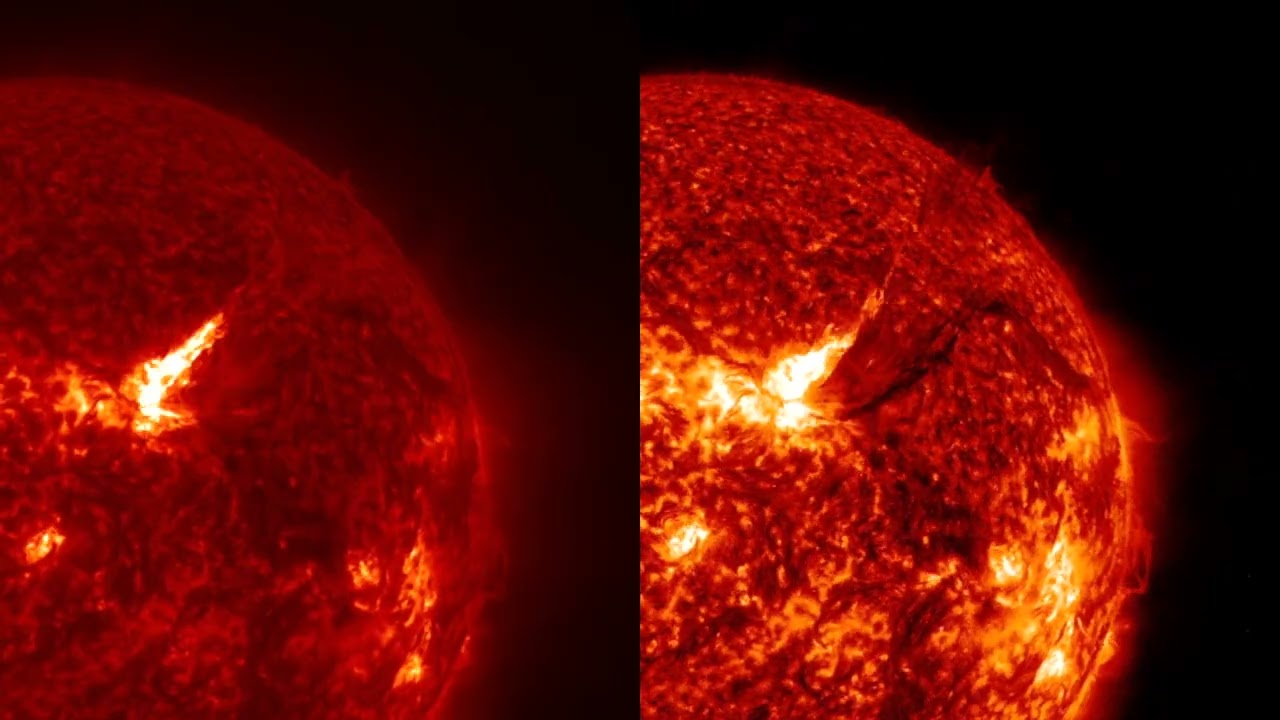
Solar Flares and CMEs at Earth - More Likely | S0 News June.3.2026
SpaceWeatherNewsS0s
2K views•2026-06-03



