It is a disservice to science to mask the profound discoveries on Enceladus with such sensationalist, clickbait titles. This approach trades intellectual integrity for cheap views and misleads the public about the reality of space exploration.
Install our extension to search inside any video instantly.
US Gov't Secretly Released Footage of 2,000 Mile-Long UFO Near SaturnAdded:
Scientists say there's a place in our solar system outside of Earth that has the chemical makeup to potentially support life. That place is Enceladus.
[music] For years, astronomers have been drawn to Saturn because of what bubbles up from an ocean hidden by a layer of ice.
There's a fresh twist in the tale now.
Researchers analyzing data from NASA's Cassini probe [music] have spotted mysterious objects almost 2,000 m long smashing through Saturn's clouds, leaving [music] sparkling trails behind them. This discovery caught scientists offguard. Scientists are perplexed by the bizarre flying [music] saucershaped objects creation. This incredible find on Saturn's moon has infused a renewed zeal into the search for alien life within our solar system. What is this thing with a saucer shape? Could there be intelligent life beyond Earth on Saturn? Join us as we investigate the UFO sighting near Saturn [music] that's sending tremors across our understanding of the solar system.
A NASA spacecraft [music] has just obtained its most stunning view yet of a small flying saucer that is orbiting well within Saturn's rings. [music] The new images initially made Cassini scientist Carolyn Porco believe they might be works of art. They are genuine.
Science has an advantage over fiction.
On March 7th, NASA's Cassini probe captured the unusual shape [music] of the saucer which turned out to be a small moon called Pan. Pan after the Greek deity of [music] wild places who played the flute is a shepherd moon with a diameter of 21 mi. It occupies a hole in Saturn's A- [music] ring, the outermost ring of ice particles. Japan, like a miniature Roomba armed with a force field, continuously clears [music] debris from the gap as it whizzes around Saturn. It was the lack of ring debris that first tipped off astronomers to the existence of Pan in the mid 1980s. It wasn't until 1990 when scientists led by Mark Shaalter carefully examined [music] data sent back by NASA's Voyager 2 mission that they confirmed the presence of the tiny moon responsible for [music] creating the gap. The Cassini spacecraft's rapid transit through Saturn's system has finally afforded [music] astronomers a close-up view of Pan. Its distinctive walnut shape was initially [music] attributed by Porco and her colleagues to ring debris seen in early photographs. Newer photographs reveal in great detail [music] that the moon is wrapped with an equatorial accretion disc, a thin smooth covering of ring particles stuck [music] to Pan's waistline by the moon's weak gravity.
This is such a far cry from the nondescript dots that I was tracking way back in 1990 in the Voyager images. It's very gratifying finally [music] to see Pan's closeup, says Shoalter, now at the SETI Institute in California. In a 2007 study published in Science, Porco suggested the thin [music] disc formed long ago before the moon had completely vacuumed out material from the gap. The shape, as others have also pointed [music] out, is probably because it is always sweeping up fine dust from the rings, Sha Walter explains. Due to Pan's large size and relatively thin rings, dust is concentrated near its equator.
Pan isn't alone in its bizarre appearance. Another small moon, Atlas, bears a similar shape for similar [music] reasons. On the frigid moon of Saturn, however, researchers have revealed yet another astounding finding.
Scientists [music] discovered buried in archived data the detection of phosphate in the water of the moon and Celatus nearly six years after NASA's [music] Cassini spacecraft probe crashed into Saturn and ended its historic mission.
This vital [music] component has never before been found in an ocean outside of Earth. One of the 145 known moons of Saturn, Enceladus, [music] has attracted the attention of both astronomers and astrobiologists [music] because of its intriguing geological activity and the possibility of extraterrestrial life.
Enceladus, named [music] for a giant from Greek mythology, is a small celestial body with a diameter of around 310 [music] mi, making it roughly 17th the size of the moon. Despite its dimminionive [music] stature, Enceladus has a major impact on its neighborhood, primarily via influencing Saturn's E-ring, the second outermost ring of the planet. Because its surface is primarily [music] covered in new pure ice, Enceladus is one of the solar systems most reflective [music] bodies. Nearly all of the sunlight that reaches it is reflected. Enceladus [music] is one of the sun's brightest objects because a huge portion of its surface is made of water ice. The topography is a mix of smooth, youthful terrain [music] and older, highly cratered sections. The tiger stripes or sulsy, four roughly [music] parallel deep blue fissures that spew out water-rich plumes in the south pole area of the moon [music] are particularly fascinating. The tiger stripes in the south pole area of Enceladus are [music] noted for their active geysers that erupt from them. These eruptions are a type of cryovalkcanism [music] where the eruptions are composed of water, ice, and gases such as ammonia and carbon dioxide rather than molten rock. The material that the plumes expel fuels [music] Saturn's E-ring. The evidence for a subterranean ocean of liquid water on Enceladus is maybe the most exciting finding yet. [music] The presence of salt in the plumes suggests that the moon's rocky mantle is in contact with the water, which opens [music] the possibility of chemical reactions that could support life. The ocean is thought to be universal and [music] is encased in an ice shell that might be up to several kilome thick. Enceladus [music] has emerged as a possible home for extraterrestrial life as a result of the identification of a subsurface [music] ocean as well as the presence of different salts in organic molecules.
Another promising [music] sign for life is the finding of silica nano particles which raises the [music] possibility that there may be hydrothermal activity on Enceladus' bottom. The recent discovery of phosphorus as phosphates, [music] another essential component of life in plume samples, has added increased gasoline to the chance of finding extraterrestrial [music] life.
Multiple space missions have investigated Encelletus. Although the two Voyager spacecraft passed by it in the 1980s, the most in-depth observations of Enceladus were made by NASA's Cassini probe after it arrived at Saturn in 2004. Cassini found the subterranean [music] ocean and geysers on the moon. From 2004 until 2017, the Cassini spacecraft [music] investigated Saturn, its rings, and moons. In approximately 13 years, samples of ice particles and water vapor emitted by cryovcanic plumes erupted from cracks on the frigid Enceladus were collected by [music] Cassini's cosmic dust analyzer.
The frozen waters of Saturn's moon, Enceladus, have the building blocks for life. But does it have life? The rarest of the six elements that make up life as we know it, phosphorus, has been discovered in [music] our solar system's tiniest ocean containing moon for the first time. Dr. Christopher Glind of the Southwest Scientific Institute [music] is part of an international scientific team that has discovered important evidence that suggests the existence of the key component of life beneath the [music] icy surface of Saturn's moon Enceladus. The discovery owes a great deal to data gathered [music] from NASA's Cassini spacecraft. Phosphates, which contain phosphorus, have [music] been discovered by researchers in the deep ocean of Enceladus. Phosphorus is an essential building element for life.
Enceladus is an icy moon with a vast ocean of liquid water hidden beneath its icy surface. Researchers have [music] already discovered other essential components of life such as carbon, hydrogen, nitrogen, sulfur, and oxygen in the water of the moon. However, phosphorus, which collaborates [music] with sugars to make a skeleton for DNA molecules and also aids in cell membrane [music] repair and maintenance, had evaded detection up until this point.
Now, Mars is almost old news in the search for life beyond Earth. Enceladus, the chilly moon of Saturn, [music] was once disregarded by astronomers who believed Europa, one of Jupiter's moons, [music] was too warm for life to have developed there. Several recent scientific findings, including possible chemical [music] bio signatures, have shifted the focus of scientists toward the likelihood that such extraterrestrial [music] bodies actually do host microorganisms.
There are already intriguing hints that [music] simple life forms may have developed on other solar system planets and possibly moons. But as is [music] the case in the majority of scientific subjects, occasionally progress is followed [music] by setbacks. For instance, studies that challenge earlier researches results that phosphine [music] gas in Venus's clouds might be a sign of life have been published in response. Together, [music] the studies show that the search for extraterrestrial life in our solar system has expanded beyond the initial hypothesis that it might be [music] discovered on planets like Mars or Venus. Scientists are also looking for life on exoplanets around distant [music] stars, as well as radio signals that may be from distant civilizations.
A report about [music] Enceladus is one of several recent scientific articles that discussed the hunt for traces of life in our solar system. The Cassini [music] spacecraft sampled the water plumes emitted from Enceladus between 2005 and 2015, and the results were published [music] in the journal Nature Astronomy. Methane and hydrogen were both detected at very high amounts by the probe, lending credence to the theory that bacteria have adapted to [music] life near hydrothermal vents on the ocean floor. It is hypothesized that the ocean on Enceladus is 12 15 m deep and is covered [music] by an icy crust as thick as 20 m. It is believed by scientists to be heated by the [music] tectonic movement of the moon's core rocks in Saturn's powerful gravitational field [music] and to discharge water from the ocean through fissures in the crust caused by the [music] same tidal forces. He suggested that chemical processes alone may account for the methane found in the sea. While the possibility of life evolving [music] near hydrothermal vents is hotly debated, the study found that it was very likely that it was created by [music] microorganisms.
Microbes that live in hydrothermal vents or black smokers [music] on Earth's ocean floor thrive off of the chemicals released by the vents.
Tubeworms, [music] shellfish, and crabs rely on them as the foundation of a food chain that keeps their entire deep sea ecosystem afloat without [music] the presence of sunlight needed by photosynthesizing plants. However, it is unclear whether life originated [music] in these dark depths or on the planet's bright surface. Phosphine on Venus [music] is still a hot topic of discussion as scientists search for extra solar life. The detection of phosphine [music] gas led scientists to speculate that bacteria living in the sulfuric acid clouds near the planet's [music] surface were responsible for its production. Researchers have since argued that the original team may not have detected [music] phosphine, that the gas is actually the product of volcanic activity, or that there [music] simply isn't enough water in the clouds to support life as we know it.
Professor of astronomy [music] at Cornell University and co-author of the paper, suggesting the phosphine could be created [music] by volcanoes, Jonathan Looney stated that only future space probes like the two missions NASA [music] announced last month could address the issues concerning life on Venus. Lun has also contributed to NASA's Europa Clipper mission where she worked on the Missy instrument that will investigate infrared [music] light reflected from Jupiter's moon in the coming years. Although not as well understood as Enceladus, Europa may also harbor an ocean of liquid water beneath her icy surface. One [music] of the most plausible places in the solar system for extraterrestrial life to have evolved.
It is believed to be older, larger, and probably warmer than the ocean on Enceladus. The unexpected discovery of liquid water beneath Enceladus's ice exterior was made possible by Cassini's exhaustive study. The spacecraft studied samples of plumes emitted from the moon's icy [music] surface, which contained ice grains and gases. The study of the data showed that salt-rich ice grains contained [music] sodium phosphates, indicating that phosphates are abundant in the lunar subsurface [music] ocean. Enceladus, the small moon, only a few hundred miles in diameter, appears to feature a soda ocean [music] due to its carbonated, frothy, salty water. If you drank a glass, you might get a soapy aftertaste.
[music] Frozen particles travel through crevices in the ice and spurt into space, revealing the ocean beneath. Some scientists [music] have expressed distaste for the name geysers, which has been applied to the plumes [music] because it implies continuous liquid water eruptions like those at Old Faithful. Phosphorus was [music] detected after years of analyzing data from Cassini's instrument hits as it sped past the icy moon. Carbon, [music] hydrogen, nitrogen, oxygen, phosphorus and sulfur. Schnops are the sex of elements that [music] combined with water and energy form the basis of biochemistry on Earth. Phosphorus represents the [music] P in this acronym. Phosphorus has been called a bottleneck for life [music] due to its scarcity. The ocean of Enceladus, however, is rich in it. [music] This means there is no choke point in the soda ocean. Phosphorus, the report states, is thus extremely unlikely to be a limiting factor in the survival of puditive life on Enceladus. The icy moons of Jupiter [music] and Saturn are able to support ocean life despite their extreme distance from the sun because they generate heat through gravitational energy. Internal heat is generated as the small bodies are pushed and stretched by [music] tidal forces created by their orbits around the large planets. The rocky [music] volcano covered moon of Jupiter Io is a prime example of this occurrence. Hydrothermal vents [music] like those on Earth that release nutrient-rich water into the ocean may be powered by tidal [music] heating on Enceladus. Because biology is still in its infancy, even the most fundamental notion of life [music] eludes scientists. Although scientists may confidently state what conditions are necessary for life on Earth, no one knows if these [music] are universally true. Phosphates, which include phosphorus, are essential for the development of all known forms of life.
Phosphates are necessary for the construction of [music] nucleic acids, DNA, and RNA, cell membranes, molecules that transport energy, the skeletal systems of humans and other [music] animals, and the microbiome of plankton in the ocean. Researchers explained the high levels of phosphates found in Enceladus's ocean. Researchers [music] discovered that the plume forming ocean waters on the moon included phosphate concentrations at least 100 times higher than those found in Earth's oceans. It's one thing [music] to use a model to anticipate the existence of phosphate, but it's a whole other ballgame to actually locate the evidence for [music] phosphate. This is a remarkable achievement in the field of astrobiology and represents a significant development in the hunt for extraterrestrial [music] life. The oceans of several worlds are covered by glaciers. Over the past 25 years, [music] scientists have recognized the solar systems abundance of worlds that protect oceans beneath [music] an icy crust. Pluto and the icy moons of the large planets, such as Titan and [music] Saturn's moon, Enceladus, are examples of such objects.
These ice covered ocean worlds can live at a broader range of [music] distances from the sun than Earth can sustain surface liquid water, thereby expanding [music] the number of habitable worlds in the galaxy. They also made hints that phosphate [music] levels would be higher in cold worlds.
In Enceladus and perhaps other frozen [music] ocean worlds beyond Jupiter, geocchemical tests and modeling show that such high phosphate concentrations originate from improved phosphate mineral solubility. [music] The ocean of Enceladus has been found to meet what is often regarded as the most stringent condition for life. The next logical step is to revisit Enceladus to confirm whether or not the livable ocean is populated. This remarkable finding can be attributed to the Cassini expedition which exemplifies the value of sustained efforts to explore the cosmos. Through the use of the cosmic dust analyzer, sodium phosphates within saltrich ice [music] grains were identified by Cassini. This high-tech sensor played a crucial role in demonstrating [music] the likelihood that phosphates, a form of phosphorus, are abundant in Enceladus' oceans. It's a remarkable illustration of how technology created [music] by humans has increased our access to and knowledge of the cosmos.
The way we see potentially habitable planets may change as a result of this new information. This study adds [music] to the growing body of evidence that frozen worlds harboring underground oceans are far [music] more abundant in the cosmos than was previously believed.
This is due to the fact that ocean worlds, unlike Earth, are possible at a broader range of distances from their host stars. increasing the likelihood that they [music] exist. All forms of life on Earth are built from the same basic materials. It's not created [music] from radioactive materials like uranium. Phosphorus being only one of six required elements has an especially large [music] impact on Earth's biology.
It's essential, for instance, to cellular energy transfer and DNA RNA structure. Is [music] phosphorus strictly necessary in biochemistry or may there be an alternative biology?
According to [music] scientific theory, phosphorus is the best candidate for the functions it plays in everyday life [music] because it possesses the ideal combination of qualities. The inner ocean of Enceladus is so similar to that of Earth that we would certainly recognize any form of life there. A planetary geocchemist at Arizona State University, Male Zolotov, authored a viewpoint [music] essay for nature and reviewed the new work. He reaffirmed his belief that Mars is where extraterrestrial life is most likely [music] to exist. However, he clarified that he is a scientist, not a science fiction author, and that there are many unanswered questions. We don't know the specifics of what led to [music] the first signs of life. He stated one of Jupiter's large moons, Europa, [music] may also contain the entire set of Kops elements. A Jupiter orbiter being built by NASA [music] called Europa Clipper, will get a closer look. The most fascinating planet in our solar system [music] right now, aside from the one we are on, is probably Enceladus. In fact, these amazing [music] discoveries have only increased our desire and motivation for more research, advancing our quest to comprehend [music] the cosmos and our place within it. There has never been a more promising time to study astrobiology.
uh when you're in positions of of privileged access like a systems administrator for these sort of intelligence community agencies and because of that you see things that uh may be disturbing.
For decades humanity has been captivated by the allure of our celestial neighbor, the moon. We've walked upon its dusty surface, planted [music] our flag, and dreamed of returning. But have you ever asked yourself, why, in the age of smartphones and self-driving [music] cars, haven't we gone back? Why does the moon, once a symbol of human achievement, remain untouched by human feet for over half a century? Could it be that there's more [music] to the story than we've been told? Is there something beyond the official narrative that's been hidden from the world? Join us in this [music] groundbreaking expose as Edward Snowden unveils the stunning reasons why we [music] have not gone back to the moon for over half a century.
[music] According to Snowden, one big reason NASA hasn't gone back to the moon is the huge amount of money it takes. It's like trying to buy a ticket to outer space.
Super expensive. Back when President Kennedy [music] was in charge, he thought it would cost about $7 billion.
But in the end, it ended up being more than $20 billion. That's a lot of cash.
The Apollo [music] project, which was all about going to the moon, cost a whopping $25.8 billion. [music] In today's money, that's like $264 billion.
That's more money than most of [music] us can even picture. And get this, over 400,000 people along with help from [music] more than 20,000 companies and schools had to work together to make it happen. So, you can see why the [music] cost was sky-high. Then there was President Nixon. He had some serious doubts about [music] going back to the moon. He thought it was too dangerous and way too expensive. He [music] believed that only if there was a competition or some way to make money out of it, it would make sense to go back. So, he was not a big fan of the moon missions. Now, let's [music] fast forward to the 1980s. President Ronald Reagan had this big idea for a space station [music] called Space Station Freedom. At first, it was supposed to cost around $8 billion, [music] but by 2010, it had ballooned to over $100 billion. That's like your allowance going from $8 to $100 in just a few [music] years. NASA wanted it to be more efficient, but the costs just kept going up and up. Here's where it [music] gets interesting. The space industry wanted a rocket that was faster, cheaper, and could be used more than once. [music] NASA's Aremis program didn't have that kind of rocket. Their SLS rocket was a one-time use deal. After every launch, it was like throwing the rocket away right into the ocean. Not very eco-friendly. But guess what? SpaceX, [music] led by Elon Musk, is working on something cool called Starship. It's a rocket that [music] can be used over and over again, like a space Uber. So far, they've spent $5 billion on it, way less [music] than the $23 billion NASA put into the SLS. But Starship needs to prove it can do the job for NASA. Right now, the SLS [music] is on the launchpad, ready to go. It's NASA's only option for getting to the moon. If it works, [music] it's like a gold star for the United States in the tech department. But if it fails, it's like a big [music] step backwards for the whole plan. NASA's got a lot riding on these tests. If things go [music] wrong, it could be a real headache for the whole project. It might even mean the end of part of the plan. So, you [music] see, the moon mission isn't just about exploring. It's also about dealing with some seriously big numbers [music] and some pretty tricky technology. Embarking on a journey to the moon may sound like a dreamy adventure, but let us unravel the hidden hazards of such a quest. Moon trips are perilous endeavors fraught with life-threatening challenges.
[music] One haunting chapter in lunar exploration history was the Apollo 1 launchpad tragedy, where a fiery [music] inferno claimed the lives of three brave astronauts. It's a chilling reminder that venturing beyond our Earth's grasp isn't a walk in the park. The Apollo 13 mission encountered [music] a hairraising incident as an oxygen tank exploded. Miraculously, no lives were lost and the astronauts safely [music] returned to our blue planet. Neil Armstrong, the famed moon walker, [music] also danced with danger. In a lunar landing training session, his spaceship's engine faltered and the module exploded. Swift ejection saved him from certain doom. Even during [music] the historic Apollo 11 landing, peril lurked. Armstrong and his crew faced a turbulent descent. A vigilant US Air Force meteorologist Hank Bradley, wielding [music] advanced technology, averted catastrophe. His sharp eye detected a looming thunderstorm [music] in the spacecraft's path. Quick action diverted disaster, ensuring a safe splashdown [music] in the Pacific Ocean.
Beyond human error, lunar voyages grapple with nature's challenges.
According to Snowden, moon dust, deceptively innocent looking, can wreak havoc on equipment. Then there's the lunar night, a harrowing twoe plunge into darkness. When sunlight graces the moon, scorching heat poses a fresh threat. and [music] asteroids. Those celestial wanderers menace astronauts on their lunar sojourns. So before you fantasize about a moonlit romantic escapade with your lover, ponder these realities. [music] The moon is no Starbucks haven. It's a cosmic wilderness where danger [music] prowls. Yet for the fearless explorers amongst us, these risks only fuel the desire to venture into the unknown.
Vanessa, would you dare return to the moon, knowing the [music] perilous dance that awaits? The call of exploration beckons, but the hazards are woven [music] into its fabric. The moon remains a mistress of mystery and danger, waiting for humanity's [music] next daring step. Another reason, according to Snowden, is about how things shift when the government and rules change. In a democratic society, there's [music] always a need for regular shifts in leadership. Each new government comes in with its own [music] hopes and beliefs. The leaders of the United States also affect NASA's plans.
Every time a new [music] group takes charge, they have their own ideas for what NASA should do. This creates problems for NASA's plans. Each government focuses [music] on certain projects that don't take too long to finish. This makes it hard for NASA's big [music] plans to happen. These big plans need a lot of money and time. They last longer than just one president's time in office. For example, back in 2004, President George W. Bush [music] asked NASA to come up with a plan after the space shuttles. NASA made the constellation program. It was part of a bigger plan called the space exploration initiative. The plan was to use rockets and a spaceship called Aries and Orion to get astronauts to the moon. NASA spent a lot of [music] money and time on this $9 billion in 5 years, but it didn't work out. Later, President Barack [music] Obama stopped this plan. He said it was costing too much and taking too long. He wanted NASA to focus on different things like going to Mars. So, the plan to go to the moon [music] got cancelled. Then, President Donald Trump came in. He liked the idea of the [music] big rocket, the SLS. He wanted to use it to go to the moon and Mars. He aimed to get astronauts back on the moon [music] by 2024. He even asked for more money for this, but these changes in plans cost a lot. NASA has canceled [music] many projects and lost a huge amount of money. It's been happening for years. Ever since the time of John F.
Kennedy, no president [music] has been able to keep the plan to return to the moon. Every time plans get set, a new government takes over and cancels the plans. Even now with [music] President Joe Biden, things are staying the same.
He's sticking to the same plan that [music] Trump set, focusing on going back to the moon. He's even asking for more money to do [music] it. He's not changing the space force either. So, the cycle of changing plans [music] and goals continues. After the intense space race between the United States and Russia, which was an extension of their Cold War [music] rivalry, both nations were eager to prove their technological prowess in the realm of space. [music] This rivalry stemmed from the post World War II nuclear arms race and took shape as a race to [music] showcase supremacy in the space industry. The Soviet Union took the lead by launching the historic Sputnik 1 satellite in October 1957 and later sending Yuri Gagarin into space in [music] 1961. These feats left American officials concerned, spurring them to seek their own significant victories.
President John F. Kennedy in 1962 faced [music] the challenge of landing Americans on the moon. He appealed to Congress at a time when the US lagged behind the Soviet Union in space development. Despite [music] the difficulties, NASA, the US National Aeronautics and Space Administration, secured the necessary resources. [music] By 1966, NASA received a substantial allocation, amounting to about 4.5% [music] of the total federal budget, enabling the ambitious Apollo program. Within just 7 years, NASA's spending boost made the moon landing possible. [music] The space race appeared to end as the US successfully beat the Soviet Union to the moon. Snowden believes that this triumph [music] was partly driven by Cold War politics. President Kennedy viewed the Apollo program as a means to assert American superiority. [music] In 1966, NASA initiated the first unmanned Apollo mission and went on to land 12 astronauts [music] on the lunar surface through six manned missions by 1972. These missions yielded invaluable [music] scientific insights through experiments and the collection of rock samples.
Flags were [music] planted and nuclearpowered instruments transmitted data back to Earth. Despite the tremendous achievements of the Apollo program, NASA never returned to the moon after 1972. While the end of the [music] space race played a role, other factors contributed to this decision. One such factor is the immense cost associated with lunar missions which [music] deterred subsequent administrations from committing the necessary resources.
Another reason from Snowden's [music] perspective is that not many people are interested in the space mission. A survey in 2018 found that most Americans [music] would rather spend money on studying the climate than sending people to the moon or Mars. While 72% of the people in the survey wanted the United [music] States to be a leader in space exploration, only 13% thought sending astronauts [music] to the moon should be a top priority. Some African-Amean communities were especially against the moon project. [music] Ralph Abernathy led a civil rights protest with over 500 African-Ameans at the [music] Kennedy Space Center. They carried signs that said things like, "For the cost of feeding [music] an astronaut for 12 days, we could feed a starving child for eight." This protest showed that the Apollo [music] space program was causing division among the American people, and the government decided [music] to take a break from space adventures. There's also a theory that fewer kids and young people want to become [music] astronauts these days.
Research shows that more kids dream of being successful YouTubers than astronauts. Because fewer [music] people are interested in becoming astronauts, the government and policymakers don't see going back to the moon as a top priority. Also, the constant shift in national priorities has caused significant changes in focus. with urgent matters like addressing climate change, tracking asteroids, combating poverty, promoting gender equality, funding peace missions in troubled nations, and eradicating terrorism.
Other endeavors take a back seat.
Consider the example of Obama's administration, which succeeded in defeating Osama bin Laden due to its clear focus as opposed to an administration more concerned with lunar exploration. A pivotal moment was the 1973 oil crisis, forcing a shift in national priorities. This shift led to reduced resources for NASA's research and scientific undertakings, affecting their ability to embark on new lunar and Mars missions. The budget allocated to NASA dwindled, falling below 1% and [music] by 2005 it was a mere 0.4%.
Consequently, lunar missions became unfeasible. A 2005 NASA report estimated a staggering $14 billion, now equivalent to around $133 billion for a moon return mission. Given pressing [music] concerns, authorities prioritize issues like climate, poverty, and security over adventurous moon exploration. While moon missions offer theoretical [music] benefits, they're now secondary. This explains why NASA hasn't revisited the moon. The unrelenting shift [music] in national priorities towards urgent global challenges and limited resources for space exploration make it impractical until pressing matters are addressed.
The alluring prospect of lunar exploration remains on hold. One other big reason according to Snowden stems from the problems with computer programs and machines. The last time [music] people visited the moon was during Apollo 17 with Eugene Cernin being the last human to set foot there. So, why hasn't NASA gone back? Is it because they can't [music] figure out the science or technology? Unfortunately, it seems like the folks who build spaceships and rockets are still figuring things out. This is causing a lot of risk, which [music] doesn't seem like a good idea. For instance, let's look at the SLS, a big rocket. In April 2022, they tried to put fuel in it and then take it out, but something went wrong. They found a broken part and [music] a leak. The person in charge of checking things at NASA, Paul Martin, said Boeing, the company building the SLS, didn't plan and do the job well.
It's worth noting that the last time NASA tried a completely new rocket for the moon was way back in November 1967.
[music] It was called Apollo 4, and it took lots of people from different places a long time to make it work. It's taken even more years for [music] the new space launch system to get ready for takeoff.
Despite mountains of proof supporting Apollo 11's historic mission to the moon, there remain doubters [music] who insist it was all a hoax. In 1976, Bill Casing emerged [music] as a vocal advocate of this theory. He penned a tiny pamphlet titled, "We never went to the moon," where he contended that America lacked the necessary technology for a lunar journey. His arguments wielded persuasion [music] because he possessed an insider's viewpoint.
Remarkably, he [music] had contributed to the US space program and played a role in crafting the potent Saturn 5 rocket engines. For these skeptics, the logic goes like this. If we couldn't [music] construct a capable spacecraft for such a colossal odyssey, then the celebrated moon landing must have been an elaborate charade. This leaves us pondering what step should NASA take to transform the dream of dispatching a fresh team of astronauts to the moon into reality. Moreover, with China's astounding leaps in space technology, could their progress spur NASA to conceive an even more astounding lunar return? In the face of naysayers, Apollo 11's legacy stands firm, an emblem of human accomplishment. However, Bill Casing's tale serves as a reminder that skepticism persists, fueled by the ever evolving landscape of space exploration.
The challenge for NASA now lies in silencing these doubts and rekindling [music] the nation's lunar aspirations.
China's advancements should serve as both a motivation and a catalyst [music] for NASA's reinvigorated lunar ambitions. The next chapter in lunar exploration awaits with history watching to see whether the doubters or dreamers will prevail. The moon A4 5 billionyear-old giant rock raises [music] doubts about human visits. It's a risky venture due to international conflicts and [music] less than perfect technology. Memories of past moon missions filled with astronaut hazards loom large. So, is it worth the risk?
This ancient celestial body pockmarked with craters [music] and massive rocks poses landing challenges. In 1969, the US spent [music] a fortune just to find a safe landing spot, showcasing the moon's tricky surface. Environmental concerns [music] also cloud lunar visits. Moon's history is marked by space rocks bombarding its surface. Then there's the enigmatic moon dust charged [music] by the sun, troubling Apollo missions. To stay longer or build homes, we must tackle [music] this pesky dust.
Moon weather is peculiar with two weeks scorching heat followed by frigid darkness. NASA strives to keep astronauts warm and powered. But readiness remains uncertain. With human safety at stake, why not dispatch robots? Astronaut Buzz Aldrin argues for the human touch. Robots excel at science, but humans offer unique experiences. [music] Buzz and Neil Armstrong's lunar odyssey included an odd smell. Neil likened it to wet ashes. Buzz to postfirework burnt charcoal. Robots can't sense such nuances. [music] Moreover, lunar mysteries abound.
Whispers of potential moon dwelling aliens persist with rumors of secret astronaut encounters. Yet, caution must prevail. We shouldn't provoke interstellar conflicts in our journey to the moon. Let's weigh the risks and rewards wisely, avoiding unintended consequences [music] that could turn the cosmos into a real life Star Wars saga.
One more reason why going to the moon might not be a good idea is that some folks believe there aren't enough good reasons for it. They think [music] that the benefits we might get from going to the moon are just ideas and not facts.
Plus, the government doesn't [music] want to spend a lot of taxpayers money on a project like this because it's risky. Some people [music] think that the real problem isn't going back to the moon, but figuring out what we can gain from it. They say there's more to going to the moon than just showing we can do it. [music] For a long time, there's been a debate about whether going to the moon is even worth it. The main question is, [music] will we learn important things from this exploration? Some space researchers believe the moon is a good place to learn [music] about how the solar system has changed over time. They say the moon is special because it doesn't have air or water, so it doesn't change like Earth. That's what David Kring, a scientist who [music] studies the moon, thought. But in 2003, a terrible thing happened. The space shuttle Colombia crashed and all [music] seven crew members died. This made people ask why we risk going into space when it's so dangerous. President George [music] W. Bush had an idea. He said, "Maybe going to the moon is a safer way to explore [music] space, but is it worth the risk?" That's a big question, and it's one of the things NASA is still thinking about before going back to the moon. The depth of space in scope [music] and color like we've never seen before. All thanks to a massive telescope.
[music] In a monumental leap [music] for humanity's quest to unravel the mysteries of the universe, the James Webb Space Telescope has just dropped a bombshell announcement that's [music] bound to redefine the boundaries of our understanding. The JWS has just discovered unprecedented proportions of 632 unidentified [music] objects sailing through the void from a distant solar system. But what exactly [music] are these mysterious travelers?
And what tales do they carry across the vast expanse of space? Join us as [music] we decode the mysteries that have been flung by the 632 unidentified objects from another solar [music] system.
The spectacle of discovering [music] peculiar objects suddenly appearing in the vast expanse of space isn't a new phenomenon. Throughout the annals of astronomy, instances have arisen [music] where novel entities seem to materialize within our solar neighborhood. Yet, the outcomes for these objects haven't always aligned with our optimistic expectations. Meanwhile, one of the most renowned occurrences hails from the Kepler mission, a grand endeavor aimed at demystifying the secrets of exoplanets beyond our familiar solar system. Equipped with a remarkable capacity to detect even the slightest fluctuations [music] in starlight, Kepler's investigation uncovered a treasure trove of potential exoplanet [music] candidates. Initially, these newfound celestial wanderers appeared poised to revolutionize our understanding [music] of the universe.
However, a closer examination unveiled a twist in this cosmic tale. More than half of the initially identified colossal [music] exoplanets, though first seen as groundbreaking revelations, turned out to be miragages.
>> [music] >> These false positives, deceptive signals masquerading as genuine cosmic entities, offered a stark reminder that not all discoveries stand as solid [music] truths until supported by an abundance of confirming data. NASA's transiting exoplanet [music] survey satellite mission designed to scan vast celestial regions for exoplanet prospects also encountered its share [music] of surprises. In some instances, the promising observations faded into obscurity, revealing themselves to be fainter than anticipated. Navigating the intricate [music] dance of light and shadows within our solar system, astronomers have faced a cosmic challenge, distinguishing between real celestial marvels and [music] deceptive miragages.
Extensive efforts have been poured into honing this skill, ensuring that the truths of the universe aren't obscured [music] by illusions. But the journey doesn't stop there. It led us to the creation of a remarkable tool that doesn't just detect celestial objects, but [music] does so with unparalleled precision. That's the cosmic marvel, the James Webb Space [music] Telescope.
Standing proudly in a league of its own, the James Web Space Telescope boasts an extraordinary ability to delve deep [music] into the early universe, a feat its predecessors could only dream of.
Its substantial size and cuttingedge instruments [music] grant it the power to peer back billions of years, capturing light from the farthest corners [music] of space. Through this lens, it provides us a unique glimpse into the universe's infancy, unraveling [music] the intricate tales of galaxies, stars, and planetary systems. What sets the James Webb telescope [music] apart from its forerunners like the Hubble Space Telescope is its expanded vision.
Imagine [music] a spectrum of light like a rainbow of cosmic clues. James Web doesn't just observe part of this spectrum. [music] It observes a much larger chunk, particularly in the infrared range. This advantage enables it to study [music] celestial phenomena that would have remained hidden otherwise all at once. A capability [music] the Hubble couldn't match.
Imagine a telescope with the power to see through cosmic curtains. [music] The James Web Space Telescope is that and more. Its secret weapon, an extended range that punches [music] through the dust clouds that usually veil celestial sights. Imagine being able to see clearer [music] and brighter, like having cosmic x-ray vision. By capturing a whopping six times more light than its predecessor, the Hubble Space Telescope, the JWSD reveals not just stars, [music] but entire constellations within intricate celestial neighborhoods, such as the spellbinding [music] Karina Nebula. But the story gets even more exciting when we consider where this marvel is stationed [music] at the special point called Lraange 2. Roughly a million miles away from Earth, this [music] point delicately balances the gravitational forces of the Earth and the Sun. What does that mean? No more wobbles caused [music] by our planet's atmosphere. This ethereal vantage point erases the distortion and interference that Earth's [music] atmosphere can cause. Like a cosmic window cleaner, floating high above our [music] atmosphere, the JWST sidesteps the cosmic traffic jams of atmospheric turbulence, light pollution, and light absorption. This stellar seclusion gifts astronomers a front [music] row seat to the universe, sands the smudges and blurriness that plagued earlier telescopes. The view is so pristine that it's like [music] having an artist's canvas untouched by the elements. The JWST's [music] location isn't just about avoiding annoyances. It's about tapping into cosmic wavelengths. Think of it like tuning into different radio stations.
[music] The JWST tunes into a broader range of wavelengths, especially in the infrared part of the spectrum. This is like listening to [music] cosmic music that was previously inaudible. Earth's atmosphere is like a cosmic puzzle. It lets some light through, but keeps other kinds at bay. When it comes to infrared [music] light, it's like an invisible barrier. This limitation has kept many [music] groundbased telescopes from fully exploring the universe. in this crucial range. However, the James Webb [music] Space Telescope has found a way to soar above these restrictions, giving it a golden key to the cosmos. Perched far beyond Earth's [music] atmosphere, the JWST is like a cosmic eagle with unobstructed vision. Unlike its Earthbound [music] counterparts, it can freely observe a wide array of infrared wavelengths without interference. This superpower sets the stage for groundbreaking [music] revelations previously locked away from us. But here's where the JWST's adventure gets even [music] more captivating. Old telescopes often had a problem with the cold. Not the JWST. It thrives in the chilly vastness [music] of space. To achieve its best performance, its instruments and mirrors need to be kept at frosty temperatures. It's like they've been bundled up in [music] cosmic winter coats. This icy environment might sound like a challenge, but it's a strength for the JWS. How? Well, it's all thanks to a clever sunshield. This shield wraps around the telescope, guarding it [music] from the sun's scorching heat and ensuring that its sensitive instruments stay frosty. In this cool, [music] controlled setting, the JWST becomes a cosmic hunter, picking up faint signals that other telescopes might miss. This means it can spot and study celestial [music] objects that emit weak infrared signals like faraway galaxies, newborn planetary systems, and even ancient whispers from the universe's birth. The icy playground of the JWST is [music] like a scientist's dream come true. Its space-based position allows it to transform [music] what could be challenging into its unique advantages. Imagine a hidden treasure trove right in our cosmic [music] backyard. It's called the Kyper Belt, and it's like a bustling hub of celestial characters beyond [music] Neptune's orbit. These aren't just ordinary space rocks. There are 632 fascinating [music] ensembles of comets, asteroids, and fragments from our solar systems early days. Think of the Kyper Belt as a cosmic pocket, a bustling marketplace where cosmic merchants display their [music] wares. Among these wares are Kyper Belt objects, a diverse group with their own stories to tell.
Comets, like cosmic snowballs, [music] dazzle the sky with their tales when they approach the sun. Asteroids, rugged space travelers, are like cosmic time capsules that give us a glimpse into the [music] universe's beginnings. Size matters here, too. The Kyper belt isn't just bigger. It's like the heavyweight champion [music] compared to the asteroid belt, a realm between Mars and Jupiter that hosts most of our systems rocky leftovers. Imagine a [music] bustling city compared to a quaint village. These asteroids come in all shapes and sizes, from pebbles to giants spanning hundreds of kilome. They're like a cosmic jigsaw [music] puzzle that astronomers are piecing together. But there's more to this cosmic interaction than meets [music] the eye. In the Kyper belt, these objects are constantly on the move, [music] interacting with the rhythm of gravity. Sometimes they collide, sending cosmic fireworks across the sky. It's like a [music] cosmic ballet with piouettes and unexpected twirls. The Kyper Belt is like a grand cosmic [music] mystery novel waiting to be explored. Each object tells a chapter of our solar systems history. By studying them, [music] scientists decipher the secrets of our past, our place in the universe, and the unseen forces that shape our cosmic neighborhood. It's a celestial journey that reminds us that our solar system is a dynamic, ever [music] evolving place with tales waiting to be discovered.
Imagine the asteroid belt as a grand cosmic stage [music] with two distinct acts, each starring its cast of characters. Act one is [music] the inner belt where asteroids swirl closer to Mars than to Jupiter. Just before act two, there's a gap [music] called the Kirkwood Gap. Think of it as a mysterious doorway about 2.5 astronomical [music] units from the sun.
Beyond that door, act two commences with the outer belt where asteroids venture closer to Jupiter's [music] orbit. This cosmic choreography emerges from the tango of gravity between these space boulders and their planetary neighbors.
Though it sounds bustling, the asteroid belt is surprisingly spacious. Think of it like strolling through a wide desert.
The asteroids, although fascinating, [music] are often tens of thousands of kilome apart. This cosmic desert lets spacecraft [music] navigate through with ease. Unmanned explorers cruise through on missions either to the outer reaches of our solar system or to study specific asteroid actors up close. These spacecraft, [music] like cosmic detectives, reveal asteroid secrets. They beam back data, images, and [music] stories about these rocky layers. They tell us tales about composition, structure, and even the ancient history etched into these celestial stones. [music] But here's the twist. Despite its vastness, the asteroid belt's overall mass is just a fraction compared to other cosmic [music] objects. Imagine it as a feather in the grand tapestry of space, a mere 3% of the moon's [music] mass. This cosmic puzzle piece reminds us of the enormity and diversity of our solar system. Now, let's peek beyond [music] the asteroid belt. There's another cast waiting in the cosmic wings, the Kyper belt objects. These are the distant relatives, [music] sometimes even tinier than asteroids, that occupy the outskirts of our solar system. Their combined [music] mass is less than 1% of anything else out there.
Now, imagine the Kyper [music] Belt as a frozen carnival beyond Neptune's backyard. It's like a treasure chest of cosmic [music] goodies, although less hefty than our whole planet. These goodies, known as Kyper Belt objects, KBOs, [music] come in all shapes and sizes, like a cosmic dressup party. What makes these KBOs [music] special is their frosty nature. They're like cosmic popsicles made up of frozen stuff [music] like methane, ammonia, and water. These icy treasures have been chilling in the Kyper [music] Belt's frigid depths since our solar systems dawn, keeping their cool for billions of years. This sets them apart from the rocky characters [music] found closer to the sun. One of the coolest things about the Kyper Belt is its VIP guest list of dwarf planets. Think of these as [music] cosmic mini celebrities. Pluto, Homia, and Quuar are some of the famous faces [music] in this lineup. They're like little siblings to the big planets, sharing traits like a round shape, decent size, [music] and their gravitational sway over their cosmic neighborhoods. These mini worlds are like time capsules from our solar systems early years, whispering tales of its youth and [music] growth. Now, let's count the attendees. Around 35,000 KBOs with diameters [music] larger than 62 mi. A pretty impressive turnout. But hold on to your cosmic hats. There could be up to a staggering 100 [music] million smaller and fainter kos measuring 12 mi or less across. So, while we're talking about 632 mysterious objects, remember that the Kyper [music] Belt is like a hidden attic full of secrets. Within the Kyper Belt's cosmic crowd, there's a [music] troop of smaller actors that might be harder to spot, but play a big role in the show.
Imagine [music] them as the background dancers who make the stage come alive.
While trickier to detect, [music] they form a major part of the Kyper Belts population. This means scientists need to dig deep and do a lot of research to understand them better. To make sense of this diverse [music] cast, scientists have sorted them into two main categories. The first group, called classical Kyper [music] belt objects, are like steady hikers on a well-marked trail. They follow paths that aren't easily swayed by [music] Neptune's gravitational tugs. The second group, resonant Kyper Belt objects, are like cosmic dance partners with Neptune.
Their orbits have a unique [music] rhythm that resonates with Neptune's orbital dance. This makes them interact more intensely like partners in an intricate ballroom routine. These dances [music] create stable orbits and give us a peak into the Kyper Belt's complex gravitational choreography.
Imagine the Kyper Belt [music] as a bustling market with objects stacked up in three dimensions. Most of the action happens within [music] 10° above and below the ecliptic plane. This plane is like a flat dance floor where most planets, including Earth, do their orbital dance around the sun. But the Kyper Belt's market isn't limited to this floor. There's also a more spread out section [music] stretching even farther. Meanwhile, imagine the cosmic interaction where planets waltz in [music] a neat circle around the sun. On the other hand, Kyper belt, it's like a group of cosmic rebels with their unique moves. Unlike the planets [music] that stick to a flat routine, the Kyper Belt objects add a twist with their significant tilt or inclination. This celestial tilt means [music] that the KBO's don't just dance on the same plane as the planets. They have a different [music] angle, like dancing to their cosmic beat. This makes them stand out as cosmic oddballs, adding a touch of excitement to our solar [music] systems dance party. Most of the KBO action happens within 10° above and below the ecliptic plane. The cosmic dance floor where planets groove. But here's where it gets [music] interesting. This cosmic gathering forms a close-knit group, kind of like stars in a celestial huddle.
Their orbits are inclined, making them resemble a cosmic choir practicing a [music] special routine. But the Kyper Belt doesn't just have a main act.
Beyond this star-studded cluster, [music] there's an afterparty with a more spread out crowd. Think of it as the cosmic carnival extending farther with KBOs scattered in all directions.
This adds a layer of mystery. What drives these [music] cosmic partygoers to take their unique paths? Imagine a cosmic playground filled with celestial adventurers taking their [music] zigzagging paths while some stick to smooth orbits like the planets. Others embrace their free spirit, following wobbly and [music] tilted paths. This diverse cast of cosmic characters contributes to the Kyper Belt's dense population. This packed assembly is like a cosmic community photo. It gives [music] us a glimpse of the Kyper Belt's true heft. It's not just a flat sheet.
It's a sprawling cosmic [music] playground. Think of it as a bustling city in space where each building represents a Kyper belt object. These KBOs come [music] in all sizes, shapes, and styles, forming a celestial mosaic that makes our solar system more colorful. In this 3D [music] cosmic canvas, every nook and cranny is occupied by a KBO, each with its own story. [music] Imagine these celestial wanderers as pieces of a grand cosmic puzzle. And astronomers [music] are the puzzle solvers, piecing together the tales of their travels and the whispers of their ancient pasts. Imagine being a cosmic [music] detective trying to peek into the Kyper Belt's treasure trove of icy wonders. Here's the twist. These treasures are quite shy, so catching them in the act is tricky. Astronomers [music] can't just zoom in and take a snapshot, but they've got a bag of clever tricks up their sleeves. So, what are these Kyper [music] belt objects, KBOs, made of? Think of them as cosmic ice cream cones with flavors that freeze in the cold depths of space. They're like the cosmic [music] leftovers from the solar systems icy beginnings. Most of them are a mix of water, ammonia, and methane. Scientists confirm this mix [music] through a special technique called spectroscopy. It's like reading the cosmic recipe book by analyzing the light they [music] give off. Diving into the fun part of the variety show.
Imagine this icy playground stretching [music] outwards. Here, where it's super chilly, icy materials rain supreme.
Think of it as a cosmic freezer where water, ammonia, and methane hold [music] their icy forms. This is where you'll find icy heroes like comets. Cosmic snowballs that dazzle us when they [music] swing by the sun. Scientists call these chill Kyper belt objects cold classical KBOs. And they're like the true ice cream lovers of the cosmic parlor. But there's more to this cosmic treat shop. As you venture closer to the sun within the Kyper Belt, the icy mix starts [music] to change. It's like moving from the deep freezer to the fridge. The flavors shift as the sun's warmth gently melts some of the icy [music] coatings. This zone becomes a mix of icy and rocky objects, creating a fascinating array of cosmic confections.
Now imagine Kyper belt objects as cosmic shape shifters, altering their appearances as [music] they draw near to the sun's warmth. It's like cosmic dressup. Their composition costumes change [music] as they interact with solar radiation and bask in the sun's proximity. This dynamic dance between the sun and these objects creates a cosmic [music] makeover. Here's the twist. The sun's warmth can be a bit too much for some. Imagine cosmic ice cream [music] cones melting in the sun's heat.
For some Kyper belt objects, this warmth leads to a dramatic shift. Their [music] icy veneer made of water, ammonia, and methane starts to evaporate like a morning mist. What's left behind are rocky and less volatile materials, turning these objects into cosmic chameleons. But wait, there's [music] more to the story. Not all objects are affected in the same way. Some are like resilient space travelers [music] with the icy layer staying put despite the sun's attempt to steal their cosmic flavors. Others, however, are like cosmic marshmallows melting in [music] hot cocoa, undergoing drastic transformations.
Imagine trying to solve a puzzle [music] where each piece has its unique shape and texture. That's what scientists face when studying these everchanging Kyper belt objects. [music] It's like trying to understand an evershifting kaleidoscope of cosmic compositions. To unlock these secrets, researchers are employing advanced tools like the James Web Telescope, a cosmic detective [music] with the ability to peer through space's veils and decode the mysteries of these icy travelers. It's a thrilling cosmic journey, a puzzle that's gradually revealing its pieces, [music] bringing us closer to understanding the dazzling complexity of our solar systems distant realms.
Thanks for watching another episode of Voyager. While you are still here, make sure to click the video on your screen for [music] more quality content.
Related Videos

Spiral Galaxy NGC 3370 from Hubble | NASA APOD 2025-11-05 #Shorts
galaxygallery
938 views•2026-05-30

SOMETHING inside the SUN is CHANGING
RaysAstrophotography
1K views•2026-06-03

There May Be A Giant Hole In The Universe... And We Might Be Inside It | The Cosmic Ledger Entry 015
TheCosmicLedger
145 views•2026-05-31

Captured the Blue Moon (with a twist) 🌙✨ #space #bluemoon #telescope
realAstroExplorer
674 views•2026-06-01

The Map We Sent to the Stars in 1977 — Why Scientists Now Regret It
TheAncientRecord7
183 views•2026-06-03

Is this a copy of our galaxy? Discover Galaxy M81!
UniverseDocumentaries-cc4mb
995 views•2026-05-31

10 Planet Where a Black Hole Replaces the Sun
cosmicexplorer-EN
147 views•2026-06-02
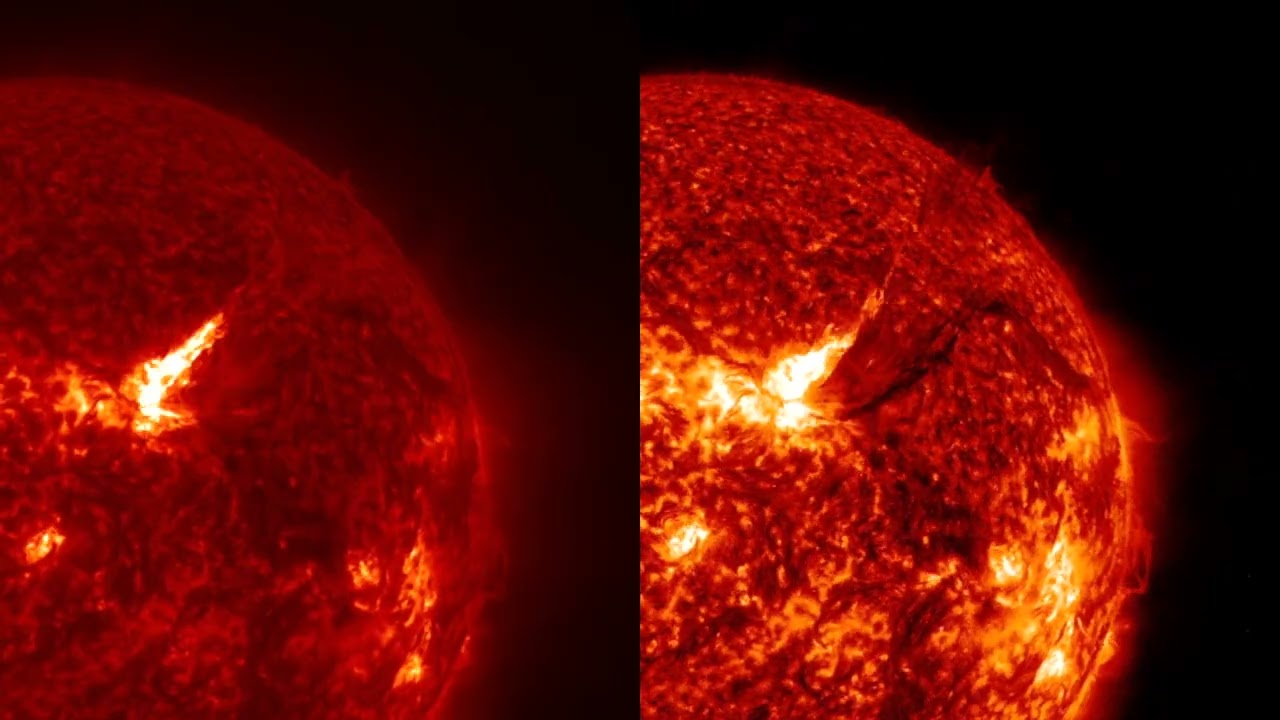
Solar Flares and CMEs at Earth - More Likely | S0 News June.3.2026
SpaceWeatherNewsS0s
2K views•2026-06-03



