Voyager 2's 1989 flyby of Neptune revealed that Triton, Neptune's largest moon, possesses a hazy atmosphere 3-7 miles high composed of nitrogen and organic gases at extreme cold temperatures of -350°F, displays diverse terrain including flat plains and ridges hundreds of meters high, and orbits Neptune in a retrograde direction, leading scientists to classify it as a planet despite its moon-like size.
Install our extension to search inside any video instantly.
Voyager 2's Flyby Of Neptune (1989)Added:
For months, scientists have been awaiting the pictures from the Voyager spacecraft as it raced by the planet Neptune, 2.8 billion miles away, right at the edge of our solar system. But when Voyager finally got there, it wasn't Neptune that had scientists on the edge of their seats. It was the biggest of Neptune's six moons, Triton.
One scientist called it a world unlike we've ever seen before. Jim Slade has been watching the pictures come in at the Jet Propulsion Lab in California.
They'd expected surprises from the pictures of Triton, but nothing like the things they saw.
>> As the pictures were coming in, everybody was just stunned.
>> Stunned by the variety of landscapes, which were from flat plains to ridges hundreds of meters high, a dormant volcano that once spewed methane gas.
>> We're seeing very clearly uh several different kinds of terrain. The uh darker um appear to be older terrains. They they have craters.
>> There was intense excitement in the laboratory as as the pictures poured in to tell more and more about the mysterious object. Triton has a hazy atmosphere about 3 to 7 miles high, probably laced with nitrogen and natural gas. They are organic gases, part of the elements that make life, but they're super cold, minus 350° moving around the planet, condensing into ice in its coldest spots. Triton is believed to be a piece of planetary material caught by Neptune's gravity and orbiting backwards. It's about the size of our moon, but scientists are willing to call Triton a planet.
>> A world circling a world.
>> Yes.
>> Voyager has now begin under spin out its final pictures of Neptune with its newly discovered rings and huge perpetual storms. But the people here are calling Triton the real mind blower of the event.
>> All we can say now is the wild, what a way to leave the solar system.
>> Voyager's had this kind of day at least three times before, at Jupiter, Saturn, and Uranus, in each case rewriting most of what was known about the great outer planets and the moons that surround them.
Jim Slade, ABC News, Jet Propulsion Laboratory, Pasadena.
>> As Voyager flies out of our solar system, most of its job is finished.
Most, but not all. Here's Morton Dean.
>> It's like an old friend now. An old friend passing on to a heavenly future.
A future endless and mysterious.
For another 30 years, until its nuclear fuel is gone, Voyager is expected to continue sending scientific data.
Between now and then, still another major discovery is expected. As the Voyager passes from our solar system to interstellar space, scientific instruments may record for the first time where the boundary is, where our solar system ends.
Later, when the Voyager's voice falls silent, the journey becomes less scientific and more spiritual.
When we won't be able to hear Voyager or see it, how will we know it's still out there?
Then science will borrow from religion, and faith will become important. As important as it was when the mission was first planned.
Have faith when the programmers say the spacecraft will next approach a celestial body in 40,000 years. It won't be a close encounter. The Voyager will pass the star Ross 248 at a distance of 6 trillion miles. While the Voyager has introduced us to worlds we've never seen, the spaceship is also prepared to introduce Earth to any living beings encountered during the wondrous wandering through space. On board are all sorts of sounds and pictures from Earth, including greetings in many languages.
If there are any beings out there, would they be tempted to find out where the voices actually come from? To find out more about who we are?
Or would they already know?
Morton Dean, ABC News, New York.
Related Videos

Spiral Galaxy NGC 3370 from Hubble | NASA APOD 2025-11-05 #Shorts
galaxygallery
938 views•2026-05-30

SOMETHING inside the SUN is CHANGING
RaysAstrophotography
1K views•2026-06-03

There May Be A Giant Hole In The Universe... And We Might Be Inside It | The Cosmic Ledger Entry 015
TheCosmicLedger
145 views•2026-05-31

Captured the Blue Moon (with a twist) 🌙✨ #space #bluemoon #telescope
realAstroExplorer
674 views•2026-06-01

The Map We Sent to the Stars in 1977 — Why Scientists Now Regret It
TheAncientRecord7
183 views•2026-06-03

Is this a copy of our galaxy? Discover Galaxy M81!
UniverseDocumentaries-cc4mb
995 views•2026-05-31

10 Planet Where a Black Hole Replaces the Sun
cosmicexplorer-EN
147 views•2026-06-02
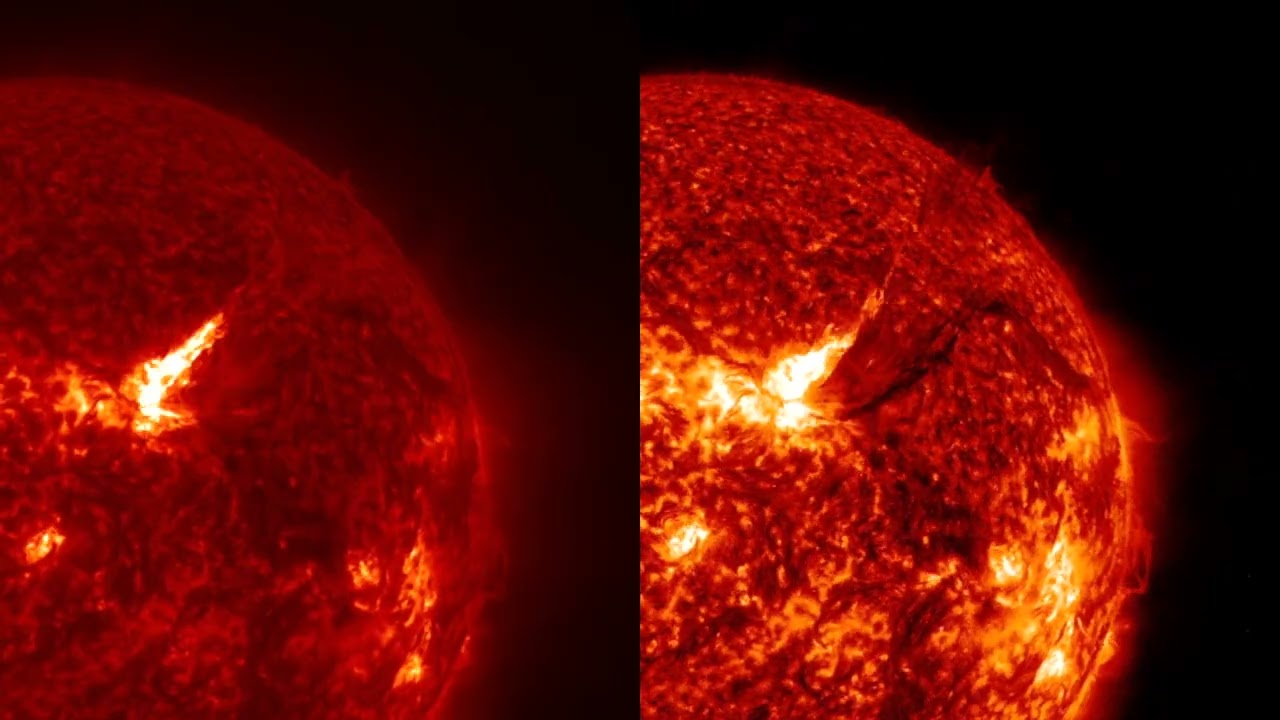
Solar Flares and CMEs at Earth - More Likely | S0 News June.3.2026
SpaceWeatherNewsS0s
2K views•2026-06-03



