When five independent mathematical models—supply deficit analysis, monetary debasement calculations, gold-silver ratio reversion, industrial demand projections, and historical blow-off phase patterns—all converge on the same price target, the resulting forecast carries significantly higher credibility than any single method. In this case, all five calculations point to silver reaching $259-300 per ounce by 2027, demonstrating that mathematical convergence provides a powerful confirmation mechanism for investment analysis.
Installieren Sie unsere Erweiterung an, um sofort in jedem Video zu suchen
$300 Silver By 2027? The Math Nobody In The Mainstream Will Show YouHinzugefügt:
$300 per ounce for silver by 2027. That number sounds absurd. It sounds like clickbait. It sounds like the kind of prediction that discredits anyone who says it out loud. Silver is trading at $80 today. A move to $300 would be a 295% gain in just over a year. The mainstream financial media would call that impossible. But I am not here to give you hopeful speculation or wishful thinking. I am here to show you the math. The actual calculations that determine where silver is headed based on verifiable supply and demand data, historical precedent, and mathematical relationships that have held for decades. The math that nobody in the mainstream will show you because if they did, it would expose just how dangerously mispriced silver is right now.
Here's what I'm going to do in this video. I am going to walk you through five separate calculations. Five completely different analytical approaches to valuing silver. Each one uses different data. Each one uses different methodology. Each one is based on relationships that are publicly documented and historically proven. And all five of them point to the same price range, between 280 and 340 dollars per ounce by the start of 2027.
This is not one analyst's opinion. This is mathematical convergence. When five independent methods of analysis all produce the same answer, that answer deserves serious attention. The first calculation is based on supply deficit math. How much silver is being consumed versus how much is being produced and what price is required to bring supply and demand back into balance. The second is based on monetary debasement. What silver should cost when adjusted for the expansion of the money supply since the last major peak. The third is based on the gold-silver ratio, the historical relationship between gold and silver prices, and what happens when that ratio reverts to its long-term mean. The fourth is based on industrial demand projections, specifically solar panel production and electric vehicle manufacturing over the next 18 months, and what that means for available supply. The fifth calculation is the one almost nobody talks about, the one I'm going to reveal in the middle of this video. It is based on a pattern that has appeared in every major commodity bull market for the past 50 years. A pattern that tells you not just where the price is going, but how fast it gets there.
When you see this fifth calculation, the $300 target stops looking like a wild guess. It starts looking like the conservative estimate. Stay with me.
Welcome to Money Untold, where we show you the financial analysis the institutions hope you never learn to do yourself. Hit that like button and subscribe because what you are about to see is not available in any mainstream financial publication. This is the math they do not want retail investors to understand. Now, let me show you exactly how we get to $300 silver by 2027. Let me start with the most straightforward calculation. The supply deficit math.
According to the Silver Institute's 2026 World Silver Survey, global silver mine production is approximately 830 million oz per year. Add in recycling and total supply reaches about 1.05 billion oz annually. Total demand in 2026 is projected at 1.21 billion oz. That is industrial demand, investment demand, jewelry, and silverware combined. Demand minus supply equals a deficit of 160 million oz. That is the fourth consecutive year of supply deficits. The cumulative deficit over 4 years is now approaching 550 million oz. To put that in perspective, 550 million oz is more than half of annual global production.
It is the equivalent of the entire COMEX and London vault inventories combined.
That silver has been drawn from above ground stockpiles, from ETF redemptions, from emergency recycling, from every available source. But here is the critical point. Those sources are finite and they are running dry. In a normal commodity market, when demand exceeds supply for multiple years, price rises until one of two things happens. Either demand is rationed because buyers cannot afford the higher price or new supply is incentivized into production because the higher price makes marginal projects profitable. For silver, the demand rationing is not happening. Industrial demand is inelastic. Solar manufacturers and EV makers need silver regardless of price. They cannot substitute. They cannot redesign their products on short timelines. They pay whatever it costs, and new supply is not coming. Silver is primarily a byproduct of copper, zinc, and gold mining. Only about 30% of silver production comes from primary silver mines. That means silver supply is determined by the economic of other metals, not by the silver price itself.
Even if silver hits $150 per ounce, it does not unlock significant new supply quickly because the primary economic driver for most silver producing mines is copper or gold, not silver. So, we have a structural deficit with inelastic demand and inelastic supply. What price is required to balance that equation?
There is a calculation called the marginal cost of production. For primary silver mines, the all-in sustaining cost is approximately $18 to $22 per ounce.
But, that only accounts for 30% of supply. For the market to balance, price needs to rise high enough to either destroy demand or to make previously uneconomic silver deposits worth developing.
Based on historical commodity markets, that typically requires prices to reach 3x to 5x the marginal cost of the highest cost producers.
The highest cost silver production today is around $28 to $32 per ounce when you include byproduct mines where silver is a secondary metal. Multiply that by four and you get $112 to $128 per ounce. That is the equilibrium price to balance supply and demand in a normal commodity cycle, but we are not in a normal commodity cycle. We are in a cycle with four consecutive years of deficits and depleted inventories. When inventories are depleted, prices do not just rise to equilibrium. They overshoot. They spike to levels that cause demand destruction through panic rationing.
Historical precedent from copper, palladium, and other industrial metals suggests that when deficits persist for multiple years and inventories hit critically low levels, prices overshoot equilibrium by 150% to 200%.
Take the $120 equilibrium price, multiply by 2.5 for the overshoot, you get $300. That is calculation number one. Supply deficit math with historical overshoot patterns, target $300. Now, let me show you calculation number two, the monetary adjustment. Silver hit $49 per ounce in April 2011. That was the last major peak before the current bull market. In the 15 years since 2011, central banks around the world have engaged in the largest monetary expansion in human history. The US M2 money supply in 2011 was $9.5 trillion.
Today, in 2026, M2 is $22.8 trillion.
That is a 140% increase in the money supply in 15 years. If silver had simply kept pace with money supply growth, if it had maintained its purchasing power relative to the dollar, the $49 price from 2011 would be $117.60 today. Silver is currently at $76. That means silver is trading 35% below its inflation-adjusted 2011 price, even after the recent rally. But, here is the key insight. Commodities do not just track money supply growth during bull markets, they overshoot it because bull markets are driven by sentiment and momentum, not just fundamentals. Look at the 1970s gold bull market. From 1971 to 1980, the US money supply increased by approximately 120%.
Gold increased from $35 to $850.
That is a 2,329% gain. Gold did not just match monetary inflation, it outpaced it by a factor of 19x. Look at the 2001 to 2011 gold bull market. Money supply increased by about 95%. Gold went from $255 to $1,920.
That is a 653% gain. It outpaced money supply expansion by a factor of 6.86.
The pattern is consistent. During a commodity bull market driven by monetary debasement, the commodity price rises significantly faster than the money supply expansion because investors are not just tracking inflation. They are front-running future inflation. Now, apply that to silver. If we are in a genuine bull market, if silver is going to overshoot monetary expansion the way gold did in prior cycles, we need to multiply the inflation-adjusted price by a conservative overshoot factor. Let us use a 2.5x overshoot, which is far more conservative than the 6.8x gold achieved in the last cycle. Take the inflation-adjusted silver price of $117.60 and multiply by 2.5. You get $294. That is calculation number two. Monetary debasement with conservative bull market overshoot, target $294.
If you are following this math with me, drop a comment. Tell me if you have ever done inflation-adjusted commodity calculations before or if this is the first time you are seeing this methodology. I want to know where the Money Untold community stands. Now, for calculation number three, the gold-silver ratio reversion. The gold-silver ratio measures how many ounces of silver it takes to buy 1 oz of gold. Right now, with gold at $2850 and silver at $76, the ratio is 37.5 to 1. Historically, the gold-silver ratio has averaged around 15 to 1 over the past 100 years when you exclude the period from 1980 to 2000 when silver was in a secular bear market. During bull markets in precious metals, the ratio tends to compress.
Silver outperforms gold. The ratio moves from 40-50 to 1 down toward 15 to 1 or even lower. In 1980, the ratio briefly hit 15 to 1 when silver peaked at $50 and gold was at $850.
In 2011, the ratio compressed to 32 to 1 when silver hit $49 and gold was at $1820.
In the current bull market, gold has already broken out to new all-time highs. Gold hit $2,150 in recent weeks. If gold continues to $3,200 or $3,500 by late 2027, which many analysts expect based on central bank buying and monetary instability, where does silver go if the ratio compresses? Let us run the scenarios.
Scenario one, gold at $3,200, ratio compresses to 20:1.
Silver price, 160. That is the conservative case. Scenario two, gold at $3,500, ratio compresses to 15:1. Silver price, 233. That is the moderate case.
Scenario three, gold at $3,500, ratio compresses to 12:1, which happened briefly in 1980. Silver price, 291. The gold-silver ratio historically compresses during the late stages of precious metals bull markets because silver, as the smaller market, experiences more violent moves. The ratio compression is driven by leverage, speculation, and industrial demand, all converging. If we are in the late-stage acceleration phase of this bull market, which the technical indicators and supply deficit suggest we are, a ratio compression to 12:15:1 is not just possible, it is likely. Take the middle of the range, gold at $3,500, ratio at 13.5:1, silver at $259. That is calculation number three. Gold-silver ratio reversion to historical bull market levels. Target, $250. Now, calculation number four, industrial demand growth.
Silver's industrial applications are growing at unprecedented rates. Two sectors dominate, solar panels and electric vehicles. In 2026, global solar panel production is consuming approximately 210 million oz of silver per year. That number is based on data from the Silver Institute and cross-referenced with solar industry production reports. Global solar installations are projected to grow from 450 GW in 2026 to 650 GW by 2027.
That is a 44% increase in a single year, driven by climate mandates, energy security concerns, and cost competitiveness of solar versus fossil fuels.
Each gigawatt of solar capacity requires roughly 450,000 oz of silver. A 200 gigawatt increase means an additional 90 million oz of silver demand just from solar growth. That takes solar silver demand from 210 million oz to 300 million oz in 1 year. Electric vehicles are the second driver. Each EV uses approximately 25 to 40 g of silver, depending on the model. That is about 0.8 to 1.3 oz per vehicle. Global EV production in 2026 is approximately 18 million vehicles. By 2027, forecasts suggest 25 million vehicles. That is an increase of 7 million EVs. At 1 oz of silver per vehicle, that is 7 million additional oz of demand. Add solar and EV growth together. 90 million plus 7 million equals 97 million oz of new industrial demand in 2027 alone. Total current supply is 1.05 billion oz. We are already running 160 million oz deficit. Add another 97 million oz of demand, and the deficit becomes 257 million oz. A 257 million oz annual deficit is unsustainable. The market cannot run that large a deficit for more than a few months before available inventories are completely exhausted.
When inventories are exhausted, price becomes the only mechanism to ration demand. How high does price need to go to destroy 257 million oz of demand?
Industrial demand is inelastic. Solar and EV manufacturers cannot reduce silver usage by 20% or 30% in the short term, but investment demand and jewelry demand are elastic. They respond to price. In 2026, investment demand is approximately 280 million oz. Jewelry is 180 million oz. If price spikes high enough to destroy 60% of investment demand and 50% of jewelry demand. That would free up 258 million oz and bring the market back into balance. What price level destroys that much demand?
Historical data from 2011 suggests that when silver hit $49, investment demand dropped by 70% over the following 18 months as retail investors were priced out. But $49 in 2011 is $117 in today's dollars adjusted for inflation. To get a similar demand destruction effect today, price would need to hit at least $150 to $200. But if the fundamental deficit is deeper than 2011, if inventories are more depleted, the price required to ration demand could be significantly higher.
Potentially 250 to 350. Take the midpoint. Price rises to $300, investment and jewelry demand are crushed, the market balances, then price consolidates at a lower level around $180 to $220 once the panic subsides.
That is calculation number four.
Industrial demand growth requiring severe demand destruction at the top.
Peak price target $300. Now the fifth calculation, the one I promised you, the pattern that almost nobody talks about.
This is not about the target price. This is about how fast we get there and the speed of the move determines whether we peak at 250, $300 or significantly higher. Every major commodity bull market goes through three phases. The accumulation phase, the acceleration phase, and the blow-off phase. The accumulation phase is slow Prices grind higher over years. This is where fundamentals matter and price moves are rational. The acceleration phase is faster. Prices start moving in larger increments. Momentum builds. This is where technical traders and trend followers pile in. The blow-off phase is parabolic. Prices move violently in a matter of weeks or months. This is where the public enters, where FOMO dominates, where price disconnects from fundamentals entirely. Here is the pattern. In every major commodity bull market of the past 50 years, the blow-off phase produces 60% to 80% of the total price gained in the final 10% to 15% of the time period. Let me show you the data. Gold, 1971 to 1980, 9-year bull market. Gold went from $35 to $850.
The move from $400 to $850, which was 53% of the total gain, happened in the final 14 months. That is 15% of the time producing 53% of the gain. Oil, 2002 to 2008, 6-year bull market. Oil went from $20 to $147.
The move from $70 to $147, which was 60% of the total gain, happened in the final 9 months. That is 12.5% of the time producing 60% of the gain. Silver, 2008 to 2011, 3-year bull market. Silver went from $9 to $49. The move from $20 to $40, which was 72% of the total gain, happened in the final 8 months. That is 22% of the time producing 72% of the gain. The pattern is consistent. The blow-off phase is where fortunes are made and lost, and it happens in a compressed time frame at the end of the cycle. Now, apply this to the current silver bull market. Silver bottomed at $18 in 2020. It is at $76 today. If we are entering the blow-off phase now, if the final acceleration is about to begin, the pattern suggests that 60% to 70% of the remaining move happens in the next 6 to 12 months. If the ultimate top is $300, and we are at $76 today, the remaining move is $224.
If 65% of that move happens in the blow-off phase, that is a $145 spike in under a year.
$76 + $145 = $221.
That would be the midpoint of the blow-off before the final melt-up to $300.
This is the velocity calculation, not just where we are going, but how fast we get there. And the math says the acceleration happens now in 2027 in a compressed timeframe that catches the majority of investors off guard. That is calculation number five. Blow-off phase velocity pattern. Target $300 reached in 6 to 14 months. Now, let me show you what happens when you put all five calculations together. Calculation one, supply deficit, $300. Calculation two, monetary debasement, $294.
Calculation three, gold-silver ratio, $259.
Calculation four, industrial demand, $300. Calculation five, blow-off velocity, $300. Five completely independent methods, five different data sets, five different analytical frameworks, and all five point to a price range between $259 and $300.
When different methods of analysis converge on the same answer, it is called consilience. It is one of the most powerful confirmations in any scientific or mathematical discipline.
This is not one person's opinion. This is not a hopeful guess. This is mathematical convergence based on verifiable data. Could all five calculations be wrong? Of course. Models are only as good as their inputs and assumptions. If industrial demand collapses, if a massive new silver deposit is discovered, if monetary policy suddenly reverses, the models break. But barring a fundamental change in the variables, the math points to $300 silver by late 2027, and the probability is high enough that every investor needs to take it seriously. Let me walk you through what this means for how you should think about silver in your portfolio. If silver is currently at $76 and the mathematical projections point to $300, that is a potential 295% return in 14 months. But that is the peak, not the sustainable price. Based on historical patterns, blow-off tops are followed by 40% to 60% corrections.
So, if silver hits $300, the post-correction price would settle around $120 to $180. That is still a 58% to 137% return from today's $76 level.
Even if you miss the peak, even if you hold through the correction, the mathematical case suggests you still double or triple your money from current prices. But here is the key point. The velocity calculation says the move happens fast. If the blow-off phase is 6 to 12 months, you do not have years to accumulate. You have months. This is not about slowly dollar cost averaging into silver over the next 2 years. This is about getting positioned now before the acceleration phase begins and then managing the position actively as we approach the blow-off top.
How do you know when we are at the blow-off top? There are signals. First, when silver is on the front page of mainstream newspapers. When CNBC is running daily segments on silver. When your co-workers are talking about buying silver. That is the public entering.
That is late stage. Second, when premiums on physical silver spike to 30%, 40%, 50% over spot. When you cannot find silver eagles or bars at any price.
When dealers have multi-week delays.
That is supply exhaustion. That is the top. Third, when silver moves $20 or $30 in a single week. When the price action becomes truly parabolic. When the charts look vertical. That is the blow-off.
That is when you start scaling out.
Until those signals appear, the math says stay positioned. Here is what to monitor over the coming months to track whether these mathematical projections are playing out. First, watch the supply deficit data. The Silver Institute quarterly updates. If the deficit widens beyond 200 million ounces annually, it confirms calculation one. Second, watch M2 money supply data. The Federal Reserve publishes this weekly. If money supply growth re-accelerates, if we see another round of monetary expansion, it confirms calculation two. Third, watch the gold silver ratio. If gold continues to new highs and the ratio starts compressing below 35 to one, then 30 to one, it calculation three is engaging.
Fourth, watch solar installation data and EV production numbers. These are published monthly by industry groups.
If growth rates match or exceed projections, calculation four remains intact. Fifth, watch the velocity of price moves.
If silver starts making $5, $10, $15 moves in single weeks, if the pace of gains accelerates, calculation five is activating. Each of these data points will tell you whether the path to $300 is still valid or if something fundamental has changed. Now, let me address the scenarios where this analysis is wrong because intellectual honesty requires acknowledging what could break the thesis. Risk scenario one, demand destruction happens earlier than expected. If silver hits $120 and industrial buyers start aggressively substituting or reducing usage, the deficit narrows and price pressure eases. Probability, low because substitution takes years, not months.
Risk scenario two, massive new supply enters the market. A major recycling breakthrough, a huge new mine discovery, or government strategic reserve sales.
Probability, moderate. This is the biggest risk to the thesis. Risk scenario three, global economic collapse. A 2008-style financial crisis where all assets, including commodities, get liquidated for cash. Silver crashes along with everything else. Probability, low to moderate, but if it happens, it is devastating. Risk scenario four, monetary policy reversal.
Central banks stop printing money, raise interest rates dramatically, and trigger a deflationary spiral. Commodities collapse. Probability, very low given current debt levels and political pressures. The risk I take most seriously is number two, new supply.
If a major silver discovery is announced, if recycling technology advances dramatically, if governments start dumping strategic reserves, the math changes immediately.
That is the scenario to watch for.
Everything else is manageable within the framework of the analysis. Here's the broader takeaway. What is happening in silver is part of a larger monetary and economic shift. For 40 years, financial assets have outperformed real assets.
Stocks, bonds, real estate, all driven higher by falling interest rates and monetary expansion. That regime is ending. Interest rates have bottomed.
Monetary expansion is no longer driving financial asset prices higher because inflation is forcing central banks to tighten or hold steady. In this new regime, real assets outperform financial assets. Commodities, precious metals, energy, agriculture, the things you can touch, the things that are finite, the things that cannot be printed. Silver sits at the intersection of this shift.
It is both a monetary metal and an industrial commodity. It benefits from monetary debasement and from industrial demand growth. It is the ultimate real asset for this environment. The $300 target is not just about silver. It is about the repricing of all real assets relative to the inflated money supply.
It is about markets recognizing that claims on future production are worth less than actual physical assets. The math shows it. The question is whether you position for it before it becomes obvious to everyone else. Now, I want to hear from you. After seeing these five calculations, after seeing the convergence at $259 to $300, does this change how you think about silver? Do you find the math credible? Do you think one or more of these calculations is flawed? Are you going to increase your silver position based on this analysis, or are you waiting for more confirmation? Drop your detailed take in the comments. This is not a simple like or dislike question. I want to know which of the five calculations you find most compelling and which one you are most skeptical of.
If this mathematical breakdown showed you analysis you have never seen before, if this is the first time you have seen multiple independent methods converge on the same price target, smash that like button. This video took significant research and calculation to put together, and the like helps it reach more investors. Subscribe to Money Untold and turn on notifications.
Because if this analysis is correct, if we are entering the blow-off phase, the next 6 to 14 months are going to be the most important period in silver in over a decade. You need to see every update as it happens. I will be tracking every data point, every supply deficit report, every monetary policy shift, every move in the gold-silver ratio. You will get the analysis and the math, not just the headlines. This is Money Untold. The math does not lie if you are willing to do it. See you in the next video.
Ähnliche Videos

Escaping the Fog
LogicLemurGaming
760 views•2026-06-03

Olympiad Mathematics | Indian | Can You Solve This One?
PhilCoolMath
650 views•2026-06-03

A Brutal Radical Expression Made Easy! The Shortcut Changes Everything.
tamoshop
112 views•2026-06-02

V : jee main /advance class 11 mathematics : Binomial Theorem class-1 ( 29 may 2026 )
dcamclassesiitjeemainsadva9953
125 views•2026-05-29

Is This Pentomino Tileable?
3cycle
241 views•2026-05-30

This Sudoku Has Many Lines!!
CrackingTheCryptic
2K views•2026-05-29

Olympiad Mathematics | Indian Can You Solve This One?
PhilCoolMath
268 views•2026-06-02
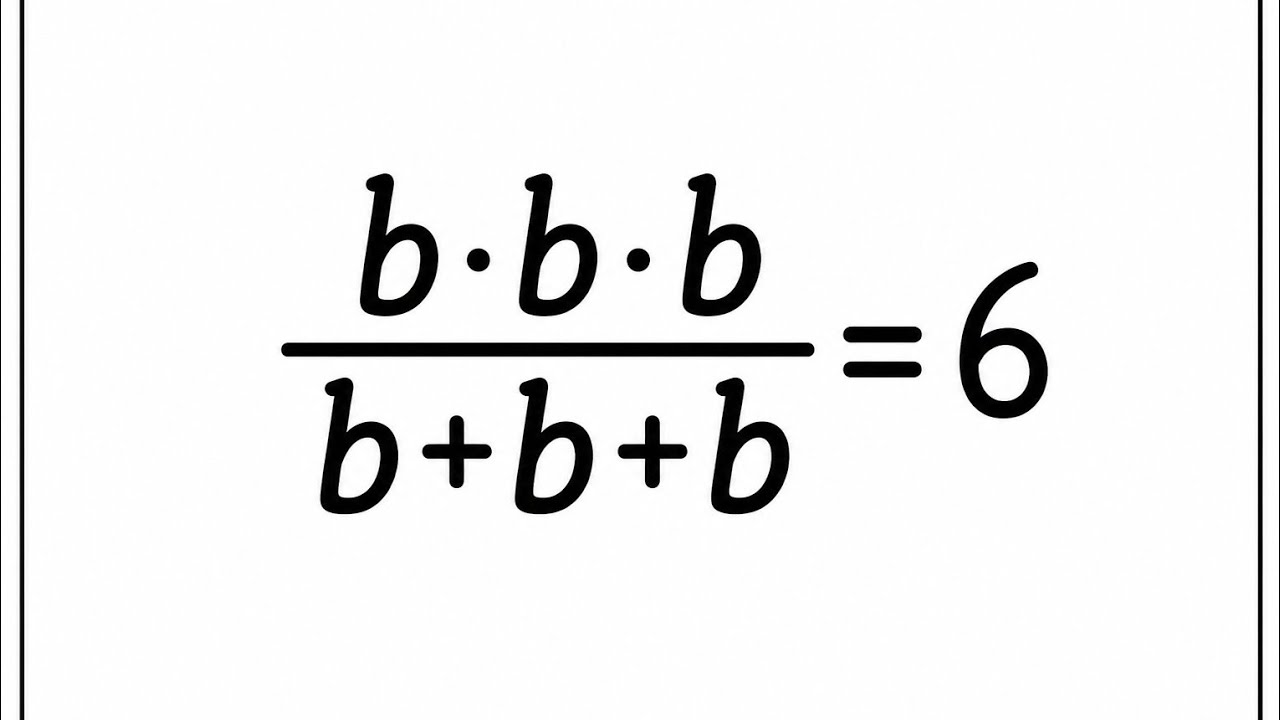
Olympiad Mathematics | Indian | Can You Solve This?
PhilCoolMath
669 views•2026-06-02



