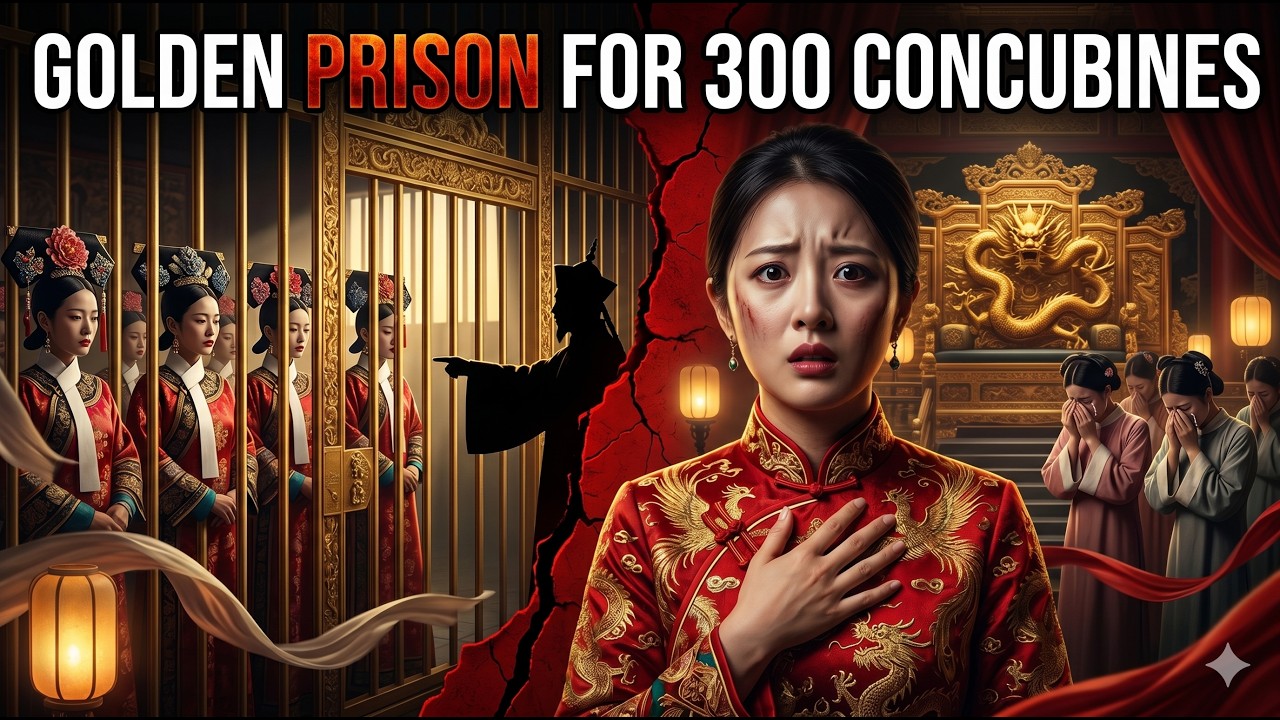
The Ming Dynasty (1368-1644) operated a vast imperial harem system in the Forbidden City where approximately 3,000 women were selected at ages 13-16, most never meeting the emperor and living as virgins for decades. The system employed 70,000 eunuchs who managed the palace and sometimes formed intimate relationships with palace women. Most concubines died forgotten, with their names recorded in administrative ledgers that were largely burned during the dynasty's fall, erasing 40,000-80,000 women from history.
Install our extension to search inside any video instantly.
She Was 14 When the Forbidden City Locked Her In FOREVER | The Dark Truth About 3,000 ConcubinesAdded:
You are 14 years old. Government inspectors show up at your family's door. They measure your height, check your teeth, look at your hands, smell your breath. Your father cannot say no.
Saying no is not an option that exists.
3 weeks later, you are carried through the largest gates you have ever seen.
Gates so tall they block the sun, and they close behind you. You will never leave. Welcome to the Forbidden City.
Population one emperor, and roughly 3,000 women who exist on paper entirely for him. Here is what nobody tells you about that number. Most of those women never met the emperor, not once. They lived inside those walls for decades, performing rituals for a man whose face they would never see, and when they died, often still virgins, their names were recorded in a ledger and then forgotten. This is not a story about luxury. It is a story about what happens when an entire system is built to make women disappear. The Ming Dynasty ruled China from 1368 to 1644.
For nearly 300 years, the Forbidden City in Beijing was the center of the known world. 9,000 rooms, 180 acres, surrounded by a moat and walls 35 ft high. The emperors who lived there were considered the sons of heaven, literally divine. The records that survived, imperial household registers, eunuch administrative logs, the private writings of the very few women who managed to leave accounts, were kept by the people who ran the system, which means they recorded what they wanted to record and buried what they didn't. What got buried was the daily reality of the women inside. We are going to unbury it.
Every few years, the imperial court conducts what is called a selection.
Officials fan out across the empire looking for girls between the ages of 13 and 16. The criteria are specific. No physical defects, good family background, correct height and proportions, pleasant face, calm disposition.
You are selected. Your family does not celebrate. They grieve quietly because they understand what this means.
You are leaving and you are not coming back. In exchange, they receive a title bump, some silver, and the right to tell neighbors their daughter serves the emperor. You travel to Beijing in a convoy with dozens of other girls. You barely speak to each other. At the palace gates, you are processed like cargo, bathed, re-clothed, assigned a number in a register. Your old name is technically still yours, but no one will use it. You are now a palace woman, a gongnu, a concubine candidate, and then you wait. Most of you will wait forever.
Here is where it gets complicated because the Forbidden City was not a single world. It was a pyramid, and where you landed on that pyramid determined everything. At the very top, the empress, one woman, chosen from a noble family, politically powerful, largely untouchable. Below her, the imperial noble consort, then noble consorts, then consorts, then concubines, then beauties, then talented ladies, and then, below all of these ranked titles, thousands of unnamed palace women who received no rank at all. Each tier had different food rations, different sleeping quarters, different clothing allowances, different number of servants. The gap between the top and the bottom was not a step. It was a cliff. If you were selected and assigned no rank, here is your daily life. You wake before dawn. You perform your duties, cleaning, sewing, preparing ceremonial items, waiting in designated courtyards for instructions that may or may not come. You eat two meals a day.
The food is rationed by rank, and your rank is the lowest, so your rations are small. You sleep in a room with 12 other women. The emperor is somewhere in this same complex. You have never seen him.
You will not see him. This is your life for decades. Now, here is the part that the official records phrase very delicately, and that we are going to phrase plainly. On the rare occasions when an emperor chose to spend the night with a concubine, the process was this.
A eunuch presented the emperor with a tray of jade tablets, each engraved with a woman's name. The emperor turned a tablet face down. That woman was then carried to his chambers, carried, not walked, because walking would have allowed time to smuggle a weapon inside clothing. She was wrapped in a robe and physically transported. A senior eunuch waited outside. He recorded the time she entered and the time she left. If she conceived a child, that moment was the most important of her life. The only ladder out of the lower tiers. If she did not conceive, she returned to her courtyard. The chances of being on that tray at all, vanishingly small. The emperor had too many names, too many tablets, too many nights occupied with politics and ritual and illness. Most women never got turned face down. Most women grew old in the courtyard. You cannot understand the Forbidden City without understanding the eunuchs, and you cannot understand the eunuchs without sitting with what that word actually means. Boys, some as young as eight, were castrated, usually by their own families, so they could qualify for palace employment. The operation was called Jing Shen, purification. Families paid for it. It was an investment. A eunuch position in the Imperial Palace was stable government employment with potential for enormous political power.
By the mid-Ming Dynasty, the palace employed roughly 70,000 eunuchs. You cannot make this number up, 70,000.
They were the ones who actually ran the Forbidden City, managing supply chains, controlling access to the emperor, delivering messages, recording births and deaths.
They were also the only men allowed into the inner court where the women lived, which created a dynamic that the official records handle very carefully, and that several scholars have documented more honestly. Eunuchs and palace women were sometimes the only human connection either had. Eunuchs were sometimes called male companions by palace women.
Some relationships were transactional.
Some appear to have been genuinely intimate in ways that the system had not intended to allow and did not know how to categorize. The Ming court had a word for these relationships, dui shi, paired eating, a euphemism so thin you can see through it. Every few generations, a concubine actually climbed. Lady Wan, born around 1428, entered the palace as a servant girl and eventually became the favored companion of the Chenghua Emperor. She was 17 years older than him. The emperor was devoted to her in a way that drove the court into visible panic. She controlled access to him.
She controlled which other women he saw.
When other concubines became pregnant, she arranged for the pregnancies to end.
For years, the court believed the emperor had no heirs because of some mysterious imperial health problem. The problem had a name. The name was Lady Wan, and she was not going to let another woman's child threaten her position.
When she finally died, the emperor wept and stopped eating. He said there was no longer any reason for joy.
He died 8 months later. Lady Wan had no official rank at the start, no family connections.
She made herself indispensable through proximity, patience, and the kind of ruthlessness that the system rewarded and then refused to document honestly.
The court historians recorded her as a corrupting influence, a warning, a bad example. She was also, by any reasonable measure, one of the most powerful people in China for two decades. When an emperor died, the question of what to do with his concubines had several answers across Chinese history, and none of them were good. In the earlier dynasties, the answer was human sacrifice. Concubines were buried with the emperor, alive.
Archaeological excavations of pre-Ming imperial tombs have found skeletal remains in positions that suggest the women were sealed inside and left to die. Some remain had their hands pressed against the walls. The Ming Dynasty officially discontinued this practice, mostly.
The last documented case of concubine burial with an emperor in the Ming period was the death of the Xuande Emperor in 1435.
30 women were selected. They were brought into a room, fed a final meal, and handed white silk. The emperor's son, watching, reportedly wept. One of the women called out to him as she died, asking him to take care of her parents.
He couldn't do anything. He was the crown prince. She was a palace woman.
The system was larger than both of them.
After the burial practice was discontinued, the other option was a lifetime of ritual mourning. Surviving concubines shaved their heads. They wore white. They were moved to a section of the palace called the Palace of Longevity, which sounds peaceful and was not. They spent the rest of their lives in a supervised performance of grief for a man many of them had never actually met.
So, who built this system and why?
The Forbidden City was designed by the Yongle Emperor, who moved the imperial capital to Beijing in 1420.
The architectural logic was explicit.
The palace was a cosmological model, heaven at the center.
The emperor as the axis of the universe.
Everything else, including 3,000 women's lives, organized around that center as a furniture is organized around a throne.
The legal framework that trapped women inside it was the Ming household registration system, the Huji.
Once a woman was registered as a palace woman, her legal identity was absorbed into the imperial household. She had no independent legal existence. She could not own property. She could not bring a lawsuit. She could not send a letter without it being read by a unique first.
The Qing Dynasty that followed kept the system almost entirely intact. The British diplomats who visited in the 1800s described the Forbidden City as a model of civilization. They did not ask what was happening inside the inner courts. The women who died inside those walls between 1420 and 1644, somewhere between 40 and 80,000 of them across the Ming period by historical estimates, had their names written in ledgers that were considered administrative documents, not historical ones. Most of those ledgers were burned during the fall of the Ming. The names went with them. The Forbidden City is still standing. You can buy a ticket today and walk through those 9,000 rooms and photograph the throne room and eat ice cream by the moat. 40 million tourists visit every year. What they are walking through is one of the largest enclosures ever built for human beings.
The women who lived inside it were not imprisoned in any law that used that word. They were simply registered, classified, rationed, and quietly forgotten inside a system so total it did not need locks. History recorded the emperors, their wars, their calligraphy, their poetry, their jade collections.
The women got ledgers. The ledgers got burned. What survives are fragments. A eunuch's administrative note, a concubine's poem scratched onto a wall, a foreign diplomat's offhand observation. The skeletal remains of women buried with emperors whose names we still know. The Forbidden City was built to last forever. It did. The women who filled it were built to be forgotten.
Most of them were. But not all of the ledgers burned and not all the names are gone. And that is the entire reason this channel exists. Animated forgotten lives. See you in the next one.
Related Videos

They Said Flight Was Impossible—Then Two Bicycle Mechanics Changed Everything#wrightbrothers
umars997
526 views•2026-05-30

#SeamansAct1915 #MaritimeHistory #LifeAtSea #BoatShitCrazyX #SaferWorkEnvironment
BoatShitCrazyX
859 views•2026-06-01

Black Women Were Banned From White Suffrage Groups
Peoplediduknow
782 views•2026-05-31

A Volcano Created Frankenstein — And Killed Summer for a Year
TheDarkSideOfSmth
389 views•2026-05-29

Born into slavery in Beaufort
RoadsanRoots
613 views•2026-05-31

50.32 Judah And Israel Split / Jeroboam's False Religion - 2 Chronicles ch. 10-11
smyrnachristianchurchkokomo
107 views•2026-05-29

Iran's Secret Society Wrote the Constitution — Then Got Hanged for It
TheShadowLecture
502 views•2026-05-29
How the Qing Dynasty's Imperial Harem System Actually Worked
HiddenTime360
580 views•2026-05-28



