NASA's CHEOPS mission discovered HIP 67522 b, a Jupiter-sized planet orbiting so close to its young star that its magnetic field interacts with the star's magnetic field lines, triggering solar flares approximately 100 times more energetic than expected. These flares blast radiation directly back at the planet, slowly stripping away its atmosphere and causing it to shrink from Jupiter size to Neptune size over approximately 100 million years. This represents the first observed case of a planet influencing its own star and causing its own destruction.
Install our extension to search inside any video instantly.
NASA Just Found 300 Galaxies That Shouldn't Exist & A Planet Literally Killing ItselfAdded:
What if I told you NASA just found 300 galaxies that literally shouldn't exist [music] and a planet out here actively destroying itself? Yeah, space just got weird. Let's go. In August 2025, researchers using NASA's James Webb [music] Space Telescope spotted 300 objects in the early universe and they are [music] way too bright. Like criminally suspiciously bright. These aren't just regular galaxies. [music] These are candidates from the very beginning of time back when the universe was still in its toddler phase after the Big Bang. Scientists [music] use something called the dropout technique.
Basically, the cosmic version of a disappearing act [music] where objects vanish in blue light but pop up in red. That tells us their light has been traveling for billions [music] of years. If even a few of these 300 objects are confirmed, our entire theory of how galaxies form gets rewritten.
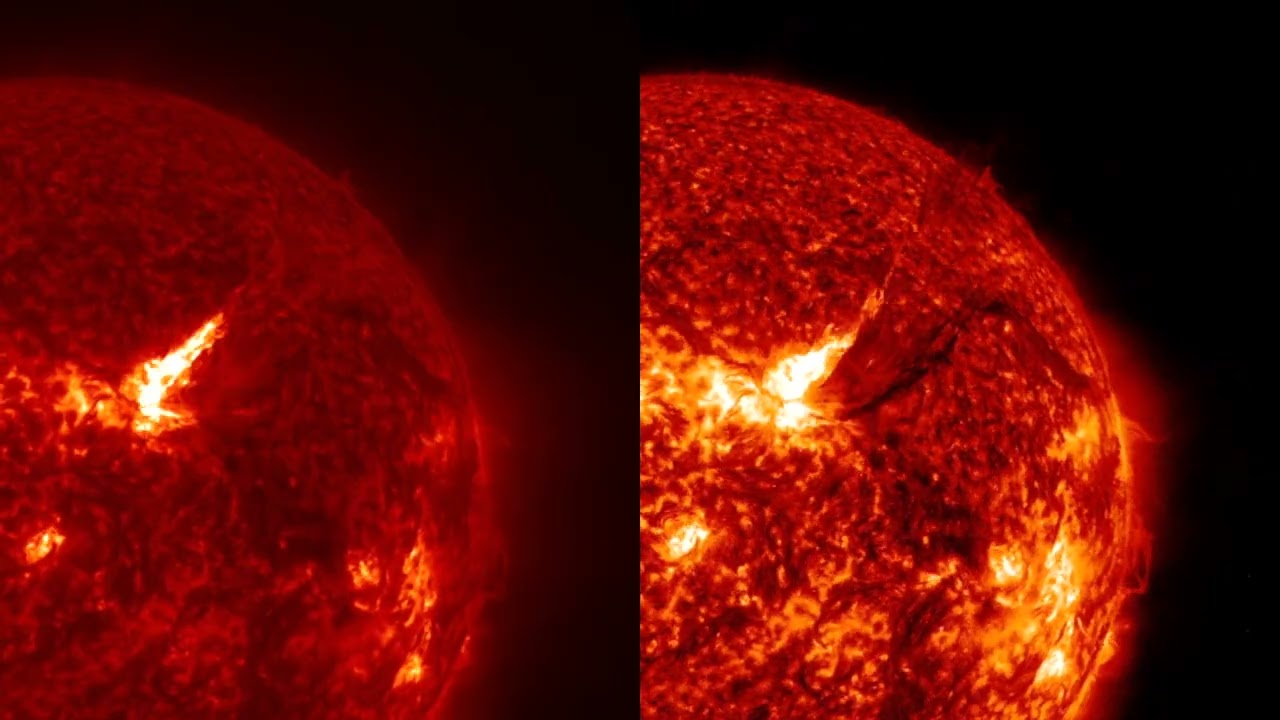
[music] How Jing Yan from the University of Missouri said it best. It could challenge current ideas about how [music] galaxies formed in the early universe. No big deal. just rewriting the history of [music] everything. Now, let's talk about HIPP 67522b, a planet that is, and I'm not exaggerating, triggering its own destruction. ESSA's KOP [music] Space Telescope caught this wild situation in 2025. This planet [music] orbits so close to its young star, completing a full orbit in just 7 days that it magnetic field is actually whipping the stars [music] magnetic field lines like a rope and causing massive solar flares.
Those flares about 100 times more energetic than scientists expected. And guess what direction they fire? Straight back at the planet. The planet is the size of Jupiter, but has the density of candy [music] floss. Basically cosmic cotton candy. So all that radiation is slowly blasting its [music] atmosphere away. In 100 million years, it goes from Jupiter size to Neptune size. [music] This is the first time we've ever seen a planet influence its own star, a planet causing its own doom. That's [music] not science, that's drama. So, to recap, Web found 300 galaxies that break [music] physics, and Kios found a planet with an actual death wish. The universe isn't just vast, it's unhinged. [music] If this blew your mind, smash that like button, subscribe, and drop a comment.
What discovery shocks you the most?
[music] I'll see you in the next
Related Videos

Spiral Galaxy NGC 3370 from Hubble | NASA APOD 2025-11-05 #Shorts
galaxygallery
938 views•2026-05-30

SOMETHING inside the SUN is CHANGING
RaysAstrophotography
1K views•2026-06-03

Captured the Blue Moon (with a twist) 🌙✨ #space #bluemoon #telescope
realAstroExplorer
674 views•2026-06-01

There May Be A Giant Hole In The Universe... And We Might Be Inside It | The Cosmic Ledger Entry 015
TheCosmicLedger
145 views•2026-05-31

The Map We Sent to the Stars in 1977 — Why Scientists Now Regret It
TheAncientRecord7
183 views•2026-06-03

10 Planet Where a Black Hole Replaces the Sun
cosmicexplorer-EN
147 views•2026-06-02

Is this a copy of our galaxy? Discover Galaxy M81!
UniverseDocumentaries-cc4mb
995 views•2026-05-31
Solar Flares and CMEs at Earth - More Likely | S0 News June.3.2026
SpaceWeatherNewsS0s
2K views•2026-06-03



