The video successfully transforms dry geological data into a vivid narrative of Mars' aqueous past, bridging the gap between raw science and public imagination. However, the sensationalist framing feels like an unnecessary concession to the attention economy for such profound planetary discoveries.
Install our extension to search inside any video instantly.
NASA's Mars Rover Capture Most Intriguing Shocking 360° Footage of Avanavero Hill - Curiosity LifeAdded:
Hidden within this ancient Martian outcrop are dark erosion-resistant fragments unlike the surrounding rock.
Scientists believe these mineral-rich inclusions may contain iron-bearing compounds, sulfates, or other dense materials shaped by water-driven geochemical activity billions of years ago.
As relentless Martian winds stripped away softer layers, these hardened structures endured.
NASA named this fascinating formation Hata, after Canada's Hata Lake.
Now, join us on a journey across the Martian frontier, where unusual shapes and haunting landscapes hinted a story billions of years in the making.
What you're witnessing is the latest breathtaking 360° panoramic footage captured by NASA's Mars rover in a hilly Martian region known as Au Avanaro.
Right here at the Au Avanaro site, Curiosity used the drill mounted on its robotic arm to collect a powdered rock sample, just one of more than three dozen it has collected over the last decade.
Each sample is carefully analyzed by the onboard lab instruments to uncover the secrets of Mars's ancient past.
This region captured by NASA's Curiosity Mars rover lies within Gale Crater, an ancient basin believed to have hosted lakes long ago.
In this desolate stretch of the Martian landscape, something stands out, something unusual.
Amid sharp layered rock formations and dry red dust, lies a smooth, nearly perfect sphere, unlike anything else around.
Its bluish-gray surface is striking, a strange contrast to the reddish terrain around it.
What is this?
A naturally formed concretion? The remnant of ancient water activity? Or perhaps a meteorite from deep space resting silently on the surface of Mars?
It raises questions and sparks wonder.
>> This intriguing 4K view is stitched together from 127 individual images taken on the 3,509th Martian day of the mission.
It was captured using the rover's mast camera and then color corrected here on Earth to reflect how the scene might look under Earth-like lighting.
This mind-boggling 360° panorama holds the memory of both gentle wind and violent change.
The view not just of Mars, but of a planet that's still alive in its own quiet, alien way.
On Earth, we call this erosion.
On Mars, it's history etched into stone and sand.
>> From this elevated Martian ridge, we look out across a landscape carved by time.
Layered rock, shifting sand, and silent winds that have shaped the planet for eons.
But there at the edge of the frame, a shattered basin calls our attention.
Marked by this white circle, it's more than just a dip in the terrain.
Could this have once held standing water?
A shallow lake?
Or a floodplain sculpted during Mars' wetter past?
Now shift your focus here, near the edge of the ridge.
A strange figure emerges from the terrain.
Dark, upright, almost sculpted.
It stands out from the jagged rock surrounding it.
Its silhouette oddly [music] mechanical, almost deliberate.
Is it just a curious rock formation?
Or something more?
A remnant from the rover? A meteorite?
Or perhaps something Mars hasn't yet revealed.
On Mars, perception and mystery walk hand in hand.
And [music] every distant shape invites a thousand questions.
>> These tilted layers may once have been part of a massive Martian sand bar formed by sediments carried through a river that flowed into the ancient lake.
>> [music] >> Now we're looking at a quiet Martian slope, untouched, ancient, and eerily beautiful.
The surface is marked with soft rhythmic patterns, ripples in the sand shaped by winds that have blown for millions of years.
These delicate waves, though still today, speak of movement of time.
Above them, jagged layers of sedimentary rock lie like stacked pages of Mars' deep past.
They tell a story of shifting climates, of water that once flowed, and winds that still sculpt.
>> [music] >> Each stratum is a chapter in the planet's watery past, a record of when Mars was alive with rivers, lakes, and flowing sediments long before it became the cold desert we see today.
Between signs of ancient rivers, possible underground water, strange rock formations, and Martian anomalies, one thing is clear.
Mars has a past, and we may just be scratching the surface of a shocking truth.
>> [music] >> Here, red arrow points to an even darker void.
Could this be a crack?
Or a sign of ancient stream?
We don't know, but we do know this.
Every strange shadow, every hidden crevice on Mars bring us one step closer to understanding a world that may have once held more than just As we move closer, the mystery deepens.
Notice how the rock slabs form unusually symmetrical lines, straight edges, intersecting planes, almost as if nature had help.
Scientists believe Mars was once Earth-like.
Oceans, lakes, rivers, but these rocks tell a different story.
A story of dramatic shifts, violent erosion, and perhaps abandonment.
This isn't just a scene of Martian surface.
This is whisper from another world.
And every strange formation could be the beginning of [music] the greatest discovery in human history.
>> Now, pay close attention to the screen because what you are about to witness may be one of the most intriguing sights hidden within the red planet's silent terrain.
This next footage shows the mysterious anomaly stands out among the scattered rocks and dust.
>> [music] >> At first glance, it appears to resemble a small humanoid statue.
A figure frozen in time with an outstretched arm as if signaling across the barren landscape.
Could this be nothing more than a natural rock formation shaped by erosion? Or is it a silent remnant of something far more mysterious?
Mars never stops surprising us.
Formations like these challenge everything we know about its past.
Do you think Mars could be humanity's next destination? Share your thoughts in the comments below. And if this video sparked your curiosity, give it a thumbs up and subscribe for more cosmic adventures.
Related Videos

Spiral Galaxy NGC 3370 from Hubble | NASA APOD 2025-11-05 #Shorts
galaxygallery
938 views•2026-05-30

SOMETHING inside the SUN is CHANGING
RaysAstrophotography
1K views•2026-06-03

There May Be A Giant Hole In The Universe... And We Might Be Inside It | The Cosmic Ledger Entry 015
TheCosmicLedger
145 views•2026-05-31

Captured the Blue Moon (with a twist) 🌙✨ #space #bluemoon #telescope
realAstroExplorer
674 views•2026-06-01

The Map We Sent to the Stars in 1977 — Why Scientists Now Regret It
TheAncientRecord7
183 views•2026-06-03

Is this a copy of our galaxy? Discover Galaxy M81!
UniverseDocumentaries-cc4mb
995 views•2026-05-31

10 Planet Where a Black Hole Replaces the Sun
cosmicexplorer-EN
147 views•2026-06-02
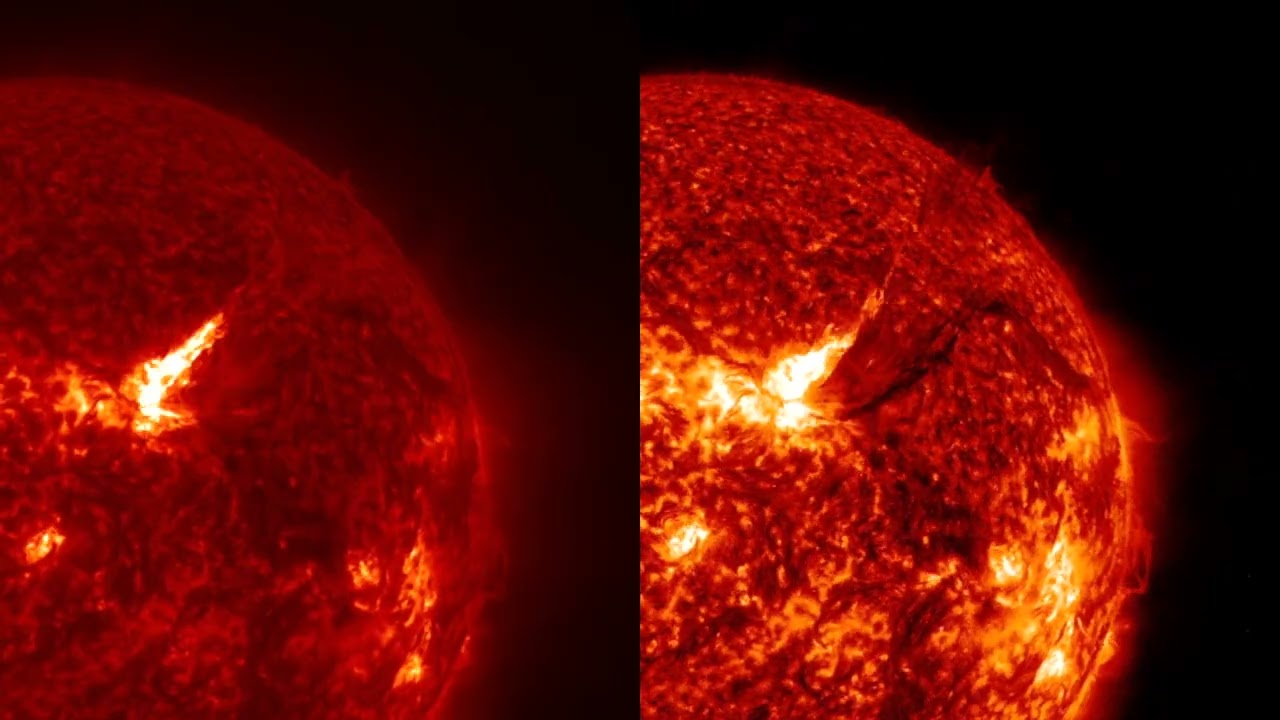
Solar Flares and CMEs at Earth - More Likely | S0 News June.3.2026
SpaceWeatherNewsS0s
2K views•2026-06-03



