Sensationalizing scientific refinement as a "breakdown" is merely clickbait for those who prefer drama over the iterative reality of cosmology. It mistakes a necessary update to our models for a total collapse of established physics.
Install our extension to search inside any video instantly.
NASA Spent $10 Billion to Confirm the Big Bang. James Webb Just Broke It.Added:
NASA spent 10 billion dollars and 25 years building the James Webb Space Telescope specifically to look at the earliest galaxies in the universe and confirm our best model of how everything began.
It is doing the opposite.
The galaxies [music] Webb is finding in the early universe are too big, too developed, and too structured to exist under the timeline the Big Bang model requires.
Not slightly off, not a rounding error, galaxies that should have taken billions of years to form appearing fully assembled within the first few hundred million years after the universe began.
The physicists who built Webb are now publicly using words like crisis and tension and cannot be explained. [music] Those are not words scientists use casually.
Those are words scientists use when the data is breaking the model and they cannot make [music] it stop.
This is not a fringe claim.
This is happening in peer-reviewed journals at major conferences and in the careful, measured language of [music] researchers who spent their careers building the theory that their own instrument is now dismantling.
Here is what Webb found, why it matters, and what it means for everything we thought we understood about where we came from.
The standard cosmological model, called Lambda-CDM for cold dark matter with a cosmological constant, >> [music] >> is one of the most successful scientific theories ever constructed.
It correctly predicts the large-scale [music] structure of the universe, the cosmic microwave background, the abundance of light elements, and the accelerating expansion of space itself.
It has survived decades of increasingly [music] precise observational tests.
The model makes a specific prediction about galaxy formation in the early universe.
In the first few hundred million years after the Big Bang, the universe was a nearly uniform hot plasma.
Slight density variations caused matter to begin clumping under gravity.
Those clumps [music] slowly accumulated into the first stars, which began forming around 400 million years after the Big Bang.
Those stars gradually assembled into small, irregular, dim proto-galaxies.
Those proto-galaxies then merged and grew over billions of years into the massive, [music] structured galaxies we see nearby today.
The timeline is critical.
Large, massive, well-structured galaxies require billions of years to build.
The model does not permit shortcuts. You cannot rush gravity.
Web was designed in part to observe [music] this process, to photograph the early universe and see those first small, chaotic proto-galaxies exactly where the model predicted they would be.
The science team expected to find faint, irregular objects.
They expected the distant universe to look young and primitive.
It does not.
In Web's [music] first deep field images released in 2022, and in every major observational campaign since, [music] the early universe is full of galaxies that are not supposed to be there.
In 2023, a study published in Nature Astronomy analyzed six galaxies Web detected at redshifts between 7.4 and 9.1, meaning we are seeing them as they existed 500 and 700 million years after the Big Bang.
The researchers found that these galaxies have stellar masses comparable to the Milky Way today.
Galaxies that are as massive as our own galaxy, fully formed in a universe that was less than 700 million years old.
The lead researcher described the finding as >> [music] >> too big, too early.
Her exact words in the published paper were that these galaxies challenge our understanding of galaxy formation and evolution in the early universe.
That is extraordinarily restrained language for what the numbers actually say.
The numbers say that under the standard model, these galaxies should not exist.
The matter required to build them had not yet had time to accumulate.
The stars required to give them their mass had not yet had time to form and die and recycle their material into new stellar generations.
The gravitational mergers required to assemble their structures had not yet had time to occur.
And yet there they are.
In image after image from the most powerful telescope humanity has ever built, the early universe looks less like a construction site and more like a finished city.
What that means for our understanding of the universe, the timeline is wrong or the physics is wrong or both.
The impossible early galaxies are not the only problem Webb has created for standard cosmology.
They arrived on top of a crack in the model that was already there.
The Hubble tension is the name physicists give to a disagreement that has been growing for a decade between two independent ways of measuring how fast the universe is expanding.
The expansion rate, called the Hubble constant, determines the age and size of the universe and is one of the most important numbers in all of physics.
When you calculate the Hubble constant from the cosmic microwave background, the afterglow of the Big Bang, measured in exquisite detail by the Planck satellite, you get one number.
When you measure it directly from nearby supernovae and variable stars, using physical rulers to calibrate distances in the local universe, you get a different number.
The two numbers disagree by approximately 8 to 10%. And that gap [music] has not closed as measurements have become more precise.
It has widened.
Web was partly intended to [music] resolve this tension by providing more precise measurements of the local distance ladder.
It did the opposite.
Web's measurements of Cepheid variable stars, the standard candles used to calibrate cosmic distances, have confirmed, and in some cases sharpened, the discrepancy rather than resolving it.
Two independent measurement methods using completely different physics are giving different answers for the expansion rate of the universe.
Under the standard model, this should not be possible.
Either one of the measurement methods has an unknown systematic error, or the standard model is missing something fundamental about how the universe expands.
The model's defenders argue for the first possibility.
The data keeps pushing toward the second.
Here is what is actually at stake if the standard cosmological model needs revision.
Lambda CDM is not just a description of how galaxies form.
It is the framework that gives us the age of the universe, 13.8 billion years.
And that age is built into everything.
The timeline of stellar evolution, the predicted abundance of elements, the structure of the cosmic microwave background.
Every piece of cosmological data we have has been interpreted through this framework.
If the model is wrong about galaxy formation timelines, it may be wrong about other things, too.
The age of the universe might be different than we calculated.
Dark energy, the mysterious force driving the accelerating expansion of space, might behave differently than the cosmological constant assumes.
Dark matter, which makes up roughly 27% of the universe's total mass energy content, might have different properties than cold dark matter models predict.
None of this means the Big Bang did not happen.
The evidence for an initial hot dense state is overwhelming and is not threatened by these findings.
What is threatened is the specific model, lambda CDM, that describes what happened after the Big Bang and how the universe evolved from that initial state to what we observe today.
The difference matters.
The Big Bang is the event.
Lambda CDM is the theory of everything that followed.
Web is finding that the theory of everything that followed may need significant revision.
And here is the uncomfortable part that the popular science coverage tends to smooth over.
We do not yet have a replacement.
There is no fully developed alternative cosmological model that explains the impossible early galaxies, resolves the Hubble tension, and preserves the successful predictions of lambda CDM simultaneously.
Researchers are working on modifications, alternative dark energy models, different assumptions about how dark matter behaves, scenarios involving early universe phase transitions, but none of them have yet produced a complete picture that fits all the data.
We are, at this moment, in the interval between the old model not working and the new model not yet existing.
It is worth being precise about the language researchers are using because the gap between what the data says and what makes it into public statements is significant.
In private conversations at conferences, in the acknowledgement sections of papers, and in the careful qualifications of interviews, the physicists working with Webb data are saying things they would not have said 5 years ago.
Allison Kirkpatrick, an astronomer at the University of Kansas who has studied the early galaxy population extensively, said in a 2023 interview that she was having an existential crisis about the early galaxy findings.
That is not language a tenured cosmologist uses lightly.
Ivo Labbe, the lead author of the Nature Astronomy paper analyzing the six anomalously massive early galaxies, has described the findings as sitting right at the edge of what seems possible under the standard model.
His team's paper used the phrase "number densities that challenge current galaxy formation models", which in the careful language of academic cosmology is the equivalent of saying the model appears to be broken.
Mike Boylan-Kolchin, a theoretical cosmologist at the University of Texas, published an analysis in 2023 calculating the probability that early galaxies as massive as Webb is finding could exist under Lambda-CDM.
His conclusion was that some of the candidate galaxies represent a five-sigma tension with the standard model.
Five-sigma is the threshold physicists use to declare a discovery.
A five-sigma tension with a model means the model is almost certainly wrong about something important.
These are not fringe researchers. These are some of the most prominent scientists in the field using the language of genuine scientific crisis to describe what Webb is showing them.
Here is where we actually stand.
James Webb Space Telescope is working exactly as designed.
Its instruments are performing beyond specification.
The data it is returning is clean, precise, and reproducible.
Webb is doing its job perfectly.
The problem is what that data is saying.
The early universe does not look the way the best cosmological model of the last several decades predicted it would look.
Galaxies that required billions of years to build appear fully assembled within the universe's first few hundred million years.
The expansion rate of the universe stubbornly produces two different answers depending on which method you use to measure it.
The model that correctly predicted so much else is failing to predict these specific [music] fundamental things.
This is how science actually works at the frontier.
Not the smooth narrative of confirmation and progress that gets written in textbooks afterward, but the uncomfortable, slow process of data accumulating against a model until enough weight builds that the model must change.
The data is accumulating. The weight is building.
Web was not built to break the Big Bang Theory. It was built to see deeper into the universe than any instrument before it and return the clearest [music] possible picture of what is actually there.
It is doing that.
The picture it is returning does [music] not match what the theory said would be there.
That discrepancy is not Web's problem.
It belongs to physics.
And physics, unlike our models of it, does not care whether we are ready for the answer.
Related Videos

Spiral Galaxy NGC 3370 from Hubble | NASA APOD 2025-11-05 #Shorts
galaxygallery
938 views•2026-05-30

SOMETHING inside the SUN is CHANGING
RaysAstrophotography
1K views•2026-06-03

There May Be A Giant Hole In The Universe... And We Might Be Inside It | The Cosmic Ledger Entry 015
TheCosmicLedger
145 views•2026-05-31

Captured the Blue Moon (with a twist) 🌙✨ #space #bluemoon #telescope
realAstroExplorer
674 views•2026-06-01

The Map We Sent to the Stars in 1977 — Why Scientists Now Regret It
TheAncientRecord7
183 views•2026-06-03

Is this a copy of our galaxy? Discover Galaxy M81!
UniverseDocumentaries-cc4mb
995 views•2026-05-31

10 Planet Where a Black Hole Replaces the Sun
cosmicexplorer-EN
147 views•2026-06-02
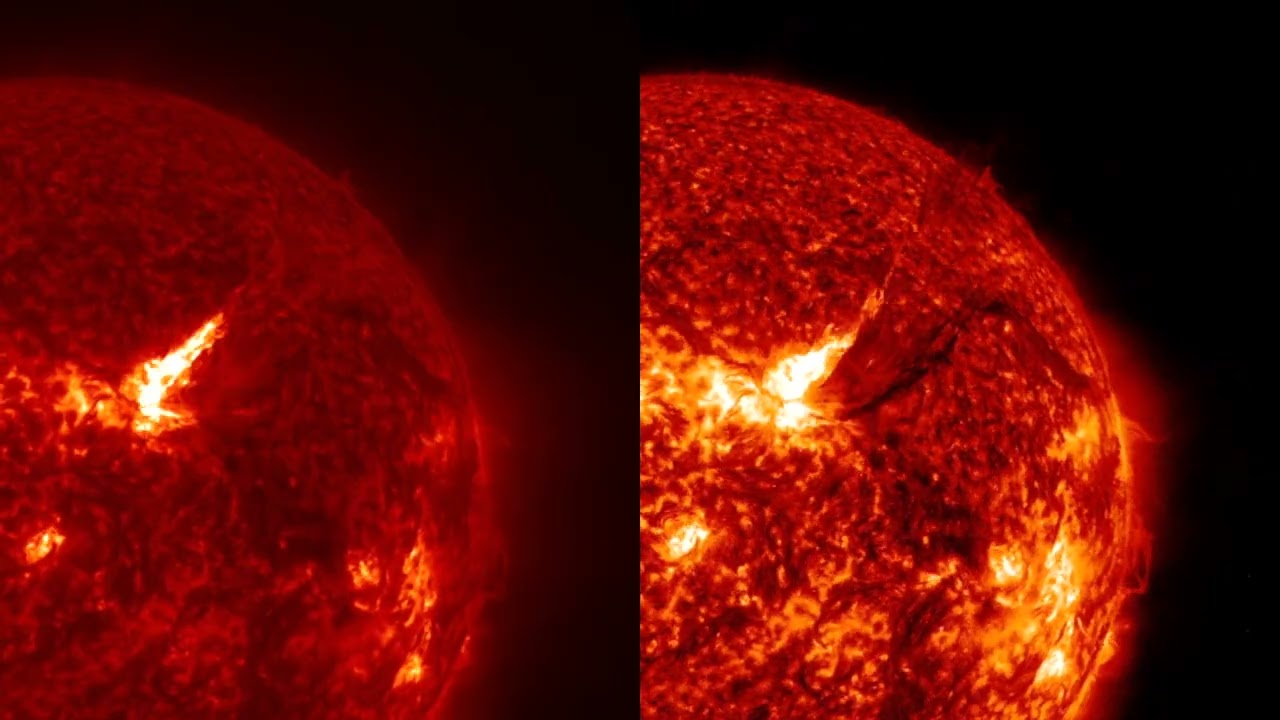
Solar Flares and CMEs at Earth - More Likely | S0 News June.3.2026
SpaceWeatherNewsS0s
2K views•2026-06-03



