Scientists theorize that Earth once had two moons after a giant impact 4.5 billion years ago, when a Mars-sized protoplanet called Thea collided with the young Earth, creating a debris disc that may have formed two satellites; the smaller moon eventually merged with the larger one in a low-energy 'cosmic pancake' collision, explaining the Moon's asymmetric far side, which has a thicker crust (20-30 km) that prevented volcanic resurfacing unlike the near side's thinner crust.
Install our extension to search inside any video instantly.
Did Earth Once Have TWO Moons? The Hidden Truth Revealed!Added:
Look up at the night sky and the story appears simple. One planet, one moon, a stable partnership suspended in darkness. But that simplicity is an illusion. 4 1/2 billion years ago, the early solar system was not orderly. It was violent. A crowded arena of protolanets colliding, fragmenting, and reassembling. In that chaos, something extraordinary may have happened above the molten surface of the young earth.
The moon we know today might not have formed alone. When the Soviet spacecraft Luna 3 transmitted the first images of the moon's far side, scientists were confronted with a mystery. The near side was marked by vast dark plains of solidified lava. The far side was thicker, higher, scarred, almost alien in comparison. Why would a single celestial body have two such radically different faces? Decades later, advanced gravitational mapping and computer simulations introduced a provocative possibility. After the giant impact that formed the moon, Earth may have briefly possessed a second natural satellite, smaller, quieter, and ultimately doomed.
Did two moons once share our sky? If so, what ended their coexistence? And could the evidence still be written across the lunar surface we see every night? To answer these questions, we must return to the birth of the Earth moon system to a collision that nearly destroyed our planet and perhaps created more than one companion.
The day Earth was nearly destroyed.
4 1/2 billion years ago, the solar system was not a finished structure. It was an active construction site, unstable, violent, and crowded with protolanets still competing for dominance. The young Earth had only recently formed, its surface a vast ocean of magma, its rotation far faster than today. Days may have lasted only 5 or 6 hours. There were no oceans, no continents, no atmosphere fit for life.
Into this chaos entered a body roughly the size of Mars, a protolanet scientists call Thea. Its orbit intersected with Earth's. Gravitational interactions made collision inevitable.
This was not a glancing meteor strike.
It was a planetary scale impact.
Simulations suggest the collision occurred at an oblique angle, vaporizing large portions of both bodies. Rock was heated to plasma.
A significant fraction of Earth's mantle was ejected into orbit. Thea itself was largely destroyed. Its iron core merging with Earth's interior, helping to enlarge our planet's metallic core. What followed was not silence, but transformation. The debris did not scatter into deep space. Much of it remained gravitationally bound, forming a dense disc of molten rock and vapor encircling Earth, a temporary ring system glowing against the darkness.
Within this disc, gravity began its slow work. Particles collided, clumped, and accreted. Over time, perhaps within tens of thousands of years, a large body condensed from this material. That body would become the moon. The giant impact hypothesis explains several otherwise puzzling facts. The moon's relatively small iron core, its chemical similarity to Earth's mantle, and the angular momentum of the Earth moon system. But modern computer models suggest something more complex may have occurred. The debris disc was massive. Under the right conditions, it may not have produced just one satellite. It may have produced two. The two moon hypothesis. For decades, the giant impact hypothesis appeared complete. A single collision, a single debris disc, a single moon. The narrative was elegant. But when planetary scientists began running higher resolution computer simulations in the early 21st century, new possibilities emerged. Models developed at institutions such as University of California, Santa Cruz suggested that the debris disc formed after Thea's impact may not have behaved so simply.
In these simulations, the material orbiting Earth did not always condense into one dominant body immediately.
Under certain orbital conditions, a second, smaller satellite could form, roughly 1/3 the diameter of the present moon. This smaller body would not have orbited randomly.
It may have formed near one of Earth's stable gravitational balance points known as Lraange points. specifically L4 or L5. These are regions where the gravitational pull of Earth and the newly forming moon combined with orbital motion create temporary zones of equilibrium.
Objects placed there can remain relatively stable for extended periods.
For millions of years, Earth may have possessed two moons sharing a similar orbital path. The larger body gradually becoming the moon we know today. the smaller one trailing or leading along the same orbit locked in gravitational choreography.
Such arrangements are not theoretical abstractions.
Jupiter hosts Trojan asteroids at its lrangee points. Similar gravitational relationships exist elsewhere in the solar system, but stability at this scale is rarely permanent. gravitational systems evolve. Subtle perturbations from Earth's own tidal forces, from solar gravity, from interactions between the two moons would slowly alter their paths. Dual moon systems around a single planet are inherently delicate. The mathematics suggests that coexistence can persist for millions of years. But over longer time scales, convergence becomes likely. Eventually, the orbits would shift just enough, and when they did, the encounter would not resemble a cinematic explosion. It would unfold at cosmic walking speed.
The lunar far side mystery. For most of human history, the moon appeared symmetrical.
It always presented the same face, a consequence of tidal locking, where its rotation period matches its orbit around Earth. The far side remained unseen, concealed beyond the horizon of speculation. That changed in 1959 when the Soviet spacecraft Luna 3 transmitted the first images of the moon's hidden hemisphere. The photographs were grainy, but the message was unmistakable. The far side did not resemble the near side at all. A hemisphere visible from Earth is marked by vast dark plains known as Maria.
Ancient basaltic lava flows that filled enormous impact basins. These smooth expanses give the moon its familiar pattern. But the far side lacked such seas. Instead, it appeared rugged and densely crated, dominated by highlands.
For decades, this asymmetry puzzled planetary scientists.
Impacts alone could not explain it.
Meteorites strike both hemispheres. Nor could simple cooling patterns fully account for the disparity. The breakthrough came with precise gravitational mapping. Between 2011 and 2012, NASA's Grail orbited the moon in tandem, measuring subtle variations in its gravitational field. The data revealed that the lunar crust on the far side is significantly thicker by roughly 20 to 30 km on average. A thicker crust makes volcanic resurfacing more difficult. On the near side, thinner crust allowed magma from the moon's interior to break through, flooding basins with lava. On the far side, the crust acted as a barrier, preserving the ancient highland terrain. But this raised a deeper question. Why would a single celestial body develop such uneven custal thickness? One explanation involves tidal heating and asymmetric cooling during the moon's early molten phase. Another more provocative hypothesis suggests that the far side may carry the remnants of another body, material accreted during a slow merger with a smaller companion. If true, the rugged hemisphere we never see directly may be a geological scar. The fossilized remains of a lost moon. The cosmic pancake collision. If two moons once orbited Earth, their coexistence would have been temporary. Orbital systems are not static. They evolve under constant gravitational influence. Over millions of years, even slight perturbations can destabilize delicate arrangements.
Simulations suggest that the smaller moon, roughly one-third the diameter of today's moon, eventually drifted from its stable position near a Lrangee point. As gravitational balance weakened, its orbit began to intersect more closely with the larger lunar body.
A crucial detail lies in relative velocity. Unlike high-speed asteroid impacts that generate massive craters, this encounter would have occurred at comparatively low speeds on the order of 2 to 3 km/s.
In cosmic terms, that is slow. The two bodies were traveling in similar orbital paths around Earth, not approaching each other from deep space. The result would not have been catastrophic fragmentation.
Instead, planetary scientists describe it as a low energy accretion event.
Imagine two masses of partially solidified rock meeting without sufficient kinetic energy to shatter one another completely. The smaller body would have deformed upon impact, spreading material across one hemisphere of the larger moon. Rather than excavating a giant basin, it would have added volume, thickening the crust where it adhered. This model helps explain why the lunar far side crust is both thicker and compositionally distinct in subtle ways. It also aligns with gravitational data indicating uneven internal mass distribution. The collision has been described informally as a cosmic pancake, not an explosion, but a gradual merging. The smaller moon did not vanish. It became part of the larger one. If this hypothesis is correct, every time we observe the moon's far side in spacecraft imagery, we are looking at geological remains of a sibling that once shared Earth's sky.
Yet, this was not the only dramatic phase in Earth's early orbital history.
Before the system stabilized, our planet may have briefly worn something even more spectacular.
Rings.
rings around Earth. Long before the Earth moon system stabilized, our planet may have resembled something far less familiar. Not a solitary blue world with a single satellite, but a planet encircled by debris. After the giant impact with Thea, vast quantities of molten rock and vaporized material entered orbit. Much of this debris eventually accreted into the moon. But not all orbital material immediately condenses into a stable satellite.
Inside a critical boundary known as the Ro limit, gravitational forces prevent loose material from clumping into a single body. Within this zone, tidal forces from Earth would have torn apart, forming aggregates, spreading them into a flat rotating disc. For a time, Earth likely possessed rings, not icy like those of Saturn, but composed of silicut rock and metallic fragments glowing with residual heat. From the planet's surface, the sky may have been crossed by a luminous band of orbiting debris.
Such rings are not permanent structures.
Orbital drag, collisions, and gravitational interactions cause particles to spiral inward or clump outward over time. Material beyond the ro limit can accrete into moons.
Material inside gradually falls back to the planet. Mars offers a glimpse of this process in motion. Its moon Phobos is slowly spiraling inward. In tens of millions of years, it may cross Mars's ro limit and disintegrate into a temporary ring before eventually raining down. Earth's rings, if they existed, would have been short-lived on geological time scales, perhaps lasting thousands to millions of years. Over time, gravity simplified the system.
Debris either coalesed into the moon or returned to Earth's surface in prolonged meteoritic showers. The solar system tends towards stability.
Excess companions are merged, ejected, or destroyed. What remains is a cleaner configuration.
But even today, Earth's gravitational reach occasionally captures wandering objects, echoes of a more crowded past.
And some of them stay closer than most people realize, the ghost moons of today. Earth no longer has rings, and it no longer hosts a second large satellite. But it is not entirely alone.
In 1986, astronomers identified an unusual near-Earth object. 3753 Crruth roughly 5 km in diameter. It was initially labeled by media as a second moon. That description was misleading.
Kruth does not orbit Earth in the conventional sense. Instead, it follows a horseshoe shaped path around the sun synchronized with Earth's orbit. From our perspective, it appears to loop around us over centuries, but it remains gravitationally bound primarily to the sun. Profan is what scientists call a quasi satellite, an object sharing Earth's orbital period without being a true moon. Its trajectory is stable and poses no imminent collision threat. It is a gravitational dance partner, not a hidden companion. More intriguing are temporarily captured orbiters. Small asteroids occasionally wander close enough to be snared briefly by Earth's gravity. In 2006, an object designated 2006 RH120 completed several loops around our planet before escaping. In 2020, another small body 2020 CD3 was confirmed to have orbited Earth for years before drifting away. These mini moons are typically only a few meters across. Cosmic visitors rather than permanent residents.
Then there is 469219 Kamo Allea.
Discovered in 2016, this small quasi satellite measures roughly 40 to 60 m across. Spectral analysis conducted in 2021 revealed something unexpected. Its surface composition closely resembles lunar material. One leading hypothesis suggests it may be a fragment ejected from the moon by a past impact. If confirmed, Kamoa would represent a literal shard of our moon traveling alongside Earth, a distant echo of ancient collisions. These objects are not proof of a hidden second moon, but they demonstrate that Earth's gravitational sphere remains active and dynamic. The sky appears stable. The mechanics behind it are anything but.
And even the moon we know so well is not fixed in place. It is slowly, measurably moving away. The moon is leaving. The moon appears constant, fixed against the stars, rising and setting with dependable rhythm. But precision measurements reveal a slow departure.
In 1969, astronauts from the Apollo program placed retroreflectors on the lunar surface. These mirrored panels allow scientists to fire lasers from Earth and measure the return time with extraordinary accuracy. The result is unambiguous. The moon is receding at a rate of approximately 3.8 cm per year.
The cause is tidal friction. Earth's rotation creates tidal bulges in its oceans. Because Earth spins faster than the moon orbits, these bulges are pulled slightly ahead of the Earth moon line.
The moon's gravity interacts with this displaced mass, transferring angular momentum from Earth to the moon. As a result, Earth's rotation gradually slows, lengthening the day while the moon gains energy and moves outward.
This process has been operating for billions of years. Fossilized coral growth patterns indicate that hundreds of millions of years ago, Earth's day was shorter and the moon was significantly closer. In the distant future, billions of years from now, the system will approach tidal equilibrium.
Earth's rotation and the moon's orbit could synchronize, locking both bodies in a mutual gravitational embrace. But long before that, the expanding sun will transform the inner solar system. The critical insight is this. The Earth moon system is not static. It evolves. It always has. If a second moon once existed, its disappearance would have been part of that evolutionary trajectory.
Gravity simplifying what chaos first created. We inhabit a moment of relative stability.
One moon, balanced tides, a steady axial tilt. But that stability is not eternal.
It is the result of ancient collisions and gradual adjustments across cosmic time. And when we look up at the moon tonight, we are not seeing permanence.
We are seeing the survivor of a violent beginning.
What the second moon means for us.
If Earth once possessed two moons, even briefly, the implications extend beyond orbital mechanics. They touch the deeper question of why our planet became habitable at all. The moon plays a critical stabilizing role. Its gravitational pull dampens large oscillations in Earth's axial tilt.
Without that stabilizing torque, computer models suggest Earth's oblquity could vary chaotically over geological time scales, shifting from modest tilts to extreme angles.
Such swings would produce severe climate transitions, destabilizing long-term environmental conditions. Mars, which lacks a large stabilizing moon, experiences far greater axial variation.
Earth's comparatively steady tilt has helped maintain relatively stable climate zones for hundreds of millions of years. Tides are another consequence.
The moon's gravitational pull generates tidal cycles that influence ocean circulation and coastal ecosystems. Some origin of life hypotheses propose that tidal pools alternately flooded and exposed may have provided chemical environments conducive to early biological complexity.
While life's emergence remains an open question, tidal energy unquestionably shaped early Earth's surface chemistry.
If two moons once orbited Earth, tidal patterns would have been more complex and potentially more intense. Such a configuration might have altered early ocean mixing and crustal stresses. Yet, long-term orbital stability likely required simplification. Two large satellites sharing similar orbits would eventually collide or one would be ejected. Stability favored one survivor.
In that sense, the merger hypothesis reflects a broader theme in planetary evolution. Excess bodies are consolidated. Chaos gives way to equilibrium. The moon we see today may carry the geological memory of that consolidation.
A far side thickened by ancient accretion, a surface bearing scars of formation.
Earth did not always have one moon. It may not always have one in the distant future. But in this era, our single satellite represents a balance struck after immense violence. What appears serene in the night sky is the outcome of collisions, gravitational mathematics, and billions of years of adjustment.
The simplicity we observe is the residue of a far more complex beginning.
Related Videos

Spiral Galaxy NGC 3370 from Hubble | NASA APOD 2025-11-05 #Shorts
galaxygallery
938 views•2026-05-30

SOMETHING inside the SUN is CHANGING
RaysAstrophotography
1K views•2026-06-03

Captured the Blue Moon (with a twist) 🌙✨ #space #bluemoon #telescope
realAstroExplorer
674 views•2026-06-01

There May Be A Giant Hole In The Universe... And We Might Be Inside It | The Cosmic Ledger Entry 015
TheCosmicLedger
145 views•2026-05-31

The Map We Sent to the Stars in 1977 — Why Scientists Now Regret It
TheAncientRecord7
183 views•2026-06-03

10 Planet Where a Black Hole Replaces the Sun
cosmicexplorer-EN
147 views•2026-06-02

Is this a copy of our galaxy? Discover Galaxy M81!
UniverseDocumentaries-cc4mb
995 views•2026-05-31
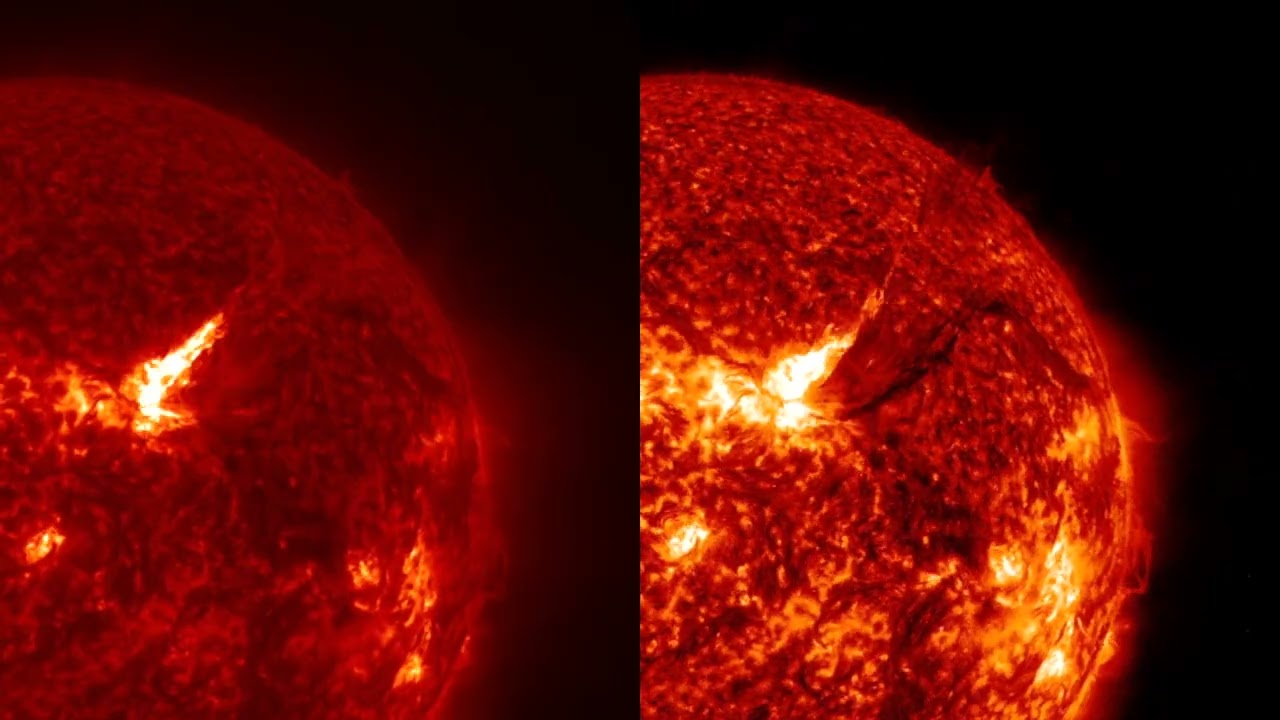
Solar Flares and CMEs at Earth - More Likely | S0 News June.3.2026
SpaceWeatherNewsS0s
2K views•2026-06-03



