Solubility is the maximum amount of solute that can dissolve in a solvent at a given temperature and pressure. The principle 'like dissolves like' explains that polar solutes dissolve in polar solvents (e.g., NaCl in water) while nonpolar solutes dissolve in nonpolar solvents (e.g., oil in benzene). A solution becomes saturated when it cannot dissolve any more solute at a given temperature, and dynamic equilibrium is reached when the rate of dissolution equals the rate of crystallization. According to Le Chatelier's principle, increasing temperature shifts equilibrium toward the endothermic direction (more dissolution for endothermic reactions), while pressure changes have no effect on solid or liquid solutes.
Install our extension to search inside any video instantly.
LOK G LIVE | 6.45 | PUC-II | CHP 1 SOLUTION
Added:Hello.
Hello.
Hello.
Can you hear me?
Take a deep breath.
>> [snorts] [sighs] >> Yes, good morning.
My dear students.
Welcome Deepti. Good morning. Good morning.
Let us continue in the chapter solutions.
The second topic after learning concentration of the solution, let us continue with the second topic.
Second topic that is a solubility.
>> [applause] >> What is meant by solubility? We will try to understand.
Let us see suppose that you take a beaker.
Right?
In one beaker you take water.
In one beaker you take water H2O.
Suppose that you take in another beaker.
In another beaker say benzene.
Right? Benzene.
You try to dissolve.
Take sodium chloride salt.
Right? If you put it in water at given temperature, say room temperature.
And if you shake it well using a glass rod, what do you observe?
Suppose that you dissolve same sodium chloride in benzene. shake it with water, what happens at the given temperature?
Now, your observation is that sodium chloride after some time vanishes.
Vanishes.
Right?
And in in benzene, sodium chloride cannot dissolve, it will settle at the bottom.
Means what? We say that sodium chloride is dissolved in water.
Sodium chloride is not dissolved [clears throat] in water, not dissolved in water, it is a dissolved in water.
Now, what is the meaning of it?
Generally, when a particular substance taken in a small quantity, we say that it is a solute.
Here, solute is A solution consists of two parts, we learned in the beginning only.
This particular solute, this is a solvent.
When you put a solid, let us take solubility.
Of This is a solid, sodium chloride is a solid.
And this water is a solvent is a liquid, solute is solid.
When you take a solid sodium chloride dissolved in water, after some put it in water, after some time, the these particular sodium chlorides do not become visible. Then, we say that sodium chloride is soluble in water.
And we also that sodium chloride is insoluble in benzene.
Why it is insoluble in benzene?
Why it is soluble in water?
For that, there is a principle. There is a principle of solubility. What do you mean by solubility?
Solubility is the maximum amount of the maximum amount of maximum amount of amount of solute dissolved in a solvent solvent at given temperature.
At say constant temperature and pressure.
At constant temperature temperature and pressure because the solubility depends on two factors.
One is called as a temperature and the other one is called as pressure.
They are the factors that affect the solubility. What is the solubility? The maximum amount of the solute dissolved at the dissolved dissolved dissolved in a solvent in a solvent the maximum amount of the solute dissolved in a solvent at constant temperature and pressure or given temperature given temperature and pressure given temperature and pressure.
This is called as solubility.
Whenever you dissolve solute in a say solid solute in a we'll see the solubility of solid in solid in liquid.
Solid solute in a liquid solvent we are going to study the solubility.
Now what [clears throat] happens during this process?
This it is not sodium chloride is not soluble in benzene.
Sodium chloride is not soluble in benzene.
But sodium chloride is soluble in water.
You take oil now.
Oil or you can take a a toluene, any organic substance or oil you can take.
If you add oil to the water, it's a liquid. Oil to the water, oil will oil will not dissolve in water, it will float on the top.
They are separated because oil will be lighter than have density less than water, therefore it floats and the oil is insoluble in water.
But oil will mix with water, benzene.
Why why this happens?
Observe that sodium chloride is there is a principle of solubility.
Solubility is based on the principle.
The principle of solubility in short we can say that like dissolve in like.
Like dissolve in like. What is the meaning of like here?
Like here, see in a solute there are two types of substances. One is called as polar solute.
Polar means sodium chloride is ionic compound.
Ionic compound it has a positive ions and negative ions.
Water is also polar in nature.
What do you mean by polar? Polar means the particular >> [clears throat] >> molecule will have opposite charge centers.
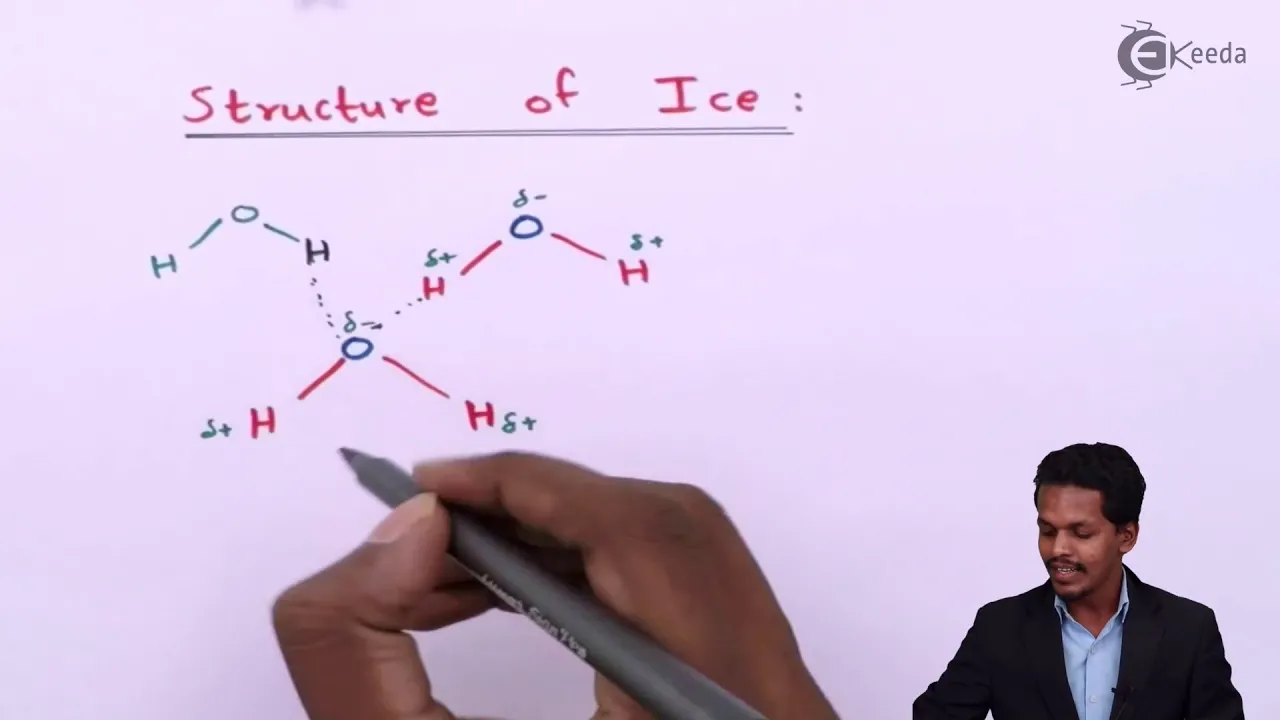
Similarly, water is considered to be polar. How the water is considered as polar? Observe here, oxygen end will have a negative charge.
Hydrogen end will have a positive charge because oxygen is more electronegative, therefore the electrons are pulled shared electrons are pulled more towards oxygen, therefore oxygen end will get a slightly negative charge, hydrogen end end will get a slight positive charge. Therefore, water is a polar solvent. The meaning of like dissolving like is polar solutes can dissolve in polar solvents. Polar solute cannot dissolve in nonpolar. See, benzene this particular benzene is a aromatic hydrocarbon.
You studied in the first year.
And this particular benzene is in liquid state.
C6H6 is the molecular formula. Liquid state. It contains only uh double bond and single covalent bonds. Therefore, it is nonpolar. Most of the organic compounds are nonpolar.
Sodium chloride is polar in nature.
Benzene is nonpolar. Therefore, sodium chloride cannot dissolve with a nonpolar. The meaning is that polar dissolves in polar.
Right?
Polar substance dissolves in polar.
Polar dissolves in polar.
Nonpolar dissolves in nonpolar. That is the meaning of like dissolving like.
Nonpolar dissolves in nonpolar.
Nonpolar.
Means the solute.
You see the solvent.
The meaning is that the polar solute dissolves in polar solute dissolves in polar solvent.
Nonpolar solute nonpolar solute dissolve in nonpolar solvent. That is the principle of solubility.
I hope you understood the principle of solubility.
Sodium chloride dissolves in water because both of them are polar.
Oil dissolves in benzene because both of them are nonpolar. Nonpolar dissolves in non-polar. Polar dissolves in polar is a principle of the solubility. I hope it is clear at you now.
Okay? Now, we'll continue the study.
This concept is clear at to you.
That is polar dissolves in polar and a non-polar dissolves in non-polar. What happens? Let us see the case of case of sodium chloride put in water.
What What What happens inside there?
So, why it vanishes? Where the solute particles went was a big big question for many chemists.
Sodium chloride is a you know that white-colored solid.
Solid.
This solid [laughter] after putting it after some time if you shake it well, it will vanish. Means where they have gone?
Right? So, what happens is this particular solute particles when they are put in water, this particular water will separate the particles.
Means NaCl ions are separated into Na+ Cl- ion.
The positive water molecule This particular Na+ ions are surrounded by negative charge of the water molecule.
So, for that I take this one as a water molecule oxygen and completely surrounded.
Large number of molecules of water with the negative charge center will surround will surround Na+ ion.
Clear? And a large number of water molecules with their hydrogen end Hydrogen end is a negatively positively charged will surround Cl- ion.
Will surround Cl- ion. This will have positive charge.
Partial positive charge. Thus, the Cl- ions and Na+ ions are isolated.
And as a result ions Na+ ion is separated and Cl- ion is separated. This particular process is called as dissolution.
What it is called as? Dissolution.
Dissolution means dissolution means this particular solute particles are completely particles are separated in case of polar and polar separated and now we say that sodium chloride is dissolved in water.
That is the meaning of this particular dissolution.
Right?
Now, if you go on adding more and more solute every every solvent every solvent has got a capacity. Look like each one of us has a capacity to eat.
If I eat two rotis I'll be saturated. After two rotis, if I eat three rotis I will face the indigestion. You get it? So, therefore this every solvent will have certain capacity to dissolve dissolve um solute particles at a given temperature. Therefore, solubility is a depends upon solubility depends upon two factors. One factor is the temperature and the factor is the pressure.
Right? Means at a given temperature and pressure.
Generally, a particular solvent solvent will have certain capacity certain volume of the solvent will have a capacity to dissolve solute in it.
Right? That capacity itself is called as solubility.
Right? And this solubility depends on two factors. One is temperature and the pressure.
Now, during the process what happens is as you go on solving more and more solute the particular solvent which can still dissolve which can still dissolve You add one spoon of sodium chloride, shake it when it dissolve. You add a second spoon of sodium chloride, mix it may dissolve. If you go on dissolving more and more and more solute in it, a stage is reached when what happens is when even if you add more amount of the solute, it will not dissolve. It will be settled at the bottom.
It is called as crystallization.
Observe here.
The solution which can still dissolve still dissolve dissolve solute at a given temperature is called as unsaturated solution. What it is called as?
Unsaturated solution.
These solutions means unsaturated solution will have the solvent which can still dissolve the solvent which can which can still dissolve more amount of the solute still dissolve dissolve >> [cough] >> more amount of solute in it more solute at a given temperature at given temperature at given temperature is called is called what it is called? Is called unsaturated solution. What it is called as? Unsaturated solution. You can open the pen and paper, go on writing.
Writing is very important.
Unsaturated solution. Writing makes you perfect, reading makes you complete.
Don't leave the habit of writing.
Now, what is unsaturated solution?
The solution you can even say the solution which can which can still dissolve more solute at given temperature is called as unsaturated solution.
Very important.
Now, if you go on adding more and more solute a stage is reached when it when these particular crystals of sodium chloride will collide and settle at the bottom, that process is called as crystallization. What it is called as? Crystallization.
Means the crystals will separate out.
They will settle at the bottom.
And then now we say that see, there is a stage is reached even if you add more sodium chloride in it, it cannot dissolve any more solvent any more solute in it, then we say that the solution is said to be what? A saturated solution.
It is called as saturated solution.
What do you mean by saturated solution?
Saturated solution means a solution which cannot dissolve any more solvent solute in it.
You can say saturated solution.
Saturated solution.
What is a saturated solution?
A solution which cannot dissolve solution which cannot dissolve any more cannot dissolve cannot dissolve any more any more solute in it solute in it is called is called as saturated solution.
Saturated solution.
saturated solution See, the solutions are of two types mainly. One is saturated solution, another one is called as saturated unsaturated solution which can dissolve more solute in it, which cannot dissolve dissolve any more solute in it at a given temperature, very important. at given temperature at given temperature or at a constant temperature is called is called is called saturated solution. Means, if you go on increasing the temperature is called a saturated solution.
Okay.
I hope you understood what is saturated solution, what is unsaturated solution.
After reaching the saturation, if you add excess of solute in it, the solute to solute particles will collide themselves and settle at the bottom.
This particular process is called as crystallization.
Then we say that the solution is super saturated. Then it is called as super saturated. When the solution is crosses saturation level, what happens? When you eat more than the requirement, will get vomit, you know, indigestion, vomit.
That is what happens here in super saturated solution.
These particular solute particles will collide between themselves and settle at the bottom. This particular solution is called as super saturated. And this during the process you can expect the crystallization.
What it is called as crystallization.
I hope you understood now.
This particular reaction how the reaction takes place is once this particular saturated stage is reached, this is solvent the solute stuff of that you have taken in this case the solid solute and the solvent solvent is liquid solvent is liquid right? Now the at this particular a stage is reached and at what rate solid solid solute dissolve in solvent to form a solution solution this particular process we call it as a dissolution dissolution right?
And if from the solution excess of excess of when it becomes a super saturated excess these particular solute particles will collide themselves and the reaction will be reversed and these solute particles in it will unite and form the solute back. This particular process is called as crystallization.
is called as crystallization.
At a particular stage both dissolution and crystallization take place at the same rate then we say that this particular solution solution will be the liquid state because solvent is in the liquid state and then we say that it is in a dynamic equilibrium then it is in a dynamic equilibrium is reached.
You know what is the equilibrium state?
dynamic equilibrium Observe. What is the dynamic equilibrium? For what is the forward reaction? Solute when put in solvent it forms a solution is a dissolution forward reaction. What is the backward reaction? When the crystals cross saturation point super saturated yes excess crystals will collide between themselves settle at the bottom this is called as crystallization is backward reaction.
When the both the forward reaction and backward reaction are taking place, initially forward reaction will be very fast.
After some time, backward reaction begins. Means from the solution, crystals are separated. Sodium chloride crystals are separated. The process is called as crystallization. Both these forward as well as the backward reactions are taking place at the same rate.
Means rate of forward reaction rate of forward reaction forward reaction forward reaction become equal to become equal to rate of backward reaction rate of backward reaction backward reaction rate of backward reaction, then we say that that particular process has attained a dynamic equilibrium.
Means both forward and backward reactions are taking place at the same rate. Then we say that this particular situation is said to be dynamic equilibrium.
Right? So, this is a dynamic equilibrium. Once a dynamic equilibrium is reached uh reached uh now we say that this particular solution is in a dynamic equilibrium.
And this equilibrium state, once equilibrium state is reached right? In equilibrium concept uh there is a law called as Le [clears throat] Chatelier's principle.
Le Chatelier's principle Le Chatelier was an industrial chemist.
He gave a principle on equilibrium system. What do you mean by equilibrium system? Our entire body is a equilibrium system.
See, the pH of the blood is always 7.4.
Even though we are lot of changes are taking place, our body is a entire system of equilibrium.
Right? Our body is a will maintain the equilibrium. When our body is in equilibrium, we say that we are healthy.
When the equilibrium is a disturbed, then unhealthiness starts. What is What is illness?
Illness causes whenever equilibrium of the body is a disturbed.
Are you getting me? Then our body will try itself Our bodies will try itself to regain.
Suppose that you feel very much a tired.
If you sleep for 1 hour 2 hours, then at the sleeping hours your body will attain itself adjust itself and come back to the healthy state.
Generally, most of the times we'll be healthy. Once you feel unhealthy means there is a that equilibrium in your body is a disturbed.
That is what Le Chatelier's principle states.
Right?
When a constant means a change in temperature, in the change in temperature, change in pressure, adding solute to it, as adding solvent to it, any disturbance that takes place, right?
Then this particular system will try to attain the equilibrium state back. Means if I increase the temperature, increase the temperature, increase the temperature, the equilibrium will try try to decrease it. Means increase the temperature, equilibrium will try. Suppose that this is in equilibrium at 25° C.
If I increase the temperature, then the system will try to nullify the effect.
Means to bring back to the 25° C. Our human body temperature is always 37° C.
Whenever we get fever, it will cross a 37° C.
Are you getting me? And for that again our body will try to Once all fever are gone, your body will again come to normal body temperature. Means our body is a equilibrium system.
And the average human body temperature is 37°C.
Right? Always the system will try to attain if I increase the if the body temperature is increased, then body will work to decrease it to maintain it at 37°C.
That is what Le Chatelier uh states. We It is states that you can note down those who don't know the statement of Le Chatelier's principle.
Right?
>> [clears throat] >> The equilibrium system when a constraint Constraint means when a constraint he uses the word constraint means variable constraint.
Like constant like a change in change in temperature, pressure, concentration of the solution.
When a constraint such as change in temperature, such as such as such as change in temperature change in a temperature, change in pressure change in pressure pressure or um change in concentration change in concentration of reactant and product change in concentration of reactant and product reactant or product reactant and product, right? The equilibrium system will try to nullify the effect.
The equilibrium system will try to will try to nullify Right? nullify Try to nullify the effect.
And then come back to the equilibrium state. Come back to the equilibrium state.
Come back to the equilibrium state.
That is what is the meaning of equilibrium state. You know, you have to check here.
We check here you know you have to check here.
One the system of equilibrium reach out.
Means at what rate solute are dissolving in solvent to form a solution at the same state at at what rate dissolution is taking place at the rate at the same rate precipitation is taking place. And this such a reaction is called as a reversible reaction.
When both the forward backward reaction are taking [clears throat] place a stage is reached when both of them take place at the same rate. Then we say that equilibrium is reached. When the dynamic equilibrium you see this equilibrium is a dynamic. For an observer for an observer it appears that the reaction is stopped. No, it is not stopped. It is a dynamic. What is the meaning of dynamic?
Two fighters are standing here, right?
They are pushing each other at the very high force.
And for an observer it appears that no nobody is moving but both of them are applying equal force [laughter] to push other.
For an observer it appears that reaction is stopped. That is the meaning of dynamic. Dynamic means for an observer reaction appears to be stopped.
Temperature will remain constant.
Pressure will remain constant.
Concentration will remains constant at the equilibrium.
But for an observer the reaction appears to be stopped. It is not stopped. It is taking place in [clears throat] both forward at the same rate. Therefore, we say that it is not a static, it is not a static Static means stopped. Reaction is not static, it is dynamic.
Such an equilibrium is called as dynamic equilibrium.
I hope you are getting me.
And the what Le Chatelier said is that whenever you disturb whenever you disturb Right? Means whenever you get a problem, then what you do generally in your daily life? You meet some other person to solve that problem.
If you find problem in mathematics, you will go and meet to the mathematics Meet to the mathematics teacher and get it solved. Again, you will come to the normal stress.
Non-stressful stress. If you have got any ill health, then you go to the doctor and balance it again. So, like that whenever this is equilibrium dynamic equilibrium system is a disturbed Le Chatelier says that the equilibrium system to maintain the equilibrium system either the reaction more reaction takes place in the forward direction or more reaction takes place in the backward direction and come back to the equilibrium state. Means it will try to be in the equilibrium state.
If you are not healthy, you are not healthy you feel uneasiness.
Either it takes place in the forward direction or it takes place in the forward backward direction.
Other temperature, other pressure, say 25°C two atmospheric pressure equilibrium temperature 30 >> two atmospheric pressure or equilibrium of 30 degree centigrade either state not temperature is here my dear temperature 30 degree centigrade pressure 30 degree centigrade 30 degree centigrade my dear friend either it takes place in the forward direction or it takes place in the backward suppose not pressure one atmospheric reaction pressure matter two atmospheric means equilibrium state will try to nullify the effect effect when constant such as change in temperature change in pressure change in concentration of reactant or product is applied is applied to a equilibrium system is applied to a is applied to an equilibrium system is applied to equilibrium system the system the equilibrium will try to nullify the effect and come back to the equilibrium state this is the tendency observed by Le Chatelier according to Le Chatelier principle now we will see we have got a dynamic equilibrium now I will write the dynamic equilibrium of a a solution of a solid solute solid solute in liquid solvent means solid in liquid solid in liquid like sodium chloride in water now the solvent now now let me take a a solute solute is in solid state now we have solvent >> [cough and clears throat] >> in state.
I will write the reversible sign.
This is solute solid plus a solvent liquid and this is a reversible process.
Forward reaction is the dissolution, backward reaction is crystallization.
And you will get a solution. This solution will be in which state? This solution will be in the liquid state.
Okay.
Suppose that this particular forward reaction is endothermic. Means uh enthalpy of heat of the products are It is having plus heat.
Whenever you write plus heat on the product side, means that it is exothermic or an endothermic. It is exothermic.
Suppose exothermic.
For example, when you dissolve sodium chloride in water, sodium chloride in water, water right?
And uh suppose that it attained the equilibrium here, you will get the sodium chloride solution. Uh Na+ ions aqua plus Cl- aqua and it will absorb heat energy which is equal to minus 5.45 kJ.
This minus sign indicates it is endothermic. What it is called as endothermic.
Means that much of heat energy is absorbed.
Absorbed.
I will take another example. If you take sodium hydroxide 5.45 kJ per mole that much that much that much of heat energy is absorbed.
Sodium hydroxide solid when it dissolved in water suppose that it attained the equilibrium, then you will get here Na+ aqua plus OH- it will ionize.
It will liberate heat energy of 42 kJ per mole. You go to the laboratory, take a test tube, right?
Take a distilled water in it, add sodium chloride and shake it well and hold the test tube, you feel colder.
You add sodium hydroxide in another test tube, sodium hydroxide in another test tube, and shake it well, you will feel you will feel hotter.
Because dissolution of sodium hydroxide in water is exothermic reaction.
Generally, exothermic reactions are written with a positive sign on the right hand side.
Endothermic reactions are written with a negative sign on the product side.
Now, forward reaction is forward and then dissolution. Forward reaction means dissolution is dissolution is endothermic. Now, we'll see the effect of temperature on the equilibrium system using Le Chatelier's principle. Effect of temperature.
Right?
Suppose that I increase the temperature now.
I increase the temperature of the solution. What happens?
What happens in this case? What happens in this case?
According to Le Chatelier's principle, when I increase the temperature, okay, let me rub this part. Then I I hope you understood these things. I'll rub this so that you can clearly understand.
See, in the first case, effect of temperature on the dynamic equilibrium of a solid solute in a liquid solvent.
The solution will be in liquid state.
And it may be plus or minus heat. I've taken in particular example, sodium chloride when dissolved in water, heat energy is absorbed. Therefore, it is endothermic.
This is endothermic.
Heat energy absorbed.
And sodium hydroxide dissolution in water is exothermic. 42 kJ per mole of heat energy is liberated. Therefore, it is exothermic.
Exothermic.
Means uh heat energy liberated. Heat liberated. Try to understand clearly.
Le Chatelier's principle.
Right? Suppose that I increase the temperature. Temperature increase money there.
Forward reaction in the day. Forward reaction in the It will absorb the heat energy.
In another forward reaction in the It will liberate the heat energy. When I increase the temperature in this case, if the reaction is if the reaction is endothermic if the reaction is endothermic endothermic endo- thermic.
Forward reaction is endothermic.
So, when the temperature is temperature is increased according to Le Chatelier's principle that increased the temperature must be what?
Must be absorbed. Suppose that it is at equilibrium at the 25° C. If I increase the temperature to 50° C, heat it.
Heat the uh heat the test tube.
Heat the test tube containing sodium chloride solution. If I heat it if I heat it, what do you observe? Up to 50° C.
Now, to come back to the equilibrium, whatever increase in the temperature is there, it should be absorbed.
To absorb the heat energy the equilibrium has got only one solution. Either more forward reaction should take place or more backward reaction should take place.
So, what is your guess? When the temperature is increased according to Le Chatelier's principle, to nullify the effect, means excess of 25° C is to be absorbed. Remember, if the forward reaction is exothermic endothermic, backward reaction will be exothermic.
Right? If the forward reaction is exothermic, backward reaction will be endothermic.
Means, during formation of a product, excess amount of amount of heat energy is liberated, same amount of heat energy should be absorbed to give back the reactant.
That is another important rule in it.
Means, in order to nullify the effect, do you think this forward reaction is endothermic means backward reaction will be what?
Exothermic.
Means, excess of to absorb excess of heat energy, excess of heat energy, do you think more dissolution takes place or more crystallization takes place?
Think.
To absorb heat energy, to absorb heat energy, it excess of heat energy, then the forward reaction is endothermic means reaction will take place in the forward direction and nullify the effect.
If the reaction is endothermic, when temperature is increased, to nullify the effect to nullify the effect to nullify the effect in after day Huh? To nullify the effect, huh?
Reaction, more reaction reaction, more reaction takes place.
More reaction takes place.
Takes place.
In a in [clears throat] a in what in such a direction in a such a direction in a more reaction takes place more reaction takes place takes place takes place in a forward direction forward reaction or more dissolution takes place more dissolution takes place more dissolution takes place more dissolution of solute that takes place solute that takes place Are you getting me?
Means equilibrium shifts to what right means effect of temperature is if the reaction is if the dissolution is of a solution is the the solution is forward reaction of the solution is endothermic endothermic like sodium chloride water is endothermic then if if you increase the temperature reaction more dissolution takes place and equilibrium will shift to the right In the second case if the reaction is a if the reaction is a exothermic what do you expect? If the reaction is exothermic or the same endothermic reaction I will finish it first endothermic endothermic reaction Try to understand the concept when the temperature is increased equilibrium shifts to what forward direction forward means from left to right If the temperature is decreased what happens? When the temperature is decreased now you can easily guess when the temperature is decreased suppose that or sodium chloride in water is equilibrium at 25 degrees If I cool it to 10° C, again at to gain gain at 25° C, the reaction should take place what?
Backward reaction. Because forward reaction is endothermic, then backward reaction will be exothermic.
When the temperature is required, the more reaction takes place in backward direction, means more dissolution takes place here.
And here more crystallization takes place.
Crystallization takes place according to which principle? Le Chatelier's principle.
Right? That is the effect of temperature of a solid in a liquid solution. You will be asked, "Explain what is the effect of temperature on a solution of solid in liquid in dynamic equilibrium."
When the temperature is increased, forward reaction is endothermic.
Right? That to nullify the nullify the excess heat, more endothermic reaction should take place. Therefore, equilibrium shifts to right. Equilibrium shifts to right, means more dissolution takes place.
I hope it is clear now.
I hope it is clear now.
Okay?
Now, if the temperature is a decreased, say I cool it to 10° C. Uh Again it to come back to 25° C, backward reaction takes place. Backward reaction takes place. So that more crystallization takes place.
I hope you understood.
Is that clear? That is the effect of temperature. You will be asked, "Effect of temperature, effect of temperature."
I think I made you very clear.
So, effect of temperature on the solubility of a solid in liquid is if the forward reaction endothermic If the forward reaction is endothermic when the temperature is increased right? To nullify the effect, more forward reaction takes place so that heat energy will be absorbed. Again, equilibrium will be maintained.
If the temperature is decreased If the temperature is uh decreased right? Decreased then to nullify the effect, when the forward reaction is endothermic, backward reaction crystallization will be exothermic.
Therefore, when the temperature is increased to to increase the temperature, backward reaction takes place.
That is the effect of temperature. If the reaction is exothermic See, I have given both the examples.
Exothermic.
I have given exothermic reaction here.
Sodium hydroxide dissolved in water, forward reaction is exothermic. We're writing the equation as plus 42 kJ per mole.
Now, can you guess what happens when the temperature is increased?
Temperature is increased.
Temperature is uh decreased.
Now, guess.
If you understood the concept guess it.
If the temperature is increased temperature is increased. If the reaction is exothermic If the reaction is exothermic and temperature is increased, what do you expect?
See, forward reaction is exothermic.
When the temperature is increased, backward reaction will be what?
Endothermic.
Right?
Now, when you increase the temperature to absorb excess of heat energy in case of sodium hydroxide, do you think crystallization takes place or more dissolution takes place?
Backward reaction takes place.
Which reaction? Backward reaction takes place, means more crystallization takes place. More crystallization takes place.
To absorb the increased energy. If the reaction is a solution is a endothermic exothermic sodium hydroxide is exothermic in nature.
If the temperature is decreased, in which direction reaction takes place is forward direction. Why? When the temperature is a decreased for the system to increase the temperature, more exothermic reaction is takes place. Therefore, forward reaction takes place and that is dissolution will takes place more.
This is the effect of effect of temperature >> [clears throat] >> on the dynamic equilibrium of a solution of solid solute in a liquid liquid solvent.
I hope the concept is clear to you.
Okay, fine.
What is the effect of pressure?
What do you think? Effect of pressure?
Pressure?
See, remember effect of pressure.
Effect of pressure.
Generally, the term pressure corresponds to what?
You talk of pressure of what? Only gases. Why?
See, what is the difference between solid, liquid and gases? You try to understand.
I will make you clear.
Right?
I will take a solid sodium chloride here.
I will take a solid crystals of sodium chloride sodium chloride.
I will take a water here.
Water here.
And I will take in a beaker right hydrogen gas.
Here water in a beaker.
What is the difference between solid and liquid and gas?
If you apply more pressure more pressure on it solids cannot compress.
Because already they are very compact closely packed sodium chloride crystals are closely packed water is liquid.
And if you apply pressure on this particular liquid and it will not decrease up to its its volume will not decrease.
Are you getting me? Because according to Boyle's law at a given temperature volume is inversely proportional to pressure.
As you increase the pressure volume should decrease. It is applicable only for what? Gases.
Therefore if the solute is >> [cough and clears throat] >> solid and liquid generally pressure has no effect on it. Pressure has got effect only on what? Gases.
Therefore you can conclude that right? In a solid and liquid solute in a solid in a in a in a in a dissolution in a dissolution of in a solubility can say in solubility in solubility of >> [clears throat and cough] >> solid solute solid solute and liquid solute liquid solute change in pressure change in pressure has no effect.
Change in pressure remember this change in pressure has no effect [clears throat] on it.
No effect on it.
I hope you understood this.
Because so because this effect of pressure is only applicable to the gases.
Only applic- only applicable to the gases.
Clear it to you?
Only applicable to the gases. So therefore, what happens when a gas is dissolved in liquid.
Gas is a dissolved in the solution of a gas in a liquid will see in the next class. The there is a law called as Henry's law. About that we'll discuss in the next class.
That's all for today, my dear students.
Watch Logit channel and >> [clears throat and cough] >> invite your friends. This channel is created to clear the concepts. If your the concepts are not clear, you can ask me again and again.
Right? We'll meet tomorrow with the Tomorrow I think we completed inverse trigonometric function. Be ready to write a test.
Right? Today night only I will send you a question paper of a 20 marks of 45 minutes.
Right? Late night you write it and keep it ready. Early morning at 6:45 I will solve the problem on inverse trigonometric function.
After completing that, I will start matrices.
Okay?
And tomorrow you have maths test.
Remember, I will send you in the WhatsApp group.
And next period we'll continue with the solutions. You make it perfect. Study the textbook and attend the class with the pen and paper. Have notes. Writing is very important. Don't just watch it.
With the pen and paper, watch these classes.
And tonight tonight after late night at 10:00, I will send you the paper, and don't open it. Morning, whenever 45 minutes of time you get, even night also, 45 time, 45 minutes time you get, you study. By 7:30 or by 8:00, I will send you.
I will send you. Between 7:30 to 8:00, I will send you the paper. 45 minutes you write it and keep it ready, and don't copy, and be sincere, and I will be discussing the paper with scheme of evaluation. Then you have to evaluate and send the marks in the group, and I will all [clears throat] your paper photo of the paper and along with the total marks you send.
And that is offline test taken here with followed by discussion.
Right. That's all, my dear students.
Bye-bye. See you tomorrow morning for a discussion of the paper [clears throat] I will send in the evening today.
Tomorrow morning at 6:45. Bye-bye. See you.
>> [cough and clears throat]
Related Videos
5:56
Chemistry
Structure of Ice - Hydrogen - Chemistry Class 11
Ekeeda
50K views•2019-05-06
45:56
Chemistry
2019 O Levels revision - O Levels Combined Chemistry 2018 revision
acescorers3110
646 views•2019-10-29
6:56
Chemistry
Study Organic Chemistry with Lluís: Total Synthesis of Vilmoraconitine
NROChemistry
2K views•2025-01-09
1:08
Chemistry
How to Write the Formula for Tin (II) sulfate
wbreslyn
11K views•2019-02-26
18:46
Chemistry
Why “Chemical-Free” is a Lie | Exposing Chemophobia
PaleBlueThoughts
978 views•2023-10-13

1:55
Chemistry
OCl2 Lewis Structure (Dichloride monoxide)
geometryofmolecules6271
5K views•2022-03-28

3:31
Chemistry
Lets Talk About Peacock Ore! Are Those Colors Natural?!
YeOldeRockShop-com
14K views•2021-03-09
2:42
Chemistry
Use of strontium in daily life
Viveksirmotivation
599 views•2022-01-18
Trending

13:38
Law
WOW! Judge TURNS THE TABLES on Trump in His OWN $10B LAWSUIT!!!
MeidasTouch
197K views•2026-07-23

13:25
Business
Playstation NO DISC/NO BUY Fight Is Over...
DavidJaffeGames
4K views•2026-07-23

22:40
Business
Steam and Xbox Just Dropped The Hammer On PlayStation
OhNoItsAlexx
9K views•2026-07-23

16:52
Anthropology
Americans Confused in Australia for 17 Minutes Straight
IWrocker
17K views•2026-07-23