Cover cropping with legumes like hairy vetch and winter rye can significantly improve soil organic matter and water-holding capacity, helping farmers achieve higher yields during drought conditions without expensive inputs. This practice, documented in USDA literature since 1911 and successfully used by farmers like Walter Voss in the 1930s, was overlooked by extension services until a farmer in financial distress rediscovered it through his father's field journals.
拡張機能をインストールして、あらゆる動画内を即座に検索しましょう
He Was Ready to Quit Farming After Endless Losses — Then One Experiment Changed Everything追加:
October 1971 Pratt County, Kansas The smell hit him before the light did.
That particular mix of wet clay and something underneath it.
Something almost sweet and almost rotten.
That a man learns to read the way others read a face.
Harlan Voss was 61 years old.
He had walked this ground since the age of seven when his father first pressed his palm flat against the dirt and told him to feel what the soil was saying.
That morning, crouched at the edge of his south field in the gray quarter hour before sunrise Harlan pressed both hands into the topsoil and felt nothing he recognized.
The ground was tight as packed sand.
It gave back no moisture.
It smelled like the inside of a concrete building.
He had farmed 640 acres in Pratt County for 34 years.
He had survived the dry summer of 1952 the early frost of 1959 the rust blight that took his neighbor Bud Caldwell's entire wheat crop in 1963.
He knew this land the way a man knows his own handwriting.
What he felt that morning under his palms was not weather damage.
It was something slower and more permanent.
And he had been watching it arrive for 3 years without being able to name it.
The First National Bank of Pratt held a note against the farm for $118,000 restructured twice in the last 4 years.
His yield on winter wheat had dropped from 38 bushels per acre in 1967 to 19 bushels per acre in 1971.
At the current market price of $1.56 per bushel 640 acres of failing wheat returned less than $19,000 gross.
Operating costs ran $24,000.
The difference came from savings, and the savings were nearly gone.
His wife, Lena, kept the books and had not said anything to him about the numbers in 6 weeks.
The silence was its own kind of ledger.
If the 1972 crop failed, the bank would foreclose.
That was not speculation.
Harlan had the letter.
He drove his red 1958 Farmall 450 into town the first week of October to speak with the county extension agent, a man named Gerald Felps, who had held the position for 11 years and who spoke in the practiced, patient voice of a man accustomed to delivering bad news gently.
Felps spread a soil test report across his desk, results from three of Harlan's fields tested in August, and traced a column of numbers with his finger.
The pH had dropped to 5.1 on the south field.
Phosphorus was low.
Potassium was below threshold.
But the number Felps kept returning to was organic matter, 0.8%.
Typical Kansas wheat ground ran between 2% and 4%.
Below 1%, the soil lost its ability to hold water, regulate temperature, or support the microbial activity that unlocked nutrients.
Below 1%, fertilizer washed past the roots before the plant could use it.
"What you've got here, Harlan, is decades of continuous tillage and open-row cultivation with no carbon return," Felps said.
"The organic matter is gone.
You could triple your fertilizer application and it wouldn't help because the soil can't hold it."
Harlan asked what the recommended solution was.
Phelps told him deep till to break up the hard pan layer, apply limestone to correct pH, increase phosphate fertilizer by 40% and wait 3 to 5 years for soil chemistry to recover.
The cost to implement this program across 640 acres was estimated between $9,000 and $12,000 in the first year alone, not counting time or fuel.
Harlan sat with that number for a moment.
He did not have $9,000.
He did not have $2,000.
He asked Phelps if there was any faster way. Phelps said no.
The science was settled.
Soil recovery was a slow process.
At the feed store on Main Street 2 days later, Harlan's neighbor, Roy Fenstermacher, leaned against the counter and asked how the meeting with Phelps had gone.
Harlan told him.
Fenstermacher shook his head and said it sounded like Harlan might want to consider liquidating the north parcels before the bank forced the issue.
Another man at the counter, Dale Krupke, who farmed 480 acres west of town and whose yields had been strong, nodded and said that was probably the sensible move.
He said it without cruelty.
That was almost worse.
Harlan bought a 50-lb sack of mineral supplement for his three remaining cattle and drove home.
He did not speak to Lena that evening.
He sat at the kitchen table after supper and read the extension report again, line by line, and then set it face down on the table and looked at the wall.
If you like quiet, specific stories about real farming and real people.
Subscribe now.
More like this every week.
Three weeks after the meeting with Phelps, Harlan climbed into the attic above the machine shed, a low, hot space under a corrugated tin roof where the heat of the summer still sat in the wood and insulation, and pulled out four wooden boxes his father had stored there before he died in 1958.
He had not opened them in over a decade.
Inside the boxes, under a layer of folded burlap, were notebooks, 41 of them.
His father, Walter Voss, had kept field journals from 1921 through 1956, written in a cramped, precise pencil hand in composition books bought at the hardware store in Medicine Lodge.
Harlan carried the boxes downstairs and began reading.
Walter Voss had not been a formally educated man.
He had attended school through the eighth grade and had learned the rest from watching.
But in those journals, Harlan found something that stopped him mid-page on a Tuesday afternoon in October, 1971.
A sequence of entries from 1934, the worst year of the Dust Bowl, when most farmers in the region had lost everything.
Walter had not lost his crop that year.
He had recorded a yield of 22 bushels per acre on his driest field.
The entries described what he called green manure intervals, deliberately seeding 1/3 of his ground each fall not with wheat, but with a cover mix of hairy vetch and winter rye, turning that cover under in spring to feed the soil before planting.
He had combined this with a practice he called stubble standing, leaving wheat stubble 8 to 10 in tall after harvest, rather than disking it under immediately.
Letting it break wind, trap moisture, and decompose slowly into the surface layer over summer.
Walter had borrowed the idea from a German immigrant named Georg Holster, who had farmed in Comanche County in the 1920s.
Holster had grown up farming in Württemberg, where cover cropping had been standard practice for 300 years.
He had explained to Walter that the soil was not simply dirt.
It was a community of organisms that needed feeding, and that the American practice of taking from the ground without returning anything to it was, in Holster's words, "borrowing from a man who will one day ask to be paid."
Harlan read the 1934 entries three times.
Then he read the entries from 1935, 1936, and 1937, each of which showed the same rotation continuing, and the yield numbers holding steady while neighbors' fields were empty.
The extension office did not recommend cover cropping for dry land wheat in Kansas in 1971.
The prevailing advice was clean tillage, bare ground between crops, maximum fertilizer inputs.
The university bulletins said that cover crops competed for the same moisture that winter wheat needed and were a net negative in low rainfall counties.
Walter's notebook said otherwise.
And Walter's notebooks came from a man who had watched those fields for 35 years and had never written down a word he hadn't measured.
Harlan did not call Phelps.
He did not post a notice at the feed store.
He drove his 1958 Farmall 450 to the Pratt elevator the following Monday and bought 60 lb of hairy vetch seed and 40 lb of winter rye.
The total cost was $31.40.
He paid in cash from the coffee can above the refrigerator.
He seeded 210 acres, 1/3 of the farm, the south field, and the east half of the center parcel with the cover mix on October 14th.
On the remaining 430 acres, he drilled winter wheat as normal.
And on both parcels, when he harvested the marginal wheat stubble in late July, he left the standing residue at 9 in instead of disking it flat.
He told Lena that evening what he had done.
She asked if the extension office had approved it.
He said no.
She looked at him for a long moment across the kitchen table and then nodded once and went back to her book.
November came cold and early that year.
The cover crop on the south field germinated in a sparse thin mat, not the thick stand Harlan had hoped for, but green, visibly alive against the pale stubble around it.
He walked those rows every second morning, boots heavy with frost-wet clay, watching the vetch push its small compound leaves upward in the gray November light.
Roy Fenstermacher drove past the south field one afternoon in December and stopped his truck at the gate.
He stood outside in the cold and stared at the green cover for a moment, then called across to Harlan, who was checking a fence post 50 yards away.
"What in the world are you planting there?"
Fenstermacher said.
"Vetch and rye." Harlan said.
"That's going into your wheat ground."
"Next spring." Harlan said.
Fenstermacher shook his head slowly.
"Harlan, that's competing with your moisture reserve.
You know what the county average rainfall is.
You can't afford a cover crop on that field."
Harlan drove the fence post another 2 in into the ground with the steel driver and did not answer.
Fenstermacher stood at the gate for another moment, then got back in his truck.
He told Dale Krupke about it the following week at the grain elevator, and Krupke said he thought Harlan had finally lost the thread.
Krupke was not unkind about it.
He said it quietly to a small group of men at the elevator scale, and they all nodded with a particular mixture of sympathy and confirmation that communities reserve for a man they have quietly decided is finished.
That winter, Harlan drove to Wichita on a Thursday in February and spent 4 hours at the Wichita State University Library.
He asked the reference librarian for any agricultural journals from before 1940 that dealt with dry land soil management.
She brought him two bound volumes of the Kansas State Agricultural College Bulletin from the 1920s and a slim publication from the USDA Bureau of Soils dated 1911.
He sat at a wooden table under fluorescent lights and read for the entire afternoon.
The 1911 USDA report described organic matter as the primary engine of soil water retention and estimated that each 1% increase in organic matter allowed an acre of soil to hold an additional 20,000 gallons of water.
At Harlan's current organic matter level of 0.8% his soil was operating at roughly 1/5 of its natural water holding capacity.
The mathematics were straightforward.
His drought problem was not a rainfall problem.
It was a soil structure problem.
And soil structure was not fixed with fertilizer.
It was built with biology.
He drove back to Pratt in the dark, the heater fan running loud on the Farmall's flatbed truck.
The fields on either side of the highway white and flat under a quarter moon.
He thought about Georg Holzer who had farmed in Württemberg and then in Comanche County and whose name appeared in his father's notebook exactly once.
A small acknowledgement in a margin.
Holzer showed me this.
He said the Germans learned it from the Romans.
Harlan pulled into the machine shed at 11:00, cut the engine and sat in the dark cab for a moment.
Then he climbed out, latched the shed door and walked across the yard to the house.
He was not confident.
He was simply committed.
Spring 1972 arrived with a dry March that worried every farmer in Pratt County.
Rainfall for the month measured 0.6 inches against a 30-year average of 1.4 inches.
The extension office sent out an advisory noting that subsoil moisture reserves were critically low and recommending that farmers with marginal ground consider reducing their planted acreage to conserve costs.
Harlan received the advisory, read it, and filed it in the box where he kept extension materials.
In April, he terminated the cover crop on the south field by running his 1964 John Deere 4010 green two-tone the cab still smelling of diesel and the rubber floor mat cracked along the driver side through the field with a tandem disc set shallow, 2 to 3 in, slicing the vetch and rye at the crown without inverting the soil.
He left the chopped residue on the surface and waited 10 days.
Then he drilled wheat into the green mulch variety Centurion which his father had also favored.
A hard red winter variety with a short, stiff straw that stood up to wind.
He had never planted into standing residue before.
The drill wanted to plug.
He spent an afternoon adjusting the seed tube spacing and the down force on the press wheels hands black with soil and old grease the April sun already hot on the back of his neck.
Lena brought him a sandwich at noon.
She stood beside the drill and looked at the field and said it looked different from the other fields.
"Smells different, too."
Harlan said.
She looked at him and he looked at her and that was the end of the conversation.
By late May the wheat on the south field stood visibly darker green than the wheat on the neighboring parcels.
Harlan walked it on a morning when the temperature was already 82° at 8:00, and the soil under his boots on the cover cropped ground held a faint resilience, not hard, not spongy, but giving slightly the way good bread gives under a thumb.
The wheat on the north field, tilled clean and drilled bare, was already showing stress color at the leaf tips, the pale yellow-green of insufficient moisture uptake.
He noted the difference in his own journal, one line in pencil, "South field holding color.
North field showing stress.
Moisture difference measurable under foot."
He told no one.
In June, the county recorded its driest month since 1956.
Total rainfall, 1.1 in.
The extension office issued a second advisory predicting below average yields across Pratt County and surrounding areas.
Dale Kropfky lost half his stand on his driest 80 acres to heat stress and stopped it at the roots.
Fenstermacher's west field turned bronze 2 weeks before it was supposed to.
On July 3rd, 1972, Harlan's south field was still green.
He had not told anyone about the father's notebooks.
He had not explained the cover crop system to Phelps or to Fenstermacher or to anyone at the elevator.
He walked those rows in the early morning of July 3rd.
The air already hot and still at 6:00 a.m.
The sky a pale, cloudless white.
And he counted heads on the wheat plants along a measured 30-ft row and did not celebrate and did not stop.
He had also, in February of that year, retained an attorney in Pratt named Marion Driscoll, a quiet, careful man who specialized in agricultural disputes.
He had given Driscoll a copy of the original soil test, the extension advisory, and a letter he had written documenting a conversation with Phelps in October 1971, in which Phelps had advised a remediation program that Harlan could not have financed without borrowing additional money against land that was already mortgaged above its productive value.
The question Driscoll was asked to examine was whether the extension service had a duty to provide lower cost alternatives to farmers in documented financial distress, and whether the failure to mention cover cropping, an established zero-cost practice documented in USDA literature since at least 1911, constituted a material omission.
Driscoll said he would look into it.
Harvest on the south field began on August 11th, 1972, a Saturday.
The morning air smelled of warm grain and dry straw, a clean, almost caramel smell that Harlan had not experienced fully in 3 years.
He climbed into the cab of his 1961 Massey Ferguson 35 combine, red and gray, the serial number worn off the cowling, the reel slightly bent on the port side from a fence post incident in 1968.
At 6:45 in the morning, when the dew had just lifted enough to run, he cut the south field in 8 hours.
That evening, at the Pratt elevator scale, the weight ticket read 31.4 bushels per acre average across 210 acres of cover cropped ground.
The county average for 1972, announced 2 weeks later by the USDA, was 14.6 bushels per acre, the lowest in 11 years due to the June drought.
Harlan folded the weight ticket and put it in his shirt pocket.
He drove the Farmall back to the machine shed and spent 40 minutes greasing the combine header bearings, a task he performed after every harvest on a schedule written on a card tacked inside the shed door.
Then he washed his hands at the outdoor spigot and walked to the house.
Lena was at the kitchen table.
He set the weight ticket on the table in front of her.
She read it.
She did not speak for a moment.
Then she said, "Your father knew."
Harlan said, "He wrote it all down."
She put her hand flat on the table, not on the ticket, but beside it.
And they sat like that for a few minutes in the kitchen that smelled of coffee and the end of summer.
If you're still here, you already know this story is worth finishing.
Subscribe so you don't miss the next one.
Word moved through Pratt County the way water moves through flat ground, slowly, without announcement, finding every low point.
The elevator manager mentioned the number to two farmers who came in the following Monday.
One of those farmers mentioned it to his brother-in-law.
By the third week of August, Dale Krupke had heard the number twice from two separate people and did not believe it either time.
Krupke drove out to the Voss place on a Thursday afternoon.
He knocked on the machine shed door and Harland came out wiping his hands on a rag.
Krupke said he'd heard the yield number and wanted to know if it was accurate.
Harland handed him the weight ticket from his shirt pocket.
Krupke read it.
His face didn't change immediately.
He read it a second time.
Then he looked up at the South Field, which had been cleared and now showed the clean gold brown of cut stubble at 9 in the same the same standing height Harland's father had practiced in the 1930s.
"What did you do different?" Krupke said.
"Cover crop last fall." Harland said.
"Hairy vetch and winter rye."
"Terminated shallow in April."
Krupke stood and looked at the field.
"That's competing with your moisture."
"I know that's what they say." Harland said.
Krupke looked at the weight ticket again.
He said nothing for a long moment. Then he said, "Gerald Phelps told you to deep till and lime."
"He did." Harland said.
Krupke folded the weight ticket carefully and handed it back.
He was quiet for a long time.
Then he said, in a voice that had lost its certainty, "I need to understand how this works."
Harland nodded.
"He said, come back Saturday and I'll show you what my father wrote."
Gerald Phelps received a formal letter from Marion Driscoll's office in October 1972.
The letter documented the October 1971 consultation, the soil test results, the financial position of the Voss farm at that time, and the extension recommendation that had required capital the farm did not possess.
It noted that cover cropping with hairy vetch, a practice documented in USDA bulletin number 417 from 1911, and practiced successfully in Pratt County by at least one farmer continuously since 1934, had not been mentioned as an alternative.
It requested a formal written response from the Kansas State Extension Service regarding its protocols for advising farmers in financial distress.
Phelps received the letter on a Monday.
By Wednesday, he had forwarded it to the district extension director in Hutchinson.
The director forwarded it to the legal department at Kansas State University's College of Agriculture.
The legal review took 4 months.
In February 1973, the Kansas State Extension Service issued a formal written revision to its advisory protocol for southeastern Kansas dryland wheat counties.
The revision added a section titled low input soil recovery alternatives that included cover crop rotation as a recommended first line option for farms with organic matter below 1%.
The revision cited bulletin number 417 and acknowledged that this approach had not been adequately communicated to producers in the region.
It did not name Harland Voss.
It did not need to.
Phelps drove out to the Voss farm in March 1973 alone on a Tuesday afternoon when the cover crop on the south field was just beginning to show its second year growth.
The vetch thicker now, the rye taller, the soil beginning to show a surface tilt that it had not shown in years.
He stood at the field edge for a while without speaking.
Then he said to Harlan, who stood beside him, "I should have known about this.
It was in our own literature."
Harlan said, "Your father didn't show you either."
Phelps looked at him.
"Nobody showed any of us." Harlan said.
"The question is what we do when we find out."
Phelps said nothing to that.
But in the following growing season, he recommended cover cropping to 11 farmers in the county.
Eight of them planted it.
By 1975, the practice was standard in his advisory rotation.
The ripple was not dramatic.
It moved the way all important agricultural knowledge moves, from field to field, from one farm's gate to the next, carried by the kind of conversation that happens when two men stop their trucks on a dirt road, and one says, "What are you doing different on that south 40?"
A young farmer named Ted Schreiber, from the east side of the county, had watched Harlan's 1972 yield from across a fence line.
He was 28 years old, farming 320 acres on a thin margin with a new note at the bank.
And when he heard the number at the elevator, he drove home and thought about it for 3 days.
He knocked on Harlan's door in September 1972 and asked if he could see the notebooks.
Harlan brought him into the kitchen and set all 41 of them on the table and left him alone with them for 4 hours.
He came back to find Schreiber on the last notebook, writing in his own notepad.
His handwriting fast and concentrated.
Schreiber planted cover crops on 160 of his acres in the fall of 1972.
His 1973 yield on those parcels was 28 bushels per acre against the county average of 18.
He paid his note current for the first time in 3 years.
He told two other farmers.
Each of them told one more.
By 1976, seven farms within 12 miles of the Voss place were running hairy vetch and winter rye rotations.
None of them had been advised to do so by the extension office.
All of them had come to it through the chain of conversation that ran back to a Tuesday afternoon in Harland's kitchen and a set of 41 notebooks that Walter Voss had written by lamplight.
Harland was approached in 1974 by a writer from the Wichita Eagle who had heard about the yield numbers through a source at the elevator.
The writer wanted to do a feature piece.
He drove out on a Wednesday morning with a camera and a notepad.
Harland met him at the gate and said he appreciated the visit but did not have time for a story.
He said it without hostility.
The writer sat in his car for a moment then drove away.
When Lena asked why he'd turned the reporter down, Harland said, "The work is what matters.
If the work is right, the work will say it."
She said, "Your father would have done the same thing."
He was greasing the combine header at the time.
He did not stop working.
The knowledge in those 41 notebooks reached seven farms then 20 then more than any of them counted.
Subscribe if you want to hear more stories like this one.
In the fall of 1989, Harlan Voss was 79 years old.
He walked with a slight forward lean that had developed in the last few years.
A slow compression of the years.
But his hands were still capable and his eye for the ground had not left him.
He had handed the primary operation of the farm to his son Dennis in 1985.
Dennis was 44, a careful farmer who had grown up watching his father press his palms into the soil and read it and who had learned to do the same.
On a late October afternoon, the light going gold and flat across the South Field, still cover cropped, still rotated, now in its 18th consecutive year of the system, Harlan walked the fence line with his grandson, a boy of 15 named Paul who had asked to spend the afternoon learning the field.
Paul was the kind of boy who asked specific questions, not because he was trying to impress anyone, but because he genuinely wanted to understand how things worked.
Harlan walked him to the South Field and showed him the cover crop stand, thicker now than it had been in any early year.
The vetch dark and nodulated at the roots with nitrogen-fixing bacteria that had colonized the soil progressively over 18 years.
"Why do we keep doing the cover crop?"
Paul said.
"Dad says yields are good now.
Couldn't we just plant straight through?"
Harlan crouched down and pushed his fingers into the soil surface.
He held a small amount in his palm, dark, moist, granular, with the slight yielding of something that was alive.
He held it out for Paul to feel.
"Your great-grandfather found this out in 1934, when everything else was dying," Harlan said.
"He wrote it down.
I read it, and I tried it.
If we stop doing it, the soil forgets.
If the soil forgets, we forget.
Then somebody has to find it again, and it cost them what it nearly cost me."
Paul held the soil in his hand.
He did not say anything for a moment.
Then he said, "We're keeping it alive."
Harlan said, "We're keeping the record accurate."
He stood back up slowly, and they walked back along the fence line toward the machine shed as the light failed.
The 1958 Farmall 450 stood in the shed, clean and greased, the red paint worn to gray at the high wear points, the footstep, the seat bolts, the throttle lever, but mechanically sound.
Dennis had asked twice about replacing it with something newer.
Harlan had said no, not because of sentiment, but because the 450 was calibrated to the farm's particular row spacing, and recalibrating a newer machine would introduce variables he did not want.
The maintenance log for the 450 hung on a nail beside it, a three-ring binder containing 47 pages of dated entries in three different handwritings, Walter's, Harlan's, and Dennis's.
Paul looked at the binder on his way past it.
He stopped and opened it to the first page.
Walter Voss's pencil entries from 1957, the year before he died.
"Can I read this?" Paul said.
"Take it in the house." Harlan said.
"Bring it back in the morning."
The South Field of the Voss Farm in Pratt County, Kansas, was still in continuous cover crop rotation in the fall of 1989.
The organic matter on that field, tested in 1987, had risen from 0.8% to 3.1% over 15 years.
A change that the soil scientists at Kansas State University later described in a 1991 extension publication as requiring a consistent, patient, biologically driven soil management commitment over a period of at least a decade.
The publication did not mention Harlan Voss.
His father's 41 composition notebooks sat on a shelf in the farmhouse in a wooden box with a fitted lid that Harlan had built in the winter of 1973.
They were not museum objects. They were used.
Paul Voss, in later years, could tell you the page number of the 1934 entry without looking.
The Farmall 450 still started on the first crank.
The soil in Pratt County eventually taught many people what Georg Holster had told Walter Voss in the 1920s.
What Walter had written in a cramped pencil hand and stored in a box for his son to find.
What Harlan had pressed into the ground and confirmed with his own hands in the terrible dry summer of 1972.
The knowledge had never gone anywhere.
It had simply been waiting for a man in enough trouble to go looking for it.
That is almost always how the most necessary knowledge survives.
Not in institutions, not in published guidelines, not in the advice of men who believe the science is settled.
It survives in the specific.
A number written in pencil.
A field walked at first light.
A pair of hands pressed flat against the ground in October.
Reading.
If this story stayed with you, subscribe.
We find the ones the textbooks forgot.
関連おすすめ

Taking $10,000 Cash To Green the Driest Barrio in Bolivia
LeafofLifeEarth
528 views•2026-05-29
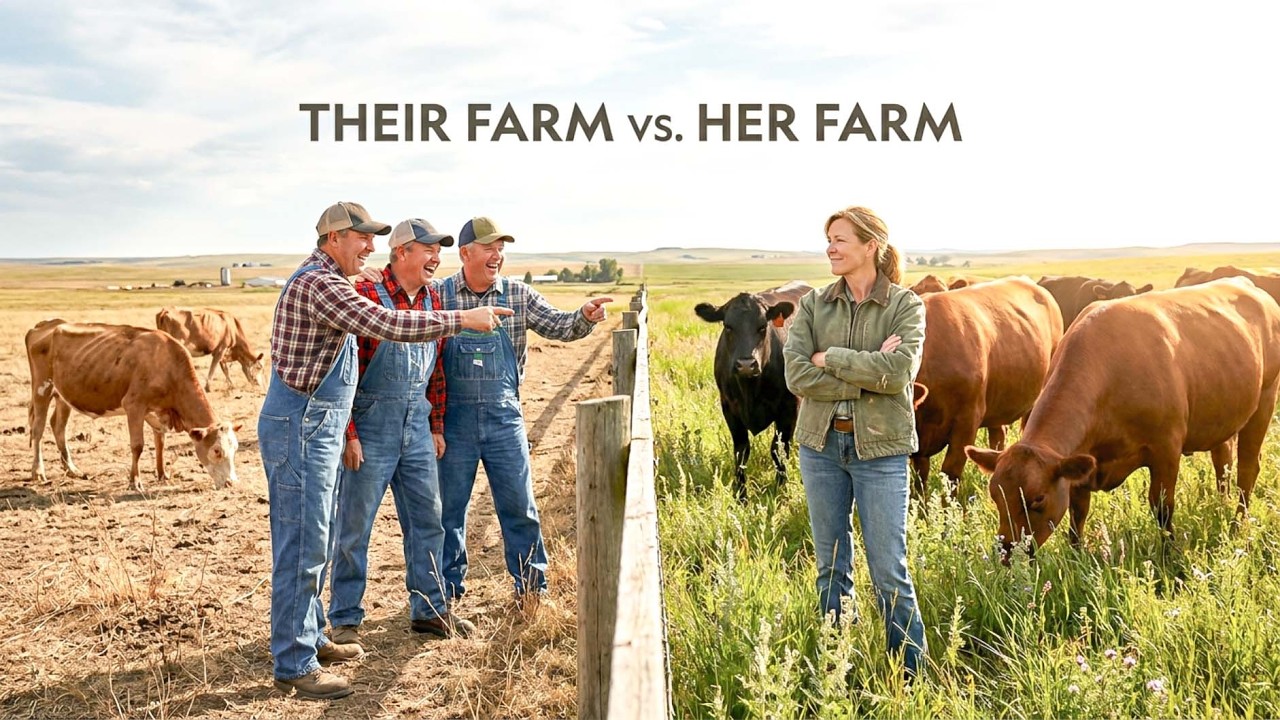
They Laughed When She Let the Weeds Grow Between the Fences — Then Her Cattle Outweighed Every Herd
BackroadHarvest
117 views•2026-05-28

Mozambique RELEASES AFRICA'S MOST DANGEROUS ANIMAL - After 2 Months, The Results Shock Scientists
SimpleDiscovery24
541 views•2026-05-29

The Bay Poisoned by Mercury #shorts
harmedino
289 views•2026-06-01

Calgary Flood Watch Day 4 🚨 Bow River Not Expected to Peak Until Tomorrow
RealtorDhirYYC
103 views•2026-06-01

Cute Seals Spotted On Remote UK Island | Our Tiny Islands
Channel4OnTour
141 views•2026-05-29

This Jamaican Pond Has A Deadly Reputation
MyEyesAreYours-i3s
656 views•2026-05-28

Glowing Blue Powder Turned Brazilian City Into Radioactive Wasteland
Adnan-Sandhu976
637 views•2026-05-31



