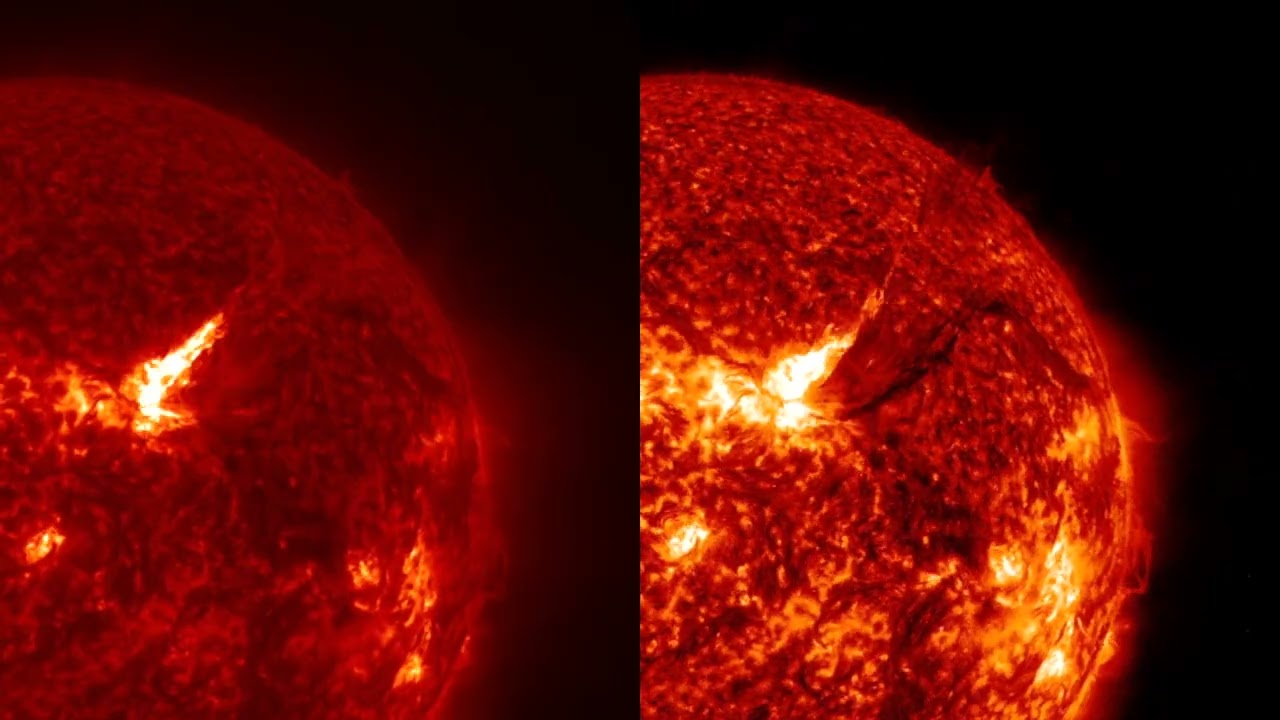
Young, rapidly rotating stars like the 30-million-year-old red dwarf DG CVn exhibit much higher flare activity than the present-day Sun, with flares lasting nearly 20 days and reaching X100,000 intensity—orders of magnitude larger than solar flares. This extreme activity makes planets orbiting such stars more vulnerable to radiation and particle impacts, even though red dwarfs are promising candidates for hosting habitable-zone planets (estimated 40% have super-Earths). The key principle is that stellar rotation rate directly influences flare intensity, and closer planetary orbits increase susceptibility to stellar flare effects.
Install our extension to search inside any video instantly.
The Tiny Star with a Monster Flare (DG CVn) P.2Added:
that a flare event, uh, if you will, that lasted almost 20 [music] days.
This was a very different star than the Sun, so we don't really have to worry about this [music] happening in the present-day Sun. The young Sun, such large events may have occurred. In the [music] present-day Sun, the activity levels are much lower. And fundamental reason that DG CVn [music] is more active than the Sun is that a very young star, 30 million years, it's rapidly rotating. Young stars are born that way, and rapid rotation is one [music] of the key ingredients that powers activity. The faster the rotation, the greater the activity.
While not a threat to us, the massive flares [music] of red dwarf stars can help us better understand the flares produced by our own Sun.
They are also of interest because red dwarf [music] stars are often orbited by planets.
Some data suggest that 40% [music] of red dwarfs have super-Earth-type planets orbiting in a habitable zone where liquid water is possible.
If this is [music] true, then they are good candidates for supporting life.
However, the habitable zone around a cool, dim star [music] like DG CVn is much closer to the star than the Earth is to the Sun.
When planets [music] are closer to their star, they're more susceptible to anything the star does. For instance, if the star flares, uh, the planet [music] is much closer to the star, and it can be hit [music] by the radiation or the particles that get ejected from the star when this flare [music] process happens.
Related Videos

Spiral Galaxy NGC 3370 from Hubble | NASA APOD 2025-11-05 #Shorts
galaxygallery
938 views•2026-05-30

SOMETHING inside the SUN is CHANGING
RaysAstrophotography
1K views•2026-06-03

Captured the Blue Moon (with a twist) 🌙✨ #space #bluemoon #telescope
realAstroExplorer
674 views•2026-06-01

There May Be A Giant Hole In The Universe... And We Might Be Inside It | The Cosmic Ledger Entry 015
TheCosmicLedger
145 views•2026-05-31

The Map We Sent to the Stars in 1977 — Why Scientists Now Regret It
TheAncientRecord7
183 views•2026-06-03

10 Planet Where a Black Hole Replaces the Sun
cosmicexplorer-EN
147 views•2026-06-02

Is this a copy of our galaxy? Discover Galaxy M81!
UniverseDocumentaries-cc4mb
995 views•2026-05-31
Solar Flares and CMEs at Earth - More Likely | S0 News June.3.2026
SpaceWeatherNewsS0s
2K views•2026-06-03



