NASA's Perseverance rover discovered kaolinite mineral in Jezero Crater, indicating Mars once had rainforests with rainfall and rivers, suggesting a stable climate with thick atmosphere and functioning water cycle for hundreds of millions of years. Additionally, scientists identified skylights leading to underground cave systems in Hebrus Valles, which could preserve ancient life forms by protecting them from radiation and temperature extremes. These discoveries suggest Mars may have been habitable for much longer than previously thought, with underground caves potentially serving as ideal locations for finding traces of ancient microbial life.
Install our extension to search inside any video instantly.
New Mars Discovery Is BIGGER News Than Artemis — But It’s Being IgnoredAdded:
There's a huge hole on Mars, more than 300 ft wide, and it seems that NASA agrees that it could be an opening into an underground world.
Could a mysterious space civilization be hiding in there?
Well, experts from NASA think that the hole might lead to a lower layer under the surface of the red planet. You can think of it like a trapdoor that opens into a basement. Scientists care a lot about holes like this because they might connect to big underground caves.
These caves would be hidden from the surface and could be safer places for life to exist.
You see, Mars' surface [music] is a rough place. It's freezing cold, extremely dry, and constantly hit by radiation.
Meanwhile, underground spaces are different. They're like natural shelters, protecting [music] anything inside.
That's what makes them some of the best places to look for signs of life on Mars. [music] Interestingly, NASA is usually very careful when talking about life on other planets.
Until now, most researchers have been focusing on tiny life forms like microbes, which might be hiding in frozen oceans on nearby planets and moons. But now, scientists really think this hole could lead to huge underground caves.
If that's true, besides looking for signs of life, this spot could become a target for future astronauts, since the caves [music] could turn into great shelters and even a Martian base.
The photo with the hole isn't new. It was taken in 2017 by the Mars Reconnaissance Orbiter.
In the image, we can see many holes scattered across the ground.
The area basically looks like Swiss cheese. Most of the holes have dark dusty ground under a thin layer of light-colored frozen carbon dioxide, aka dry ice.
>> [music] >> But one hole stands out from the rest.
It's perfectly round, sits in the upper part of the image, and is about 328 ft wide. That's a massive opening. The hole also has a perfectly round crater around it. It's like something punched through the surface and left a ring behind.
>> [music] >> Scientists think it may have been caused by a meteor impact.
Scientists believe Mars was much more like Earth billions of years ago with better conditions for life. But today, the best chance of finding signs of life is underground.
Mars no longer has a strong magnetic field or a thick atmosphere, so its surface is constantly blasted by harmful radiation from space.
Underground caves or lava tubes act like natural bunkers, shielding anything inside from that radiation. This makes them [music] the most promising places to search for life. Because of that protection, astronauts might one day find signs of past life there or even fossils.
To hunt for these hidden spaces, NASA brought in experts on underground structures and seismic activity from the US Geological Survey.
In 2019, they released a detailed map showing more than 1,000 possible cave entrances scattered all over Mars.
There's a catch, though. All of this data comes from spacecraft [music] flying about 250 miles above the Martian surface. From that height, scientists [music] can spot holes, but they can't see how deep they go or what's underneath. [music] Some may be true caves, while others could just be shallow dents in the rock.
Other missions, including the European Space Agency's Mars Express, [music] have also found signs of ancient lava tubes beneath Mars' long-extinct volcanoes.
But what makes this newly released image stand out is that it clearly shows at least one hole that appears to lead into an unknown underground layer.
>> [music] >> And if current plans come true, the earliest human astronauts could see this massive opening with their own eyes in the 2030s.
>> [music] >> And maybe they'll also be able to examine another Martian mystery.
>> [music] >> For more than 50 years, scientists have been puzzled by about 2 million dark streaks spread across the surface of Mars. These black marks look like long stains or shadows running downhill. It's almost like someone spilled ink on the [music] planet. They were first spotted in the 1970s, and for decades, no one could explain what caused them.
These marks are called slope streaks.
They appear on steep slopes, crater walls, and ridges all over Mars. From far away, they look flat and dark.
At first, scientists thought the streaks were caused by melting ice. This could create muddy landslides similar to wet dirt sliding down a hill on Earth.
Even today, researchers still believe the streaks come from landslides, but not the kind involving water.
>> [music] >> New research using data from NASA's Mars Reconnaissance Orbiter shows that most of these streaks are caused by dry landslides.
>> [music] >> Instead of mud or water, it's loose dust suddenly slipping downhill, more like dry sand [music] pouring off a pile when it gets disturbed. This explains how the streaks can form [music] in Mars' cold, dry environment. One famous example is on Apollinaris Mons. It's an extinct volcano south of Mars' equator. On one side of a ridge, hundreds of streaks run side by side, which [music] makes the surface look like a barcode. These streaks appeared sometime between 2013 and 2017.
Scientists figured out a bit later that a nearby meteoroid impact could have triggered them. The impact [music] didn't hit the ridge directly, but the shock shook the ground, and it was enough to send dust downhill.
Now, because some [music] streaks appeared after impacts, many scientists thought that meteoroids or Marsquakes [music] were responsible for creating most slope streaks.
But a new study shows that [music] this idea is kind of wrong.
The study in question looked at about 2.1 million slope streaks. They were photographed by NASA's Mars Reconnaissance Orbiter over a long period from 2006 [music] to 2024.
Scientists have estimated that Mars has around 1.6 million slope streaks [music] in total. But some streaks have been counted more than once because they appear in different image sets.
So, after analyzing all this data, researchers have concluded that almost all new streaks form because of wind and dust, not impacts or [music] quakes.
Look, seasons change on Mars, and winds slowly move dust and sand. When that loose material suddenly slips downhill, it leaves [music] behind a dark streak.
It's like brushing dust off a surface and revealing a darker layer underneath.
Meteoroid impacts and Marsquakes do [music] create some streaks, too, but only in very specific spots.
Overall, they play a very small role.
Less than 0.1% of new slope streaks are caused by impacts and Marsquakes.
The analysis has also shown that slope streaks are not spread evenly across Mars. They're grouped into five main regions.
In each of these areas, new streaks usually form during times of the year when winds are strongest.
There's a key tipping point called the dust movement threshold. Once winds get strong enough to lift and move dust, the loose material on slopes becomes unstable.
When that happens, dust can suddenly slide downhill, creating a dark streak.
This is similar to how strong winds on Mars can kick up dust and form spinning columns called dust devils. [music] They're like small tornadoes moving across the planet's flat planes.
One reason this mystery took so long to solve is that these streaks form when scientists can't easily see them happen.
The conditions that create new streaks usually occur around sunrise and sunset.
And because this phenomenon happens in low light, no spacecraft has directly watched a streak form in real time.
The study also calculated how often new streaks appear. On average, about 0.5 new streaks form each year for every existing streak. And since Mars has around 1.6 million slope streaks, that's roughly 80,000 new streaks forming every year. Most streaks seem to stick around for several decades before they slowly fade away. However, scientists don't yet have enough long-term data to be completely sure.
Another cool discovery, even though slope streaks cover less than 0.1% of Mars' surface, they may be one of the biggest sources of dust in the Martian atmosphere.
In other words, these small-looking features may play a much larger role than we expected. That's why understanding how slope streaks move dust around Mars is important. Mars' dust affects weather, visibility, and even how much sunlight reaches the ground. That matters a lot for future human colonies, which would need stable conditions to survive and operate safely.
Hold on to your space helmets because NASA's Curiosity rover has just stumbled upon the wildest rock formation ever.
And on April Fools' Day, isn't that just the weirdest coincidence? The device captured some images with some rocks that look like dragon bones.
Now, let me take you back to 2012 when Curiosity [music] made its grand entrance on Martian soil.
It was like the queen bee of rovers, the biggest [music] and most capable one at the time.
And boy, has it been making waves since then.
It's even discovered evidence of water and organic molecules on Mars. These findings [music] were giant leaps in our quest to find out if Mars ever had its own little creatures.
But hey, let's not forget that Curiosity is no spring chicken anymore.
It's been trotting around Mars for a solid 11 years, and its heyday may have come and gone with the launch of the shiny new Perseverance rover.
Nevertheless, Curiosity still manages to capture our imagination with its knack for spotting familiar-looking rocks.
From objects shaped like fish backbones [music] to ones that resemble traffic lights, Curiosity has given us plenty to marvel at. [music] But now the internet is exploding with excitement over the jaw-dropping images from Curiosity's mast camera. People are going bonkers over what can only be described as dragon bones. One astrobiologist acknowledged we've seen our fair share of weird-looking objects on Mars, >> [music] >> but this one exceeded all expectations.
The current theory is that these unique ripples on the structure were formed after a whole lot of erosion, probably caused by the Martian winds. Now, you might be thinking, "Okay, cool, but what's the big deal about a funky rock?"
Well, for starters, it's a reminder of just how much we still have to uncover about our mysterious red neighbor.
While we're gazing over potential dragon bones and daydreaming about interplanetary adventures, Curiosity has its serious hat on. Its main mission is to gather as much data as possible and figure out if Mars was ever a cozy home for teeny-tiny microbial [music] life forms.
It isn't the first time our trusty Curiosity rover has stumbled upon something truly out of this world. Our robotic explorer buddy has also given us a peek at a teeny-tiny rock on the red planet. It bears an uncanny resemblance to a fossilized book. Can you imagine stumbling upon a Martian library?
On the 3,800th Martian day of its mission, our adventurous rover captured an intriguing snapshot of this unusual discovery. Using its nifty Mars Hand Lens Imager attached to its robotic arm, Curiosity snapped a pic of this rock that looks like it's been plucked straight from a librarian's wildest dreams.
Before you get too carried away with fantasies of outer space reading materials, let's clarify the dimensions of this rock. While it may resemble a book, it's pint-sized in comparison. In fact, it's only a mere 1 in across. So, don't go expecting the next Martian bestseller to hit the shelves anytime soon. It's more of a pocket-sized edition, >> [music] >> perfect for a quick read during interplanetary commutes.
Now, before you get too excited about this discovery, do know that NASA officials commented the peculiarly shaped rocks are pretty common on Mars.
Also, billions of years of relentless Martian winds have swept away everything except these uniquely shaped remnants.
Curiosity has quite the eye for spotting unusual formations. Back in February 2022, [music] our rover pal stumbled upon a mineral flower with branching patterns that looked like it had been styled by a florist. It measured a petite 0.4 in width.
>> [music] >> And just a few weeks later, on February 16th, Curiosity managed to capture some rocky evidence of ancient lakes featuring teeny ripples and [music] waves frozen in time. If you thought Mars was just a desolate red wasteland, >> [music] >> think again.
Scientists have even discovered larger-scale shapes etched into the Martian surface by ancient water. For instance, >> [music] >> there's a rock formation that bears an uncanny resemblance to the adorable face of a teddy bear.
Who knew Mars had a cuddly side? And to top [music] it off, there's another rock that looks like the spitting image of the frizzy-haired cartoon character.
But Curiosity isn't just about oddities and peculiarities. Remember that time on February 2nd when [music] the rover unveiled the first clear images of sun rays on Mars?
Picture this. As the sun dips below the Martian horizon during sunrises or sunsets, [music] its rays create a mesmerizing sight as they pierce through gaps in the clouds. [music] It's like Mother Nature's own laser light show.
There are even images online with a so-called doorway on Mars.
>> [music] >> And no, it's not a secret passage for little green Martians to hop in and out [music] of, if that's what you're thinking. The internet went bonkers when Curiosity captured a snapshot that seemed to reveal an object resembling a door. Cue the weird theories and intergalactic excitement. [music] Nothing to worry about, as experts have chimed in with a down-to-earth explanation.
According to specialists who know a thing or two about Mars geology, this particular structure is most likely [music] the result of natural erosion.
Boring answer, I know, but erosion is yet again [music] to blame here.
However, some scientists have also chimed in with a dash of humor on the matter.
They pointed out that [music] the door stands at a modest height of less than 3 ft.
So, even if we were to believe [music] it's a doorway for Martians, we'd have to imagine a particular type of tiny extraterrestrial beings, like Martian hobbits.
But let's get back to reality, shall we?
The consensus among experts is that this [music] door is nothing more than a shallow opening in the rock, cleverly crafted by the forces of nature.
Those visible layers were likely deposited around 4 billion years ago under sedimentary conditions, potentially in a river or [music] a wind-blown dune.
The winds on Mars have been hard at work eroding these layers over time, >> [music] >> leaving behind the intriguing features we see today.
And if you look closely, you'll notice a few natural vertical fractures scattered throughout the image.
These fractures are a result of rocks weathering on Mars.
And the small cave-like structure we've affectionately nicknamed the door seems to have formed at the [music] intersection of these fractures and the aforementioned layers.
It's almost as if a gigantic Martian boulder decided to take a tumble, creating this whimsical cave [music] entrance.
There's also a famous Mars crater that's not just your ordinary run-of-the-mill hole in the ground. It's chock-full of shiny opal gemstones.
According to a cool new study, those mysterious halos of rocks surrounding cracks [music] in the Martian crater might actually be made up of water-rich opal gemstones. Can you imagine that?
Mars, the planet [music] of bling.
Curiosity yet again came to the rescue and did some serious snooping around.
It seems there's an ancient dried-up lake bed on Mars that is teeming with opal gemstones.
These objects could be evidence that water and rock have been having a grand old time beneath [music] the Martian surface, much more recently than anyone had previously thought that is.
Now, when scientists start talking about water, you know they're on the hunt for signs of life. After all, water is pretty crucial for life as we know it.
But here's the catch.
Water isn't flowing on Mars anymore. So, these clever scientists have to put on their detective [music] hats and search for geological signs that water once existed there.
What does opal have to do with [music] water on the Martian surface? Well, to make opal, you need rocks with a whole lot of silica and some good old H2O.
There's more. Research has [music] also dove deep into the Curiosity rover's image archive and discovered that these opal-rich halos are not just hanging out in one spot. Nope. They seem to [music] be spread out all over the place in Gale Crater, which is like a huge ancient lake bed. So, what did these clever scientists do next? They ran some tests, [music] of course. Using Curiosity's fancy instruments, they confirmed that these light-colored halos do in fact contain opal.
All this data and those cool fracture halo pictures from earlier in the mission led the researchers [music] to a mind-boggling conclusion. Water must have been hanging out all over Gale Crater for a long time after the ancient lake dried up.
This means that life might have existed on Mars and for a bit longer [music] than we'd been guessing. Who knows?
Maybe even into Mars's modern geological period, which get this, started [music] a whopping 2.9 billion years ago.
Have we found another civilization? Is that [music] a door to someone's home on another planet? Can we peek through the windows? After all, it was NASA's Curiosity rover that sent this image to Earth. And right now, this rover is exploring the surface of Mars.
Unfortunately, astronomers were fast to disappoint us.
>> [music] >> They claim that it was just a natural part of the Martian landscape. There are several clues that made them think it wasn't a real door. For example, it's tiny, a mere 3 ft high. But it might simply mean the Martians aren't that tall, you may object. But scientists keep insisting that what looks like a door is actually an opening in a rock created by natural forces like winds and erosion. The thing is, if you look at the rock attentively, you may notice strata, the layers of silt that stand out because they're harder than the surrounding material.
>> [music] >> These strata dip here on the left and a bit higher on the right.
>> [music] >> They likely appeared around 4 billion years ago in a river or a wind-blown dune. Since the strata became visible, powerful Martian winds have eroded them even more. And now, you can see that they disappear inside the door. And look at this. See those cracks? Yeah, those.
That's how rocks weather on the red planet. This small cave probably formed when several fractures crossed the strata. A pretty large boulder might have fallen out under its own weight, and this created the door-shaped opening.
Now, this theory is quite plausible because even though the gravity on Mars isn't as strong as on Earth, it's still strong enough to do it. Besides, see that rock to the right of the opening?
It has a suspiciously smooth vertical edge. It must be the culprit. It probably fell out not so long ago, and Martian winds haven't got rid of it yet.
And winds on Mars can be exceptionally powerful. This planet is infamous for its intense [music] dust storms.
Sometimes, they kick up so much dust that you can see it through a telescope on Earth. Such storms occur every year and cover continent-sized areas.
>> [music] >> They also last for weeks at a time. But besides these annual storms, there are even larger storms that happen much more rarely. But they're more powerful and way more intense. Those are called global dust storms because they encircle the entire planet. [music] But even if you got caught in the most severe storm on Mars, it wouldn't be as terrible as you might think. The wind speed on the worst Martian storms reaches [music] 60 mph tops. Hurricane-force winds on our planet can be twice that speed. You should also keep in mind that the atmosphere on the red planet is 1% as dense as the atmosphere on Earth. That's why if you decided to fly a kite on Mars, you'd need the wind to be much faster than on Earth. Otherwise, you wouldn't even be able to get the kite in the air. In other words, even though it's quite windy on Mars, it [music] doesn't feel as intense as on our home planet. Oh, by the way, you might have noticed I keep calling Mars [music] the red planet. Why? Look. Our neighbor is covered in dust, soil, and rock [music] that is rich in iron oxide. That's what gives the surface of the planet its trademark red hue. And look, there's the trademark. Nah, just kidding.
Mars is the fourth planet from the Sun.
Not so far away from the star, you might say. And still, it's a cold and deserted world. [music] The average temperature on its surface is minus 81° Fahrenheit.
But, if you ever visit one of its poles during the wintertime, bring a lot of warm clothing >> [music] >> because the temperatures are likely to drop to minus 220° there. In the summer though, you might feel very comfortable in some regions. There, the temperatures can [music] rise to 70°. Not very different from what we're used to.
Mars is one of the most explored space bodies in the solar system.
>> [music] >> At the moment, NASA has two rovers roaming the red landscapes, Curiosity and Perseverance. There's also one lander called InSight and helicopter Ingenuity nicknamed Ginny.
Perseverance is the most advanced and largest rover ever sent to another world. The journey to the red planet took 203 days, and Ginny traveled to Mars attached to the belly of Perseverance. Sounds cozy. And now, I'm going to tell you something really curious. Let's say you're a Babylonian who lived around 5,000 years ago.
>> [music] >> Babylonia was an empire in ancient Mesopotamia. Just think back to sixth grade. Anyway, your neighbor comes up to you and says, "What day is it today?"
[music] And what do you answer? It's Mars day. Wait, what? When the ancient Babylonians created the week, they decided to divide it into seven parts.
Each day got named after some space body, like the [music] moon, the sun, Venus, and so on. Mars day was on Tuesday.
The Babylonians believed that each of these space objects influenced [music] their lives on the day named after it.
And since Mars was red in color, they associated it with aggression. [music] That's why on Tuesdays, they had special ceremonies to avoid the influence of the unfriendly planet. Indeed, Mars might seem unfriendly to a tired traveler.
It's atmosphere is very thin. Its volume is a near 1% of the atmosphere on Earth. In other words, there's Mars's atmosphere is mostly made [music] up of carbon dioxide. At such high concentrations, it's toxic for us humans. And if you were looking for some oxygen to breathe on Mars, you'd come away empty-handed. There's only 1/10 of 1% of oxygen in the air on the red planet. That's definitely not enough for you to survive there.
At the moment, Mars has two moons, Deimos and Phobos. Astronomers think they may be asteroids once caught in the gravitational field of the planet. The moons are shaped like potatoes. That's because their mass is too little for gravity to give them a spherical form.
Potatoes, eh? Maybe they should be renamed mashed and au gratin.
One day, Mars will get a ring of its own. It might happen in the next 20 to 40 million years. Will Bright Side be there? Stay tuned. Mars's gravitational forces will tear apart the planet's largest moon, Phobos. Hey, it really will get mashed. Some chunks of the former moon will crash into Mars, and others will break apart and create the ring around the planet. This ring might exist for at least 100 million years.
The surface of Mars is cut by a huge canyon system known as Valles Marineris.
Hmm, sounds like a pasta sauce.
>> [music] >> If it were on Earth, it'd stretch all the way from New York to California, over 3,000 miles. At its widest part, the largest canyon on Mars is 200 miles, and it reaches 4 miles at its steepest [music] point. If you still have difficulties imagining the sheer size of this natural phenomenon, here you go.
Valles Marineris is 10 times the size of the Grand Canyon on Earth.
Now, since we're on the subject of gigantic things, [music] let's talk about Olympus Mons. This is the largest volcano in the solar system, and it's [music] on Mars, too. It's three times as tall as Mount Everest on our planet, and that's the tallest mountain above sea level. And the base of Olympus Mons is as large as the state of New Mexico.
Now, scientists think there could have been water on Mars in the past. What made them think so? They found lots of ancient river valley networks and lake beds on the surface of the red planet.
Plus, on Mars, there are minerals and rocks that could only form in liquid water. Mars might even have experienced terrible floods 3 and 1/2 billion years ago.
These days, there's still some water on the red planet, but Mars's atmosphere is too thin for this water to stay in its liquid form on the surface. Now, it only exists in the form of water ice. You can find it just under the surface of the planet in its polar regions. The only place where this water is visible is at the north polar ice cap. Also, sometimes salty water flows down crater walls and hillsides. And there are tiny quantities of water in the planet's atmosphere, but it only exists as vapor. So, as a vacation spot, hmm, I think I'll pass.
On Mars, nothing is ordinary. That's [music] why a single rock spotted by NASA's Perseverance rover in Jezero crater has drawn everyone's [music] attention.
Its surface is covered with tiny spheres.
This texture is both bizarre and weirdly, painfully familiar.
Haven't we seen something similar on Earth?
Yes, we have. Does it mean there's a mysterious connection between Earth and the red planet?
NASA's Perseverance rover has been busy exploring Mars, and on August 5th, 2025, it spotted something unusual. A rock [music] that looks like it came straight out of a medieval armory. It looks like a knight's helmet forgotten after a battle. Or maybe it's the hat of a witch that crash-landed on the red planet.
>> [laughter] >> Researchers officially nicknamed the rock Hornfels. It has a dome-shaped top with a pointed tip [music] and a rim that flares out. Its surface is rough and covered with tiny bumps. But, the coolest thing [music] is that the rock isn't just lumpy. It's made up almost entirely of little round spheres.
Imagine bubble [music] wrap that someone balled up and spray-painted Mars red.
Here you go.
Geologists aren't too impressed by the rock's shape, but its composition makes them raise their eyebrows.
Such little spheres could have formed in a few days. Chemical weathering, volcanic activity, >> [music] >> or if rock vaporized by a meteorite cooled down and condensed.
On Earth, rocks with similar textures [music] sometimes come from processes involving water, and this is one of the reasons why everyone is so [music] excited now.
If underground waters had a hand in shaping the rock, it could mean there was a lot of water on Mars in [music] the past. And water means life.
Now, another cool thing about this helmet is that it's a floating rock.
The term means that it looks completely different from those around it.
Basically, this rock doesn't belong to the area where the rover found it. The best guess is that it was launched from another location.
Maybe it was a volcanic [music] eruption. Or more likely, an asteroid smacked into the Martian surface and flung it across the landscape.
Interestingly, this isn't the first bubble rock [music] Perseverance has seen.
Back in March 2025, it found another sphere-covered rock.
And some of the tiny balls had holes in them.
If you look closely at Hornfels, you can see a bunch of those, too.
>> [music] >> That might mean they're what geologists call ooids, small spherical layered grains. On Earth, ooids form when calcium carbonate builds up layer by layer in shallow water.
Picture a warm shallow [music] sea near the equator.
The water is a little chalky, and waves are constantly moving things around.
That's the kind of place ooids are born.
They grow like pearls in oysters.
An ooid starts small, usually with a tiny grain of sand [music] or some other speck.
The water is overloaded with calcium carbonate. So, every time the waves [music] move that grain around, a new layer builds up.
Over time, the layers [music] pile on, and you've got yourself a neat little ball.
Sometimes the center [music] isn't as tough as the layer surrounding it.
That's why the core can dissolve or even disappear [music] completely, leaving behind a hole.
If those Martian spheres formed in the same way, this might be the reason why they have those tiny cavities inside them.
But, there's another possibility. On Earth, the other way of ooid formation is biological.
In other words, [music] they sometimes start with the remains of tiny living organisms.
Could the ooids on the red planet have formed in the same way?
Of course.
>> [music] >> This doesn't mean we can slap a life found on Mars headline on it just yet.
But, the fact that these holes exist is a clue that hints that Mars might have had the right kind of conditions for life.
Well, maybe not seashells and oysters, but definitely something worth paying attention to.
Weird Earth-like formations aren't the only intriguing things found on Mars.
In March 2025, NASA's Perseverance rover spotted something that looked like a bunch of tiny spider eggs. That something was made up of hundreds of little round balls stuck together.
It was just sitting there on a hill called Witch Hazel near the edge of Jezero crater.
On closer inspection, it turned [music] out to be a weirdly shaped rock with a bit of red Martian dust on it. Yeah, sadly or luckily, those weren't Martian spider eggs.
Even so, the formation really [music] stood out from everything else around it.
The Perseverance team named the weird rock [music] Saint Paul's Bay. It's a floating rock, too, just like Hornfels.
Something once moved this rock from its original spot. One theory claims [music] that it could have been created when a meteorite smashed into Mars.
The powerful impact must have blasted rocks into the air. Then, those bits could have cooled down and formed those tiny balls.
If that's true, [music] the rock might have come from really far away.
Another cool find occurred in April 2023 [music] when NASA's Curiosity rover took a little break from searching for signs of ancient water on Mars and stumbled upon a travel book.
Later, scientists figured out that it wasn't [music] really a book, just a rock. But it does look like a little hardcover with a page frozen mid-turn.
This book rock is [music] tiny, measuring only about 1 in wide.
In February 2022, [music] the Curiosity rover spotted something that could only be described as a tiny flower made of minerals.
It looked like [music] little coral branches, but it was actually a mineral deposit. Pretty rare to see in a flower-like [music] shape.
Most of these kinds of deposits form when ancient water mixes with rocks on the Martian surface. So, they're not exactly new to scientists.
But that one was unique since it looked like a tiny plant or [music] flower.
In January 2023, the University of Arizona shared another bizarre image. A rock formation on Mars that looked [music] like the face of a giant teddy bear. It had two distinct beady eyes, a [music] button nose, and an upturned mouth. It was captured by NASA's Mars Reconnaissance Orbiter, which was orbiting the red planet at the time.
Scientists from the University of Arizona explained [music] that the teddy bear face was likely just a natural formation like a broken [music] uphill or mound in the center of an ancient crater.
But let's get back to Hornfels.
Perseverance snapped that [music] strange bumpy rock photo during its 234th week on Mars.
>> [music] >> And NASA even picked it as the rover's best shot of the week.
Of course, the rover's main job isn't collecting [music] cool-looking rocks.
Perseverance was launched on July 30th, 2020 with a big goal. To search for traces of ancient microbial life and figure out if Mars [music] was ever truly habitable.
That mission is connected directly [music] to NASA's Artemis program. It's focused on setting up a long-term base on the moon.
The idea [music] is that such colonies on Earth's natural satellite will help manage and support the first astronaut landing on Mars.
At the same time, SpaceX CEO Elon Musk has his own ideas.
He wants to send uncrewed missions to Mars as soon as the end of 2026.
In the meantime, Perseverance has been busy. It's first assignment was exploring Jezero crater. A site chosen because it once held water.
After 3 years of work, the rover [music] wrapped up its full survey of the crater. It happened in December 2024.
NASA explained why [music] this mattered. If Mars really went through long wet periods, Jezero's lake beds or shorelines could be some of the best places to look for fossilized signs of past life.
Perseverance isn't alone, either. Four other rovers have reached Mars over the years. The very first, Sojourner, landed in July 1997.
Then came Opportunity, which was expected to last just 3 months, but ended up operating for an [music] incredible 15 years until 2018.
As for the bubbly rocks, scientists want [music] to know more than just what they're made of. They're curious about where those rocks originally formed.
And whether they lie in layers that could reveal how different [music] materials build up over time.
Studying their unusual makeup could tell researchers a lot about Mars's inner processes and how its environment shaped the planet's [music] surface over billions of years. And maybe we could finally find out if there was life on the red [music] planet.
It's staring at you, and you're staring at it.
>> [music] >> A giant eye that seems to be pulling you into an abyss. You're hovering over it in your space copter. But however scared you might be, you still need to do your job. So, you send your copter down to the surface of the red planet. Right, that's where you are, on Mars. But first things first, you take a moment to remember everything you know about the fourth planet [music] from the sun. It's the last of the inner planets. Those are the planets that lie within the asteroid belt. They're also called [music] terrestrial since they're made up of rocks and metals. The atmosphere of Mars is much thinner than Earth's. It contains 95% carbon dioxide and a mere 1% of oxygen. In other words, don't [music] even think about pulling off your helmet. Anyway, there's no time to waste. You land on the surface of the planet and find yourself in a brownish-red [music] world. That's a good thing you're wearing a spacesuit.
This place is freezing cold. The thermometer sewn into the sleeve of your suit shows -80° Fahrenheit.
Time to take your first step on the Martian surface. The planet looks quite colorful, and the hue of a particular area depends on the minerals that make up the soil. The ground under your feet is covered in fine dust. It looks like rust. The same orange dust is in the air. Good thing you have your own supply of oxygen and don't need to breathe Martian air. The layer of this dust covering the surface of Mars can be from 6 to 40 ft thick. You hope you'll avoid getting swallowed by some Martian quicksand.
You start walking, feeling very light.
Mars is just 15% of our planet's volume and a mere 11% of Earth's mass. It means that gravity here is much weaker. Its pull is 38% as strong as the pull of gravity on the surface of Earth. You jump up and down and then try to run several hundred feet. Huh, you haven't even broken a sweat.
What makes it harder for you to explore the place on foot is that the planet's surface is rocky, covered with craters and volcanoes, old dry lake beds, and canyons. You see something huge towering on the horizon, but you try to suppress your curiosity. You'll have enough time to figure out what it is later.
Suddenly, a massive cloud appears in the distance. It looks as if a huge herd of horses is approaching you. In reality, you better get back into your copter and fly away as fast as you can. That's one of Mars's infamous dust storms. They mostly occur during the summer in the southern hemisphere of the red planet.
They can sometimes [music] cover the entire planet, and you see the largest ones from Earth.
You hop into your copter and set a course for the eye that scared you so much. Winding channels that look like veins run through the eyeball. But the closer you get, the less it looks like an actual eye. Soon you realize it's a crater. It's giant, almost 19 mi across.
Around the [music] crater, which looks as if it has a pupil, there are other even bigger craters. They likely formed billions of [music] years ago. That's when Mars had to withstand multiple attacks of space rocks. But why is the eye crater darker than the surrounding landscape? Scientists think that once there was Martian water in the enormous pit. Remember those channels? They were likely carrying that water. And since the crater was filled with water, it stopped some substances and minerals from eroding away.
Now, remember that towering something on the horizon? It's time to go and explore it. When you come close, you realize it's the largest shield volcano in the entire solar system, Olympus Mons. It's more than 370 mi in diameter, which is almost the same size as the state of Arizona. You tilt your [music] head.
Wow, the mountain is 16 mi high. It's also rimmed by 4-mi high cliffs. To picture the sheer size of the volcano, let's make some comparisons. The largest volcano on Earth is Mauna Loa, towering around 2 and 1/2 mi above sea level [music] and stretching 75 mi across.
Sounds impressive, but the volume of Olympus Mons is around 100 times larger than that of Mauna Loa. The Martian giant could swallow the whole chain of Hawaiian Islands from Kauai to Hawaii.
But why is this volcano so large? It might be the result of lower surface gravity and higher eruption rates. Or the reason might be the red planet's crust, [music] which is very different from Earth's. It's static. You see, on our planet, the crust is made of 15 to 20 moving tectonic plates. As plates move over hotspots, producing lava, new volcanoes form, and the already existing ones become extinct. That's why lava can get to the surface through many vents.
But on Mars, the crust isn't broken into the same tectonic plates as on Earth.
And the lava has nothing to do but pile in one very, very large volcano.
>> [music] >> So, how about getting closer to the enormous mountain? But, once you step out of your copter on [music] Martian soil, the ground under your feet starts shaking. Well, that's a marsquake. But, how can it happen if Mars doesn't have any actively shifting tectonic plates?
Specialists from NASA are sure marsquakes occur when energy inside the planet gets suddenly released. It leads to rock fractures and cracks in the planet's crust.
Another powerful jolt, and one of such cracks opens right next to you. You fall to the ground, afraid to move, but soon everything calms down. You wait for a couple of minutes, just to be sure, and get up. Oh, look. Here's a perfect opportunity to explore the insides of the red planet. The crack is large [music] enough to send a special research robot.
The planet's crust is thin and consists of volcanic basalt rock. The mantle that surrounds the core of the planet is made up of thick silicates, oxygen, and some minerals. You can probably compare [music] it with soft rocky toothpaste.
Mars's mantle is also much thinner than Earth's. It's just 800 to 1,100 miles thick.
As for the planet's core, it's made mostly of iron, nickel, and sulfur, and is between 900 and 1,200 miles wide.
This core doesn't move. That's why Mars doesn't have a planet-wide magnetic field.
Unfortunately, your drone is now lost in the depths of the red planet. You leave it there and continue [music] your exploration. Your next destination is Valles Marineris. It sounds more like an Italian red sauce, but it's actually an enormous canyon, or rather a canyon system that runs along Mars's equator.
It's as awe-inspiring as Olympus Mons, more than 2,600 miles long and over 4 miles deep. The thing is so huge, it could span the entire continental United States from the Pacific to the Atlantic Ocean.
Now, let's make another comparison. One of the most famous canyons on Earth is the Grand Canyon in Arizona. But, it's 10 times shorter and around four times less deep than this canyon on Mars.
Some scientists [music] think that Valles Marineris is the edge of an enormous tectonic plate. It moves so slowly that almost nothing has happened in that region over millions of years, and the movement of this plate probably [music] began 3 and 1/2 billion years ago.
Anyway, the only thing left on your today's to-do list [music] is to visit Mars's moons. They're among the tiniest in the solar system. Phobos is the largest of the two. It orbits a mere 3,700 miles above the surface [music] of Mars.
There's no other known moon that travels closer to its mother planet. It whips around the red planet three times a day, while the second moon, Deimos, needs 30 hours to complete one orbit. Phobos is getting closer and closer to Mars, about 6 feet each 100 years. Within the next 50 million years, it'll either crash into the planet or break apart [music] and form a ring. Happy, but tired, you return to your spaceship. Tomorrow, you'll continue exploring the magnificent red planet, and who knows what discoveries are awaiting you.
Now, it seems there's new solid evidence that Mars once had rainforests, real rainfall, and long-lasting rivers.
NASA's Perseverance rover found a mineral called kaolinite on the floor of Jezero Crater. Down on Earth, this stuff only forms in warm, wet places with heavy rain that lasts for millions of years, and [music] this kind of rain feeds jungles, not deserts. That means Mars had showers for a long time, and that changes everything we thought we knew about the planet.
So, that [music] mysterious kaolinite doesn't form from a quick flood or a melting glacier. It forms when liquid water keeps soaking into rock over insanely long periods, breaking it down grain by grain. When Perseverance spotted kaolinite pebbles and boulders scattered across Mars, scientists [music] realized Mars once behaved less like Antarctica and more like the Amazon. That tells us >> [music] >> that ancient Mars had a stable climate, thick enough for atmosphere, and a functioning water cycle with clouds, rain, and runoff.
The place where the kaolinite showed up, Jezero Crater, is pretty cool itself. It used to be a massive lake fed by rivers that carved channels you can still see today from orbit. Scientists think those rivers could have washed the kaolinite into the crater like a conveyor belt of rainforest soil.
Another theory is that a meteor impact blasted the material out of nearby terrain and dropped it there like cosmic shrapnel. Either way, water clearly moved these rocks around, and moving water is a huge deal >> [music] >> because stagnant water doesn't shape landscapes like that.
Every form of life we know depends on liquid water, not ice, not vapor, liquid water that sticks around. A warm, [music] wet Mars with rainfall would have had streams, wetlands, and chemical reactions happening nonstop, [music] which are the same ingredients Earth used to kick-start life. Now, this doesn't mean Mars definitely had some creatures waving at the sky, but the planet checked way more [music] boxes for habitability than we ever expected it to.
For decades, Mars looked like [music] a planet that maybe thought for 5 minutes and then froze forever. Now, it looks more like a world that stayed comfortable for hundreds of millions of years before everything went wrong.
Scientists think Mars lost its atmosphere [music] because it lacked a strong magnetic field, which is like a shield that protects planets from the solar wind, a constant blast of charged particles from the sun that can strip a planet [music] bare over time.
While all that rainforest talk grabs headlines, Mars keeps stacking surprises.
In 2025, scientists spotted skylights on Mars. Those are giant holes in the surface of the red planet that drop straight down into underground [music] cave systems, which formed long ago. On Earth, caves like this protect life from [music] radiation, temperature swings, and surface chaos, which makes them perfect hiding spots if [music] ancient Martian life ever existed. Some of these caves might be karsted, which means slightly acidic water slowly dissolved the rock, carving out underground chambers over time. [music] That process needs liquid water and patience, which Mars apparently had plenty of back in the day. Scientists [music] suspect these caves could trap ice, preserve chemical fingerprints of life, or even lock away organic material untouched for billions [music] of years, like a time capsule no one has opened yet.
The caves sit in a region called Hebrus Valles, tucked between an old volcano and a massive [music] plain in Mars's northern half.
This area doesn't show signs of lava tubes, which scientists [music] already know exist on Mars. Instead, it shows ancient river channels, hydrated minerals, and sediments that only form when water sticks [music] around.
Scientists spotted eight skylights and knew they weren't impact craters because nothing splashed outward when they formed. The surface simply collapsed into [music] empty space below.
Researchers pulled this story together using old Mars mission data, including mineral maps, hydrogen [music] readings that hinted at buried water, and ultra-sharp images from orbit. The big deal is this. Caves protect things. They block radiation, [music] trap ice, and preserve chemical traces far better than the surface ever could. If Mars ever hosted life, even tiny microbes, those caves rank among the best places to find what's left.
Now, a year earlier, in July 2024, the Perseverance rover drove [music] along what used to be a river billions of years old. After the river dried up, part of a rock [music] face broke loose and fell into the channel. Perseverance found it sitting there, untouched for ages.
Scientists named it Shayawa Falls. The rock surface [music] showed tiny dark spots scientists nicknamed poppy seeds, and larger pale blobs with dark rims called leopard spots. [music] When Perseverance zoomed in, it also detected organic molecules. These are carbon-based compounds, the same basic ingredient every living [music] thing on Earth uses. Scientists predicted years ago that if Mars ever hosted microbes, rocks like this one would exist. These spots matter because life needs [music] energy. Some organisms use sunlight, others eat chemistry. Microbes can survive [music] by moving electrons between chemicals, kind of like stealing spare batteries to power themselves. At Shayawa Falls, scientists [music] think microbes could have taken electrons from organic compounds and handed them to iron in the rock.
>> [music] >> That reaction releases energy that microbes can use to survive. So, Sherlock, [music] the evidence lines up. The dark dots and rims contain a mineral called vivianite, which only forms when iron gains electrons. When iron changes this way, >> [music] >> it loses its rusty red color and turns pale. That explains why the centers of the leopard spots look lighter.
Perseverance also found another mineral there called greigite. Greigite needs sulfide to form, and microbes can create sulfide by feeding electrons to sulfate, another chemical found in the rock.
Now, scientists can't [music] fully analyze this rock yet, but they already have one tool down on Earth, the kind so small you'd miss them unless you knew exactly how to look.
If microbes ever lived in Mars's ancient oceans, they probably didn't leave skeletons or bones. They left chemical fingerprints locked inside minerals. On Earth, microbes showed up in oceans about 3.7 [music] billion years ago, give or take.
Mars had water around the same time.
>> [music] >> When water evaporates, it leaves minerals behind, and some of those minerals can trap microorganisms like bugs and ants. On Mars, scientists expect sulfate minerals to play that role. On Earth, gypsum [music] does the same thing.
To test this idea, researchers went to a gypsum quarry in Algeria.
Millions of years ago, the Mediterranean Sea almost dried up and left thick gypsum layers behind. Those layers preserved ancient bacteria inside them.
All this makes the site a perfect Mars stand-in.
The team tested [music] a compact device called LIMS, which is an easier way of saying laser ablation ionization mass spectrometer, which I'm only going to say once. A laser zaps a tiny spot on a rock, vaporizes [music] it, and then reads the chemical elements released.
Each element leaves a unique signal like a barcode. That lets scientists spot chemical traces linked to life.
When they aimed LIMS at the Algerian gypsum, scientists found thin thread-like structures already known to be bacteria. They also spotted minerals that microbes [music] help create, like dolomite and certain clays. That matters because microbes don't just leave fossils. They change rocks while they live.
Mars makes this harder, though. Its environment differs from Earth's, and any fossils there would [music] be billions of years old, not millions.
Scientists also need to rule out non-living processes [music] that could copy these signals.
Now, lots of people think that to find all the answers, >> [music] >> humans must go to Mars. And the number one goal for the first human mission to Mars is finding life, not digging up resources [music] or setting flags.
Scientists want to know if Mars ever hosted living organisms, if it still does today, or if the planet once ran the chemical [music] experiments that led to life. After that, researchers want to understand where Mars keeps [music] its water and carbon dioxide, how those cycles work, and how they changed over time.
Geology comes next [music] because rocks keep the planet's memory.
Every layer tells part of Mars's story.
Scientists need [music] to understand how Mars affects the human body, the brain, and even group dynamics when people live together in isolation.
Long-term plans [music] go even farther.
Scientists want to learn how plants, microbes, and animals survive on Mars, how radiation alters DNA, and whether reproduction works across generations.
They also want to know if Martian microbes could harm astronauts or equipment.
NASA made this cool rover called Curiosity and sent it to Mars to see what else we can find out about the red planet, the one that will possibly become our next home.
Curiosity has been exploring the surface of Mars, taking measurements, and gathering data about the planet for more than 10 years. And good old Curiosity stumbled upon some interesting wave-rippled [music] rocks in the region of the Martian surface that was kind of expected to be drier. Scientists believe this area was actually a lake bed.
It might be the bottom of a dried-up lake and all that sediment and other things that have accumulated there. All this can give us some important clues about the history of the lake. For instance, the types of organisms that might have lived there, how deep the lake was, how long it was there, and similar stuff.
These wave-rippled patterns tell us that these rocks may have formed when strong Martian winds were moving the water in this big ancient lake.
You know that specific sound you can hear when you're holding a seashell to your ear?
You actually hear it because of the way the air gets trapped inside the shell and moves against its walls. The air cannot escape, so it vibrates at frequencies that depend on the size of the shell.
In other words, you have a feeling you hear the sound of waves hitting a shore.
That's Mars in my imagination now, a spot where you can still hear the long-lost sound of waves crashing against the shores of mysterious gigantic lakes.
During its mission, Curiosity also came across a metallic object, which turned out to be a meteorite.
This unusual rock that came from space is made of nickel and iron. Its name is Cacao, and it's about the size of a small car, 6.5 ft long, and weighs over a ton.
This is an important discovery because we don't often find metallic objects on the Martian surface.
Most of the rocks there are made of basalt or some other volcanic materials.
So, that chunk of metal could tell us more about the history of Mars and how it formed. Plus, it definitely stands out. The surface of Mars is red from oxides, while Cacao is metallic-looking [music] and dark gray. It's rounded and smooth, too, which means it once passed through Mars's atmosphere.
There have been other robots exploring Mars, too.
>> [music] >> For instance, NASA's Mars Reconnaissance Orbiter, MRO, stumbled upon circular sand dunes. Sand dunes are usually very common on the red planet. They come in many different shapes and [music] sizes, but circular ones like these are really rare.
They consist of dark sand with light-colored material surrounding them.
And the cool thing is that these dunes are arranged in [music] a specific pattern, similar to the spokes of a wheel.
It could be because of the way the winds blow.
But back to our buddy Curiosity, it's been exploring many other interesting things, like oxygen levels in the Martian atmosphere.
The levels change depending on the season.
>> [music] >> There's more oxygen in the spring and summer.
It's still not clear why, though, and of [music] course, even that is not enough for us to really breathe there.
The concentration of oxygen on Mars is 0.1%, which is about 100 times less than the concentration in Earth's atmosphere.
The atmosphere of Mars is mostly made up of carbon dioxide with traces of other gases.
>> [music] >> Curiosity was so good that it also decided to analyze the age of rocks it found. [music] It seems they're much older than we previously thought. Some of them date back more than 3 billion years.
Curiosity found organic molecules in soil samples, too.
These molecules are basically building blocks of life. Now, this doesn't prove there's indeed life on [music] Mars.
It's just one of the things that suggests there might have been some form of life a long [music] time ago.
Curiosity discovered potential evidence that there might [music] be a large reservoir of liquid water beneath the south polar ice cap, probably very salty and full of different minerals. This high salinity [music] is the reason why this water could remain liquid at temperatures well below freezing.
>> [music] >> It would be cool to have some sort of subsurface ocean to take a dip in, especially when these crazy Martian winds are raging on the surface.
And it would be great to have something that would protect us from those insane radiation levels on the red planet.
There are some pretty toxic chemicals and salts in the Martian soil, which can be really bad for humans. [music] Astronauts could potentially end up being exposed to these toxic [music] chemicals, either through direct contact with the soil or by inhaling dust that contains these salts.
Also, these substances could be a problem for growing crops. This is a really big discovery for long-term missions to Mars because astronauts [music] would need to be able to grow their own food so they can survive while there.
Another thing that favors the idea of potential life on Mars is discovering methane there. Methane is a very important finding because usually living organisms produce this gas. So, where did it come from if not from them?
In reality, there are a few possible explanations [music] for that.
One is the geological activity of underground reservoirs.
Another idea is that meteorites brought methane to the red planet.
What's interesting is that levels of methane are higher in particular areas.
So, yeah, I don't know about you, but I'll stick to the theory that it comes from living organisms.
Now, it's possible that volcanoes on Mars are still active. We know there are many extinct volcanoes on the red planet, but we've never found enough evidence to prove that some of them are still alive. Scientists studied volcanic deposits and found out that some volcanoes could have erupted maybe 50,000 years ago. Before that, everyone thought the last eruption happened 3 to 4 billion years ago.
If you could compress the geological history of Mars into just 1 day, this would be like having an eruption a second ago. So, you never know. There might still be magma bubbling in secret under the Martian surface.
All the future generations that might end [music] up building their life there, could really have some fun.
Mars turned into a cold and barren place that can't really support life over time. And one of the main reasons for that was losing its atmosphere.
The red planet used to have a much thicker atmosphere, similar to Earth's.
One major reason for that [music] is its relatively weak magnetic field.
Earth's magnetic field helps protect our atmosphere from the solar wind, a stream of charged particles that comes from the sun.
Without this protection, >> [music] >> Mars had nothing to help it confront this insanely strong force [music] that eventually took away most of its atmosphere.
Another factor that played a big role in the loss of Mars's atmosphere is its relatively low gravity.
Because Mars has weaker gravity than Earth, it's easier for gas molecules to escape [music] into space. So, Mars probably used to be more similar to our home planet. But with its current thin atmosphere, it can't keep any heat, which makes it very cold and very complicated for us to explore. But maybe it's better for us that we didn't visit the red planet back in its old times.
There's this story about an ancient mega flood that might have happened there.
So, yes, the red planet probably used to be a wetter and more hospitable place than it is today. With beautiful flowing rivers and amazing lakes, ponds, and other bodies of water.
And some research showed evidence of large channels carved into the planet's surface.
These channels are way bigger than any we previously found on the planet.
>> [music] >> They suggest this mega flood happened billions of years ago.
Perhaps it happened as a result of different factors, like volcanic activity, melting ice, >> [music] >> and the release of carbon dioxide from the planet's crust.
The flood may have created some temporary pools of water, too.
Hopefully, [music] it will mean more interesting clues for finding traces of microbial life. How about [music] that?
The soil beneath your feet is red and dry. The place is freezing cold. Rusty colored dust is floating in the air. You make one step, then another. It's hard to move because of the thick layer of dust your feet are sinking into. You're on Mars, and you've come [music] here after hearing some absolutely incredible news.
These days, the so-called red planet indeed looks dry and dusty. [music] But scientists think that this world might have been very different a long, long time ago. They have found some evidence of a huge ocean that could have existed on the surface of Mars about 3.5 billion years ago.
>> [music] >> And this ocean probably covered hundreds of thousands of square miles.
It all started with numerous satellite images of the surface of the red planet.
[music] They were snapped at different angles.
As a result, researchers managed [music] to construct a relief map of the area.
They charted out more than 4,000 miles of specific formations that had most likely been carved by rivers. Those formations could also be channels once carved out on the sea floor.
Scientists [music] used the data gathered by the Mars Reconnaissance Orbiter in 2007.
They analyzed [music] the thickness of the ridges and their angles and locations. Their main goal was to explore [music] the topographical depression called Aeolis Dorsum.
It turned out that all those years ago, this part of the red planet had been undergoing a series of constant changes.
They could have been caused by the rapid movement of rocks pulled around by currents and rivers, as well as noticeable increases in sea level.
Researchers also noticed a pretty clear boundary that separated the southern highlands of Mars, elevated and highly cratered, [music] from the smooth lowlands of the planet.
It looked very similar to a shoreline left by a ginormous ocean.
This all likely means that in ancient times, there indeed was an ocean on the surface of Mars, and [music] a large one at that. What's even more exciting is that the existence of such an ocean might mean the existence of life.
This discovery can tell scientists [music] a lot about the ancient climate on the red planet, as well as its evolution.
We now know there had to be a period on Mars when the planet was quite warm, and its atmosphere was [music] thick enough to keep so much liquid water.
What's even more incredible, the climate in the northern hemisphere of Mars 3 billion years ago could have resembled the one we have on Earth nowadays.
[music] But then, where is this ocean now? What happened to it?
Perhaps the climate of the red planet was becoming cooler and the surface of the ocean froze.
There's a theory claiming that these days, the ocean remains in its frozen state deep under a layer of rock, debris, and dust under a northern plain called Vastitas Borealis.
Or the ocean's waters could have been lost to the atmosphere and eventually [music] space through the process of atmospheric sputtering.
During this process, atoms get knocked away from the atmosphere after colliding with high-energy particles coming from the sun.
Anyway, the theory of an ocean that once covered a substantial part of Mars's northern hemisphere hasn't been confirmed yet. Scientists are still arguing about its existence.
As for now, Mars is a very cold world with an average [music] temperature of -80° Fahrenheit. The planet's surface is rocky. It's covered with dry lake beds, craters, volcanoes, and canyons.
The ocean that might have existed on Mars isn't the only awesome thing about this planet. Let's speak about those sandstorms raging on the red planet. In movies, they're depicted as incredibly powerful forces of nature, destroying astronauts' camps [music] and tearing their spaceships into pieces. But how much of it is true?
Mars is indeed infamous for producing dust storms so massive they can be seen by telescopes [music] on Earth. They sometimes cover continent-sized areas and can last for weeks at a time. But besides them, [music] there are much rarer storms that occur once in three Mars years, which is about five and [music] a half Earth years. Such storms are larger and much more intense than regular ones. They encircle the entire [music] planet. That's why scientists call them global dust storms.
At the same time, it's [music] unlikely that even a global dust storm could cause serious harm to astronauts [music] or their equipment. Even though Martian storms are massive, the wind speed reaches 60 mph tops. That's less than half the speed of most hurricane force winds on Earth.
Plus, this comparison of wind speeds can be kind of misleading. The atmosphere on Mars is just 1% or so as dense as the atmosphere on our planet. It means that the wind there needs to blow much faster to cause any damage or even fly a kite.
Now, let's move to the next amazing phenomenon spotted on the red planet.
When you look at it from a distance, >> [music] >> it looks like an eye. There are even some winding channels that look like veins running through the eyeball. But the closer you get, the less the formation looks like an actual eye.
>> [music] >> It's actually a giant crater, almost 19 miles in diameter.
Around the crater, which looks as if it has a pupil, there are other, even bigger, craters. They likely formed billions of years ago. That's when Mars had to withstand multiple [music] attacks of space rocks.
But why is the eye crater darker than the surrounding landscape? Scientists think that once water filled the ginormous pit. Remember those channels?
They were likely carrying that water.
And since the crater was filled with water, it stopped some substances and minerals from eroding away.
Your next destination >> [music] >> is Valles Marineris. That's an enormous canyon, or rather, a canyon system that runs along Mars's equator. It stretches for more than 2,500 miles.
It's also four times as deep as the famous Grand Canyon on Earth. The thing is so huge, [music] it could span the entire continental United States from the Pacific to the Atlantic Ocean.
Most scientists think that Valles Marineris is a huge tectonic crack in the crust of the red planet. [music] It could have formed when the planet was cooling down in the distant past.
Another breathtaking sight on Mars is the largest shield volcano in the entire solar system, Olympus Mons. It's more than 370 miles in diameter, which means it's almost the same size as the state of Arizona.
The mountain is also 16 miles high and rimmed by incredibly tall cliffs. To imagine the sheer size of the volcano, let's make some comparisons.
The largest volcano on Earth is Mauna Loa, around 2.6 miles high and 75 miles across, which actually sounds pretty impressive. But the volume of Olympus Mons is around 100 times larger than that of Mauna Loa. The Martian giant could swallow the whole chain of Hawaiian Islands from Kauai to Hawaii.
[music] Scientists have been wondering for quite some time why this volcano is so large.
It might be the result of lower surface gravity and higher eruption rates. Or the reason may be the [music] red planet's crust, which is very different from Earth's. On our planet, the crust is made up of 15 to 20 [music] moving tectonic plates. As plates move over hotspots that produce lava, new volcanoes form and the already [music] existing ones become extinct. That's why lava can get to the surface through many vents. But on Mars, the crust isn't broken into the same tectonic plates as on Earth and the lava has nothing to do but pile in one very very large volcano.
[music] Now, if you visited Mars and decided to go on an evening stroll, [music] you'd witness a strange phenomenon. It occurs on the red planet after sunset when temperatures fall below -80° [music] Fahrenheit. A bizarre mysterious glow spreads across the Martian sky.
Unfortunately, without special equipment, you wouldn't be able to observe this soft glow. Visible only in ultraviolet light, this night glow is the result of chemical reactions that occurred dozens of miles above the surface of the red planet.
You know, our planet can be absolutely breathtaking if you know where to look.
From Greenland's green waves to deserts glowing like molten gold, the planet looks like living art.
But there's something even better than knowing what to look for. It's knowing where to look from.
For example, from a few hundred miles above the ground where satellites are.
So you can see [music] faces in deserts, hearts in sand, spiral skulls, and mirror lakes flashing sunlight straight back into space.
These are some of the weirdest things you can see from space.
In the middle of the Sahara Desert, satellites once caught sight of something meant to scare visitors from outer space.
It's a colossal skull staring right up [music] at the sky.
Its hollow eye sockets, long nose ridge, and cracked outline looked eerily human.
Almost as if something enormous had been fossilized beneath [music] the sand.
The photo spread quickly online with people wondering if it could be the remains of an ancient giant, a lost monument, or even evidence of a civilization swallowed by the desert ages ago.
But in this case, the truth is climactic. The skull is no fossil or ruin. It's the remains of an ancient volcanic pit carved out by a massive eruption hundreds of thousands of years ago. Over time, [music] relentless desert winds carved away the softer layers of rock while the tougher ones held firm, leaving behind ridges, pits, and hollows. When sunlight hits it just right, those shadows fall perfectly into place, completing the illusion of a face.
Down in the Namib Desert, there's an incredible natural wonder.
Fairy circles.
>> [music] >> Roughly circular bare patches in the grasslands.
From above, it looks like a perfect circle cut into the sandy landscape surrounded by shimmering golden dunes.
Some people thought it might be an ancient crater or even a ritual site hidden by shifting sands.
Others guessed it could be the mark of a long extinct lake or a meteorite that fell millions of years ago. But the real explanation might be even more fascinating.
The formation lies in a region famous for fairy circles, thousands of mysterious round patches scattered across Namibia.
For decades, no one knew what caused them. Then researchers discovered the patterns [music] seem to emerge naturally shaped by wind, roots, and even termite colonies competing for scarce water.
Over time, these small circles can merge into larger perfect rings.
Like the ones satellites now call the heart of the desert.
The desert is a sight to behold on the ground, >> [music] >> but from space, the sheer size of it will make you pause.
In the heart of the Canadian Badlands, satellites can see a formation [music] that strikingly resembles a human face.
Seemingly resting sideways in the soil.
This quirky landmark is called the Badlands Guardian by locals. The coincidence is also great. Imagine if you could see a guy wearing a Roman helmet while looking at Italy from space.
The contours create what appears to be a forehead, an eye, a nose, and even lips.
Some folks amusingly assist that they can see a pair of headphones resting in the ear.
For years, people speculated about its origin, pondering whether it was an ancient artifact or a colossal sculpture hidden beneath the surface.
However, unless we are proven otherwise, we must believe that the guardian is actually a natural formation shaped by the relentless forces of wind and rain over millennia.
But the headphones are real.
Okay, that's a joke. They're simply a road and an oil well pad >> [music] >> constructed long after nature had woven this artwork.
Now, what makes this illusion even cooler is the play of sunlight.
Depending on the angle, shadows play around in the gullies and ridges, making the face look almost real.
It's an amazing natural effect, a mix of light and erosion. You could say it's our brains' knack for seeing faces everywhere, but come on, just look at it.
Near Egypt's Red Sea Coast, [music] satellites once revealed something that looked almost too perfect to be natural.
A massive spiral design carved into the desert floor.
Thousands of sand mounds and depressions arranged in hypnotic precision stretching wider than a city block.
Well, let's speculate. It could be something left after visitors [music] from other planets or maybe a forgotten symbol from an ancient civilization.
Now, theories spread fast. Some said it might be a secret military installation [music] or a message meant for the skies. Others wondered if it was another one of those unexplained desert geoglyphs like the Nazca Lines in Peru.
But when artists came forward, the mystery got solved. [music] It's a bit anticlimactic. The spirals turned out to be part of Desert Breath, a massive art installation built back in 1997 by three artists who wanted to make [music] something that could only be fully seen from above. Over 1 million square feet of sand were sculpted into smooth cones [music] and hollows designed to slowly fade away over time as wind reclaimed the land.
Ironically, that's exactly why it still fools people today. From orbit, >> [music] >> the desert's light and shadows preserve its shape perfectly, making it look brand new every time the sun hits it.
It's one of those rare [music] creations where art, time, and nature work together.
The pattern [music] is still mesmerizing. And if visitors came from above, they'd be sure to admire it, baffled as we were.
Meanwhile, far out on the coastal plains of Peru, satellites reveal something absolutely unbelievable.
Etched into the desert are enormous figures. From the ground, you can't see them properly, but from above, they turn into another large-scale art. There's a hummingbird, a monkey, and probably the most famous of them all, a spider. The eight-legged creature is so [music] perfectly drawn, it looks like it's crawling across the Earth.
The spider alone spans about 150 [music] ft from leg to leg. And what's strange is that it matches a species found deep in the Amazon rainforest hundreds of miles away.
So, how could people 2,000 years ago know what it looked like so clearly and carve it into the ground with that kind of precision?
Well, theories flooded in. Some claimed the lines were messages to deities watching from the heavens. Others thought they might mark the paths of underground waters or serve as ritual sites to call for [music] rain.
But the leading explanation today is both clever and beautiful.
The Nazca people scraped away the dark gravel coating the desert to expose lighter soil beneath, creating enormous white outlines that have survived for centuries thanks to the desert's [music] dry, windless climate.
The Nazca Lines were never meant to be seen from the ground, at least not by wingless humans. [music] But now we have satellites and it's breathtaking.
Now, over in China's Gobi Desert, satellites once captured a series of bizarre geometric [music] patterns etched into the sand.
Huge grids, bright white lines, and crosshatching that go on for miles.
When they first popped up on Google Earth, they went viral. People thought they were looking at gigantic runways, coded [music] symbols, or even the remnants of a lost civilization.
Some even speculated they might be a message meant for visitors from space.
Well, eventually, experts figured out that those massive lines were actually satellite calibration [music] targets used by China to check the accuracy of their military and remote sensing satellites.
Those bright white patterns reflect sunlight really well, helping instruments [music] measure distance, focus, and orientation from way up in orbit.
The shapes are really large. Some are over a mile wide and set up in perfect right angles that would impress >> [music] >> any perfectionist.
They're made for cameras thousands of miles above, not for human eyes. From the ground, they just look like stretches of gravel [music] and stone.
But from space, they turn into some of the most precise targets ever created by people.
There's more, but that's for some other video. For example, the Eye of the Sahara in Mauritania, a massive [music] 25-mi-wide spiral that looks like a portal burned into the desert.
Or, the boiling Danakil Depression in Ethiopia, glowing [music] in neon golds and greens like it's from another planet entirely.
It's kind of cool that you can observe works of art just by zooming in a bit.
Like it's all just a matter of perspective.
Mars looks like a silent, barren, red desert, but it hides a terrifying threat no astronaut can escape. Martians? Nah, it's worse. Dust.
It might sound odd at first, but Martian dust is razor-sharp, toxic, and relentless. It's filled with chemicals so dangerous [music] they can destroy not just the technology, but your body from the inside.
The dust we breathe on Earth is worn smooth over thousands of years by water and wind.
But, Mars doesn't have a nice, delightful atmosphere and tons of water like we do. It's dust, called regolith, is angular and cruel. And unfortunately, it doesn't want to stay politely on the ground. It's constantly [music] falling from the sky and covering everything.
Every few years, Mars undergoes planet-wide dust storms.
>> [music] >> They coat landers, vehicles, habitats in a thick, suffocating blanket.
NASA's rovers have already been crippled by this invisible threat. Their Opportunity rover, a plucky machine that long outlived its original [music] mission, was finally finished off when dust covered its solar panels. The poor rover couldn't recharge. And eventually, the dust will get into spacesuits. Then, astronauts would be in danger because this regolith is laden with some dangerous stuff.
The first is silica, fine inhalable particles. Once you breathe those in, they can cause an incurable scarring of lung tissue.
Next, gypsum, a mineral that, while harmless in small doses, could also cause big respiratory issues when inhaled constantly.
One of the most horrifying ones is perchlorates. These are salts that can mess up thyroid glands and create a situation where the body stops producing enough blood cells.
And finally, nanophase iron oxides.
These are tiny iron particles that can infiltrate the bloodstream, and trust me, that's not going to be pretty, either. Martian dust is also exceptionally fine. Individual dust grains are as small as 3 micrometers, which is about the size of [music] a mold spore. For comparison, a human hair is about 30 times thicker.
That means it could get in super easily and get deep into the lungs. Once inside [music] the body, the dust isn't easily expelled. There's this sticky mucus in human lungs that serves to keep us safe from stuff like that, >> [music] >> designed to trap and expel invaders.
But, particles smaller than 5 micrometers bypass the lungs' natural defenses. You might not even notice anything, while the dust would remain trapped inside you until it eventually enters the bloodstream.
You might think we just have to filter it, but regolith is super hard to protect people from. Exposure to it could happen in every imaginable way, through inhalation, contaminated suits and surfaces, eye exposure, which could even lead to blindness, or even accidentally eating contaminated food and water.
Sure, astronauts will be shielded inside high-tech suits, but even the best suits won't be perfect. Regolith is small and clings to surfaces even with electrostatic charges and mechanical tenacity. It can sneak into helmet seals and worm its way into ventilation systems. Or, say we build a habitat module, but its air filters could clog during a dust storm. Or, the Opportunity situation might repeat. Solar arrays covered with dust and failing just when life support systems need full power.
The consequences for human crews could be catastrophic. But hey, luckily, there's good news. NASA is already thinking ahead about this. First, dust filtration will be essential. They want to fill habitats and rovers with [music] high-efficiency air systems, the ones that would trap even the finest of particles. Of course, they'd still clog and would have to be replaced, which means that future missions will have to carry extra filters, enough for years of exposure, or even invent self-cleaning [music] filtration systems.
There's also this thing called electrostatic repulsion devices. It's technology that uses electric [music] fields to push dust away from surfaces.
This could keep spacesuits, airlocks, and life support modules [music] dust-free.
Of course, the strictest protocols must be inside habitats.
Poor astronauts would have to do home chores literally every day. Vacuum their suits, scrub floors, replace air filters. Imagine conquering other planets only to end up doing home chores again.
What's even worse is that we already have space radiation, which is everywhere above the Earth's atmosphere.
It's been a huge headache [music] for decades. Adding Martian dust exposure to the mix would make that problem even worse, not even mentioning freezing nights and the lack of a supportive atmosphere.
The grim truth is that there will be no emergency evacuations [music] from Mars. The red planet lies at least 9 months of travel away from Earth.
There are also communication delays of up to [music] 22 minutes each way. So, no matter what happens, astronauts will have to be fully self-reliant.
The journey to Mars is going to be messy and super complicated. Space isn't a vacation spot. Your muscles waste away in zero gravity. You'll experience vision loss because the brain pressures against your eyes. Your blood changes, and that's just what astronauts on Earth orbit go through. And this isn't the only problem NASA is currently facing.
Another one is how to send stuff there in general. You can't ship every brick and salad to Mars. It's too heavy, too expensive, and too slow. So, [music] our astronauts will have to DIY their way into survival right there on the spot.
We'll have to grow food in red dirt, print habitats out of nothing, and engineer microbes that turn carbon dioxide into breathable oxygen.
They'll also have to get used to new, [music] weird living conditions. Mars is the fourth planet from the sun, right after Earth, and it receives less sunlight than we do. Its gravity is about 40% of Earth's, which means when standing there, you'll feel lighter, and your bones will weaken faster. One year there lasts 687 Earth days. But hey, you get twice the birthdays.
And yeah, it's livable. It's just [music] wrapped in an unbreathable carbon dioxide atmosphere, dusted with toxic soils, and baked in unfiltered cosmic radiation. Even water exists, frozen at the poles and buried underground, though no oceans. Space living will be part science fair, part medieval farm, and part sci-fi horror.
Some space agencies are talking about terraforming. That means changing Mars to be more Earth-like, thickening its atmosphere, warming its soil, releasing liquid water. Sounds like salvation, but it's actually extremely complicated and dangerous.
While there are no little green people [music] to greet us on Mars, there might still be life there in the forms of bacteria, ancient, slow-moving, tucked deep underground.
Mars used to have entire oceans covering its northern hemisphere. Back in the day, it resembled Earth. It might have had a thick atmosphere, rivers slicing through canyons, [music] rain falling from the skies, and lakes shimmering under twin moons.
But, somewhere about 3.5 billion years ago, things changed. The water dried out or froze. The planet's atmosphere thinned into a whisper.
Now, all we have from this time >> [music] >> are ancient signs, the valleys, the deltas, the hints of methane in the air.
They remain like a fossil record.
All this means that life could have existed [music] on Mars. Not some big animals or human-like species, that's extremely unlikely, but some tiny organisms. And unfortunately, [music] if they were there, we struggle to find them now.
Still, some bacteria are extremely persistent. It's possible [music] that we'll find traces of them somewhere on the Martian surface.
That would be our first ever living organisms found [music] outside our planet, and proof that extraterrestrial life is possible and not as rare as we thought.
But, if we start terraforming, we might destroy these ecosystems before we [music] even find them. We could erase Mars's ancient history, its geological wonders, and its right to exist as it is.
Do we really have the right to do all that just because we want beachfront property on Valles Marineris?
It's the Jurassic Park dilemma all over again. We're so preoccupied with whether we could do that that we don't stop to think [music] if we should.
Plus, exploring Mars isn't just about discovering life. It's about understanding [music] Earth's future, the nature of life itself, and maybe even finding humanity's second home. We might also discover [music] that we should put more effort into cleaning up our current home. Meanwhile, Mars researchers remain optimistic. They think that with proper planning and equipment, all the dangers are manageable. The road to Mars [music] won't just demand bigger rockets and better suits. It will demand wisdom, and we'll see how the future unfolds.
Related Videos

Spiral Galaxy NGC 3370 from Hubble | NASA APOD 2025-11-05 #Shorts
galaxygallery
938 views•2026-05-30

SOMETHING inside the SUN is CHANGING
RaysAstrophotography
1K views•2026-06-03

There May Be A Giant Hole In The Universe... And We Might Be Inside It | The Cosmic Ledger Entry 015
TheCosmicLedger
145 views•2026-05-31

Captured the Blue Moon (with a twist) 🌙✨ #space #bluemoon #telescope
realAstroExplorer
674 views•2026-06-01

The Map We Sent to the Stars in 1977 — Why Scientists Now Regret It
TheAncientRecord7
183 views•2026-06-03

Is this a copy of our galaxy? Discover Galaxy M81!
UniverseDocumentaries-cc4mb
995 views•2026-05-31

10 Planet Where a Black Hole Replaces the Sun
cosmicexplorer-EN
147 views•2026-06-02
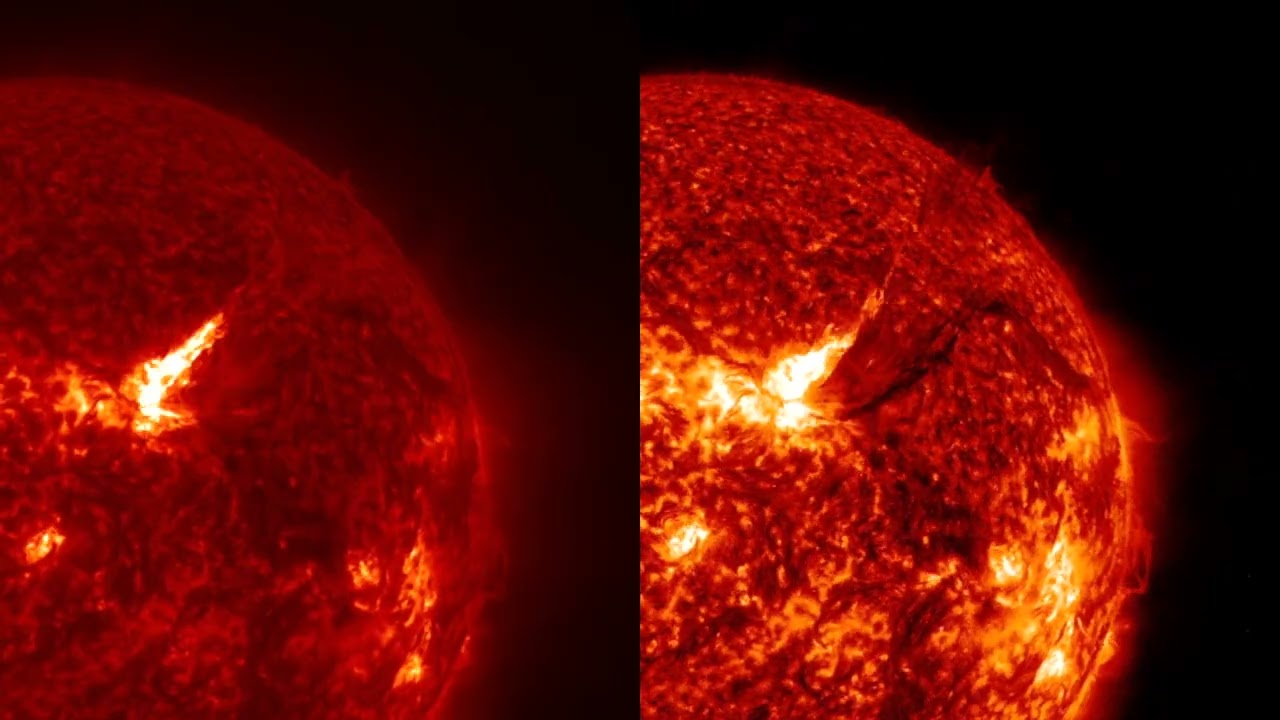
Solar Flares and CMEs at Earth - More Likely | S0 News June.3.2026
SpaceWeatherNewsS0s
2K views•2026-06-03



