A technically rigorous and authentic field record that captures the ephemeral beauty of C/2025 R3 with professional-grade precision. It exemplifies the value of empirical observation in an era often dominated by over-processed imagery.
Install our extension to search inside any video instantly.
The Brightest Comet This Spring: C/2025 R3 (PanSTARRS)Added:
Hi everyone! Tonight is a perfect starry night, so I decided to head to the mountains to observe and photograph the brightest comet this spring — C/2025 R3 (PANSTARRS). And now I’m gonna show you how it all turned out. My name is Alex, and you’re watching The Night Sky Journey. Let’s go.
I’m observing in the mountains of Kyrgyzstan, at around seventeen hundred meters above sea level. The location isn’t perfect, it’s about Bortle 4. The southern view is good. You can see the center of the Milky Way. But to the north, the view is much worse, because there is a city of over a million people about 50 km away. Still, for a bright comet, that’s not really a problem—especially since it’s visible in the eastern sky. Comet C/2025 R3 (PANSTARRS) is located in the constellation Pegasus. First, I decided to observe the comet visually.
It’s easy to find even without GoTo. It’s visible right in the finder scope. And in the eyepiece, I noticed a very compact coma and a thin ion tail about half a degree long. That’s what I was able to see with a 130 mm telescope. I got so carried away with visual observing that I almost missed the moment for imaging. The sky started to brighten very quickly, and I had to switch telescopes and set up my imaging rig. I used an SvBony 70 ED telescope and a ZWO 294 Pro camera. I captured 25 frames, each 30 seconds long.
Look how much brighter the sky is getting. Dawn was already breaking. Here’s the constellation Pegasus, and here’s the spot where the comet was located.
On the bright side, the snowy mountain peaks became more visible. Just look at that—beautiful.
And here’s what I ended up with. I made a short animation showing the motion over 12 minutes of imaging. The comet was around magnitude 5. Its long ion tail didn’t even fit into the frame, and you can see how quickly it fades into the light of dawn.
That’s why, I only stacked 10 frames, with a total exposure time of just 5 minutes, and this is the result. Not bad, considering the challenging conditions.
So what’s next? The comet will move through the constellations of Pegasus and Pisces, heading toward the Sun. It should continue to brighten and may even reach magnitude 2. But at the same time, the viewing conditions will get worse. So, that’s how this observation turned out. I hope you found it interesting. If you did, make sure to leave a like, drop a comment, and subscribe to the channel. The channel is still pretty small, but it's growing Wishing you clear skies and successful observations. See you!
Related Videos

Spiral Galaxy NGC 3370 from Hubble | NASA APOD 2025-11-05 #Shorts
galaxygallery
938 views•2026-05-30

SOMETHING inside the SUN is CHANGING
RaysAstrophotography
1K views•2026-06-03

There May Be A Giant Hole In The Universe... And We Might Be Inside It | The Cosmic Ledger Entry 015
TheCosmicLedger
145 views•2026-05-31

Captured the Blue Moon (with a twist) 🌙✨ #space #bluemoon #telescope
realAstroExplorer
674 views•2026-06-01

The Map We Sent to the Stars in 1977 — Why Scientists Now Regret It
TheAncientRecord7
183 views•2026-06-03

Is this a copy of our galaxy? Discover Galaxy M81!
UniverseDocumentaries-cc4mb
995 views•2026-05-31

10 Planet Where a Black Hole Replaces the Sun
cosmicexplorer-EN
147 views•2026-06-02
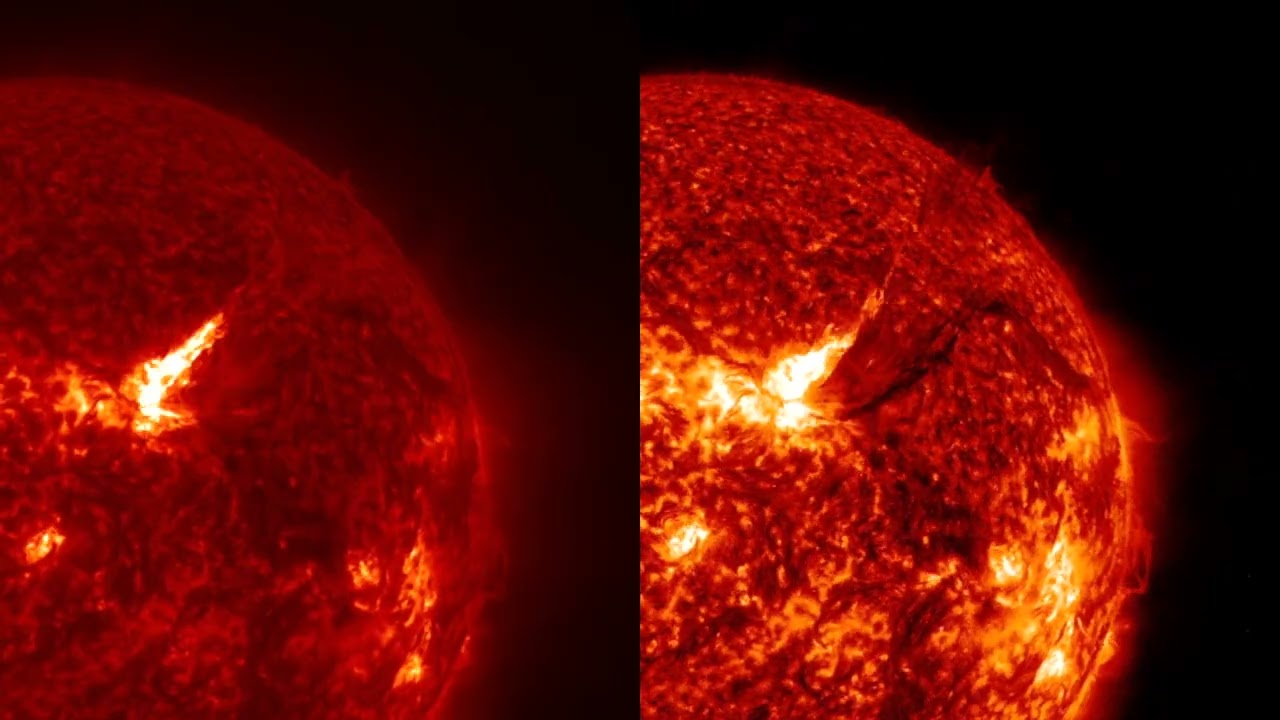
Solar Flares and CMEs at Earth - More Likely | S0 News June.3.2026
SpaceWeatherNewsS0s
2K views•2026-06-03



