A sophisticated distillation of ALMA’s high-resolution data that captures the intricate mechanics of galactic evolution with remarkable clarity. It successfully elevates astronomical observation into a rigorous yet accessible study of cosmic star-forming efficiency.
Install our extension to search inside any video instantly.
The Needle Galaxy (NGC 4565) Explained | ALMA Telescope ObservationsAdded:
An international team of astronomers has utilized the Atacama Large Millimeter/submillimeter Array, or Alma, to conduct high-resolution observations of the stunning Needle Galaxy.
Known as NGC 4565, the Needle Galaxy is famous for its narrow edge-on profile, giving it its distinct needle-like appearance.
This edge-on spiral is a truly massive system, stretching about 176,000 light-years in diameter and containing an estimated 80 billion solar masses.
NGC 4565 is highly significant to astronomers, as it's considered an analog to our own Milky Way Galaxy, sharing many key characteristics with the Andromeda Galaxy.
To gain deeper insights into this galactic neighbor, astronomers embarked on a new observational campaign using Alma's powerful high-resolution capabilities.
The goal was to get a detailed, high-inclination view of the molecular gas, focusing on the 12 CO and 13 CO emissions in NGC 4565.
Studying the molecular gas within the galaxy's interstellar medium is crucial for understanding star formation, galaxy evolution, and how gas cycles through different cosmic phases.
The Alma observations yielded fascinating details about the distribution and characteristics of the molecular gas within the Needle Galaxy.
The high resolution allowed the team to successfully resolve giant molecular cloud-scale structures across the entire molecular disk, even in its low-density outer regions.
Observations show very little molecular gas exists inside the inner ring, followed by a disk dominated by molecular hydrogen, and finally a hydrogen iodide outer disk.
The study examined how molecular cloud properties and the vertical structure of the interstellar medium vary across the galaxy's radius.
In terms of radial profiles, the Needle Galaxy shows similarities to the Andromeda Galaxy and the spiral galaxy NGC 2775.
Crucially, the molecular disk was found to be very thin, exhibiting minimal vertical flaring even with increasing radius, reflecting its overall structure.
The properties of the giant molecular clouds in NGC 4565, such as size and density, generally align with distributions seen in less inclined galaxies. A significant discovery was the detection of a prominent dense star-forming complex on the galaxy's ring, which the researchers aptly named the East Ring Pile Up.
This pile up is a prominent star-forming region, corresponding to a high density of molecular gas on the galaxy's ring.
Within this complex, a compact bright region dubbed the Jewel was identified, comparable in density to local starburst regions like 30 Doradus.
These high-resolution Alma observations provide invaluable new insights into the molecular gas properties of the Needle Galaxy, enhancing our understanding of star formation and galaxy evolution.
Related Videos

Spiral Galaxy NGC 3370 from Hubble | NASA APOD 2025-11-05 #Shorts
galaxygallery
938 views•2026-05-30

SOMETHING inside the SUN is CHANGING
RaysAstrophotography
1K views•2026-06-03

There May Be A Giant Hole In The Universe... And We Might Be Inside It | The Cosmic Ledger Entry 015
TheCosmicLedger
145 views•2026-05-31

Captured the Blue Moon (with a twist) 🌙✨ #space #bluemoon #telescope
realAstroExplorer
674 views•2026-06-01

The Map We Sent to the Stars in 1977 — Why Scientists Now Regret It
TheAncientRecord7
183 views•2026-06-03

Is this a copy of our galaxy? Discover Galaxy M81!
UniverseDocumentaries-cc4mb
995 views•2026-05-31

10 Planet Where a Black Hole Replaces the Sun
cosmicexplorer-EN
147 views•2026-06-02
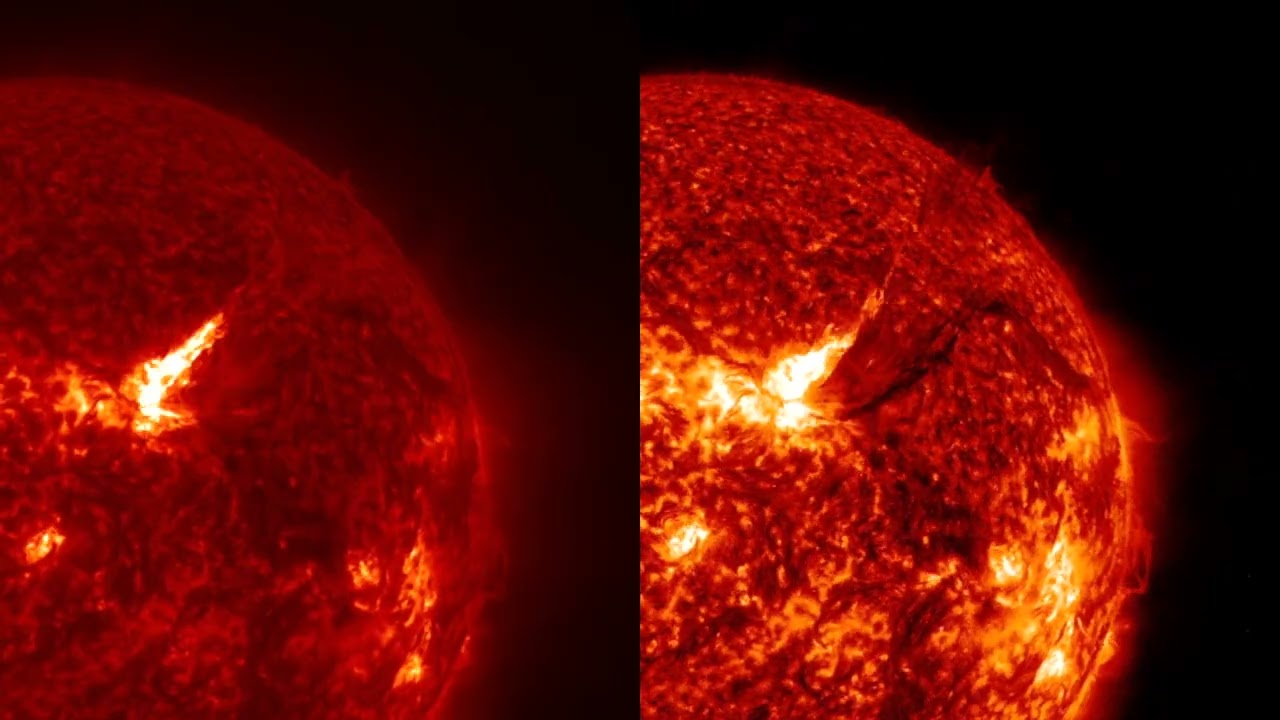
Solar Flares and CMEs at Earth - More Likely | S0 News June.3.2026
SpaceWeatherNewsS0s
2K views•2026-06-03



