This video masterfully demonstrates how the intersection of historical humanities and modern astrophysics can reveal cosmic patterns hidden for centuries. It serves as a powerful reminder that ancient records are not just literature, but vital empirical data for understanding our planet's history.
Install our extension to search inside any video instantly.
A medieval Japanese poet helped modern astronomers find a solar stormAdded:
Another year gone by and still no spring warms my heart.
It's nothing to me.
But now I am accustomed to stare at the sky at dawn.
Fujiwara no Teika This episode is something of a sequel to a previous short I did a few years back in which I outlined the use of Japanese historical records, particularly the oral history of the Ainu people of Hokkaido to pinpoint the beginning of the solar cycle.
I have not gone out of my way to focus on Japanese history.
It's simply the Japanese records are that good.
Shinto shrines have kept accurate weather and atmospheric records for the last 1300 years.
And on April 10th astronomers announced the confirmation of a solar event within that record.
In part due to the work of a Japanese poet.
And not just any Japanese poet.
Fujiwara no Teika is considered a master of waka the dominant poetic form in Japan for over a thousand years.
These days Japanese poetry is synonymous with haiku but that form did not emerge until the 17th century.
Waka which simply means Japanese poetry dates as far back as the 8th century.
While the term could be applied to any early poetic form it was chiefly associated with tanka a five-line verse with a 5-7-5-7-7 syllable structure of which Teika was considered the undisputed master.
Teika was born in 1162 to a distant branch of a noble family nearly all of whom were successful poets.
It was in part to shore up his family's reputation that Teika became a poet himself.
In 1200 the then 20-year-old Emperor Toba II abdicated and retired to a monastery because it allowed him more freedom to engage in politics than if he'd retained the ritual and ceremony-choked official position.
One of his first acts in this newly liberated state was to hold a poetry contest.
The compilation of two volumes of poetry each comprising 100 linked wakas in thematic sequence.
Teika was 38 and in a stagnant career he needed the boost.
Unfortunately, he had publicly derided one of his competitors who happened to be very well connected at court as a fake poet.
Thanks to a friend's direct appeal to the emperor, however he made it in.
Toba was so impressed by Teika's 100 poems that he granted him a position at his court.
By 1222 when Toba ordered Teika to compile an anthology of waka poetry their relationship began to curdle.
Teika was a rigid perfectionist demanding only the best poems be included rejecting even his own.
Toba perhaps in accordance with the aesthetic of wabi-sabi demanded imperfect poems be included to offset the good.
While the resultant book Shinkokinshu is widely regarded as a masterpiece their relationship never recovered.
Thankfully, in 1221 Toba had the brilliant idea of rebelling against the Kamakura shogunate.
He failed and was exiled.
Despite his new-found creative liberty Teika was hobbled by illness.
Though he still managed to compile one of the great anthologies of Japanese poetry Ogura Hyakunin Isshu the little treasury of 100 poets one poem each whose poems form the basis for many modern Japanese card games.
It is not from any of his poems, unfortunately that Teika owes his current astronomical notoriety.
Like many people of his time and station he kept a diary today known as the record of the clear moon.
The document had 56 years of his life.
And on the 22nd and 23rd of February 1204 he recorded red lights in the northern sky over Kyoto for three consecutive days.
Kyoto lies at 35° north latitude.
Aurorae should not usually be observed below 60° north a variance of nearly 3000 km.
Low-latitude aurorae were observed across East Asia during the years 1200 to 1205 suggesting an unusually strong solar maximum perhaps exacerbated by the Earth's magnetic dipole pointing toward East Asia at the time.
This event is one of the oldest solar storms in the historical record.
But history is not the only available record.
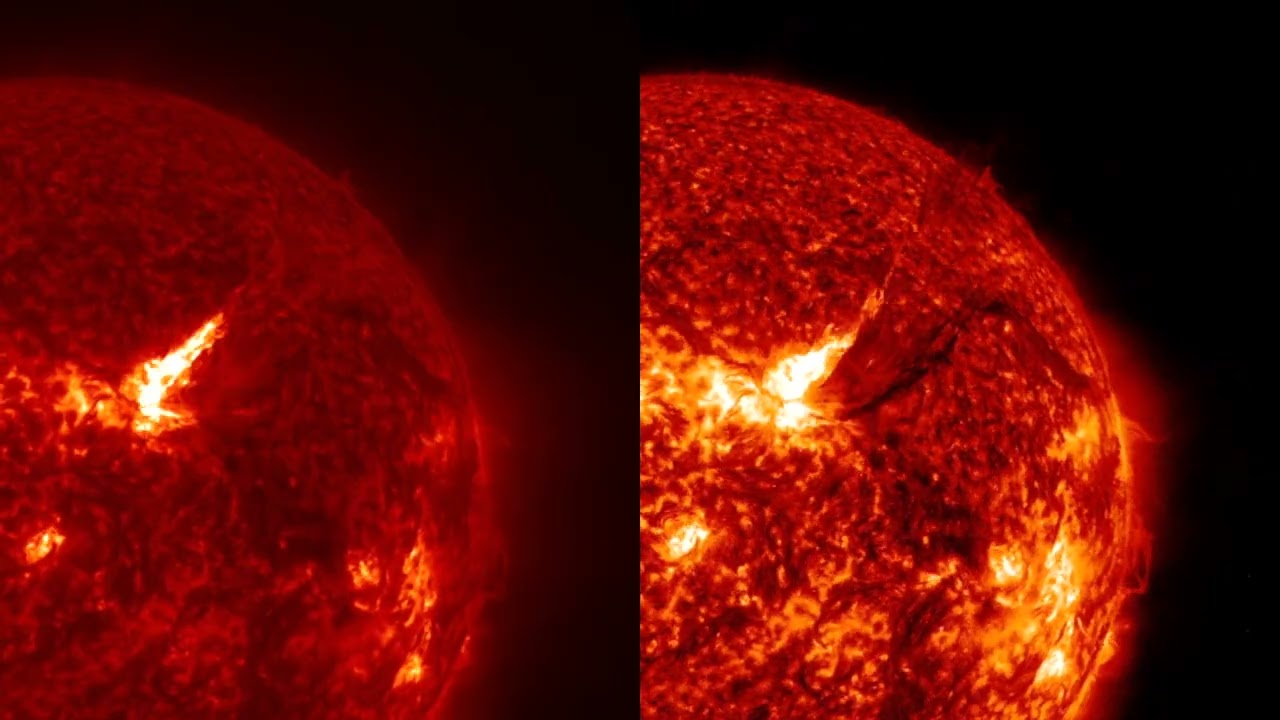
Extreme solar events known as geomagnetic storms are caused by solar flares bursts of high-energy light and coronal mass ejections bursts of superheated electrically charged matter erupting on the sun's surface.
When swarms of protons meet Earth's atmosphere they can convert its nitrogen into radioactive carbon-14 which is then absorbed by plants.
Because carbon-14 has a half-life of 5700 years tree rings can provide a fairly accurate timeline of extreme solar events.
The largest of such events occur on time scales of thousands of years with the earliest known dated to 12,350 BC.
Smaller-scale events such as that recorded by Teika are likely more frequent but are much harder to observe in the tree record.
That's where the historical record steps in.
Written records of aurorae and sunspots can help guide scientists to locate smaller events.
And this month a study by Hiroko Miyahara and colleagues of the Okinawa Institute of Science and Technology did a high-precision analysis of tree ring data from 1196 to 1211 AD.
This activity forms part of the medieval solar activity maximum a period from about 1100 to 1250 during which the solar cycle quickened from every 11 to every 8 years.
This activity is strongly associated with the medieval warm period an era of sustained high temperatures in the North Atlantic that enabled the Vikings to settle Iceland and Greenland.
The period from 1200 to 1205, however was a particularly active phase with cycle short even for the time.
While the results did not fall outside the predicted range of the period a spike in carbon-14 was observed for the year 1200 to 1201.
This is the largest C14 spike in a thousand years 14 times larger than the largest in modern history which occurred in February 1956. [clears throat] Those of you of a certain age who watch my channel may be puzzled at this.
For in the past I have mentioned the so-called Carrington event a solar storm that produced aurorae in the tropics and set telegraph stations on fire across the planet.
Why was there no such event in 1956?
Well, there is little to no correlation between the amount of particle radiation absorbed by our atmosphere and the severity of a solar event.
The Carrington event astonished the world but its C14 footprint is a ghost.
This may explain the relative scarcity of C14 during the 1204 aurora observations by Teika and his contemporaries which occurred near the solar minimum for the time.
Why aurorae formed during a solar minimum is not known and offers a potential new avenue for exploration into the nature of our temperamental star.
Related Videos

Spiral Galaxy NGC 3370 from Hubble | NASA APOD 2025-11-05 #Shorts
galaxygallery
938 views•2026-05-30

SOMETHING inside the SUN is CHANGING
RaysAstrophotography
1K views•2026-06-03

There May Be A Giant Hole In The Universe... And We Might Be Inside It | The Cosmic Ledger Entry 015
TheCosmicLedger
145 views•2026-05-31

Captured the Blue Moon (with a twist) 🌙✨ #space #bluemoon #telescope
realAstroExplorer
674 views•2026-06-01

The Map We Sent to the Stars in 1977 — Why Scientists Now Regret It
TheAncientRecord7
183 views•2026-06-03

Is this a copy of our galaxy? Discover Galaxy M81!
UniverseDocumentaries-cc4mb
995 views•2026-05-31

10 Planet Where a Black Hole Replaces the Sun
cosmicexplorer-EN
147 views•2026-06-02
Solar Flares and CMEs at Earth - More Likely | S0 News June.3.2026
SpaceWeatherNewsS0s
2K views•2026-06-03



