This video provides a sharp reality check on scientific anomalies by distinguishing genuine cosmic events from human observational bias. It serves as a necessary reminder that data integrity must always come before the urge to find patterns in the stars.
Install our extension to search inside any video instantly.
Halley's Comet's Debris Is Hitting Earth Tonight — But Something Is OffAdded:
Hal's comet will not return until 2061.
Most of you watching this will never see it. But tonight, what it left behind is here, streaking through our atmosphere at speeds that would take you from New York to London in less than 3 minutes.
This is one of the most predictable events in all of astronomy. We have the math, we have the history, we have centuries of data. So, explain to me why the fireball count in 2026 is doing something it has never done before. That deviation has a name in statistics, 4.5 sigma, and it means the probability of this being random chance is roughly 1 in 170,000. NASA noticed, NASA has not explained it. So stay with me because not everything burning up in tonight's sky was on the schedule. Something else is in there. And tonight, you will know what might be up there with Hal's crumbs. If this already has you asking questions, hit like and subscribe to the Sky Lab because we are not done watching this sky. The anomaly is still active.
The analysis is still incomplete. And somewhere between a database that mislocates bolides by a thousand miles and a fireball rate that has no clean explanation, there is a gap that somebody needs to keep filling in. That is what we do here. You're going to want to be here when the next piece lands.
Now, let us get into it.
Part one. The window opens. The sky.
Tonight is a controlled experiment.
Right now, tonight, while you're reading this or sitting in the dark or standing in your backyard squinting at a sky that looks completely ordinary, Earth is plowing through the debris field of the most famous comet in human history at 66 km/s.
That is not a metaphor. That is not an approximation. That is a real number.
And it translates to roughly 148,000 mph, which is the speed at which pieces of Hali's comet are currently entering our atmosphere and burning up somewhere above your head. Some of them are the size of a grain of sand. Some are larger. All of them are ancient. And the thing that makes tonight genuinely remarkable is not the spectacle itself.
It is the fact that we can predict this spectacle almost perfectly. And yet this year, something in the prediction is not adding up. Let's establish the baseline first because understanding why tonight is strange requires understanding why tonight is supposed to be completely ordinary. The Eater Aquarid meteor shower is one of the most precisely understood celestial events on the annual calendar. It peaks in early May every single year. It has been doing this since before recorded human history. The debris stream that produces it was laid down by Hal's comet across hundreds of orbital passes around the sun. Each path shedding material, each piece of material slowly spreading out across the comet's orbital path, and Earth crossing that path at the same time every year, like a car driving through the same stretch of gravel on the same road at the same speed on the same date. The radiant point, the spot in the sky where the meteors appear to originate, sits in the constellation Aquarius near the star eta Aquar, hence the name. The geometry is locked in, the velocity is locked in. The expected rate under ideal conditions is somewhere between 50 and 60 m/ hour at the zenithal hourly rate which is the theoretical maximum under a perfectly dark sky with the radiant directly overhead. This is what a controlled experiment looks like in astronomy. You know the source, you know the speed, you know the direction, you know roughly how many particles Earth will encounter and roughly how bright they will be. You can calculate the expected output with the kind of precision that makes physicists deeply satisfied with the universe. And that precision matters tonight because it gives us something to compare against. When you run an experiment, you need a baseline. You need to know what normal looks like before you can identify what abnormal looks like. The EA Aquarids give us that baseline or they are supposed to. Hal's comet last visited the inner solar system in 1986.
If you were alive then and old enough to remember it, you may recall that it was a bit of a disappointment. Too far from Earth for easy naked eye viewing, washed out by light pollution for most observers, not the dramatic naked eye spectacle that previous generations had witnessed. The comet's next scheduled return is 2061. Take a moment with that number. 2061. That is 35 years from now.
If you are watching this video and you're over the age of 50, the statistical probability that you will be alive to see Hal's comet return is not particularly high. Even if you are younger, you will be old. The comet you will see in 2061, if you see it at all, will find you in a very different chapter of your life than the one you are in right now. And yet tonight, what that comet left behind is here. It is hitting our atmosphere. It is burning up in streaks of light above every continent on Earth. Hi is gone, but its debris is present. And that is a strange and beautiful fact that is worth sitting with for a moment before we get into the part that is not beautiful at all.
Because here is where the controlled experiment starts to develop a crack.
2026 has by multiple independent measures produced an unusual number of fireball events over the United States.
Not a modest uptick, not a statistical blip that requires squinting at a graph to notice. a surge that one independent analyst, a researcher named Stefan Burns, quantified as a 4.5 sigma deviation from expected baseline rates.
4.5 sigma in the language of statistics, that means the probability of seeing this kind of variation by random chance alone is roughly 1 in 170,000.
These are the kinds of numbers that in particle physics would represent a discovery. In epidemiology, they would trigger an investigation. In atmospheric science, they would demand an explanation. NASA has acknowledged the increased activity. What NASA has not done, at least not publicly, at least not in a way that the scientific community has found satisfying, is explain it. And here is where it gets layered in a way that keeps me thinking about this at 2 in the morning. Because the explanation NASA offered was essentially this. It is fireball season.
orbital geometry aligns in spring in a way that produces more detected events.
It is a known pattern, nothing to see here. And that would be completely reasonable except that fireball season happens every year and the deviation we're talking about is not a gradual increase consistent with seasonal patterns. It is a spike. It has a shape that looks different from seasonal variation. And it has a geographic concentration that seasonal effects alone do not neatly explain. But before we can test any of this, before we can use tonight's Eater Aquarid shower as the calibration tool it could theoretically be, we need to reckon with a problem that runs even deeper than the anomaly itself. The system we use to track these events. The infrastructure of detection and reporting that is supposed to tell us what is real and what is noise has its own accuracy issues. known, documented, peer-reviewed accuracy issues. Which means the question is not just whether something unusual is happening in the sky. The question is whether we would even be able to tell if it was. Tonight is not just observation. Tonight is calibration. And the instrument we're using to calibrate with has already been shown in published research to sometimes point at the wrong place in the sky by distances of over a,000 miles. So, when you go outside tonight to watch the crumbs of Hal's comet burn up above you, and I genuinely hope you do, keep that in the back of your mind. You are not just watching a meteor shower. You're participating in a real-time test of whether the anomaly this channel has been tracking for months is a data illusion, a detection failure, or evidence of something additional entering our atmosphere that we have not yet identified. The shower is the signal. The noise is everything else.
And right now we cannot fully separate them.
Part two, the window opens. What normal should look like, but won't.
Before we can talk about what is wrong with tonight's picture, we need to be precise about what the picture is supposed to look like. Not in the simplified way you find in a beginner's astronomy guide, but in the actual edgecase physics constrained way that makes tonight genuinely tricky to interpret even under ideal conditions.
Because here is the thing. The Eater Aquariads are not a typical meteor shower. They sit near the upper boundary of entry velocity for Earth crossing debris streams. And that matters in ways that are easy to underestimate. 66 km/s is fast. Not just fast in a general sense. Fast in a way that has specific measurable consequences for what you see in the sky. When a particle enters the atmosphere at that velocity, the kinetic energy available for ablation scales with the square of the speed. double the speed, four times the energy. Which means eater aquarid meteors relative to slower showers release a disproportionate amount of energy during their atmospheric entry. The result is that even small particles, things that would be nearly invisible during a slower shower, can produce bright dramatic streaks. The shower punches above its weight class in terms of visual spectacle. And there is a specific consequence of this that becomes important when we start trying to count anomalies. A high fraction of Eater Aquaried meteors leave persistent trains. These are glowing ionization trails that linger in the atmosphere for seconds, sometimes longer, after the meteor itself has burned up. The fraction of persistent train meteors in this shower run somewhere between 10 and 15% under good conditions. For comparison, many slower showers produce persistent trains in only a few% of events. That means the sky during an EA Aquarian peak looks more dramatic, more active, more unusual than it technically is. Individual meteors look more impressive. And observers, particularly casual ones who do not spend a lot of time watching meteor showers, can come away with a strong subjective impression that something extraordinary is happening, even when everything is proceeding exactly as predicted. Now, layer on the hemispheric geometry because this is where tonight's observations get complicated depending on where you're watching from. The radiant point in Aquarius rises highest in the southern hemisphere. For observers in Australia, Southern Africa, and South America, the Eater Aquarids are genuinely one of the best showers of the year. The radiant climbs well above the horizon before dawn. The viewing window is long, and the geometry is favorable for catching a high proportion of the available meteors. For observers in the northern hemisphere, which includes most of the United States and Europe, the situation is considerably less favorable. The radiance stays low.
The viewing window before dawn is compressed. You are catching meteors coming in at a shallower angle, which means they appear to travel longer paths across the sky, but fewer of them are actually detectable per hour.
And then there is the moon. Tonight, May 5th and 6th, 2026, the moon is in its waning gibbus phase.
Not full, but bright enough to wash out faint meteors for most of the observing window. This is not catastrophic for the shower, but it is significant. It acts as a filter. The faint end of the meteor distribution. The sand grain-ized particles that produce magnitude 5 or six meteors get suppressed. What survives the lunar filter are the brighter events, the magnitude 1 or 2 meteors, the occasional bolide. The statistical consequence of this is a selection effect that makes the observed population look different from the actual population. You're seeing a biased sample. You're seeing the bright tail of the distribution while the rest is buried in moonlight. And if you are trying to use tonight's observations to calibrate whether there is an anomalous excess of bright events in the sky, that selection effect becomes a serious complication. Here is the other piece of the geometry that creates interpretive trouble. A low radiant produces meteors that appear to travel on long flat paths across the sky. They seem slower. They seem to come from a direction that is harder to trace back precisely.
The angular forcehortening that makes radiant tracing straight forward when the radiant is high overhead becomes a source of genuine ambiguity when the radiant is near the horizon. A meteor that grazes in from low in the east and travels most of the way across the sky before burning out can look to a casual observer like it came from almost anywhere. It could be an etoquarid on a standard trajectory. It could be a sporadic meteor moving in a completely different direction at low elevation angles. The visual difference between these two things is not reliably distinguishable by eye. And this is before we even get to the issue of fireballs specifically. The bright bolide class events that are at the center of the anomaly we are tracking.
Because fireballs are memorable, a fireball that crosses the sky at magnitude minus5 is something you remember. You tell people about it. You post it online. You look it up. And when there is a widely covered story about an anomalous spike in fireball activity, the reporting behavior of the public changes. People who might not have reported a moderately bright meteor 6 months ago are now much more likely to report it because they have been primed to consider it potentially significant.
This is not dishonesty. It is human behavior and it contaminates the data set in ways that are genuinely difficult to correct for. So the sky tonight is already under entirely normal conditions. A place where your perceptions are being systematically distorted. Bright meteors dominate because the moon suppresses faint ones.
Apparent paths are misleading because the radiant is low. Persistent trains make individual events look more dramatic than they are. The northern hemisphere viewing window is short, concentrating observations, and the background of heightened public attention to fireball anomalies is amplifying reporting rates for events that might have gone unrecorded in a different year. All of this is happening before we even consider whether there is a genuine anomaly to detect. Which is precisely why the central question is something actually off or are we seeing normal processes through a distorted lens is so difficult to answer and why tonight for all its predictability might tell us less than we hope. The sky already lies to you under normal conditions. The question is whether it is lying more than usual tonight or telling you a truth you are not prepared to hear. Part three. The window opens.
The first crack in the model. The American Meteor Society maintains one of the most detailed public databases of fireball observations in the world. It aggregates reports from trained observers and casual sky watchers alike, cross reference by geography, time, and trajectory data when available. It is imperfect. All observational databases are. But it is the primary public-f facing record of what people are seeing in the sky over the United States. And when you plot the 2026 data against historical baselines, something stands out that is not easy to explain away.
The reporting rate for fireball events in 2026 is running higher than expected, not slightly higher, meaningfully higher, and the divergence is not distributed evenly across the calendar.
It is concentrated in a way that raises questions. The critical clarification here, and it is one that gets lost in most coverage of this topic, is that the anomaly is not primarily within the Eater Aquarid shower itself. The shower will produce what the shower has always produced, a well-characterized population of fast, bright meteors originating from a specific radiant point. The surplus events that constitute the 2026 anomaly are not based on available analysis, primarily attributable to Hal's debris. They are, in the technical language of meteor science, non-radiant fireballs. Events that cannot be convincingly traced back to any known active shower. Events that appear to come from random directions at varying velocities and without the organized stream structure that characterizes shower meteors. These are what the field calls sporadics, and the sporadic rate is what appears elevated in 2026. This distinction matters enormously. When a known shower produces more meteors than expected, there are clear mechanisms to investigate. The density of the debris stream may have been enhanced by a recent cometry passage. The stream may have been perturbed by planetary gravity. The Earth may be threading a denser filament within the broader stream. These are tractable problems. You look at the comet's orbital history. You model the stream dynamics. You compare with previous years. But when the sporadic rate rises, when the random background population of debris entering our atmosphere appears to increase, the explanatory options are much wider and most of them are harder to test. The first thing you need to understand about radiant tracing is that it sounds more precise than it usually is in practice.
In principle, you can take the observed path of any meteor across the sky and project it backward to determine where in the sky it appears to originate. If that origin point clusters near Eater Aquaria, you have a shower meteor. If it does not, if it points to some random patch of sky that does not correspond to any known active radiant, you have a sporadic or an unknown source. But this back projection requires accurate angular measurements of the meteor's path, ideally from multiple independent observers at different locations who can provide triangulation.
A single observer watching a low elevation meteor with a compressed apparent path is simply not in a position to perform reliable radiant tracing. The geometry does not allow it.
And when you look at the fireball reports in the AMS database, a large fraction of them come from single observers, well-intentioned, honest, but geometrically limited in what they can actually determine about where the event came from. This is the origin of the contamination problem that complicates everything we're trying to do tonight.
The data set contains two populations.
Shower meteors that have been correctly identified as such and a mixed bag of events that have been labeled as sporadics. Some of which genuinely are sporadics. Some of which may be shower meteors that were mclassified because of poor geometry and potentially some of which represent something else entirely.
The labels are fuzzy. The boundaries between populations are blurry and the surplus events in 2026 are predominantly appearing in the part of the data set where the fuzziness is greatest. The single observer low elevation high brightness events where radiant determination is weakest. There is a deeper problem lurking here that is worth naming directly because it is the thing that makes tonight's shower both useful and confusing. As a test case, the Aquarid shower provides cover. When you have a high-profile, well publicized meteor shower happening, the reporting rate goes up. The public is primed to look. Media outlets run pieces about the shower. Social media fills with videos.
And the result is that any non-show events that happen to occur on the same night or in the days surrounding the peak are much more likely to be captured and reported than they would be on a random night in October. The signal to noise problem cuts both ways. The shower increases our chances of detecting genuine anomalies. But it also increases our chances of creating artificial anomalies through the very act of looking harder. Which means the data set may already be contaminated not by fraud or error, but by attention. The anomaly we have been tracking since early 2026 may be at least in part a product of the same heightened scrutiny that is making it visible. And that is not a comfortable thought if you have been watching these numbers and starting to wonder whether the sky has genuinely changed. It might have or the sky might be exactly what it always was and we might just be watching it more carefully now. Tonight will not resolve that ambiguity but it will add another data point and somewhere in the overlap between what we predict and what we observe the answer or at least the shape of the answer is hiding.
Part four. The anomaly, the 4.5 sigma problem.
Let's talk about what 4.5 sigma actually means because it is the kind of number that gets thrown around in discussions like this as if it settles everything.
When in reality, it is the beginning of a question rather than the end of one.
In statistics, sigma refers to standard deviations from the mean of a distribution. If you measure a large number of things that vary randomly, fireball rates for instance, measured across many years, the variation will tend to cluster around an average with most values falling within one or two standard deviations in either direction.
A one sigma deviation is moderately unusual. A two sigma deviation happens roughly 5% of the time by chance. A 3 sigma deviation happens roughly 0.3% of the time. 4.5 sigma is the kind of number that if your data and baseline assumptions are clean means you are looking at something that would occur by random chance roughly once in 170,000 instances in high energy physics. A 5 sigma threshold is the standard for claiming a discovery. 4.5 sigma is close to that threshold. It is not something you can dismiss without a serious accounting. But here is the crucial caveat and it is one that Stephan Burns himself has been careful to acknowledge.
A sigma claim is only as solid as the baseline it is measured against.
The statistical power of a deviation depends entirely on the quality of the comparison. If your baseline contains systematic errors, if the historical rates you're comparing against were themselves measured with a different instrument under different reporting conditions or with a different population of observers, then the apparent deviation may be a product of the comparison itself rather than a genuine change in the underlying phenomenon. And the fireball reporting infrastructure has changed substantially over the past decade. The proliferation of smartphones, dash cams, home security cameras, and dedicated all sky meteor cameras has dramatically increased the probability that any given event over a populated area will be recorded and reported. This is a trend with a positive slope, more coverage every year, and any analysis of fireball rates that does not carefully correct for the expanding observation network risks mistaking an instrumental increase for a physical one. So the first question we have to ask about the 4.5 sigma spike is whether the baseline was constructed in a way that accounts for this increasing observation coverage. The honest answer is that it is difficult to fully correct for this and different analysts make different assumptions about how to do it. Stefan Burns's analysis appears to show a deviation that persists even after accounting for the general trend of increasing reports. But the margin of confidence around that claim is narrower than the headline sigma number implies because the corrections themselves introduce uncertainty. This does not mean the analysis is wrong. It means the statistical case is more nuanced than a single number can capture and nuance unfortunately tends to get lost in the transition from analysis to discussion.
Now consider the NASA explanation. The AY's position, and to be fair, this is a paraphrase of what has been communicated in various public-f facing contexts rather than a formal published statement, is that increased fireball activity in spring is expected. Earth's orbital position in late April and early May places us in a geometry where we encounter several overlapping debris sources simultaneously.
The Eater Aquarids themselves are one.
The Anththeron source, which we will get to in more detail later, is another.
Various minor showers and sporadic extreme contributions add background noise. The confluence of these sources in the same calendar window predictably elevates activity relative to say January or November. This explanation is technically correct. What it does not address is why the elevation in 2026 appears to exceed the elevation of previous years not just in absolute terms but in the shape of the excess.
Seasonal variation produces a gradual ramp up and ramp down centered on the peak activity period. What the 2026 data appears to show in the months leading up to tonight is something more like a cluster of elevated episodes rather than a smooth seasonal curve. That clustering is not predicted by the seasonal explanation. It requires a different mechanism. The March 2026 cluster deserves specific attention because it is the piece of the anomaly picture that is hardest to fit into any of the standard explanations. In a period of several weeks centered on mid-March, the United States experienced multiple significant fireball events that generated widespread public attention.
events reported across multiple states, generating hundreds of individual witness reports, each occurring within a time frame that is unusual even for active fireball periods.
The geographic concentration of these events, multiple major events over the same broad continental region within weeks is statistically notable. Fireball events are not expected to cluster geographically in this way. The sporadic background should be roughly isotropic.
Events should be distributed randomly in direction and location with no preferred geography.
When you see a geographic cluster, it raises the possibility that the events share a common source or trajectory, that they are not as random as the sporadic label implies. This could have several explanations. It could be a detection artifact. There are simply more observers and more dash cams and more security cameras per square mile in the continental United States than anywhere else on Earth. So, if you're going to see a geographic cluster of reported events, it will almost always appear to be over America, regardless of where the events actually are. It could be a genuine cluster resulting from Earth, passing through a localized density enhancement in a debris stream, the cosmic equivalent of hitting a pothole on an otherwise smooth road. It could be a coincidence that will smooth out when viewed over a longer time baseline, or it could be something more interesting and more troubling. The data at this point does not allow us to choose definitively between these options. But the cluster exists in the record. It is real and it is not explained. And the deeper you go into the data, the less stable the conventional explanation looks, which is exactly the kind of situation that should make a careful observer pay very close attention to what the sky is doing tonight.
Part five, the anomaly. The instrument is not neutral.
There is a moment in any scientific investigation where you stop asking questions about the phenomenon and start asking questions about the detector. It is an uncomfortable shift because it means confronting the possibility that the thing you have been studying might be partly a product of the device you were using to study it. We have reached that moment in this story. Before we can meaningfully interpret the 2026 fireball anomaly, before we can say with any confidence whether the signal is real or inflated or missing pieces, we have to reckon with what is actually known in the peer-reviewed literature about the accuracy of the primary instrument.
NASA's Center for Near-Earth Object Studies bolide database. The SNES database is the closest thing the scientific community has to a public comprehensive record of energetic bolide events detected globally. It uses a network of US government sensors, infrasound arrays, satellite optical detectors, seismic instruments to detect and characterize significant atmospheric entry events, objects large enough and energetic enough to produce measurable signals beyond the visible light of a simple fireball. The database is publicly accessible. It is widely cited.
It is used by researchers, journalists, science communicators, and policy makers as a reliable record of what is actually hitting Earth's atmosphere at the higher energy end of the spectrum. The problem is that a peer-reviewed study published in the scientific literature, not a fringe blog, not an alternative analyst, but actual published research, found that the database has two distinct accuracy populations. And the larger of those populations is the one containing most of the events. The finding to put it plainly is this. Senos events above approximately 0.45 kotons of estimated impact energy have relatively well constrained location accuracy. Below that threshold, which covers a large fraction of all reported events, the location accuracy degrades substantially. Errors in the listed geographic coordinates can reach hundreds of kilome. In documented cases, the error reaches more than a thousand miles. More than a thousand miles. To put that in physical terms, an event listed in the Senos database as occurring over the western United States could in reality have occurred over the eastern United States or over the ocean or over Canada. The coordinates are not wrong in some trivial rounding error sense. They are wrong in a sense that materially affects every geographic analysis you might try to perform on the data set. This has direct consequences for the 2026 anomaly discussion. When analysts look at geographic clustering of fireball events and try to determine whether there is a meaningful pattern, events concentrated over a particular region, trajectory families suggesting a common source. They're relying on the coordinate data in these databases. If a significant fraction of those coordinates are wrong by hundreds to thousands of miles, then apparent geographic clusters may be artifacts of the location errors rather than real spatial structure in the data. Events that appear to cluster over the continental United States might actually be distributed across a much larger area with the apparent clustering produced by the bias in detection geometry. American sensors detecting American area events more reliably, combined with mislocation errors that pull events from the edges of the detection network toward the center. There was a specific anomalous entry in the Canos database from recent months that illustrates the problem with uncomfortable clarity. An event was listed with coordinates placing it in the interior of Antarctica, a remote uninhabited region where the probability of independent corroboration is essentially zero. There is no network of eyewitnesses in the Antarctic interior.
There are no dash cams. There are no local news reports. The event sits in the database as a data point with coordinates with an estimated energy and with no practical way for anyone to verify whether it actually occurred at that location or whether the coordinates represent another instance of the mislocation error documented in the peer review. It is not proof of fraud. It is not even necessarily proof of error, but it is a perfect illustration of the epistemological problem the database creates. Events that cannot be independently verified, listed with apparent precision in a record that is treated as reliable. The reason this matters so much for tonight and for the central question of whether the 2026 anomaly is real is that the database is not just a source of individual facts.
It is the foundation of the baseline.
When someone calculates how many significant bolide events are expected per year, they are counting from this database. When they calculate the expected geographic distribution, they are using these coordinates. When they identify the 4.5 sigma deviation, they are measuring against a baseline that inherits all of these errors. An instrument that systematically mislocates events does not just introduce noise into individual measurements. It distorts the statistical properties of the entire data set in ways that can mimic real signals. You cannot separate signal from noise when the instrument that is supposed to be detecting the signal is actively shifting it. This is not an argument that the anomaly is fake. It is an argument that the anomaly is harder to characterize than the headline numbers suggest. The deviation might be real and fully as large as the analysis indicates, or it might be real but smaller, with part of the apparent spike being an artifact of changing detection geometry over time. Or it might be mostly instrumental with only a small genuine signal buried inside a larger measurement distortion. Tonight's observations from thousands of individual sky watches from the AMS reporting network from the all sky camera systems that are increasingly covering the northern hemisphere add data that is independent of the Senos satellite detection network. They are a different instrument. And when two instruments measure the same thing and give you different answers, sometimes it's because one of them is miscalibrated. Tonight might help us figure out which one.
Part six, the anomaly. Detection gap meets peak visibility.
NASA's planetary defense infrastructure as of early 2026 has cataloged and characterized the orbits of roughly 95% of near-Earth objects larger than 1 km in diameter. That sounds reassuring until you recall that the civilization ending threshold is roughly 10 km. The chicks impactor was probably 12. And the objects that concern planetary defense planners most in the near to medium-term are not the civilization enders but the city enders and region devastators in the 100 meter to 500 m range. In that size class, the discovery completeness drops significantly.
Current estimates suggest that roughly 40% of hazardous near-Earth objects in the size range most relevant to regional damage remain undetected. We have not found them yet. We do not know where they are. We do not know when they are coming and the detection network that is supposed to be finding them has systematic coverage gaps that are not randomly distributed. They cluster in specific parts of the sky that correspond to specific times of day and specific seasons of the year. The southern hemisphere has historically been under represented in asteroid discovery surveys. Most of the major survey programs, Pan Stars, Catalina Sky Survey, the Atlas system are predominantly northern hemisphere operations. This creates an angular blind spot. Objects approaching Earth from directions that are best observed from southern latitudes have a higher probability of going undetected until they are close enough to be caught by the northern surveys, which means a shorter warning time and a smaller observational baseline for orbit determination. This is not a secret. It is documented in the planetary defense literature and it overlaps in a specific uncomfortable way with tonight's geometry. The Eater Aquari radiant is a southern sky feature. The viewing advantage for tonight's shower is in the southern hemisphere and the detection gaps in our surveillance network are also concentrated in the southern hemisphere.
Overlay this with tonight's peak observing conditions and a paradox emerges that sounds counterintuitive but is real. Maximum sky watcher participation does not necessarily mean maximum accuracy. Tonight, more human beings will be outside looking at the sky than on almost any other night of the year, at least in the context of intentional meteor observing. Social media will be full of videos and reports. The AMS reporting system will collect more submissions in a 12-hour window than it does on most nights in a month. And yet all of this observation is not uniformly distributed across the sky or across the range of event types and energies that matter for the question we are trying to answer. Casual observers looking for meteor shower streaks will tend to focus on the northeast near the rising radiant. They will spend most of their time looking at events that are almost certainly genuine interaquid meteors. The events that might contain anomaly signal, the non-radiant bolides, the unusual trajectory events, the energetic fireballs that appear to come from unexpected directions are more likely to be missed or mclassified by a population of observers who are primed to see a meteor shower and are therefore interpreting everything through that framework. Human beings are extraordinary at finding patterns. We are so extraordinary at it that we find them when they are not there. a cognitive tendency with the technical name paridolia in the visual domain but operating just as powerfully in the domain of event sequences and causal attribution. When there is a widely covered story about anomalous fireball activity and then a major meteor shower happens, the human brain has a very strong tendency to connect these two facts into a causal narrative even if the connection is not real. The fireball anomaly and the eta aquarid shower are happening on overlapping time scales, but they may be completely independent phenomena. The temptation to treat them as related to see the shower as somehow confirming or amplifying the anomaly or to see the anomaly as a harbinger of something the shower is part of is understandable, but it is not justified by the current evidence. The clustering illusion is particularly powerful in this context when the human mind encounters several unusual events in a short time period. A spike in fireball reports, a major earthquake swarm, a new interstellar object, a geomagnetic storm. It naturally constructs a narrative that connects them because connection is the primary tool the brain uses to understand the world. This is a feature of human cognition, not a bug.
It is what allows us to learn from experience and identify real patterns in noisy data. But it is also what causes us to sometimes see patterns that are not there. Particularly when we are in a state of heightened attention. Tonight is precisely the kind of situation where this tendency is at its strongest. A major predicted event occurring against a backdrop of ongoing anomalies under conditions of increased public attention in a domain where the data quality is known to be imperfect.
The risk is not that we will miss something real. The risk is that we will collectively decide something is real based on the story we're already telling ourselves rather than on what the sky actually shows. And the only defense against that is the same thing it has always been. Careful observation, careful reporting, and extreme reluctance to conclude anything before the data has been properly analyzed.
Part seven. Collision of streams. Not all fireballs belong to Halley. Here is a fact that most people watching a meteor shower tonight will not think about. Some of the meteors they see are not part of the shower at all. They were never part of Hal's comet. They have nothing to do with eater aquaria or debris streams or cometry returns. They are sporadic meteors, background particles distributed throughout the inner solar system with no organized stream structure. And they are always present on every night of the year mixed in with whatever shower meteors happen to be active at the same time. On a typical night, the sporadic background contributes somewhere between 5 and 10 meteors per hour to what a skilled observer can see. During the eta aquarid peak, shower meteors dominate the count, but the sporadics are still there, woven into the same sky, indistinguishable to the naked eye from the real shower meteors, unless you are carefully tracking trajectories.
One specific source of background meteors that is active year round and peaks in May is what the meteor science community calls the anthalion source.
The anthalion is the point in the sky directly opposite the sun, the antisolar point. Debris that orbits the sun in roughly the same direction as Earth, but at slightly different speeds tends to approach Earth from roughly this direction, producing a diffuse, low inensity stream of meteors that appears to originate near the antisolar point at any given time of year. In early May, the Anthian source is positioned in Libra and Scorpius, not far in terms of angular distance from the eater aquarid radiant in Aquarius. The velocity distributions of anthalion meteors and EARID meteors overlap in the observable range. The brightness distributions overlap and crucially for a low elevation observer in the northern hemisphere with a compressed viewing window and a bright moon washing out precise angular measurements, the two populations are not reliably separable by casual observation. This matters for the current discussion because the 2026 anomaly appears to involve bright events. The fireball class of meteors generally defined as magnitude minus3 or brighter. And the anthalion source is capable of producing fireballs not at the rate a major comet derived shower produces them, but consistently throughout the year with a slight may elevation due to orbital geometry. If the anthalion contribution in 2026 were unusually high due to some density enhancement in the background sporadic population, this could explain part of the observed increase without invoking any exotic new source. It is a mundane possibility and mundane possibilities should always be assessed first. But the anthalon source is itself poorly characterized in terms of year-to-year variability. The sporadic background is almost by definition not organized enough to produce predictable annual statistics.
We do not have a reliable baseline for what the anthalion source is expected to produce in any given year, which means we cannot easily test whether it is elevated. The visual similarity between different meteoroid populations is one of the genuine challenges in observational meteor astronomy that rarely gets discussed in popular coverage. Meteors from different sources look alike to the human eye. The spectral differences between a piece of Hal's comet and a random chunk of s-type asteroid debris are real, but not visible to casual observers. The velocity difference between an Antholian meteor and an EA aquarid, while measurable with instruments, is not something you can perceive by watching a streak of light cross the sky in under a second. The human eye is a bad discriminator in this domain. It can tell you that a fireball was bright and approximately where in the sky it appeared and roughly in what direction it traveled. Beyond that, it is mostly guessing. Which is why, as we circle back to the central question tonight, is the 2026 anomaly real? And does the Aquarid shower give us any leverage to test it? The honest answer is that eyeballs alone will not be enough. The shower gives us a statistical expectation. What the sky produces tonight either fits that expectation or it does not. But understanding why it does not fit if it does not will require more than observation. It will require measurement.
Part eight. Collision of streams. The multiream hypothesis.
The picture of Earth's cosmic environment that most people carry in their heads is cleaner than the real thing. In the mental model, there is Earth. There are a few known comets and there is empty space between them.
The meteor showers happen when we pass through a comet's trail and then the trail is behind us and we are back in empty space until the next one. This model is not wrong exactly. It captures the broad structure of what happens, but it misses the texture. The inner solar system is not clean. It is threaded through with dozens of debris streams.
Some from well-known comets, some from sources that have been identified but poorly characterized, some from sources we have not yet found, and all of them overlapping and intersecting in a dynamic tangle that makes the simple picture look almost naive.
Earth does not pass through one or two streams per year. It passes through many. The International Meteor Organization's working list of meteor showers includes well over 900 entries, 900 separate stream associations, ranging from the major annual showers that everyone knows to minor low inensity streams that produce only a few meteors per hour and are only detectable statistically over many years of careful observation. Most of these streams coexist with each other in the sky, their contributions overlapping and adding to the overall rate that observers see on any given night. The question of how to separate these contributions, how to attribute a specific observed fireball to a specific source stream is in most cases not answerable with certainty from visual observation alone. Within this context, there is a specific candidate that deserves attention in the 2026 story. a stream designated M2026A1 associated with research by Patrick Schober and colleagues which represents a structurally stable debris stream that is not the product of recent fragmentation.
The significance of that phrase not the product of recent fragmentation is worth unpacking. When a comet or asteroid breaks apart, it creates a new stream of debris that is relatively tightly concentrated in space because the breakup was recent and the pieces have not had time to spread out along the orbital path. These young streams can produce intense brief outbursts of meteor activity that are recognizably different from the background. Older stable streams by contrast have had millions of years to spread out and they produce a diffuse consistent background contribution that does not vary dramatically from year to year. Showers M 2026.
A one stream falls into this latter category. An established stable stream with a long history and predictable behavior. But here is where it connects back to the central thread. Even wellestablished stable streams can produce variability in their observed output. The interaction between Earth's orbit and the stream is not a simple knife through butter crossing. The stream has internal density structure.
Places where the debris is more concentrated and places where it is more diffuse. The gravitational influence of Jupiter and Saturn can shift these density structures over time, producing years of elevated output from a given stream, followed by years of reduced output without any change in the stream's fundamental identity. If M2026A1 happens to be passing through a denser filament in 2026, its contribution to the background fireball rate could be elevated relative to recent years. not dramatically, not in a way that would be immediately obvious, but in a way that could add a meaningful percentage to the background rate and contribute to the apparent anomaly. The problem with this explanation, and it is a significant problem, is that it would typically not produce the kind of sharp localized spike that the 2026 data appears to show. Stream density enhancements tend to produce gradual increases and decreases, not sudden jumps. And the geographic and temporal clustering of the March 2026 events specifically does not fit neatly into a diffuse randomly distributed stream background. Multiple major events over the same continental region in a compressed time window is not the signature of a broad diffuse stream contribution. It looks more like a localized density enhancement in the stream or a different source entirely or something that has not been identified yet. The multiream hypothesis is the most conservative of the available explanations. It keeps us within known physics, known source populations, and known stream behaviors. But it is probably not the complete answer. And its incompleteness is precisely what makes the next question. The one that goes right up to the edge of what current science can address, the one that is hardest to ignore.
Part nine, collision of streams, the interstellar edge case. In July 2025, astronomers detected an object designated 3i/las.
The designation 3i is significant. It marks this as the third confirmed interstellar object observed passing through our solar system. The first was Umuama in 2017. A strange tumbling elongated body that behaved in ways that defied easy classification and generated more scientific controversy per unit volume than perhaps any object in the history of astronomy. The second was Borisov in 2019, a more conventional looking comet that turned out to have originated in another stellar system, but behaved in ways that were remarkably similar to objects from our own solar system. And now 3II/Atlas detected in 2025, adding a third data point to a category that barely existed a decade ago. Let me be absolutely clear about what the hypothesis here is and equally clear about its current evidentary status.
There is a speculative framework in which debris shed by an interstellar object passing through the inner solar system, dust, small particles, material released as the object is heated during its perihelion passage could in principle enter earth crossing orbits and eventually contribute to the atmospheric entry rate. This is not an established mechanism. It has not been confirmed to have occurred. There is no peer-reviewed evidence linking 3II/Atlas or any of its predecessors to the fireball anomaly we've been discussing.
The debris hypothesis as it applies to 2026 events is precisely that, a hypothesis.
It exists at the boundary of what is physically plausible, not within the domain of what has been demonstrated.
What makes it worth mentioning at all, and I want to be careful here because I am not in the business of treating speculation as evidence, is the detection problem. If interstellar debris were entering the solar system and evolving into Earth crossing trajectories, what would it look like?
The honest answer is that it would look very similar to solar system debris.
Once a particle is captured or deflected into an orbit that crosses Earth's path, the information about its interstellar origin is largely erased from its observable orbital characteristics. The velocity might be slightly higher than expected for a solar system object at the same heliocentric distance. The isotopic ratios in the ablation spectrum would differ from solar system material, but you cannot measure isotopic ratios from the ground during a fireball event.
You cannot distinguish from a light curve or a trajectory measurement whether a fireball originated in our solar system or was once part of a cloud in interstellar space. The two populations would be observationally indistinguishable with current tools applied to current events. Avi Lobo at Harvard has been cataloging what he describes as anomalous objects and fragments that may have interstellar origins. His catalog and his methodology are subjects of ongoing scientific debate with many researchers questioning his statistical interpretations and source attributions. I am citing his work here as context as evidence that the question of interstellar debris in Earth's atmosphere is at least being asked by credentialed researchers in institutional settings, not as validation of his specific claims. The scientific community's overall assessment is skeptical. that skepticism is appropriate. But skepticism is not the same as dismissal, and the physical mechanism by which interstellar material could contribute to Earth's atmospheric entry rate is at least coherent in principle, even if unconfirmed in practice. Tonight's observations sit at the extreme edge of this question in a specific way. If any interstellar debris were contributing to the 2026 anomaly, it would be undetectable in real time with the tools available to casual observers. It would require post analysis of spectral data from highresolution all sky cameras.
Comparison of ablation signatures against solar system meteoroid models and statistical analysis of velocity distributions at the high energy tail.
None of that happens tonight. None of it happens fast. But tonight's data will eventually be analyzed. And the Aquar shower provides the cleanest possible baseline population against which to compare anomalous events. Because the Aquariads have known solar system origins, known velocities, known composition, and anything that deviates significantly from that population will stand out in the postevent analysis. We cannot confirm the interstellar edge case tonight, but we can begin to constrain it. And that is how science works at the frontier, not in a single dramatic revelation, but in the slow accumulation of constraints that progressively narrow the space of possibilities until the truth is the only thing left standing.
Part 10, the compound window. Solar activity as a modifier.
A geomagnetic storm at the G2 level, which Earth experienced in the days leading up to tonight's shower, is not a dramatic event by the standards of solar weather. It is moderate. It triggers aurora sightings at mid latitudes. It can cause minor disruptions to radio communications and GPS systems. It does not, under any established physical mechanism, cause meteors. The sun does not reach into the outer solar system and push cometry debris onto new trajectories because of a coronal mass ejection. That is not how any of this works. And I want to be clear about that before discussing why the solar conditions are worth mentioning at all in the context of tonight. The relevance is subtler. The geomagnetic storm is the result of a coronal mass ejection. A burst of charged plasma from the sun arriving at Earth and interacting with the magnetosphere.
Part of that interaction involves compressing and reshaping the upper atmosphere. The thermosphere, where the majority of meteoroid ablation occurs, is not static. It expands and contracts with solar activity. During elevated geomagnetic conditions, the thermosphere at certain altitudes can have slightly higher density than during quiet periods, which affects the altitude at which incoming particles begin to ablate and the rate at which they lose energy.
The practical consequence for meteor observing is modest. a small potential shift in the brightness and altitude distribution of observed meteors, but it adds another variable to the already complicated picture of tonight's sky. It does not create false fireballs, but it does modify the atmospheric environment in which real fireballs are occurring and in the context of an anomaly investigation that depends on accurate characterization of fireball properties.
Any systematic modification of those properties is worth noting. The solar conditions are not causing the anomaly but they are adjusting the filter through which we are observing it.
Part 11. The compound window. Earth responding but not connected.
In the same weeks that the fireball anomaly was generating attention online.
The region around New Zealand and the southern Pacific was experiencing an elevated swarm of seismic activity.
multiple moderate earthquakes in a compressed time period, drawing attention on social media and producing the inevitable wave of connection making between simultaneous unusual events. And look, I get it. When unusual things stack up on the same calendar page, the human brain does what it was built to do. It looks for the thread connecting them. That instinct has kept our species alive for a long time. It is also, in contexts like this one, a trap. Let me be direct about the seismic question.
because it is the kind of claim that spreads fast and deserves a clean answer. There is no established physical mechanism by which increased meteoroid flux into the atmosphere causes or correlates with seismic activity. None.
The energy scales simply do not line up.
A fireball that produces a sonic boom loud enough to rattle windows that generates visible light across multiple states that gets reported by thousands of people and shows up in infrasound arrays across a continent. That event releases the energy equivalent of at most a few thousand tons of TNT during its atmospheric passage. That sounds like a lot until you put it next to the energy stored in a tectonic system, building toward even a moderate earthquake. A magnitude 6 earthquake releases energy roughly equivalent to the Hiroshima atomic bomb. A magnitude 7 releases 30 times that.
The tectonic forces involved in the New Zealand swarm were operating at energy levels that dwarf anything a fireball could deliver to the crust by many orders of magnitude. The idea that meteors are shaking the ground is not a fringe theory that mainstream science is too timid to investigate. It is a hypothesis that fails on the arithmetic before it even reaches the physics. So the earthquake swarm and the fireball anomaly are almost certainly coincidental in time. They are two real phenomena, both worth serious attention, both generating legitimate scientific interest, occurring on overlapping time scales by chance. The word coincidental here is not dismissive. Coincidences happen constantly. The universe is not organized around human narrative. Events do not coordinate their timing to make our stories more satisfying. And yet the pull toward connection is so strong, so immediate, so deeply wired into the way human beings process information that even people who know better, researchers, science communicators, people who have spent years thinking carefully about causation and correlation can feel it. That magnetic pull toward the unified theory, the single explanation that makes all the strange things make sense at once. It feels like insight. It is usually pattern noise. This matters for the central question of tonight's investigation in a way that is easy to underestimate. The fireball anomaly is real. The spike in reporting is real.
The statistical deviation is real. The database accuracy problems are real.
These are documented, evidenced, worth taking seriously. But the moment you start bundling the fireball anomaly together with the New Zealand earthquakes, with the geomagnetic storm, with the new interstellar object, with the sungrazing comet, with the volcanic activity clusters, the moment you start treating all of these as chapters in a single story, you have left the domain of investigation and entered the domain of narrative construction. And narrative construction, however satisfying it feels, is not a method for finding out what is true. Here is the cognitive mechanism worth understanding because it is operating on all of us right now including me.
When you encounter a cluster of unusual events, the brain automatically calculates something like a subjective improbability score for the cluster as a whole. Multiple strange things happening at once feels less likely than any single strange thing happening alone.
But this intuition is wrong in a specific and important way. It fails to account for the base rate of each individual event.
Unusual things happen constantly.
Earthquakes happen constantly. The planet experiences thousands of seismic events every single day. The vast majority too small to feel but real and recorded. Nonetheless, fireball events happen constantly. The Earth is struck by approximately 100 tons of extraterrestrial material every single day. Most of it dust, some of it larger.
Geomagnetic storms happen multiple times per year. New solar system objects are discovered regularly. When you have this many categories of events, each with a meaningful probability of occurring in any given month, the probability that several of them will coincide in the same news cycle is actually not low at all. What is low is the probability of any specific combination being chosen in advance. But we did not choose this combination in advance. We noticed it after it happened. And that changes the statistics entirely. This is a version of what statisticians call the Texas sharpshooter fallacy. You fire bullets at a barn wall, then draw the target around wherever the bullets landed and announce that you are an extraordinary marksman. The cluster of unusual events in the spring of 2026 looks extraordinary because we are drawing the target around the bullets after the fact. If the New Zealand earthquakes had happened in January and the fireball spike had peaked in September, nobody would be connecting them. The connection exists because they happen to overlap in time. And overlapping in time is something events do constantly without any physical linkage whatsoever. None of this means we should stop paying attention. The opposite. It means we need to be more disciplined about what we are paying attention to and more rigorous about what we are and are not claiming. The New Zealand seismic swarm deserves investigation by seismologists working within the framework of plate tectonics, subduction zone dynamics, and fault stress accumulation. The actual physical systems that govern earthquake generation, that investigation will not find a meteor connection because there is no meteor connection to find. The fireball anomaly deserves investigation by meteor scientists, orbital dynamicists, and atmospheric physicists working within the framework of debris stream dynamics, detection network calibration, and statistical baseline construction. That investigation may or may not find a clean answer, but it will find a better answer than any cross-disciplinary bundling with unrelated phenomena can provide. The temptation to bundle is especially strong right now because the fireball anomaly is genuinely unresolved.
When something is unexplained, the explanatory vacuum pulls in everything nearby. If we knew exactly why the fireball rate is elevated in 2026, if there were a clean, published, peer-reviewed account of the mechanism, the temptation to connect it with earthquakes and geomagnetic storms would largely dissolve. It is precisely the absence of a satisfying explanation that makes the anomaly feel like part of a larger pattern. The brain abhores an explanatory vacuum the way it abhores any other kind and in the absence of the correct explanation it will reach for whatever explanatory material is available even material from completely unrelated domains. So here is where we land on this particular thread and it is a position I want to be clear about because it is easy to misread. I am not dismissing the earthquake swarm. I am not dismissing the fireball anomaly. I am not dismissing the geomagnetic activity or the interstellar object or any of the other elements that have been clustering in the public conversation about the state of the current sky. Each of these things is real. Each of them is worth understanding. What I'm dismissing is the narrative that connects them into a single story because that narrative is a product of human pattern seeking operating on coincident timelines, not a product of physical linkage operating through identifiable mechanisms. The sky is busy right now. The ground is active.
The sun is doing what it does. These facts coexist in time without requiring a unified theory to explain them. And the discipline of keeping them separate, of resisting the narrative gravity that pulls them together is not a failure of imagination. It is the basic requirement of honest investigation. The earthquake swarm is real. The fireball anomaly is real. Tonight they share a calendar and nothing else.
Part 12. The compound window. The sun grazer in the background.
There is one more object sharing the sky with tonight's events. And I want to tell you about it not because it changes the central story. It does not, but because it belongs in the picture for reasons that will make sense by the time we are finished with it. Comet C/2026 A1 designated maps by the Minor Planet Center was discovered earlier this year.
And the more astronomers looked at its orbital solution, the more interesting its trajectory became. This is an extreme sungrazer. That phrase gets used loosely sometimes, but in this case, it earns every syllable. The perihelion passage of C/2026A1 brings it to within a fraction of a solar radius of the actual surface of the sun. Not close to the sun in the way that Mercury is close to the sun. close to the sun in the way that makes solar physicists lean forward in their chairs.
To put that distance in terms that mean something, the sun's surface, the photosphere, sits at a radius of roughly 432,000 mi from its center, C/2026A1, at its closest approach, will be skimming at a distance that places it well within the sun's corona. the outermost layer of the solar atmosphere, the region that reaches temperatures of over a million degrees C. For reasons that solar physicists have been arguing about for decades, the comet will not be visiting the neighborhood of the sun. It will be threading the needle through the sun's outer atmosphere at a speed that near perihelion will exceed the escape velocity of the solar system itself.
This is not a gentle orbit. This is a near collision in slow motion playing out over hours. The family this comet belongs to or appears to belong to based on its orbital characteristics is the Cro Sungrazers.
The Cro group is one of the most studied families of comets in solar astronomy and their origin story is genuinely one of the stranger narratives in the solar systems biography.
The current leading hypothesis is that all Cro sunraisers are fragments of a single massive progenitor comet. An object that may have been one of the largest comets ever to enter the inner solar system that broke apart during a close solar passage at some point in the past, probably within the last few thousand years. The fragments continued on similar orbits, some of them fragmenting further on subsequent passes, producing a cascade of objects that now populate a family of related trajectories, all converging on the same terrifying perihelion geometry. When you see a crot sungrazer, you're looking at a piece of something that was once far larger. A remnant, a shard of a comet that no longer exists as a single body.
SOHO, the solar and heliospheric observatory, has been detecting Cro's sungrazers for decades. The spacecraft's coronagraph, an instrument that blocks out the disc of the sun to image the surrounding corona, has caught hundreds of them making their final approaches.
Most of them do not survive. They come in bright and fast and then they simply stop appearing on the other side of the sun. Disrupted by tidal forces and solar radiation and the sheer thermal violence of passing through the corona at perihelion velocities, they leave behind clouds of gas and dust that expand along the orbital path. And those clouds gradually disperse into the interplanetary medium. And the comet that was the piece of the ancient progenitor that survived intact for millennia through the cold outer solar system is simply gone. Converted into a smear of debris on a curve around the sun. Whether C/2026A1 will survive its perihelion passage is genuinely unknown at the time of tonight's shower. The survival odds for extreme CO sungrazers are not favorable.
The variables that determine survival, the nuclear size, the composition, the rotation state, the exact perihelion distance are not all well constrained from preparian observations. Some crit sungrazers that looked like strong survival candidates have disrupted at the last moment. A few that looked marginal have emerged on the other side battered and diminished but intact, continuing on their long orbital arcs back into the outer solar system. C/2026 A1 will show us which kind it is when it gets there and not before. The suspense is real and it is the kind that only orbital mechanics can generate. Slow, inevitable, and completely indifferent to our interest in the outcome. Now, here is the part I want to be careful about because this is exactly the kind of object that attracts speculative connection making of the sort we discussed in the context of the New Zealand earthquakes. A dramatic sungrazer appearing in the same year as an anomalous fireball spike against the backdrop of elevated geomagnetic activity and a new interstellar visitor.
It fits too neatly into a narrative of a sky in unusual turmoil. And I want to be precise about what the evidence actually says, which is this. C/2026A1 is not the source of tonight's meteors.
It is not connected to the Aquaria debris stream. It does not share an orbital family with Hal's comet.
Its presence in the inner solar system at the same time as the fireball anomaly is a coincidence in the same way that two strangers sharing a birthday is a coincidence. Real in the sense that both things are true simultaneously.
Meaningless in the sense that one does not cause or predict the other. The debris that a disrupting sunrazer produces does not immediately translate into earthcrossing meteoroids. The material released during perihelion disruption disperses along the comet's orbital path which in the case of crit sungrazers is a highly elliptical orbit with a perihelion near the sun and an aelion somewhere in the outer solar system. Earth's orbit does not intersect this orbital family in a way that would produce a detectable meteor shower on any near-term time scale. Even if C/2026A1 disrupts completely at perihelion, which remains possible, the debris cloud it produces will not be visiting our upper atmosphere tonight, the geometry simply does not work that way. You cannot take material released near the sun at perihelion and have it arrive at Earth's orbital distance on a time scale of days or weeks. Orbital mechanics is patient.
Debris dispersal across a new stream takes decades to centuries to produce a detectable meteor association. Tonight's fireballs, whatever their source, are not from this comet. But here is what C/2026A1 does contribute, and it is worth naming honestly rather than dismissing entirely. It contributes to the psychological texture of this moment in astronomy.
There is a real phenomenon in how scientific communities and public audiences process information where the simultaneous presence of multiple unusual objects and events in the same observational window elevates the perceived significance of each individual element. The fireball anomaly would feel less pressing if it were occurring in an otherwise quiet year.
The database accuracy problems would feel less urgent if they were not coinciding with an active anomaly investigation. The interstellar object and the sun grazer and the geomagnetic storm and the seismic activity all add weight to the background sense that the sky deserves attention right now. And that sense while it can lead to the kind of speurious connection making we need to guard against is not entirely irrational. Sometimes a busy sky is just a busy sky and sometimes the accumulation of individually explainable events is itself a signal that our monitoring cadence and our analytical attention should be elevated. The honest position is that C/2026A1 is a genuinely remarkable object on its own terms, completely independent of everything else happening in the current sky. A possible crruit sungrazer making an extreme perihelion passage is worth watching for the same reason any dramatic solar system event is worth watching. Because it is rare, because it tests the edges of what we understand about cometry, survival and disruption dynamics, and because the outcome, survival or disruption, will add a data point to a family of objects that we still do not fully understand despite decades of SOHO observations. Whether it survives or not, it is a piece of the ancient solar system revealing something about itself in real time. That is worth paying attention to entirely on its own merits. The sky right now simply has a lot going on. Some of it is connected.
Most of it is not. And the discipline of knowing the difference is the whole game.
Part 13, the test. How you would actually tell the difference.
Let's talk about what it would actually take to determine from tonight's observations whether the anomaly is real. Not in the way that makes for a satisfying YouTube thumbnail, but in the way that would satisfy a scientist who has spent their career thinking about atmospheric entry physics and statistical methods. Because the gap between those two standards is enormous.
And it is worth being honest about it.
Most of what gets shared on social media in the hours after a major fireball event is not knowledge. It is the feeling of knowledge. And those two things are not the same even when they feel identical from the inside. Radiant back tracing is the fundamental method by which astronomers distinguish shower meteors from sporadics. And understanding how it works and more importantly how it fails is essential to understanding why tonight's sky is so difficult to read in real time. The principle is straightforward enough.
Every meteor travels in a specific direction across the sky. And if you extend that path backward, it points to a location in the celestial sphere called the apparent radiant. Think of it like tracing a bullet back to the gun.
For a meteor that belongs to the Aquarian shower, that backward extension will point to the vicinity of Eater Aquaria in the constellation Aquarius.
For a sporadic meteor, it will point somewhere else, some random patch of sky with no organized source population behind it. For a meteor from a different active stream, it will point to that stream's radiant. In principle, this gives you a clean diagnostic tool. In practice, it is considerably messier and the messiness matters enormously for what we are trying to test tonight. The back tracing method works in principle with a single observer tracking a single meteor carefully, but carefully is doing a lot of work in that sentence. It requires accurate angular measurements of the meteor's entry point where in the sky it first became visible and its exit point where it burned out or left the field of view. These are not estimates you can reconstruct casually from memory after the fact. They require you to know the sky well enough to reference the meteor's path against specific stars or constellation boundaries to have paid attention to the beginning of the streak rather than only the bright middle and to have some sense of the angular scale of what you were looking at. These are measurements that demand a level of attention, equipment, and training that most casual sky watchers tonight simply will not have. And there is no shame in that. Most people watching tonight are watching because the sky is beautiful, not because they are conducting a scientific observation. But it means that the radiant determination from any individual casual observer is in most cases not reliable enough to contribute meaningfully to the classification question. The angular measurement problem is compounded significantly by the atmospheric geometry we discussed earlier in this video, a meteor that enters from a low elevation, which describes most of what northern hemisphere observers will see tonight.
Given the eta aquarid radiance position near the horizon travels a long apparent path across the sky. That long path should in principle give you more angular data to work with. More sky covered means more reference points for reconstruction.
But the forcehortening of the radiant direction at low elevations introduces a specific geometric distortion that undermines this advantage. The angular convergence that makes radiant determination reliable when the radiant is high overhead becomes blurred and ambiguous when the radiant is near the horizon.
Many Eater Aquarid meteors tonight, even if tracked with reasonable care by an attentive observer, will produce a backward projection that does not cleanly converge on Eater Aquari. Not because they are not eaterquarids, but because the geometry near the northern hemisphere horizon introduces enough ambiguity to blur the convergence point into a broad region of sky rather than a specific location. An untrained observer doing their best with an entirely genuine eater aquarid meteor might reasonably conclude it was sporadic. The sky lies even to people who are trying not to be lied to. Multi-observer triangulation is the method that solves most of these problems. And it is worth understanding why because it is also the method that explains why the distributed observation network tonight. Thousands of people across the continent looking up at the same sky is more scientifically valuable than any single observer could be alone. Even an expert one. If multiple observers at different geographic locations independently record the same meteor event, its apparent path from each location, its duration, its brightness as a function of time, then the triangulation can determine the actual three-dimensional trajectory through the atmosphere. Not the apparent path projected onto the celestial sphere, but the real physical path through the real physical atmosphere. the altitude at which ablation began, the angle of entry, the terminal altitude, the ground track.
From that three-dimensional trajectory, the pre-atmospheric orbital elements can be derived with enough accuracy to identify the source population with genuine confidence. This meteor came from this direction in space at this velocity on this orbital geometry, which is consistent with this debris stream and inconsistent with that one. That is the level of identification that the classification question actually requires.
Networks like the global meteor network and the meteor observation network do exactly this routinely for events that fall within their fields of view. These are distributed systems of standardized all sky cameras operating continuously collecting synchronized video data from multiple stations simultaneously feeding into analysis pipelines that perform automated trajectory determination for thousands of events per year. They are genuinely remarkable scientific infrastructure and the data they produce is orders of magnitude more reliable than anything that comes from individual visual observation. The problem is coverage. The networks do not cover the whole sky. Their geographic distribution is uneven with much better coverage in Europe and parts of North America than in the southern hemisphere over oceans or in high latitude regions. The majority of fireball events globally, including most of the events that would be most interesting for testing the 2026 anomaly, given that some of the clustering has appeared in geographic areas with partial camera coverage, are recorded by at most one station. And one station gives you an apparent path on the celestial sphere. It does not give you a three-dimensional trajectory. You are back to the single observer problem with a camera instead of a human eye, but the same geometric limitations.
The American Meteor Society's public reporting process exists precisely to capture what the camera networks miss and it is a genuinely important piece of the observational infrastructure even with all its limitations.
When you file a report with the AMS after witnessing a fireball tonight, you are contributing to a database that analysts will use in the weeks following the shower peak to attempt post hawk triangulation for events that generated multiple reports from different locations. The reports collect the time, duration, apparent direction of travel, estimated brightness, color, any fragmentation behavior, and the observer's precise location. When enough reports come in for the same event from sufficiently separated locations, the geometry becomes tractable. The triangulation is imperfect. It is working backward from human recollections rather than forward from synchronized instrument data. But it is better than nothing. And for some events, it is good enough to produce useful trajectory constraints. The limitation of this process comes down to the reliability of the individual reports, which in turn comes down to something that is genuinely uncomfortable to confront. Human memory under surprise is not a reliable scientific instrument. A fireball event that lasts 3 to 5 seconds and involves a sudden, bright, unexpected stimulus.
Something that appears without warning, moves fast, and may produce sound or fragmentation, activates cognitive and physiological responses that are not optimized for accurate measurement. Time perception compresses dramatically under surprise. What felt like 10 seconds of observation was probably two. Brightness estimates without reference points tend to be systematically inflated. The fireball always seems brighter in memory than the physical evidence suggests it was. Direction estimates, particularly for the trailing portion of the trajectory, are subject to significant recall error because the observer's attention during the early part of the event was occupied by the shock of recognition rather than angular measurement. These are not failures of intelligence or attention. They are documented features of human perceptual psychology operating under the conditions that a fireball event reliably produces. The result of all of this, the geometric limitations, the coverage gaps, the memory reliability issues, the post hawk triangulation constraints is a system where realtime certainty is simply not available.
Tonight, fireball events will occur.
Some of them will be eater aquarid meteors. Some will be sporadics, some may be from overlapping minor streams, and a small number may be the anomalous events that the 2026 data has been pointing toward for months. But in real time from the ground with human eyes or even with individual camera stations, you cannot tell them apart with confidence. Classification happens after the event in the analysis phase by people working with multiple overlapping data sources, cross referencing reports, running trajectory models, comparing velocity distributions and gradient convergence statistics. It takes days at minimum, often weeks. Sometimes the classification remains genuinely ambiguous even after thorough analysis.
The theater of certainty, the immediate sense shared on social media within minutes of a major fireball that this was real, this was anomalous, this confirms something is not a reflection of actual knowledge. It is the feeling of observation without the substance of analysis. It is pattern recognition operating faster than evidence evaluation. And in the context of the 2026 anomaly investigation, where the central question is whether a real physical signal is present in a noisy data set, the theater of certainty is not just intellectually unsatisfying. It is actively counterproductive.
False confirmations contaminate the record. Premature conclusions narrow the investigation before the data has had chance to speak. The gap between what tonight's sky will show us and what tonight's sky will prove is vast. And navigating that gap carefully, resisting the narrative pull, holding the question open, waiting for the analysis is the only path to an answer that will actually hold up.
Part 14, the test. What to watch for tonight? So given all of that, given the limitations of real-time observation, the ambiguity of radiant tracing, the selection bias from the moon, the distortion of low elevation geometry, the known inaccuracies in the primary tracking database, what can you actually do tonight that is useful? What should you watch for? And how should you think about what you see if you want to contribute meaningful data rather than just adding noise to an already noisy system? Because there is a real answer to that question and it is more specific than go outside and look up which is what most meteor shower coverage gives you. Tonight has stakes that most meteor shower nights do not. The bar for useful observation is higher than usual and it is worth being precise about what clears it. The most valuable thing an individual observer can do is submit accurate detailed reports to the American Meteor Society for any fireball event they witness. And the emphasis in that sentence is on accurate and detailed rather than fast. This is counterintuitive in an era where the instinct is to post immediately to be first to get the video up before the moment passes. But a report submitted 2 hours after the event with careful reconstruction of the direction, duration, and brightness is substantially more useful to analysts than a report submitted within minutes based on rough impressions formed while the adrenaline was still running. The AMS reporting system is not Twitter. It is not optimized for speed. It is optimized for the kind of careful, referenced, cross-checkable information that makes post hawk triangulation possible. Give it what it needs, not what is easiest to produce quickly. The specific piece of information that is most useful for distinguishing anomalous events from standard shower meteors is the apparent direction of travel and more specifically the entry point and the exit point of the meteor's path across the sky. Not where the meteor was at its brightest, which is what most casual observers remember most vividly because brightness is what captures attention. Not the general region of sky it crossed, which is what most casual descriptions provide. The entry point where in the sky the streak first became visible and the termination point where it burned out, fragmented or left the field of view referenced against specific stars, constellation boundaries or compass bearings with elevation estimates. If you can describe those two end points with even moderate precision, you've given an analyst the raw material for a radiant back projection attempt.
If you can also estimate the apparent angular length of the path, how many fist widths at arms length the street covered for instance, you have added a constraint on the entry geometry. That combination of data aggregated across dozens or hundreds of reports for the same event from different locations is what makes trajectory determination possible after the fact. Now, let's talk about what the anomaly actually looks like if it is present tonight. Because this is where most coverage gets it wrong in a way that matters. The signal you would be looking for is not a single dramatic event that announces itself as extraordinary. It is not a fireball so bright or so strange that any reasonable observer would immediately recognize it as something outside the normal shower population.
The human brain is looking for the exception that proves the rule. The one event that is so obviously different that it settles the question by itself.
That is not how statistical anomalies work. The signal, if it is real, is a pattern. Events that cluster in time more tightly than the expected random distribution of shower meteors predicts.
The plusen statistics of a uniform random process have a specific shape and departures from that shape are detectable in aggregate even when no individual event is distinctive. Events whose apparent directions of travel consistently fail to point back toward Aquarius when multiple reports from different locations are examined together. Events whose velocity profiles reconstructed from multistation camera data differ from the expected 66 km/s signature of Eater aquaried material.
None of these patterns can be identified by a single observer on a single night watching with their eyes. They require aggregated data from many observers analyzed over days and weeks. What you contribute tonight is a data point. The conclusion, if there is one, comes from the accumulation of thousands of data points processed by people with the tools to find structure in the noise.
That said, there are specific observational features worth noting in real time because they flag individual events for priority analysis. Events that go to the front of the queue when analysts start working through the post shower data. The first is extreme brightness. A fireball reaching magnitude minus 10 or brighter, which means matching or exceeding the apparent brightness of the full moon is rare enough that any single such event deserves the most detailed report you can produce, regardless of what direction it appeared to come from, or whether it seemed consistent with the shower. Events at this brightness level represent objects large enough to survive significantly deeper into the atmosphere than typical meteoric particles, and their terminal behavior carries information about composition and structural integrity that smaller events cannot provide. If you see something that turns night into day, even briefly, take a breath, let the impression settle, and then reconstruct it as carefully as you can. Terminal fragmentation is the second feature worth flagging specifically. This is when the fireball visibly breaks apart near the end of its luminous trajectory.
What looks like a single streak suddenly becoming two or three or more pieces, each continuing briefly on its own path before burning out. Fragmentation behavior carries compositional information. Cometary debris, the kind of loosely bound volatile rich material that makes up Hali's dust trail tends to ablate smoothly and completely at high altitude because the particles are fragile and the volatiles drive rapid uniform mass loss.
Stony asteroidal material, by contrast, is structurally more coherent and tends to penetrate deeper before fragmenting in ways that produce visible breakup events. An anomalously high fragmentation rate among tonight's bright events would suggest a population enriched in asteroidal rather than cometry material, which would be informative about the source of any surplus events because Hal's debris should not be producing a lot of terminal fragmentation signatures. Color is the third observable worth noting.
The color of a meteor's luminous trail reflects the chemistry of the ablating material and the plasma it generates in the surrounding atmosphere. Green coloration, particularly vivid green, often indicates the presence of magnesium and diatomic carbon in the ablation chemistry. Signatures that can be associated with specific compositional classes of meteoroid material. Unusual red coloration at lower altitudes can indicate atmospheric nitrogen and oxygen emission from material penetrating into denser air, suggesting a slower, more robust object than the typical high alitude eater aquarid burn. These are not definitive compositional diagnosis. Meteor spectroscopy requires instruments, not eyes. But color anomalies noted consistently across multiple reports for the same event add useful prior information to the spectral analysis that camera systems can sometimes provide. The fourth observable is acoustic. If you witness a fireball tonight and then somewhere between 30 seconds and several minutes later, you hear a rumbling rolling sound, something like distant thunder, but without the crack, sustained and low. That is a sonic boom from the same event, delayed by the travel time of sound from the meteor's altitude to your location. The delay time matters. For every 3 seconds of delay, the sound source was roughly 1 km away from you horizontally at the altitude of the event, which gives a rough constraint on the meteor's terminal altitude and ground track. If you are in a position to note the delay, count the seconds between the visual event and the acoustic arrival. That information combined with your location adds a geometric constraint that can help pin down the trajectory.
Acoustic events indicate objects that penetrated significantly into the lower atmosphere, which again implies something more structurally coherent than typical cometry dust. The deeper point underneath all of this practical guidance is one worth sitting with before you go outside tonight. You are part of the data set, whether you intend to be or not. Every observation that gets reported, every video that gets posted to social media with a timestamp and a location, every account that gets added to the collective record shapes what scientists will collectively believe happened during the 2026 Eater Aquarid peak. The scientific picture of tonight, the picture that researchers will be working with next month, next year in a decade when someone is writing a review paper on the 2026 fireball anomaly and trying to reconstruct what the observational record showed is being assembled right now in real time by thousands of people scattered across the dark side of the planet. Most of them are outside primarily because the sky is beautiful, because someone told them a famous comet's debris was burning up overhead. Because standing in the dark watching streaks of ancient light is one of the genuinely free pleasures the universe offers without conditions. That is a completely sufficient reason to be out there. But it means that the scientific record of tonight is being written by people who mostly did not sign up to be scientific recordkeepers.
And the quality of that record depends on the care those people bring to what they report. Distributed observation is one of the most powerful tools in citizen science precisely because it puts instruments, human eyes, phone cameras, dash cams, home security systems in places that no professional network can afford to cover. The Eater Aquarid Peak is one of the best natural experiments the calendar provides for testing what we think we know about the near-Earth debris environment against what the sky actually does when we pay careful attention. Tonight's shower is predictable. The test embedded inside it is not. Pay attention to what you see.
Report it carefully and completely rather than quickly and approximately.
Note the features that flag events for priority analysis. And resist with everything you have, the temptation to decide what your observation means before the data has had the time and the aggregation it needs to tell you. The sky is not going to give you a conclusion tonight. It is going to give you evidence. What we do with that evidence over the weeks that follow is where the answer, if there is one, will actually live.
Part 15, the anomaly. The unresolved question.
Here is what we know with confidence about Hal's comet. It is a periodic comet with an orbital period of approximately 75 to 76 years. It has been observed by human beings for at least 2,000 years, possibly longer, though the historical record becomes ambiguous in the distant past.
Julius Caesar's assassination was followed by a comet that Roman historians recorded with awe and attributed with meaning. The Norman conquest of England in 1066 was preceded by a comet that the Bayu tapestry depicts with figures pointing upward in evident alarm. Edmund Hi himself did not discover the comet that carries his name. He recognized it, realized that comets observed in 1682, 1682, 1656, and 1682 were the same object returning on a predictable schedule and used Newton's newly published gravitational mechanics to predict its return. He did not live to see that prediction confirmed, but it was confirmed exactly as he calculated.
And the confirmation was one of the early demonstrations that the universe runs on mathematics that human beings can actually read.
The comet's orbit is now known with extraordinary precision. Its chemical composition has been characterized by direct spacecraft observation. In 1986, the European Space Ay's Gotto probe flew through its coma at close range, surviving long enough to return images of the nucleus and measurements of the gas and dust it was shedding into the interplanetary medium. The nucleus turned out to be darker than coal, irregular in shape, venting jets of material from specific active regions on its surface as it was heated by the approaching sun. It was up close stranger and more specific than the mathematical abstraction of its orbit had suggested. It was a place, a particular individual chemically complex body with its own geography and its own behavior. and the debris it shed during that pass and every pass before it across centuries is what is burning up above your head tonight. The ghost of every prior return laid in our path waiting for us to drive through it on schedule. The debris stream it has deposited across its orbital path is the source of two named meteor showers every year. The etaquerids in May and the Orionids in October. two windows per year when Earth crosses Hali's orbital plane and encounters the material the comet left behind. The Orionids arrive in autumn when the radiant is well placed for northern hemisphere observers. The Eta Aquariads arrive now, favoring the southern hemisphere, burning up in pre-dawn skies that most of the world's population is asleep to miss. Both showers have been occurring with predictable regularity for as long as human beings have been recording what they see in the sky. The comet is in the most literal sense possible one of the most known and predictable objects in our solar system. It is the archetype of the understood. If you wanted to build a case that the cosmos is legible, that the universe operates according to rules that patient observation can decode, Hal's comet is one of your strongest exhibits. Which is exactly why what has been happening in 2026 is so difficult to fit into the familiar picture. The fireball rate is elevated. Not slightly, not ambiguously, not in a way that requires squinting at a graph to notice.
The elevation is statistically significant by multiple independent analyses, and it sits in the data with the stubborn persistence of something that does not want to be explained away.
The geographic distribution of events has shown clustering patterns that known stream contributions do not account for.
The database that is supposed to provide the authoritative record of these events, the primary public facing instrument for tracking what enters our atmosphere at the energetic end of the spectrum, has been shown in peer-reviewed literature to have accuracy limitations that complicate the analysis in both directions. It may be obscuring real events that fell outside clean detection geometry. It may be generating apparent events that are mislocation artifacts. Coordinates that place a bolide in Antarctica or in the middle of an ocean when the actual event occurred somewhere else entirely. The instrument is not neutral. The record it produces is not clean and we're trying to use that record to answer a question that requires a clean record to answer.
Layer on top of this the broader context of the current sky. The solar systems immediate neighborhood has acquired a third confirmed interstellar visitor in less than a decade. 3II/Atlas detected in 2025, adding to a category of objects that barely existed as a recognized phenomenon before Umuam Mua arrived in 2017.
A sungrazer of potential historical significance is transiting the inner solar system on a trajectory that will bring it to within a fraction of a solar radius of the sun's surface in the same orbital family as fragments of a progenitor comet that broke apart centuries ago. The geomagnetic environment has been elevated by solar activity producing G-class storms that compress the magnetosphere and modify the upper atmosphere through which tonight's meteors will be passing. The Earth has been seismically active in multiple regions, generating the inevitable wave of connection making that social media produces whenever unusual things happen on overlapping time scales. And all of this is converging on one of the most watched and analyzed meteor showers of the year.
A shower that is simultaneously a celebrated celestial event and this year an imperfect but real test of whether the anomaly is something we have to take seriously. Is all of this connected?
almost certainly not in any direct physical sense. I want to be precise about this because the temptation to unify is powerful and the intellectual cost of yielding to it is high. The fireball anomaly, if it is real, has a cause that operates on cosmic time scales. Orbital dynamics evolving over decades. Stream density structures shifting under gravitational perturbation from Jupiter and Saturn.
debris populations changing in ways that do not respond to solar weather or tectonic activity or the arrival of an interstellar visitor. The interstellar object and the sun grazer are each following their own gravitational destinies with no causal connection to what is happening in the upper atmosphere over North America. The geomagnetic storms modify the atmospheric environment in subtle ways but do not create fireballs. The earthquakes have no physical pathway to fireball production. The convergence of all these things in the same news cycle is temporal, not causal. Things happen at the same time all the time. The sky is always busy. The ground is always active. The sun is always doing something. We just are not usually paying this much attention to all of it simultaneously. And attention creates the illusion of coordination where the underlying reality is independent coincidence.
But there is a deeper sense in which the coincidence of tonight's events, the perfectly predicted and the stubbornly unexplained arriving together in the same sky, illuminate something genuinely important about where we actually stand in our understanding of the near-Earth environment. We live in a solar system we understand reasonably well. The major bodies are cataloged. The orbital mechanics are solved. The big picture is legible in the way that Hali recognized it was legible three centuries ago. But the details are not fully mapped. The diffuse background structures of the debris environment, the lowdensity streams, the sporadic source populations, the density variations within known streams, the contribution of poorly characterized minor bodies remain incompletely understood even after decades of dedicated survey work.
The detection networks that are supposed to monitor the energetic end of the atmospheric entry spectrum have coverage gaps that are not randomly distributed.
The databases that record what the networks detect have accuracy problems that are documented but not corrected.
And the statistical frameworks we use to identify anomalies in this imperfect data are only as reliable as the baseline assumptions they are built on which inherit all of the above limitations. This is not a reason for alarm. The probability that any individual fireball tonight represents a meaningful hazard is negligible. The 2026 anomaly, whatever its cause turns out to be, does not appear to constitute a threat in any operational sense. The Earth is not in danger from the eater aquarids. And the surplus events in the fireball record, if they are real, are not the kind of objects that keep planetary defense researchers awake at night. But the anomaly does constitute a question. And questions matter, especially when they resist easy answers. Because the questions that resist easy answers are the ones that eventually forced the framework to change.
The history of science is largely a history of uncomfortable questions that turned out to be pointing at something real that the existing models had not accounted for. What the scientific process does with tonight is exactly what it always does. And it is worth describing clearly because the pace of it is so different from the pace of public attention. It accumulates data.
It waits for the postevent analysis. It brings in the all sky camera networks and cross references their trajectory solutions against the AMS reports and the satellite detection data. It runs the radiant back projections on every event with sufficient angular coverage.
It compares the velocity distributions of tonight's observed population against the expected EA aquarid profile and looks for excess at the tails. It argues about baselines and correction factors and sigma values and systematic errors in ways that are not interesting to watch in real time, but that produce eventually a result that is either robust or is not. This process takes months, sometimes longer. The conclusions it reaches are specific and evidenced and hedged in ways that headlines cannot accommodate, and they are almost always less dramatic than either the alarmed interpretation or the dismissive interpretation that formed within hours of the first reports. That is not a failure of science. That is science being honest about what it actually knows versus what it suspects.
Tonight's shower will happen exactly as Hal's orbital mechanics predict. The Earth will pass through the debris field at the predicted time from the predicted direction at the predicted velocity.
Meteors will appear in the sky at roughly the predicted rate, originating from the predicted radiant, burning up at the predicted altitude in the predicted brightness distribution modified by the moon's interference. The ghost of Hal's comet will trace lines of ancient fire across the pre-dawn sky with the mechanical reliability of a solar system that has been running the same calculation for 4.5 billion years.
The physics is impeccable on the level of the shower itself. There are no surprises scheduled and none are expected. The question, the question this channel has been sitting with since the anomalous data first became visible in the early months of 2026 is whether anything else is happening alongside the predicted shower. Whether the surplus events in the fireball record have a physical reality that tonight's heightened observation will make harder to dismiss or easier to characterize.
whether the clustering patterns that have appeared in the data persist when examined against the cleanest available baseline, a peak meteor shower night with maximum observer coverage and a well- characterized expected population, or whether they dissolve into noise when the comparison is finally rigorous enough to test them properly, whether the debris fields that Earth is threading through in this particular orbital window are exactly what the models say they are, or whether something has added material to the near-Earth environment that was not in the prediction.
a density enhancement in a known stream that happened to peak this year. An uncharacterized minor stream that Earth is intersecting for the first time in the instrument era. Something older and more poorly understood that has been present all along but invisible below the detection threshold until the reporting network became sensitive enough to catch it. We built the tools to track the sky because we recognized at some point in the development of space fairing civilization that the solar system is not entirely safe and that knowing what is out there is preferable to not knowing.
The comets we know about Halley, Swift Tuttle, Enk, the Cro family, the Jupiter family comets cataloged in their hundreds are the ones we have been watching long enough to characterize.
They are known because they were found.
The objects we have not found yet are not hypothetical. They are real physical bodies moving through the same solar system on their own schedules, unaware of our surveys and indifferent to our detection completeness statistics. They represent a genuine non-trivial fraction of the near-Earth population that will eventually be found either by a survey telescope catching them in advance or by the atmosphere catching them from below.
The gap between those two outcomes is the gap that planetary defense exists to close. And the gap is not yet closed.
The comet itself is somewhere in the outer solar system right now, well past the orbit of Saturn, moving through the dark on its long elliptical arc back toward the sun. It is heading for its 2061 return. that appointment with the inner solar system that most of the people watching this video will not be alive to witness or will witness as very old people in a world that will be unrecognizable in its specifics even if the sky above it remains the same. The nucleus that Gioto photographed in 1986 is still out there, still dark, still carrying in its frozen interior the same primordial material it has been carrying since the solar system was young. water, ice, and carbon compounds and silicut grains that formed in the pre-olar nebula before the sun ignited, preserved in cold storage for 4.5 billion years, and periodically vaporized in small quantities when the orbital cycle brings the comet close enough to the sun to heat its surface. It does not know we are watching. It does not know about the anomaly or the database problems or the sigma calculations or the March cluster or the Antarctic mislocation. It is doing what it has always done, following the gravitational script written for it before the Earth existed, indifferent to the attention of the creatures on the third planet who named it and tracked it and built instruments to study what it leaves behind. We are the ones who named it. We are the ones who recognized the pattern across centuries of separate observations and realized it was the same object returning. We are the ones who sent a spacecraft to its coma and watched it vent gas and dust into space at close range. We are the ones who built the sensors and the networks and the statistical frameworks to monitor what it leaves behind. And who noticed that something in the data for 2026 does not quite match what those frameworks predict and who are using tonight's shower, imperfect instrument that it is, as a test of whether that mismatch is real. That capacity to notice the gap between what the model predicts and what the sky actually does and to refuse to be satisfied until the gap is explained is the thing that makes this entire enterprise worth doing. The gap between prediction and observation is not a failure of science. It is where science lives. Mercury's orbit did not quite follow Newtonian gravity and the resolution of that discrepancy gave us general relativity. The expansion of the universe did not quite fit matter-only models. And the resolution of that discrepancy gave us dark energy as a concept. Still poorly understood, still being argued about, but real in the sense that the data required it. The sky tonight may match the prediction perfectly. The anomaly may dissolve under scrutiny. The 4.5 sigma deviation may turn out to be a combination of reporting inflation and database artifacts and seasonal geometry.
Explainable and ordinary and unremarkable in hindsight. That outcome is possible. That outcome would be a result. Science does not require anomalies to be real. It requires them to be tested honestly. But if the anomaly is real, if the surplus events persist, if the clustering patterns hold, if the post analysis of tonight's data adds evidence rather than subtracting it, then we are looking at a gap that needs filling. A place where the model and the sky disagree, and neither the model nor the sky is wrong about what it is doing, which means something is missing from the picture.
And somewhere in that missing piece, there is something worth finding. Go outside tonight if you can watch the sky. Report what you see. The meteor shower will happen exactly as predicted.
The question is whether anything else will happen with it. And whether standing in the dark under 4.5 billion years of gravitational choreography, looking up at ancient light burning itself out at 148,000 mph above your head, you will be paying close enough attention to notice.
Related Videos

Spiral Galaxy NGC 3370 from Hubble | NASA APOD 2025-11-05 #Shorts
galaxygallery
938 views•2026-05-30

SOMETHING inside the SUN is CHANGING
RaysAstrophotography
1K views•2026-06-03

There May Be A Giant Hole In The Universe... And We Might Be Inside It | The Cosmic Ledger Entry 015
TheCosmicLedger
145 views•2026-05-31

Captured the Blue Moon (with a twist) 🌙✨ #space #bluemoon #telescope
realAstroExplorer
674 views•2026-06-01

The Map We Sent to the Stars in 1977 — Why Scientists Now Regret It
TheAncientRecord7
183 views•2026-06-03

Is this a copy of our galaxy? Discover Galaxy M81!
UniverseDocumentaries-cc4mb
995 views•2026-05-31

10 Planet Where a Black Hole Replaces the Sun
cosmicexplorer-EN
147 views•2026-06-02
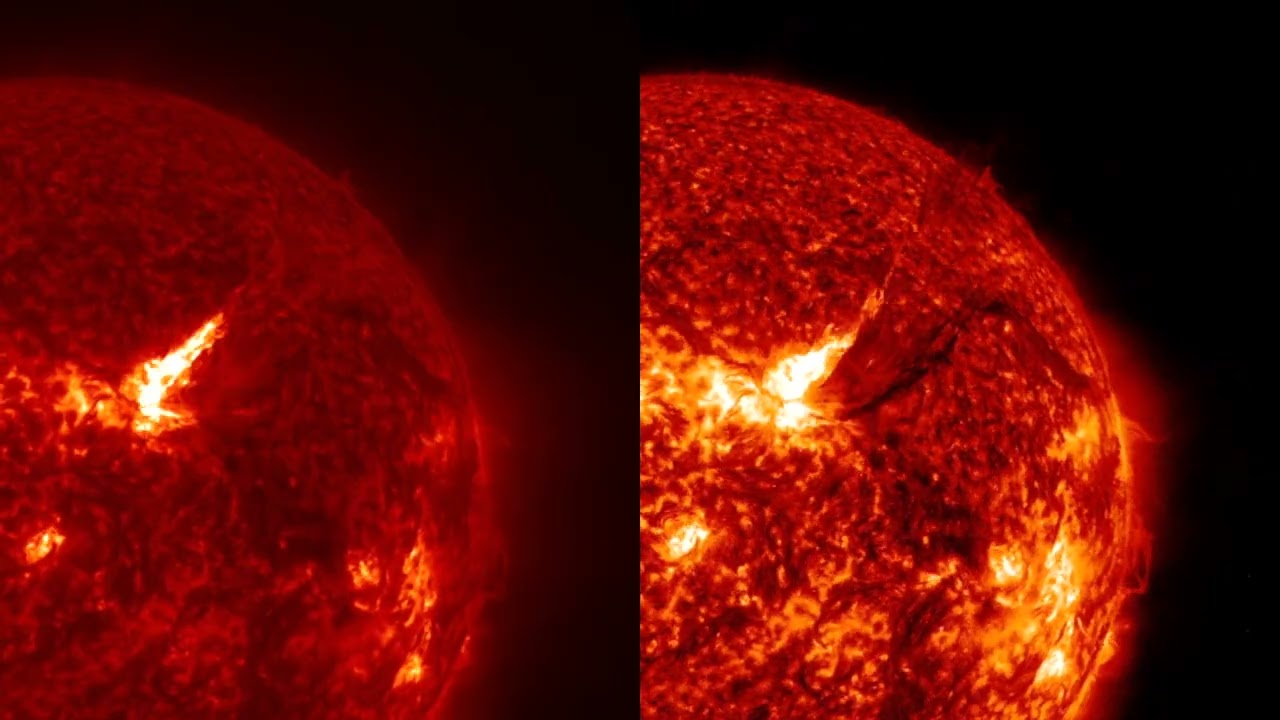
Solar Flares and CMEs at Earth - More Likely | S0 News June.3.2026
SpaceWeatherNewsS0s
2K views•2026-06-03



