Asteroid 2026 JH2, discovered only 8 days before its closest approach to Earth at 90,000 km (nearly 4 times closer than the Moon), illustrates the critical challenge of detecting small, dark near-Earth objects that approach from the Sun's direction, creating blind spots for ground-based telescopes; while NASA confirmed no impact risk, this event demonstrates that even a basketball court-sized asteroid moving at 15 km/s could cause regional damage through atmospheric air bursts, and the 8-day detection window is insufficient for deflection missions like DART, highlighting the urgent need for space-based detection systems like NEO Surveyor to identify potential threats years in advance.
Install our extension to search inside any video instantly.
This Asteroid passed Closer Than the MoonAdded:
A few days ago, we didn't know this existed. Now it is passing closer than the moon. A telescope in the Arizona desert caught a flicker of light moving faster than any star.
Within hours, NASA's orbital computers flagged it. Within days, it became one of the most significant lunar distance flybys of the decade. It's called 2026 JH2. It's the size of a professional basketball court. And this Monday, it's coming closer to us than the moon. In fact, it will pass just 90,000 km from our surface. NASA says there is no danger of impact this time. But here is the part that should keep you up tonight. [music] The asteroid was only detected days before its closest approach. A reminder of how difficult small, dark objects are to spot. So, we're looking at the path of this cosmic intruder, the blind spot that nearly hid it from us, and what would happen if the math was off by just 1%? 2026 JH2 was discovered by the Mt.
Lemmon Survey. This is part of a global planetary defense network designed to find rocks before they find us. But space is big and asteroids are incredibly dark.
Most of these near-Earth objects come at us from the direction of the sun.
This creates a literal blind spot where our ground-based telescopes can't see.
2026 JH2 emerged from that dark zone just last week. Eight days sounds like a lot of time, but in orbital mechanics, it's a heartbeat.
If this rock were on a collision course, eight days wouldn't be enough to launch a deflection mission. We would have been spectators to history. But how much damage can a basketball court really do?
To understand the power of 2026 JH2, we have to look back at February 2013. The Chelyabinsk meteor was roughly 20 m wide. It exploded 30 km above Russia with the force of 500 kilotons of TNT, 30 times more powerful than the Hiroshima bomb. And here's what makes this even worse. We almost didn't see it at all. 2026 JH2 is significantly larger and moving at a staggering 15 km per second. If this object entered our atmosphere, it wouldn't just be a pretty light show. It would create powerful air bursts capable of regional damage.
But Monday's event isn't about an impact. It's about the gravity slingshot. When a rock passes this close, Earth's gravity actually changes the asteroid's future.
This Monday at approximately 21:23 UTC, Earth will reach out and grab 2026 JH2.
Because it's passing at only 90,000 km, our planet's gravitational well will pull on the rock, slingshotting it into a completely new orbit. This makes 2026 JH2 a chaotic object. Every time it visits us, its path changes. Scientists are working around the clock to calculate where it will go next. Is it being flung safely away into the deep solar system, or is it being set up for a direct hit decades from now? In 2022, NASA proved we could change an asteroid's path with the DART mission.
But that mission took years of planning.
But for an object like 2026 JH2, discovered with only an 8-day lead, DART wouldn't work. Our best defense right now is the NEO Surveyor, a space telescope designed to sit in the blind spot and find these rocks years in advance. But until that is fully operational, our detection systems are improving, but gaps still exist. 2026 JH2 is a reminder that the solar system is a shooting gallery, and we are living in the gaps between the bullets. If you have a decent backyard telescope, anything with a 6-in aperture or larger, you can actually see this happen.
On Monday night, 2026 JH2 will reach a magnitude of about 11.5.
It won't look like a fireball. It will look like a star that is moving way too fast. In fact, its apparent motion will be so quick, you'll be able to see it move across the background stars in real time. 2026 JH2 is a guest passing through our neighborhood. It's a scientific gift that allows us to study the bones of our solar system up close, but it's also a warning. This one missed, but the next one might not, and we might not see it coming.
You can check out our video about NASA's plan in case something from space was heading toward us.
And if you want to stay updated on the latest discoveries in 2026, hit subscribe. We'll see you at the flyby.
Fuel your curiosity.
Related Videos

Spiral Galaxy NGC 3370 from Hubble | NASA APOD 2025-11-05 #Shorts
galaxygallery
938 views•2026-05-30

SOMETHING inside the SUN is CHANGING
RaysAstrophotography
1K views•2026-06-03

Captured the Blue Moon (with a twist) 🌙✨ #space #bluemoon #telescope
realAstroExplorer
674 views•2026-06-01

There May Be A Giant Hole In The Universe... And We Might Be Inside It | The Cosmic Ledger Entry 015
TheCosmicLedger
145 views•2026-05-31

The Map We Sent to the Stars in 1977 — Why Scientists Now Regret It
TheAncientRecord7
183 views•2026-06-03

10 Planet Where a Black Hole Replaces the Sun
cosmicexplorer-EN
147 views•2026-06-02

Is this a copy of our galaxy? Discover Galaxy M81!
UniverseDocumentaries-cc4mb
995 views•2026-05-31
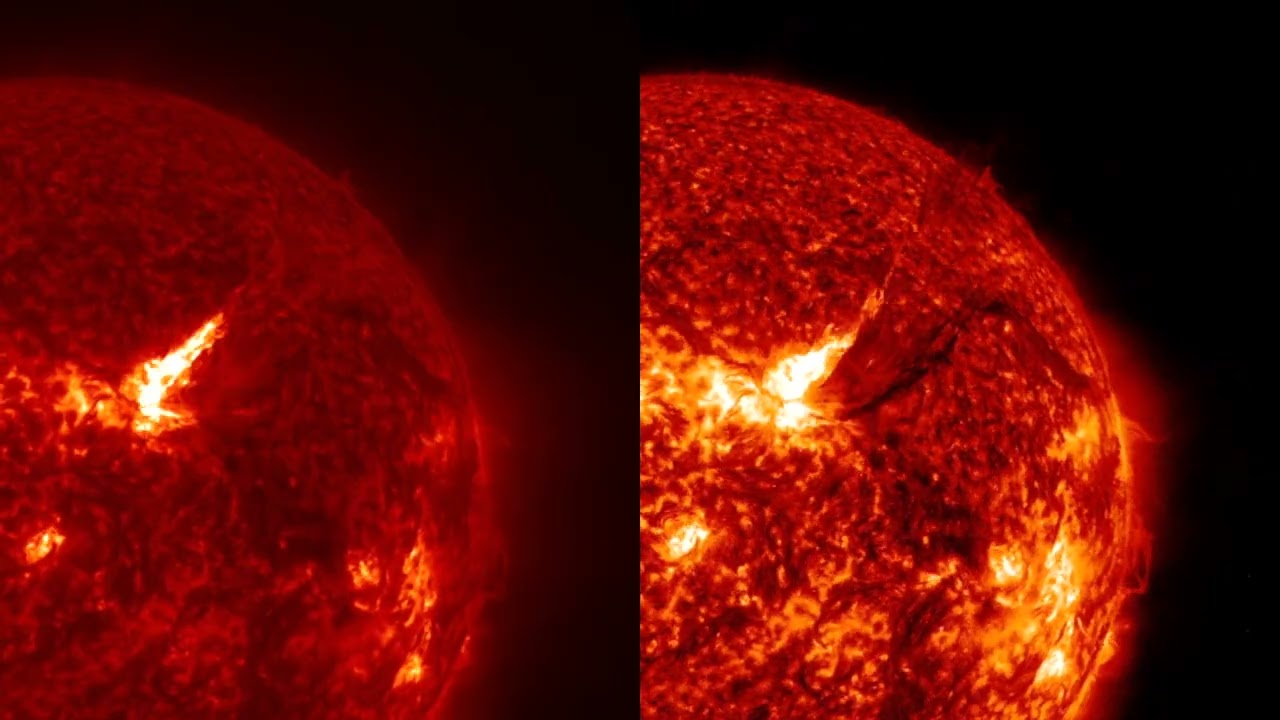
Solar Flares and CMEs at Earth - More Likely | S0 News June.3.2026
SpaceWeatherNewsS0s
2K views•2026-06-03



