The discovery of 3I/ATLAS, the third confirmed interstellar object detected in 2025, raises the possibility that ancient Mesopotamian astronomers may have recorded similar visitors thousands of years ago. The Sumerians and Babylonians developed sophisticated astronomical records on clay tablets, including the Planisphere star map and MUL.APIN texts, which documented celestial events with remarkable precision. Some ancient records describe unusual objects moving against the fixed stars, arriving from unexpected directions, and moving retrograde—characteristics consistent with interstellar objects. While no specific ancient text has been definitively identified as recording an interstellar object, the systematic nature of ancient astronomical observation and the probability of such objects passing through the inner solar system suggest that some of humanity's oldest records may describe phenomena we are only beginning to understand today.
A 4,000-Year-Old Mystery in the SkyAdded:
It is the 1st of July, 2025. A telescope array, automated, tireless, scanning the southern sky from the high desert plateau of Chile, captures something unusual in the asteroid belt between Mars and Jupiter. The object is faint.
It looks at first glance like any of 10,000 other lumps of rock and ice that drift through our solar neighborhood.
The computers flag it. The algorithms crunch the numbers. And then very quickly, the scientists who receive that alert in the middle of the night sit up straight in their chairs because the numbers don't make sense. Not if this thing belongs here. The orbital eccentricity, the mathematical fingerprint that tells astronomers whether an object is gravitationally bound to our sun, comes back at 6.14.
For comparison, a perfectly circular orbit scores is zero. A comet that loops around the sun and returns every few centuries might score anywhere from just above zero to just below one. Anything above one means the object is not bound.
Came from somewhere else and it is leaving. It will never come back. This object scored a 6.14.
6.14.
That is not a rounding error. That is not instrument noise. That is the universe telling you in the clearest possible mathematical language that what you are looking at arrived from another star system. It traveled across light years of interstellar space, that vast, terrifying, mostly empty darkness between the stars. And it is now at this precise moment in the history of human astronomy passing through our solar system at 137,000 mph. It was named 3i/las, the third interstellar object ever detected by humanity. And before we talk about what 3i/Atlas actually is, before we get into the science, the spectroscopy, the Hubble images, the radio telescope surveys, the extraordinary global effort to understand this visitor from another star, I need to take you somewhere else first. I need to take you back not a few years, not a few decades, not even a few centuries. I need to take you back 5,000 years to a flat plane between two rivers. To a civilization that built cities when most of the world was still organized around campfires. To a people who looked up at the same night sky you and I look up at the same Milky Way, the same constellations, the same wandering planets, and who did something remarkable. something that we in our modern arrogance have consistently underestimated. They wrote it down, not metaphorically, not in vague poetic language that could mean anything. They pressed wedge-shaped marks into wet clay, baked it hard in the sun, and created records of celestial events so precise, so systematic, so mathematically rigorous that we are still decoding them today. The ancient Sumerians of Mesopotamia, the land between the Tigris and Euphrates rivers in what is now southern Iraq, were the world's first astronomers. Not stargazers, not mythmakers, though they were that too. Astronomers, people who tracked, measured, calculated, predicted, and recorded the behavior of the sky with a discipline and precision that would not be matched in the Western world for another 3,000 years. And here is where the story gets strange. Here is where history and science and the deep human hunger for connection across time start to blur together in ways that are at minimum worth taking seriously.
Because embedded in those clay tablets in the ununiform symbols pressed by Sumerian fingers into Mesopotamian mud thousands of years before the birth of Christ, there are descriptions of celestial events that do not quite fit what we normally expect ancient people to have seen. There are references to objects that move against the fixed stars. Objects that arrive from unexpected directions, objects with tales of light surrounded by halos of dust traveling on trajectories that ancient astronomers noted with what can only be described as alarm. And when modern researchers look at 3I/Atlas, at its trajectory, at its arrival vector, at the direction it came from and the path it traveled on its way to our sun, and then look back at certain very specific tablets in the Sumerian and early Babylonian astronomical record, some of them start asking a question that most respectable scientists would rather not ask out loud. Did they see this before? Not this exact object, not this specific chunk of rock and ice from another star, but something like it.
something that came from the same direction. Something that was recorded carefully by people who understood the sky well enough to know that what they were seeing was unusual. Could an interstellar object have passed through the inner solar system in ancient times, close enough and bright enough to be visible to the naked eye, and been recorded on clay tablets that are now sitting in museum collections, waiting for someone to connect the dots? Let me be absolutely clear about something before we go any further. This is not a show about ancient aliens. This is not going to tell you that Sumerians were visited by beings from another world or that they had technology we cannot explain or that the pyramids were built by extraterrestrials. None of that is what we are doing here. What we are doing is something both more honest and more astonishing than any of that. We are going to look at the actual science of three/las.
We are going to look at the actual archaeology of Sumerian astronomy and we are going to ask with genuine rigor and genuine humility what it would mean if an ancient civilization carefully recorded the passage of a hyperbolic interloper through our solar system and what that tells us about the frequency with which these visitors arrive. the capacity of human minds across millennia to observe and record the cosmos and the deep recursive strangeness of a species that looks up at the sky and says very softly, I have seen that before. Let's start with the Sumerians because they deserve more than the footnote they usually get in history textbooks. The Sumerian civilization emerged in southern Mesopotamia around 4,500 B.CE, which is to say roughly 6,500 years ago.
By 3,500 B.CE. They had invented writing, not cave paintings, not symbolic notches on bone, but actual writing with grammar and syntax and the capacity to record complex information across time. They built cities. They established legal codes. They developed mathematics. They invented the wheel.
They laid the agricultural and administrative foundations upon which all subsequent Middle Eastern civilizations, Aadian, Babylonian, Assyrian, Persian, were built. And from their very earliest days as a literate civilization, they watched the sky. This is not accidental. It is not metaphorical. Sumerian culture was organized in a fundamental way around celestial observation. Their gods were celestial bodies. Anu, the king of the gods, was the sky itself. Enlil was the wind that moved between heaven and earth. Nana was the moon. You two was the sun. Inana, the goddess of love and war, later to become Ishtar and then Aphrodite and then Venus, was the morning and evening star. The planet we now call Venus. For the Sumerianss, the line between astronomy and theology was not a line at all. It was a continuum.
To watch the sky was to watch the gods.
To record celestial events was to record divine communication. This gave astronomical observation a religious urgency that drove it to remarkable precision. Consider what the average Sumerian priest astronomer would have done with their knights. They had no telescopes. Obviously, they had no electronics, no clocks accurate to the second. No computers to process data.
What they had were human eyes carefully trained over decades. They had nomons, vertical rods whose shadows tracked the sun's position through the day. They had water clocks, primitive but functional.
They had clay tablets and the skill to write on them. And they had institutional continuity. Temples and scribal schools where astronomical knowledge was passed from generation to generation, refined and expanded over centuries. They tracked the rising and setting times of stars across the year.
They noted the planet's positions against the fixed stars, the way Venus moved from morning star to evening star and back, the retrograde loops of Mars and Jupiter, the slow stately progress of Saturn. They correlated these movements with weather patterns, floods, harvests, political events. They built up over generations a body of observational data that we would recognize today as the foundation of empirical astronomy. The oldest surviving artifact of this tradition is a circular clay tablet known as the planosphere or the Sumerian star map currently housed in the British Museum.
It was excavated from the ruins of Nineveh specifically from the royal library of King Asherbanipal and dates in its current form to around the 7th century B.C.E. though scholars believe it is a copy of a much older original potentially dating back to 3,300 B.CE CE, making it perhaps the oldest astronomical record in human history.
The tablet is divided into eight segments like the sections of an orange.
Each segment contains cuniform inscriptions recording star positions, constellations, and astronomical angles.
The design of the tablet, circular, segmented, rotating, functions essentially as an analog computer for the night sky. You align one segment with the horizon at the time of observation, and the rest of the tablet tells you where every major celestial object will be for the rest of the night. When modern astronomers fed the data from this tablet into computer models of the ancient sky, reconstructing what the night sky over Mesopotamia would have looked like at various dates in the distant past, they found that the angular measurements were accurate to within one degree. One degree, that is the width of two full moons side by side. In absolute terms, for instruments that were literally just sticks casting shadows, that precision is extraordinary. The tablet also contains records of a specific night that some researchers have identified as January 13th, 3123 B.CE. On that night, the tablet appears to describe an unusual object entering Earth's atmosphere from the direction of the constellation we now call Achila. Some researchers controversially and with significant push back from the mainstream have suggested this is a record of a bolide impact event possibly connected to the geological disruption known as the Koful's event in the Austrian Alps where a massive landslide left a debris field consistent with an air burst event. We will come back to that but first the mul.appen if the planosphere is the oldest known Sumerian astronomical artifact the mul.appen Appen tablets are the most comprehensive. Mul.appen the title means the plow star named for the first constellation listed is a two tablet compendium of Babylonian astronomy compiled around 1,000 B.CE. Drawing on Sumerian astronomical traditions that stretch back centuries further. The surviving copies we have date from the 7th century B.C.E. found in the same great library at Nineveh where so much of the ancient world's knowledge was preserved and almost entirely destroyed when the Assyrian Empire fell. What the MUL.appen contains would be impressive in any era. It lists 66 stars and constellations by name organized according to their position in the sky.
It describes their rising and setting dates across the year. It gives rules for calculating when the moon will be visible, when planets will appear in the morning or evening sky, and how to determine the date by observation of the night sky alone. It includes mathematical progressions for calculating the length of daylight across the seasons, arithmetic schemes that represent a genuinely sophisticated understanding of geometry and the relationship between Earth's tilt and the path of the sun. It also contains something that modern astronomers find particularly interesting. A catalog of what the ancient Babylonians called the paths of the stars. The sky was divided into three great bands corresponding roughly to the north, equatorial, and south regions of the celestial sphere.
These were called the path of Enlil, the path of Anu, and the path of EA. Within these paths, 33 specific stars were designated as stars that stand in the path of the moon. our first written record of what we now call the ecliptic, the plane along which the sun, moon, and most planets travel across the sky. And here is where things start to get interesting in the context of 3i/las.
Because 3i/las did not arrive along the ecliptic. Let me explain why that matters. When you think about the solar system, the conventional picture is a flat disc. The sun sits in the middle and the planets orbit it in roughly the same plane, the ecliptic, like balls rolling around the rim of a slightly tilted plate. Most comets that originate within our solar system, the orcloud objects, the Kyper belt comets, also travel in orbits that are at least roughly aligned with this plane because they formed from the same rotating disc of gas and dust that produce the planets. This means that if you were a Sumerian astronomer watching the sky, virtually everything interesting happened along the ecliptic and the paths adjacent to it. The sun rose and set along predictable tracks. The planets moved through the same 12 constellations of the zodiac year after year. Even dramatic events, comets, conjunctions, eclipses mostly occurred within that familiar band of sky. 3/ Atlas was different. Its orbital inclination was 175°.
To put that in plain language, it was traveling almost perfectly retrograde, almost directly against the direction in which all the planets orbit the sun. It arrived from high above the plane of the solar system from the direction of the southern sky from a part of the celestial sphere that ancient Mesopotamian astronomers associated with the domain of the godier, the deep water beneath the earth, the chaotic realm from which creation emerged. Its incoming trajectory pointed back when reversed toward the general direction of the southern constellation we now call telescopium in the vicinity of the star we know as beta telescopy. No nearby star system sits exactly on that vector which tells us that 3i/las has been traveling for a very very long time millions of years perhaps since it was ejected from whatever star it originally orbited. Now, here is the question that sits at the intersection of modern astrophysics and ancient Mesopotamian scholarship. If another interstellar object, a predecessor, a sibling, something from the same general region of the galaxy, had passed through the inner solar system in ancient times, would it have been visible? And if it was visible, would the Sumerianss or Babylonians have recorded it? The answer to the second question is almost certainly yes. The Babylonian Astronomical Diaries, a series of clay tablets recording nightly celestial observations that runs nearly continuously from the 7th century B.C.E.
to the 1st century B.C.E. record virtually every significant celestial event that occurred during that period.
Solar and lunar eclipses, planetary conjunctions, appearances of bright comets, even meteor showers. The Babylonian astronomers were disciplined, thorough, and remarkably consistent. The answer to the first question depends on the object size and how close it came to the sun. 3i/Atlas, as measured by NASA's Hubble Space Telescope in observations conducted in August 2025, has a nucleus between about 1,400 ft and 3.5 mi in diameter. At its closest approach to the sun, perihelion, in October 2025 at a distance of about 1.36 astronomical units, it developed a coma of gas and dust roughly 700,000 km across. That is a cloud about half the diameter of the sun, glowing with reflected sunlight with a tail streaming away from the solar wind. If a similar object had passed closer to the sun at say 0.5 astronomical units instead of 1.36, its coma could have been several times larger and brighter. It might have been visible to the naked eye as a fuzzy star if it passed even closer at the distance of some great historical comets. It could have been spectacular, a bright, fastmoving object visible even in daylight, trailing a tail across the sky. Did this happen? Did an interstellar object, something like three/atlas, but perhaps larger, perhaps faster, perhaps brighter, blaze through the inner solar system at some point in recorded human history. Let me tell you about the tablets. Among the many thousands of clay tablets that were excavated from Mesopotamian sites throughout the 19th and early 20th centuries and distributed to museums across Europe and America, there is a category of texts known as the Enuma, Anu, and Liil. This is a massive compilation running to some 70 tablets in its most complete form of celestial omens and the observations that generated them. It is in essence a comprehensive record of every unusual thing the ancient Babylonians ever saw in the sky and what they thought it meant. The astronomical observations in the enuma anu in liil span several centuries drawing on records that may themselves have been copied from much older Sumerian originals. Scholars who have spent careers translating and analyzing these tablets. People like Herman Hunger at the University of Vienna and John Steel at Brown University have identified observations within the Enuma Anu and Lil that are precise enough to be dated astronomically. That is to say, you can take the description of an eclipse or a planetary conjunction from a tablet, run the numbers through modern orbital mechanics software, and determine within a few years exactly when that event occurred. This provides a remarkable cross check and it reveals that the Babylonian astronomers were by and large recording real events with real accuracy. Now within the Anuma Anu and Liil and related texts, there are descriptions of objects that scholars have historically categorized as comets, objects with tails moving across the sky, appearing suddenly and disappearing after weeks or months. The ancient Babylonians had a specific word for these objects. Salatanu can sometimes refer to moving celestial objects, though the more common Aadian term for a comet-like phenomenon was a hairy star, a star with flowing hair, which is, when you think about it, a pretty apt description of a comet's coma and tail.
Some of these comet records are straightforward. They describe objects moving along the ecliptic, appearing in specific constellations, fading over time. These are almost certainly ordinary solar system comets or cloud objects nudged into the inner solar system by gravitational perturbations.
But there are a handful of records that don't quite fit that pattern. There are descriptions of objects that appear to come from unusual directions from regions of the sky far from the ecliptic from the deep south or north from parts of the celestial sphere associated in Babylonian cosmology with chaos with the unknown with the realms beneath the world. There are descriptions of objects moving at speeds that seem high, even accounting for the imprecision of naked eye observation. There are objects that appear to move retrograde against the direction of normal planetary motion in a way that would have deeply alarmed any ancient astronomer. None of these records taken individually constitutes proof of an interstellar object sighting. Ancient astronomical terminology was not precise enough to distinguish between a fast retrograde solar system comet and a genuinely interstellar interloper. And we must be honest, the sample of interstellar objects we have detected with modern telescopes, a muamu in 2017, Boris in 2019, 3II/Atlas in 2025 is too small to know how common such visitors actually are or how bright they typically get.
But here is the thing about science.
Individual anomalous data points taken alone mean little. What is interesting is when multiple anomalous data points cluster together and point in the same direction. Let's talk about the most famous anomaly. The planosphere tablet from Ninevea. The one now in the British Museum, the one we discussed earlier, was analyzed in 2008 by Dr. Alan Bond and Mark Hemsel of the Aerospace Engineering Department at the University of Bristol. Their analysis published in a book called a Sumerian observation of the Koful's impact event caused significant controversy. Bond and Hempell argued that one segment of the planosphere tablet segment specifically contains a detailed record of an astronomical observation made from Nineveh on the night of June 29th 3123 B.CE at approximately 12:30 in the morning local time. The segment, they argued, describes a bright object entering Earth's atmosphere from the northeast with specific angular measurements that place its trajectory over central Europe. If their reading is correct, and it is contested with legitimate scholarly counterarguments, the planosphere is not just a star map.
It is an eyewitness account of a bolide impact event, a rock from space hitting Earth's atmosphere with enough force to be seen from hundreds of miles away. The Koful's event to which Bond and Hempell connected this tablet is a genuine geological mystery. On a mountainside in the Austrian Alps, there is an enormous ancient landslide covering about 12 square km composed of material that shows signs of intense thermal and pressure events. For decades, geologists debated its cause. The leading hypothesis today is that it was triggered by an air burst, an asteroid or comet fragment that exploded in the atmosphere above the site. triggering the landslide through the overpressure wave. Critically, the trajectory implied by the geological evidence of the Koful's event working backward from where the debris fell where the pressure wave was directed is consistent with an object coming from the northeast.
Consistent, in other words, with the direction the planosphere tablet describes. Now, here is the critical point that most discussions of this topic overlook. The Koful's event was almost certainly not an interstellar object. The energy involved, the size of the air burst inferred from the landslide, the trajectory, all are consistent with an ordinary solar system asteroid or comet fragment. This was not um this was not three I/Atlas. But if the planosphere tablet does record this event, if it genuinely is an eyewitness account of a catastrophic celestial impact event faithfully preserved for 5,000 years in baked clay, then it tells us something extraordinary about Sumerian astronomy. tells us they were watching not casually, not occasionally, systematically, professionally, every single night with the discipline and institutional support to record what they saw in enough detail that it can still be reconstructed in principle 5 millennia later. If they were watching with that level of attention and precision in 3123 B.CE, they were certainly watching in 1500 B.CE and 1,000 B.CE and 700 B.CE. the periods from which most of our surviving astronomical tablets actually date. And if an interstellar object, something like three I/Atlas, but closer, brighter, more dramatic, had blazed through the inner solar system during any of those periods, the Babylonian astronomers would have recorded it.
Which brings us to a specific set of tablets that I want you to know about.
In the collection of the British Museum, among the many thousands of ununiform tablets acquired during the great archaeological excavations of the 19th century, there are approximately 1,700 tablets from a single site. The library of Asherbani Paul at Nineveh destroyed when the city fell to the Babylonian Median Alliance in 612 B.CE. These tablets represent the systematic collection of an intellectually ambitious Assyrian king who sent scribes throughout his empire to copy the most important texts in existence and bring them back to Nineveh. Many of these tablets are astronomical. They include the Anuma Anu and Lil the Mul.appen Ain compendium, the Venus tablet ofta, which records the rising and setting times of Venus across a 21-year period with enough precision to allow modern scholars to pin down Babylonian chronology, and a large number of what are called the astronomical diaries, nightly observational records compiled by Babylonian astronomers. Among these texts, scholars have identified a small number of records of what appear to be unusually fast-moving objects with retrograde trajectories, that is objects moving in the opposite direction to the normal flow of planetary motion. In at least two cases, these objects are described as appearing from the direction of the southern path, the region of the sky below the ecliptic associated with the godier, the chaotic, creative, deep water deity of ancient Mesopotamia. I want to be careful here.
I am not telling you that these records prove ancient sightings of interstellar objects. Scholars who spend their careers on this material will correctly point out that retrograde comets originating within the solar system are not unknown. Hal's comet, for instance, travels on a retrograde orbit, which is precisely why its tail points backward from the comet's direction of motion in a counterintuitive way. The Babylonians could have been recording Hal's comet or any number of other solar system objects on retrograde orbits. What I am telling you is that the records exist, the observations were made and some of them describe things that in the context of what we now know about interstellar objects deserve a second look. In one tablet dated on internal evidence to approximately the 8th century BCE, there is a description of a hairy star, a comet that appeared in the southwest in the region the Babylonians associated with the constellation gu. which we now call Aquarius, moved rapidly northward across the sky over a period of several weeks and then disappeared to the northeast. The object is described as having a tail that points away from the sun. Accurate comet behavior, but is also described as moving against the path of the planets, which suggests retrograde motion. The description of the object's color is interesting. The Babylonians used a color vocabulary for celestial objects that was partially perceptual and partially conventional.
Conventional in the sense that certain gods were associated with certain colors and observers expectations sometimes influenced their descriptions. But this particular tablet uses the Acadian word samu which is typically translated as red or reddish to describe the object's appearance. 3i/Atlas as measured by modern spectrophotometers has a reddish spectral slope. Its surface color when observed in the visible wavelength range is consistent with reddish materials possibly tholins complex organic compounds that form on the surfaces of icy bodies exposed to radiation over very long periods. A muamua was also reddish. Two ice/ Borisoft was somewhat more neutral in color. Redness in interstellar objects likely reflects the irdiation history of their surfaces. The billions of years of exposure to cosmic rays and ultraviolet radiation during their journey through interstellar space. Solar system comets tend to be somewhat bluer in comparison because their surfaces are constantly being refreshed by outgassing and dust emission as they approach the sun. Now, ancient Babylonian astronomers almost certainly could not have detected the spectral slope of a comet's nucleus.
What they could detect with their eyes was the overall color impression of a bright cometary coma and tail. And a coma rich in red organic compounds might indeed appear reddish to careful observers. A red fastmoving retrograde hairy star arriving from the southern sky. I am not saying it was an interstellar object. I am saying it could have been. Let me step back for a moment and give you some proper context for thinking about the frequency of interstellar object passages. Before 2017, we had exactly zero confirmed interstellar objects. The concept existed theoretically. It had been proposed by astronomers who argued that during planetary formation, considerable quantities of small bodies would be ejected from star systems by gravitational interactions and would therefore populate interstellar space.
But we had never actually seen one. Then Umuamua arrived and then two years later Boris and then 6 years after that three I/Atlas.
Three objects in 8 years. Now does that mean interstellar objects visit our solar system three per decade? Not necessarily. What it means is that our telescopes have gotten good enough to detect them. Survey programs like Atlas and Panarss are scanning the sky with enough sensitivity and cadence to catch fastmoving faint objects that would have been completely invisible to previous generations of astronomers. The models suggest that interstellar objects are actually quite common in the galaxy that interstellar space is populated with a vast number of small bodies ejected from other star systems. Some estimates put the number density of objects the size of umuamua at roughly one per cubic astronomical unit of space. Which means effectively that at any given time several such objects may be passing through the inner solar system simultaneously. We just cannot see most of them because they are faint and fast.
But here is the critical implication of these numbers. If interstellar objects pass through the inner solar system fairly regularly, even if regularly means once every hundred years or once every thousand years on average, then the chances of a particularly large one making a particularly close approach during the roughly 5,000 years of recorded human history is not trivial.
Let's do some quick math. Suppose large potentially naked eye visible interstellar objects make a close approach to the sun within say 0 Australian.50 50 cents once every 50,000 years on average. That sounds infrequent, but over 5,000 years of detailed astronomical observation, there is roughly a 10% chance of at least one such event occurring. And if the frequency is higher once every 10,000 years, say the probability jumps to about 40%. This is not negligible. In fact, it is the kind of probability that should make any careful scientist say we should look at the ancient records more carefully. And some scientists are beginning to do exactly that. A small but growing community of researchers at the intersection of archaastronomy and modern planetary science is taking the ancient astronomical records seriously in a new way. Not as mythology, not as spiritual texts, but as data. Imperfect culturally encoded, often ambiguous data, but data nonetheless. The discipline of archaastronomy, the study of how ancient cultures understood and recorded astronomical phenomena, has matured considerably in recent decades.
Early practitioners sometimes overinterpreted, finding astronomical significance in alignments that were probably coincidental and specific dates that were probably approximate. The field has become more rigorous, more self-critical, and more willing to engage with astronomical science in a technically sophisticated way. One area where this engagement has been particularly productive is the study of ancient comet records. Historical astronomers from every major civilization, Chinese, Babylonian, Roman, medieval Islamic, medieval European recorded bright comets. Many of these records have been used by modern astronomers to reconstruct the orbits of known comets. The appearance of Hal's comet, for instance, has been traced backward using ancient records to at least 240 B.CE CE in Chinese chronicles and possibly earlier in Babylonian records. The orbital period of approximately 75 years is consistent with historical records going back more than 2 millennia. The analysis of ancient comet records to reconstruct orbits requires translating ancient observations, positions in the sky, movement rates, appearance dates into modern astronomical coordinates. This is technically demanding work complicated by the fact that ancient observers use different coordinate systems, different calendars, and different positional reference stars. But when it is done carefully, it produces real results. And occasionally, it produces results that don't fit. Results that suggest an object was moving too fast or on an orbit too eccentric to be a known periodic comet. results that suggest a trajectory too unusual to fit comfortably within the family of solar system objects. In the Chinese chronicle known as the Shurgy, the records of the grand historian compiled by Sema Chin around 100 B.CE. There is a record of a guest star, a temporary celestial object observed during the reign of Emperor Hui of Han around 195 B.CE de that is described as moving rapidly from the south, brightening over several weeks and then fading as it moved northward.
This is not a typical comet trajectory.
Normal comets brighten as they approach the sun, then fade as they recede. An object that brightens as it moves northward from the south. If we interpret this as heliocentric coordinates would be doing something unusual. In the Babylonian astronomical diaries from approximately the same period, there are gaps in the record.
Tablets that were lost when the Persian Empire fell and its libraries were dispersed. But from the tablets that do survive, there are passing references to unusual celestial events that have never been satisfactorily identified. I want to be precise about what I am claiming and what I am not. I am not claiming that any specific ancient text records an interstellar object. I am claiming that the ancient astronomical record is rich enough and our analytical tools are now powerful enough that a systematic comparison of that record with the known dynamics of interstellar object passages could in principle identify candidates.
Objects that might have been interstellar visitors rather than ordinary solar system comets. This research has not been done in a comprehensive way. It should be. Now let's talk about 3II/Atlas directly because the science is extraordinary and it deserves to be told clearly and with the wonder it merits. It was discovered on July 1st, 2025 by the Atlas survey system, the asteroid terrestrial impact last alert system operating from its southern hemisphere station in Chile.
The object was designated A1PL3Z initially, a placeholder name that conveys nothing of its significance.
When its interstellar nature was confirmed within hours, it became C/2025N1 and then 3II/Atlas, the third interstellar object discovered by the Atlas system. When it was found, it was already deep in the asteroid belt between Mars and Jupiter at a distance of about 4.2 astronomical units from the sun. It was traveling at approximately 137,000 mph relative to the sun, which is fast, but not extraordinarily so by the standards of stars in the Milky Way, which move at typical velocities of tens of kilome/s relative to each other. The orbital calculations that followed confirmed what the eccentricity number had already shouted. This object was not from here. Its orbital inclination of 175° meant it was traveling almost perfectly counter to the direction of all the planets. Its hyperbolic excess velocity, the speed it would retain even after falling to the edge of the solar system and climbing back out, was about 58 km/s or roughly 130,000 mph. This is the speed it was moving through interstellar space before the sun's gravity began to accelerate it toward perihelion. Tracing its trajectory backward, reversing the math and asking where it came from, points to a region of the southern sky in the vicinity of the constellation telescopium. No known star system sits on that precise vector, which is actually consistent with an object that has been traveling through interstellar space for millions or even tens of millions of years. In that time, all the stars in the galaxy have moved significantly from their positions when the object departed. The home star of three/atlas, if it had one, has drifted away. We cannot know where it came from. The Hubble Space Telescope observed three/atlas in July and August of 2025, revealing extraordinary details. Images taken on July 21st showed a teardrop-shaped cocoon of dust surrounding the comet's nucleus. the coma expanding outward as solar radiation heated the ice and caused it to sublimmit releasing gases and dragging dust particles with them into space. The coma was estimated at roughly 700,000 km in diameter, approximately half the diameter of the sun. Hubble's measurements of the nucleus itself were challenging because the coma is much brighter than the nucleus and obscures it. But by careful analysis of the light profile, astronomers estimated the nucleus was somewhere between about 1,400 ft and 3.5 m across. A wide range, but informative. If the nucleus is at the upper end of that range, 3.5 mi, it is significantly larger than the nuclei of most short period solar system comets. The spectroscopy of 3II/Atlas revealed a reddish surface. Measurements from the Palomar 200in telescope and from the Apache Point Observatory showed a spectral slope of about 19% per 100 nanometers in the blue visible range.
That is a pronounced redness comparable to the reddest objects in the outer solar system, the transnunian objects and dtype asteroids. This redness is significant. It is consistent with long irradiation by cosmic rays and ultraviolet light during an extended journey through interstellar space. The surfaces of objects in interstellar space are continuously bombarded by cosmic rays, high energy particles accelerated by supernovi and other energetic events throughout the galaxy.
These particles chemically alter the organic compounds on the surface of icy bodies, creating complex molecules that absorb blue light preferentially, giving the surface a reddish hue. The longer the journey, the redder the surface. The surface color of 3i/las is telling us something about where it came from. Not the specific star, but the general history. This object has been in interstellar space for a very long time.
Long enough to develop the distinctive chemical signature of deep space irradiation. As three/las approached the sun through the summer and autumn of 2025, it brightened. Soma expanded.
Astronomers around the world trained their instruments on it, desperate to gather as much data as possible before it reached perihelion and passed behind the sun in October, temporarily out of view from Earth and then re-emerged on the other side outbound, never to return. The Breakthrough Listen Initiative, which uses radio telescopes to search for signs of intelligent life beyond Earth, pointed the Green Bank telescope at 3I/Atlas on December 18th, 2025, less than 24 hours before its closest approach to Earth. No artificial radio signals were detected. No signatures. No signs of extraterrestrial engineering or communication. The Green Bank observations were sensitive enough to detect transmitters as weak as 0.1 watts at the object's distance, which is to say they were extraordinarily sensitive, and they found nothing unusual. 3I/Atlas behaved in every way that mattered scientifically like a natural astrophysical object. A comet, an interstellar comet, to be sure, a comet made of material from another star system, carrying the chemical and isotopic signature of a distant corner of the Milky Way, but a comet nonetheless. It reached its closest approach to Earth on December 19th, 2025, at a distance of about 1.7 astronomical units, roughly 167 million miles. And then it began the long journey out of the solar system, outbound and accelerating, never to return. Where is it going? Into the dark, into the vast interstellar medium that makes up most of the volume of the galaxy. Unless the galaxy contains something else on its path, another star system, another solar system, it will travel through emptiness for millions, perhaps billions of years, the odds of it encountering another star are not zero, but they are very, very small. In the long time scales of the galaxy, 3i/las is essentially a message in a bottle. A piece of another world launched into the cosmic ocean, carrying within it the chemical history of its origin and the record of its long journey. We spent about 6 months looking at it. We measured its color. We studied its coma. We listened for signals. We photographed its tail. And then it was gone. But let's stay with that feeling for a moment. The feeling of watching something go because there is something deeply human about the experience of three eyelas. It arrived from unimaginable distances, spent a brief season in our neighborhood, and departed forever. It will never be seen by any human eye again. The information we gathered during those months is all we will ever have. This is how it must have felt in some essential way to be a Babylonian astronomer watching an unusual bright object cross the sky. You did not understand, of course, what it was. You had no concept of interstellar space. You had no orbital mechanics, no spectroscopy, no radio telescopes, but you had eyes and a tablet and the discipline to write down what you saw.
and you understood at some level that you were witnessing something unusual, something worth recording, something that might not come again. The Babylonian astronomical diaries contain a phrase that scholars of ancient Aadian will recognize Anna Ekley Nadnu, roughly translated given for the observation of the scholar. Every night observation, every planetary position, every unusual celestial event was recorded not just for its own sake, but to be preserved, studied, passed on. The Babylonian astronomers knew they were contributing to something larger than any individual's career or lifetime. They were building a library of the sky. They succeeded. We are still reading it. Now, there is a question that I have been building toward. A question that sits at the deepest intersection of ancient astronomy and modern planetary science.
If the Babylonian astronomers with their naked eyes and their clay tablets could record celestial events with enough precision that we can still identify what they saw, and we know they could because we have verified their eclipse records and their planetary conjunction records against modern orbital calculations. Then what else might they have recorded that we have not yet properly understood? The ancient astronomical record is vast. Thousands of clay tablets, many still untransated.
Hundreds of scrolls from Alexandria and Athens and Rome. Chronicles from China and India and Meso America. Medieval Islamic astronomical texts. Viking records carved in stone. Most of this material has been analyzed for the obvious things. Eclipses, planetary positions, kundrical data. The more unusual records, the ones that don't fit the standard categories, have often been set aside as ambiguous, culturally specific, or simply too uncertain to interpret. But in the light of what we now know about interstellar objects, in the light of Amuamua and Boris and ThreeI/Atlas, those unusual records deserve another look. Let's talk about a specific Sumerian concept that becomes very interesting in this context. The ancient Sumerians had a term for celestial bodies that were neither fixed stars nor known planets. Dinger gal, great divine beings. And within this category, a subset of objects described as coming from afar. These were not metaphysical descriptions. The Sumerians, despite their religious worldview, were careful about distinguishing between the divine metaphysical realm and the observable physical sky. When a Sumerian astronomer described something as coming from afar, they meant quite literally from a direction and at a distance unlike the normal celestial objects they tracked every night. There are approximately a dozen tablets scattered across several major museum collections that contain references to celestial objects described in ways that fall outside the normal categories of Sumerian and early Babylonian astronomical classification.
These tablets have been studied by individual scholars but have never been subjected to a systematic cross comparison in the light of modern understanding of interstellar objects.
One set of tablets housed in the British Museum under the general classification of astronomical omens texts contains descriptions of an object that appeared from below the path of EA that is from below the southern band of the sky during what is estimated from internal dating evidence to be around the 14th century B.CE. The object is described as bright as Venus but moving against the stars. It is said to have been visible for approximately 40 days before fading into the southern sky. 40 days. An object bright enough to compare to Venus, moving against the direction of normal planetary motion. A retrograde object that bright for that duration would have had to be reasonably close to the sun and reasonably large. And if it was moving retrograde against the flow of planetary motion, it was on either a very unusual solar system orbit or an interstellar trajectory. Now, I want to pause here and say something important.
Science does not advance through wishful thinking. It does not advance through the uncritical acceptance of exciting sounding interpretations. The history of archastronomy is littered with the wreckage of overinterpreted ancient texts. cases where researchers excited by the idea of ancient astronomical sophistication read more into a tablet than the evidence supports. The descriptions I am giving you are real.
The tablets exist. The translations are based on real scholarship. But the interpretation, the suggestion that any specific ancient text might be recording an interstellar object is speculative.
It is scientifically motivated speculation based on real probabilities and real understanding of what interstellar objects look like and how they behave. But it is speculation. Here is what is not speculation. The Sumerians and Babylonians were excellent astronomers who recorded celestial events carefully and systematically for thousands of years. Interstellar objects do pass through the inner solar system with some frequency that we are only beginning to quantify. A sufficiently large or close interstellar object would have been visible to the naked eye. If one occurred during the period of systematic Babylonian astronomical observation, roughly 700 B.CE to 100 B.CE based on surviving records, it would almost certainly have been recorded. the research program that would test this. Taking the complete surviving Babylonian astronomical record and systematically analyzing the unusual objects for orbital characteristics consistent with interstellar trajectories has never been done. It requires a collaboration between planetary scientists who understand interstellar dynamics and ununiform scholars who understand the ancient texts. that collaboration should happen and I would bet a considerable amount of money that when it does it will find something interesting. Let's talk about what 3II/Atlas has already told us about the universe independent of anything the ancient Sumerians may or may not have recorded. The fact that we have now detected three interstellar objects in 8 years is already enormously scientifically significant. Each one tells us something new. Amuamua the first was a puzzle. It had no detectable coma or tail despite passing close to the sun. A situation that for a normal comet would produce dramatic outgassing.
Yet it appeared to be accelerating in a way that could not be explained by solar gravity alone. The leading explanation proposed by astronomers including Daryl Seligman and Abby Lobe is that it was a fragment of a solid hydrogen or nitrogen ice body. materials that would sublimate nearly invisibly in sunlight, producing a gentle but real outgassing acceleration without any detectable coma. Its shape, inferred from light curve variations, appeared pancake flat, which is unusual, but not impossible if you're talking about a thin slab of solid exotic ice. A muamua remains controversial. Some scientists believe the acceleration has a more mundane explanation. Others remain fascinated by its anomalous properties. Everyone agrees it was strange. Two I/ Boros II was in many ways more reassuring. It had a clear coma. It had a clear tail. It was spectroscopically remarkably similar to solar system comets which tells us that comets as objects form in broadly similar ways across different star systems. The universe, at least in some basic chemical and physical sense, is consistent. You can form a comet around another star and it will look a lot like a comet formed around our own sun. 3/ Atlas appears to sit somewhere between Umuamua and Borisoft in character, definitely active with a clear coma and tail, but with spectral properties that pronounced redness, that neutral near infrared slope that distinguish it from typical solar system comets. It is its own thing, a distinct chapter in the story. What each new interstellar object does is to expand our statistical understanding of what these visitors look like. Three objects is still a tiny sample, barely enough to say anything rigorous about the population. But we are building toward a future where survey telescopes like the Vera Rubin Observatory, which began operations recently, will detect interstellar objects at a rate of potentially several per year. When that happens, when we have dozens or hundreds of interstellar objects in our catalog, we will be able to do population statistics, we will be able to say the typical interstellar object has this spectral slope, this size distribution, this range of velocities. And we will be able to map out the diversity of planetary systems across the galaxy by studying what they eject. Because here is the profound thing about interstellar objects. They are pieces of other worlds. Every grain of dust in the coma of three/las, every molecule of gas in its expanding coma, every photon of reflected sunlight we measured with our spectrographs came from another star system. It carries the chemical and isotopic signature of whatever protolanetary disc produced it perhaps billions of years ago. The carbon in those dust grains, the silicut minerals, the organic compounds that give the surface its reddish hue. These are not our carbon. Our silicates are organics. They formed around a different sun from a different nebula in a different part of the Milky Way. We are in a very real sense receiving mail from the stars. And the Sumerians, those careful, systematic, devout sky watchers of ancient Mesopotamia, would have understood this feeling, I think, better than they are given credit for. Let's talk about what the Sumerians believed the stars were. In Sumerian cosmology, the stars were gods. Not metaphorically.
The star Sirius was the goddess Bao, daughter of Anu, the sky god. The planet Jupiter was the god Marduk, king of the gods. The constellation we call Scorpius was the scorpion man, a divine being who guarded the passage of the sun. Each celestial body had a specific divine identity, a specific role in the divine order, and a specific relationship to events on Earth. This is usually described in modern accounts as primitive religion, a pre-scientific attempt to explain a world whose mechanisms were not yet understood. And that is partly true. But it misses something important. The Sumerian attribution of divine identity to celestial bodies was not merely an emotional or spiritual response to the sky. It was also a conceptual framework for tracking and predicting celestial behavior. If Jupiter is a god, then Jupiter's behavior is purposeful. It follows rules. It has patterns. It can be understood. And if you watch Jupiter carefully enough for long enough, you can predict where it will be. which within the Sumerian conceptual framework means you can predict what the god will do next. This is in a roundabout way exactly what modern astronomers do. We describe celestial bodies as following the laws of physics, gravity, orbital mechanics, thermodynamics and we use those laws to predict their behavior.
The Sumerians described celestial bodies as following the will of the gods and they used long records of past behavior to predict future behavior. The conceptual frameworks are radically different. The empirical practice, careful systematic observation, and recordkeeping in service of prediction is strikingly similar. Now, if a god behaved in an unexpected way, if a celestial body appeared that didn't fit the established categories of sun, moon, planets, fixed stars, the sumerian response was not to dismiss it or explain it away. It was to record it carefully and try to understand what the god was communicating. an interstellar object passing through the inner solar system. A bright, fast-moving, retrograde object arriving from below the ecliptic from the realm associated with the chaos godier would have been understood as a significant divine communication. It would have provoked the same response as a solar eclipse or an unusual planetary conjunction.
Careful observation, careful recording, and earnest attempts at interpretation.
The interpretation would have been wrong of course not because the Sumerianss were unintelligent but because they didn't have the conceptual tools Newton's gravitational mechanics Kepler's orbital laws modern chemistry to understand what an interstellar object actually is. But the observation would have been real and the record would have been as careful and as precise as any other Sumerian astronomical record which is to say worth looking at. I want to introduce you to a concept that astrophysicists call the stellar neighborhood. The Milky Way galaxy contains approximately 200 to 400 billion stars. These stars are not randomly distributed in space. They cluster in the plane of the galaxy, concentrate in certain stellar associations and moving groups and follow the galaxy's spiral arms as they orbit the galactic center over hundreds of millions of years. Our sun soul sits in a relatively quiet region of the galaxy called the Orion arm about 26,000 light-years from the galactic center.
Within a radius of about 300 lighty years from the sun, there are a few thousand stars. This is our stellar neighborhood in the local sense of the word. These are the stars whose light we can see as individual points rather than as the blur of the galactic background.
These are the stars close enough that interstellar objects ejected from their planetary systems could in principle reach our solar system in reasonable time scales. Interstellar objects are ejected from planetary systems primarily during the chaotic early phase of planetary formation when gravitational interactions between growing planets scatter smaller bodies planetessimals protoclimts out of the system on hyperbolic trajectories. The more massive planets a system has, the more efficient this scattering process is.
Our own solar system, dominated by the giant planets Jupiter and Saturn, ejected an enormous number of objects in its early history. The velocity of ejected objects depends on the mass of the planet doing the scattering and the speed of the ejection encounter.
Jupiter, the most massive planet in our solar system, can accelerate small bodies to velocities of tens of kilome/s.
Saturn can do similar things. Other star systems with similar or more massive giant planets could eject objects at comparable velocities. At a velocity of say 50 km/s, which is roughly the velocity of 3 I/Atlas in interstellar space, an object would travel from a nearby star 10 lighty years away in about 60,000 years. That is essentially instantaneous on geological time scales, but very long compared to recorded human history. However, the Milky Way is also full of stars that are much closer to us on the stellar evolutionary timeline.
Stars that formed and developed their planetary systems hundreds of millions of years ago and have been ejecting objects ever since. The interstellar medium is populated with objects that were launched from stellar systems across a wide range of distances and times. The direction from which an interstellar object arrives does not uniquely identify its origin star because the object has been traveling for so long that the origin star has moved significantly from its ancient position. But it does constrain the possibilities. Objects arriving from certain directions are more likely to have come from certain stellar associations or moving groups. Clusters of stars that form together from the same nebula and have been moving through the galaxy together ever since. 3i/las arrived from the direction of the southern sky from the vicinity of the constellation telescopium. This region of the sky when you look through it contains no particularly prominent nearby star systems. But there are moving groups of stars, families of stars that form together whose past positions when traced backward using stellar kinematics could have placed individual members in the vicinity of three eye/atlas's incoming trajectory millions of years ago. This kind of analysis, stellar archaeology, tracking the ancient positions of stars using their current velocities is exactly the kind of research that is ongoing in the wake of the three eye/atlas discovery.
It is difficult, uncertain work, but it is real science with real prospects of telling us something interesting about where this visitor came from. Now I want to return to the Sumerianss one more time because there is a specific aspect of their astronomical practice that has never to my knowledge been properly appreciated in the context of interstellar objects. The Sumerian and Babylonian astronomers did not just record what they saw. They also recorded what they expected to see and the discrepancy between the two. This is a sophistication that is easy to underestimate. It requires a prior model, a set of predictions about where celestial bodies should be and when they should appear against which actual observations can be checked. The fact that Babylonian astronomers had such models and that these models were good enough to make useful predictions is attested by centuries of astronomical records. The Babylonian Golyear texts are a particularly striking example.
These were tables that listed for each planet its behavior in a year exactly one planetary cycle in the past and used that as a prediction for the current year on the grounds that the planetary cycles repeat. For Venus, the cycle is 8 years. For Jupiter, it is about 12 years. For Saturn, 59 years. The Babylonians compiled tables based on these periods and use them to predict planetary positions in advance. This works because the planetary cycles do repeat with impressive regularity. The Venus cycle of 8 years and the five Venus periods is accurate to within a couple of days. The Babylonians knew this and they used it and it worked. But here is the implication. If the Babylonian astronomers could predict where Venus would be years in advance, they could certainly recognize when something appeared in the sky that was not Venus, not Jupiter, not any of the expected objects in the expected places.
something anomalous, something unprecedented, something that did not fit the model. An interstellar object moving fast, moving retrograde, arriving from an unexpected direction, not appearing in any of their predictive tables, would have stood out with absolute clarity against the carefully charted background of the expected sky. It would have been, in the language of modern statistics, an extreme outlier. a sigma 10 event, something so far outside the expected behavior of the sky that it would demand the attention of every astronomer and priest in the observation network and it would have been recorded. Here is something I find deeply genuinely moving about this moment in the history of science. We live at a peculiar juncture.
We are the first generation of humans with the technology to detect interstellar objects, to measure their properties, reconstruct their trajectories, understand their physics.
We are also simultaneously the beneficiaries of 5,000 years of systematic sky watching by our intellectual ancestors whose records survive in fragmentaryary form in museum collections around the world. The instruments are different. The conceptual frameworks are different. The scale of understanding is wildly, almost incomprehensibly different. But the fundamental human act, looking up, paying attention, writing it down, is exactly the same. When a Babylonian astronomer in the 7th century B.CE pressed a stylus into wet clay to record the position of an unusual bright object in the sky, they were doing at the deepest level exactly what the Atlas telescope system in Chile did on July 1st, 2025. They were witnessing the sky and preserving the record. The Atlas system recorded a pixel level brightening of an object against the fixed stars. The Babylonian astronomer recorded the angular position of a hairy star relative to the stars of a specific constellation. The data formats are entirely different. The underlying act is the same. We are the bridge between those two data formats. We are the generation with the computational tools, the orbital mechanics, the cuniform scholarship and the spectroscopic databases to potentially connect ancient records to modern understanding. The Samrian star map in the British Museum waited in the ruins of Nineveh for 2,600 years before 19th century archaeologists dug it up. It waited another 150 years in museum storage before modern computer modeling let us reconstruct the ancient sky and understand what it was recording. What else is waiting? Let me talk about the future because it is brighter in almost every sense than the questions we are currently able to answer. The Vera Rubin Observatory, previously known as the LSST, the large synoptic survey telescope, has recently come online on the Sero Pashon Ridge in Chile. Its 8.4 mirror and 3.2 billion pixel camera will survey the entire visible southern sky every three nights, reaching depths that previous survey telescopes could not approach. The data it generates year after year will be processed by sophisticated algorithms designed to identify moving objects, transient events, and crucially objects with hyperbolic orbits. The prediction is that the Reuben Observatory will detect interstellar objects at a rate of roughly 10 per year, possibly more.
Instead of three objects in 8 years, we could soon have hundreds of objects in our catalog. The statistical science that is currently impossible, the population studies, the compositional surveys, the diversity mapping of interstellar visitors will become routine. This will transform our understanding of planetary systems across the Milky Way. Because every interstellar object is a sample of its origin star system, its elemental composition reflects the chemistry of the protolanetary disc that produced it.
Its size and structure reflect the physical processes of planetmal formation in that disc. Its velocity reflects the mass and orbital dynamics of the planet that ejected it. By studying a large diverse population of interstellar objects, we will effectively be studying a sample of planetary systems that we could never directly observe, systems too distant for any foreseeable telescope to image directly. The Reuben Observatory data will also make it possible to detect interstellar objects much earlier in their approach when they are still far beyond Jupiter's orbit, giving us months or even years to prepare targeted observations. For 3i/Atlas, we had about 6 months between discovery and perihelion. For future large interstellar objects detected by Reuben, we might have years, long enough to plan and launch a dedicated spacecraft mission to fly alongside the object as it passes through the inner solar system. That mission would be the greatest in the history of planetary science. Imagine a spacecraft launched urgently with a kinetic interceptor trajectory, burning every propellant ounce to match velocities with an incoming interstellar object, arriving alongside the visitor in the outer solar system and accompanying it through perihelion, imaging its surface, sampling its coma, measuring its composition with mass spectrometers and gas chromatographs, listening for any signal, intentional or otherwise, that might tell us something about its origin. The technology for this mission exists. The concept has been studied.
What has been lacking is the warning time, the early detection that would give mission planners enough time to respond. The Reuben Observatory could change that. Now, let's bring it all together. We began with a question. Did ancient Sumerian sky maps predict the arrival of three ice/ Atlas? The word predict is probably too strong. The Sumerians did not know about interstellar objects. They could not have predicted the specific arrival of 3I/Atlas in 2025. The mathematical and physical framework necessary to make that kind of prediction did not exist in 300 B.CE or 1,000 B.CE or even 100 B.CE.
But the question properly rephrased is more interesting and more defensible.
Did the ancient astronomers of Mesopotamia observe and carefully record the passage of objects through the inner solar system that were anomalous in ways consistent with interstellar origin? And if so, what would it mean if we could identify those records today? It would mean several things. First, it would mean that interstellar objects pass through the inner solar system with a frequency high enough that at least one occurred during the roughly 3,000 years of serious Babylonian astronomical recordkeeping. This would put important constraints on the number density of interstellar objects in the solar neighborhood, a quantity that current estimates still have large uncertainty in. Second, it would mean that at least some interstellar objects large enough to be visible to the naked eye, several kilometers in diameter, making a close approach to the sun, arrive in the inner solar system with meaningful frequency.
This has implications for the size distribution of interstellar objects, which is currently highly uncertain.
Third, and most profoundly, it would represent a remarkable continuity of human sky watching. A thread that runs from the clay tablets of ancient Sumer through the modern instruments of Atlas Chile, carrying the same fundamental project of understanding the cosmos across five millennia of human history.
The universe does not care whether we are watching. It does not modify its behavior for our attention. Interstellar objects arrived in the inner solar system before humans existed and they will arrive long after humans are extinct or transformed into something unrecognizable. The universe is indifferent. But we are not. We watch.
We measure. We write it down. We do not stop. And the thread that connects a Babylonian astronomer pressing cuniform into clay on a winter night in Ninevea 2,700 years ago to a computer algorithm flagging a hyperbolic trajectory on a server farm in Hawaii in 2025 is unbroken. That continuity is one of the most extraordinary things about our species. I want to tell you about the direction from which three/las came one more time because it has a resonance I find personally striking. The object arrived from the south, from below the ecliptic, from the region of the sky that the ancient Babylonians associated with the godier, the lord of the Abzu, the underground freshwater ocean that in Sumerian cosmology lay beneath the flat earth and sustained all life. A was the god of wisdom, of magic, of craft. He was the god who gave humans the gifts of civilization, writing, agriculture, mathematics, law. He was in a real sense the Sumerian patron god of the very astronomers who were watching the sky.
And in the Sumerian cosmological framework, Ea's domain, the path of EA in the sky, the southern band of the celestial sphere, was the realm of the unknown, the realm from which things came that did not belong to the ordered world of sun and moon and planets. The realm of the deep and the strange and the creative. Three I/Atlas came from EA's path. I am not saying the Sumerianss were right about their gods.
I am not saying the universe is sending messages in the language of ancient religion. The orbital mechanics of interstellar objects do not care about Sumerian cosmology. Three I/Atlas arrived from the south because of the specific dynamics of whatever star system ejected it, not because any divine intelligence chose that direction. But I am saying there is something remarkable about the fact that the ancient Babylonians designated the southern sky, the region outside the ordered predictable paths of the known planets as the domain of the unknown and the creative. Because that is in a very real astrophysical sense exactly where the unexpected visitors come from, not from the ecliptic where the known objects travel, from the vast three-dimensional mostly uncharted space above and below that thin plane. The Sumerianss did not know this. They could not have known it. But they were careful enough observers and their conceptual framework was flexible enough to code the unexpected into their cosmology. A's path is where the strange things happen.
It is where the sky surprises you. It is where the things that don't fit appear.
5,000 years later, that is still where the interstellar objects come from.
Let's talk about what we still don't know because this is science and the questions we cannot yet answer are as important as the ones we can. We don't know where three I/Atlas came from. We know the general direction backward traced the trajectory points toward the constellation telescopium in the southern sky, but no specific star system aligns precisely with that vector. Either the origin star has moved significantly from the incoming trajectory vector over the millions of years of three/atlas's interstellar journey or the object was scattered several times during its long voyage changing direction. Both are plausible.
We don't know how old three I/Atlas is.
By which I mean we don't know how long ago it was ejected from its home system and we don't know whether its home system still exists. The star that produced it could have gone supernova billions of years ago. 3 I/Atlas could be older than our own solar system. We don't know its interior composition. We measured its surface, the reddish irradiated crust, and we measured its coma, the gases and dust released as solar heating vaporized the outer icy layers. But the interior is hidden from us. Could be predominantly water ice like most solar system comets. It could contain significant amounts of carbon monoxide or nitrogen ice like the outer solar system objects. It could contain materials unlike anything in our own solar system, reflecting the chemistry of a completely different stellar environment. We don't know if it is representative. Two of our three interstellar objects, Boris and Three/Atlas, look broadly like comets. Amuamua looked like something else entirely. Does the universe produce interstellar comets and interstellar asteroids and interstellar something else entirely in equal measure? We don't know. And we don't know cannot know with current tools how many times during the history of the solar system a large interstellar object has made a genuinely close approach within the asteroid belt within the orbit of Mars within the orbit of Earth.
Calculations suggest these are rare events on human time scales but not impossible. And there is no rule that says such a close approach had to leave any physical evidence we could detect today unless someone was watching and wrote it down. There is one more piece of ancient astronomical evidence I want to tell you about and then we will bring this to a close. In 2020, a team of archoastronomers led by Graham Hancock, a controversial figure, I should note, who operates well outside the mainstream of academic archaeology and whose broader claims about ancient civilizations are not supported by most scholars, but working in collaboration with some legitimate researchers in the field, published a paper claiming to have found evidence of a comet or asteroid impact event encoded in the carvings at Gobecley, the extraordinary temple complex in southeastern Turkey that dates to approximately 10,000 B.CE.
The specific claim was that carvings on certain stone pillars at Gobecity, the world's oldest known temple built by pre-aggricultural hunter gatherers more than 11,000 years ago, depicted a swarm of objects hitting Earth from a specific direction in the sky. The researchers proposed this was a record of the Younger Drya's impact, a still controversial hypothesis that proposes a commentary or asteroidal impact event around 12,900 years ago triggered the younger Drya's cooling period and caused massive extinctions. The younger Drya's impact hypothesis is itself disputed.
The evidence platinum spikes in sedimentary layers, sphereral deposits in soils, possible air burst features at archaeological sites is intriguing but not conclusive. Many geologists and impact researchers find it plausible.
Others are skeptical. But here is what is not in dispute. Gobecity was built by people who were watching the sky. The pillars are aligned with celestial reference points. The carvings include what appear to be depictions of specific constellations or celestial groupings.
Whatever was happening in the sky at the time Gobeclet was built was important enough to encode in stone. And this is not the only preiterate culture that appears to have been tracking celestial events. The megalithic monument at New Graange in Ireland built around 3,200 B.CE CE is precisely aligned with the winter solstice sunrise, suggesting sophisticated knowledge of the solar year structure. Stonehenge was clearly used for astronomical purposes. Cave paintings in multiple locations around the world include what appear to be records of specific stellar groupings.
Human beings have been watching the sky, measuring the sky, and recording the sky for as long as we have been behaviorally modern. And this means the record of unusual celestial events, asteroids, comets, and potentially interstellar objects extends far beyond the written Babylonian archives. It extends into the visual records of preiterate cultures, into the stone alignments of megalithic builders, into the stories and myths of oral traditions that preserve in distorted but potentially recoverable form memories of things that people saw with their eyes thousands of years ago.
The challenge is decoding them. The tools for doing that, archoastronomy, computational sky modeling, improved understanding of interstellar object dynamics are only now reaching the level of sophistication where serious research is possible. We are standing at the beginning of a new kind of history. Let me tell you what I think about all of this. Not as a scientist hedging claims, but as someone who spends a lot of time thinking about the cosmos and our place in it. We live on a small rock orbiting an unremarkable star in an ordinary spiral galaxy, one of hundreds of billions of galaxies in the observable universe. We have been here as a species for perhaps 300,000 years. We have been literate for perhaps 6,000 years. We have had instruments capable of detecting interstellar objects for about a decade. In that decade, three of them have come through. That is extraordinary. Not because it's unexpected. Theoretically, these objects should be common. Not because it's alarming. None of them came anywhere near us. It is extraordinary because of what it means for the universe's capacity to distribute itself. The universe is not static. Material flows.
Planets form, eject objects, grow old, die, scatter their remains across interstellar space. The stars themselves are in constant slow motion through the galaxy, their planetary systems shedding material as they go. The Milky Way is not just a collection of separate isolated star systems. It is in some deep sense a single connected system with material flowing between its stars over time scales of millions and billions of years. 3i/las is not just a visitor. It is evidence of that connectivity. It is a physical object that once orbited another sun, was launched into interstellar space by the gravity of that sun's planets, traveled for millions of years through the galaxy, and arrived in our solar system for a brief, glorious 6-month visit before departing forever. It carried with it the chemistry of another world.
Molecules formed in the clouds of another stars protolanetary disc.
Minerals shaped by processes we have never directly observed. organic compounds built from carbon and hydrogen and oxygen that never existed in our solar system before. And when it sublimated its outer layers in the heat of our sun, it released some of those molecules into our solar system. Tiny amount, invisible effectively, but real.
The universe has been exchanging material between star systems for as long as stars have existed. We are potentially the recipients of biologybuilding molecules from other stellar neighborhoods. The panspermia hypothesis, the idea that life or life's chemical precursors might spread between star systems on objects like three/las remains speculative and controversial.
But three/atlas makes it at least more physically plausible than it was before.
We are not alone in the galaxy in the sense that the galaxy is full of matter from other star systems. We are embedded in a web of slowly exchanging material that stretches across light years and unfolds over geological time. 3i/las is a thread in that web visible to us for one brief season. And the Sumerianss they stood in the flat fertile land between two rivers in the warmth of the Middle Eastern night. And they looked up at the same stars we see now. Orion, Scorpius, the Pletes, the Milky Way, much brighter then than now because there were no cities, no electric lights, no light pollution anywhere on Earth. Just the sky in its full terrifying magnificent darkness. And they watched and they measured and they pressed their observations into clay.
They did not know what the stars were.
They did not know that the sun was a star. They did not know that the universe was 13.8 8 billion years old or that it contained hundreds of billions of galaxies or that objects could travel between star systems. They thought the sky was a dome and the stars were points of divine light fixed into its surface and the planets were gods walking across it. But they watched and in watching in that ancient human inextinguishable drive to pay attention to the cosmos, to record what you see, to pass it on, they preserved information that we are still excavating. Some of that information may tell us about the passage of interstellar visitors through the ancient solar system. We don't know yet.
We need to look more carefully. We need to bring the tools of modern planetary science into dialogue with the tools of ancient language scholarship. We need to take the unusual records, the retrograde objects, the fast-moving bright stars arriving from below EA's path and subject them to the same rigorous analysis we apply to modern comet observations. This is not mysticism.
This is archaeology and astronomy working together. The story of ThreeI/Atlas and the Sumerian sky maps is not at bottom a story about whether ancient people had secret knowledge or advanced technology or contact with alien visitors. It is a story about something both simpler and more profound than that. It is a story about the continuity of human curiosity. It is a story about the universe sending visitors through our solar neighborhood again and again for billions of years and about the moment 5,000 years ago when our species became smart and disciplined and organized enough to notice to write it down to pass it on.
We are that chain every link of it. The Sumerian astronomer in the temple at Nepor watching the sky from a ziggurat terrace in 100 B.CE. The Babylonian scribe copying the Anuma Anu in Liil onto fresh clay in the library of Asherbanipal in 650 B.CE. The British museum curator cataloging the tablets excavated from Nineveh in 1853. The computer algorithm in Hawaii on July 1st, 2025 flagging a hyperbolic anomaly in the asteroid belt. The Hubble Space Telescope painting a teardropshaped coma in the darkness. the Green Bank telescope listening for signals that were not there. All of them watching the same sky. All of them writing it down.
There is a phrase from the ancient Sumerian astronomical tradition that I want to leave you with. It is from the introduction to one of the great Omen texts written by a scribe whose name we do not know sometime in the second millennium before Christ. The phrase is same youitim. Heaven and earth. In Sumerian and Babylonian thought, heaven and earth were not separate realms. They were two aspects of a single created cosmos in constant dialogue. What happened in heaven was reflected on earth. What was observed on earth illuminated heaven. The astronomer priests who watched the sky were not just recording data. They were participating in an ongoing conversation between the human and the cosmic. I am not a Sumerian. I am a scientist who lives in the 21st century and believes the universe operates according to physical laws that can be discovered and understood. I do not believe the stars are gods. But I do believe I know that the sky is in dialogue with us. Not in the way the Sumerianss imagined through divine will and celestial omens, but in the physical, chemical, geological, biological way that the universe always communicates by sending material. The water in your body arrived here partly in comets. The carbon in your DNA was forged in the interior of stars that died before the sun was born. The iron in your blood was synthesized in a supernova. Possibly the one whose shock wave triggered the collapse of the nebula that became our solar system. And now three I/Atlas, a piece of another world carrying the chemistry of another star, has passed through our solar system, sublimating its outer layers, releasing its ancient molecules into the space around us, heaven and earth, in constant, slow, magnificent conversation. The Sumerianss were right about that. They were watching a conversation they couldn't fully understand, but they were watching. They were paying attention.
They wrote it down. And 5,000 years later, we are still reading. 3/ Atlas is gone now. It passed perihelion on October 29th, 2025. It made its closest approach to Earth on December 19th, 2025. The Green Bank telescope listened to it one last time. The Subaru telescope photographed it in the pre-dawn sky over Hawaii in December.
And then it moved on outbound, decelerating slightly against the sun's gravity, but with far more than enough speed to escape entirely. It will cross the orbit of Jupiter again, the orbit of Saturn, the orbit of Uranus and Neptune and Pluto. It will cross the helopause, the boundary where the sun's solar wind becomes too thin to push against the interstellar medium and enter true interstellar space again. And then it will travel for millions of years, for tens of millions of years through the dark between the stars, through the vast, cold, quiet interstellar medium where the nearest star is four light years away and the cosmic microwave background is the only warmth. It will probably never encounter another star.
The odds are simply too low. But it might. On the time scales of galactic evolution, stranger things have happened. And if it does, if in a 100 million years three I/Atlas encounters another star system, approaches another sun, develops another coma in the warmth of another stars light, it will carry something remarkable. It will carry molecules, its own molecules, from its home system, wherever that was, and now mixed into its outer coma, dispersed and diluted, but real. A tiny fraction of our solar system. Solar wind particles that struck it during its perihelion passage. Photons of sunlight that were absorbed and remitted by its dust. In the most infinite decimal symbolic way, it carries a trace of us. A trace of 2025.
A trace of the Hubble Space Telescope and the Green Bank telescope and the Atlas survey and every human eye that watched it cross the sky last year. A trace of wondering. The universe is very large. It is very old. And across its vast extent and its incomprehensible duration, matter moves and mixes and flows, carrying information about where it has been and what it has encountered.
We are part of that flow. The Sumerianss were part of that flow. 3i/las is part of that flow. And somewhere in a museum collection in London or Vienna or Chicago, in a tablet pressed into clay by hands that have been dust for 3,000 years, there may be a record of a visitor like this one. A retrograde hairy star that appeared from below the path of EA and blazed across the Mesopotamian night sky and was carefully noted by someone whose name we will never know. We haven't found it yet, but we're looking. And the universe indifferent, vast, magnificent, always surprising is still sending visitors.
All we have to do is
Related Videos

Spiral Galaxy NGC 3370 from Hubble | NASA APOD 2025-11-05 #Shorts
galaxygallery
938 views•2026-05-30

SOMETHING inside the SUN is CHANGING
RaysAstrophotography
1K views•2026-06-03

There May Be A Giant Hole In The Universe... And We Might Be Inside It | The Cosmic Ledger Entry 015
TheCosmicLedger
145 views•2026-05-31

Captured the Blue Moon (with a twist) 🌙✨ #space #bluemoon #telescope
realAstroExplorer
674 views•2026-06-01

The Map We Sent to the Stars in 1977 — Why Scientists Now Regret It
TheAncientRecord7
183 views•2026-06-03

Is this a copy of our galaxy? Discover Galaxy M81!
UniverseDocumentaries-cc4mb
995 views•2026-05-31

10 Planet Where a Black Hole Replaces the Sun
cosmicexplorer-EN
147 views•2026-06-02
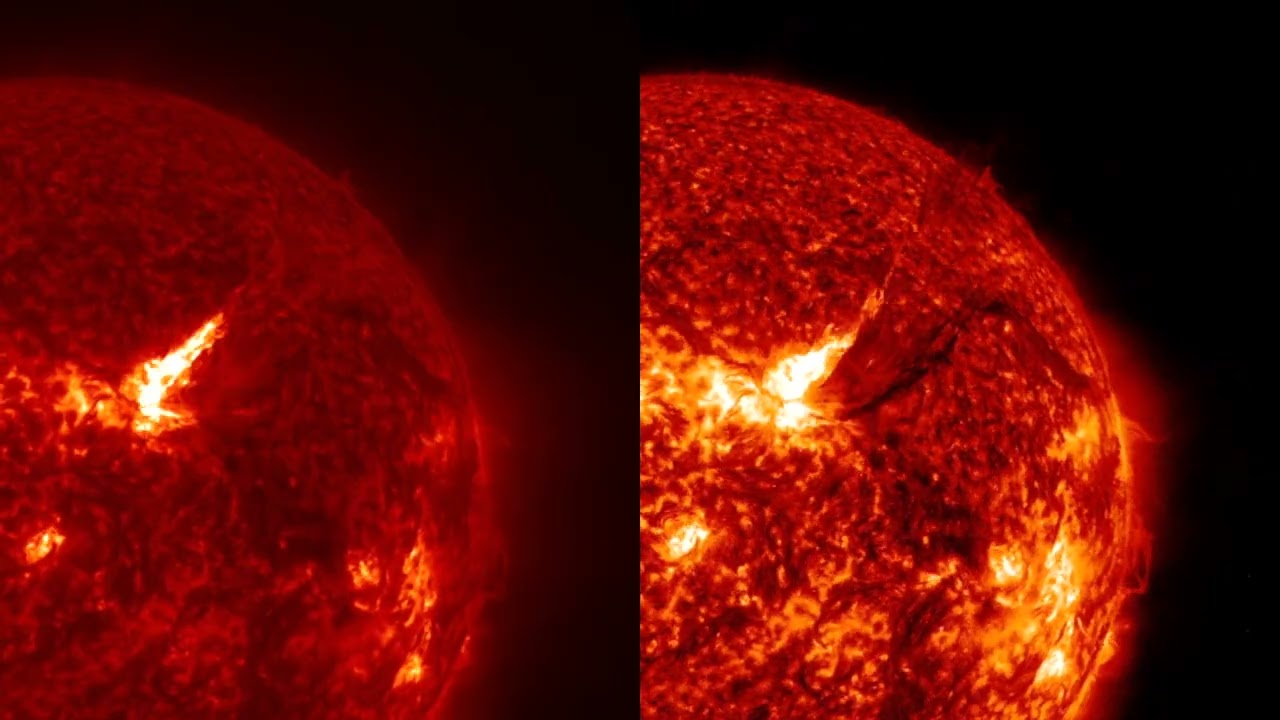
Solar Flares and CMEs at Earth - More Likely | S0 News June.3.2026
SpaceWeatherNewsS0s
2K views•2026-06-03



