Kentridge turns a confusing painting into a deep lesson on life by rebranding visual messiness as a deliberate philosophical choice. It is a classic example of how intellectuals find profound meaning in things that others might just find disorienting.
Instala nuestra extensión para buscar dentro de cualquier video al instante
William Kentridge on Max Beckmann’s 1938 painting ‘Death (Tod)’Añadido:
So, this is the painting "Death Tot" death by Max Beckmann.
He painted it in 1938, just after the death of Ernst Ludwig Kirchner, when Beckmann was in Amsterdam on his way from Nazi Germany to exile in America.
And we know that Beckmann was interested in Gnosticism, and so all of these things are present in the picture, but they're not the things that interest me primarily.
I'm interested in the different riddles and associations that the picture, the painting, launches for us. So, the most obvious one, of course, is that it is a reversible picture. One's not certain what is top and what is bottom, what is heaven and what is hell. And it's a painting that one can reverse.
So, that you either have your choir as a choir on the ground or else as that hanging from the ceiling.
One's not certain whether the choir here is a malevolent or a benign choir singing for us. But the first question is of the instability of the picture.
It's a bit like the Tiepolo ceilings, where you're not certain what's the correct vantage point. And one sort of circles one of these paintings to find where one should be and to discover that is no stable vantage point. And that, I suppose, is the central theme of this painting, the the question of of instability. We have the strange figure with its trumpet and its red phallus and its wings. Is it a devil? Is it a Is it an angel? It brings to mind much earlier painting of people blowing trumpets to send souls down to hell. This from a a book my grandfather gave me when I was 15 of Michelangelo's Last Judgement.
There are the strange faces and the associations they bring the speckled teeth, the overabundance of teeth in the different mouths that bring to mind the Francis Bacon teeth in particular in this figure from the three figures at the base of a crucifixion.
Francis Bacon painted this one the figure from the base of a crucifixion in 1944 and Beckmann was painting in 1938, but I knew the Bacon before I knew the Beckmann. So the Beckmann seems to be influenced by the Bacon.
So there's a sense in which times shift when you're looking at a painting they chronology changes entirely. Here we have a 1938 painting, but is the woman in it a reference to classical antiquity with her long flowing robes or rather Josephine Baker from the Weimar era.
There are moments of domesticity the woman changing her shoes which could be a Degas or the nurse which puts us in the hospital and even though the woman's in a coffin there's still a hospital bed letter with all her vital temperatures and and conditions.
And then there are associations which are almost probably more far-flung.
There's the strange woman and a fish that could be a reworking almost of a Hieronymus Bosch of different images of people and fish together. We have the woman with her green skin brings to mind paintings by Memling in which people are painted with chloraemia kind of the greenish huge skin which was a kind of anorexia of the middle of the Middle Ages. And there's the strange figure that's really just a head on feet that couldn't I couldn't stop thinking of the book The Magic Pudding which was a children's novel in verse from Australia from the turn of the 20th century and the central character is just a a head in a pudding bowl with his legs. Now, these are obviously not things that Beckmann was thinking about when painting, but they're the kinds of associations that come from the painting to us. And we have to understand that this overload of riddles is part of the pleasure of looking at the painting. It is very much done as a theater set. Not only are there footlights, but all of the perspective, the flats are there is on us on a stage where perspective can be altered, flats can be shifted in order to make a false distance and space. And he treats the picture plane as if it is a theatrical space. And we are invited to be an audience complicit in the making of the production as Beckmann leads us from one moment in the painting to the next scene and across to the next moment.
Videos Relacionados

क्या भगवान शिव हारिती की नकल हैं? झूठे दावे का पर्दाफाश | हारिती बौद्ध देवी बनाम भगवान शिव
sanatansamiksha
1K views•2026-05-30

This is one of the biggest street art exhibitions in London but there’s a twist 👀 Danish
ExploringLondonCity
1K views•2026-05-30

They stole his entire life on his deathbed #history #art
Nocthera
1K views•2026-06-01
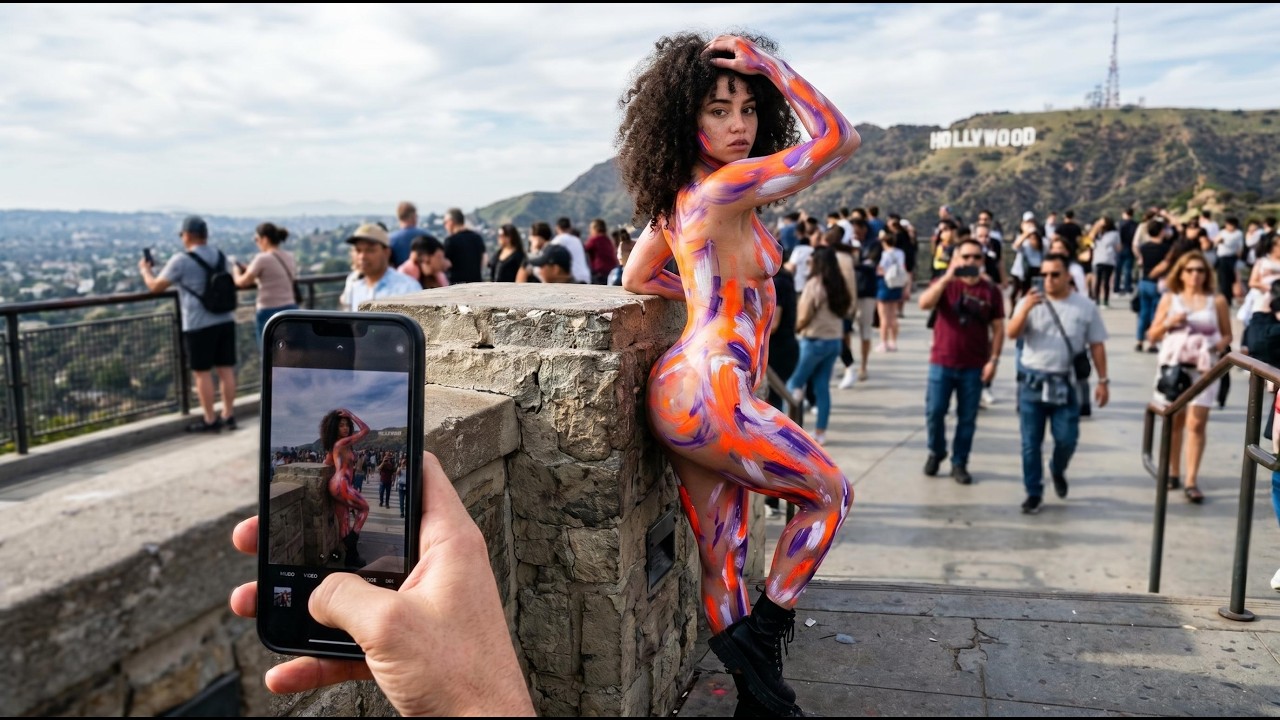
How Hollywood Body Art Changed the Way America Sees the Human Body Forever
Ink_and_Instinct
213 views•2026-06-02

Praying Hands — Albrecht Dürer (c. 1508) #shortvideo
ArtMysteries-r2d
276 views•2026-05-30

[ 🇸🇪 ] Sveriges Television (SVT 1 & SVT 2) ident history
bekdesign
1K views•2026-05-31

Between Heaven and Earth: The Art of Ancient Assyria -- Dr. Kiersten Neumann -- #ARCC26
AssyrianCulturalFoundation
849 views•2026-06-04

Nobody Gets This Marilyn Monroe Costume Detail Right—Not Even the Academy Museum
andmayhemensued
346 views•2026-06-02